Journal of Chemical and Pharmaceutical Research, 2014, 6(3):858-862
Research Article
CODEN(USA) : JCPRC5
ISSN : 0975-7384
Ecological design in network learning environment
Jiguang Li
School of Computer and Information Engineering, Xinxiang University, Henan, China
_____________________________________________________________________________________________ABSTRACT
In the rapid development of information technology, education, change of social background, the word "ecology" is more and more get the favor of education researchers. Ecological network learning environment to the learner and learning environment as a whole, focus on the interaction between learners and learning environment, attention generated in the learning process, focus on formation and maintenance of network learning ecology, is considered to be adapt to the future development trend of network learning environment. Ecology "based on" ecological learning "and" learning "learning ecosystem" supplies "as keywords to retrieve relevant literature, through to classify the literature, comparative analysis, think: the ecological network learning environment research comes from WebX.0, mix (asurgeon - up), the development of cloud computing and other technical and support; ecological psychology, Theory of complexity theory, uniform for ecological design of the network learning environment provide direct theoretical support; Researchers from the perspectives of natural ecological system, learn the characteristics of organic life resources perspective and cultural ecology.
Keywords: Learning design; ecological learning; open learning; supply
_____________________________________________________________________________________________
INTRODUCTION
network Learning environment, the word "ecology" gradually became popular in the field of e-Learning. Many researchers consider ecological network learning environment should adapt to the development trends of future technology and learning [2].Ecological structure and ecological support (Affordance), ecological design methods (ecological) Approach in network learning environment are proposed from a different perspective.
TECHNOLOGY AND THEORY SUPPORT IN NETWORK LEARNING ENVIRONMENT ECOLOGICAL DESIGN
The word "ecology" is used in the studying of network learning environment, on one hand is the driving of social media technology such as webX.0, and on the other hand is new learning theory support corresponding to the ecological theory and the technology development [3].We try to comb the technology driving factors and theoretical support in order to better understand the foundation of the ecological design of online learning environment.
TECHNICAL SUPPORT WEB 2.0
Only have a certain complexity is it possible to create ecological system, complexity is relatively simple compared with simplicity[4].With the development of Web technology, the network connectivity is gradually increasing, providing the basic complex "network" support for the network learning environment ecology. Chun-Ming Leung divided the development of Web into four stages which connectivity gradually. As shown in figure 1.Web 1.0 is a simple web page linking different information in the form of links; In web 2.0 era, the applications of a variety of tools promoting collaboration between people, have given rise to Social networks (Social Web); Web3.0 Semantic technology development makes the knowledge linking in the form of a Semantic Web, with the interconnection between people, knowledge unified, the trend of next generation of Web will be the links of human intelligence network (Meta Web)[5]. With the increase of the connection properties interactive relationship between network learners and the learning environment is becoming more and more complex and the complexity is the essential basis formed the essential network learning ecology.
Fig.1 Increasing Connectivity
CLOUD COMPUTING
Cloud computing is a kind of calculations based on the Internet, in this way, the software and hardware sharing resources and information can be on demand for computers and other equipment. Cloud computing on basis of open criterions and services provide safe, fast and convenient data storage and network computing service in the center of Internet, so that the Internet "cloud" becomes data center and the computing center on Internet. User who own computers that can access to the Internet terminal equipment (PC, laptop, tablet PC, mobile phone, etc.) can visit resources and process information anywhere and anytime [6]. With the development of cloud computing technology, ubiquitous learning has become an important concept education concept. It enables learners to participate in various interactive network learning environment, in order to create more convenient conditions for network learning environment [7].
MASH-UP
Mash-up originally derived from the popular music, it is a new method to produce effect of mixed two kinds of different styles of music. In the field of designing, mixing means mixing different elements together and forming a new harmonious body to produce amazing results. In the field of computer, mash-up is composed of one or more sources which integrate message sources to produce new website or new way of network application, aiming to integrate the content of the different external data sources and services, learning resources and elements, services and features to build a rich and open learning environment[8]. In this environment, learners can easily integrate internal and external applications or services to generate new services using the Mash-up site, build your own
Web1.0 Web 2.0 Web 3.0 Web X.0
The Web Social Web Semantic Web Meta Web
personal learning environment with one-step experience. Mix reflects the integrated application of tools and services, thus creating the environment diversity, richness and openness embodied the concept of "ecology". At present, many ISPs provide simple tools, such as: Yahoo Pipes, Google Mash-up Editor, Microsoft Popfly, Intel mash Maker, etc.
THEORETICAL SUPPORT
Many researches of network learning environment ecology is developing with analogy to the natural ecological system, ecological design of the network learning environment can't live without the guidance of the basic theory of ecology, education ecology[9].
In the process of literature research, we found that the ecological research has great containment, even allows all theory of ecology which can help to build good network learning, such as ecological psychology, complexity theory, scenario learning theory, active theory, system dynamics theory and so on, however, we think three theories are proposed to direct support network learning environment ecology design.
ECOLOGICAL PSYCHOLOGY
Using the perspective of ecology and ecological psychology method, a discipline between human and environment, it researches the unity of human and environment about the complex of the relationship between human and the environment considers the organism and environment in the process of multiple interactions evolution, forming a symbiotic interactions. Ecological learning is based on the interpretation of the relationship between man and environment from the perspective of ecological psychology, from the Angle of integrity, adaptability and diversity to survey study, in which learning is learners' perception of environment and the effect on the result of the interaction between environmental behaviors[10].Veda thinks, in the view of ecological learning vision , "Learners as information surveyor take positive activities, with a purpose of reflection, provide supplies to scenes (physical and social environment)in debugging process". The construction of ecological network learning environment take ecological psychology, learning theory as the theoretical guidance, trying to explore how to make full use of the integration of the rich integration technology of network learning environment to promote ecological study topic.
COMPLEXITY THEORY
Complexity theory was born out of critique of reductionism, thinks "simplicity thinking in the complexity of the world must lurk under relatively simple order is disrupting, you can go to any place where is complex, we are forced to operate all programs from the concept of whole or systematic conception to deal with complexity problem." Simplification is the segmentation and closed to the real. Complexity emphasizes the whole and integrity. Complexity theories are: nonlinear, integrity, relationship, chaos, dynamic, open, self-organizing, etc. Currently, the majority of the learning environment research is still the practice of reductionism, with more and more people aware of the complexity of the education, learning, learning environment, the researchers began to explore the complexity theory applied in the field of education, some researchers also began to discuss complexity theory under the guidance of network learning environment construction, such as master Xie Ran thesis "learning environment based on complexity theory and building" attempt to consider complexity theory as a tool, with a new Angle of view to re-examine learning environment, and proposed the principle of complexity theory and the specific implementation measures to construct learning environment. Complexity theory provides methodology guidance to learners as a whole, complexity theory make us recognize that the learning environment is a complex system, our study should not only pay attention to a side of the learning environment, but pay attention to learning environment in the whole produced by the interaction between various components of integrity and the function achieved by the learning environment as a whole. The main point of complexity science methodology coincide with the ecological ideal, is the most important theories support in the study of ecological network learning environment design.
NETWORK LEARNING ENVIRONMENT ECOLOGICAL STRUCTURE DESIGN
The purpose of ecological network learning environment design is to "create the sustainable development of the network learning ecology", according to structure decides function, function determines the value .The essence and function of something which are controlled by their own structures. Researchers attempt from the perspective of natural ecological system, the resources of organic life characteristics, cultural and ecological perspective on the structure of network learning environment to discuss.
THE NATURAL ECOSYSTEM PERSPECTIVE
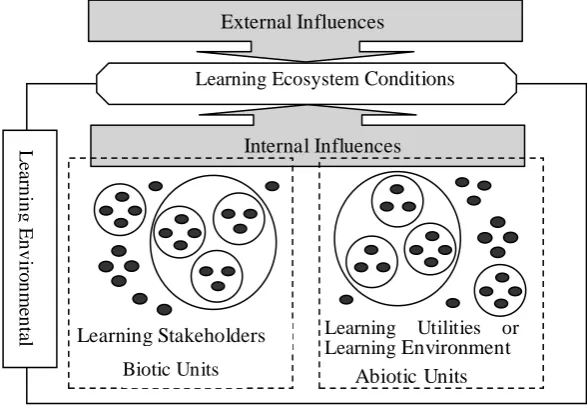
take teachers as part of the learning environment. Vanessa Chang & Christian Guetl divide the biological factors and non-biological factors in ecological system, on the basis of the analysis of the ecological system, the digital Learning Ecosystem (e - Learning Ecosystem, ELES) concept and structure are proposed ,as shown in figure 2,
[image:4.595.151.445.259.463.2]He ELES elements can be divided into biological ingredients (Biotic Units Stakeholders) and Abiotic components (Abiotic Units, Utilities), and defines the study condition of Ecosystem (Learning Ecosystem the Conditions), as the boundary of the Learning environment, Learning Environmental Borders), these Conditions are the dual effects of the external and internal. Ceng Xiangyue ecosystem ecology (2011) will be remote teaching main body is divided into three species, population and community level, the species and population is divided into service personnel three kinds of students, teachers and teaching; The ecological environment can be divided into learning resources and learning support service environment, teaching environment and teaching management etc.; Ecological interactions in the system including the interaction in the population, population, ecological interactions between the subject and the role of the ecological environment and ecological system and the interaction of the external system (social environment). Ecological Zhang Lixin professor (2008) argues that virtual learning environment on learners as the main body, is made up of matter
Fig. 2virtual learning environme nt
CONCLUSION
Ecology reflect is a kind of tolerance, overall, the interdisciplinary perspective, compared with the traditional network learning environment, ecological network learning environment no longer just focus on the default, more attention generated; Rather than focus on individual development as an individual, paying attention to individual development in the community; Learners learn not only from environment, but with a good interactive learning environment; Environmental design is not chasing new technology, but a reasonable choice and use of technology. Ecological network learning environment is not only reflected in the technical support, ecological teaching level is more important in teaching and learning, the institution of learning community in social power level also can’t be allowed to ignore.
REFERENCES
[1]Xiaoli Qin. Ecological Psychology[M].Shanghai: Shanghai Education Press, 2006.87. [2]Qing Li. Chinese distance education,2009, (7) :65-69.
[3]Pata, K. &Laanpere, M.An Ecological Meta-Design framework foropen learning ecosystems[R].Berlin, Germany:
ECER’ 2011,2011.
[4]Chang, V., Guetl, C. E-Learning Ecosystem (ELES)-A Holistic Approach for the Development of more Effective Learning Environment.
[5]George Siemens. Connectivism: A Learning Theory for the Digital Age [EB/OL].
http://www.elearnspace.org/Articles/connectivism.htm,2004-12-12.
[6]G. Siemens. Knowing knowledge[M]. Vancouver, B.C.: Lulu Press,2006.15.
[7]Chun-ming Leung .From connectivity to next-generation learning[A].l. Coiffait & Hill. Blue Skies: New thinking External Influences
Internal Influences Learning Ecosystem Conditions
L
ea
rni
ng E
nvi
ro
nm
ent
al
Biotic Units Learning Stakeholders
about the future of higher education[C]. London: Pearson Press,2012.45-48
[8]Allen,I.E.,J.Seaman."Staying thecourse: Online education in the United State,2008". http://www.sloan-c.org/publications/survey/pdf/staying_the_course.pdf . 2008 [9] Brown,J.Leveraging the Web for Creating Learning Ecologies. Key note on the International Conferenceon Computers in Education (ICCE 1998) .
1998
[9] C.K.Looi.Enhancing learning ecology on the Internet. Journal of Computer Assisted Learning .2001