Examining the Mathematical Modeling Processes of
Primary School 4th-Grade Students: Shopping Problem
Mustafa Ulu
Department of Education Sciences, Dumlupınar University, Turkey
Copyright©2017 by authors, all rights reserved. Authors agree that this article remains permanently open access under the terms of the Creative Commons Attribution License 4.0 International License
Abstract
The purpose of this study is to identify primary school students’ thinking processes within the mathematical modeling process and the challenges they encounter, if any. This is a basic qualitative research study conducted in a primary school in the city of Kütahya in the academic year of 2015-2016. The study group of the research was composed of 22 students at 4th-grade who were selected with criterion sampling which is a purposive sampling method. The study data were collected with the clinical interview method and reported using the content analysis. It was consequently found that the students constituted two groups as those who provided a realistic solution and those who could not. There were more students who could not provide a realistic solution. Those who couldn’t provide realistic solution tried to construct the mental representation of real situation through literal comprehension, which became insufficient in revealing the hidden situations involved in the problem text. Not noticing the hidden actions in the text led them to form a mathematical equation without structuring the problem and thus their solutions were unrealistic. Those who could provide realistic solutions, on the other hand, decide their operations within the context of the characters, time, place and relation between the events in the problem, which enabled the mental representation of the problem text to be critical reading and inferential comprehension focused as well as literal comprehension focused and thus allowed the students to reveal the hidden situations in the text. Accordingly, students posed new problems by gathering the required extra information according to these hidden situations and went for the real model. Thus, analyzing the problem situation is various contexts, students solved according to multiple conditions. It was also seen that students with realistic solutions utilized the validation process to determine the consistencies and inconsistencies of their solutions in real life context while those with unrealistic solutions utilized it to check their operations.Keywords
Primary School Students, Mathematical Modeling, Realistic Solution1. Introduction
The PISA survey has become an influential factor in reforming educational practices (Liang, [93]) and making decisions about educational policy (Yore, Anderson, & Hung Chiu, [95]). PISA results showed that the competencies measured in PISA surveys are better predictors for 15 year-old students’ later success (Schleicher, [94]). One of the skills measured in PISA is mathematical literacy, which can be defined as “turning real-life problems into mathematics” and “interpreting existing knowledge and adapting it to real-life” (Blum and Niss, [13]; Lesh and Doerr, [50]). PISA categorizes problem solvers into seven levels. Those under the first level are the students who cannot solve problems, whereas the first level defines the students who can solve routine problems when the question is expressed clearly and all the required information is provided for solution. The second category defines the students who can reason simple relations that are evident at the first glance. The third level and above express the students who can adapt mathematics to real-life situations. PISA [95] revealed that 45.9% of the high school students trained in OECD countries are below the third level. These results show that approximately half of the high school students in OECD countries have trouble in solving real life problems. In Turkey, where the study was conducted, the situation is even more disturbing than the OECD countries because PISA [95] revealed that 77.6% of Turkish high school students cannot solve real world problems.
might vary from one student to another like “Let’s allocate the remaining students to the other buses” or “We can take a smaller minibus.” It was seen in these studies that most of the students gave the answer “6.5 buses are required.” It was also seen in these studies that students couldn’t come up with realistic solutions in similar problem situations.
With structural reforms in the mathematics curriculum in Singapore in 1992, the time spent on mathematical content where factual and operational skills are prominent was decreased 30% and problem solving skills were added at the same percentage (Kaur, [96]). Singapore mathematics curriculum gives as much importance to the time spent on problem solving activities as the problem types to be solved in the lesson. In this country, from the first years of primary school to the end of high school, the subject starts to be taught with exercise type problems and realistic problems follow when the subject has been understood (Kaur & Yeap, [97]). When realistic problems were tackled in lessons, they were considered within the context of mathematical modeling. This was reflected to PISA results [98] and the rate of students below the third level in Singapore fell down to %20.1. The levels at which the highest mathematical skills are presented at PISA [98] are the fifth and sixth levels that determine students with mathematical modeling skills. According to PISA [98], the rate of students with mathematical modeling skills in Singapore is 34.8%, while this rate falls down to 10.7% in OECD countries and to 1.1% in Turkey. The fact that students from Singapore have better performance in solving real world problems than their peers in other countries points out the need for developing mathematical modeling skills at early ages.
Schwarzkopt [71] states that interaction between real life and mathematics is needed for analyzing the content-based mathematical texts. Maass [57] defines this interaction as “mathematical modeling” and argues that the process of mathematical modeling starts with real-life problems and ends with results agreeing with real life. According to Lesh and Doerr [50], mathematical modeling is a process of transforming a qualitative real-life situation into a mathematical form and interpreting the acquired results again in real-life conditions by doing the necessary mathematical operations. Studies have shown that modeling activities provide students with: (a) a powerful tool to use in developing critical and high-level thinking skills (English & Watters, [30], (b) a new and effective learning environment where existing deficiencies in conceptual knowledge are identified and new mathematical knowledge is gained (Chamberlin, [21], (c) encouragement to use different and various representations to explain conceptual systems (Boaler, [15]; English& Watters,[32]; Mousoulides,[54]).
Mathematical modeling studies have generally focused on high school and university students (Blum and Leiß, [12]; Borromeo Ferri & Blum [18]; Wijaya et al., [89]; Hıdıroğlu,
Dede, Kula & Güzel, [37]. Verschaffel, Greer &De Corte [81], Verschaffel, De Corte & Vierstraete [80] Xin, Lin, Zhang & Yan [87], and Çelik & Güler [24] suggest that
difficulties in modeling real-life problems start during primary school years. Therefore, English [31], Şahin [68],
Şahin & Eraslan [69] emphasized that students need to be introduced to modeling activities which involve real life situations so that they can be equipped with advanced mathematical skills as of primary school years. There are only the studies conducted by Şahin [68], Şahin & Eraslan [69] which aimed at identifying primary school students’ mathematical modeling skills in Turkey. In these studies, data were collected with the focus group interview method with 3 students chosen out of 18 students after a 5-week preliminary education provided for the primary school students and it was seen in the study that the primary school students tried daily life-related assumptions, produced opinions and tested the accuracy of their models by associating them with real life. In this context, a study has been needed to identify to what extent students can use the modeling cycle in regard only to their individual performances without a modeling education and group effect. Another reason why such a study was needed is that all necessary information for solving the problem was presented in the study conducted by Şahin and Eraslan [69]. However, because some real world problems may need the student to consider certain hidden actions to update the given problem, extra information may sometimes be required so that the actual problem can be modeled accurately. In this context, the purpose of this study is to identify primary 4th grade students’ thinking processes within the modeling process in real world problems requiring extra information and the challenges they encounter, if any.
1.1. Theoretical framework
According to Hegarty, Mayer & Monk [35], there are two approaches in problem solving process: short-cut approach and comprehension- oriented. They stated that individuals decide their operations upon certain special words (more, less, times, etc.) they choose without understanding the problem in short-cut approach whereas in comprehension-oriented approach, they decide their operations within the context of the characters, time, place and relation between the events in the problem. In their studies, Hegarty et al. [35], Viennot and Moreau [82], Soylu and Soylu [73], Pape [62], Smith, Gerretson, Olkun & Joutsenlahti [72] revealed that students with lower problem solving success do over-regularization whereas successful students achieve more real solutions by forming accurate relations between the problem elements (characters, time, place and events).
the short-cut approach are addressed within the scope of procedural knowledge (Anderson, [3]; Byrnes & Wasik, [20], Baroody, Feil, & Johnson, [8].
In a study by Soylu and Soylu [73], most of the students’ answers to the question “When Ali gives 5 of his apples to
Ayşe, he has 10 apples left, so how many apples did Ali have in the beginning?” was 10 − 5 = 5. It was determined through an interview that as a result of over-regularizing the expression “left”, students did subtraction instead of addition. In a study by Viennot and Moreau [82], students were first asked “Luke comes to school with 15 marbles. He plays two games and loses 7 marbles in the first game. At the end of the second game, Luke, being a good gamer, ends up with 34 marbles. How many marbles did Luke lose in the second game if he had lost or how many did he win if he had won the second game?” and then the same problem was asked again by replacing “a good gamer” with “a bad gamer”. At the end of the study, it was determined that some of the students who wrote “He won 26 marbles” to the questions with “a good gamer” changed answer and said “He lost 26 marbles” to the questions with “a bad gamer”. These two situations show that word-oriented solutions prevent achieving realistic solutions and so one should go for comprehension-oriented solutions.
The studies performed by Anderson, [3]; Brynes and Wasik [20]; and Baroody et al. [8], it was observed that the procedural knowledge may fall insufficient in the first-time situations and contextual knowledge is needed for such situations. Kieren [44] and Baroody et al. [8] defined conceptual knowledge as associating recently-learned knowledge with previously-learned knowledge and real life, constructing the knowledge in accordance with individual traits and processing it through a rational sieve. They emphasized that procedural knowledge may be enough for solving exercise type problems but process skills and conceptual knowledge are in the forefront as realistic problems have a more complex structure. According to NTCM [101] and MEB [54], today’s educational programs advocate the idea “conceptual understanding rather than procedural knowledge or rule-driven computation” both
mathematics-wise in general and problem solving-wise. Emphasizing that there are similarities between understanding a story and a problem, Dijk & Knitsch [79]; Kintsch & Greeno [45] and Reusser [67], Staub and Reusser [74] stated that just as students should focus on the whole text to understand the story, so should they focus on the whole problem text instead of focusing on a single word to understand the problem accurately. Staub and Reusser [74] carried this idea one step further and structured a model called “from the text to situation and from situation to equation” that aims to help students solve a problem just as they analyze a story. This model was initially used to prevent elementary school students from over-regularizing while solving problems requiring addition and subtraction; however, it became the origin of modeling cycle- developed by Blum and Leiss [12] and finalized by Borromeo Ferri [16] aiming at solving realistic problems. The modeling cycle developed by Borromeo Ferri [16] is presented in Figure 1.
[image:3.595.109.426.582.732.2]According to Figure 1, in the first phase, the mental representation of the situation model should be established in the real situation and it is expected from the solver to understand the problem. Contemporary approaches to story problem solving have emphasized the conceptual understanding of a story problem before attempting any solution that involves selecting and applying an arithmetic operation for solution (Jonassen, [41]. According to Kintsch [46] in conceptual understanding phase individual needs to comprehend the problem text literally, inferentially and critically. Literal comprehension, the first level of comprehension, requires that a student can extract information that is explicitly stated in a passage (Lapp & Flood, [49]; McCormick, [53]. According to Kintsch ([46], literal comprehension lets us find answers for WH-questions (e.g. who, what, where, when, how) in the text. This level of understanding is dependent upon students’ word-level processing skills, or their ability to accurately identify individual words and understand the meaning created by the combination of words into propositions and sentences (Perfetti, Landi, & Oakhill, [65].
Inferential comprehension aims to establish empathy between the character in the text and the reader and to determine why the event in the text is being told, what its effects are on the reader, what the motives of the main character in the text are, what the main idea the author is trying to convey in the text is and the cause and effect relations between the events (Kneene & Zimmermann, [43]. Kintsch [46] expresses inferential comprehension as a situational model and states that establishing a situational model during comprehension will activate the background information of the reader about the event and thus richer information units will be reached which are inclined to real life and whose connection with the background information has been established. It is stated that the main purpose in reading a text is thought to be inferential comprehension but literal comprehension is a prerequisite for inferential comprehension to occur (Allen, [1]; Kinsch, [46]; Suk, [76]; Vacca, Vacca, Gove, Burkey, Lenhart,&McKeon, [77]; Ulu, [86].
Critical reading enables the individual to follow what words and sentences in the reading text mean and handle the text in a wider perspective. Within this framework, an individual who address the text from the critical point of view have the ability to survey the mind constantly and keep it alive (Odabaş, Odabaş & Polat, [59]. During critical reading, the reader performs the act of reading by asking himself/herself questions about inconsistencies among thoughts or events handled in the text, the reasons why the text was written, and the appropriateness or sufficiency of examples given. It is necessary to utilize the abilities to investigate and analyze the causations of phenomena or events, produce thoughts, organize thoughts, compare opinions, make inferences, evaluate discussions and solve problems in this process (MEB, [54]. Individual, within this framework, is to comprehend the phenomena or events and the primary message to be given by them during critical reading in the first place (literal comprehension). Next, one needs to reveal the implicit meaning in the text. In this phase, individual tries to reveal the message that the author wants to communicate through causations (inferential comprehension) (Basaraba, Yovanoff, Alonzo, & Tindal, [9]. After the causations have been revealed, individual relates between what he/she has read before, the experiences and information in his/her mind and the implicit information in text and makes an inference by judging, questioning, evaluating what he/she has obtained and benefiting from credible resources (Özensoy, [60]. Reader spends more time and effort in critical reading than in other reading techniques. While a non-critical reader accepts what is narrated in the text as being inarguably true and tries to memorize them, a critical reader is also interested in how the subject is described as much as paying attention to what is narrated and with what thoughts they are supported (Aşılıoğlu, 2008).
Kispal [47], Chikalanga [23], Zwiers [92], Presley [66] and Kintsch [46] stated that an individual who made an inference and critical reading during comprehension was at
the same time reasoning. The role of reasoning during problem solving was defined as reaching a solution by integrating every proposition in the problem text in a logical consistency (Leighton &Sternberg, [48]. Regarding the definitions above, significant resemblances are seen between reading comprehension and reasoning skill during problem solving. Background information should be activated other information should be reached about the explicit information in the text both in inferential comprehension during reading comprehension and in reasoning during problem solving. Literature shows that a positive relation exists between problem solving and reasoning skills (Barbey & Barsalou,[7]; Çelik & Özdemir, [25]; Çetin & Ertekin, [24]; Umay, [84]; Yurt & Sünbül, [91]. Staub and Reusser [74] stated that the comprehension strategies can be utilized in this phase, and in the studies performed by Hite [36] and Ulu, Tertemiz & Peker [85], it was seen that the problem-solving achievement can be improved just by giving training for comprehension strategies.
As seen in Figure 1, individuals who envision the problem situation and make sense of it are expected to simplify and structure the problem and those who have achieved this stage will have formed the real model. Reusser (1995), Niss, (2003), Borromeo Ferri (2007), Blum and Ferri (2009) define this stage the process of forming new problems by collecting the necessary new information according to hidden actions revealed in comprehension process. Simplifying is the discrimination of information necessary and unnecessary for solution. Structuring is the process of associating the problem elements based on the scenario in the problem text (Reusser, 1995; Niss, 2003). Borromeo Ferri (2005) thinks that the structuring step is a process of internal representation, in other words, taking the mental picture of the problem situation. Internal representation is composed of two steps: recall and association. Charles and Lester (1984), and Altun (2007) define individuals' asking themselves “Have I solved a similar problem before” as recall. Organizing the information from the long-term memory, discriminating what is given in the problem in accordance with what is asked and adapting it into the current problem situation are defined as association (Steele and Johanning, 2004; Cummins, Kintsch, Reusser and Weimer, 1988).
During the third stage, the solver is supposed to build the mathematical model with reference to the real model and in this process, the individual is supposed to do mathematization. Mathematization is a process in which a problem already existing in the brain structured non-graphically is converted into tables, figures or symbols (Blum and Borromeo Ferri, 2009; Borromeo Ferri, 2006). According to Niss (2003), at this stage, the strategy to be used for solution is operated and the next stage- mathematical working- follows. In mathematical working process, figures, tables or equations are put into service to reach a mathematical solution.
then validate. Blum [10] regards the interpreting phase as questioning the likelihood that the mathematical result occurs in real life. According to Borromeo Ferri & Blum [19], Borromeo Ferri [16] the individual performs two types of validation: “intuitive validation” (more unconscious) and “knowledge-based validation (more conscious).” Intuitive validation is that the individual thinks he/she has made an error because of a situation he/she cannot explain; if he/she is to explain that error with mathematical evidence, he/she has performed a knowledge-based validation. In addition, Borromeo Ferri [17] regards the fact that individuals mistake the validation process for controlling the accuracy of the mathematical operations as a mistake and consider it rather individual's questioning if the solutions and the result obtained is reasonable in regard to real-life conditions. It was explored in the studies conducted by Maass [51], Wijaya, Panhuizen, Doorman & Robitzsch [89], and Eraslan & Kant [33] that the students gave up solving the problem generally in the mathematical result step and ignored two most important steps of the modeling cycle: interpretation and validation. The studies conducted by Teong [83], and Özsoy [61] found that using the control processes reduced the errors.
To see the processes of modeling cycle more concretely, a problem developed by Blum and Ferri (2009:46) to analyze the behaviors of high-school students in modeling process is presented in Figure 2.
Blum and Borromeo Ferri [14] explain the modeling process in the problem shown in Figure 2 as follows. The first step is to understand the given problem situation, that is the problem solver has to understand a situation model which here involves at least two gas stations and the 20 km connection. The second step is to structure the situation by bringing certain variables into play, especially tank volume and consumption rate of the Golf, and to simplify the
situation by defining what “worthwhile” should mean, leading to a real model of the situation. In the standard model, “worthwhile” means only “minimising the costs of filling up and driving”. Mathematisation, the third step, transforms the real model into a mathematical model which consists here of certain equations, perhaps with variables. The fourth step is working mathematically (calculating etc.) which yields mathematical results. In step five, these are interpreted in the real world as real results, ending up in a recommendation for Mrs. Stone of what to do. A validation of these results, step six, may show that it is appropriate or necessary to go round the loop a second time, for instance in order to take into account more factors such as time or air pollution. Dependent on which factors have been chosen, the recommendations for Mrs. Stone might be quite different. The seventh and final step is an exposure of the final solution. Several studies have shown that each step in the modelling process (see Fig. 1) is a potential cognitive barrier for students, a potential “blockage” or “red flag situation” (Galbraith & Stillman [100]; Stillman [99]). “ The studies performed by Blum & Leiß [11], Borromeo Ferri & Blum[18], Schapp, Vos & Goedhart [70], Wischgoll, Pauli & Reusser [88], and Wijaya et al. [89] also revealed that since students get stuck in understanding the situation and thus constructing a situation model, they could not evaluate all the variables together when transforming the real situation into the mathematical model. It has been seen that these troubles were caused by the fact that one cannot comprehend the elements given in various representative formats (verbal, visual, symbolic) in the model (English &Watters, [32];
English, [31]; Şahin, [68]; Şahin & Eraslan, [69], cannot
transform what is given into different representative
structures (English, [31]; Şahin [68]; Şahin & Eraslan, [69]
[image:5.595.108.509.518.658.2]and cannot choose the right operation (English, [29]).
2. Method
2.1. Design of the Study
According to Merriam [55], researchers do not always conduct a qualitative research study to examine a culture (ethnography), reveal a phenomenon (phenomenology), to create a theory, examine a given unit or a limited system (case study) or identify and solve a problem (action research). Researchers sometimes conduct qualitative research in an interpretative approach as in this study (Merriam, [55]; Merriam, [56]; Research that cannot be explained through other qualitative research designs and require an interpretive approach are considered within the scope of basic qualitative research design. In this study, too, it was aimed neither to study a culture or create a theory nor examine a given unit or limited system as in case studies. In accordance with the purpose of the study, the modeling processes and the difficulties confronted during the modeling process were addressed in an interpretative approach; the study was designed in accordance with the basic qualitative analysis approach in this context.
Piaget argues that errors made by children provide important information on their nature of thinking and it is necessary to use the clinical interview method, which is a method of asking flexible questions, to explore the richness of students' thoughts and evaluate the cognitive skill (Baki, Güven & Karataş, [5]. According to Frederiksen, Glaser, Lesgold & Shafto [34], standard tests can only determine to what extent the students solve the problem correctly or incorrectly but do not question why they do it correctly and what to do so that they achieve the right result. Karataş and Güven [42] regard the clinical interview method as one of the measurement methods that can be used for evaluating the problem-solving skill and think that the reason for the errors made by students when solving problems can be revealed as they are solving it. Hunting [39] stated that the clinical interview method is dynamic and the errors made by the student are identified rather by him/her. In this context, since students’ thinking processes within the modeling process and the challenges they encounter, if any, are examined, clinical interview method was conducted
2.2. Sampling
The study group of the research was formed with the criterion sampling strategy which is a purposive sampling method; purposive sampling is the selection of data resources to provide rich information so that a case can be studied in depth (Yıldırım & Şimşek, [90]. In this scope, five
criteria that are directly related to the research purpose were set to select the sample which would provide the data. These criteria are: (1) students must be attending the 4th grade of a primary school, (2) location of the school must be appropriate for the shopping problem used in the study, (3) the teacher have not solve a problem similar to the shopping problem in the in-class activities before, (4) the classroom teacher must believe that there are students in the class that can give different answers to the problem, and (5) the classroom teacher must be willing to participate in the study. According to these criteria, it was decided that the study group should be a Kütahya Dumlupınar College, training from Pre-school education to 8th grade, situated within the borders of the university central campus .The college was in the 4th place among 149 secondary schools in the 2014/2015 TEOG (Transition from Primary to Secondary Education) Exam ranking in Kütahya . There are three 4th-grade classes in this school; as a result of the interview made with the classroom teachers of these classes, one of them stated that the question was a high-level one and the students would find it difficult, another classroom did not take kindly to the application of the study in the classroom because he/she believed the research would take too long and impede the educational activities. The teacher of the third class stated that the class met the study criteria, he/she was not going to be able to continue teaching in the school for a personal problem and we could perform the application on the very same day. In accordance with teacher’s opinions, it was decided that the study group was to be formed with the students of that class and the parents of those students were contacted with by the help of the school administration and necessary permissions were obtained. The study group was composed of 22 students (13 girls, 9 boys). Ages of the students vary between 10 years 2 months old and 10 years and 9 months old.
2.3. Collection and Analysis of the Data
Figure 3. Adapted version of the problem used for identifying 8th-to-10th-grade students’ modeling skills by Blum and Borromeo Ferri [14] for the primary school 4th-grade students
Table 1. Extra information that may be needed for the solution
Questions Answers
How much is the carfare? 1 lira 50 kuruş (discounted student carfare) How much is the taxi fare? 50 liras for a round trip in total How long is the lunch break at the school? 60 minutes
Is lunch served at the school?
If so, at what time? There is lunch served for free at the school. Starts at 12.00 am and ends at 12.30 pm.
How long does it take for the busses to arrive at the Vase?
It takes 20 minutes for the busses to go to and 20 minutes to come back from the Vase if there is no traffic jam.
It takes 25 minutes for the busses to go to and 25 minutes to come back from the Vase in case of moderate traffic jam.
It takes 30 minutes for the busses to go to and 30 minutes to come back from the Vase if there is heavy traffic.
What is the time schedule for the busses? There is a bus from the school to the Vase in every 3 minutes. There is a bus from the Vase to the school in every 3 minutes. How far is the stationery from the Vase? 2 minutes at most.
Does Enes have the competence to get on the bus and go to the Vase on his own?
This question was asked to the 8th-grade students of the school and all of them said they were able to get on the bus and go to the city center on their own and their families
were okay with that.
During the data collection processes, interviews were performed in a hall with two rooms so that interviewed students could not influence others who were not interviewed yet. One of the rooms is larger than the other. There are two doors in the larger part of the hall, one of which is used to go inside and get out and the other one for getting to the smaller part. In the smaller part, there is a door used to leave the hall other than the one that is used for getting to the larger part. In this context, all the 22 students which constituted the study group were taken into the larger part of the hall and they were summoned to the smaller part where the clinical interviews were performed in the order of their school numbers. The student whose interview was completed was sent to his/her classroom through the exit door in the smaller part. During the application, the students were asked for solving the problem and explaining the
solution vocally. There was no time restriction for solving the problem. If the student needed the extra information given in Table 1 during the clinical interview, the information was shared with him/her.
[image:7.595.67.543.335.541.2]revealed as 3 liras, 12 liras, Carfare, Danger, Time, Lunch, and Taxi. The experts decided that these opinions were to constitute the research codes. Next, it was decided that the codes were to be examined in two themes according to the studies conducted by Verschaffel et al. [81], Verschaffel et al. [80], Xin et al. [87]: realistic and unrealistic solutions. Upon experts’ unanimous decision, the solutions that only focused on the profit Enes would make without involving the commuting time into the solution since the distance from the school and the Vase is by no means walking distance were grouped as unrealistic while those questioning the cost, whether it would cause any problems in terms of time and whether it would be dangerous considering the Enes would have to take a vehicle to the Vase were grouped as realistic solutions. Finally, the themes and codes were evaluated in accordance with the modeling cycle stages developed by Blum & Borromeo Ferri [14]. The opinions of an expert
specialized in Turkish language was also received to evaluate individuals’ reading skills.
3. Findings
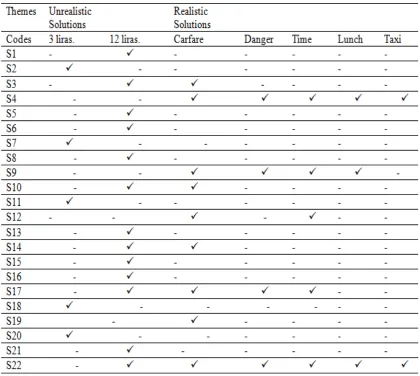
[image:8.595.94.515.312.688.2]In this section of the research, the content analysis was performed on video recordings of the clinical interviews which involve the answers to the shopping problem. The answers were encoded to conduct the content analysis and themes were created on the basis of the codes. The code and theme distribution of the participant students is given in Table 2.
It is seen in Table 2 that the answers given by the participants are grouped in seven codes and two themes. Next sections of the study explain the themes and the codes related to the themes in a detailed manner.
3.1. Unrealistic Solutions
According to the Table 2, the theme of unrealistic answer was observed in 18 solutions. The solutions in this theme are divided into two sub-codes: The first one suggests that “Enes should buy the cardboard from the stationery next to the Vase since he would get a 3 liras profit.” The clinical interviews showed that 5 student solutions (S2, S7, S11, S18, S20) gathered under this code. The following is the clinical interview performed with Student 7 on this code:
R: Could you read the question first?
S7: Shall I read it out?
R: Read it the way in which you can understand it better.
S7: Okay. (Student reads it out once) It’s done.
R: Could you explain the question?
S7: There is a kid called Enes and he forgot buying the cardboards. The cardboard is 6 liras at the canteen, 3 liras there at the Vase. It asks us to help Enes.
R: Let’s help, then. What would you recommend Enes to do?
S7: I think he should go and buy it from the stationery next to the Vase because he would get a 3 liras profit.
R: How did you get that he would get a profit?
S7: Because it is 6 liras at the canteen, 3 liras at the Vase; if we subtracted 3 from 6, we find he would get a 3 liras profit.
R: Do you think it is worth going to the Vase for 3 liras?
S7: Yes. Because Enes would save more money.
R: Do you think the problem is logical, is there anything in the problem that does not sound plausible?
S7: No, there isn’t.
R: Then, the question is clear?
S7: Yes.
R: Is it difficult?
S7: It is very easy.
When examining the interview above, it is seen that the student could not make the right sense of the problem situation which he/she tried to solve on the basis of the real-life situation. He/she did not perceive the clear statement “The teacher of the technology design class asked him and his friends last week to bring cardboards in four different colors for today’s class: orange, yellow, green, and pink” in the text and made a simple literal comprehension error and made an inferential comprehension error because he/she did not understand Enes’ round trip to the Vase. The inferential comprehension here caused the question to be perceived by the student as a routine problem. Blum [12], Blum and Borromeo Ferri [14] stated that the mental representation of the real-life model and the problem situation is performed simultaneously in this type of problem and the mathematical model is directly constructed since routine problems can be solve without the need for real life knowledge. In this context, the student set forth the “6 Turkish liras - 3 Turkish liras” equation and turned the verbal statement into mathematical symbols, concluding the mathematical result of “he would get a 3 liras profit” by doing the mathematical operations
based on that equation. Interpreting this mathematical result, the student recommended Enes to buy the cardboard from the stationery next to the Vase because Enes would save more money and achieved the real result via a wrong solution. The student was asked the question “Do you think the problem is logical, is there anything in the problem that does not sound plausible?” for validation but stated that the question was very easy and there was no confusion when solving it. This case enabled to see that the student did not perform critical reading in the stage of comprehending the problem.
The second code of the unrealistic answer theme suggests that “Enes should buy the cardboard from the stationery next to the Vase since he would get a 12 liras profit.” The clinical interviews showed that 13 student solutions (S1, S3, S5, S6, S8, S10, S13, S14, S15, S16, S17, S21, S22) gathered under this code. The following is the clinical interview performed with Student 21 on this code:
R: Could you read the question first?
S21: Okay. (The student read it once, highlighted the
numbers) I read it.
R: Could you explain the question?
S21: The cardboard is 6 liras at the canteen, 3 liras from the stationery next to the Vase. Enes needs to buy cardboards in 4 different colors. It asks where he should buy them to get more profit.
R: Do you think it is the exact question?
S21: No, but it asks that.
R: Let’s solve it, then.
S21: If he bought from the canteen, he’d pay 24 liras.
R: Why?
S21: Because he’d buy 4 cardboards at 6 liras a piece. If he bought them from the stationery next to the Vase, he’d pay 12 liras.
R: Yes.
S21: Then, we subtract 12 from 24 to find 12 liras.
R: What does 12 liras mean here?
S21: It shows that Enes would get a 12 liras profit if he
bought them there at the Vase.
R: Do you think Enes should buy the cardboards from the stationery next to the Vase?
S21: He’d get a 50% profit.
R: Do you think the problem is logical, is there anything in the problem that does not sound plausible?
S21: No, there isn’t.
R: Then, the question is clear?
S21: Yes.
R: Is it difficult?
S21: It is easy.
turned into a routine problem because there was no interferential comprehension as in the first code and the mathematical result of “he would get a 12 liras profit” was achieved with mathematical equations. As a result of interpreting the mathematical result, the students recommended that the cardboards should be bought from the stationery at the Vase because it would spare more money for Enes and they came to the stage of real results in the modeling cycle. The students who provided this solution could not notice that their solution was unrealistic because they thought that the conditions of buying the cardboard from the stationery next to the Vase and the school were the same. The students were asked the question “Do you think the problem is logical, is there anything in the problem that does not sound plausible?” to ensure the awareness and 8 students (S1, S5, S6, S8, S13, S15, S16, S21) completed their solutions, stating that there was no confusion about the situation and the problem was loud and clear. This case enabled to see that the student could not read the problem critically in the stage of comprehending the problem.
3.2. Realistic Solutions
Despite having completed their solutions, 5 (S3, S10, S14, S17, S22) of the student who achieved the result “he would get a 12 liras profit” changed their solutions on the basis of researcher’s question “Do you think the problem is logical, is there anything in the problem that does not sound plausible?” and questioned how Enes would go to the stationery next to the Vase. As a result of this questioning, the students stated that Enes could go to the stationery next to the Vase by bus and would pay a carfare. Accordingly, the “Carfare” code was added to the study. The following is the clinical interview performed with Student 10 on the “Carfare” code:
R: Could you read the question first?
S10: Okay. (The student read it twice.) It’s done.
R: Could you explain the question?
S10: Enes will buy 4 cardboards. A piece of carboard is 6 liras at the school, 3 liras next to the Vase; it asks us to help him decide where to buy them.
R: Do you think it is the exact question?
S10: Yes.
R: Let’s solve it, then.
S10: If he bought from the canteen, he’d pay 24 liras, if he
bought from stationery next to the Vase, he’d pay.
R: Is it done?
S10: No. If you subtract 12 liras from 24 liras, it’d be 12
liras.
R: What does 12 liras mean here?
S10: That he’d get a 12 liras profit if he bought it from the
stationery next to the Vase.
R: What does 12 liras mean here?
S10: It shows that Enes would get a 12 liras profit if he
bought them there at the Vase.
R: Do you think Enes should buy the cardboards from the stationery next to the Vase?
S10: Yes. It’d be very profitable.
R: Do you think the problem is logical, is there anything in the problem that does not sound plausible?
S10: (The student thought about it a minute and read it
again) Yes, teacher.
R: What made you confused?
S10: He’s supposed to go to the Vase...
R: Yes.
S10: He couldn’t walk to there.
R: How would he, then?
S10: He could go by bus.
R: When did you get this issue?
S10: When I was reading it.
R: Which one?
S10: When reading for the first time.
R: Why didn’t you tell, then?
S10: Because there was no carfare?
R: Does it change the result if he went there by bus?
S10: Yes. Because he’d pay for the bus. Then he might not have any money left.
R: How so?
S10: Teacher, if the carfare was 6 liras when he was going there, he’d have no many left when returning.
R: Then, what do we need to know about?
S10: The carfare.
R: Do you know about it?
S10: I don’t know.
R: How can we learn about it?
S10: We can ask my elder brother, he frequently takes the bus.
R: How are we supposed to find your brother now?
S10: He’s here, he’s 7th-grade.
R: I know about it, too. Discounted student carfare is 1.5 liras.
S10: Then, he’d get a 9 liras profit?
R: So, where should Enes buy the cardboards from?
S10: He’d move into profit, anyways, Teacher. He should
buy it from the stationery next to the Vase.
R: Is there any other point that is not plausible?
S10: Not anymore, Teacher.
question. There were 4 other students (S4, S9, S12, S19) who questioned that Enes needs to pay for the bus but these students achieved this code on their own without the need for directing questions during the comprehension stage. The following is the clinical interview performed with Student 19 who achieved the Carfare code without getting any support in the comprehension stage:
R: Could you read the question first?
S19: Yes. (The student read it silently thrice). Teacher, I think this question is incomplete.
R: Why?
S19: Because the Vase is far away, he’d need to take a bus.
R: He could take it.
S19: But he’d pay for the bus if he took it.
R: Let’s make up the missing point, then. What is it?
S19: I don’t know the carfare. How much is it?
R: How can we learn about it?
S19: There are lots of busses at the corner, we could ask
the drivers there.
R: I asked on behalf of you. Discounted student carfare is 1.50 liras. Can you solve the question now?
S19: If he bought the cardboards from the canteen, he’d
pay 24 liras. If he bought them from the place next to the Vase, he’d pay 12 liras and 3 liras more.
R: Why would he pay 24 liras to the canteen?
S19: At 6 liras a piece, he’d buy 4 cardboards and that is 24 liras.
R: Why would he pay 12 liras to the stationery next to the Vase?
S19: Because a cardboard is 3 liras there, 4 cardboards
add up to 12 liras.
R: For what would he pay 3 liras?
S19: For the bus.
R: But the carfare is 1.5 liras, why would you have him pay 3 liras?
S19: He’d pay when going there and coming back from
there.
R: Keep solving it.
S19: If he bought them from the canteen, it’d be 24 liras, if
he bought them from the Vase, he’d pay 15 liras including the carfare. He’d make a 9 liras profit if he bought from the Vase.
R: What would you recommend Enes to do?
S19: He would save 9 liras, I think he should buy them
from the place next to the Vase.
R: Is there any other missing point you noticed in the problem?
S19: No, Teacher.
According to the quoted interview above, how the student stated that the question was incomplete while reading the problem during the transition from the real situation to the mental representation of the situation shows that he/she performed critical reading and the inferential comprehension became activated when he/she thought that Enes needed to pay for the bus. With the activation of inferential comprehension, the student structured the problem as
transitioning from the mental representation of the situation to the real model and asked “how much the carfare was”. The student stated that he/she could make up the lack of information about the carfare by asking the drivers about it but he/she was told that it was not necessary and the discounted student carfare was 1.50 Turkish liras. As soon as the student learned that the carfare was 1.50 Turkish liras, he/she had accessed the extra real life information necessary for the solution of the problem. In the next stage, the student mathematized the problem during the transition from the real model to the mathematical model and set forth the equation (6 lirasx4)-(4 lirasx3)+(1.50 lirasx2). To achieve the mathematical result from the mathematical model, the student worked mathematically and concluded that if Enes had bought the cardboards from the stationery next to the Vase, he would have paid 9 liras less than if he would have bought them from the canteen. The student interpreted the problem when achieving the real result from the mathematical result and thought that Enes would have spared a remarkable amount of money if he had bought the cardboards from the stationery next to the Vase, achieving the real result. Following this stage, the student was asked the question “Is there any other missing point you noticed in the problem?” for validation but did give the answer, so the interview was ended.
4 students (S3, S4, S10, S17) who achieved the Carfare code stated that it would be dangerous for Enes to go to the Vase alone upon the question “Is there any other missing point you noticed in the problem?” and the Danger code was accordingly added to the study. The following is the clinical interview performed with Student 3 on the Danger code:
S3: ………
R: Where would you suggest Enes to buy the cardboards from?
S3: Because he’d get a 9 liras profit, to buy them from the place next to the Vase.
R: Is there any other missing point you noticed in the problem?
S3: Yes, Teacher.Wouldn’t it be dangerous for him to go the Vase alone?
R: Why?
S3: For example, my mother doesn’t let me go away places alone.
R: Why?
S3: Because I’m minor. But Enes is older than me.
R: How did you get it?
S3: Because Enes is an 8th-grade.
R: How old can Enes be?
S3: I’m 10 years old. The 5th-grades are 11 years old, the 6th-grades are 12 years old, the 7th-grades are 13 years old, the 8-th grades are 14 years old. He can be 14 years old, Teacher.
R: If Enes was 14 years old, would he go to the Vase from here alone?
R: I asked the 8th-grades, they all said that their mothers let them take the bus and go to the Vase alone.
S3: Then, he can go.
R: Is there any other missing point you noticed in the problem?
S3: No.
According to the quoted interview above, the student validated the answer when coming back to the real situation from the real result and stated that it would be dangerous for Enes to go the Vase on his own by looking at the problem situation from a critical point of view. When it was asked the student to evaluate this proposition, he/she first made an inferential sense of the mental representation of the situation and thought that Enes’ age needed to be known so that the situation could be evaluated. During the structuring stage in the transition from the mental representation of the situation to the real model in the modeling cycle, the student needed the extra real life information and thought that he/she could access the information in his/her classroom and on the basis of his/her own age. Based on this information, achieving the mathematical model from the real model, the student stated that he was 10 years old and studying in the 4th grade and mathematized the problem by increasing the age by 1 in parallel with the grade level, concluding the mathematical result that Enes who is studying in the 8th grade could be 14 years old. Getting to the real result from the mathematical result, the student did not interpret the problem because he/she did not know whether Enes have the competence to go to the Vase on his own. In this context, the information that individuals at the age of 14 are permitted to go to the Vase alone by their parents was shared. The student interpreted that it would not be dangerous for Enes to go to the Vase alone based on this information and achieved the real result, recommending that he should buy it from the stationery next to the Vase as he would get a 9 liras profit. In this stage, 2 students (S3, S10) stated that there were no other missing points and ended the solution.
2 students (S4, S17) who achieved the Danger code and 3 students (S9, S12, S22), who could not, stated that Enes might have trouble with time if he went to the stationery next to the Vase, so the “Time” code was added to the study. The following is the clinical interview performed with Student 17 on the Time code:
S17: ………
………
R: Now that it would not be dangerous for him to go alone, do you think he should buy them from the stationery next to the Vase?
S17: It isn’t dangerous but the Vase is too far away.
R: Do you think he’d get tired? He’d take the bus at the end of the day.
S17: No, Teacher, he might not make it.
R: How could we know if he made it?
S17: We need to know how many minutes it takes for the
busses to go and come back.
R: How can we learn about it?
S17: Maybe it’s on the internet, but we can ask the drivers.
R: I asked them. How about taking a look at this table? (The information obtained from the bus drivers before was presented)
It takes 20 minutes for the busses to go to and 20 minutes to come back from the Vase if there is no traffic jam.
It takes 25 minutes for the busses to go to and 25 minutes to come back from the Vase in case of moderate traffic jam.
It takes 30 minutes for the busses to go to and 30 minutes to come back from the Vase if there is heavy traffic.
S17: (After having examined it for a while) If there was no
traffic jam, it would take 20 minutes to go and 20 minutes to come back, 40 minutes in total. What if the bus didn’t come by? I sometimes take the bus with my mother, it doesn’t come by right away.
R: There is a bus going from the school the Vase in every 3 minutes and another one from the Vase in every 3 minutes.
S17: He’d come back in 46 minutes, then only if there was
no traffic jam.
R: What if otherwise?
S17: Then, he couldn’t make it.
R: How many minutes is the lunch break?
S17: An hour. If there was traffic jam, he’d go there in 30 minutes and come back in 30 minutes. And he couldn’t make it if he waited for the bus.
R: What if there was moderate traffic?
S17: He could go and come back in 56 minutes. But he might lose time at the stationery, too. He might be late for the class, again.
R: What should Enes do?
S17: I think he should buy them from the school, otherwise
his teacher would be angry at him.
R: Is there anything you want to add?
S17: No.
have come back in 60 minutes if there had been heavy traffic; and it would have been vague for him to come back in 60 minutes if there had been moderate traffic. The student interpreted the problem as going from the mathematical result to the real result and recommended Enes to buy the cardboards from the school because there was a risk of being late for the class and 2 students (S12, S17) ended the solution in this stage.
3 students (S4, S9, S22) who questioned the Time code revalidated their solutions and kept looking at the problem situation from a critical point of view and questioned what Enes would do if he were to buy the cardboards from the stationery next to the Vase. That is why the “Lunch” code was added to the study. The following is the clinical interview performed with Student 9 on the Danger code:
S9: ………..
R: Do you recommend him to buy them from the school canteen because he couldn’t make it?
S9: Yes, Teacher. Enes would miss the lunch if he went to the stationery next to the Vase.
R: Is lunch served at the school?
S9: Yes, Teacher.
R: At what time does it start?
S9: Starts at 12.00 am and ends at 12.30 pm.
R: He might eat lunch and then go.
S9: Then, there’s no way he could make it.
R: What if he didn’t eat lunch?
S9: He couldn’t pay attention to the class because he was hungry.
R: Couldn’t he eat somewhere else?
S9: The time isn’t enough again.
R: What about the recess?
S9: Then, he’d have to pay to the canteen, too?
R: How much would he pay?
S9: He could buy a toasted sandwich at 3 liras.
R: Why a toasted sandwich?
S9: It might a sandwich, too. But there isn’t anything else to eat.
R: How much is that?
S9: That’s also 3 liras.
R: Then, what profit would he get if he went to the Vase?
S9: It’d drop to 6 liras.
R: Wouldn’t Enes drink anything?
S9: If he did, he’d pay more and get less profit.
R: Do you think it’d be worth going to the Vase for Enes for 6 liras?
S9: If he could make it to the school, yes but he couldn’t take the class if he couldn’t.
R: What would you do?
S9: I’d buy them from the school canteen.
R: Why?
S9: I’d be hungry otherwise.
R: But you wouldn’t be hungry. You’d eat at the canteen.
S9: My mother won’t let me eat at the canteen.
R: Why?
S9: She says it’s unhealthy.
R: Do you have any other plan so Enes could eat lunch at the school and make it to the class?
S9: No.
Per the interview above, the student validated the problem when coming back to the real situation from the real result and question whether Enes would make it for the lunch. The student started questioning by adding the time spent for lunch to the mathematical result obtained in the time theme. In the interpretation stage when getting to the real result from the mathematical result, the student emphasized that it was impossible for Enes to make it to the class if he ate lunch whereas it was difficult for him to make it even if he didn’t eat. Upon this answer, the student was asked to evaluate the suggestion that Enes would eat at the canteen during the recess and spare his lunch break for buying the cardboards from the stationery next to the Vase. When evaluating this suggestion, the student created the mental representation of the situation by making the inferential sense and thought that Enes would pay to the canteen, too. The student needed the extra real life information in the structuring stage during the transition from the mental representation of the situation to the real model in the modeling cycle. This information is what Enes would eat and how much he would pay to the canteen. The student gave the answer on his/her own and stated that Enes had no other alternative than eating a toasted sandwich or a plain sandwich at the canteen for lunch and their price was 3 liras each. Restructuring the problem on the basis of the real-life information, the student also mathematized the problem when getting from the real model to the mathematical model and decided to exclude the lunch money from the profit which Enes would have got if he had bought the cardboards from the stationery next to the Vase. Accordingly, the mathematizing stage was completed with the equation 9-6 and the mathematical result of 6 Turkish liras was achieved. The necessary interpretation was provided by the student during the transition from the mathematical result to the real result and the student recommended Enes to buy the cardboards from the school canteen even though he would get only a 6 liras profit because he would have missed the lunch and the food at the canteen was not healthy. Student 9 gave up the solution at this point.
2 students (S4, S22) who questioned the Lunch code revalidated their answers, kept looking at the problem situation from a critical point of view and questioned the possibility that Enes might make it to the class if he ate lunch at school and bought the cardboards from the stationery next to the Vase and thought that it was possible if he went there by taking a taxi. The Taxi theme was accordingly added to the context. The following is the clinical interview performed with Student 4 on the Taxi theme:
...
R: Do you have any other plan so Enes could eat lunch at the school and make it to the class?
R: Why?
S4: Taxi is fast, Teacher.
R: Let’s say he should take a taxi? Where would he find one?
S4: He could find its phone number on the internet.
R: Okay, let him call a taxi?
S4: Then, we must know how much he’d pay for the taxi.
R: How do we learn about that?
S4: We could ask when we call?
R: It is 25 liras to the Vase and another 25 liras from there via taxi.
S4: He’d lose much money.
R: Why?
S4: 25 liras to go, 25TL to come back, the carboards are 12 liras. He’d pay 62 liras in total. He’d buy them from the canteen at 20 liras.
R: How much would he lose?
S4:42 Turkish liras.
R: Is it a bad idea to take a taxi?
S4: Evet.
R: What should Enes do?
S4: He should buy them from the canteen, otherwise he’d miss both the class and the lunch.
According to the quoted interview above, Student 4 validated the answer when coming back to the real situation from the real result and stated that Enes would eat lunch at school, buy the cardboards from the stationery next to the Vase and could make it to the class if he took a taxi. When the student was asked to evaluate this proposition, he/she created the mental representation of the situation by making the inferential sense and thought that Enes would pay for the taxi, too. The student needed the extra real life information in the structuring stage during the transition from the mental representation of the situation to the real model in the modeling cycle. This information is how much Enes would pay for the taxi to go to the Vase. The information that it is 25 liras to go to the Vase and 25 liras to come back to the Vase by taxi was provided. Restructuring the problem based on the real-life information, the student mathematized the problem when getting to the mathematical model from the real model and determined how much Enes would pay for a taxi to go to the Vase with the equation 25+25+12 and achieved the discrepancy between buying the cardboards from the canteen and buying them from the stationery next to the Vase with the equation 25+25+12-20. Based on the equation obtained, the student worked mathematically and achieved the result that Enes would loss 42 liras by taking a taxi to buy cardboards. The student made the necessary interpretation getting to the real result from the mathematical result and recommended Enes to buy the cardboards from the canteen, otherwise he’d lose 42 liras.
4. Discussion, Conclusion and
Recommendations
It was aimed in this study to evaluate primary 4th-grade students’ processes of solving the shopping problem within the scope of the modeling cycle developed by Borromeo Ferri (2006). In the research, it was found that the answers obtained were divided into two themes as unrealistic solutions and realistic solutions and majority of the students could not provide a realistic solution. These findings coincide with the findings obtained in the original form of the problem which was prepared for high school students (Blum and Leiß, [11]; Blum and Borromeo Ferri, [14]. PISA (2015) results also reveal that students have trouble with solving the problem texts that include modeling around the world. In the studies conducted by Verschaffel et al. [81], Verschaffel et al. [80], and Xin et al.[87], it was found that majority of the primary school students achieved right mathematical results but could not interpret the results under real life circumstances. This reveals the fact that the relationship between mathematics and real life needs to be improved as of early ages (English, [31]; Şahin, [68]; Şahin
and Eraslan, [69]. Şahin [68], Şahin and Eraslan [69] concluded in their studies with primary students that students could achieve realistic results, set accurate models and test those models when activities are performed to provide them with this skill in in-class activities.
It has been stated that the understanding step, which is the first step of modeling cycle, may become one of the biggest obstacles in front of the solution if it is not properly structured (Wijaya et al., [89], This situation was observed in this study, too, and it was revealed that the students who provided an unrealistic solution could not understand the problem properly. Jonassen [41] stated that modern approaches put a strong emphasize on conceptual understanding, Kintsch [46] argued that in conceptual understanding phase individual needs to comprehend the problem text literally, inferentially and critically. According to Kintsch [46] literal comprehension lets us find answers for WH-questions (e.g. who, what, where, when, how) in the text. In the study conducted by Ulu [86], it was seen that reading rate, accuracy reading percentage and prosodic reading skill have an impact on literal comprehension skill. It was concluded in the study that some of the students made the literal comprehension error. It was expected from the students to make inferential and evaluative sense beyond the literal comprehension in the problem; however, it is known that students who cannot comprehend the problem literally cannot comprehend it inferentially and evaluatively, either (Allen, [1]; Kinsch, [46]; Suk, [76]; Vacca, et al.[77]; Ulu, [86]. Similar results were achieved in this study and the literal comprehension error brought about the wrong mathematical modeling. It was determined that the students who made this error could not make sense in depth and approach the problem text from a critical point of view because they could not apprehend the relationship among the problem elements (person, event, place, time.)
Students need to reveal the implicit actions within the text so that the problem used in the research could be solved realistically. Perfetti et al. [65] state that inferential comprehension must first take place for implicit actions to be revealed. Kintsch [46] stated that inferential sense making during reading draw individuals in the problem situation, help their preliminary knowledge to kick in and contribute to the production of solutions associated with real life. The fact that majority of the students could not reveal the implicit actions in the shopping problem indicates that they could not associate the problem situation with their real-life experiences, in other words, they found it difficult to make an inferential sense. Kispal [47], Chikalanga [23], Zwiers [92], Pressley [66], and Kintsch [46] concluded that individuals reason when making inferential sense whereas Barbey and Barsalou [7], Çelik and Özdemir [25] Çetin and Ertekin [24], Umay [84] and Yurt & Sünbül [91] found that reasoning has an impact on the problem-solving skill. As a result of the study, the fact that majority of the students could not achieve the realistic results because they could not make an inferential sense shows that they had difficulty in reasoning. Kintsch [46] stated that individuals also set a situational model during inferential sense making and there is no difference between understanding a story and understanding a problem text while Staub and Reusser [74] suggested that comprehension strategies need to be set to
work. In the studies conducted by Hite [36] and Ulu et al. [86], it was seen that problem-solving achievement could be increased and errors could be mitigated by providing the comprehension strategies alone. Multitude of the problems due to inferential sense making in the study indicates that those strategies could be utilized during the understanding phase of the modeling. It was observed in the study that the most important characteristic distinguishing the students who provided a realistic solution from those who could not was that they did not perceive the event in the problem as being one way but a chain of events like in a story and revealed the causations among these events.
![Figure 1. Modeling cycle from Borromeo Ferri [16]](https://thumb-us.123doks.com/thumbv2/123dok_us/8772255.899519/3.595.109.426.582.732/figure-modeling-cycle-from-borromeo-ferri.webp)
![Figure 2. The exemplary problem used within the scope of modeling studies (Blum and Borromeo Ferri [14])](https://thumb-us.123doks.com/thumbv2/123dok_us/8772255.899519/5.595.108.509.518.658/figure-exemplary-problem-scope-modeling-studies-borromeo-ferri.webp)
![Figure 3. Adapted version of the problem used for identifying 8th-to-10th-grade students’ modeling skills by Blum and Borromeo Ferri [14] for the primary school 4th-grade students](https://thumb-us.123doks.com/thumbv2/123dok_us/8772255.899519/7.595.67.543.335.541/figure-adapted-identifying-students-modeling-borromeo-primary-students.webp)