International Journal of Emerging Technology and Advanced Engineering
Website: www.ijetae.com (ISSN 2250-2459,ISO 9001:2008 Certified Journal, Volume 3, Issue 4, April 2013)
188
Wireless Sensor Network and RFID for Smart Parking System
Manjusha Patil
1, Vasant N. Bhonge
21 ,2Department of Electronics and Telecomm, Engineering, SSGM College of Engineering,
SHEGAON 444203 India
Abstract—As the numbers of vehicles on the road are
increasing day by day parking problems are bound to exist. Problems which arise due to insufficient parking space are traffic congestion, driver frustration and air pollution. The price for expanding parking area is extremely high.So researchers are recently turned to applying technologies for management of parking area. It is realized that this simple invention could be applied to monitor and manage vehicles in a parking garage. The system can then inform drivers about the number of available parking spaces and in which area should they be directed to. This kind of system helps to minimize traffic congestion problems and driver’s frustration while finding a vacant space in a crowded parking garage. This paper describes the work to modify the original WSN and use of RFID and zigbee technology and its result are obtained when it is applied to parking garages.
Keywords— Smart Parking, Traffic Monitoring, WSN,
RFID, Zigbee.
I. INTRODUCTION
As the numbers of vehicles on the road are increasing tremendously from thousands to lacs, the traffic problems are bound to exist. In the year 1951 the number of the registered vehicles was 35000 while the figure increased to
15.03 lacs in 2007 and still increasing
tremendously[1].Almost all major cities are facing the parking problems, insufficient parking space cause traffic jams, air pollution ,health hazards etc,. The price for parking expansion is extremely high. Smart parking is a parking garage/system that utilizes various technologies to efficiently manage the garage [2]. In the near future the demand for the intelligent parking service will increase because the rapid growth in the automotive industries. The automatic management of parking lots by accurate monitoring and providing service to the customers and administrators is provided by such emerging services. A cost effective solution to this service can be provided by Wireless sensor networks which consists of large number of sensor placed in area of interest or in existing parking lots without installing new, expensive cabling and are capable of adjusting with the cheap and easily available sensors.
The information obtained from each sensing node is processed collaboratively in two manners either in distributed or centralized manner to evaluate other meaningful metrics such as time of parking, automatic payment etc,[7]. The RFID can be used for secure, fast and easy checking in and checking out of the vehicles [3]. It can be used in variety of applications. Zigbee wireless technology provides secured data transfer; it specifies application layers and network layer. It operates in 2.4GHz ISM band and has data rate up to 250kb/s at the ranges from 10 to 70m [8].
II. TYPES OF SMART PARKING SYSTEMS
Today we can find several smart parking facilities in most of the major cities. Customer and the parking operator are benefited by the smart parking service in different ways:
i. Space availability can be determined before entering
the garage and/or parking level.
ii.This type of system significantly reduces traffic and
air pollution – by minimizing the time required to locate open spaces.
iii. Future parking patterns and trends can be predicted
from the system data and this data can be used to minimize the vehicle thefts.
iv.Staff requirements are also reduced to control the
traffic.
v. The parking operator can use the system data to
develop or improve pricing strategies [2].
Smart parking systems can be categorized into 5 systems as following [2][9]:
A. Parking Guidance Information Systems (PGI)
International Journal of Emerging Technology and Advanced Engineering
Website: www.ijetae.com (ISSN 2250-2459,ISO 9001:2008 Certified Journal, Volume 3, Issue 4, April 2013)
189
Loop detectors, ultrasonic, machine vision, infrared, microwave detectors can be used for this purpose. Information, ranged from ”empty” or ”full” lot, to the number of availability, or to the exact location of available spaces, are displayed at various spots so that drivers can make better decision[2].
B. Transit-Based Information Systems
It gives parking space information and public transportation schedules in Park and Ride facilities. The system’s main purpose is to encourage commuters to park their vehicles and use buses or trains for their transit.[2] This in turn will reduce traffic congestion, pollution, and fuel consumption. Vehicle detectors are employed similar to PGI. Messages are then displayed on variable message signs along highways leading to park and ride lots.
C. Smart Payment Systems
Smart payment systems employ advanced technologies to implement payment systems in place of conventional parking meters. The systems allow fast and convenience payment, improving collection rates for fine, and reducing the rate of assaults on parking officials. Technologies employed include contact methods (debit, credit cards), contactless methods (smart cards, RFID cards)[9], and
mobile communication devices (mobile phone
services).The payment for specific parking space will be used to calculate occupied parking spaces. Conventional detectors employed in above systems are not necessary here. [4]
D. E-parking
E-parking employs advanced technologies to combine and streamline parking reservation and payment systems. Using this system, a driver could inquire about the availability, reserve for a parking space at a given destination, and pay when leaving [9].The system is accessed via cell phone, PDA and/or internet. Still conventional detectors are needed to detect approaching vehicles. However, the system must be able to identify customers and/or their vehicles making reservation and allows them the access to reserved space. The identification process at the parking lot may employ confirmation code access that the customer receives on cell phone [2].
E. Automated Parking
Automatic parking is a computer-controlled mechanical system that allows customers to drive their cars into one of several bays, lock their cars, and let the computer do the rest [9]. To pick up their cars, the customers just punch in their codes and passwords, then the machine will retrieve their cars and ready to leave in just a few minutes.
Automatic parking allows for an efficient use of expensive and limited parking spaces. A variety of vehicle detectors are installed in this system. Based on the above classification of smart parking systems, a parking garage may employ one or a combination of above systems to best serve their customers. The system determines the occupancy of a given area and display space-availability information to customers via dynamic message signs located throughout the garage [2].
III. PARKING GUIDANCE AND INFORMATION SYSTEM
USING WSN
Wireless sensor networks (WSN) are widely used in almost all research fields for different application such as marine life monitoring, structural health monitoring, inspection, smart homes, automotive industry, etc. [5]. A typical sensor network consists of large number of sensor nodes; each of the nodes contains different types of sensors, spread in the region of interest. A sensor node by itself has memory, battery power, communication capabilities; a group of sensors collaborating with each other can accomplish a much bigger task efficiently. It can give a cost effective solution.
RFID is Radio Frequency Identification that helps to identify the animate or inanimate through radio waves .It enables wireless data transmission. RFID technology increases company efficiency and provides advantages on both company and client-wise.[2] RFID technology is much more secure compared to other networks .RFID technology is used for vehicle identification system and no personnel is required in this process. Automatically vehicles are identified and parking-lot fees are collected via this system. RFID system helps the vehicles to check-in and check-out within less time in secure and convenient conditions. Most of the system in parking area has barriers at the gate. These system allows one by one parking, is time consuming and thus preventing multiple check-ins or check-outs at a time.
The functions of all parts in the PGIS are as follows:
A. Monitoring node
The monitoring nodes are installed aside of every parking space detects the status of parking space with ultrasonic and transmits message by RF communication module. It also receives commands from information and management center to carry out some procedures.
B. Routing node
International Journal of Emerging Technology and Advanced Engineering
Website: www.ijetae.com (ISSN 2250-2459,ISO 9001:2008 Certified Journal, Volume 3, Issue 4, April 2013)
190 C. Sink node
[image:3.612.54.281.214.326.2]The sink node is installed in the monitoring room. It collects the information of the parking spaces and delivers it to the information and management center. It connects to the information and management center through an RS-232 interface. The node acts as the gateway between WSN and networks outside [6].
Fig. I. Topology of WSN
D. LED display
There is a large LED screen at the entrance of the parking lot to tell the new-coming car the available parking spaces in this parking lot and show the path to the optimal parking space according to the result by the optimal parking space choice model [2] from the PGIS. In addition, there are some LED displays at the main turnoffs which help the drivers to find the optimal parking space with less time.
E. Information and management center
The center takes the charge of managing and maintaining of the whole system. It processes the data from the monitoring nodes, calculates the optimal parking space for the new-coming car, counts the parking fee and controls the LED screen and displays. The center also sends commands to the nodes and controls the whole network. When there is a new-coming car, the PGIS will calculate an optimal parking space, and plan a path to the space for the car. All the information will show in the LED screen. After the car parked in the parking space, the monitoring node will detect the status in a short time and transmit the data to the sink node. The sink node would notify the information and management center the change as soon as it receives the message. The center would re-calculate the guiding information and show it in LED screen [6].
IV. AN OVERVIEW OF OUR SYSTEM
There are two sections in our system monitoring section and control sections, which contains sensing elements, processing elements and display devices.
First are sensor nodes, second is LED display, and last is information and management center. The information and management center is the main part of PGIS.
A. Monitoring Section
[image:3.612.357.554.219.345.2]The monitoring section contains the sensor network, the controller to process, and the display device. The block for monitoring section is shown:
Fig. II. Monitoring Section
The WSN in the parking lot contains three kinds of
sensor nodes, which are monitoring nodes, routing nodes and sink node. In addition, the LED displays are installed at the main turnoffs of the roads and the LED screen is installed at the entrance of the parking lots.
The flow diagram for the vehicle checking and checking out in a parking lot is shown below:
Checking in process: When a registered vehicle comes to any parking-lot to check-in, the system checks whether it is registered to the system or not.[3] If it is registered, and it doesn't have any check-in or check-out records available, the check-in information is stored in the database and the barrier will lift off for the vehicle to drive in.
[image:3.612.353.522.519.695.2]International Journal of Emerging Technology and Advanced Engineering
Website: www.ijetae.com (ISSN 2250-2459,ISO 9001:2008 Certified Journal, Volume 3, Issue 4, April 2013)
[image:4.612.78.265.196.395.2]191 Checking out process: A checking-out vehicle's identification information is searched on the database first. If it is a registered vehicle and it didn't have an unauthorized access the system will allow its check-out [3]. During the check-out, the system finds its check-in date and time and updates it with the check-out date and time.
Fig. IV.Parking lot checking out process
[image:4.612.330.553.266.331.2]The sensor network is present in the monitoring section that is in the parking area to collect the data through different nodes and process it. This data is processed by a controller and the flow diagram for the monitoring section is as follows:
Fig. V.Process in monitoring section
The sensors are placed in the parking area, they provide the information about the parking slots, this information is processed by the controller and the information is displayed on the LCD screens placed in the parking area and at each turn.
This information is provided to the control section at the entrance through the zigbee so as to guide the drivers and also to maintain the database.
B. Control section
[image:4.612.83.250.468.652.2]The control section is at the entrance of the parking area, for checking in and checking out process of the vehicles, to maintain the database we need. The personal computer, for communication with monitoring area zigbee is required, for displaying information LCD panels are used. The rfid reader is used to read the rfid tags and will only allow the authorized vehicles to avoid the possibilities of car theft.
Fig. VI. Block diagram of control section
Flow diagram for the control is as follows:
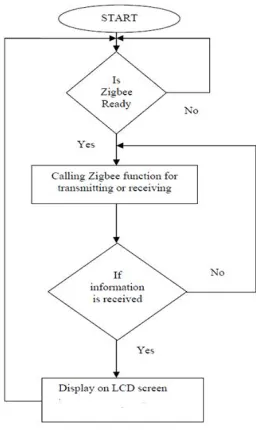
At the entrance, the control section have zigbee module to get the data from the monitoring section .The obtained information about the parking slots has to be displayed on the lcd panels. This information is processed by the controller and then displayed. All time before sending or receiving some data we have to check availability of zigbee.
If the zigbee module is ready then the data is transmitted or received. The obtained information is displayed further
[image:4.612.374.502.477.692.2]International Journal of Emerging Technology and Advanced Engineering
Website: www.ijetae.com (ISSN 2250-2459,ISO 9001:2008 Certified Journal, Volume 3, Issue 4, April 2013)
192
V. HARDWARE REQUIREMENTS
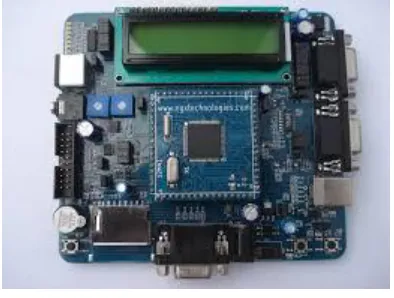
The hardware used contains the ARM7/LPC2148 controller, zigbee modules for communication, the reflection sensors and LCD panels. To get the information of parking lots effectively, the detection of the parking spaces must be effectively, reliably and stably. At the same time, the cost must be considered. The microcontroller we chose is LPC 2148, which is a 32-bit MCU working with low supply voltage range 3.0 V to 3.6 V. The processor provides three interfaces which are GPIO, SPI and ADC. They are used to communicate with zigbee modules, refection sensor. The wireless communication module is 802.15.4, which a low power RF module is working on the worldwide 2.4 GHz ISM bandwidth, and the maximum data transmit rate can reach 250 kbps [6]. The sensor module consists of reflection sensor; these sensors are
employed becauseCompact design operation range 0 to 20
[image:5.612.70.267.351.500.2]mm, high sensitivity, low dark current, minimized crosstalk. The LPC 2148 with all the peripherals is shown:
Fig. VIII. LPC 2148 Board
VI. SOFTWARE REQUIREMENTS
The software environment used is Keil micro vision, Flash magic and Express PCB.
VII. CONCLUSION
This paper introduces a PGIS based WSN. We developed a sensor network which carries all information about the parking space from the sensor node to management centre via Zigbee. The sensor network and the information and management center constitute a PGIS. The experimental results determine that the PGIS we developed can satisfy the application. This system can be conveniently installed in the parking lots. There is no need to change the existing parking system and it is compatible with the existing wired networks. So, this PGIS can be greatly adapted and also has good market significance.
REFERENCE
[1] Azeem Uddin, 2009. Traffic congestion in Indian cities: Challenges of a rising power.
[2] Jatuporn Chinrungrueng Udomporn Sunantachaikul Satien Triamlumlerd 2007. Smart Parking: an Application of optical Wireless Sensor Network. Proceedings of the International Symposium on Applications and the Internet Workshops
[3] Zeydin PALA* and Nihat INAN;**,April 2009.Smart Parking Applications Using RFID Technology. Jin Wen University of Science and Technology.
[4] M.Y.I. Idris, Y.Y. Leng, E.M. Tamil, N.M. Noor and Z Razak, 2009.Parking guidance system utilizing Wireless Sensor Network and ultrasonic sensor.Information Technology Journal.
[5] Hsin-Mu Tsai1, Cem Saraydar2, Timothy Talty2, Michael Ames2, Andrew Macdonald2, and Ozan K. Tonguz1,2007 .ZigBee-based Intra-car Wireless Sensor Network,ICC proceedings.
[6] Mingkai Chen Tianhai Chang,A Parking Guidance and Information System based on Wireless Sensor Network, 2011, Proceeding of the IEEE International Conference on Information and Automation Shenzhen, China
[7] Sangwon Lee, Dukhee Yoon, Amitabha Ghosh, Intelligent Parking Lot Application Using Wireless Sensor Networks,2008, 978-1-4244-2249-4/08.
[8] Dr.P.C.Jain, K.P.Vijaygopalan, RFID and Wireless Sensor Networks,2010, Proceedings of ASCNT.