International Journal of Emerging Technology and Advanced Engineering
Website: www.ijetae.com (ISSN 2250-2459,ISO 9001:2008 Certified Journal, Volume 3, Issue 3, March 2013)
249
Experimental Study on SI Engine At Different Ignition Timing
Using CNG And Gasoline-20% n Butanol Blend
Munde Gopal G.
1, Dr. Dalu Rajendra S.
21M. Tech Student, Thermal Engineering
2Asso. Professor and HOD, Department of Mechanical Engineering,
Government College of Engineering, Amravati
Abstract— Gasoline and diesel fuel will become scarce and
most costly. Alternative fuel technology, availability and use will become more common in the coming decades for IC engines. Compressed natural gas (CNG) and Alcohols is the most favorite for fossil fuel substitution. It causes less pollution and increases efficiency of engine. The objectives are to investigate the effect of ignition timing on performance and emissions SI engine operation.
This paper presents the results obtained from running a 1-cylinder spark ignition engine with gasoline- 20% n Butanol blend and compressed natural gas (CNG). The performance and emissions of the engine with 8 compression ratio was evaluated at 220,270,320 ignition advances of BTDC. The AVL Digas 444 type emission analyzer uses for CO, HC, CO2 and NOx for emission measurement. On average, CNG yielded good performance such as BTE, BSFC, and EGT Compared to gasoline and B20 shows almost similar gasoline. In terms of exhaust emissions of CNG at WOT results showed that HC, CO and CO2 were significantly reduced compared to gasoline and also in case (B20) 20% n-Butanol show reduced. The NOx emissions of the B20 are more compared to CNG and gasoline.
Index Terms—Compressed Natural gas (CNG), B20
(Gasoline-20%n-Butanol Blend), alternative fuel, SI engine, Ignition timing, emission
I. INTRODUCTION
It is the dream of engineers and scientists to develop engines and fuels such that very few quantity of harmful emissions are generated, and these could be let into the surroundings without a major impact on the environment. Air pollution is predominately emitted through the exhaust of motor vehicles and the combustion of fossil fuels. Government around the world has set forth many regulatory laws to control the emissions. One of the serious problems facing the modern technological society is the drastic increase in environmental pollution by internal combustion engines (IC engines) The most common alternative fuels for internal combustion engines (ICE) are LPG, CNG, LNG, 15 % gasoline-methane blend ,gasoline-ethanol blends, gasoline-butanol blend, hydrogen (H2) and DME [1-3].
Despite the variety of the alternative fuels, number of vehicles which are using alternative fuels is a very small percentage of those using conventional fossil fuels. This is due to some typical problems of alternative fuels such as transportation, storing and distribution, besides some necessary modifications on the engines and the vehicles. Therefore a tremendous effort is focused on these issues, expecting a wider use of the alternative fuels. [9]
Natural gas is regarded as one of the most promising alternative fuels and probably the cleanest fuels. CNG (compressed natural gas), a gaseous form of natural gas, clearly has some substantial benefits compared to gasoline and diesel. These include lower fuel costs, higher octane and, most certainly, cleaner exhaust emissions. As a result, CNG as a fuel is clean, economical and has been in use worldwide to power vehicles. There are over 1,500,000 vehicles in the world produced by Honda, Ford, Toyota, Volvo, Mercedes Benz, Optare, Iveco, Cummins and Scania running on CNG. It also has been noted in literature that natural gas have high-octane value, a good cold-starting characteristics that cause less wear on engine and can be fueled at home.
International Journal of Emerging Technology and Advanced Engineering
Website: www.ijetae.com (ISSN 2250-2459,ISO 9001:2008 Certified Journal, Volume 3, Issue 3, March 2013)
250
A. Literature Review:
Many researchers have worked on the emission control and performance enhancement of SI engines. M. K Hassan, I. Aris, S. Mahmod, R. Sidek[3] worked on Experimental investigations of performance and exhaust gases, concentration at various ignition and injection timing for high compression engine fuelled with compressed natural gas (CNG) engine. The engine implements central direct injection (DI) method. All injectors are positioned within a certain degrees of spark plug. It is called as CNGDI engine. The results showed that, Low CO concentration occurs at late injection timing and the lowest emission is 0.011% when we applied 300 bTDC of ignition at 3600 CA injection timing. The most influential factor for CO development is ignition timing. Complete combustion occurs at (3000 EOI, 250-280 bTDC) as illustrated in the CO2 and O2 contour. Mardani Ali Sera et al [1] had investigate the effects of density on the performance of a CNG fuelled engine either in dual-fuel, bi-fuel or dedicated forms is lower performance compare to that of gasoline. One significant factor that reduces the CNG engine performance is its low volumetric efficiency due to low density of a CNG fuel. In this research the cooling system and heat exchanger device were installed to 16 L EFI engine to vary the density of CNG fuel. The results showed that the fuel density plays an important effect on the performance of CNG engine and at the same time
maintaining the lower exhaust emission. The latest research to the ignition of CNG was reported by
Kidoguchi.Y et al., [8]. The CNG was injected directly into the combustion chamber by gas injector and the jet was ignited by spark plug. The results showed that the ignitability of CNG jet could be improved by controlling jet velocity. Ignition near injector at jet boundary is effective to reduce jet velocity, resulting in improvement of ignitability. Multiple injections were applied to CNG jet combustion and it was found the multistage injection is useful to reduce initial jet velocity and promote initial flame development. The method of controlling jet velocity is leading to high ignitability of CNG jet with high injection pressure. The experimental was conducted on single cylinder engine.
D. Balaji [10] introduced influence of isobutanol blend in spark ignition engine performance operated with gasoline and ethanol. A four stroke, single cylinder SI engine was used for conducting this study .Performance tests were conducted for fuel consumption, volumetric efficiency, brake thermal efficiency, brake power, engine torque and brake specific fuel consumption, using unleaded gasoline and additives blends with different percentages of fuel at varying engine torque condition and constant engine speed. The result showed that blending unleaded gasoline with additives increases the brake power, volumetric and brake thermal efficiencies and fuel consumption addition of 5% isobutanol and 10% ethanol to gasoline gave the best results for all measured parameters at all engine torque values.
Further, 30% blend of butanol were investigated for NOx emission by two way dividing two part by preheating the air and by varying the ignition timing, under different values of inlet air temperatures ,10% increase in NOx was observed when the inlet air temperature increased from 400 to 608oC. For 30% iso-butanol-gasoline blend experimental results show that preheating inlet air causes knock and misfire to occur at less advanced ignition timing. Retarding ignition timing causes the engine thermal efficiency to decrease.
II. EXPERIMENTAL DETAIL AND METHODOLOGY
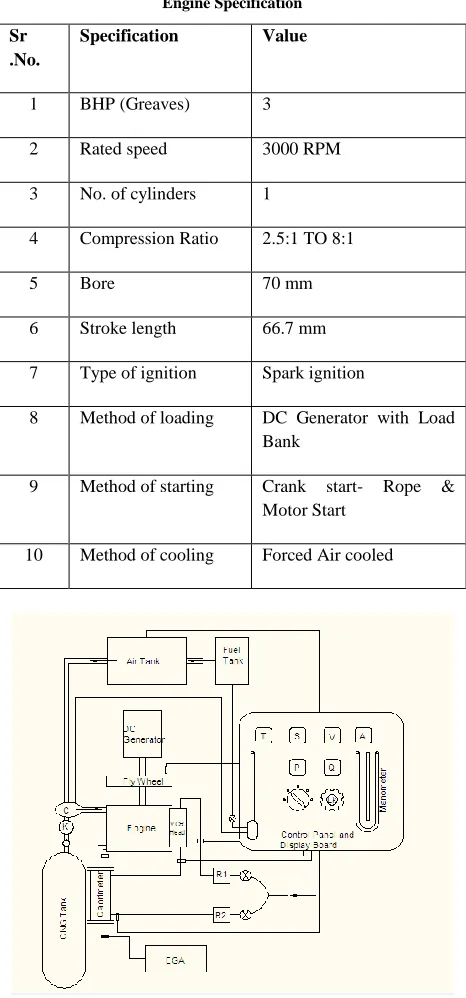
Experimentation was carried out on Greaves MK-25 engine which was modifies by Tech-ed equipments limited, Bangalore. Basically MK-25 was designed with f-shape combustion chamber which was then replaced by over head piston, the up and down movement of piston causes change in clearance volume of engine resulting into change in compression ratio. Five gas digital analyzer of AVL limited was used form analysis of exhaust gases coming from the engine. Further detail of engine and setup is described below.
A. Engine Specification
International Journal of Emerging Technology and Advanced Engineering
Website: www.ijetae.com (ISSN 2250-2459,ISO 9001:2008 Certified Journal, Volume 3, Issue 3, March 2013)
[image:3.612.198.550.97.624.2]251
Table 1 Engine Specification
Sr .No.
Specification Value
1 BHP (Greaves) 3
2 Rated speed 3000 RPM
3 No. of cylinders 1
4 Compression Ratio 2.5:1 TO 8:1
5 Bore 70 mm
6 Stroke length 66.7 mm
7 Type of ignition Spark ignition
8 Method of loading DC Generator with Load Bank
9 Method of starting Crank start- Rope & Motor Start
10 Method of cooling Forced Air cooled
Figure 1: Detail of engine setup
T Digital temperature Indicator connected with thermocouples with K type thermocouple having range 0-600o C (0C)
S Digital Tachometer Indicator connected with flux cut type sensor (rpm); (Make: SYSTEM, Model: TM803)(PNP)(Range 0-50000rpm, 0.05%±1)
V Voltmeter (Volt). A Ammeter (amps)
P Fuel rate indicator provided with load cell to the fuel tank and duel indicator in (gms)&(Kg/hr); (Make : PARAMETRIC, Model: FRI05)
Q Air rate indicator connected to air tank with duel indicator in(mm of H2O)&(m3/hr); (Make :PARAMETRIC, Model: FRI05) R1 Rota meter for measurement of water flow to
VCR head
R2 Rota meter for measurement of water flow rate to the calorimeter
C Carburetor K CNG Kit LK Loading knob
[image:3.612.52.285.134.633.2]TK Temperature indicator knob
Figure 2: Actual setup of engine with emission analyze
[image:3.612.333.559.197.605.2]International Journal of Emerging Technology and Advanced Engineering
Website: www.ijetae.com (ISSN 2250-2459,ISO 9001:2008 Certified Journal, Volume 3, Issue 3, March 2013)
252 AVL Digas444 type of five gas analyzer is used for exhaust gas analyzer as mentioned above, it is provide with exhaust inlet which used to insert into the exhaust pipe of sample gas these gas is then sucked by analyzer separating out condensate before analysis of gas. Thus four gases were analyzed for the experimentation.
III. RESULT AND DISCUSSION
All the tests presented in this paper were carried out at an engine speed of 2,500 rpm and wide-open throttle. For different Ignition Timing that is at 220, 270, & 320 BTDC and at compression ratio of 8 and the results obtained during experimentation are discussed as under
A. Brake specific Fuel Consumption
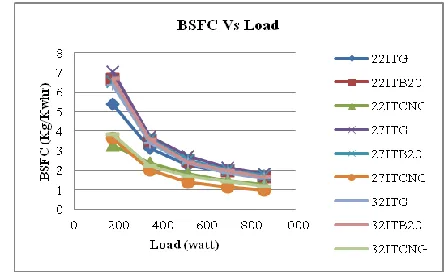
[image:4.612.325.562.337.498.2]Brake specific fuel consumption has the decreasing characteristics with increase in load, Graph shows the brake specific fuel consumption at different loads using Gasoline, CNG and B20 at different Ignition Timing of 220, 270 & 320 BTDC and at compression ratio of 8, it is observed that brake specific fuel consumption for CNG is less as compared to gasoline and B20, using gasoline as a fuel the least brake specific fuel consumption was obtained at 320 BTDC whereas at 270 BTDC brake specific fuel consumption was having the highest value.
Figure 3: Brake specific Fuel Consumption with varying load at 220,
270 & 320 BTDC Ignition Timing
Looking for brake specific fuel consumption using CNG as a fuel it is observed that at 270 BTDC it is having the least value, the result obtained at 220 and 320 BTDC are having values nearer to each other. Also looking for brake specific fuel consumption using B20 as a fuel it is observed that at 270 BTDC brake specific fuel consumption was having the highest value, the result obtained at 220 and 320 BTDC are having values nearer to each other.
B. Brake thermal efficiency
[image:4.612.56.280.416.552.2]Brake thermal efficiency is the function of actual power gain from total supplied energy input. Graph shows the comparison of Thermal Efficiency for CNG, B20 and gasoline at different Ignition Timing 220, 270 & 320 BTDC. Among for the fuel the maximum brake thermal efficiency was obtained at 270 BTDC using CNG as a fuel, the thermal efficiency of CNG is good compared to that of gasoline and B20, this is due to less amount of fuel consumed while using CNG as a fuel, for CNG the least amount of thermal efficiency was obtained at 220 BTDC further advancing the Ignition timing showed improvement in Thermal efficiency. Using gasoline as a fuel the maximum Brake Thermal efficiency was obtained at 320 BTDC, whereas the least thermal efficiency was obtained at 270 BTDC. Also looking for Brake Thermal efficiency using B20 as a fuel it is observed that at 220, 270 and 320 BTDC are having values nearer to each other.
Figure 4: Brake Thermal efficiency with varying load at 220, 270 & 320 BTDC Ignition Timing
C. Exhaust Gas Temperature
International Journal of Emerging Technology and Advanced Engineering
Website: www.ijetae.com (ISSN 2250-2459,ISO 9001:2008 Certified Journal, Volume 3, Issue 3, March 2013)
[image:5.612.322.565.112.284.2]253
Figure 5: Exhaust gas temperature with varying load at 220, 270 &
320 BTDC Ignition Timing
Advancing the Ignition timing increases the partial oxidation reaction during compression stroke, whereas when the Ignition timing is retarded then there is decrease in pressure and temperature peaks during combustion process as there is less time between Ignition timing and Top dead center to complete chemical reaction, so large amount of fuel gets burn after TDC in expansion stroke which is known as post reaction, post reaction mainly occurs between Carbon monoxide and hydrocarbons in the exhaust system. Therefore retarding the ignition timing is always associated with incomplete combustion and an increase in the exhaust temperature. Graph shows the Effect of Ignition timing on exhaust gas temperature for Gasoline, CNG and B20 it shows advancing the Ignition Timing reduces the exhaust gas temperature, the exhaust gas temperature using B20 as a fuel is having more value compared to gasoline and CNG.
D. Carbon Mono-Oxide (CO) Emission
[image:5.612.55.286.122.258.2]Ignition timing effects the Carbon monoxide emission, as shown in Figures below, it is observed that CO emission is higher while using Gasoline as a fuel compared to CNG and B20, it can be stated that advancing the Ignition timing increases the CO emission this may be the condition due to reduction in temperature, it can also be stated that CO emission is not having much variation comparing results at 220, 270 & 320 BTDC. At 220 BTDC the percentage of CO emission is having the least value for all load condition and for both the fuels Gasoline and B20, further when the Ignition timing is advanced there is increase in CO emission percentage, maximum CO emission percentage is observed at 320 BTDC using Gasoline as a fuel whereas using CNG as a fuel it is observed at 220 BTDC, Also for using B20 as a fuel it is observed at 270 BTDC, this may be the condition that as the ignition time is advanced there is reduction in exhaust gas temperature thereby oxidation of CO reduces and its emission increases.
Figure 6: CO emission with varying load at 220, 270 & 320 BTDC
Ignition Timing
E. Hydrocarbon (HC) Emission
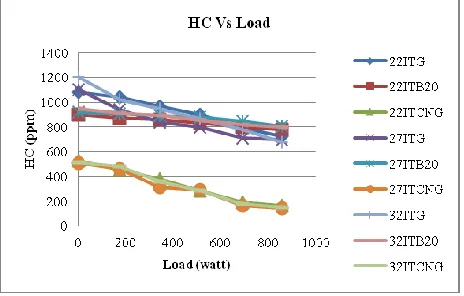
It is observed that there is decrease in Hydrocarbon emissions with increase in load for all Ignition Timing, graph shows that as the Ignition timing is advanced there is increase in Hydrocarbon emission, observation showed that Hydro carbon emission at 320 BTDC is more compared to that at 220 & 270 BTDC, this may be due to the reason that as the Ignition Timing is advanced there is reduction in temperature, so the hydro carbon combustion might get reduced, Using Gasoline as a fuel hydrocarbon emission is having more value compared to that of CNG and B20.
Figure 7: HC emission with varying load at 220, 270 & 320 BTDC
[image:5.612.329.561.451.599.2]International Journal of Emerging Technology and Advanced Engineering
Website: www.ijetae.com (ISSN 2250-2459,ISO 9001:2008 Certified Journal, Volume 3, Issue 3, March 2013)
254
[image:6.612.52.291.121.274.2]F. Carbon Di-Oxide (CO2) Emission
Figure 8: CO2 emission with varying load at 220, 270 & 320 BTDC
Ignition Timing
CO2 emission percentage does not vary more with the change in Ignition timing as shown in Figures below, It is observed that CO2 emission increases with increase in load and retarding the Ignition timing, Graph shows that at 220 BTDC the CO2 emission is higher compared to 270 & 320 BTDC, as at 220 BTDC due to high temperature the complete combustion of carbon monoxide takes place therefore there might be increase in CO2 emission.
Maximum CO2 emission percentage is observed at 220 BTDC using Gasoline as a fuel whereas using CNG and B20 as a fuel it is observed at 270 BTDC, Carbon dioxide is product of complete combustion of fuel and higher emission of CO2 is desirable. When hydrocarbon burns in presence of sufficient air then it generates heat producing carbon dioxide and water as final product of reaction.
G. Nitrogen Di-Oxide (NOx) Emission
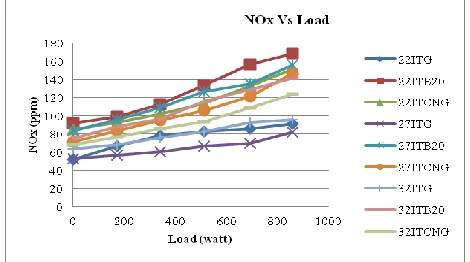
Graphs shows the NOx emission for the Gasoline, CNG and B20 it is observed that advancing the Ignition Timing increases the NOx emission, it also shows that Nox emission for B20 is having more value compared to that of gasoline and CNG at all load condition.
Figure 9: NOX emission with varying load at 220, 270 & 320 BTDC
Ignition Timing
IV. CONCLUSION
In this study, the effect of Ignition Timing on the performance of single cylinder spark ignition engine fueled with gasoline, CNG and B20 was studied, based on the experimental study, the following results of Gasoline, CNG and B20 can be concluded:
1) The BSFC for CNG is always less than that of the gasoline and slightly than the B20. BSFC decreases with the increase in the load for the all fuels used. 2) BTE increases with at all the loading conditions as
BSFC decreases. Thus CNG shows higher BTE as compared to B20 and Gasoline and B20 shows higher BTE as compared to Gasoline.
3) Advancing the Ignition timing had decrease in exhaust gas temperature, Using B20 and CNG as a fuel exhaust gas temperature is more compared to gasoline at all Ignition Timing.
4) CO emission goes on increasing with Ignition advancement but has minute variation; it is also observed that CO emission for Gasoline is more as compared to that of CNG and B20. CO2 emission goes on reducing with advancing the Ignition Timing, CO2 emission also has little variation with change in Ignition Timing, and it is observed that CO2 emission for gasoline is more compared to that of CNG and B20.
5) The percentage of Hydro carbon (HC) emission goes on increasing with advancing the ignition Timing, with increase in load there was reduction in Hydrocarbon emission, The hydro carbon emission for CNG was less compared to Gasoline and B20 at all Ignition Timing.
6) It is observed that NOx emission was having low value at 270 BTDC using gasoline as a fuel, whereas for CNG and B20 also NOX emission was observed to be low at 320 BTDC, further advancing the Ignition timing had shown increase in NOx emission, it is found that NOx emission was more while using B20 as a fuel compared to that of Gasoline and CNG. 7) Evaluating the performance characteristics on the
[image:6.612.51.286.561.692.2]International Journal of Emerging Technology and Advanced Engineering
Website: www.ijetae.com (ISSN 2250-2459,ISO 9001:2008 Certified Journal, Volume 3, Issue 3, March 2013)
255 REFERENCES
[1] Mardani Ali Sera, Rosli Abu Bakar and Sin Kwan Leong “Effect of Fuel Density on the Performance of CNG Fuelled Engine” Dept. of Mechanical Engineering, University Technology Malaysia, 81310 UTM Skudai Johor Darul Ta‟zim Malaysia.
[2] Fanhua Ma et al,'' Performance and emission characteristics of turbocharged spark-ignition hydrogen enriched compressed natural gas engine under wide open throttle operating conditions''. International journal of hydrogen energy 35 (2010) pp. 12502-12509 [3] M.K Hassan, I.Aris, S..Mahmod, R. Sidek, "'Influence of Injection and Ignition of CNG Fuelled Direct Injection Engine at Constant Speed.'' Australian Journal of Basic and Applied Sciences, 4(10): 4870-4879, 2010 ISSN 1991-8178
[4] Munde Gopal G., Dr.Dalu Rajendra S. “Compressed Natural Gas as an Alternative Fuel for Spark Ignition Engine: A Review”, International Journal of Engineering & Innovative Technology (ISSN: 2277-3754) Volume 2, Issue 6, December 2012.
[5] Heywood J.B, Internal combustion engine fundamentals, McGraw Hill Book CoUSA. 1995.
[6] Ganesan V. '' Internal Combustion Engines” Third Edition Tata McGraw-Hill, 2007 New Delhi.
[7] Huang, Z., S. Shiga, T. Ueda, N. Nakamura, T. Ishma, T. Obokata, M. Tsue and M. Kono, 2003. “Effect of fuel injection timing relative to ignition timing on natural-gas direct injection combustion”. J.Eng. Gas Turbines and Power., 125: 783-790
[8] Kidoguchi,Y., Y. Nakamura, N. Nakajima, Y. Fukui and K. Miwa, 2008. “Control of injection and ignition to improve ignitability of CNG jet”. Transaction of the Japan Society of Mechanical Engineer, Part B, 74(7): 1655-1661.
[9] F.N.Alasfour, “Effect of butanol on in-cylinder combustion process. part 1 spark ignition engine”. Applied Thermal Engineering Vol. 18, No. 8, pp. 609-618, 1998.
[10] D.BALAJI, “Influence of isobutanol blend in spark ignition engine performance operated with gasoline and ethanol‟, International Journal of Engineering Science and Technology, Vol. 2(7), 2010, pp. 2859-2868
[11] H S Farkade, A P Pathre, ”Experimental investigation of methanol, ethanol and butanol blends with gasoline on SI engine” International Journal of Emerging Technology and Advanced Engineering, (ISSN 2250-2459), Volume 2, Issue 4, April 2012.
[12] Barıs Erkus, Ali Sürmen, M. Ihsan Karamangil, Rıdvan Arslan , “ The Effect of Ignition Timing on Performance of LPG Injected SI Engine”,
[13] Energy Technology Systems Analysis Program (ETSAP)- Technology Brief T03-April2010- www.etsap.org
[14] R. Chandra, V.K. Vijay et al “Performance evaluation of a constant speed IC engine on CNG, methane enriched biogas and biogas''. Applied Energy 88 (2011) pp. 3969–3977.
[15] S.Akansu, Zafer Dulger, Nafiz Kahraman, T.Nejat Veziroglu (2004)˝ Internal Combustion Engines Fuelled With HCNG Mixtures” International Journal Of Hydrogen Energy 29(2004) pp.1527-1539 [16] Ranbir Singh. "'Performance and exhaust gas emissions analysis of
direct injection CNG-Diesel dual fuel engine" International Journal of Engineering Science and Technology (IJEST) Vol. 4 No.03, (March 2012) ISSN: 0975-5462.
[17] Rosli Abu Bakar, Mardani Ali Sera and Wong Hong Mun(2001) “Towards The Implementation Of CNG Engine: A Literature Review Approach To Problems And Solutions'', BSME-ASME International Conference on Thermal Engineering 31( December 2001 – 2 January 2002), Dhaka ISBN.