Journal of Chemical and Pharmaceutical Research, 2015, 7(4):204-208
Research Article
CODEN(USA) : JCPRC5
ISSN : 0975-7384
Experimental study of asphaltene precipitation in the process of CO
2flooding
Jinsheng Zhao
1*, Ziqiang Xu
2and Lina Shen
31
College of Petroleum Engineering, Xi’an Shiyou University, Xi’an, Shaanxi, PR China
2
Research Institute of Oil & Gas Technology, Changqing Oil field Company, Shaanxi, PR China
3
Exploration and Development Research Institute, Changqing Oil field Company, Shaanxi, PR China
_____________________________________________________________________________________________
ABSTRACT
Because of the high displacement efficiency and greenhouse gas emissions reduction, CO2 flooding technology is more and more attention from home and abroad, but in the process of CO2 flooding, there is a phenomenon of asphaltene precipitation which can cause the reduction of permeability. With actual crude oil in certain oilfield as an example, the regular pattern of asphaltene precipitation in the process of CO2 injection was studied, and the results showed that with the increase of injection pressure, amount of asphaltene precipitation increase gradually, and the core permeability decreases. For the influence of asphaltene precipitation, in the oil displacement process, the displacement efficiency decline.
Keywords: Asphaltene precipitation, CO2 flooding, Displacement efficiency, Permeability
_____________________________________________________________________________________________
INTRODUCTION
In the process of CO2 miscible flooding, CO2 can extract the light component of crude oil or make its gasification,
reducing interfacial tension to make CO2 miscible in oil, this is the most important mechanism of CO2 flooding to
improve oil recovery. On the one hand, the technology of CO2 flooding use greenhouse gas CO2 as oil displacement
agent to protect the ecological environment and improve economic efficiency, and on the other hand, this way of oil displacement can improve oil recovery significantly andeconomic performance, so CO2 flooding technology is
more and more attention from home and abroad[1-3].
Under the condition of normal oil reservoir, colloid-asphaltene-crude oil is in a state of dynamic balance. CO2
flooding can reduce the asphaltene stability, causing asphaltene flocculation and sedimentation[4-5]. Asphaltene deposition would block reservoir and oil extraction equipment, reduce the oil well productivity, increase production and operation costs, processing costs faced by the current petroleum industry is one of the highest technical problem[6-7]. Therefore, the study of asphaltene precipitation of oilfield development has important guiding meaning and application value.
EXPERIMENTAL SECTION Experimental principle
Experimental apparatus and materials
[image:2.595.154.457.164.362.2]According to the experimental principle and purpose, considering the basic principle of core displacement experiment device and the discharged liquid flow metering and the need of sampling, a set of asphaltene precipitation measuring and displacement experimental device was designed and manufactured. The experimental device is mainly composed of the advection pump, hand pump, core gripper, back pressure regulating system, differential pressure gauge, pressure sensor, incubator, etc. The experimental device was aclosed system to against the change of oil/gas component. The flow chart is as follows:
Fig.1 The experiment flow diagram
1、2—container 3、4、8、10、12、14、16—valve 5—constant-flux pump
6、11、17—pressure gauge 7、15、21—manometer 9—core holder
13—hand pump 8—incubator 19—back-pressure valve 20—core
(1) Experimental apparatus
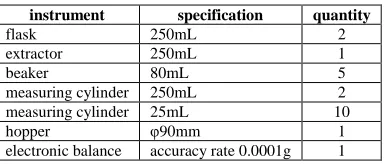
[image:2.595.212.405.456.538.2]Experimental instruments used are shown in table1.
Table 1 Experimental apparatus
instrument specification quantity
flask 250mL 2
extractor 250mL 1
beaker 80mL 5
measuring cylinder 250mL 2
measuring cylinder 25mL 10
hopper φ90mm 1
electronic balance accuracy rate 0.0001g 1
(2)Experimental materials
[image:2.595.99.516.632.701.2]The purity of dioxide used in experiment is 99.99%. The oil used is compound of dehydrated crude from Yuan-284 area and aviation kerosene in accordance with the proportion of 1:2. The density of the oil is 0.75 g/cm3 and the viscosity is 1.05 mPa.s at the temperature of 70℃.The cores used in the experiment are sand packed model with the size of Φ3.8cm×30cm.Core parameters are shown in table2.
Table 2 The core parameter and experimental program
No permeability /10-3um2 Porosity /% Length
/cm Sectional area /cm
2 Experimental program Remark
1 152 15.6 30 6.25
pressure /MPa
5
Q=0.1ml/min T=70℃
2 148 15.6 30 6.25 8
3 156 15.6 30 6.25 12
4 146 15.6 30 6.25 15
5 161 15.6 30 6.25 17
Experimental procedure
pressure.(4)The CO2 was injected into the core to sweep oil until no oil flow out, and the oil and gas volume
displaced by CO2 were measured. (5)Measuring the content of asphaltene in sweepout oil. (6)Calculating residual
asphalt in the core.
[image:3.595.98.513.161.423.2]RESULTS AND DISCUSSION Effect of pressure on the content of deposited asphaltene
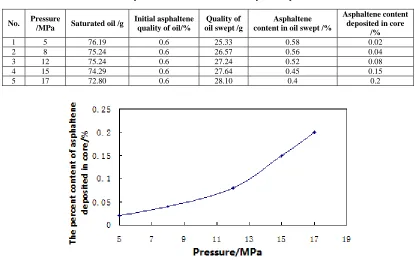
Table 3 Experimental data of the content of deposited asphaltene
No. Pressure
/MPa Saturated oil /g
Initial asphaltene quality of oil/%
Quality of oil swept /g
Asphaltene content in oil swept /%
Asphaltene content deposited in core
/%
1 5 76.19 0.6 25.33 0.58 0.02
2 8 75.24 0.6 26.57 0.56 0.04
3 12 75.24 0.6 27.24 0.52 0.08
4 15 74.29 0.6 27.64 0.45 0.15
5 17 72.80 0.6 28.10 0.4 0.2
Fig.2 The curve of the content of asphaltene precipitation vs. injection pressure
At the experiment temperature of 70℃, with the increase of injecting pressure, the content of asphaltene precipitation increase gradually.
Based on the colloid theory, because CO2 or other small molecule hydrocarbon and asphaltene are highly
asymmetric component on the thermodynamics, the main show of the asymmetric is: (1) There is a huge difference in the molecular size.(2) There are large difference between polar molecules. As the injected CO2 dissolved in the oil,
its concentration in the solvation layer increases, and a large number of CO2 molecules occupy the surface space of
asphaltene molecules, which make the gum concentration decreased relatively and the surface energy of system greatly increased, and the micelle can not form or the thickness of micellar solvation layer is not enough, which cause asphaltene molecules associating each other to form bigger molecules in order to reduce the surface energy. When the colloidal particles continue to increase to critical point (that is, the asphaltene precipitation point), asphaltene began to deposit. The higher the injection pressure, the dissolution ability of CO2 in the oil stronger, more
of the small molecular components of crude oil increase, and the more the asphaltene colloid concentrations of stabilizer is smaller, the more conducive to the asphalt mutual association formed precipitation.
When the system temperature and pressure is greater than the critical temperature and pressure of CO2, CO2 is
supercritical fluid, and the extraction ability for the light component in crude oil is stronger. In the CO2-crude oil
system, the extraction efficiency of CO2 on crude oil increased with the increase of the pressure. And its function is
to reduce oil solvation layer in the concentration of the small molecule hydrocarbon deposits, and reduce the amount of asphaltene deposition.
The sedimentary asphalt quality will be the result of comprehensive effect of the above two. When CO2 injection
pressure is low, the deposition effect obviously, and asphaltene deposition quantity increased with the increase of gas injection pressure increase; When the CO2 pressure reaches a certain extent and make the effect is greater than
the deposition effect after the dissolution of supercritical fluid, asphaltene precipitation amount will decrease with the increase of gas injection pressure.
Fig.2 is that the amount of asphaltene precipitation increase with the injecting pressure increase. Analyzing the reason, because the original formation pressure of study block HuaQing Chang 6 reservoir is 16.7 MPa, so the highest pressure in this study is only 17 MPa, and it is mainly sedimentary effect in the experimental pressure range.
Effect of asphaltene precipitation on permeability
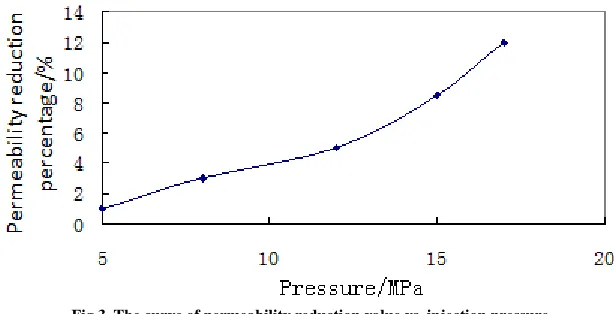
[image:4.595.151.458.180.337.2]As shown in Fig.3, with the increase of injection pressure, amount of asphaltene deposition increases gradually and the permeability of core decreases. At the highest test pressure of 17 MPa, the permeability decreased 12% from the original permeability 161mD dropped to 142 mD.
Fig 3. The curve of permeability reduction value vs. injection pressure
Effect of asphaltene precipitation on displacement efficiency
[image:4.595.172.440.449.595.2]As shown in Fig.3, with the increase of injection pressure, the displacement efficiency of kerosene and simulated oil increases also, and at the same pressure, the displacement efficiency of keroseneis higher than that of simulated oil, and the displacement efficiency difference of kerosene and simulated oil increases with the increase of injection pressure, which show that part of the asphaltene deposited in core in the process of oil displacement and precipitation amount increases with the increase of injection pressure. But on the whole, because the asphaltene content of crude oil in HuaQing Chang6 reservoir is low (0.6%), and precipitation amount is small, so the influence of asphaltene precipitation on oil displacement efficiency is not big.
Fig 4. The curve of oil displacement efficiency value vs. injection pressure
CONCLUSION
With the increase of injection pressure, amount of asphaltene precipitation increase gradually. With the increase of injection pressure, the core permeability decreases. At the highest test pressure of 17 MPa, the permeability decreased 12%. For the influence of asphaltene precipitation, in the oil displacement process, the displacement efficiency decline.
Acknowledgements
REFERENCES
[1]Lu Guiwu, Li Yingfeng, Song hui, et al. Petroleum Exploration and Development, 2008,35(1),67-72. [2] Zhang Liang, Wang Shu, Zhang Li, et al. Petroleum Exploration and Development, 2009,36(6), 737-742. [3]Shen Pingping, Liao Xinwei, Liu Qingjie. Petroleum Exploration and Development, 2009, 36(2), 216-220. [4]Anderko A. Fluid Phase Equilibrium, 1992,75,89-103.
[5]Peng D Y, Robinson D B. Ind. and Eng. Chem. , 1976, 15(1),59 -64.