IMPROVING PID CONTROLLER OF MOTOR SHAFT ANGULAR POSITION BY USING GENETIC ALGORITHM
ARIF ABIDIN B MUHAMAD
A project report submitted in partial fulfillment of the requirement for the award of the
Degree of Master of Electrical Engineering
Faculty of Electrical and Electronic Engineering Universiti Tun Hussein Onn Malaysia
ABSTRACT
ABSTRAK
TABLE OF CONTENTS
TITTLE i
DECLARATION ii
DEDICATION iii
ACKNOWLEDGEMENT iv
ABSTRACT v
ABSTRAK vi
TABLE OF CONTENTS vii
LIST OF TABLES xii
LIST OF FIGURES xiii
LIST OF SYMBOLS AND ABBREVIATIONS xvii
LIST OF APPENDICES xviii
CHAPTER 1 INTRODUCTION 1
1.1 DC Servomotor - An Overview 1
1.2 Motor Shaft Angular Position Control - An Overview 1
1.3 Proportional Integral Derivative Controller - An Overview 2
Overview 2
1.6 Background of Project 3
1.7 Problem Statement 5
1.8 Project Objectives 5
1.9 Project Scope 6
1.10 Project Limitation 6
1.11 Significant of Study 7
CHAPTER 2 LITERATURE REVIEW 9
2.1 Introduction 9
2.2 Servo Motor Incremental Shaft Encoder 9
2.2.1 Position Sensing 9
2.2.2 Simplified Incremental Shaft Encoder 10
2.3 Motor Shaft Angular Position Control 12
2.3.1 Angular Position Control Block Diagram and Fundamentals 12
2.4 Servo Response Terminology 14
2.5 Standard PID control 15
2.6 ZN Based PID Terminology 16
2.7 GA Terminology 18
2.8 GA for Optimization 21
2.9 GA Software 23
2.10 Experimental Model: Lab-Volt Digital Servo Model 8063 24
2.10.1 Servo System Hardware 24
2.11 Case Studies on the Previous Researches 28
2.11.1 Title: Nonstationary Optimal Positioning Controller Design Using GA Meta- Optimization 29
2.11.2 Title: Tuning PID Controller Using Adaptive Genetic Algorithms 29
2.11.3 Title: Dc Motor Control Using Ziegler Nichols and Genetic Algorithm Technique 29
2.11.4 Title: Modeling and Control of Three Phase BLDC Motor using PID with Genetic Algorithm 30 2.11.5 Title: Position Control of DC Motor Using Genetic Algorithm Based PID Controller 30
2.11.6 Robust Genetic Algorithm Approach to Modelling and Control 31
2.11.7 Parameter Optimization of PID Controllers Based on Genetic Algorithm 31
2.11.8 Analysis and Summary of Case Studies on the Previous Researches 32
2.11.9 Project Hypothesis based on Previous Researches Result 34
CHAPTER 3 METHODOLOGY 35
3.1 Introduction 35
3.2 Project Development 35
3.3 Project Concept 37
3.5 Tuning the PID Controller with the ZN Method 39
3.5.1 Significantly Damped Step Response 40
3.6 Tuning the PID Controller with the Genetic Optimal Method 41
3.7 GAOT Module Terminology 44
3.7.1 Initializing the Population of the GA 44
3.7.2 Setting the Parameters for the GA 45
3.7.3 Performing the GA 47
3.7.4 Objective Function of the GA 48
3.7.5 Initiazega File 49
3.7.6 Maximum Generation Termination 50
3.7.7 Normalized Geometric Selection 51
3.7.8 Arithmetic Crossover 51
3.7.9 Uniform Mutation 52
3.7.10 Parse 52
3.8 Defining of Parameters 53
CHAPTER 4 RESULT AND ANALYSIS 54
4.1 Introduction 54
4.2 Results Experiment for the ZN Based PID Controller 54
4.3 Results Simulation for the ZN Based PID Controller 60
4.4 Result Simulation for the GA Based PID Controller 63
4.5 Result Experiment for the GA Based PID Controller 72
4.6 Comparative Study between ZN and GA Performances 74
CHAPTER 5 CONCLUSION AND RECOMMENDATION 79
5.2 Conclusion 79
5.3 Recommendation for Future Works 80
REFERENCES 82
APPENDICES 85
APPENDIX A : MATLAB Code for GAOT 86
APPENDIX B : Gantt Chart for Master Project 1 Planning 101
LIST OF TABLES
2.1 Effects of PID parameters variations on a step response 17 2.2 Specifications of the Lab-Volt Digital Servo Model 8063 25
2.3 Summary of case studies 32
3.1 Servo motor characteristics for a brush-type permanent-
magnet dc motor 38
3.2 Initialization Parameters 53
4.1 Analysis of GA based PID simulation 72
4.2 Comparative study between ZN based PID by experiment
and simulation 74
4.3 Comparative study between GA based PID by experiment
and simulation 75
4.4 Comparative study between ZN-PID simulation and GA-
PID simulation 76
4.5 Comparative study between ZN-PID experiment and GA-
LIST OF FIGURES
1.1 Direct Digital Control (DDC) schematic 8
2.1 Simplified incremental encoder diagram 11
2.2 Quadrature signals A and B 11
2.3 Block diagram of a position-control servo system with
motor shaft incremental encoder 13
2.4 Simplified position control servo system block diagram
with overall scaling factor 13
2.5 Simplified position-control servo system block diagram 13
2.6 A typical stable position response 15
2.7 Expended PID controller block diagram. 16
2.8 Flow chart of GA functions and process 19
2.9 Representation of the executed operations during a generation 21
2.10 GA for optimization 22
2.11 Lab-Volt Digital Servo Model 8063 24
2.12 The mechanical unit 26
2.13 The servo controller 27
2.14 Flywheel coupled to motor shaft, platform unloaded 27
2.15 Default-position control screen 28
3.1 Flowchart of project development 36
3.2 Block diagram of project system design 37
3.3 Quarter amplitude decay response 40
3.4 Chromosome representation 42
3.5 Simulation flow chart for the computation of GA-PID
controller parameters 43
3.6 Defining system transfer function 44
3.7 Code for initialize the GA 45
3.8 Code for set the parameters 46
3.10 Code to perform the objective function 48
3.11 Code for ITAE implementation 49
3.12 Code to ensure stabilization of the controlled system 49 3.13 Code for initialization function used by ga.m 50 3.14 Code for termination function used by ga.m 50 3.15 Code for selection function used by ga.m 51 3.16 Code for crossover operator used by ga.m 51 3.17 Code for mutation operators used by ga.m 52
3.18 Code for utility function 52
4.1 Illustration of exported data file 55
4.2 The pulses generated by position sensing incremental
encoder for Step 1 55
4.3 Effect of the proportional gain on the Step response 56 4.4 The pulses generated by position sensing incremental
encoder for Step 2 57
4.5 Tuning the controller with the ZN method step response 57 4.6 The pulses generated by position sensing incremental
encoder for Step 3 (td = 70ms) 58
4.7 Quarter amplitude decay Step response with td = 70ms
step response 58
4.8 The pulses generated by position sensing incremental
encoder for Step 4 59
4.9 Significantly damped step response 60
4.10 M-file for the plant system with PID controller 61 4.11 Performance response for ZN based PID controller
simulation 62
4.12 Convergence of the generations with population size 20 64 4.13 Optimum solution of the PID chromosomes with
population size 20 64
4.14 Performance of the optimized PID chromosomes with
population size 20 64
population size 40 65 4.17 Performance of the optimized PID chromosomes with
population size 40 65
4.18 Convergence of the generations with population size 50 66 4.19 Optimum solution of the PID chromosomes with
population size 50 66
4.20 Performance of the optimized PID chromosomes with
population size 50 66
4.21 Convergence of the generations with population size 60 67 4.22 Optimum solution of the PID chromosomes with
population size 60 67
4.23 Performance of the optimized PID chromosomes with
population size 60 67
4.24 Convergence of the generations with population size 70 68 4.25 Optimum solution of the PID chromosomes with
population size 70 68
4.26 Performance of the optimized PID chromosomes with
population size 70 68
4.27 Convergence of the generations with population size 80 69 4.28 Optimum solution of the PID chromosomes with
population size 80 69
4.29 Performance of the optimized PID chromosomes with
population size 80 69
4.30 Convergence of the generations with population size 90 70 4.31 Optimum solution of the PID chromosomes with
population size 90 70
4.32 Performance of the optimized PID chromosomes with
population size 90 70
4.33 Convergence of the generations with population size 100 71 4.34 Optimum solution of the PID chromosomes with
population size 100 71
4.35 Performance of the optimized PID chromosomes with
4.36 The pulses generated by a position sensing incremental encoder
for Kp97.33601, Ki99.6854, Kd1.81466 gain by offline GA 73 4.37 The step response of Kp97.33601, Ki99.6854, Kd1.81466 gain
by offline GA 73
5.1 The block diagram of proposed real time position control based
LIST OF SYMBOLS AND ABBREVIATIONS
AGA - adaptive genetic algorithms DAQ - Data acquisition
DAS - Data Acquisition System DC - Direct Current
DDC - Direct Digital Control DSP - Digital Signal Processing F(x) - fitness function
GA - Genetic Algorithm
GAOT - Genetic Algorithm Optimization Toolbox gmax - maximum number of generations
Kd , Td - Derivative Gain Ki , Ti - Integral Gain Kp - Proportional Gain KU - ultimate gain
NOR - nonstationary optimal regulator PC - Personal Computer
PID - Proportional integral derivative pc, pm - probabilities
LIST OF APPENDICES
APPENDIX TITTLE PAGE
A MATLAB Code for GAOT 86
CHAPTER 1
INTRODUCTION
This chapter introduces the project that has been working out. The important overview of the project background and description including the problem statements, project objectives, project scopes and significant of this project have emphasized in this chapter.
1.1 DC Servomotor– An Overview
A servomechanism is an automatic device that uses error-sensing feedback to correct the error in the mechanism. A servo motor, which is a type of servomechanism, is provided with a sensor (e.g., an incremental encoder, a position potentiometer, a speed sensor) that compares the command (e.g., the applied voltage) with the actual movement (e.g., the motor position) (Ruano, 2005). Using a controller and appropriate control strategies, the error existing between the command and the actual movement can be determined, analysed, and then corrected. Servo motors are used more and more because they give much more precision and/or rapidity to the movements of a mechanical system. A robot manipulator, for example, usually contains many servo motors.
1.2 Motor Shaft Angular Position Control – An Overview
position transducer that reports the angle of shaft displacement in discrete steps.
1.3 Proportional Integral Derivative Controller- An Overview
Proportional integral derivative (PID) control schemes are wide utilized in most of control system for a long time for it easy in structure, reliable operating and robust in performances function. One key issue for their success is that they act within the processes in restraint in a manner closely like human’s natural responses to outside stimuli, that is the combined effects of naturalness (proportional action), post training (integral action) and projection into future (derivative action) (Stephen, 2011). However, it is still a awfully necessary downside a way to determine or tune the PID parameters, as a result of these parameters have an excellent influence on the stability and therefore the performance of the control system. Yet, the plants with high nonlinearity, high time-delay and high order can’t be controlled effectively employing a simple PID controller.
1.4 Ziegler-Nichols Based PID Controller – An Overview
Ziegler-Nichols (ZN) is one of the most widely used method for the tuning of the PID controller gains, yet this method is limited for application till the ratio of 4:1 for the first and the second peaks in the closed loop response, thus leading towards an oscillatory response (Astrom, Hagglund, 1995). Initially, the unit step function i.e. transfer function of the plant is obtained, and by the ZN rule base, the parameters required can easily be estimated, but far from optimal.
1.5 Genetic Algorithm as Optimal Robust Controller - An Overview
solves the optimization problem. One of the popular approaches to the mathematics-based approach to optimal design of a control system has been optimal robust control, in which an objective function, often based on a norm of a functional, is optimized, whereas a controller (dynamic or static) is obtained that may tolerate variation of plant parameters and unordered dynamics (Stephen, 2011).
1.6 Project Background
Digital servomotor has been widely known to be employ in associate automation and industrial because of its excellent speed control characteristics. Servo systems contain error-driven control loops. Servo tuning is an associate integral a part of any motion system and directly impacts the accuracy and performance, which driven a properly tuned system to give higher precision and additional stability. A system is considered stable if the particular position is finite once the commanded position is finite. By mean, a system is stable if a commanded position results in the motor coming to rest at a single position. In another ways, system is considered unstable when any commanded position typically results in an exponential increase in position error. By mean a system is unstable when the attempts to achieve a position result in oscillations that never dampen. Hence, the whole system performance strongly depends on the controller efficiency and will cause the tuning process plays a key role in the system behaviour. In this work, the servo systems will be analysed, specifically the positioning control systems.
as a platform to create an optimal robust controller strategy for the linear control systems. GA during this project is used to seek out an optimal gain automatically for robust controller for linear control systems. This project had been done on this technique to examine the implication of exploitation GA in a system and to obtain best result in tuning position control of a servo motor. GA will be applied to the area of PID optimisation in an off-line tuning environment. Tuning a system off-line means that the PID parameters of the controller are updated when the system has been taken off-line. The PID values are updated using the systems input and output data after the system has been placed offline. These updated PID values are used in place of the old PID values. This process continues till the optimum PID coefficients of the system in question have been obtained.
The first important issue in designing a control system is the consideration of stability. A control system is stable if and only if all roots of the characteristic equation are placed in the left half of the s-plane. If its real parts are negative, it displays absolute stability. According to the Hurwitz test, the absolute stability of a control system can be tested by means of the coefficients of the characteristic equation, without calculation of the exact position of the roots of the characteristic equation. The goal of the control, despite disturbance δ(t) acting on the plant, is to keep the value of the controlled variable (the output variable) y(t) within tolerance of the value given by the reference variable (set-point) r(t) (Lab-Volt Ltd., 2010). Classical strategies for controller design use a nominal model of the plant. The robustness of the control loop is indicated by the parameters: phase margin and gain margin. The determination of appropriate controller parameters depends on the requirements of the control system. Typical requirements are: short settling time, small overshoot, good damping or small value of the squared error surface.
The positioning systems are normally unstable when they are implemented in a closed loop configuration, so when the controller is introduced into the closed loop it needs to be effectively tuned. The key issue for PID controllers is the accurate and efficient tuning of parameters. Whether the user is a relative novice, or an experienced hand to handle the parameters set up is a stressful job especially for some serious uncertain systems. Typically, the adjusting of the controller parameters is carried out using trial-and-error formulas to provide a performance, which, although not deficient, is far from optimal. In this study case of motor shaft angular position control on the Lab-Volt 8063 Digital Servo plant, the servomotor controller repeatedly has a problem in achieving the desired position control and system performance have an oscillatory response, damped and gives a slightly steady state error. In this report GA are proposed as a method for PID optimisation of nonlinear systems and compared with those of traditional ZN tuning method.
1.8 Project Objectives
The main objective of this study is to run motor operation of the Lab-Volt 8063 Digital Servo plant to ideal conditions. Hence, the specific objectives of this study are:
(i) To observe motor shaft angular position control in digital servo tuning. (ii) To compute the existing plant controller stability.
(iii) To analyse the effect of the ZN tuning method and GA tuning method on the transient operation and damping on the step response of a servo positioning system used for linear position control.
(iv) To minimize the following error of a servo system by analyse of proportional, integral and derivative tuning action on the linear position control systems. (v) To achieve the indicator performance specifications for optimize controller
By using the Lab-Volt 8063 Digital Servo System as platform for this study, the scopes of this project are as follows:
(i) Run test on the equipment to carry out an experiment of angular position control by using the classical ZN method tuning.
(ii) Simulate and the plant system with PID controller using MATLAB Simulink. (iii) Develop GA algorithm file and simulate the plant system optimization tuning
control using MATLAB Simulink.
(iv) Analyse the effect of the ZN tuning method and GA tuning method on the transient operation, damping on the step response and following error of a servo positioning system used for linear position control.
1.10 Project Limitation
At the beginning of this project, the plan of this study was to prepare an online optimization PID controller by help of GA that will control the system plant in an independent control strategies by modifying the existence ones. Unfortunately, several problems had arise; (i) The processes done were unable to validate the interface of LabView and MATLAB Simulink, (ii) Due to inadequate expertise in understanding on how to interface personal computer (PC) with position control system through Data Acquisition System (DAS) where experimental on an actual system could not been carried out, (iii) Some of the plant technical specifications are not available for the public study, hence this create some limitation of references while investigating problems on the DAQ, (iv) Researcher in control discipline in real industry field still waiting for high computer processing capability, high Digital Signal Processing (DSP) communicator, and applications software fast computation for accurate response and quick solutions for real time optimization control system developing which is still in research and development stages.
modelling prediction.
1.11 Significant of Study
Eventought the existing PID controller at the plant have a simple structure, it is quite challenging to find the optimized PID gains. Developing optimal control system will monitor the input and output signal of the plant and then will generate control signal so as to minimise the effect of parameter variation and at the same time to track the reference input (to avoid a following error). In other word, the optimal control system will automatically change its behaviour to accommodate the changes in the dynamics of the process and disturbances.
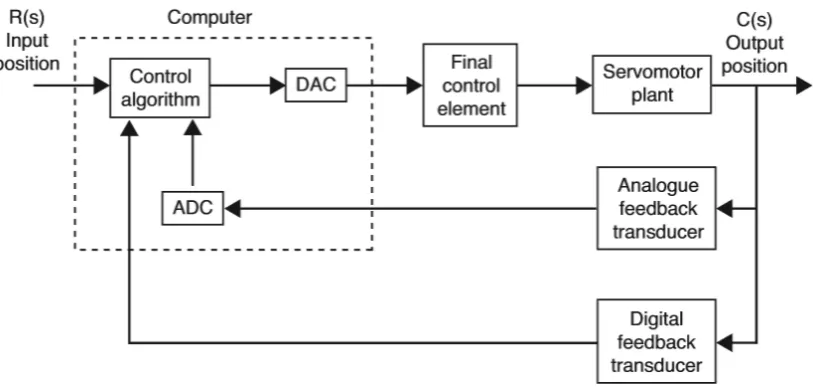
Figure 1.1: Direct Digital Control (DDC) schematic
CHAPTER 2
LITERATURE REVIEW
2.1 Introduction
This chapter will discuss on system model of servo motor incremental encoder, angular position control, robustness, model uncertainty and genetic optimal control to realize designed control. The equipment specification that used in this study will enclose. It also highlights some previous case studies that are related to this project.
2.2 Servo Motor Incremental Shaft Encoder
The most common implementation of shaft encoders today in position servos is the optical incremental type (Stephen, 2011). This is mainly due to high reliability (no moving parts contact each other) and low cost. It is essentially a position transducer that reports the angle of shaft displacement in discrete steps. These encoders give only relative position information, so absolute references are needed in any real machine. These are known usually as “home” or “limit” sensors.
2.2.1 Position Sensing
by the 90-degrees (in quadrature) out-of-phase signal pairs. If the first signal pulse leads in relation to the second, then movement is determined to be in a given direction. If the first signals pulse lags behind the second, movement occurs in the opposite direction.
When the direction is determined, the LVServo software can calculate the platform position by decoding the quadrature pulses to either add or to subtract (depending on the direction) from the pulse total. To calculate the position in this way, however, a reference point must first be set. This can be done by means of a third reference that is generated once per encoder revolution. In the Digital Servo system, a command button from the computer interface resets the incremental encoder to 0. Because of this need reference point, robots that make use of incremental encoders for sensing joint position need to be set high an initial reference point for each joint. This process is called homing the robot.
2.2.2 Simplified Incremental Shaft Encoder
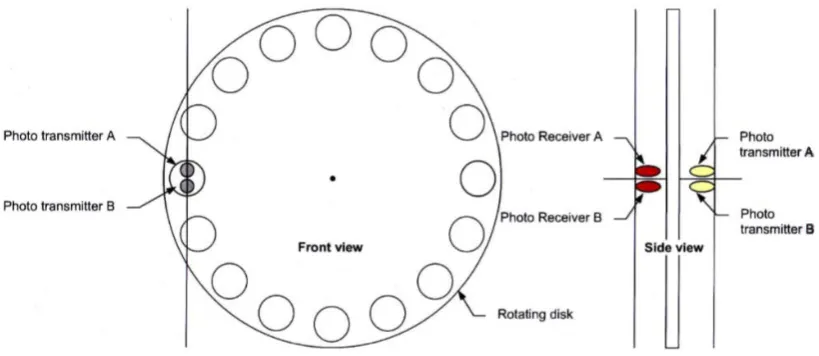
The incremental encoder described below is a simplification of actual incremental encoders. This simplification is useful to understand the basic concept underlying the operation of any incremental encoders.
Figure 2.1 : Simplified incremental encoder diagram
[image:26.595.139.501.467.657.2]Figure 2.2 shows what happens as the disc rotates. When the rotation is in a counter-clockwise direction, photo receiver A initially senses the light signal, then both A and B, followed by B only, and finally neither A nor B. In a clockwise direction, the sequence is reversed. Both signals A and B generate four-edge transitions that can be totaled to indicate the disc position. Thus, one revolution of the disc produces 64 pulses (16 x 4).
A DC motor position control finds wide applications in servo systems, especially in aerospace, automotive and mechatronics applications. The position of a DC motor can be controlled by controlling the Armature Voltage or Field Voltage. The following are few of the simple methods of controlling a DC motor shaft position (Thomas, Poongodi, 2009):
(i) Open loop - without feedback of current position, method is ineffective and inaccurate in the presence of load disturbance.
(ii) On-off controller - motor is turned on with maximum torque till it reaches set point and switches off, this may result in overshoots and oscillations.
Single directional control reaches set point in a single direction only, the angular position of a DC motor can also be controlled by varying the torque generated by varying the armature voltage or field voltage.
2.3.1 Angular Position Control Block Diagram and Fundamentals
The motor shaft incremental encoder generates 4000 counts per revolution (Lab-Volt Ltd, 2003). The digital servo system default range for position sensing measurement is ±5000 counts, which is the ±100% position. A 100% position travel is thus equivalent to 1.25 motor shaft revolution (5000/4000). An angular position of 90 degrees, for example, is equivalent to 1000 counts ((90/360)x4000). The resulting position is percentage is 20% ((1000/5000)x100).
Figure 2.3 : Block diagram of a position-control servo system with motor shaft incremental encoder
[image:28.595.150.488.333.419.2]A simplified block diagram for the proportional only position control servo system with the motor shaft incremental encoder is shown at Figure 2.4 below:
Figure 2.4 : Simplified position control servo system block diagram with overall scaling factor
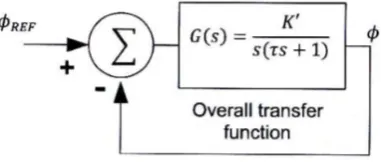
[image:28.595.225.416.597.680.2]For analysis purposes, a further simplification can be made by combining the scaling factor 5.56, controller gain 𝐾𝐶, and the speed constant 𝐾 into the term 𝐾′. Figure 2.5 shows the resulting diagram:
The first objective of tuning is to stabilize the system. The formal definition of system stability is that when a bounded input is introduced to the system, the output of the system is also bounded. Meaning that to a motion control system is that; if the system is stable, then when the position setpoint is a finite value, the final actual position of the system is also a finite value. On the other hand, if the system is unstable, then no matter how small the position setpoint or how little a disturbance (motor torque variation, load change, noise from the feedback device, etc.) the system receives, the position error will increase continuously, and exponentially in almost all cases. In practice, when the system experiences instability, the actual position will oscillate in an exponentially diverging fashion. One common perception shared by many is that whenever there is oscillation, the system is unstable. However, if the oscillation finally diminishes (damps out), even if it takes a long time, the system is still considered stable.
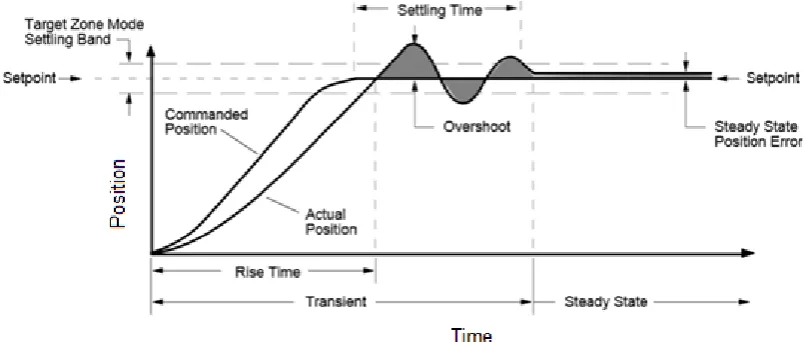
While investigating the plot of the position response versus time, there are a few measurements that can be considered as the quantitatively assess the performance of the servo:
(i) Overshoot - the measurement of the maximum magnitude that the actual position exceeds the position setpoint. It is usually measured in terms of the percentage of the setpoint value.
(ii) Rise Time - the time it takes of the actual position to pass the setpoint.
(iii) Settling Time - the time between when the commanded position reaches the setpoint and the actual position settles within a certain percentage of the position setpoint.
Figure 2.6 : A typical stable position response
2.5 Standard PID Control
The typical PID control law in its standard form is
u(𝑡) =𝐾p[e(t) + Tdde(t)dt + 𝑇1
i∫ 𝑒(𝜏)𝑑𝜏] 𝑡
0
where 𝑒(𝑡) =𝑌𝑠𝑝(𝑡)− 𝑦(𝑡) is the system error (difference between the reference input and system output), 𝑢(𝑡) the control variable, 𝐾𝑃 the proportional gain, 𝑇𝑑 the derivative time constant and 𝑇𝑖 the integral time constant.
Equation (2.1) can also be written as
u(𝑡) =𝐾pe(t) + Kdde(t)dt + Ki∫ 𝑒0𝑡 (𝜏)𝑑𝜏]
where 𝐾𝑑 =𝐾𝑃𝑇𝑑 and 𝐾𝑖 =𝐾𝑝/𝑇𝑖 . The tuning problem consists of determining the values of these three parameters with the aim of satisfying different control specifications such as set-point following, load disturbance attenuation, robustness to model uncertainties and rejection of measurement of noise.
control (𝐾𝑑) has the power to increase the stability of the system, reduce the overshoots and improve the transient responses.
2.6 ZN Based PID Terminology
In order to manage the proportional, integral and derivative terms, the Digital Servo system uses a PID controller. A PID controller is a control loop feedback controller that attempts to correct the error between a measured process variable and a desired set point by calculating and then instigating a corrective action that can adjust the process to keep the error minimal. In the case of the Digital Servo system, the measured variable is the position loop. The Digital Servo controller thus measures the error between the position reference and the actual platform position and attempts to correct it.
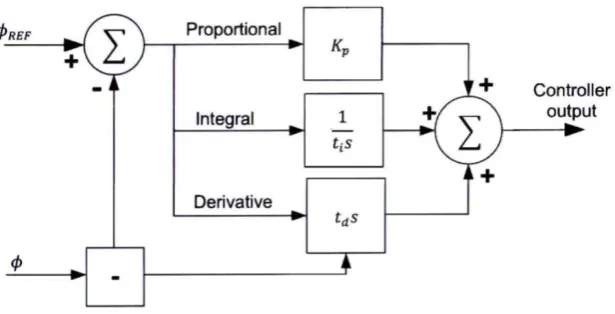
[image:31.595.168.476.530.687.2]The PID controller used in the Digital Servo system is represented in Figure 2.7 (Lab-Volt Ltd, 2003). As illustrated, derivative action can be performed either on the error value or on the process negative. Performing derivative on the process negative eliminates the impulse associated with derivative of error during position reference step transitions.
error: proportional, integral, and derivative action. Proportional action determines the controller reaction to the current error. Integral action determines the controller reaction based on the sum of the last measured error value.
Derivative action determines the controller reaction based on the rate at which the error changes. These actions are then added together to correct the system output (platform position) in order to reduce the difference between the reference value and the actual value, i.e., the system error.
When using a PID controller, it is necessary for the proportional, integral and derivative terms to be set properly, otherwise, the controlled process can become unstable. There are usually four main points to an optimal response:
(i) A minimal overshoot or no overshoot at all, (ii) A quick rise time,
(iii) A quick settling time, (iv) A low steady state error.
[image:32.595.110.534.651.732.2]The most basic tuning method is the manual tuning. This type of tuning can only be performed by people who are experienced with the process type of the application. There are three main tuning parameters: the proportional gain Kp, the integral time ti, and the derivative time td. Each tuning parameters has different effects on the response characteristics and so it is important to know when to use one instead of the other. Table 2.1 summarizes the effect of Kp, ti, or td variations on rise time, overshoot, settling time and steady-state error.
Table 2.1: Effects of PID parameters variations on a step response.
PID
parameters Rise time Overshoot Settling time
It requires first to deactivate the integral and derivative terms. The proportional gain Kp is then increased (starting form 0) until the system reaches a constant oscillation with a constant amplitude and period. This gain value is referenced as the ultimate gain KU. The oscillation period is also measured and is called the oscillation period tU. Using these two measured value, the three tuning parameters are then calculated using the equations, depending on the controller type: (P, PI, PID). This type of tuning produces a quarter amplitude decay response which is acceptable, but not optimal.
To summarize the difference effects of proportional, integral and derivative action on a servo system in angular position control, we can say that:
(i) Increasing the proportional gain Kp causes the position step response of an overdamped system to become critically damped. If the proportional gain is increased further, the critically damped system will become underdamped. As the gain increases, an oscillatory component that increases in frequency and amplitude will appear and eventually cause the system to become unstable. (ii) Adding integral action eliminates static friction error, but also increases the
tendency of the step response to oscillate and can cause the system to become unstable.
(iii) Adding derivative action can dampen or suppress an oscillating step response. Derivative action, however, is very sensitive to noise and can cause erratic behaviours when set at high values.
2.7 GA Terminology
Encoding Decoding Yes Yes Pk P0
GA terminology basically similar to that use in Biological principle: (i) Gene – the basic unit of the string (chromosome)
(ii) Chromosome – consisting of genes, its the searched optimal solution (string) (iii) Generation – it is a population in a certain phase of GA
(iv) Population – consists of chromosomes, changes from generation to generation, its size can be changed during GA but is usually constant
(v) Fitness - quantifies the optimality of a chromosome, usually it is a positive scalar, it is a result of an appropriate transform of the objective function
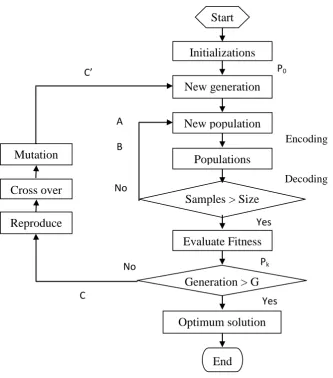
[image:34.595.116.450.317.696.2]The flow chart of GA works is shown by Figure 2.8.
Figure 2.8: Flow chart of GA functions and process Start
Initializations
New generation
New population
Populations
Samples > Size
Evaluate Fitness
Generation > G
(i) The first population P0 is generated. Strings are randomly generated from the defined space or initialized by some appropriate rule.
(ii) The objective function is computed and the fitness of each string in the k-th population Pk is evaluated.
(iii) Ending conditions are tested, if they are satisfied, the best string is selected. (iv) The first population P0 is generated. Strings are randomly generated from the
defined space or initialized by some appropriate rule.
(v) The objective function is computed and the fitness of each string in the k-th population Pk is evaluated.
(vi) Ending conditions are tested, if they are satisfied, the best string is selected. (vii) If the ending conditions are not satisfied, the best strings are selected (group
A) and are transferred to the next population. The other group C includes strings on which the crossover and mutation operations will be applied. The last group B continues directly to the new population.
(viii) By crossing, some parts of parent strings are randomly combined and changed during mutation and thus the new combined strings - genes are created. The result of these operations is a new group C’.
(ix) The new population Pk+1 consists of groups A, B, C’. (x) Go to the step (ii).
The ending conditions are met when the above defined conditions for the string are satisfied and the gradient of the purpose function is very low or unchanged. The commonly used GA stop condition is achieving of a pre-specified number of generations.
A GA differs from other common optimizing methods in some aspects: (i) it can escape from the local extremes and bring closer to the global extreme. (ii) it can search in parallel, simultaneously in several directions.
(iii) it does not need partial information about the solution like gradient of objective function.
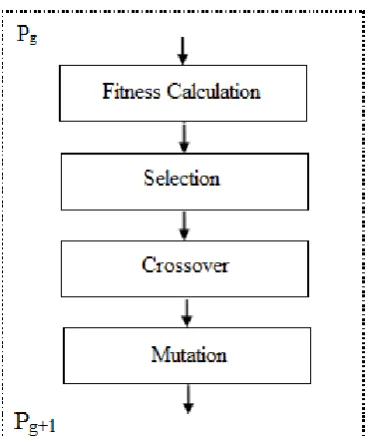
Normally, GA begin the process of optimization with a randomly selected population of individuals. Then, the fitness for each individual is calculated. Next comes the application of the genetic operators: selection, crossover, and mutation. Thus, new individuals are produced from this process, which then form the next population. The transition of a population Pg to the next population Pg+1 is called generation, where g designates the generation number (Ruano, 2005). In Figure 2.9, the operations executed during a generation are schematically represented. The evolution of the population continues through several generations, until the problem solved, which in most cases, ends in a maximum number of generations gmax.
Figure 2.9 : Representation of the executed operations during a generation
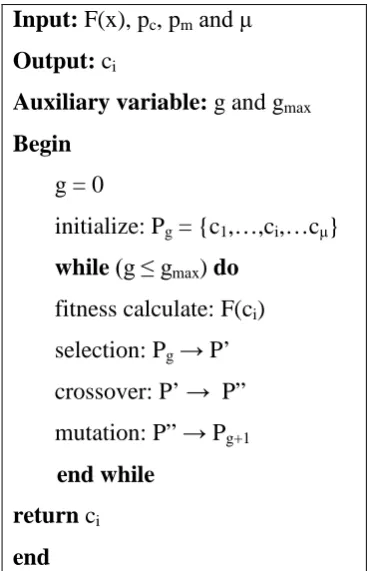
operator, with the probability pm, to the individuals of the population P” a new population results, which is designated Pg+1. If the maximum generation number gmax is not achieved, then the fitness is calculated, and the genetic operators are applied. If g = gmax, then the optimization is terminated, and the fittest individual represents the solution of the optimization problem. By repeated application of the genetic operators, its possible that the fittest individual of a generation was not selected or destroyed by crossover or mutation. Thus, the best individual would be no more contained in the next population. This problem can be avoided by ensuring that the best individual of the previous population goes into the next generation, if the best individual of the current population has a lower fitness. The best individual is replaced only by a still better individual.
Input: F(x), pc, pmand μ Output: ci
Auxiliary variable: g and gmax Begin
g = 0
initialize: Pg = {c1,…,ci,…cμ} while (g ≤ gmax) do
fitness calculate: F(ci) selection: Pg → P’ crossover: P’ → P” mutation: P” → Pg+1 end while
[image:37.595.226.412.339.625.2]return ci end
Since GA has attracted vast number of considerable research, there are several established module available in market ready for user such as:
(i) GENOCOP III – Genetic Algorithm for Constrained Problems in C (by Zbigniew Michalewicz)
(ii) DE – Differential Evolution Genetic Algorithm in C and Matlab (by Rainer Storn).
(iii) PGAPack – Parallel Genetic Algorithm in Fortran and C (from Argonne National Laboratory)
(iv) PIKAIA – Genetic algorithm in Fortran 77/90 (by Charbonneau, Knapp and Miller)
(v) GAGA – Genetic Algorithm for General Application in C (by Ian Poole) (vi) GAS – Genetic Algorithm in C++ (by Jelasity and Dombi)
(vii) GAlib – C++ Genetic Algorithm Library (by Matthew Wall) (viii) Genetic Algorithm in Matlab (by Michael B. Gordy)
(ix) GADS – Genetic Algorithm and Direct Search Toolbox in Matlab (from MathWorks)
(x) GEATbx – Genetic and Evolutionary Algorithm Toolbox for Matlab (by Hartmut Pohlheim)
(xi) GAOT – Genetic Algorithms Optimization Toolbox in Matlab (by Jeffrey Joines)
module can be downloaded for free at: http://www.ise.ncsu.edu/mirage/GAToolBox/gaot/.
2.10 Experimental Model: Lab-Volt Digital Servo Model 8063
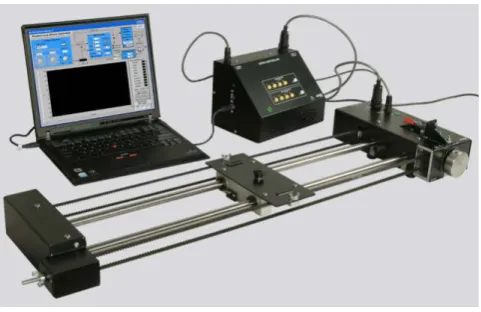
[image:39.595.200.441.360.516.2]The Lab-Volt Digital Servo training system as shown in Figure 2.11 is a compact trainer designed to familiarize students with the fundamentals of digital servo control. The system features a single-axis belt-driven positioning system, a digital servo controller, and powerful software tools. The motor control can be achieved in several ways: by using the included hardware controller, LABVIEW or MATLAB/ SIMULINK, or an optional analog controller.
Figure 2.11: Lab-Volt Digital Servo Model 8063
The features & benefits of the Lab-Volt Digital Servo Model 8063 as below: (i) Compact system that can be used on a table or bench
(ii) Servo controller and linear axis
(iii) Position and speed control, friction break, belt tensioning and backsplash, dual encoders, transferable inertia load
(iv) Safe and robust
(v) High-speed communication through a USB connection (vi) Easy connection to mechanical devices
REFERENCES
Stephen M.Tobin (2011). DC Servos, Application and Design with MATLAB. CRC Press, Taylor & Francis Group, Boca Raton.
A E Ruano (2005). Intelligent Control Systems using Computational Intelligent Techniques. The Institution of Electrical Engineers, London, UK.
Mo Jamshidi, Leandro dos Santos Coelho, Renato A.Krohling, Peter J.Fleming (2003). Robust Control Systems with Genetic Algorithms. CRC Press, Taylor & Francis Group, Boca Raton.
Lab-Volt Ltd (2003). Digital Servo Motor Control. Canada, First Edition, March. Susumu Hara (2002). Nonstationary Optimal Positioning Controller Design Using
GA Meta-Optimization. Toyota Technological Institute 2-1 2-1 Hisakata,
Tempaku-ku, Nagoya, pp. 365-367.
Guohan Lin ,Guofan Liu (2010). Tuning PID Controller Using Adaptive Genetic
Algorithms. Key Laboratory of Electrical Control, Hunan Institute of
Engineering ,College of Hunan Province Department of Electrical & Information, Hunan Institute of Engineering Xiangtan, China, pp. 519-532. Nikhileshwar P. Adhikari, Milan Choubey and Richa Singh (2012). Dc Motor
Control Using Ziegler Nichols and Genetic Algorithm Technique. Department of Electrical Engineering, Gyan Ganga College of Technology, Jabalpur, pp. 2277-2626.
Uzair Ansari, Syed Minhaj un Nabi Jafri and Saqib Alam (2011). Modeling and Control of Three Phase BLDC Motor using PID with Genetic Algorithm.
Aeronautics & Astronautics Dept Institute of Space Technology Karachi, pp. 189-194.
Approach to Modelling and Control. Department of Automatic Control Systems Faculty of Electrical Engineering and Information Technology Slovak University of Technology in Bratislava, pp. 358-363.
Hong Zhang, Yuanhu Cai, Yuchun Chen (2010). Parameter Optimization of PID
Controllers Based on Genetic Algorithm. School of Power and Energy
Northwest Polytechnical University Xi'an, China, pp. 47-49.
Ogata, K (1987). Discrete–Time Control System, University of Minnesota, Prentice Hall.
Benjamin C. Kuo (1987). Automatic Control Systems, 5th Edition, Prentice–Hall, pp 176-189.
Astrom, K., T. Hagglund (1995). PID Controllers; Theory, Design and Tuning, Instrument Society of America, Research Triangle Park, pp. 314-332.
Chowdhuri, S. Mukherjee, A. (2000). An Evolutionary Approach to Optimize Speed
Controller of DC Machines. Proceedings of IEEE International Conference
on Industrial Technology, Cilt 2: 682–687, pp. 213-231.
Chen, Q.G. and Wang, N. (2005). The distribution population–based genetic algorithm for parameter optimization PID controller, Acta Automatica Sinica 31: 646–650, pp. 102-111.
Chipperfield, A.J., Fleming, P.J., Pohlheim, H. and Fonseca, C.M. (1994). A Genetic
Algorithm Toolbox for MATLAB, Proc. International Conference on Systems
Engineering, Coventry, UK, 6–8 September, pp. 124-128.
The MathWorks Inc. (2014). Genetic Algorithm and Direct Search Toolbox 2,
Users's Guide, Retrieved on November 12, 2014, from
URL:http://www.mathworks.com
R.L.Haupt, S.E.Haupt (2004) Practical Genetic Algorithms, Second Edition, John Wiley & Sons Inc., pp. 241-262.
Goldberg, David E. (1989). Genetic Algorithms in Search, Optimization and Machine Learning. Addison–Wesley Pub. Co., pp. 341-359.
Chambers. L. (1999). Practical handbook of genetic algorithms complex coding systems. CRC, pp. 124-158.
genetic algorithms Systems, Man and Cybernetics, IEEE Transactions on, 22(5): 1033–1046, pp. 356-359.
Mahony, T.O. Downing, C.J. and Fatla, K. (2000). Genetic Algorithm for PID
Parameter Optimization: Minimizing Error Criteria, Process Control and
Instrumentation 2000 26–28 July, pp. 273-276.