THE MODELLING OF PROCESSING CONDITIONS FOR POLYPROPYLENE-NANOCLAY INTEGRAL HINGES AT HIGH HEAT EXPOSURE
MOHD HILMI OTHMAN
A thesis submitted in
fulfilment of the requirement for the award of the Doctor of Philosophy.
Faculty of Mechanical and Manufacturing Engineering Universiti Tun Hussein Onn Malaysia
ABSTRACT
ABSTRAK
CONTENTS
TITLE i DECLARATION ii DEDICATION iii
ACKNOWLEDGEMENT iv
ABSTRACT v
LIST OF TABLES x
LIST OF FIGURES xii
LIST OF SYMBOLS AND ABBREVIATIONS xiv
LIST OF APPENDICES xvii
CHAPTER 1 INTRODUCTION 1
1. 1 Background study 1
1. 2 Problem statement 2
1. 3 Objectives 3
1. 4 Scope of study 3
1. 5 Expected result 4
CHAPTER 2 LITERATURE REVIEW 5
2. 1 Introduction 5
2.1.1 Injection moulding processing conditions 5 2.1.2 Mould for injection moulding 6 2.1.3 Simulation in injection moulding 8 2.1.4 The effect of processing conditions 11
2.1.5 Optimisation method 14
2. 2 Polypropylene- nanoclay nanocomposites 19 2.2.1 Micro mechanism, structure, morphology
and properties. 20
2.2.3 Clay content and compatibilizers 25 2. 3 Integral hinges design and applications. 30 2. 4 High heat exposure properties of polypropylene. 34 2. 5 Previous research summary 38
CHAPTER 3 METHODOLOGY 40
3. 1 Introduction 40
3. 2 Development of mould 40
3.2.1 Runner size 44
3.2.2 Gate location selection 44
3.2.3 Fabrication and verification of mould. 45 3. 3 Optimisation of processing condition at high heat
exposure 48
3.3.1 Quality performance measurement- Shrinkage,
warpage and ultimate tensile strength. 53
3.3.2 Signal to noise ratio 56
3.3.3 Best combination of processing condition 58 3. 4 Regression modelling 59 3.4.1 Regression model for room temperature 63 3.4.2 Regression model for high temperature
exposure 63 3. 5 Master curves construction. 64
3.5.1 Validation test 65
CHAPTER 4 RESULT AND DISCUSSION 66
4. 1 Introduction 66
4. 2 Development of mould findings 66
4.2.1 Runner size result 69
4.2.2 Gate location results 71 4.2.3 Fabrication and verification of actual mould 75 4. 3 Optimisation of processing condition at high heat
exposure results 79
4.3.1 Warpage results 81
4.3.2 Shrinkage results 83
4.3.4 Signal to noise ratio results 90 4.3.5 Best combination of processing condition
at room temperature 91 4.3.6 Best combination of processing condition
at high temperature 92
4. 4 Regression modelling results 94
4.4.1 Quality performance at room temperature 95 4.4.2 Quality performance for high temperature
exposure 96
4. 5 Master curves findings 97
4.5.1. Validation test results 102
4. 6 Summary 103
CHAPTER 5 CONCLUSION AND RECOMMENDATIONS 104
5.1 Conclusion 104
5.2 Recommendations 105
5.1.1 Mould design and development 105 5.1.2 Optimising processing conditions. 106 5.1.3 Product and materials 107
REFERENCES 110
LIST OF TABLES
Table 2.1 A review of simulation in injection moulding processes 9 Table 2.2 Summary of simulation area of studies and software 10 Table 2.3 Parameter change versus property effect (Bryce, 1996) 11 Table 2.4 Certain ranges of condition for polypropylene artefacts
(Bauccio et al., 1994). 12
Table 2.5 Previous study about the effects of processing condition 13 Table 2.6 Summary of multiple response optimisations. 19 Table 2.7 Previous researches about clay and compatibilizers 25 Table 2.8 Previous research in polypropylene integral hinges
development via injection moulding. 39
Table 3.1 Initial setup for injection moulding simulation. 43
Table 3.2 Evaluation criteria for mould design. 44
Table 3.3 Runner size test description. 44
Table 3.4 Physical data of AISI D2 (Uddeholm, 2014). 47
Table 3.5 Initial processing condition for actual injection moulding. 47
Table 3.6 Factors and levels selection for practical injection moulding. 48
Table 3.7 Taguchi L9 (34) Orthogonal Array for practical injection moulding. 49
Table 3.8 Thermal properties of the Titanpro 6331 polypropylene (Lotte Chemical Titan (M) Sdn Bhd., 2014). 49
Table 3.9 Properties of the Cloisite -20A (BYK Additives &Instruments, 2013). 50
Table 3.10 Formulation of polypropylene-nanoclay nanocomposites. 51
Table 4.1 Cavity filling for Test 1 67
Table 4.2 Cavity filling for Test 2 68
Table 4.3 Result of runner analysis for Test 1 69
Table 4.4 Result of processing conditions based on each design. 71
Table 4.6 Warpage measurement for 0 wt. % nanoclay specimen 82
Table 4.7 Shrinkage measurement for 0 wt. % nanoclay specimen 85
Table 4.8 Ultimate tensile strength for 0 wt. % nanoclay specimen 87
Table 4.9 Signal to noise ratio for 0 wt. % of nanoclay 90
Table 4.10 Optimum processing condition for room temperature 92
Table 4.11 Optimum processing condition for high temperature condition 93
Table 4.12 The quality performance results at room temperature 97
Table 4.13 The quality performance results at 600C exposure. 99
LIST OF FIGURES
Figure 2.1 Single screw injection moulding (Groover, 2007). 6 Figure 2.2 Schematic diagram of twice direct compounding process:
(a) first direct compounding and
(b) recompounding (Dong & Bhattacharyya, 2008) 27
Figure 3.1 Research process flow 41 Figure 3.2 Research distribution 42 Figure 3.3 Types of mould design based on runner test and gate location. 45 Figure 3.4 Design of integral hinges test sample (ISO527-2, 1993). 46 Figure 3.5 The Brabender Twin Screw Extruder Lab-Compounder KETSE 20/40 51
Figure 3.6 Field Emission Microscopy (FESEM - Model: JEOL JSM 7600F) 52
Figure 3.7 Injection moulding machines (Nissei NP7-1F, 7 tonne) 53 Figure 3.8 Mould base for sample preparation 53 Figure 3.9 Definition symbol for warpage 54 Figure 3.10 Universal Testing Machine for hinges mechanical properties analysis 55 Figure 3.11 High temperature operating range (Caronproducts, 2014) 56 Figure 3.12 Example of master curve for integral hinges quality performance 64 Figure 4.1 Volume shrinkage (%) of test samples versus design 72
Figure 4.2 Warpage (mm) of test samples versus design 72
Figure 4.3 The air traps results based on design 73
Figure 4.4 The final design of integral hinges test sample 74
Figure 4.5 Diagram of mould A 75
Figure 4.6 Diagram of mould B 76
Figure 4.7 Fabricated Mould A and Mould B 76
Figure 4.9 Shrinkage results for each mould sample 78
Figure 4.10 Material consumption based on each mould design 79
Figure 4.11 FESEM image for the pellet with 5 wt. % of nanoclay content. 80
Figure 4.12 FESEM image for the injected mould hinges with 5 wt. % of nanoclay content. 80
Figure 4.13 The measurement points of thickness, ta 81
Figure 4.14 Warpage measurement results 83
Figure 4.15 Shrinkage measurement results based on clay content 85
Figure 4.16 UTS of integral hinges for 0 wt. % nanoclay 88
Figure 4.17 UTS of integral hinges for 1 wt. % nanoclay 88
Figure 4.18 UTS of integral hinges for 5 wt. % nanoclay 89
Figure 4.19 The example of main effects plot. 91
Figure 4.20 Regression analysis at room temperature for 0 wt. % nanoclay 95
Figure 4.21 Regression analysis at 600C for 0 wt. % nanoclay 96
Figure 4.22 Regression analysis at 700C for 0 wt. % nanoclay 96
Figure 4.23 Master curve for Quality Performance vs Clay content at room temperature 98
Figure 4.24 FESEM image for the hinges with 3 wt. % of nanoclay content 100
Figure 4.25 Master curve for Quality Performance vs Clay content at 600C 100
Figure 4.26 Master curve for Quality Performance vs Clay content 700C 102
Figure 4.26 Validation test results 103
LIST OF SYMBOLS AND ABBREVIATIONS
0C - Degree Celsius
2D WAXS - Two Dimension Wide Angle X-ray Scattering
ABS - Acrylonitrile–Butadiene-Styrene
AFM - Atomic Force Microscopy ANN - Artificial Neural Network ANOVA - Analysis of Variance
BP - Back Propagation
CAD - Computer Aided Design CAE - Computer Aided Engineering CBR - Case Based Reasoning CEC - Cation Exchange Capacity CNC - Computer Numerical Control DMA - Dynamic Mechanical Analysis DSC - Differential Scanning Calorimetry EVA - Ethylene Vinyl Acetate
FEM - Finite Element Method
FKMP - Faculty of Mechanical and Manufacturing Engineering
FT - Filling Time
FTIR - Fourier Transfer Infra Red
G - Grams
G’ - Storage Modulus
GA - Genetic Algorithm
H - Height
HDPE - High Density Polyethylene
HRS - Hot Runner System
L - Length
Lave - Average Length
Lc - Length of Actual Mould Cavity
LRM - Linear Regression Method.
MD - Machine Direction
min - Minute
mm - Millimetre
MPa - Mega Pascal
MSD - Mean Squared Deviation
MT - Melt Temperature
MWNT - Multi Walled Nano Tubes
ND - Normal Direction
o-MMT - Organo-Montmorillonite OLS - Ordinary Least Squares
P-V-T - Pressure-Volume-Temperature
PC/ABS - Polycarbonate / Acrylonitrile–Butadiene-Styrene PCA - Principal Component Analysis
PP - Packing Pressure
PP-EP - Polypropylene-Ethylene Propylene PP-g-AA - Polypropylene-grafted-Acrylic Acid PP-g-MA - Polypropylene –grafted- Maleic Anhydride
Q1@600C - Quality Performance for the first formulation for the exposure condition at 600C
Q1@700C - Quality Performance for the first formulation for the exposure condition at 700C
Q1@RT - Quality Performance for the first formulation for the exposure condition at Room Temperature
QP - Quality Performance
R-Sq - Correlation Coefficient
R-Sq (adj) - Correlation Coefficient (Adjusted)
S - Second
S - Shrinkage
S/N QP - Signal to Noise for Quality Performance
S/N S - Signal to Noise for Shrinkage
S/N UTS - Signal to Noise for Ultimate Tensile Strength
S/N Z - Signal to Noise for Warpage
SA - Simulated Annealing
SEM - Scanning Electron Microscopy SIM - Sequential Injection Moulding
SIRIM - Standards and Industrial Research Institute of Malaysia
SS - Screw Speed
T ambient - Ambient Temperature
T mould - Mould Temperature
ta - Average Thickness
TD - Transverse Direction
TEM - Transmission Electron Microscopy TGA - Thermal Gravimetric Analysis TS - Transmission Spectroscopy UTM - Universal Testing Machine WAXS - Wide Angle X-ray Scattering wt.% - Weight Percentage
XRD - X-Ray Diffraction
Z - Warpage
LIST OF APPENDICES
APPENDIX TITLE PAGE
A Experimental data for warpage 120
B Experimental data for shrinkage 123
C Experimental data for ultimate tensile strength
126
D Experimental data for signal to noise ratio 132 E Main effects plots for signal to noise ratio 135
CHAPTER 1
INTRODUCTION
In this chapter, discussion about research background, problem statements, objectives and scope of study in this research have been presented. The expected result, which is the novelty of this research also, was stated at the end of this chapter.
1. 1 Background study
polymer nanocomposites system was rectified to withstand exposure to the high heat environment.
1. 2 Problem statement
The manufacturing of thin wall components with integral hinges is crucial for the several plastic industries due to the thinner components permit considerable improvement of environmental impact, beneficial effects on the reduction of fuel consumption and overall weight savings. Additionally, the decrease in thickness allows significant reduction in production costs because shorter cycle times and less material consumption. Particularly, thin wall plastic products relate to smaller and lighter parts; should be able to withstand the daily usage, and at the same time maintaining their aesthetic appearance. These features are critical in the realization of automotive interior components that must maintain high quality look and feel throughout the life cycle of the vehicle (Spina, 2004).
These intricate parts in the plastic industry, comes with toughest quality requirements, could be achieved through injection moulding technology (Nardin et al., 2002). Due to its ability to produce multifaceted shape plastic parts with good dimensional accuracy and very short cycle times, injection moulding has become one of the processes that is greatly preferred in manufacturing industry (Bozdana & Eyercioglu, 2002). These injected moulded parts, however, are very prone to defects. To avoid such quality control problems, it is desirable to successfully predict the optimum processing conditions, such as pressures, temperatures, and times (Hill, 1996). Any change in these variables can affect the process stability and the quality of the manufactured parts. Unfortunately, it has been found difficult to control and adjust simultaneously between the processing conditions and the properties of the product; and there is no single set of rules to designate which parameters to use in order to manufacture consistently a part with no defects (Dumitrescu et al., 2005). Furthermore, failures or damages of these parts become more frequent when it exposed to high temperature environment.
& Turng, 2007), Grey Relational Analysis (Khan et al., 2010) and Taguchi (Mehat & Kamaruddin, 2011) have been proven as a good solution in finding the suitable injection moulding processing condition.
Additionally, the utilisation of fillers in polymer composites also a possible solution, whereby the fillers such as nanoclay could improve the mechanical properties as well as the fire retardant behaviour. However, too many fillers with wrong processing condition might lead back to poor quality and component performance (Wang, 2012; Yuan et al., 2008).
Therefore, this research proposes to solve the problem of thermoplastic integral hinges parts design and processing conditions, by introducing a suitable model and master curves as the reference to predict the properties of polypropylene integral hinges with the additional of nanoclay Cloisite-20A. By transforming the pristine polypropylene into polymer nanocomposites, with the right clay content and processing conditions, the integral hinges were expected to sustain its function; even when it was exposed to the high heat environment.
1. 3 Objectives
The objectives of this research are:
a) To develop mould for producing the integral hinges test’s sample.
b) To optimise the processing conditions by adopting the Taguchi Optimisation Method.
c) To generate regression model base on the optimised processing condition of polypropylene-nanoclay integral hinges with the responses of quality performance, exposed to 600C to 700C.
d) To construct master curves based on the regression model for quality performance versus clay content for integral hinges.
1. 4 Scope of study
The scopes of this study are as stated:
polypropylene-grafted-maleic anhydride (PP-g-MA), containing 1 wt. % of maleic anhydride (OREVAC C100).
b) The additional material to develop these polymer nanocomposites is nanoclay Cloisite-20A, varies from 0 wt. %, 1 wt. %, 2 wt. %, 3 wt. %, 4 wt. % and 5 wt. %, obtained from Southern Clay, Inc. US, courtesy from Wilbur-Ellis Company, Connell Bros. Company (Malaysia) Sdn. Bhd.
c) The performance of polypropylene integral hinges shall be translated through shrinkage, warpage and ultimate tensile strength. The test conducted for the manufactured samples shall adopt ISO standards.
d) The mould was made from AISI D2 cold work tool steel. Evaluation shall be made to choose the best mould design to define runner size and gate location. e) The expected result shall focus more on generating the regression model that
shall be fitted in the master curves, after getting the optimised processing condition by using the Taguchi Optimisation Method.
f) The chosen processing condition were screw speed, melt temperature, injection pressure and filling time.
1. 5 Expected result
CHAPTER 2
LITERATURE REVIEW
2. 1 Introduction
This chapter is about the past works related to this project. It summarizes several previous researches which were related to this project. Previous research findings about the optimisation of injection moulding processing condition and research about polypropylene-nanoclay were included in this chapter. Research on the application of polypropylene, especially at high heat exposure was also been stated at the end of this chapter.
2.1.1 Injection moulding processing conditions
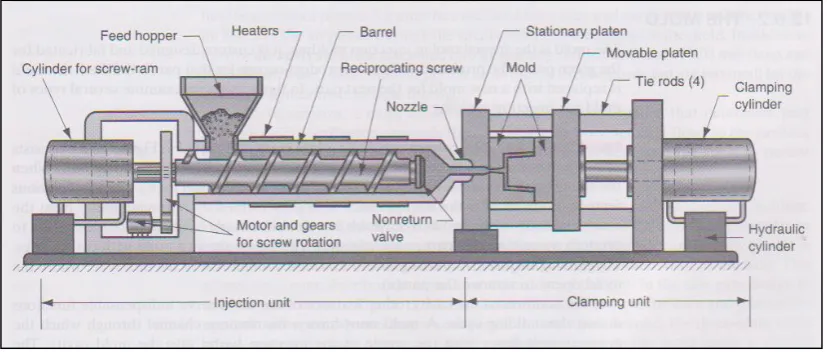
and clamping unit. A schematic diagram of injection moulding machine is shown in Figure 2.1 (Groover, 2007).
Figure 2.1: Single screw injection moulding (Groover, 2007).
Intricate and complex designs/dimensions are possible with injection moulding. In these cases, the challenge is to design and fabricate a mould that has the same geometry as the original component and which also easy for part removal. Part sizes can be in the range from about 50 grams up to about 25 kilograms, whereby the bigger parts represented by components such as refrigerator doors and automobile bumpers. The mould is the special tooling in injection moulding, because not only it determines the part shape and size, it also contributes a lot towards parts quality. For large, complex parts, the mould can be expensive, depending on the type of material and the machining time. For small parts, the mould can be built to contain multiple cavities, which is also making the mould expensive. Thus, injection moulding is economical and provide a good return of investment only for mass production (Groover, 2007).
2.1.2 Mould for injection moulding
runner is cooled, solidified, and ejected with the moulded part during each moulding cycle. This tooling becomes common due to its simplicity, least expensive, easy to construct and the easiest to operate with less maintenance as compared with the hot runner mould. This type of mould consists of two halves; which is stationary and movable half; fastened to the two platens of the moulding machine’s clamping unit. When the clamping unit opened, the two mould halves open. The function of movable half is to eject finish or desired part (Osswald et al., 2008).
Most of the mould consists of the cavity, sprue, runner, gates, injection system and cooling system. These elements are very important in ensuring the melt polymer distributed uniformly. The details about these elements are stated as below (Osswald et al., 2008).
a) Cavity - the feature which usually formed by removing metal from the mating surfaces of the two halves. Moulds can contain a single cavity or multiple cavities to produce more than one part in a single shot.
b) Sprue /distribution channels – This element leads the melt polymer from the nozzle into the mould. The sprue is in the form of carrot and act as an inlet channel to transfer molten material from the heating chamber into the runner system.
c) Runner - the function is to lead the melt polymer from the sprue to the multiple cavity moulds. Runner also acts as channels to connect the sprue bush to the cavity gates. There are two types of runner system-cold and hot. Cold runners are ejected with the part are trimmed after mould removal. The advantage of cold runner is lower mould cost. The hot runner keeps the polymer at or above its melt temperature. The material stays in the runner system after injection for the next injection.
d) Gates- Is a part that constricts the flow of plastic into the cavity. It prevents material from flowing out of the cavity when the injection pressure removed. There are one or more gates for each cavity in the mould.
f) Cooling system- This system consists of an external pump connected to passageways in the mould, through which water is circulated to remove heat from the hot plastic. Air must be evacuated from the mould cavity as the polymer rushes in. Much of the air passes through the small ejector pin clearances in the mould. In addition, narrow air vents are often machined into the parting surface; only about 0.03 mm deep and 12 to 25 mm wide, these channels permit air to escape to the outside but are too small for the viscous polymer melt to flow through.
Besides of these elements, there are other crucial factors that need to be considered specifically for thin-layered product. The factors are cycle time, gate locations and cavity condition. Cycle time is largely dependent on section thickness, machine conditions, heating capacity and injection capacity. The overall cycle time can vary from apply five seconds for thin articles to 60 seconds or more for thick articles. As for injection moulding hinges, it is important that the flow front cross the thin section at one instant. Gate location must provide balanced fill. The substantial pressure drop occurs when the flow front crosses the hinge, resulting in an increase of shrinkage rate. This may require adjustment of cavity dimensions to ensure proper fit of mating halves. The flow through the hinge will generate additional shear heating requiring additional local cooling. If the mating halves require two gates for filling and packing, they must be designed and developed to locate the weld line away from the hinges (Bauccio et al., 1994).
2.1.3 Simulation in injection moulding
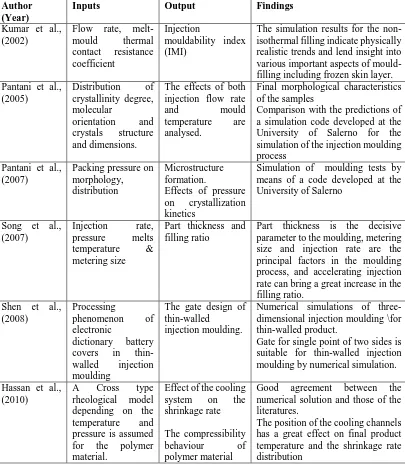
Many studies have validated the effectiveness of using numerical simulations as the input for producing good quality products through the actual injection moulding process (Beaumont et al., 2002; Othman et al., 2012). To quote a few examples, several researchers managed to discover several great issues through injection moulding simulation, such as the mould ability index (Kumar et al., 2002), effects of flow rate and temperature (Pantani et al., 2005), pressure (Pantani et al., 2007), determination of part thickness and filling ratio (Song et al., 2007), gate design (Shen et al., 2008) and cooling system (Hassan et al., 2010).
Table 2.1: A review of simulation in injection moulding processes
Author (Year)
Inputs Output Findings
Kumar et al., (2002)
Flow rate,
melt-mould thermal
contact resistance coefficient
Injection
mouldability index (IMI)
The simulation results for the non-isothermal filling indicate physically realistic trends and lend insight into various important aspects of mould-filling including frozen skin layer. Pantani et al.,
(2005)
Distribution of crystallinity degree, molecular
orientation and crystals structure and dimensions.
The effects of both injection flow rate
and mould
temperature are analysed.
Final morphological characteristics of the samples
Comparison with the predictions of a simulation code developed at the University of Salerno for the simulation of the injection moulding process
Pantani et al., (2007)
Packing pressure on morphology, distribution
Microstructure formation.
Effects of pressure on crystallization kinetics
Simulation of moulding tests by means of a code developed at the University of Salerno
Song et al., (2007)
Injection rate,
pressure melts
temperature & metering size
Part thickness and filling ratio
Part thickness is the decisive parameter to the moulding, metering size and injection rate are the principal factors in the moulding process, and accelerating injection rate can bring a great increase in the filling ratio.
Shen et al., (2008)
Processing
phenomenon of
electronic
dictionary battery covers in thin-walled injection moulding
The gate design of thin-walled
injection moulding.
Numerical simulations of three-dimensional injection moulding \for thin-walled product.
Gate for single point of two sides is suitable for thin-walled injection moulding by numerical simulation.
Hassan et al., (2010)
A Cross type
rheological model depending on the temperature and pressure is assumed for the polymer material.
Effect of the cooling
system on the
shrinkage rate
The compressibility
behaviour of
polymer material
Good agreement between the numerical solution and those of the literatures.
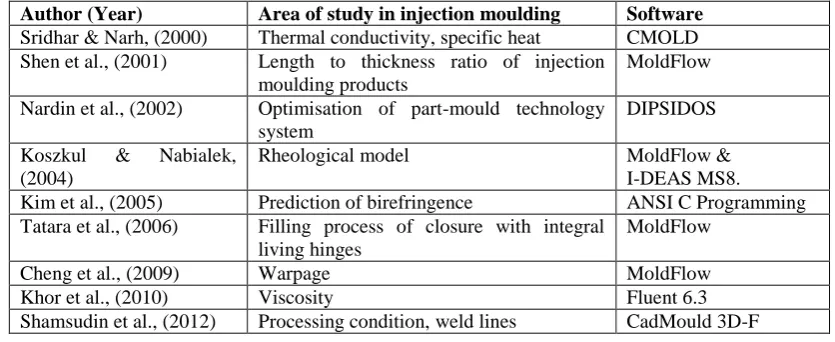
In terms of software utilisation, the types of software which have been used as a tool in injection moulding research, such as MoldFlow (Cheng et al., 2009; Harmia & Friedrich, 1997; Koszkul & Nabialek, 2004; Tatara et al., 2006), CMOLD (Sridhar & Narh, 2000; Yeung & Lau, 1997) and CadMould (Othman et al., 2012). This software has been produced good findings for future exploration, whereby by manipulating the advanced Computer Aided Engineering (CAE), this tool was programmed to predict the desired responses of injected moulding product. A summary of injection moulding simulation, consisting of the area of studies and the types of software used in research has been compressed in Table 2.2
Table 2.2: Summary of simulation area of studies and software
Author (Year) Area of study in injection moulding Software
Sridhar & Narh, (2000) Thermal conductivity, specific heat CMOLD Shen et al., (2001) Length to thickness ratio of injection
moulding products
MoldFlow
Nardin et al., (2002) Optimisation of part-mould technology system
DIPSIDOS
Koszkul & Nabialek, (2004)
Rheological model MoldFlow &
I-DEAS MS8.
Kim et al., (2005) Prediction of birefringence ANSI C Programming
Tatara et al., (2006) Filling process of closure with integral living hinges
MoldFlow
Cheng et al., (2009) Warpage MoldFlow
Khor et al., (2010) Viscosity Fluent 6.3
Shamsudin et al., (2012) Processing condition, weld lines CadMould 3D-F
2.1.4 The effect of processing conditions
The injection moulding process is a cyclic process. This process consists of several activities such as plastication; injection; packing; cooling, ejection and quality control appliances. Having preliminary knowledge about these activities is vital hence the present day competitive conditions that forced the manufacturing industries to produce faster and cheaper product with a higher quality, such as minimum warpage, sink marks, etc. Therefore, several important processing conditions for each stage of the process may influence the quality of injection moulded plastic products. The processing conditions such as melt temperature, mould temperature, injection pressure, injection velocity, packing pressure and cooling time, need to be optimised in order to achieve good results in injection moulding processes (Ozcelik & Erzurumlu, 2006)
[image:25.595.113.533.567.735.2]To describe the influence of processing conditions towards injection moulding products, for instance, based on Table 2.3 by increasing the injection pressure or increasing mould temperature can produce shrinkage (Bryce, 1996). Meanwhile, lowering back pressure, as well as lowering melt temperature can achieve less degradation. These examples demonstrate that the basic moulding parameters do work closely together and that changing a processing condition in one area may affect a value of any property in another area. By understanding this relationship, it is possible to minimize the number of adjustments required when it is necessary, making a correction due to an unexpected change in some variable of the process (Bryce, 1996).
Table 2.3: Parameter change versus property effect (Bryce, 1996)
Parameter Properties Effect
Injection pressure increased Less shrinkage, higher gloss, less wrap, harder to eject
Injection pressure decreased More shrinkage, less gloss, more wrap, easier to eject
Back pressure increased Higher density, more degradation, fewer voids
Back pressure decreased Lower density, less degradation, more voids
Melt temperature increased Faster flow, more degradation, more brittle, flashing
Melt temperature decreased Slower flow, less degradation, less brittle, less flashing
Mould temperature increased Longer cycle, higher gloss, less wrap, less shrinkage
More often than not, depending on the cavities that being filled, high injection speed is used for this material because fast filling speed will produce a uniform temperature as it fills into the cavity. If the filling rate is slow, it may cause defects at certain thin part due to rapid cooling when the first material enters the cavity. Incomplete fill, lamination and warpage are the examples of defects due to slow speed of injection, especially for polypropylene and its copolymers because it has a relatively high crystalline melting temperature and solidify quickly in the cavity (Bauccio et al., 1994).
[image:26.595.117.532.400.677.2]The thickness of a component usually affects the processing conditions in injection moulding. In this case, Table 2.4 proposed certain range of condition in the injection moulding process, specifically for polypropylene artefacts, based on various thicknesses.
Table 2.4: Certain ranges of condition for polypropylene artefacts (Bauccio et al., 1994).
Moulding Conditions
Thickness of sections
1.6 mm 3.2 mm 6.4 mm
Rear cylinder temperatures (0C) 193-216 193-204 193-204
Middle cylinder temperatures (0C) 204-232 193-216 193-216
Forward cylinder temperatures (0C) 216-249 204-232 204-216
Nozzle temperatures (0C) 193-216 193-216 193-216
Melt temperatures (0C) 204-249 204-232 193-216
Mould coolant temperatures (0C) 10-27 10-27 10-27
Hydraulic injection pressure (MPa) 4-10 4-10 4-10
Typical cycle time (s) 5-10 10-15 15-20
Plunger forward time (s) 15-25 25-35 35-60
Total cycle time (s) 15-25 25-35 35-60
Shrinkage (%) 1-2 1-2 1-2
pressure, melt temperature, mould temperature and cycle time need to be monitored (Bauccio et al., 1994).
[image:27.595.111.526.361.469.2]Several previous studies have been used as references for the effects of the injection moulding processing condition, as stated in Table 2.5. For example, to support the statement saying that temperature and pressure are the major parameter setting that influence the output of this process, previous researchers (Huang & Tai, 2001) have found that the order of the influence of process parameters on the warpage of injected parts are first, packing pressure, followed by mould temperature; melt temperature, packing time and cooling time. In addition, upon the findings, the effect of interaction between mould temperature and melt temperature could not be ignored (Huang & Tai, 2001)
Table 2.5: Previous study about the effects of processing condition
Author (Year) Response Processing conditions
( Huang & Tai, 2001) Warpage Packing pressure
(Fung et al., 2003) Yield stress and
elongation
Melt temperature
(Nagaoka et al.,2005) Core structure Injection speed
(Song et al., 2007) Part thickness Metering size, injection rate.
Other researchers (Fung et al., 2003), have concluded that the most influential process factor and the most easily influenced mechanical properties can be rectified. It was found that the melt temperature was the most influential factor to mechanical properties of both yield stress and elongation. The yield stress was more influenced by melting temperature than the elongation. The sequence of controllable factors that affecting the yield stress was slightly different from the elongation, but the melt temperature was still the most important factor above all (Fung et al., 2003)
the dormant or active role of injection speed depending on the material system has been highlighted (Nagaoka et al., 2005).
A study about thin wall injection moulding process can be a proper guideline for manufacturing polypropylene hinges artefacts. A research (Song et al., 2007) had examined the effects of injection process parameters on the moulding process for ultra-thin wall plastic parts. As for the solutions, by using the orthogonal of Taguchi method and numerical simulation, the influence of different process parameters such as injection rate, injection pressure, melt temperature, metering size and part thickness, in the moulding process for ultra-thin wall plastic parts were determined. Based on the results, the part thickness was the decisive parameter to the moulding. On the other hand, metering size and injection rate were the principal factors in the moulding process. The accelerating injection rate can increase the filling ratio. Melt temperature and injection pressure were the secondary factors, however, higher melt temperature and injection pressure were also essential in the moulding process(Song et al., 2007). Therefore; in summary, the part thickness, injection rate, melt temperature, packing pressure, filling time and screw speed are some of the important factors that need to be considered when performing an injection moulding process especially for thin layer parts such as an integral hinge.
2.1.5 Optimisation method
Part design, mould design, machine performance and processing conditions are some of the factors that will affect the quality of moulded parts. During production, quality characteristics may deviate due to drifting or shifting of processing conditions caused by machine wear, environmental change or operator fatigue. Determining optimal process parameter settings critically influences productivity, quality, and cost of production in the plastic injection moulding industry. Previously, production engineers used either trial-and-error method or Taguchi’s parameter design method to determine optimal process parameter settings for injection moulding. Yadav et al. (2012) have made a review regarding the recent research in designing and determining process parameters of injection moulding. A number of research works based on various approaches have been performed in the domain of the parameter setting for injection moulding. These approaches, including mathematical models, Taguchi method, artificial neural networks (ANN), fuzzy logic, case based reasoning (CBR), genetic algorithms (GA), finite element method (FEM), nonlinear modelling, response surface methodology, linear regression analysis, Grey rational analysis and principal component analysis (PCA) were described. The strength and the weakness of each individual approaches have been discussed with the conclusions of the potential research in determining process parameters for injection moulding.
Many published studies have emphasized the implementation of the Taguchi Optimisation Method in improving the warpage in the injection moulded part (Gao & Wang, 2008; Ozcelik & Sonat, 2009; Tang et al., 2007) as well as a sink index (Erzurumlu & Ozcelik, 2006) and weld lines (Othman et al., 2012; Ozcelik, 2011; Xie & Ziegmann, 2011).
To quote an example of Taguchi Optimisation Method, a research Oktem et al.,(2007) has been conducted regarding how to reduce warpage problem which was related to the shrinkage variation, depended on process parameters during production of thin-shell plastic components for or automobile part. The results of this research showed that warpage and shrinkage were improved by 2.17% and 0.7% respectively. It can be clearly inferred from this conclusion that Taguchi Optimisation Method is sufficient to solve the warpage problem with shrinkage for thin-shell plastic components of or that part (Oktem et al., 2007)
types, and rib layout angle, via Taguchi Optimisation Method. This method was used by exploiting mould analyses based on three level factorial designs. Orthogonal arrays of Taguchi, the signal to noise ratio, the analysis of variance were utilized to find optimal levels and the effect of process parameters on warpage and sink index (Erzurumlu & Ozcelik, 2006)
There was a research about the influence of injection parameters and mould materials on mechanical properties of acrylonitrile–butadiene–styrene (ABS) in plastic injection moulding (Ozcelik et al., 2010). The study was about optimising the effect of injection parameters such as melt temperature, packing pressure, cooling time and injection pressure towards the mechanical properties of mouldings. Signal to noise ratio for mechanical properties was calculated and the effect of the parameters on mechanical properties was determined using the analysis of variance (ANOVA). The regression analysis was also deployed to create linear mechanical models (Ozcelik et al., 2010).
Another study about the application of back propagation (BP) neural-network model to predict warpage and optimize the injected plastic parts has been developed based on key process variables, including mould temperature, melt temperature, packing pressure, packing time and cooling time during plastic injection moulding. The approach uses a BP neural network trained by the input and output data obtained from the finite element simulations which were performed on MoldFlow software platform. The product selected for this study is an automobile glove compartment cap. Trained by the results of finite element simulations conducted by orthogonal experimental design method, the prediction system applies a mathematical equation mapping the relationship between the process parameter values and the warpage value of the plastic. It has been proved that the prediction system has the ability to predict the warpage of the plastic within an error range of 2%. Process parameters have been optimised with the help of the prediction system. Meanwhile, energy consumption and production cycle were also taken into consideration. The optimised warpage value is 1.58 mm, which is shortened by 32.99% compared to the initial webpage result 2.358 mm. And the cooling time has been decreased from 20 s to 10 s, which will greatly shorten the production cycle. The final product can satisfy with the matching requirements and fit the automobile glove compartment well (Yin et al., 2010).
on-line testing equipment had been developed (Wang et al., 2009). The results of this project were compared with those obtained by the confining fluid technique. The Pressure-Volume-Temperature (P-V-T) curves were consistent, which proved that the new on-line measurement is feasible. The repeatability of the P-V-T measurement was within 0.3%. Consequently, a new P-V-T database of typical commercial materials could be established (Wang et al.,2009).
Some previous academics (Mehat & Kamaruddin, 2011) have studied the mechanical properties of products made from recycled plastic by utilizing the Taguchi Optimisation Method. By determining the optimal combination of factors and levels, the appropriate blending ratio of virgin and recycled plastic can be evaluated from the mechanical performance exhibited by the compound. The results reveal that the product made of 25% recycled polypropylene and 75% virgin polypropylene exhibits a better flexural modulus compared to the virgin form. The same product exhibits a 3.4% decrease in flexural strength.
Several scientists (Prashantha & Soulestin, 2009) have focused on the effect of multi-walled carbon nanotube (MWNT) addition on shrinkage and warpage properties of polypropylene injection mouldings before and after annealing. On the other hand, a research (Kramschuster et al., 2005) had presented the effects of processing conditions on the shrinkage and the warpage behaviour of a box-shaped, polypropylene part using conventional and microcellular injection moulding. In this research, after the injection moulding process reached steady state, the results show that the supercritical fluid content and the injection speed affect the shrinkage and warpage of microcellular injection moulded parts the most, whereas pack/hold pressure and pack/hold time have the most significant effect of these defects (Kramschuster et al., 2005).
severe injection parameters (high shear and long residence time) displays the highest storage modulus and complex viscosity, which illustrates the improved dispersion of clay platelets. This better dispersion leads to better mechanical properties, particularly higher Young modulus, tensile strength and unmatched impact strength. The major individual parameter identified is the injection flow rate, whose increase improves nanoclay dispersion. The combination of high back pressure and high screw rotational speed is also necessary to optimize the dispersion of clay nano platelets (Rajesh & Soulestin, 2012).
Since polymer materials exhibit extremely convoluted properties, the complexity of the moulding process has become very tough to attain desired part properties (Mehat et al., 2014). However, most research related to optimisation only focus on a single response or quality characteristic. In reality, determining the superlative process parameters and focusing on multi-responses are intricate tasks, but are generally required (Khan et al., 2010). Therefore a constitutive approach to solve multi-response problems using the combination of single responses through the Taguchi Optimisation Method was needed to solve this problem.
Table 2.6 shows researchers related to multiple response optimisations. Previous researchers (Annicchiarico et al., 2013; Antony & Anand, 2006; Fung & Kang, 2005; Khan et al., 2010; Mehat & Kamaruddin, 2011; & Zhou & Turng, 2007) have published several articles related to multiple responses optimisation.
To quote an example, a research (Mehat & Kamaruddin, 2011); had used the accumulation of signal to noise ratio to define the optimum processing parameter in their research. By combining the responses to be studied concurrently, the approach seems to have improved the flexural modulus and strength of the produced part using recycled plastic compared with the single response approach.
Table 2.6: Summary of multiple response optimisations.
Author (Year) Method of Optimisation Findings
Fung & Kang, 2005 Taguchi, Principal
Component Analysis
Optimum combination of process factor
and the most influential parameter for
friction properties,
Antony & Anand, 2006 Taguchi, Neuro Fuzzy
Model
Optimised responses for a double sided
surface mount technology of the electronic
assembly process.
Zhou & Turng, 2007 Gaussian process approach,
multi objective genetic
algorithm
Optimised system and process conditions
for minimizing injection pressure,
volumetric shrinkage/warpage and cycle
time.
Khan et al., 2010 Grey Relational Analysis
and Principle Component
Analysis
Optimal combination of parameter and
weighting value of tensile, compressive
and flexural strength.
Mehat & Kamaruddin,
2011
Taguchi Optimum processing condition for flexural
modulus and strength.
Annicchiarico et al.,
2013
Design of experiment Significant factors for shrinkage and part
mass.
2. 2 Polypropylene- nanoclay nanocomposites
polypropylene-nanoclay (Pavlidou & Papaspyrides, 2008; Sinha Ray & Okamoto, 2003).
By adding small amounts of nanoclay into polypropylene, both its melt characteristic (processabilities) and solid characteristics (product properties) are greatly altered. The main characteristic is that the non-Newtonian flow behaviour at low shear rates becomes more notable and shows a yield flow feature. A second plateau feature appears at low angular frequencies, which is more of a solid like characteristic. Taken together, these melt characteristic will affect the flow processabilities of the polymer (Mittal, 2009).
2.2.1 Micro mechanism, structure, morphology and properties.
In terms of the micro mechanism of plastic deformation during impact loading of polypropylene-nanoclay nanocomposites, researchers (Yuan & Misra, 2006) have examined and compared the condition with the unreinforced polypropylene under identical conditions of processing to underscore the determining role of clay. The addition of clay to polypropylene increases the impact strength in the temperature range of 0 to +70 °C. The enhancement of toughness on reinforcement of polypropylene-nanoclay is associated with change in the primary mechanism of plastic deformation from crazing and vein-type in neat polypropylene to micro void-coalescence-fibrillation process in the nanocomposite (Yuan & Misra, 2006).
morphology of [alpha] - and [gamma] -crystals of polypropylene. Furthermore, nanoclay promotes the formation of [gamma] -phase at ambient pressure, suggesting its role as structure and morphology director in the stabilization of the less accessible [gamma] -phase, and with the possibility of epitaxial growth that enhances toughness. The equilibrium melting point measurements point to thermodynamic interaction between polypropylene-nanoclay, which is supported by the change in glass transition temperature. Thus, the two components, nanoclay and pressure, together provide a unique opportunity to tune hierarchical structures and phase evolution, which has significant implication on physico-chemical and mechanical properties (Misra et al. 2010).
Significant differences in the microstructure occur when the polypropylene matrix dispersed with 4wt. % and 8wt. % nanoclay. In neat polypropylene, crystals nucleate in low to moderate crystallization pressure range of (∼0.1–60 MPa), while -phase nucleates at a crystallization pressure of 60–200 MPa. In contrast to neat polypropylene, the presence of nanoclay in the polymer matrix, promotes the formation of phase at an ambient crystallization pressure of 0.1MPa. Nanoclay and pressure-induced crystallization governs phase evolution and microstructure of Polypropylene and is associated with change in the thermodynamic and physical properties such as equilibrium melting point and glass transition temperature. This change in equilibrium melting point and glass transition temperature has pointed the thermodynamic interaction between polymer nanoparticles and nanoparticles interface driven microstructural evolution. However, the effect of nanoparticles is less dramatic when nanoclay content is increased from 4wt. % to 8wt. %, implying that the effect maximizes at 4 wt. % nanoclay (Yuan et al. 2010).
the present work exhibit high strain accumulation and stress release. Filled material show lower fatigue performance than unfilled polymer (Ferreira et al. 2011).
Observations are reported on isotactic polypropylene/organically modified nanoclay hybrids in tensile cyclic tests at room temperature. A pronounced effect of nanofillers is demonstrated: reinforcement of polypropylene with 1 wt. % of clay results in reduction of maximum and minimum strains per cycle by several times and growth of number of cycles to failure by an order of magnitude. To rationalize these findings, a constitutive model is developed in cyclic viscoelastoplasticity of polymer nanocomposites. Adjustable parameters in the stress–strain relations are found by fitting experimental data in relaxation tests and cyclic tests (16 cycles of loading– unloading). It is demonstrated that the model correctly predicts growth of maximum and minimum strains per cycle with the number of cycles and can be applied to predict fatigue failure of nanocomposites. The highlights of this research are the reinforcement strongly reduces ratcheting strain in polypropylene-nanoclay hybrids, a constitutive model is derived for lifetime evaluation under fatigue conditions and only 1 wt. % of nanoclay are sufficient to increase the number of cycles to failure by an order of magnitude (Drozdov, 2012).
the nanocomposite films increased upon the presence of clay particles, except in the case of low clay contents of 1.5 and 2.5 wt.% (Tabatabaei & Ajji, 2011).
2.2.2 Preparation methods
The preparations of polypropylene-nanoclay nanocomposites are divided into three main methods according to the starting materials and processing techniques. The methods are the intercalation of polymer or pre-polymer from solution, in situ intercalative polymerization method and melt intercalation method (Pavlidou & Papaspyrides, 2008)
The intercalation of polymer or pre-polymer from solution is the first method found in preparing the polypropylene-nanoclay. This method is based on a solvent system in which the polymer or pre-polymer is soluble and the silicate layers are swellable. The layered silicate is first swollen in a solvent, such as water, chloroform, or toluene. When the polypropylene-nanoclay solutions are mixed, the polymer chains intercalate and displace the solvent within the interlayer of the silicate. Upon solvent removal, the intercalated structure remains, resulting in polypropylene-nanoclay nanocomposite (Pavlidou & Papaspyrides, 2008)
The in situ intercalative polymerization method is the second method of preparing the polypropylene-nanoclay. This method was successfully applied by manipulating the ability of soluble metallocene catalysts to intercalate inside silicate layers, and to promote the coordination polymerization of propylene. A synthetic hectorite was first treated with methylaluminoxane in order to remove the acidic protons, and to prepare the interlayer spacing for receiving the transition metal catalyst. Another method was also discovered by making the layered silicate swollen within the liquid monomer so the polymer formation can occur between the intercalated sheets (Pavlidou & Papaspyrides, 2008)
entropic gain compensates for the decrease in conformational entropy of the confined polymer chains. This method involves annealing, statically or under shear, and a mixture of the polypropylene-nanoclay above the softening point of the polymer. While annealing, the polymer chains diffuse from the bulk polymer melt into the galleries between the silicate layers. A range of nanocomposites with structures from intercalated to exfoliate can be obtained, depending on the degree of penetration of the polymer chains into the silicate galleries. So far, experimental results indicate that the outcome of polymer intercalation depends critically on silicate function and constituent interactions. This method has great advantages over either in situ intercalative polymerization or polymer solution intercalation such as this method is environmentally nonthreatening due to the nonexistence of organic solvents. It is also compatible with current industrial process, such as extrusion and injection moulding. The direct melt intercalation was highly specific for this polymer, leading to new hybrids that were previously inaccessible. Last but not lease, the advantage of this method is the absence of a solvent, which made direct melt intercalation as an economic process for industries from a waste perspective (Sinha Ray & Okamoto, 2003).
A study (Albdiry & Yousif, 2013) had been conducted to determine the difference of polymer-nanoclay processing techniques. The researchers have performed the review in order to study the relationship between the techniques and the final characteristics and properties of polymer-nanoclay nanocomposites, in terms of the final structure formation, rheological perfection, thermo-mechanical and thermal properties. Thermodynamic and physical properties such as glass transition temperature, equilibrium melting point and crystallization temperature were also discussed in this review. The review concluded that the altering process technique (type and/or parameters) highly influences the final nanostructure morphology as well as the thermodynamic and mechanical properties of nanoclay/polymer composites (Albdiry & Yousif, 2013).
REFERENCES
Albdiry, M., & Yousif, B. (2013). A critical review on the manufacturing processes in relation to the properties of nanoclay/polymer composites. Journal of Composite Materials, 47(9), 1093-1115
Alcock, B., Cabrera, N. O., Barkoula, N. M., Reynolds, C. T., Govaert, L. E., & Peijs, T. (2007). The effect of temperature and strain rate on the mechanical properties of highly oriented polypropylene tapes and all-polypropylene composites. Composites Science and Technology, 67(10), 2061–2070.
Altan, M. (2010). Reducing shrinkage in injection moldings via the Taguchi, ANOVA and neural network methods. Materials & Design, 31(1), 599–604.
Annicchiarico, D., Attia, U. M., & Alcock, J. R. (2013). Part mass and shrinkage in micro injection moulding: Statistical based optimisation using multiple quality criteria. Polymer Testing, 32(6), 1079–1087.
Antony, J., & Anand, R. (2006). Multiple response optimization using Taguchi methodology and neuro-fuzzy based model. Journal of Manufacturing Technology Management, 17(7), 908-925.
Ataeefard, M., & Moradian, S. (2010). Surface properties of polypropylene/organoclay nanocomposites. Applied Surface Science, 257(6), 2320–2326.
Aydın, S., Yazıcı, H., Baradan, B., AydIn, S., & YazIcI, H. (2008). High temperature resistance of normal strength and autoclaved high strength mortars incorporated polypropylene and steel fibers. Construction and Building Materials, 22(4), 504– 512.
Azaman, M. D., Sapuan, S. M., Sulaiman, S., Zainudin, E. S., & Khalina, A. (2013). Shrinkages and warpage in the processability of wood-filled polypropylene composite thin-walled parts formed by injection molding. Materials & Design, 52, 1018–1026.
Beaumont, J., Nagel, R., & Sherman, R. (2002). Successful injection molding.
Cincinnati: Hanser Publishers.
Behnood, A., & Ghandehari, M. (2009). Comparison of compressive and splitting tensile strength of high-strength concrete with and without polypropylene fibers heated to high temperatures. Fire Safety Journal, 44(8), 1015–1022.
Bhattacharya, S., Kamal, M., & Gupta, R. (2008). Polymeric nanocomposites: theory and practice. Munich:Carl Hanser Publishers.
Bozdana, A. T., & Eyercioglu, Ö. (2002). Development of an expert system for the determination of injection moulding parameters of thermoplastic materials: EX-PIMM. Journal of Materials Processing Technology, 128(1-3), 113–122. Brannon, P. J. (1992). A Study of Failure Prediction in Polypropylene Living Hinges.
University of Massachusetts Lowell.Ph.D. Thesis.
Bryce, D. (1996). Plastic injection molding. Society of Manufacturing Engineers. BYK Additives &Instruments. (2013). Technical Information B-RI 10 Cloisite
Nanocomposite Additive for Halogan free Flame Retardants.
Chen, C.-P., Chuang, M.-T., Hsiao, Y.-H., Yang, Y.-K., & Tsai, C.-H. (2009). Simulation and experimental study in determining injection molding process parameters for thin-shell plastic parts via design of experiments analysis. Expert Systems with Applications, 36(7), 10752–10759.
Cheng, X. M., Zhou, L., & Sheng, N. Y. (2009). Injection Molding and Warpage of Thin-walled Parts Based on Simulated Deformation. In IEEE International Conference on Computational Intelligence and Software Engineering, 2009. CiSE 2009 (pp. 1–4).
Chinellato, A. C., Vidotti, S. E., Hu, G. H., & Pessan, L. A. (2010). Compatibilizing effect of acrylic acid modified polypropylene on the morphology and permeability properties of polypropylene/organoclay nanocomposites. Composites Science and Technology, 70(3), 458–465.
Demirer, A., Soydan, Y., & Kapti, A. O. (2007). An experimental investigation of the effects of hot runner system on injection moulding process in comparison with conventional runner system. Materials & Design, 28(5), 1467–1476.
Devore, J., & Farnum, N. (1999). Applied Statistics for Engineers and Scientist. Pacific Groove, CA: Brooks/Cole.
Dong, Y., Bhattacharyya, D., & Hunter, P. J. (2008). Experimental characterisation and object-oriented finite element modelling of polypropylene/organoclay nanocomposites. Composites Science and Technology, 68(14), 2864–2875. Drozdov, a. D., Høg Lejre, a.-L., & Christiansen, J. deC. (2009). Viscoelasticity,
viscoplasticity, and creep failure of polypropylene/clay nanocomposites. Composites Science and Technology, 69(15-16), 2596–2603.
Drozdov, A. (2012). Cyclic viscoelastoplasticity of polypropylene/nanoclay composites. Mechanics of Time-Dependent Materials, 16(4), 397-425.
Drozdov, A. D., Jensen, E. A., & Christiansen, J. de C. (2010). Nonlinear time-dependent response of polypropylene/nanoclay melts: Experiments and modeling. Computational Materials Science, 47(3), 807–816.
Dumitrescu, O. R., Baker, D. C., Foster, G. M., & Evans, K. E. (2005). Near infrared spectroscopy for in-line monitoring during injection moulding. Polymer Testing, 24(3), 367–375.
Erzurumlu, T., & Ozcelik, B. (2006). Minimization of warpage and sink index in injection-molded thermoplastic parts using Taguchi optimization method. Materials & Design.
Ferreira, J. A. M., Reis, P. N. B., Costa, J. D. M., Richardson, B. C. H., & Richardson, M. O. W. (2011). A study of the mechanical properties on polypropylene enhanced by surface treated nanoclays. Composites Part B: Engineering, 42(6), 1366–1372.
Fung, C., & Kang, P. (2005). Multi-response optimization in friction properties of PBT composites using Taguchi method and principle component analysis, 170, 602– 610.
Fung, C.-P., Huang, C.-H., & Doong, J.-L. (2003). The Study on the Optimization of Injection Molding Process Parameters with Gray Relational Analysis. Journal of Reinforced Plastics and Composites, 22(1), 51–66.
Galgali, G., Agarwal, S., & Lele, A. (2004). Effect of clay orientation on the tensile modulus of polypropylene-nanoclay composites. Polymer, 45(17), 6059–6069. Gao, Y., & Wang, X. (2008). An effective warpage optimization method in injection
molding based on the Kriging model. The International Journal of Advanced Manufacturing Technology,37(9-10), 953-960
Gordon Jr, M. (2010). Total quality process control for injection molding. (Vol. 5). New Jersey: John Wiley & Sons.
Harmia, T., & Friedrich, K. (1997). Local fracture resistance based on microstructural efficiency concept and simulation of injection molding. Theoretical and Applied Fracture Mechanics, 26(1), 47–52.
Hassan, H., Regnier, N., & Defaye, G. (2009). A 3D study on the effect of gate location on the cooling of polymer by injection molding. International Journal of Heat and Fluid Flow, 30(6), 1218–1229.
Hassan, H., Regnier, N., Le Bot, C., & Defaye, G. (2010). 3D study of cooling system effect on the heat transfer during polymer injection molding. International Journal of Thermal Sciences, 49(1), 161–169.
Hassan, H., Regnier, N., Pujos, C., Arquis, E., & Defaye, G. (2010). Modeling the effect of cooling system on the shrinkage and temperature of the polymer by injection molding. Applied Thermal Engineering, 30(13), 1547–1557.
Hill, D. (1996). Further studies of the injection moulding process. Applied Mathematical Modelling, 20(10), 719–730.
Home, M., Kubo, S., & Kamiya, D. (2001). Molding 3-DOF Planar Positioning and Orientation Tables with Large-Deflective Polymer Hinges ancl Links for Packaging Manufacturing Systems. In International Symposium on Electronic Materials and Packaging (Vol. 00, pp. 196–201).
Horie, M., Okabe, Y., Yamamoto, M., & Kamiya, D. (2005). Study on Long Life Large-Deflective Hinges in Molded Pantograph Mechanisms based on Cyclic Load-Bending Fatigue Test. In 2005 International Symposium on Electronics Materials and Packaging (Vol. 2, pp. 137–142). Ieee.
Hsieh, K.-L., Tong, L.-I., Chiu, H.-P., & Yeh, H.-Y. (2005). Optimization of a multi-response problem in Taguchi’s dynamic system. Computers & Industrial Engineering, 49(4), 556–571.
Huang, M. S., & Lin, T. Y. (2008). An innovative regression model-based searching method for setting the robust injection molding parameters. Journal of Materials Processing Technology, 198(1), 436–444.
Huang, M.-C., & Tai, C.-C. (2001). The effective factors in the warpage problem of an injection-molded part with a thin shell feature. Journal of Materials Processing Technology, 110(1), 1–9.
Ineos. (2007). Polypropylene Processing Guide.
ISO527-2. (1993). Plastics – Determination of Tensile Properties – Part 2 Test Conditions for Moulding and Extrusion Plastics.
Khor, C. Y., Ariff, Z. M., Ani, F. C., Mujeebu, M. A., Abdullah, M. Z. K., & Joseph, M. A. (2010). Three-dimensional numerical and experimental investigations on polymer rheology in meso-scale injection molding. International Communications in Heat and Mass Transfer, 37(2), 131–139.
Kim, H. ., Son, J. ., & Im, Y. . (2003). Gate location design in injection molding of an automobile junction box with integral hinges. Journal of Materials Processing Technology, 140(1-3), 110–115.
Kim, K. H., Isayev, A. I., Kwon, K., & van Sweden, C. (2005). Modeling and experimental study of birefringence in injection molding of semicrystalline polymers. Polymer, 46(12), 4183–4203.
Koszkul, J., & Nabialek, J. (2004). Viscosity models in simulation of the filling stage of the injection molding process. Journal of Materials Processing Technology, 157-158, 183–187.
Kramschuster, A., Cavitt, R., Ermer, D., Chen, Z., & Turng, L.-S. (2005). Quantitative study of shrinkage and warpage behavior for microcellular and conventional injection molding. Polymer Engineering & Science, 45(10), 1408–1418.
Kumar, A., Ghoshdastidar, P. S., & Muju, M. K. (2002). Computer simulation of transport processes during injection mold- ® lling and optimization of the molding conditions. Journal of Materials Processing Technology, 120(1-3), 438– 449.
Kumar, A. P., Depan, D., Singh Tomer, N., & Singh, R. P. (2009). Nanoscale particles for polymer degradation and stabilization—Trends and future perspectives. Progress in Polymer Science, 34(6), 479–515.
Kuram, E., Tasci, E., Altan, A. I., Medar, M. M., Yilmaz, F., & Ozcelik, B. (2013). Investigating the effects of recycling number and injection parameters on the mechanical properties of glass-fibre reinforced nylon 6 using Taguchi method. Materials & Design, 49, 139–150.
Ladhari, A., Ben Daly, H., Belhadjsalah, H., Cole, K. C., & Denault, J. (2010). Investigation of water absorption in clay-reinforced polypropylene nanocomposites. Polymer Degradation and Stability, 95(4), 429–439.
Lei, S. G., Hoa, S. V, & Ton-That, M. T. (2006). Effect of clay types on the processing and properties of polypropylene nanocomposites. Composites Science and Technology, 66(10), 1274–1279.
Lertwimolnun, W., & Vergnes, B. (2005). Influence of compatibilizer and processing conditions on the dispersion of nanoclay in a polypropylene matrix. Polymer, 46(10), 3462–3471.
Lotte Chemical Titan (M) Sdn Bhd. (2014). Titan Pro 6331 Product Data.
Massé, H., Arquis, É., Delaunay, D., Quilliet, S., & Le Bot, P. H. (2004). Heat transfer with mechanically driven thermal contact resistance at the polymer–mold interface in injection molding of polymers. International Journal of Heat and Mass Transfer, 47(8-9), 2015–2027.
Mehat, N., & Kamaruddin, S. (2011). Multi-response optimization of injection moulding processing parameters using the Taguchi method. Polymer-Plastics Technology and Engineering, 50(15), 1519-1526.
Mehat, N., Kamaruddin, S., & Othman, A. (2012). Reducing the Shrinkage in Plastic Injection Moulded Gear via Grey-Based-Taguchi Optimization Method. In Proceedings of the World Congress on Engineering 2012 Vol III (pp. 1–4).
Mehat, N., Kamaruddin, S., & Othman, A. (2014). Hybrid Integration of Taguchi Parametric Design, Grey Relational Analysis, and Principal Component Analysis Optimization for Plastic Gear Production. Chinese Journal of Engineering, 2014.
Mehat, N. M. N. M., & Kamaruddin, S. (2011). Optimization of mechanical properties of recycled plastic products via optimal processing parameters using the Taguchi method. Journal of Materials Processing Technology, 211(12), 1989-1994. Mehat, N. N. M., & Kamaruddin, S. (2011). Multi-Response Optimization of Injection
Moulding Processing Parameters Using the Taguchi Method. Polymer-Plastics Technology and Engineering, 50(15), 1519–1526.
Mekhilef, N., Ait-Kadi, A., & AjjD, A. (1995). Weld lines in injetion moulded immiscible blends: Model prediction and experimental results. Polymer, 36(10), 2033–2042.
Menges, G., Mohren, P., & Michaeli, W. (2001). How to make injection molds. Carl Hanser Verlag GmbH & Co. KG.
Misra, R. D. K., Yuan, Q., Chen, J., & Yang, Y. (2010). Hierarchical structures and phase nucleation and growth during pressure-induced crystallization of polypropylene containing a dispersion of nanoclay: The impact on physical and mechanical properties. Materials Science and Engineering: A, 527(9), 2163– 2181.
Mittal, V. (2009). Optimization of polymer nanocomposite properties. John Wiley & Sons.
Modesti, M., Lorenzetti, A., Bon, D., & Besco, S. (2006). Thermal behaviour of compatibilised polypropylene nanocomposite: Effect of processing conditions. Polymer Degradation and Stability, 91(4), 672–680.