EFFECTIVE MARKETING STRATEGY ON CONSUMER PERCEPTIONS TOWARDS PASSENGER CARS: AN ANALYSIS WITH REFERENCE TO
GAUTAM BUDDH NAGAR
Pankaj Kumar1, Dr. Savita Mohan2 Department of Management 1,2
Shri Venkateshwara University, Gajraula (Uttar Pradesh)
Abstract
The main purpose of this research is to develop a model with major variables, which influence the consumer purchase behaviour of passenger car owners in GautamBuddh Nagar. Though there are innumerable studies conducted in other countries, there are very few thesis and research work conducted to study the consumer behaviour of the passenger car industry in India and specifically in GautamBuddh Nagar. The qualitative analysis of the various trends reveals, that the industry offers immense scope even for allied industries and those looking at investing in the auto industry. Globalization and liberalization, with the entry of many prominent foreign manufacturers, changed the automobile scenario in India, since early 1990’s. These manufacturers started capturing the hearts of Indian car customers with their choice of technological and innovative product features, with quality and reliability. The results of the research contribute to the practical knowledge base of the automobile industry, specifically to the passenger car segment. It has also a great contributory value addition to the manufacturers and dealers for customizing their marketing strategy in the State.
1. OVERVIEW
In the year 2009-10, Indian automobile industry delivered more than 2 million passenger cars and more than 0.5 million commercial vehicles. As per the Eleventh Five Year Plan (2007-12), after progression in 1991, Indian Automotive Industry had enlisted a marvelous growth of 17% during five monetary years running between 2000-01 and 2005-06. Till 2002-03, it had accomplished a venture of INR 50,000 cr (US$10.99 bn) which went up to INR 80,000 cr in 2007 (US$17.58 bn) with a turnover of INR 165,000 cr (US$36.26 bn). Also, a venture worth INR 35,000 cr (US$7.69 bn) was in the pipeline. As per the Annual Report (2007-08) of Ministry of Heavy Industries and Public Enterprises, Government of India, India is the second biggest bike maker on the planet, fifth biggest commercial vehicle producer on the planet, biggest maker of tractors on the planet and fourth biggest passenger car market in India.
This accomplishment of the Indian car industry could be credited to the Indian government's choice to de-permit the part pursued by up to 100% outside direct venture through the programmed course which empowered the business to set out on another adventure since 1991. The above activities brought about setting up of assembling offices by major worldwide players[1]. It brought about the huge improvement of the production level of automobiles (which included passenger vehicles, commercial vehicles, bikes, and three-wheelers) from 2 million out of 1991 to 11.17 million vehicles in 2008-09. The above measures taken by the Indian Government made India the new platform for worldwide car
International Research Journal of Management and Commerce ISSN: (2348-9766) Impact Factor 5.564 Volume 6, Issue 4, April 2019 ©Association of Academic Researchers and Faculties (AARF)
producers like Honda, Ford, Hyundai, General Motors, and so forth. India stands eleventh in the universal passenger car market in GautamBuddh Nagar.
Most investigations have revealed the coming of more up to date innovation as the greatest chief in this viewpoint. Though Television advertising is among the greatest influencers [2] another medium like informal, magazines and evaluations likewise have their weight. Some exploration have considered elements like family needs, eco-friendliness, estimating, security and economic wellbeing as significant in automobile buying conduct of the consumer [3] while others have likewise centered around an incentive for cash, reasonableness [4] and brand character alongside the effect of producer's sites in this basic leadership process [5]. The spouses in families have been observed to be real leaders while buy of cars [6]. The Government of India's exceptional move towards financial progression and Foreign Direct Investment Policy changed the automobile business, since the mid-1990s.
2. PASSENGER VEHICLES SKID TO SLOW LANE
The year 2018 started at a high note on the back of excitement around Auto Expo 2018 and new launches. But the euphoria eventually faded away in the latter part of the year due to uneven monsoon, Kerala floods, poor festive demand, and high fuel and insurance costs. “Auto sector has witnessed the lowest quarterly performance across all segments and lowest monthly sales till now in FY19. However, the year to date numbers for FY 19 has shown a growth of 9.6 per cent and calendar year 2018 has ended with a 13 per cent growth in the face of growth in 2W and CV segment and the performance of PV in the first half or first two quarters. Year-end discounts have helped show some recoveries despite an overall de-growth in December 2018. A Small bit of easing of funding and favorable fuel price levels can improve sentiments in the first quarter of 2019 or Q4 of FY 2019.” But the market sentiment seems to affect the few carmakers as seven out of 16 carmakers posted positive growth. Out of which top four carmakers mainly Maruti Suzuki, Hyundai India, Mahindra & Mahindra, and Tata Motors accounted for over 82 percent of the Indian passenger vehicle market.
RANK OEM CY2018 CY2017 %Growth
1 Maruti Suzuki India 1731450 16,02,522 8.05
2 Hyundai Motor India 550002 5,27,319 4.3
3 Mahindra & Mahindra 249301 2,42,386 2.85
4 Tata Motors 237217 1,91,107 24.13
5 Honda Cars India 174859 1,78,755 -2.18
6 TOYOTAKIRLOSKAR 151480 1,39,566 8.54
7 Ford India 97804 88,184 10.91
8 Renault India 82368 1,12,489 -26.78
9 Nissan Motor India 41586 53,390 -22.11
10 Volkswagen India 37018 47,749 -22.47
11 FCA India 18408 15,837 16.23
12 Skoda Auto India 16692 17,438 -4.28
13 *Others 5520 5,478 0.77
Total 3393705 32,22,220 5.32
*Others = Isuzu, Force and Hindustan Motors
Among all the largest gainer was Tata Motor which posted 24.13 percent growth at 2,37,217 units in the calendar year 2018 recording a market share of 7 per cent from earlier 5.9 percent in 2017. While the largest passenger vehicle manufacturer Maruti Suzuki recorded 8.05 percent at 17, 31,450 units recording 51 percent market share in the calendar year 2018. Similarly, Ford and Toyota witnessed growths of 10.91% and 8.54%, respectively. However, the South Korean carmaker Hyundai India which launched its much-awaited hatchback Santro witnessed a slow growth of 4.30 percent at 550002 units in 2018. It also saw a decline of 0.2 percent in market share to 16.2 per cent.
3. TRENDS IN INDIAN PASSENGER VEHICLE MARKETS
The best four players to be specific Suzuki, Hyundai, Tata Motors and Mahindra and Mahindra comprise very nearly 80 percent of the passenger car deals along these lines, making it an exceptionally focused market. Be that as it may, expanding rivalry crosswise over vehicle fragments is required to lower the focus levels. New players are rapidly picking up market share, however small in a rate yet it is normal that the passenger car market will have at least five players compensating for 80 percent of the market in the up and coming years. In the financial year 2012 and 2013, industry volumes were affected by production interruptions at Maruti Suzuki which prompted a sharp decrease in its domestic market share from 45.9 percent in the financial year 2011 to 38.8 percent in the financial year 2012 and 39.1 in 2013.
4. CONSUMER BEHAVIOUR FOR PURCHASING CARS
Two significant elements have caused real advancements and developments in the transportation and automotive segment and have invigorated the use of new technologies for our transportation modes: the accessibility of vitality sources and the significant negative impacts of our transportation system on nature in GautamBuddh Nagar. The reliance on non-renewable energy sources and the ecological angles identified with our present transportation system request a central amendment of the vitality supplies as a rule and of vehicle and portability in explicit. The perpetually stringent emission models for vehicles power the automotive industry to decrease the ecological effect of traditional diesel and oil vehicles by using new technologies.
5. EFFECTIVE MARKETING STRATEGY ON CONSUMER PERCEPTIONS TOWARDS PASSENGER CARS: AN ANALYSIS
Above figure1 descriptive The Indian automobile market is packed with part of Indian just as worldwide brands like Maruti, Honda, Chevrolet, Skoda, Renault, BMW, Hyundai, Nissan, Audi, Fiat, Toyota, and General Motors and so on, 72 People are agree, 65 people are strongly agree, 39 people are disagree and 24 strongly disagree.
Figure 1: The Indian automobile market is packed with part of Indian just as worldwide brands like Maruti, Honda, Chevrolet, Skoda, Renault, BMW, Hyundai, Nissan, Audi, Fiat, Toyota, and General Motors and so on
[image:3.595.71.289.537.667.2]People are agree, 63 people are strongly agree, 35 people are disagree and 26 strongly disagree.
Figure 2: The Indian passenger vehicle industry has been advancing constantly since the last decade aside from the recessionary stage saw during FY 2019
Above figure3 descriptive the consumer is the most experiences part for satisfaction when the performance level meets or surpasses the base performance desires, 69 People are agree, 59 people are strongly agree, 41 people are disagree and 31 strongly disagree.
Figure 3: The Consumer Is the Most Experiences Part for Satisfaction When the Performance Level Meets or Surpasses the Base Performance Desires
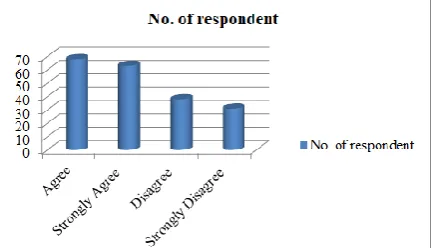
Above figure 4descriptive the consumers 'basic leadership endeavors on future buy events of a similar item or service to achieve need satisfaction in GautamBuddh Nagar, 68 People are agree, 63 people are strongly agree, 38 people are disagree and 31 strongly disagree.
Figure 4: The consumers 'basic leadership endeavors on future buy events of a similar item or service to achieve need satisfaction in GautamBuddh Nagar
[image:4.595.73.311.292.422.2] [image:4.595.74.291.505.629.2]Figure 5: The marketing strategy on consumer behavior of passenger cars in GautamBuddh Nagar is fruitful or satisfactory
Above figure6 descriptivethe passenger’s car finance options are available from Financial Institutes at reasonable rate of interest in Buddh Nagar, 73 People are Strongly agree, 64 people are agree, 33 people are disagree and 30 strongly disagree.
Figure 6: The passenger’s car finance options are available from Financial Institutes at
reasonable rate of interest in Buddh Nagar
Above figure7 descriptive shifting for product based marketing to need based marketing in GautamBuddh Nagar according to the need of customers, 68 People are Strongly agree, 58 people are agree, 39 people are disagree and 35 strongly disagree.
Figure 7: shifting for product-based marketing to need based marketing in GautamBuddh Nagar according to the need of customers
6. PASSENGER CAR INDUSTRY IN INDIA
[image:5.595.72.290.447.570.2]It is expected to grow at a CAGR of 3.05 per cent during 2016-2026. In addition, several initiatives by the Government of India and the major automobile players in the Indian market are expected to make India a leader in the two-wheeler and four wheeler market in the world by 2020. Domestic automobile production increased at 7.08 per cent CAGR between FY13-18 with 29.07 million vehicles manufactured in the country in FYFY13-18. During April 20FY13-18- 2018-January 2019, automobile production increased 9.84 per cent year-on-year to reach 26.26 million vehicle units. Overall domestic automobiles sales increased at 7.01 per cent CAGR between FY13-18 with 24.97 million vehicles getting sold in FY18. During April 2018-January 2019, highest year-on-year growth in domestic sales among all the categories was recorded in commercial vehicles at 22.79 per cent followed by 14.79 per cent year-on-year growth in the sales of three-wheelers. Premium motorbike sales in India crossed one million units in FY18
7. CONCLUSION
India is well known for its consumerism, due to the higher purchasing power, very high literacy rate and inflow of foreign money into the State, from the huge number of people of the State working in US, Europe, Australia, and other Asian and Gulf counties. With many car manufacturers launching their product in the Kerala state, the study will definitely benefit the stakeholders of car manufacturers, dealers, financing agencies, to formalize and strategize their policies towards an effective marketing strategy. The eight parameters developed and the model which was conceptualized was tested through an extensive research and quantitative analysis, to establish its acceptability.
The overview of the different car attributes in the evaluation of vehicle types showed that the purchase price, followed by the operating cost (maintenance and fuel cost) and the quality (reliability and security) of the car are the first factors consumers take into account when purchasing a vehicle. Based on these attributes, consumers will already select certain alternatives. In this respect, it can be useful to focus in further research on the Life Cycle Cost (LCC) of the conventional as well as the green cars. From a consumer s point of view, the LCC of a car is the total cost related to the life cycle of a car.
Consumer behavior consists of all human behavior that goes in making before and post purchase decisions. One can succeed in the competitive market only after understanding the complex consumer behavior of passenger towards vehicles. An understanding of the consumer enables a marketer to take marketing decisions which are compatible with its consumer needs. From study there are various major classes of consumer behavior determinants and expectations, namely socioeconomic, psychological, political, geographical, and demographic and Product & Technology in GautamBuddh Nagar.
REFERENCES
[1].Customer Satisfaction Management and Measurement (CSMM) A Specialized Unit of
Market Research Firm IMRB International (BW – Business World): Marketing White Book (2001-08)
[2].Malhotra G, Nandi A, Mukherjee A. An empirical research on consumer behaviour
towards small car segment in Indian Market. Business Perspectives and Research. 2012;1(1):37-46.
[3].Monga N, Chaudhary B, Tripathi S. Car market and buying behavior: A study of consumer perception. International Journal of Research in Management, Economics and Commerce. 2012;2(2):44-63.
[4].Nataraj S, Nagaraja N. Customer satisfaction in automobile industry–an indian online
buyers’ perspective of car manufacturers’ websites. International Journal of Multidisciplinary Research. 2012;2(6):92-107.
[5].Verma DP, Kapoor S. Dimensions of buying roles in family decision making. IIMB
Management Review. 2003;15(4):7-14.
[6].Sharma A, Kumar A, Bhardawaj A. A Review of Ambient Intelligence System: