A Monthly Double-Blind Peer Reviewed Refereed Open Access International e-Journal - Included in the International Serial Directories. GE-International Journal of Engineering Research (GE-IJER) ISSN: (2321-1717)
27 | P a g e
GE-International Journal of Engineering Research
Vol. 4, Issue 4, April 2016 IF- 4.721 ISSN: (2321-1717) © Associated Asia Research Foundation (AARF) PublicationWebsite: www.aarf.asiaEmail : [email protected] , [email protected]
PRIVACY-PRESERVING AUTHENTICATION PROTOCOL IN
SHARED AUTHORITY BASED CLOUD COMPUTING USING
TRUSTED THIRD PARTY
Mr.Tamboli Sameer Iqbal1, Prof. Amrit Priyadarshi2
1
Dattakala Group of Institutions Faculty of Engineering Swami-Chincholi, Daund, Pune-413 133
2 Dattakala Group of Institutions Faculty of Engineering Swami-Chincholi,
Daund, Pune-413 133
ABSTRACT
Cloud computing is developing as a prevalent data intelligent worldview to comprehend
users' information remotely set inside an on-line cloud machine. Cloud arrangements give
awesome comforts expected to the users to savor the experience of the on interest cloud
applications without considering the local infrastructure restrictions. Through the data
accessing, different users may be in a collaborative relationship, and therefore information
sharing becomes significant to achieve productive benefits. The existing protection
alternatives mostly give interest to the authentication to appreciate that an customer's private
data cannot be not authorized accessed, but disregard a subtle privacy concern during an
user challenging the cloud server to request other users intended for information sharing.
The challenged gain access to demand itself may uncover the user's privacy no matter
whether or certainly not it could obtain the details access permissions. Found in this paper,
we offer a shared authority based privacy-preserving authentication protocol to address
above privacy issue for cloud storage. In the, 1) shared access authority is achieved by
private access request complementing mechanism with security and personal privacy
considerations (e. g., authentication, data anonymity, user level of privacy, and forward
security); 2) attribute based gain get to control is followed to recognize that the customer can
only access the own data fields; 3) proxy re-encryption is definitely utilized by the cloud
A Monthly Double-Blind Peer Reviewed Refereed Open Access International e-Journal - Included in the International Serial Directories. GE-International Journal of Engineering Research (GE-IJER) ISSN: (2321-1717)
28 | P a g e comparability style is set up to show that the theoretically has the design correctness. What
this means is usually that the suggested process knowing privacy-preserving data access
authority sharing, is usually attractive for multi-user collaborative cloud applications.
KEYWORDS -CLOUD COMPUTING, PRIVACY PRESERVATION, SHARED
AUTHORITY, AES ALGORITHM.
INTRODUCTION
Cloud service provider give magnificent points of interest to the users to appreciate from the
on-demand Cloud applications without considering the local infrastructure restrictions. Amid
the information getting to, different users might be in a collaborative relationship, and
information presenting gets to be critical on accomplish productive advantages [1]. Thus the
existing security solutions mainly concentrate on the authentication to know that a users
private data are unable to be unauthorized accessed, but neglect a subtle privacy issue
throughout a users challenging the cloud machine to request others for data sharing. The
pushed access demand itself may expose the user’s level of privacy no matter whether or not
it can obtain the data access permissions. Different plans utilizing characteristic set up
encryption have been proposed for access control of outsourced data in cloud computing [2]. It
allows clients with limited computational solutions to outsource their large computation workloads to
the cloud, and enjoy the massive computational electricity financially, bandwidth, storage, and also
appropriate software that may be shared in a pay-per-use manner. Despite the tremendous benefits,
security is the main obstacle that helps prevent the wide adoption of this promising computing model,
especially for consumers when their confidential info are developed and consumed during the
computation. To combat against unauthorized information access, sensitive data must be encrypted
before outsourcing techniques to be able to provide end to- end data confidentiality assurance in the
cloud and beyond. However, ordinary information encryption techniques essentially prevent cloud
from undertaking any meaningful procedure of the underlying cipher text-insurance policy, producing
the computation over encrypted data a very hard difficulty. The proposed scheme not merely achieves
scalability because of its hierarchical structure. As a result, there do are present different motivations
for cloud server to respond unfaithfully also to return inappropriate outcomes, i. e., they might behave
beyond the time-honored semi honest model.
RELATEDWORK
In this section, we analyze the related works, Companies are speedily moving onto cloud
since they can at this moment utilize the finest capitals accessible available in the market in
A Monthly Double-Blind Peer Reviewed Refereed Open Access International e-Journal - Included in the International Serial Directories. GE-International Journal of Engineering Research (GE-IJER) ISSN: (2321-1717)
29 | P a g e
radically. Nevertheless as more and extra data is relocated to the cloud the security concerns
have keeping on developing. Information breaking is the greatest security issue. A skilled
programmer might effectively enter a customer part application and get into the customer's
close information [2]. Clumsy and defective APIs and interfaces turn into the objective. IT
organizations which give cloud provider allow third get together companies to alter the APIs
and familiarize their own personal functionality which often allows these companies to know
the internal workings of the cloud [2]. Denial of Service (DoS) is additionally danger in
which the client is acknowledged incomplete or not in each entrance to their own special
information. Organizations now utilize disable always says all times and DoS might
effectively primary enormous increase in cost both for the shopper and administration
supplier. Interconnection snooping is that in which a hacker can look at your online activities
and duplicate/replay a specific private data. It may also cause the user to unlawful or
unwanted sites. Loss of data is also another issue. A destructive hacker can get eliminate of
the information or any type of natural/manmade catastrophe can ruin your data. In such
instances having an high street copy is a major benefit. Carelessness of the business can also
cause data loss [3]. Suitability between different cloud providers is additionally a worry. On
the off chance that a client moves starting with one cloud then onto the next the similarity
ensures that there is absolutely no loss of data. Foreign can be utilized intended for wrong
purposes i. at the. cloud abuse. Because of the of latest innovations on the foreign it works
extremely well for top of the line estimations which should not be possible on a standard
computer[2],[3]. Insufficient comprehension of impede innovations can prompt obscure
degrees of danger. Organizations move to cloud since it gives generous bringing down of
expense however in the event that reinforcement is performed without appropriate
background taking in; the issues that happen can be even greater. Internal gatecrashers can
utilize the information for harming purposes. Safe-keeping of encryption keys is also an
issue. Regardless of the fact that you are working with encryption for increased insurance,
keeping a key a secure point of interest turns into a worry. Whom ought to be the Data Owner
of the key? Client seems to complete up being the answer however how tenacious and careful
can surely he/she be will settle on a choice the security in the data. Suitability between
different cloud providers is likewise a worry. On the off chance that a client moves starting
with one cloud then onto the next the similarity ensures that there is unquestionably no loss of
data. Cloud can be utilized planned for wrong purposes. at the. Cloud misuse. Because of the
accessibility of latest advancements on the remote access it works extremely well for top of
A Monthly Double-Blind Peer Reviewed Refereed Open Access International e-Journal - Included in the International Serial Directories. GE-International Journal of Engineering Research (GE-IJER) ISSN: (2321-1717)
30 | P a g e
understanding of cloud technologies can bring about unknown degrees of risk. Cloud
computing offers a new scheme to supplement the current usage. The users might not know
the machines which process and distribute their data. During their very own convenience
brought by this new technology, users are anxious about losing control of their own data. The
data processed on
Confuses are often utilized, leading to several issues related to accountability, including the
handling of information. Such drawbacks are becoming a hurdle to the large adoption of
cloud service. Cloud computing allows highly scalable services to become easily consumed
on the internet about an as-needed basis. A significant characteristic of the cloud services is
that users’ data are often processed slightly in unknown machines that users do not own or
perhaps operate. A drawback the existing system does not have the choice of
granting/revoking data gain access to. It has very much less security where hacking takes on a
fantastic role.
Liu et al. [12], proposed a multi-Data Owner information sharing defended plan for variable
gatherings in the weaken applications. It means to realize that a client can securely share the
information with different users by means of the untreated foreign server, and can
productively bolster dynamic gathering associations. Inside the plan, another allowed shopper
can basically directly decoded information records without per-reaching with data owners,
and client reversal, toppling; invalidation is accomplished by a reversal, upsetting, dissolution
list without modernizing the secret keys of the remaining users. Access control is connected
to verify that any client in an association can namelessly use the cloud resources, in addition
to the information proprietors' real individual can without much of a stretch be uncovered by
gathering chief for contention intervention. It shows the capacity overhead and security
calculation expense is really autonomous with the amount of teasers.
Grzonkowski ou al. [13] recommended a zero-learning proof based authentication structure
for sharing cloud arrangements. Contingent upon the amiable home frameworks, a shopper
driven methodology is put on permit the sharing of customized substance and propelled
system based provider through TCP/IP infrastructures, in which a respected option gathering
is acquainted with get decentralized communications.
Nabeel ou al.[14] proposed a broadcast group key management to boost the weakness of
symmetrical key cryptosystem in open public clouds, plus the broadcast group key
A Monthly Double-Blind Peer Reviewed Refereed Open Access International e-Journal - Included in the International Serial Directories. GE-International Journal of Engineering Research (GE-IJER) ISSN: (2321-1717)
31 | P a g e
effectively derive the symmetric keys during decryption. Appropriately, attribute based
access control mechanism is built to achieve that a great user can decrypt the contents if and
just if its identity characteristics fulfil this content provider's policies. The fine-grained
algorithm applies access control vector for determining secrets to users based on the identity
attributes, and allowing the users to derive actual symmetric keys based on their secrets and
other public information. The broadcast group key management has an evident advantage
during adding/revoking users and updating access control plans.
Wang et 's. [15] proposed a distributed storage integrity auditing mechanism, which features
the homomorphic token and allocated erasure-coded data to improve secure and trusted
safe-keeping services in impair computing. The scheme allows users to audit the cloud storage
with light communication overloads and calculation cost, and the auditing effect ensures
strong cloud safe-keeping correctness and fast data error localization. Toward the dynamic
cloud data, the scheme helps active outsourced data operations. It indicates that the structure
is resilient against failure, malicious data changes attack, and server colluding attacks
PROBLEM STATEMENT AND IMPLEMENTATION
We propose a structure for security issue to recommend protection preserving authentication
convention for the cloud information stockpiling, based about cloud storage which gives
authentication and approval without surrendering a client's private data. The primary thought
will be as comes after: 1) another protection issue in cloud safe-keeping is to be situated and
additionally distinguish an indirect individual level of security for information sharing, when
the tested request itself can't get the wearer's close to home security 2) Design an
authentication convention which upgrades a great client's entrance request, which more often
than not is connected to the security. The shared access power is accomplished by
unidentified access request planning system. 3) Cipher content arrangement is used and a
client can just get to their own special information areas and proxy re-encryption is
acknowledged to give confirmed data sharing among different users [10]. In the proposed and
examined stage, through record encryption getting of documents is expert. The document
present about the gadget will get to be encoded utilizing pass word structured Advance
encryption standard calculation. For all intents and purposes any of the transferred archives
which as a rule are secured can complete up being downloaded by client and read it on the
framework. Advance encryption standard (AES) is unquestionably not responsible to be
A Monthly Double-Blind Peer Reviewed Refereed Open Access International e-Journal - Included in the International Serial Directories. GE-International Journal of Engineering Research (GE-IJER) ISSN: (2321-1717)
32 | P a g e
a great deal more rapidly than the Rivest-Shamir-Adleman algorithm (RSA). Along these
lines, it settles on a considerable decision for security of data on the cloud [11]. It is to be
noticed that the proposed framework works just if a steady web association is generally
accessible. Here, the specific framework and information proprietor can choose whether or
[image:6.595.180.417.154.294.2]maybe not the client might
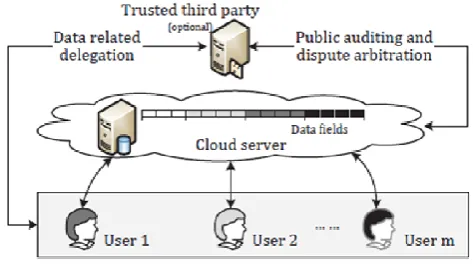
FIGURE 1: SYSTEM MODEL
get to the framework. The effectiveness check must be taking after the usage of the given
recommended model. After the response timings has recently been measured then genuine
computations will bolster the very truth that this sort of work has a huge quality. Utilization
of the Reliable Third Party shows up the testing part and the absolute best segment. In the
event that it manages all the call from the client to get to information from cloud to begin
with, it ought to: 1) Validate and an individual user2) Guarantee the information for
which the user is asking, approved to that specific user. 3) If not by any stretch of the
imagination it ought to return the inadmissible access report to user. As it were as opposed to
calling the cloud provider or maybe strategies there should be a middle person observing each
of the authentication and assent. Every one of us propose a system for the aforementioned
level of protection issue to recommend security preserving authentication convention for the
cloud information stockpiling, based about cloud storage which gives authentication and
approval without surrendering a user's private data.
IMPLEMENTATION
In this segment, the execution subtle elements of the proposed framework including different
A Monthly Double-Blind Peer Reviewed Refereed Open Access International e-Journal - Included in the International Serial Directories. GE-International Journal of Engineering Research (GE-IJER) ISSN: (2321-1717)
[image:7.595.69.562.106.350.2]33 | P a g e
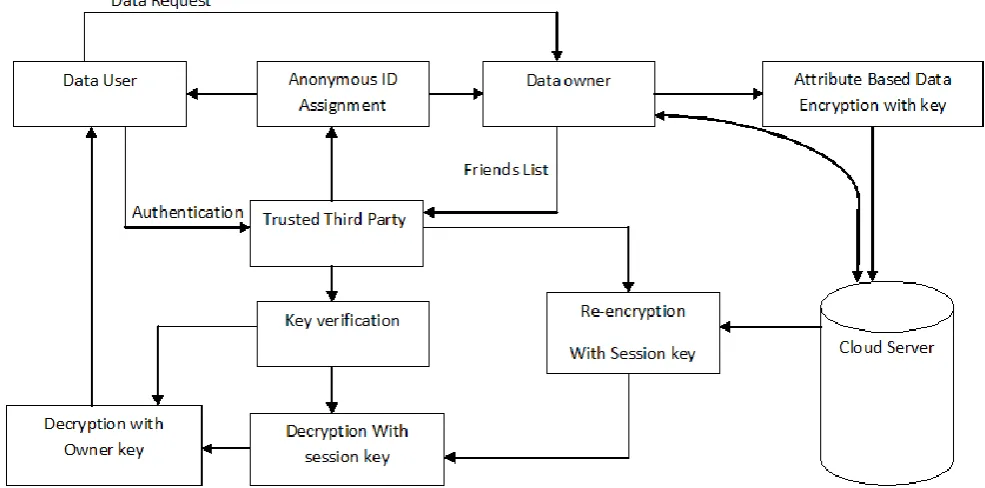
FIGURE 2: SYSTEM ARCHITECTURE
MODULE DESCRIPTION
Data Owner Registration:
A Data Owner needs to transfer its documents in a cloud server, and afterward client ought to
register first. After that just the client will have the capacity to do it. At that point
Registration technique is then taken after. These Details are stored in a database.
Data Owner Login:
This indicates among the registered individual need to login, they ought to have the
capacity to login by specifying their email id, secret key.
Client/User Registration:
In the event that a client needs to get to the information from cloud, the registration is an
A Monthly Double-Blind Peer Reviewed Refereed Open Access International e-Journal - Included in the International Serial Directories. GE-International Journal of Engineering Research (GE-IJER) ISSN: (2321-1717)
34 | P a g e
User Login:
An approved client can download the record by utilizing document id which the Data
Owner has indicated already.
Access Control:
Data Owner can permit the entrance or deny access for getting to the information.
Encryption and Decryption:
AES encryption and AES decoding is utilized for encryption and unscrambling. The
record we have transferred which must be in scrambled frame and unscramble it. Data Owner
can permit the entrance or deny access for getting to the information.
Trusted Third Party Login:
In this module Trusted Third Party has screens the information Data Owners record by
confirming the information Data Owner's document and stored the document in a database
CONCLUSIONS
With this work, we have decided another privacy challenge information accesses to in the cloud
computing to accomplish protection preserving access power sharing. Authentication is Set up to
ensure information privacy and information trustworthiness. Information namelessness is certainly
accomplished following the wrapped qualities are traded amid transmission. Client protection is
enhanced by mysterious access requests to secretly advise the cloud server about the users' entrance
needs. Forward security is realized by the session checks to stop the session association. This means
the recommended plan is conceivably used for upgraded security support in cloud applications.
REFERENCES
[1] Hong Liu, Student Member, IEEE, Huansheng Ning, Senior Member, IEEE, Qingxu
Xiong Member, IEEE,and Laurence T. Yang, Member,IEEE,”Shared Authority Based
Privacy-preserving Authentication Protocolin Cloud Computing”IEEE TRANSACTIONS
ON PARALLELAND CLOUD SYSTEMS VOL:PP NO:99 YEAR 2014
[2] B.Sameena Begum, P.Ragha Vardhini,”Augmented Privacy-Preserving Authentication Protocol by Trusted Third Party in Cloud”, NTERNATIONAL JOURNAL OF COMPUTER
A Monthly Double-Blind Peer Reviewed Refereed Open Access International e-Journal - Included in the International Serial Directories. GE-International Journal of Engineering Research (GE-IJER) ISSN: (2321-1717)
35 | P a g e
[3] Cong Wang, Student Member, IEEE, Sherman S.-M. Chow, Qian Wang,
Student Member, IEEE,Kui Ren, Member, IEEE, and Wenjing Lou, Member,
IEEE,”Privacy-Preserving Public Auditing for Secure Cloud Storage”,Proc. 34th IntlACM
SIGIR Conf. Research and Development in Information, pp. 615-624,2015
[4] Larry A. Dunning, Member, IEEE, and Ray Kresman ”Privacy Preserving
Data Sharing With Anonymous ID Assignment”IEEE TRANSACTIONS ON
INFORMATION FORENSICS AND SECURITY, VOL. 8,NO. ,FEBRUARY 2013
[5] A. Mishra, R. Jain, and A. Durresi, Cloud Computing: Networking and Communication
Challenges,IEEE Communications Magazine, vol. 50,
no. 9, pp, 24-25, 2012.
[6] R. Moreno-Vozmediano, R. S. Montero, and I. M.Llorente,Key challenges in Cloud
Computing to Enable the Future Internet of ervicesIEEE Internet omputing, [online]
eeexplore.ieee.org/stamp/stamp.jsp?tparnumber 6203493, 2012.
[7] K. Hwang and D. Li, Trusted Cloud Computing with Secure Resources and Data
Coloring, IEEE Internet Computing, vol. 14, no. 5, pp. 14-22, 2010.
[8] K. Yang and X. Jia, An Efficient and Secure Dynamic AuditingProtocol for Data Storage
in Cloud Computing, IEEE Transactions on Parallel and Cloud Systems, [online] ieeexplore.
ieee.org/stamp/stamp.jsp?tparnumber=6311398, 2012.
[9] Y. Zhu, H. Hu, G. Ahn, and M. Yu, Collaborative Provable Data Possession for Integrity
Verification in Multi-cloud Storage, IEEE ransactions
on Parallel and Cloud Systems, vol. 23, no, 12, pp. 2231-2244,2012.
[10] H. Wang, Proxy Provable Data Possession in Public Clouds,IEEE Transactions on
Services Computing, [online] ieeexplore.ieee.org/stamp/stamp.jsp?tparnumber=6357181,
2012.
[11] L. A. Dunning and R. Kresman, Privacy Preserving Data Sharing With Anonymous ID
Assignment, IEEE Transactions on Information Forensics and Security, vol. 8, no. 2, pp.
A Monthly Double-Blind Peer Reviewed Refereed Open Access International e-Journal - Included in the International Serial Directories. GE-International Journal of Engineering Research (GE-IJER) ISSN: (2321-1717)
36 | P a g e
[12] X. Liu, Y. Zhang, B. Wang, and J. Yan, Mona: Secure Multi-Owner Data Sharing for
Dynamic Groups in the Cloud, IEEE Transactions on Parallel and Cloud Systems, [online]
ieeexplore.ieee.org/stamp/stamp.jsp?tp=arnumber=6374615, 2012.
[13] S. Grzonkowski and P. M. Corcoran, Sharing Cloud Services: User Authentication for
Social Enhancement of Home Networking, IEEE Transactions on Consumer Electronics, vol.
57, no. 3, pp.1424-1432, 2011.
[14] M. Nabeel, N. Shang and E. Bertino, Privacy Preserving Policy Based Content Sharing
in Public Clouds, IEEE Transactions on Knowledge and Data Engineering, [online]
ieeexplore. ieee.org/stamp/stamp.jsp?tp=arnumber=6298891, 2012.
[15] C. Wang, Q. Wang, K. Ren, N. Cao, and W. Lou, Toward Secure and Dependable
Storage Services in Cloud Computing, IEEE Transactions on Services Computing, vol. 5, no.
2, pp. 220-232, 2012.
[16] S. Sundareswaran, A. C. Squicciarini, and D. Lin, Ensuring Cloud Accountability for
Data Sharing in the Cloud, IEEE Transactions on Dependable and Secure Computing, vol. 9,
no. 4, pp. 556-568, 2012.
[17] Y. Tang, P. C. Lee, J. C. S. Lui, and R. Perlman, Secure Overlay Cloud Storage with
Access Control and Assured Deletion, IEEE Transactions on Dependable and Secure
Computing, vol. 9, no. 6, pp. 903-916, 2012.
[18] Y. Zhu, H. Hu, G. Ahn, D. Huang, and S. Wang, Towards Temporal Access Control in
Cloud Computing, in Proceedings of the 31st Annual IEEE International Conference on
Computer Communications (IEEE INFOCOM 2012), pp. 2576-2580, March 25-30, 2012.
[19] S. Ruj, M. Stojmenovic, and A. Nayak, Decentralized Access Control with Anonymous
Authentication for Securing Data in Clouds,IEEE Transactions on Parallel and Cloud
Systems, [online] ieeexplore. ieee.org/stamp/stamp.jsp?tp=arnumber=6463404,2013.
[20] R. Sanchez, F. Almenares, P. Arias, D. Daz-Sanchez, and A.Marn, Enhancing Privacy
and Dynamic Federation in IdM for Consumer Cloud Computing, IEEE Transactions on