EFFECTS OF DEMONETISATION ON DIGITAL PAYMENTS AND
SETTLEMENTS IN INDIA
Dr (Mrs.) Padmasani1, Assistant Professor,
K. Tamilselvi2Ph. D. Research Scholar, School of commerce, Bharathiar University, India
ABSRACT
Reserve Bank of India, in line with its vision of encouraging electronic payments, achieving a less-cash society, providing safe and secure payment systems safer and secure, has geared its policies relating to the payment systems accordingly. The demonetisation in November 2016 aims to curtail the shadow economy and indirectly motivates the objective of “Digital India” i.e to increase the access of digital payments and settlements. Hence, this
paper is an attempt to evaluate the effect of demonetisation on the usage of digital payments in India. The Compounded Annual Growth Rate is 79 and 69 per cent for RTGS and REC respectively. Both the systems are growing over 10 years period with a mean value of 60.54 million and 1265.37 millions. It was also found out through paired sample t-test that the usage of RTGS and Retail Electronic Clearance systems differ significantly before and after demonetisation in India.
Key words: Demonetisation, RTGS, Retail Electronic Clearance, Growth , Effect
Introduction
For greater acceptance of electronic payments, apart from speed, efficiency and
security,creating trust and safety of operations in the psyches of the users are imperative.
Reserve Bank of India, in line with its vision of encouraging electronic payments in the
country, achieving a less-cash society, making the payment systems more safer and secured
has geared its policies relating to the payment systems accordingly. Several initiatives for
infrastructure enhancement have been taken by the country. They are white label ATMs, card
less cash withdrawal facility for unbanked persons, next generation RTGS and NEFT system
International Research Journal of Management and Commerce
ISSN: (2348-9766) Impact Factor- 5.564, Volume 4, Issue 11, November 2017 Website- www.aarf.asia, Email : [email protected] , [email protected]
for larger volumes etc. The trend for greater acceptance of electronic payments over paper
cheques by the general public is further boosting every year. The demonetisation, announced
on 8th November 2016, by Government of India, also insisted the importance of the Cash
surrendering process through direct and indirect modes of payment systems. Besides this, the
Reserve Bank has also announced regulations for cash inflow and outflow check for the
banks. The public are emphasized on utilisation of electronic modes of payment and
settlement for the prolonged queue in the bank premises both by the Central Bank and the
Government of India. Further, the aim of Digital India by the central government is gaining
its importance indirectly through demonetisation. This paper is an attempt to analyse whether
the Electronic Payment and Settlement System in India has shown any significant difference
after demonetisation.
Payment & Settlement Systems and Information Technology
Payment and Settlement Systems are a vital component of the economic and financial
base leading to the overall economic performance and financial stability by facilitating the
effective financial intermediation. With a horizon to further leveraging the use of Information
Technology (IT) in enhancing the efficient operation of the financial arrangement, the
Reserve Bank has also undertaken steps to put in place a theoretical account for off-site and
on-site surveillance of payment arrangements. Recognizing the significance of getting along
the payment and settlement systems and expansion of financial inclusion in India the
Reserve Bank works with a clear mission to learn whether the payment and settlement
systems are safe, sound, efficient, accessible and authorized.
Currently, seven forms of payments and settlement system are under legititmate
operation by RBI in India.They are Real Time Gross Settlements,Clearing Corporation of
India Limited(CCIL) operated system, Paper Clearances, Retail Electronic Clearing,Smart
card payments, Prepaid Payment Instuments and Mobile Banking systems. RBI`s thrust on
technology in payment systems have resulted in visible improvements in the settlement
processes in the Systematically Important Payment System (SIPS) ,where over 70 per cent of
transactions are handled electronically.( Rajinder Kaur &Rupinder Kaur, 2015).
The payment and settlement arrangements in India functions in a non-disruptive
manner during the financial stress in the global financial markets and thereby did not play as
a channel of transmission. Hence, payment and settlement systems have been functioning
smoothly and efficiently since 2009-10, ensuring the timely liquidation of both systematically
possible by several technical advancements that were initiated in payment and resolution
systems by the Reserve Bank.
Demonetisation in India
The French were the first to use the word Demonetize, in the years between 1850
-1855. Since then, many countries have used this policy with immense restriction and
discomfort, for its disrupt economics. India has demonetized for the first time on 12th January 1946, second time on 16th January 1978 and Third time on 8th November 2016.
In the first time, banknotes of 1000 and 10000 rupee were withdrawn and new notes
of 1000, 5000 and 10000 rupee were introduced in 1954. The measure did not succeed, as by
the end of 1947, out of a total issue of Rs. 143.97 crores of the high denomination notes,
notes of the value of Rs. 134.9 crores were exchanged. Thus, notes worth only Rs. 9.07 crores
were probably „demonetized‟, not having been presented. . It was more of “conversion”, at varying rates of profits and losses than “demonetization”. The Janata Party coalition
government had again demonetized banknotes of 1000, 5000 and 10000 rupee on 16 January
1978 as a means to curb counterfeit money and black money. In 2012, the Central Board of
Direct Taxes had recommended against demonetization, saying in a report that
"demonetization may not be a solution for tackling black money or economy, which is largely
held in the form of Benami properties, bullion and jewellery" (The Hindu,Narasaiah,2017) .
On 8th November 2016, the Government of India announced the demonetisation of
all ₹500 (US$7.80) and ₹1,000 (US$16) banknotes. The government claimed that the action
would curtail the shadow economy and crack down on the use of illicit and counterfeit cash
to fund illegal activity and terrorism.
Review of literature
Saba Abid (2016) explained the efforts made by the Reserve Bank for migration to electronic payments in Table IX.1. Correspondingly, transactions processed by the
paper-based clearing systems have shown a continuous decline both in volume and value terms.
Significant growth in e-payments is evident from the study both in terms of diversification
and innovation. Development of information and technology has been an important driver in
the growth of e-payments. Though the value and volume of these e-payments have increased
significantly still its reach is not at much great level in rural areas primarily due to lack of
Graham Wright & Anil Gupta (2016 ) analysed the three years‟ trends for the period 2012 to 2015 showing the direction of the market ― less and less paper, and more and more electronic payments ― with all electronic categories growing both in volume and value
terms. The electronic clearing comprising of ECS, NEFT and IMPS are growing at the
highest rate. The new Payment Banks will be ever-increasing focus on electronic payments.
These will be accessible to a large section of society at remarkably low cost. Since June 2015,
electronic transactions of EFT/NEFT have surpassed paper-based transactions in terms of
volume. Even in value terms a clear trend prevails towards adoption of electronic payments,
over paper-based payments.
Statement of the Problem
Demonetisation in 2016 aims to curtail the shadow economy and indirectly motivates
the objective of “Digital India” i.e. to increase the access of digital payments and settlements.
Further, this economic policy will increase the dependence on bank credit, which will help
reducing the scope for generating black money and over dependence on paper currency at the
end, increases the scope for usage of digital payment systems. Besides this, the government
also put efforts to educate and prompt people to reduce their existing, over dependence on
currency notes in payment systems. In lieu of that, they may choose settlement transfers etc.
Hence, this paper is an attempt to evaluate the effect of demonetisation in usage of digital
payments in India.
Objectives and Methodology
The primary objective is to analyse the level of operation of payment and settlements
through Information and Communication Technology methods before and after November,
2016 i.e the demonetisation in India. The modes selected for the analyses are RTGS and
Retail Electronic Payments. The analysis is purely based on secondary data published by RBI
in the form of Annual Reports, Bulletins and other reports. The statistical tools used for the
data analysis are Descriptive statistics, Compounded Annual Growth Rate Analysis and
paired sample t-test. The period of analysis is from the month of January 2016 to August
2017, 10 months before and after Demonetisation.
RTGS
The settlement of both large-value and retail interbank payments in India was
predominantly cheque-base until RTGS was implemented in March 2004 and the subsequent
issuance of instructions on the mandatory use of electronic payments for transactions between
system, operated by the RBI, large-value and interbank transactions have progressively
migrated to the RTGS system on "real time" and "gross" basis. "Gross settlement" means the
transaction is settled on one to one basis without bundling or netting with any other
transaction. Once processed, payments are final and irrevocable.
Retail Electronic Clearing (REC)
Retail payment systems in India include both paper-based and electronic (NEFT and
ECS/NECS/RECS) funds transfer systems. Cards are another popular option for retail
payments.
Electronic Clearing Service (ECS) Cr: ECS Credit ECS Credit is used for the
payment of salaries, pensions, dividends, interest etc. Payers submit credit instructions
through their banks (sponsor banks). On the settlement date, the account of each
sponsor bank is debited and the accounts of beneficiary banks are credited.
Electronic Clearing Service (ECS) Dr: This system is used for multiple debits
culminating in a single credit. A utility company gives the debit instructions (based on
mandates given by its customers) to the sponsor bank, which in turn presents them to
the clearing house for further processing. On the settlement date, the customers‟
accounts are debited and the sponsor banks‟ accounts are credited.
EFT/ NEFT: The Electronic Funds Transfer (EFT) system implemented in the mid
1990s and the National EFT (NEFT) implemented in November 2005 are deferred net
settlement (DNS) systems that process credit transfers. With the implementation of
NEFT, the EFT system has been discontinued. The NEFT system uses the Structured
Financial Messaging Solution (SFMS) for EFT message creation and transmission
from a branch to the bank‟s gateway and to the NEFT centre, using the tools available
from the SFMS
Immediate Payment Service (IMPS): It is an instant interbank electronic fund
transfer service through mobile phones. It is also being extended through other
channels such as ATM, Internet Banking etc.
Growth of RTGS and REC Transactions
The Table-1 shows the volume and value wise data and descriptive statistics of RTGS
and REC from 2007-08 to 2016-17. The volume of RTGS is 5.86 million in 2007-08 and it
has reached 107.86 million in 2016-17 and similarly the REC volume is 304.25 million and
touched 4204.96 million in 2016-17. This implies that both the Electronic payment and
settlement systems are growing over 10 years period with a mean value of 60.54 million and
whereas REC is near to 1 revealing inconsistency. The CAGR of RTGS is reporting the
highest growth of 79 per cent by volume and 21 per cent in terms of its value. The REC
growth is 69 per cent in terms of volume and 54.68 per cent growth in terms of value. Thus,
the table shows growth of RTGS and REC is positive and uptrending over the past 10 years.
Table-1 Descriptive Statistics of RTGS and REC transactions from 2007-08 to 2016-17
Source: RBI statistics
Year
Real Time Gross Settlement (RTGS)
Retail Electronic Clearing (REC)
Volume (Million)
Value (Rupees in
Billion)
Volume (Million)
Value (Rupees in
Billion)
2007-08 5.86 482945.59 304.25 14933.69
2008-09 13.38 611399.12 280.61 4164.18
2009-10 33.27 1011699.31 313.75 5966.44
2010-11 49.28 941039.33 406.38 11944.80
2011-12 55.05 1079790.58 512.44 20575.60
2012-13 68.52 1026350.05 694.07 31881.14
2013-14 81.11 904968.04 1108.32 47856.29
2014-15 92.78 929332.89 1687.44 65365.51
2015-16 98.34 1035551.64 3141.53 91408.14
2016-17 107.86 1253652.08 4204.96 132250.12
Mean 60.54 927672.86 1265.37 42634.59
SD 35.45 225177.97 1366.02 42281.76
CV 0.59 0.24 1.08 0.99
The chart 1 shows that the both the payment and settlement system are growing whereas the
growth rate of RTGS is slow and steady, but in case of REC it is showing an increasing trend
as the graph is moving upward.
Effect of Demonetisation on RTGS
The comparative analysis on utilisation of various payment and settlement systems in
India before and after demonitisation (i.e. January 2016 to October 2016 as before and
November 2016 to August 2017 as after demonitisation) reveals the effect of demonitisation.
The systems seleced for analysis are RTGS and Retail Electronic Clearing modes. The
analysis is based on the null hypothesis (H01) that, “There is no significant difference in the
utilisation of RTGS payment and settlement before and after demonetisation”
Table 2 Paired Samples Test for RTGS
Paired Differences t df Sig.
(2-tailed) Mean Std.
Deviation
Std.
Error
Mean
95% Confidence
Interval of the
Difference
Lower Upper
RTGS-BEF
RTGS AFT -.9873 1.2566 .3973 -1.8863 -.0884 -2.485 9 .035
Source : computed
0.00 1000.00 2000.00 3000.00 4000.00 5000.00
2007-08 2008-09 2009-10 2010-11 2011-12 2012-13 2013-14 2014-15 2015-16 2016-17
vo
lu
m
e
(m
ill
io
n
s)
year
Chart -1 Growth of RTGS & REC
Table 2 shows the result of the paired sample t test of RTGS utilisation before and
after demonetisation. The value is significant at 0.05 per cent , hence the null hypothesis is
rejected and concluded that there is significant difference between the volume of utilisation
of RTGS before and after demonetisation.
Effect of Demonetisation on REC
[image:8.595.71.527.151.326.2]Source : Computed
Table-3 shows the paired t test analysis of volume of utilisation of Retail Electronic
Clearing payment modes before and after demonetisation. The value is significant at .000.
Hence, the null hypothesis of (H02) “There is a no significant difference in Retail Electronic
Clearing payment and settlement before and after demonetisation” is rejected and concluded
that there is a significant difference in the volume of transactions done through REC before
and after demonetisation. In other words, the demonetisation has created an impact on Retail
Electronic Clearance.
Effect of Demonetisation on the components of REC
The Retail Electronic Clearance comprises of Electronic Clearing Service Credit and
Debit, National Electronic Funds Transfer (NEFT) and Immediate Payment Service( IMPS). The analysis comprises of the individual paried sample test results for each components of
[image:8.595.75.528.593.746.2]REC.
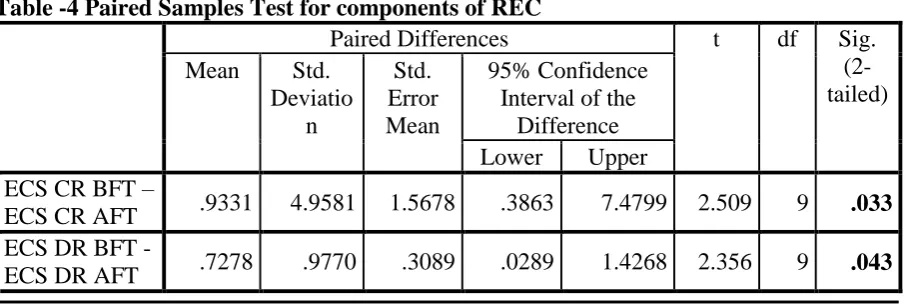
Table -4 Paired Samples Test for components of REC
Paired Differences t df Sig.
(2-tailed)
Mean Std.
Deviatio n Std. Error Mean 95% Confidence Interval of the
Difference Lower Upper ECS CR BFT –
ECS CR AFT .9331 4.9581 1.5678 .3863 7.4799 2.509 9 .033 ECS DR BFT -
ECS DR AFT .7278 .9770 .3089 .0289 1.4268 2.356 9 .043
Table 3 Paired Samples Test for Retail Electronic Clearance(REC)
Paired Differences t df Sig.
(2-tailed) Mean Std.
Deviatio
n
Std. Error
Mean
95% Confidence
Interval of the
Difference
Lower Upper
REC BEF –
REC AFT
-95.4042 35.7010 11.2896 -120.9432
NEFT BEF – NEFT AFT
-34.7499 18.4681 5.8401
-47.9612 -21.5386 -5.950 9 .000 IMPS BEF –
IMPS AFT
-32.0387 7.0497 2.2293
-37.0818 -26.9956
-14.371 9 .000 Source: Computed
The Table 4 explains the clearances made before and after Demonetisation using
paired sample t test for REC components, revealed that ECS CR, ECS DR, NEFT and IMPS
are significant at .05 per cent, Hence,it can be concluded that the usage of these modes have
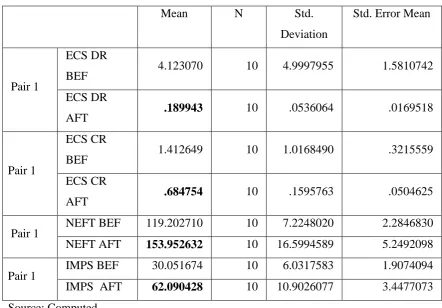
shown the effect before and after Demonetisation. Table 5 shows the mean scores of REC
which reveal the average amount of transactions done before and after demonetisation. The
mean score of ECS DR with( 4.12) and CR( 1.41) are high before Demonetisation they are
low after demonetisation.However, it is inverse in case of NEFT and IMPS revealing that
[image:9.595.82.525.316.624.2]these modes are becoming popular among the public.
Table -5 Paired Samples Statistics
Source: Computed
Amid the ongoing intense debate on the benefits and effects of demonetisation, there
has been a strong growth in digital payments and transactions in the months since the
currency swap was announced on 8th November 2016, according to Reserve Bank of India
statistics. There arises an anexiety and urge in knowing the effect of the demonetisation and
currency regulations in connection with payment and settlement transactions. The attempt of
Mean N Std.
Deviation
Std. Error Mean
Pair 1
ECS DR
BEF 4.123070 10 4.9997955 1.5810742
ECS DR
AFT .189943 10 .0536064 .0169518
Pair 1
ECS CR
BEF 1.412649 10 1.0168490 .3215559
ECS CR
AFT .684754 10 .1595763 .0504625
Pair 1 NEFT BEF 119.202710 10 7.2248020 2.2846830
NEFT AFT 153.952632 10 16.5994589 5.2492098
Pair 1 IMPS BEF 30.051674 10 6.0317583 1.9074094
the researcher brings out the fact that there exsists a significant difference in utilisation of
electronic modes of payment namely RTGS and REC.
Conclusion
Demonetisation‟s real success in encouraging digital payment methods would only be
known after completion of the remonetisation process. An intersesting fact is that the
volume of digital transactions has been picking up even before demonetisation as per RBI
report. The Compound Annual Growth Rates of RTGS and Retail Electronic Clearances are
increasing positively.The deployment of NEFT and IMPS have gained progress after
demonetisation in retail payment. The reduction or quashing of service charges levied for
these transactions will further motivate the public to move digitally. The Government of India
expects people to embrace digital transactions so that the full year target could be reached in
half the time stated by PMs address in “Mann ki Baat”. India is mounting with the target of
2,500 crore digital transactions in 2017-18, which can be visulaised in by the incessant
schemes and motivations of Reserve Bank of India.
References
1. Saba Abid (2016) “Electronic Payment System: An Evolution in Indian Banking System”, “IOSR Journal of Economics and Finance”, Vol 7(III), pp 25.
2. Karamjeet Kaur,Ashutosh Pathak,(2015)“E-Payment System on E-Commerce in India”, “International Journal of Engineering Research and Applications”, Vol. 5,
Issue 2, Part -1, pp.79-87.
3. Aastha Gupta (2013) “Electronic Mode of Payment – A Study of Indian Banking System” “International Journal of Enterprise Computing and Business Systems”
Vol.2 Issue 2, pp 1-7.
4. Deepankar Roy ,Amarendra Sahoo(2016) “Payment Systems in India: Opportunities and Challenges”,“Journal of Internet Banking and Commerce”, Vol. 21(2), pp 1
-46.
5. Thomas M. Hoenig (1995) “The Evolution Of The Payments System: A U.S. Perspective”, “Economic Review”,Third Quarter, pp 5-9.
6. Lokesh Uke (2017) “Demonetization and its effects in India”, “SSRG International
Journal of Economics and Management Studies” Vol 4(2 ), pp 18-23.
8. Narasaiah (2017) “Is demonetization a panacea to the ills of the economy ?”, “The
Hindu”.
9. Reserve Bank of India ( 2017), “Macroeconomic Impact of Demonetisation-A
Preliminary Assessment”
10. Lauren Pincus & Mark Bell (2014) “T-Test Review -Agriculture Innovation Program”.
11. Rajinder kaur & Rupinder kaur (2015) “Current And Future Scenario Of E –Payment System In India”, “International Journal Of Business Management”, VOL. 2(1) ,pp
676-681.