Journal of Criminal Law and Criminology
Volume 54
Issue 2
June
Article 14
Summer 1963
Fraudulent Check Notations
David A. Black
Follow this and additional works at:
https://scholarlycommons.law.northwestern.edu/jclc
Part of the
Criminal Law Commons,
Criminology Commons, and the
Criminology and Criminal
Justice Commons
This Criminology is brought to you for free and open access by Northwestern University School of Law Scholarly Commons. It has been accepted for inclusion in Journal of Criminal Law and Criminology by an authorized editor of Northwestern University School of Law Scholarly Commons.
Recommended Citation
FRAUDULENT CHECK NOTATIONS
DAVID A. BLACK
David A. Black is an Examiner of Questioned Documents in Los Angeles, California, where for a number of years he has been associated with Clark Sellers. Mr. Black is President of the American Society of Questioned Document Examiners and has published several articles in this journal. His present article is based upon a paper presented at the 1962 meeting of the American Society of Ques-tioned Document Examiners in Milwaukee, Xisconsin.-EDTOR.
Bank checks are probably the most numerous class of present-day business documents of con-sequence. They are at the same time a record that is usually preserved for a long period of time by both individuals and business concerns for income tax and other purposes. They are also regarded as almost self-authenticating for both tax and court purposes, having been honored in the due course of business and bearing one or more prac-tically unassailable evidences of date such as bank stamps and cancellation perforations. They are on occasion the sole record remaining in existence relating to a business transaction.
It is no wonder then that they are often pro-duced as documentary evidence in connection with lawsuits. Sometimes in this event they have been "augmented", one might say, by the addition, after passage through the bank, of a helpful nota-tion of considerable value in the suit, such as "Pay-ment in full" or "Loan" or some lengthier inscrip-tion. In testimony this notation may be fraudulently represented as having appeared on the check at the time it was originally tendered to the payee. If misrepresentation is suspected, these checks often end up under the microscope of a questioned document examiner.
These added notations may appear on the face of the check or on the back related to the endorse-ment of the payee. Sometimes they will appear on both front and back. They are usually hand-written, but where the original body of the check is typed they will often be in typewriting. Whether handwritten or typed, front or back, the physical evidence is usually present on the check to es-tablish the fraudulent nature of the notation.
Where it is alleged the same person wrote the notation as wrote the remainder of the face of the check, it may be possible to show that this is not true. Where it is true, there may be evidence in the handwriting of a different writing time, such as significant differences in size, slant, angularity,
writing speed, smoothness, spacing, or legibility. A discernibly heavier writing pressure or indenta-tion into the paper may be present in one secindenta-tion as against the other, particularly when a ball pen was used.
Another feature related to the appearance of the writing in a suspected notation which may indicate later addition, is the arrangement of the wording, which may have a crowded-in appearance or may be inclined or otherwise unnaturally posi-tioned or arranged to miss or avoid other writing or a perforation in the paper or other condition. Evidence of unnaturalness of this sort is evidence pointing toward fraudulent addition.
A difference in ink or writing instrument used in the suspected addition from that in the main body writing of the check is an unusual and un-natural circumstance indicating different writing times for each. If the payor, who did the writing, avers that both were done at the same time with the same pen and ink, he may be effectively im-peached in this respect. Where the ink in the ad-dition approximates but does not exactly match the main body inking, indicating a deliberate attempt to cause the former to duplicate the latter in appearance, it will often be found that certain strokes in the original body writing will be written over with the same kind of ink as in the addition. This is evidence of a color test on the part of the writer to see if the ink to be used for the addition matches the original writing on the check. Close microscopic examination is usually necessary to disclose and confirm this. On occasion it will be found that the major part or all of the original writing will be written over with the new ink in an effort to cause it to more closely match the added portion. If a poor job of over-writing is done, the added notation itself will also sometimes be written over, again to cause all the writing on the face to conform as to appearance.
FRAUDULENT CHECK NOTATIONS
FIGURE 1
A portion of the face of a check showing a suspected, added notation in the upper left.
FIGURE 2
Photograph of the same check made with infrared sensitive material wherein the ink of the suspected notation "washed out," but the ink of the body did not. By this means positive proof was established that the two inks were different despite their similar appearance to the eye.
graphic and conclusive proof that the ink of a suspected addition is different from that in the original writing, similar though they appear, trans-parentizing or "washing out" the one while regis-tering the other. (See figure 1 and 2.)
The multiplicity of factors necessary to take into consideration is staggering if one is to make an undetectable addition to a previously processed bank check. The average person is ignorant of most of them and therefore unsuccessful. Some of
DAVID A. BLACK
specifically to prevent ink from running out or blotting. Thus if the original fluid ink writing on a check does not "feather" but has smooth margins, whereas the strokes of a suspected addition feather out into the adjacent paper due to deterioration of the sizing, this variance establishes a significant lapse of time between the writing of the former and of the latter.
A difference in ink flow or copiosity even of the same pen and ink may indicate a difference in writing time, and if there is evidence that a blotter was used on one section and none on another, this is further possible indication of a time differential in the writings. Occasionally one encounters a case where the original fluid ink writing was heavy and when the check was folded certain areas or spots "offset", transferred, or "blotted" onto the paper opposite. The absence of any such offset markings caused by the suspected notation may be further evidence of later addition.
In some cases portions of the writing in a sus-pected addition will intersect or overlap some of the original writing on the check. Where this occurs it is often possible to determine by the use of the microscope whether the addition was written before or after the original writing. If it would have been unnatural at the time of making out the check to write the notation after the other body writing, this is some evidence of later addition. If the sus-pected notation is on the back of the check and overlaps and is determined by microscopic ex-amination to have been written after the payee's endorsement, this condition is strong evidence of addition after passage through the bank.
The sequence or order of writing of a suspected notation and of the original writing in relation to other operations to which the check has been subjected can be of great or crucial significance. If for instance the check has been folded and the writing in a disputed notation where it crosses the fold is found to have been written after the fold when examined under the microscope whereas the other body writing is found to have been written before the fold, this is evidence that a period of time elapsed between the writing of the two sections and is strongly indicative of addition after passage through the bank. In such a case, if the tenderer of the check testifies that the entire check was made out at the same time, the showing of the successive sequence of these operations, with the intervention of the folding, impeaches him.
Such evidence as to the sequence of writing and
folds may also be found with relation to writing and staple holes, pin holes, spike holes, tears in the paper, stains, wetting, etc. Many business checks are imprinted with a check protector at the time they are made out, this customarily being done after the check is filled out in writing. Most check protectors punch slots or minute holes in the paper, both on the written amount line and on the payee's name line above. Where a notation in question contacts and is determined to have been written after the check protector imprint, this gives rise to the inference that the notation was added at some later time. A ball pen stroke will usually leave visible evidence of sequence when it crosses a hole or other rupture of the paper, and fluid ink will often run through to the opposite side and sometimes bleed out into the adjacent paper on the back. This condition could not exist unless the writing stroke was made last.
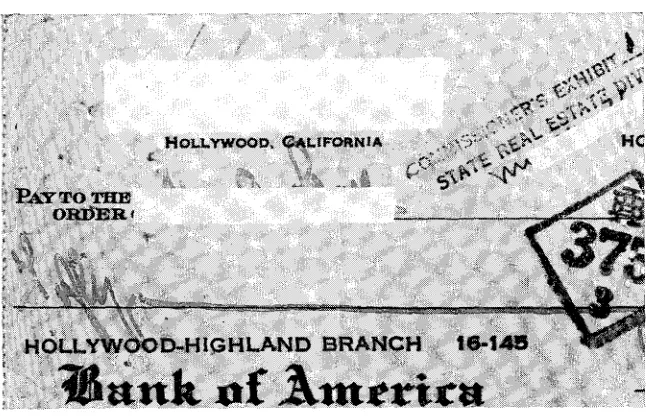
The determination of the order of occurrence of a notation in question and some other operation on the check related to the banking process can be crucial in importance. Such determinations can often be made with conclusive certainty. The principal bank-related operations are endorsement stamps, bank processing stamps and bank can-cellation perforations. It can readily be appreciated that if a fluid ink stroke can be seen under the microscope (sometimes even with the naked eye!) to have colored the sides of a circular bank per-foration in the paper and further to have run out from this hole onto the back surface of the check, this could only have occurred if the ink stroke was put on the check after the bank perforation was made. (See figures 3 and 4.)
Not long ago a case involving the problem dis-cussed herein was encountered wherein none of the strokes of a questioned check notation reading "Paid in full" intersected any writing or other condition on the face which would furnish a so-lution. It was noted however that ball pen writing in the notation on the face occupied the corre-sponding area as the ball pen endorsement on the back, both having produced a fairly heavy in-dentation or furrow in the paper. There were many places where the endorsement writing on the back intersected the writing in question on the face when viewed with light coming through the paper from the back. In a number of these places the microscopic evidence was clear that the questioned writing on the face had "pushed out" or obliterated the indentations of the endorsement writing on the back, which would otherwise have remained
FRAUDULENT CHECK NOTATIONS
Frouax 3
Magnified area of a check bearing an alleged fradulent addition on its face. A. An intersection of a portion of the questioned notation with the bank cancellation perforation. Arrow indicates the ink of the stroke flowing around the perforation.
B. The same perforation viewed from the back of the check (indicated by arrow) shows the ink of the questioned notation running through and out onto the back of the check. These evidences establish conclusively that the notation was placed on the check after bank cancellation.
heavily impressed in the paper. There were no locations where the reverse was true. This condi-tion established that the quescondi-tioned notacondi-tion was made after the check had been endorsed, which was sufficient for the purposes of the lawsuit.
If the suspected notation is in typewriting, many of the above procedures may apply. It can be shown, if such be the fact, that a different type-writer was used for the notation than for the re-mainder of typing on the check. If the same type-writer was used, it may be shown that the imprint is different in tint or darkness. Or that the cleanli-ness of the type was different when one portion was typed, causing filled-in characters in one sec-tion and none in the other. This would clearly indicate a different typing time.
Another condition confirming a different typing time is a lack of uniformity of alignment of the characters from one portion to another. If all the typing on a check is done at the same time without removing it from the typewriter, all the characters will possess a regularity of alignment governed
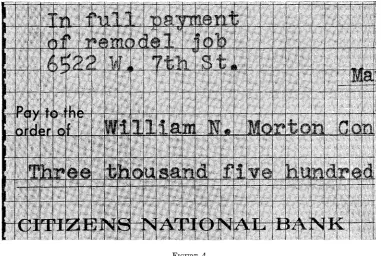
by the lateral and vertical spacing mechanism of the typewriter. The line spacing may be varied somewhat by the fractional line spacer to place the typing in proper position on the printed lines of the check, but there would be no reason to operate the paper release and move the check laterally in the machine. Therefore, while the line spacing may vary from regularity, the vertical alignment of the characters and the parallelism of the typed lines should remain preserved. If a portion of the typing is done at a different time this will not be true. Special measuring plates may be used to show the lack of uniform alignment (figure 4).
In certain cases it may be further demonstrated that a heavier typing touch or pressure is dis-played in one portion than in another, evidenced by a deeper indenting of the characters into the paper. Turning the check over and viewing the opposite side in slanting light will often show this discrepancy quite clearly.
evi-DAVID A. BLACK
FIGURE 4
The upper left area of a check with a suspected typewritten notation. Special alignment gauge (fine lines) shows that the questioned notation is out of alignment with the main body typing and therefore was placed on the check at a different time. A different typewriter was also used as can be recognized by the difference in design of the "W" and other letters.
dence of crowding in or unnatural alignment or positioning of typing above an endorsement on the back of a check is indicative of later addition. Likewise, the sequence or order of occurrence of typewritten characters and other operations can often be determined, including folds, holes, perforations, tears, check protector imprints, and so forth, to the same beneficial effect as mentioned previously in connection with handwritten nota-tions.
An abnormal circumstance sometimes encoun-tered and corroborative of irregularity in connec-tion with a suspected addiconnec-tion problem is the mutilation, soiling, or staining of the notation under suspicion. Where this is deliberately done-and this is often determinable-the purpose is to
hide or obscure any appearance of the notation's having been added later.
In any case involving a possible fraudulent ad-dition to a check, it is advantageous to get the person presenting the check on record as to exactly how and when the entire check was made out, particularly as to whether the same writing instru-ment was used throughout and whether it was all made out at the same time in a continuous opera-tion. It then may be determined if the physical evidence on the check corroborates or refutes his statements.
One last matter is of great importance-that is to determine if any bank made a microfilm of the check which would show whether the sus-pected notation was on the check when it went through the bank.