Journal of Criminal Law and Criminology
Volume 40 | Issue 2
Article 12
1949
Paint Comparison--A Method for the Preparation
of Cross Sections of Paint Chips
James G. Brewer
David Q. Burd
Follow this and additional works at:
https://scholarlycommons.law.northwestern.edu/jclc
Part of the
Criminal Law Commons,
Criminology Commons, and the
Criminology and Criminal
Justice Commons
This Criminology is brought to you for free and open access by Northwestern University School of Law Scholarly Commons. It has been accepted for inclusion in Journal of Criminal Law and Criminology by an authorized editor of Northwestern University School of Law Scholarly Commons.
Recommended Citation
PAINT COMPARISON-A METHOD FOR THE
PREPARATION OF CROSS SECTIONS OF PAINT CHIPS
James G. Brewer and David Q. Burd
James G. Brewer has been a Traffic Officer in the California Highway Patrol for fourteen years, eleven years of which he has been assigned to the laboratory of the Bureau of Special Services. His technical experience includes numerous laboratory and field investigations on auto thefts, hit and run, and other vehicle code violation cases in connection with which he has frequently appeared as an expert witness. David Q. Burd, a graduate of the Technical Criminology course of the University of California, has been a frequent contributor to this Journal. As a member of the staff of the Technical Laboratory of the California Division of Criminal Identifi-cation, he has had wide experience in laboratory investigation involving micro-analytical methods.-EDITOR.
Comparisons of paint must frequently be undertaken by law enforcement laboratories, particularly in connection with bur-glary and hit-run accident cases. This work includes visual and microscopic examination, spectrographic analysis, pigment dis-tribution studies, and occasionally other tests. When chips of paint containing several layers are encountered, examination of the color, sequence and thickness of each layer becomes of great importance. The most troublesome part of the latter comparisons is the preparation of cross sections of the samples so that all layers of paint will have a uniformly smooth surface and are visible and distinct under the microscope. Unless the cross sec-tions are very smooth, the microscopic comparison of two chips is difficult and photomicrographs taken for court use are likely to be poor.
A photomicrograph of the cross sections of two paint chips examined in connection with a hit-run accident case is shown in Figure 1. In this instance, the paint was photographed through a comparison microscope with no mechanical smoothing of the surfaces of the chips. The various layers are difficult to com-pare due to the varying roughness of the surfaces. The irregu-larity is so great that the color layers are not readily apparent, and some areas are even out of focus. It seemed reasonable that
Figure 1.
Comparison of layer structure on rough, broken edges of paint chips from sus-pected vehicle and scene of hit-and-run accident. Photograph taken through the comparison microscope.
PAINT COMPARISON
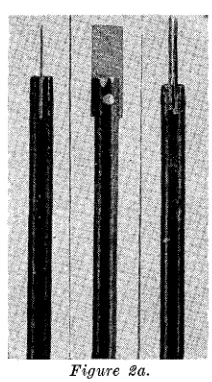
Figure Za. Pfsgure Zb.
Special tools used to make small slots Clamp holding plastic and paint chip in plastic for imbedding paint chips. ready for warming and sealing on hot
plate.
the surfaces of such cross sections could be improved by imbed-ding the specimens in some suitable mounting medium capable of being accurately smoothed. A number of mounting media were tried including sealing wax, dental impression compound, resins, and many types of plastics. Experimentation has shown that the basic idea was sound, and successful mounts have been produced with several of the media.
Of the various mounting media tried, the best was found to be methyl methacrylate in sheet form (Plexiglass or Lucite), al-though some of the other materials used worked quite well. The technique developed for mounting the paint chips consists of cutting 1/4 inch sheets of Plexiglass or Lucite into small blocks
using a hack saw, or better, a band saw. The blocks are warmed on a thermostatically controlled hot plate at about 3000 F. Small slots are then made in the center of the plastic, using tools made of pieces of razor blade or thin sheets of stainless steel fastened to metal rods. These tools are illustrated in Figure 2a. When two chips of paint are to be mounted side by side, the tips on the tool must be very smooth, exactly parallel, and suit-ably spaced. To make the slots, the blade or blades on the tool are pressed into the plastic. At the same time the blade is heated by directing the flame of a small burner against the tool. When the slots are of the desired depth, which should never be more than 2/.3 the thickness of the plastic, the mount is taken from the hot plate. The tool is left in the plastic until both have cooled. If the slots are very deep it may require a slight amount of heat on the tool to extract it.
[image:3.505.59.165.67.258.2]JAMES G. BREWER AND DAVID Q. BUBD
The paint chips to be examined are cut to the proper size and are inserted into the slots in the plastic. The mount is then placed in a small clamp such as the one illustrated in Figure 2b and again heated on the hot plate at 300' F. As the plastic softens, the clamp is tightened to close the mount around the paint chips, thus completely sealing them in.
The top of the mount in which the paint has been sealed is then filed with a fine or medium file until the paint edges are exposed and the plastic surface is flat. This surface is then smoothed by the use of very fine emery paper followed by crocus cloth. A high polish can be produced by rubbing the specimen on a fine weave cloth or chamois using jeweler's rouge as a polishing agent. This polishing method has one serious disadvantage in that the rouge is very difficult to remove from any small pores in the paint or cracks between the paint and plastic. However, two successive layers of the same paint may show a dividing line when polished that could not be observed otherwise.
In most instances, the surface need not be polished with rouge since the microscopic irregularities present after the final smoothing with crocus cloth may be caused to disappear by plac-ing a small drop of Canada balsam on top of the mount and covering it with a piece of microscope cover glass of appropriate size. It should be noted that sofne paints contain components that are soluble in xylene, which is the solvent present in liquid Canada balsam. When such paint is being studied, other micro-scopic mounting media may be substituted.
In order to make the sides as well as the cross sections of the paint chips visible the sides and ends of the plastic mount can also be smoothed and polished. The completed mount is then attached to a microscope slide with Canada balsam or glue to make it easier to handle.
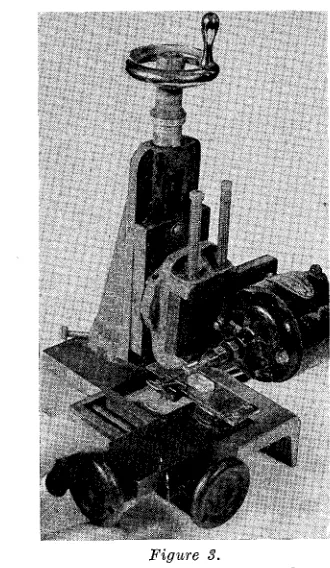
When a considerable number of paint specimens are routinely examined, it may be advantageous to construct a machine for cutting the monoplane cross sections of imbedded paint chips. An example of such a machine is shown in Figure 3. It consists of a small high speed hand tool motor with a chuck in which is held a planing bit. This is mounted on a six inch lathe milling attachment which makes it possible to raise or lower the planing bit to the desired position. The plastic mount containing the imbedded paint is cemented to a microscope slide, which is placed in a clamp on a lathe compound rest that provides for movement of the sample in the two horizontal directions. This permits longitudinal and transverse feed of the sample under the
PAINT COMPARISON
Figure 3.
Machine developed for cutting and polishing monoplane cross sections of paint chips imbedded in plastic or other materials.
cutting machine. With this equipment the surface of the plas-tic and imbedded paint is cut by traversing it under the cutting edge of the planing bit by means of the compound rest. Re-peated cuts are made, each a few thousandths of an inch deep, until the paint specimens are visible and the surface is smooth. For further smoothing, a fine emery sanding drum is substituted for the planing bit in the chuck. The surface of the mount is finally brought to a high polish using a buffing wheel. In both the smoothing and polishing operations, care must be taken to keep the pressure of the sanding drum and buffing wheel very light on the surface to avoid "burning" the plastic.
While the use of plastics for imbedding paint chips has proven to be the most satisfactory method, one of the earliest techniques tried is simpler and is adequate for general use, particularly in making preliminary comparisons. This method consists of im-bedding the samples in hot liquid sealing wax. In most in-stances, clear amber sealing wax is satisfactory although some-times another of the many available colors may be needed for proper contrast with the paint.
JAMES G. BREWER AND DAVID Q. BURD
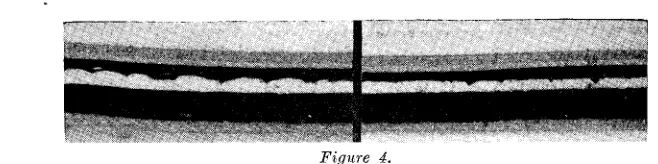
Figure 4.
Composite photograph showing cross sections of two automobile paint chips. The chips were imbedded in plastic and treated as described in this article.
To imbed the chips in sealing wax, they are first tacked on edge on a microscope slide using a very small amount of glue or sodium silicate. When it is desired to place two specimens in the same mount, the chips are tacked close together on the slide which is then placed under a stereoscopic microscope. As the glue or sodium silicate dries the specimens are moved with dis-secting needles until they are exactly parallel. Sealing wax is then melted in a small container on an electric hot plate and poured directly on top of the specimens so that it will completely cover and run between them. If desired, a small retaining form may be placed around the specimens so that the final mount will appear neater. The mounts are then cut and smoothed, either by hand or by machine, as in the case of plastics.
These methods of sample preparation greatly improve the appearance of the cross sections and frequently make it possible to detect very thin layers of paint that would not be visible with-out this type of treatment, even when examined under fairly high magnification. When testimony concerning the results of the examination is to be given in court, photographs of the com-parisons are also desirable and usually necessary. These photo-micrographs are relatively simple to take through the comparison microscope on black and white film, but somewhat more difficult to take when color film is used. Since good color film is now available and can be processed in most police laboratories, color photographs are recommended as they illustrate the compari-sons much more effectively than do black and white prints. If large sized sheet film is used, the transparencies can be shown to a jury by the use of a simple viewing box, while smaller sizes can be projected onto a screen.
1949) PAINT COMPARISON 235 In order to make a comparison more obvious, a composite photo-graph can be prepared from either color or black and white photographs, as in Figure 4. This figure shows a comparison of two chips of automobile paint which were mounted in Lucite and filed and smoothed by hand as described in this article.