71
Chapter
9
Design of The Innovative Clothes Dryer by using
“
Triz
”
Approach
Hartomo Soewardi1,a, Muhammad Fardan Mujahidi1,b 1
Department Of Industrial Engineering, Industrial Technology Faculty Islamic University Of Indonesia Yogyakarta–Indonesia
a
[email protected],[email protected]
Abstract. The global warming produces the erratic weather changes. This weather changes can have an impact
on some activities of human life. One of them is difficulties to dry the wet clothes. Because of the weather was changed disorderly between rainy and no rain. This paper presents a design of the indoor clothes dryer so that the drying process will be more effective and more efficient in any condition. Teoriya Resheniya Izobreatatelskikh Zadatc (TRIZ) methods is used to improve a design of products based on contradictive attributes that users require. A paper based survey was conducted to identify the attributes of product and design parameter was determined subjectively to design a new clothes dryer. While statistical analysis was conducted to test the hypothesis developed. Results of this study shows that the indoor clothes dryer is effective and efficient in use at 5% significant level which includes six attributes. There are size, affordable price, durable material, type of heater, the capacity of the dryer, and a time drying process.
Keywords: Clothes Dryer, TRIZ, effective, efficient
I. Introduction
The temperature of the sunny during the day is in range between 330C - 390C [1]. At this condition is generally used for drying clothes. However, rapid changes in weather that caused by global warming yield natural drying not effective and efficient. It may cause some problem for active people although the available washing machine has a drying facility. But the results may still not meet users expectations. Based on this fact so it is important to provide an effective solution for this problem. The solution is to develop a design of clothes dryer which is more effective and efficient. The previous study on drying tools for garments has been conducted by [2], [3], [4]. [2] developed drying tools with using fan to dry clothes indoor. While [3] developed the aids for drying with the sensor for moving. And [4] developed a simple design of drying tools. It just use wheel in rope for hanging the clothes. In this study it was tried to develop the different drying tool based on TRIZ approach that is a creative method for the structured problem-solving process in design [5].
II. Research Method
A. Survey
72
B. TRIZ Method
The procedure for applying TRIZ in general are as follows [6]: 1. Select a technical problem
In this step is to identify technical problem of the product and determine the contradiction between two or more technical problems.
2. Formulate a physical contradiction
Physical contradiction is formulated based on technical problem. Then this contradiction determined is sought a solution.
3. Formulate an ideal solution
In this step, improving and worsening features are identified. Then it should be decided how to enhance the desired factors and eliminate the an ecpected factors to formulate an ideal solution.
4. Find resources for the solution, making use of the capabilities of TRIZ
To get an ideal solution, the inventive principles must be determined based on the matrix of contradictions between improving and worsening features. (See APPENDIX A)
5. Determine the "strength" of the solution and choose the best one
In this step, the inventive principles identified at step 4 is selected the strongest one principle based on the problem solved.
6. Predict the development of the system considered within the problem
Hereinafter in this step is to develop the new system and chooses a possible method to make a solution. 7. Analyze the solution process in order to prevent similar problems
Analysis of the solutions obtained is conducted in this step to prevent an emergence of similar problems.
C. Statistical Analysis Method
In this study non-parametric statistical analysis was conducted to test validity and reliability of result of customer survey by using Spearmans’s Rank Correlation for validity test and Cronbach alpha coefficient for reliability test [7], [8]. While Stuart Maxwell test is conducted to test the hipothesys on no difference between the developed design and customer requirement [9].
III.
Result and Discussions
A. Customer Voice
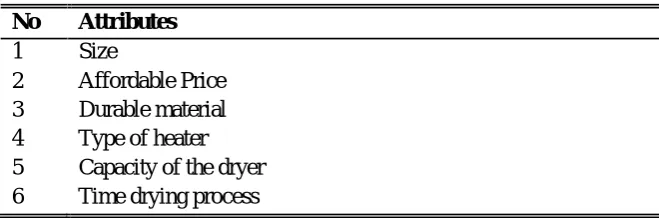
[image:2.595.139.469.649.758.2]Result of the customer surey was seen in Table I. It described six attributes that user is looking for. They are size of clothes dryer, affordable price, durable material, type of heating, the capacity of the clothes, and a time drying process. According to those attributes, users want the clothes dryer has adequate size for being able to placing in a room. As for the affordable price indicated that users want the tools can be bought in reasonable price. On the other hand, users want the clothes dryer can persist longer in use. Heater type indicated that users require not noisy in sound and safe to use. Capacity of dryer shows that users want tools can accommodate more clothes. Time drying process shows that users want tools that can dry clothes quickly.
Table I. Customer Attributes
No Attributes
1 Size
73
1 Size Volume of non-moving
object (8) Shape (12) 7, 2, 35
2 Affordable Price Amount of substance (2 ) Strength (14) 14, 35, 34, 10 3 Durable material Strength (14) Accuracy of measure
(28)
ment
3, 27, 16 4 Type of heater Power (21) Energy spent by movi
object (19)
ng
16, 6, 19, 37 5 Capacity of the
dryer Productivity (39)
Area of non-moving
object (6) 10, 35, 17, 7
6 Time drying process
Durability of non-movin object (16)
g
34, 27, 6, 40
B. Analysis of Inventive Principles Selected of Contradiction Matrix
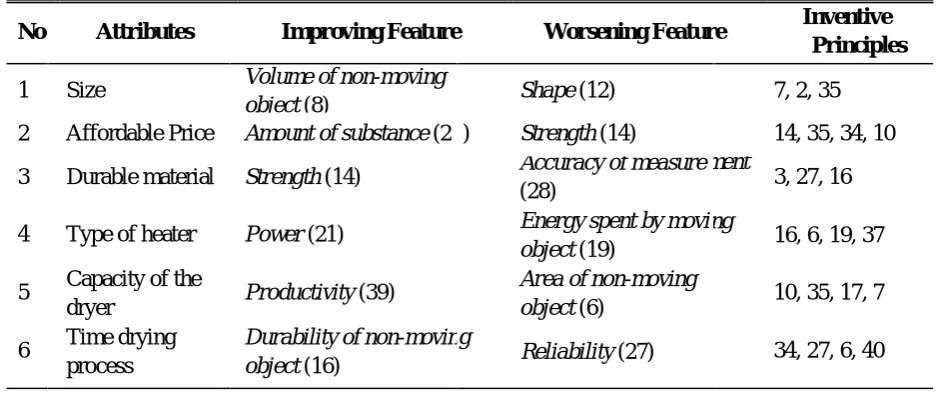
[image:3.595.69.544.149.346.2]Table II showed result of contradiction each attribute for inventive principles. Where attribute size is the principle 7 (Nesting) with sub-principle A is placing an object or system inside, placing any object or system in turn inside [5]. By using this princip the clothes dryer design with the length 85 cm, width 60 cm, height 120 cm so that it can accommodate 15 pieces of clothes.
Table II. Inventive intersections principles in contradiction matrix
No Attributes Improving Feature Worsening Feature Inventive
Principles
Reliability (27)
An inventive principle appropriate to an affordable price is the principle 10 (Preliminary Action) with sub-principle A that is do before it is needed, the changes is needed an object or system, either fully or partially [5]. Based on this princip the price of this appliance ranges between Rp 1.000.000,00 - Rp 1.500.000,00.
Inventive principles are in accordance with the attributes of a durable material is principle 3 (Local Quality) with sub-principle B that make each part of an object or system function in conditions most suitable for the operation [5]. The material used is aluminium for framework and body. It because of this material is resistant to corrosion.
Inventive principles are in accordance with the attribute type of heater is the principle 6 (Universality) with sub-principle B that uses the standard features [5]. Heaters used on this instrument are incandescent lamps by 4 units for each lamp has a power of 100 watts. And use a fan to spread the heat to all parts.
Inventive principles appropriate to attribute capacity outfit is the principle 10 (Preliminary Action) with sub-principle B is pre object or system set up so that they can come into action from the most convenient place and without losing time for delivery [5]. The clothes dryer with adequate size have appropiate capacity for fifteen clothes and they were inserted into the drying chamber by using hanger with distance between 5 cm - 6 cm so that the clothes can absorb heat from the lamp with a flat.
74
Fig 1. Design of clothes dryer [image:4.595.214.395.489.633.2]Fig. 2. Design of clothes dryer
Fig 3. Design of clothes dryer
C. Result of Validation
75
Table III. Stuart Maxwell test of Marginal Homogeneity results
User’s requirements z values
Size 0.109 Affordable Price 0.378 Durable material 0.197 Type of heater 0.739 Capacity of the dryer 0.622 Time drying process 0.796
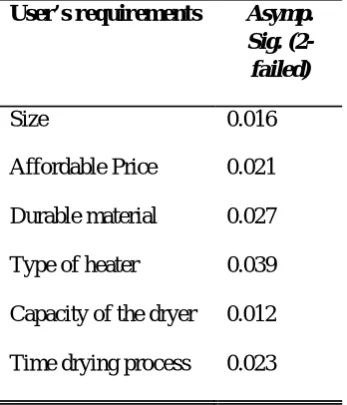
Furthermore Table IV present the result of difference test between the proposed design and the existing design by using wilcoxon test which it decides there is different between both above at 5% of significant level. Thus this design was better and more effective and more efficient to be implemented.
Table IV. Different Wilcoxon Test Results
User’s requirements Asymp. Sig. (2-failed)
Size 0.016 Affordable Price 0.021 Durable material 0.027 Type of heater 0.039 Capacity of the dryer 0.012 Time drying process 0.023
IV.
Conclusion
It can conclude as follow:
1 Attributes of clothes dryer that user required are size, affordable price, durable material, type of heating, the capacity of the clothes, and a drying process.
2 Design parameters for the clothes dryer are a box shape with a length of 85 cm, width 60 cm, and a height of 120 cm and can accommodate 15 pieces of clothing apparel. The material used is aluminum for framework and body is. To get hot on this tool using incandescent bulbs with 4 pieces each power of 100 watts. Use fan for spreading hot air. Product of temperature is in range 39oC - 42oC. And this tool can be drying clothes in less than 6 hours.
[image:5.595.219.393.354.557.2]76
References
[1] BMKG.,“Data Badan Meteorologi Klimatologi dan Geofisika”,Yogyakarta, 2010.
[2] Rismawan, E., Sulistiyanti, S., & Trisanto, A., “Rancang Bangun Protoype Penjemur Pakaian Otomatis Berbasis Mikrokontoler ATMEGA8535”,2012.
[3] Loice, R., Fransiscus, H., & Martaleo, M., “Perancangan Jemuran Otomatis Pendeteksi Hujan”,2011. [4] Nurhadi, M. W., & Widiantoro, P. Y.,“Jemuran Pakaian Otomatis dengan Menggunakan Sensor Cahaya
(LDR) dan Sensor Hujan”,2010.
[5] Zhang, J., Tan, K.-C., & Chai, K.-H., “Systematic Innovation in Service Design Through TRIZ”, 2003.
[6] M, R. D., & Andi Velahyati, H., “Desain Backpack Berdasarkan Analisis Biomekanika Dengan Pendekatan QFD dan TRIZ Untuk Pendaki Wanita.”, 2011.
[7] Singarimbum, M., “Metode Penelitian Survey”.Jakarta: LP3ES, 1989.
[8] Sheskin, D., “Handbook of Parametric and Non Parametric Statistical Procedures Third Edition”. Washington: Chapman & Hall/CRC, 2004.