Journal of Criminal Law and Criminology
Volume 64 | Issue 1
Article 8
1973
Criminal Homicide, U.S.S.R./U.S.A.: Reflections
on Soviet Data in a Comparative Framework
Walter D. Connor
Follow this and additional works at:
https://scholarlycommons.law.northwestern.edu/jclc
Part of the
Criminal Law Commons,
Criminology Commons, and the
Criminology and Criminal
Justice Commons
This Criminology is brought to you for free and open access by Northwestern University School of Law Scholarly Commons. It has been accepted for inclusion in Journal of Criminal Law and Criminology by an authorized editor of Northwestern University School of Law Scholarly Commons.
Recommended Citation
CRIMINAL HOMICIDE, U.S.S.R./U.S.A.: REFLECTIONS ON SOVIET
DATA IN A COMPARATIVE FRAMEWORK
WALTER D. CONNOR*
The general paucity of data on Soviet social conditions (in comparison to the data available from many other developed countries, including some of those in Eastern Europe) renders the exploration of sociological issues relating to the USSR rather difficult. This problem of information is especially evident when one's attention is drawn to phenomena such as crime and delinquency. Despite the growing volume of Soviet writing on these problems, "hard" data are mainly notable for their absence, and the statistics Soviet writers publish are most frequently percentage distribu-tions of unknown integers.
While lack of such data presents a formidable obstacle to research, it has not entirely discouraged Western scholars from attempts to clarify one or another segment of- the total picture of crime, alcoholism and allied forms of deviant behavior in the USSR.' The present study represents a tentative attempt at extending these inquiries in tvo ways: first, by focusing on criminal homicide, a particular type of deviant behavior with a defined quality that the categories "crime" and "delin-quency" lack; and second, by placing the admit-tedly extremely sketchy Soviet data available into a loose comparative framework with parallel data from American studies of homicide.
* Professor of Sociology, Professor of Russian &
East European Studies, University of Michigan. The original draft of this paper was prepared for the Ninth Annual Meeting, Central Slavic Conference, St. Louis, Missouri, November 19-20, 1971.
1 On alcohol problems, see Connor, Alcohol and Soviet Society, 30 SLAVIC Rviaw 3 (September, 1971); Efron, The Sovit Approach to Alcoholism, 7 SOCIAL
PROBLEmS 307-315 (1960); Mironenko, The Fight Against Alcoholism in the USSR, 14 Bu..EN OF THlE INsTITUTE FOR THE STi Y or Tm USSR 9 (Munich,
September 1967); Powell, Alcoholism in the USSR, 16
StRvEv 123-37 (Winter, 1971).
On crime and delinquency, see W. CONNOR,
DE-vIANcE IN SoviET SocrETY: CRimE, DELINQUENCY, AND AI.conOLu (1972); Connor, Juvenile Delinquency
in the USSR: Some Quantitative and Qualitative Indi-cators, 35 Am Soc. Rxv. 283-97 (1970). See also Field, Alcoholism, Crime and Delinguency in Soviet Society, 3
SOCIAL PROB.MS 100-09 (1955); Hollander, Reflections on Soviet Juvenile Delinquency in AExiRicm AND SoviET SocIET 275-83 (P. Hollander, ed. 1969); P. Juviler,
Delinquency and the Family in the USSR (paper presented at annual meeting of American Sociological Association, San Francisco, 1967).
Patterns of Soviet and American homicide with respect to sex of victims and offenders, victim-offender relationships, location of offense, weapons employed, and other aspects will be explored. Based on these and other data, some general ob-servations about Soviet homicide will be made.
There are many important questions about homicide in the USSR that of necessity remain unanswered here. These include the basic questions of how many? How much year-to-year variation? How much inter-regional variation in pattern? It is hoped, however, that the data and observations herein may be of some value, both in suggesting similarities in the social contexts that provoke homicide in the USA and the USSR, and in raising questions for further thought and investigation.
THE DATA
-The Soviet data to be examined in the next section of this paper come from several studies: Gertsenzon's study, conducted in the late 1960's, of 100 randomly selected cases of "deliberate homicide under aggravating circumstances" in the city of Moscow;2 Vlasov and Kocharov's 1963 study of an undetermined number of homicides in Briansk, Vladimir and Kalinin oblasti (provinces) ;'
Podbegaio's study of similar offenses, occurring in Rostov oblast' during 1961-1962;4 and an appar-ently nationwide survey of homicides by the All-Union Scientific Research Institute of Criminal-istics of the USSR Prokuratura, undertaken in the early 1960's.5 A few other Soviet sources have provided varied supplemental data.6
f
2A. GERTSENZON, UGOLOvWOE FRAVO I sOTSIOLOGIIA
64-78 (1970) (Moscow: "Iuridicheskaia literatura").
3 The studies by Vlasov and Kocharov are summa-rized, id. at 77-78.
4 The study by Podbegailo also is summarized, id.
I Data from this study are presented in A.
GERT-SENZON, VVEDENIE V SOVETSKUIU xRIMINOLOGu
158-63, 172-77 (1965) (Moscow: "Iuridicheskaia
literatura"). The study, it seems, cannot have been
undertaken later than 1963, since in this year the Criminalistics Institute, to whom it is ascribed, was merged into the new All-Union Institute for the Study of the Causes and Elaboration of Measures of Crime Prevention, under the Prokuratura.
WALTER D. CONNOR
The American data are supplied by: Wolfgang's survey of 588 cases of criminal homicide in Phila-delphia, 1948-1952;7
Bensing and Schroeder's study of homicides in Cuyahoga County, Ohio (Greater Cleveland), 1947-1953 (462 homicides);s and Pokorny's study of Houston, Texas, homi-cides during 1958-1961.9
Differences in the amount of data available from each source, and in the particular aspects of homi-cide examined, limit the comparative coverage. However, the same aspects are dealt with in both Soviet and American data often enough to permit the comparisons on a number of dimensions which follow.
SEX
The sex distribution of Soviet homicide offenders presents little that is surprising in view of the burden of criminological evidence on homicide in other developed societies. Homicide is an over-whelmingly male activity. Female rates (see Table 1) run from a low of 4 percent in Gertsenzon's Moscow study, to a high of 7.7 percent in Pod-begailo's investigation of Rostov oblast'. Still, proportional representation of Soviet women is lower by more than half from that of American women in Wolfgang's Philadelphia study (col. 4), a differential that remains fairly constant. (In 1967, women accounted for 1,797 of a total of 12,167 arrests reported for criminal homicide in the United States-well under 20 percent, yet well ahead of their Soviet counterparts.'0
More interesting are the figures on victimiza-tion. Of Gertsenzon's sample of homicides under "aggravating circumstances," 51 percent of the victims were women. In light of the Philadelphia figures, this is a high rate indeed. It is also prob-ably unrepresentative of the total USSR victimiza-tion rate. The official Soviet criminology textbook, citing en passant some loose figures, states that "about three-quarters" of the homicide victims
KRIM]NOLOGIAI and Stepichev, Iztchenie otdelnykh vidov presluplenii i prakticheskoe ispol'zovanie ego
rezul'tatov, in PROBLEMY ISKORENENIIA PRESTUPNOSTI
91-114 (1965) (Moscow: "Iuridicheskaia literatura")
[hereinafter cited as IzucENmEJ.
7 M. WOLFGANG, PATTERNS IN CRIMINAL HoMIcIE
(1966) [hereinafter cited as PATTERNS].
8 R. BENSING & 0. SCHROEDER, HOMICIDE IN AN
URBAN CommumT (1960).
9
Pokorny, A Comparison of Homicides in Two
Cities, 56 J. CIMs. L.C. & P.S. 479-87 (1965).
10 Federal Bureau of Investigation, U.S. Department
of Justice, UNIFORM CRIME REPORTS FOR THE UNITED STATES, 1967, 124 (1968).
TABLE 1
HoMIcmE OFFENDERS AND VICTIMS, BY SEX
Briansk
Philadel-Moscow V adimir Rostov phia
Kalinin pi
M F M F M F M F
Offender .... 96% 4 93 7 92.3 7.782.4 17.6
Victim ... 49 51 - - - - 76.423.6
Sources: cols. 1-6, Gertsenzon, Ugolovnoe pravo i sotsiologiia, pp. 77-78; cols. 7-8, Wolfgang, Patterns in Criminal Homicide, p. 32.
are male." Figures from the three-oblast' study of Vlasov and Kocharov and from Podbegailo's study would be helpful, but are unavailable.
VICTIM-OFFENDER RELATIONSHrP
A rather consistent finding in homicide studies in other countries points to the atypicality of
homicide between strangers.
While the construction of Table 2 has involved collapsing the more elaborate categories of the American studies to match those of the Soviet reports, nothing in the Soviet distribution of victim-offender relationships strongly challenges these findings, with the possible exception of the generaly higher Soviet rate of intra-family homi-cides. Moscow's high rate of 42 percent is under-standable in the light of its high rate of female victimization. Notable also is the consistently low rate of victimization of the little-known person or stranger, both in the Soviet and American statis-tics. These figures are reflected in the general statement of the criminology textbook that "al-most four-fifths of the victims are persons well known to the offenders."'2
LOCATION OF ATTACK
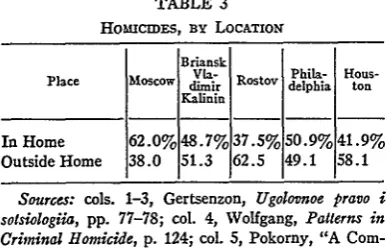
The high rates of victimization of persons well-known to the offender, often blood or marital relations, would lead one to expect a relatively high rate of homicide occurrence in the home. Table 3 bears out these expectations.
Moscow, with its high preponderance of family relationship between victim and offender, leads in the proportion of homicides committed in the home. Rostov oblast', on the other hand, with its low rate of intra-family homicide (lowest in the
11
K RtIINOLOoGIA, at 410.
'2Id.
TABLE 2
HOBUCIcES, BY VICTIM-OFFENDER RELATIONSHIP Briansk
Relationship Moscow Vladimir Rostov Philadelphia Houston Kalinin
Spouse, common-law spouse, relative 42% 40.8% 36.2% 24.7% 22.9%
Acquaintance (co-worker, neighbor) 33 42.3 43.2 51.0 51.1
Little acquainted, unacquainted 25 16.9 20.6 14.4 26.0
Sources: cols. 1-3, Gertsenzon, Ugolovnoe pravo i solsiologiia, pp. 77-78; col. 4, Wolfgang, Patterns it; Criminal Honwcide, p. 207; col. 5, Pokorny, "A Comparison of Homicides in Two Cities," p. 483.
TABLE 3
HosucmEs, BY LOCATION
Briansk
Via- RostovPhia- Hous-Place Moscow a- delphia ton
Kalinin
In Home 62.0% 48.7% 37.5% 50.9% 41.9%
Outside Home 38.0 51.3 62.5 49.1 58.1
Sources: cols. 1-3, Gertsenzon, Ugolovnoe pravo i solsiologija, pp. 77-78; col. 4, Wolfgang, Patterns in Criminal Homicide, p. 124; col. 5, Pokorny, "A
Com-parison of Homicides in Two Cities," p. 482.
Soviet studies), also has the lowest rate of homicide in the home.
The single most "favored" place for homicide outside the home is the street. In Moscow, 24 percent of the homicides studied occurred there; in the three-oblast' study, the figure was 30.8 per-cent; and in the Rostov oblast' study it was 44.2 percent.3 In Philadelphia the comparable figure was 31.4 percent.'4
MxANs EMPLOYED BY OFFENDER
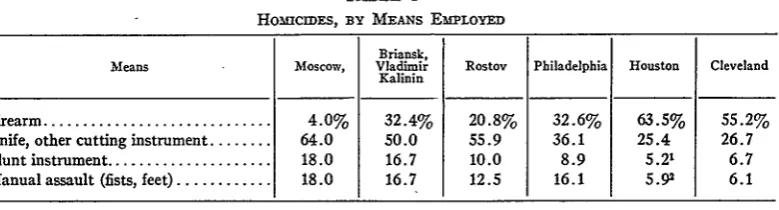
Anyone familiar with Soviet life would expect that comparatively few homicides in the USSR would be carried out with firearms. Table 4 shows this to be the case, but with some interesting anomalies. All three American cities lead the three Soviet cities in homicides by firearms, reflecting perhaps stringent gun control in the USSR, and lack of it in the United States. Yet the range among Soviet studies (28.4 percent between Moscow and Briansk-Vladimir-Kalinin) is almost as large as that between the American extremes
(30.9 percent between Philadelphia and
Cleve-land). Furthermore, the rate of
homicide-by-fire-13 A. GERTsENZON, supra note 2, at 77.
W O-FGANG, PAm=RNs, at 124.
arms reported by the three-oblast' study differs by only two-tenths of a percent from the Philadelphia investigation. Why these anomalous results?
First, the Moscow rate (4.0 percent) is undoubt-edly low. The textbook Kriminologiia attributes "about one-fifth" of all homicides in the USSR to firearms." Secondly, hunting rifles make up the vast majority of firearms used to commit homicide in the USSR; handguns and military arms are used only in scattered instances.'6 Although there is no direct statistical proof, it seems reasonable to argue that possession of firearms (i.e., hunting rifles) is proportionally much less likely in the high-density population of Moscow (Gertsenzon's study is concerned with the city alone, not the
oblast') than in the mixed urban-rural
environ-ments of the four other oblasti investigated. Per-sons in the latter may be no more violence-prone than Muscovites, but their opportunities to hunt, and hence their degree of access to arms, are likely to be higher.'7
THE ROLE OF ALCOHOL
A favorite target of Soviet writers commenting on the crime problem is the presence of alcohol as a causal or precipitating factor in many offenses. A two-stage, "drunkenness to crime" model is a
Is KRIMIOLOGIA, at 406.
16 Id.
7 On the basis of the 1959 census figures, population
densities of the oblasli are: Kalinin, 56.3 persons per sq. mile; Briansk, 89.6 persons; Vladimir, 125.7 (the
average of these three being 78.6 persons per sq. mile).
The density of Rostov oblast' works out to 84.9 persons per sq. mile. All of these, obviously, are far'below that of the city of Moscow (and indeed, fall far short of the
1959 density of the Moscow oblast'--604.9 persons per
[image:4.454.30.424.45.137.2] [image:4.454.27.221.181.305.2]WALTER D. CONNOR
TABLE 4
HOMICIDES, BY MEANS EMPLOYED
Briansk,
Means Moscow, Vladimir Rostov Philadelphia Houston Cleveland
Kalinin
Firearm ... 4.0% 32.4% 20.8% 32.6% 63.5% 55.2%
Knife, other cutting instrument ... 64.0 50.0 55.9 36.1 25.4 26.7
Blunt instrument ... 18.0 16.7 10.0 8.9 5.21 6.7
Manual assault (fists, feet) ... 18.0 16.7 12.5 16.1 5.92 6.1
2 Category originally titled "other."
2 Category originally titled "beating." (Other categories were "stabbing" and "shooting.")
Sources: cols. 1-3,,Gertsenzon, Ugolovnoe pravo i sotsiologiia, pp. 77-78; col. 4, Wolfgang, Patterns in Criminal
Homicide, p. 85; col. 5, Pokorny, "A Comparison of Homicides in Two Cities," p. 481; col. 6, Bensing and
Schroeder, 'Homicide in an Urban Community, p. 84.
' Totals greater than 100% are attributable to rounding errors. The identical figures in the two lower rows of cols. 1 and 2 suggest misprints in the original sources.
favorite of Soviet journalists and pamphleteers."i Interspersed in many commentaries on different varieties of crime are broad observations on the percentage of crimes committed "under the in-fluence." The criminology textbook, in its discus-sion of homicide, notes that "almost 75 percent" of homicides are committed by a drunken offender9 (and, in a discussion of crimes connected with drinking, specifies 74 percent).20 The criminologist Stepichev, in a discussion of data from "one [unnamed] oblast' in the RSFSR," notes that 81 percent of the homicide offenders are reported as
drunk at the time of their acts.21
Table 5 presents the data for the three Soviet studies, and Wolfgang's Philadelphia study. As the figures indicate, Soviet homicide offenders, if these data are taken as roughly indicative of a tendency, are far ahead of their American (or, at least Philadelphian) counterparts in likelihood of intoxication at time of offense. However, other Soviet data available show fairly large inter-regional variations in percentages of homicides committed by intoxicated persons.Y
What of the victims? Unlike American studies, Soviet reports rarely include a figure for intoxicated victims. However, Kriminologiia, the criminology textbook, notes that in many instances of homicide,
18
See W. CONNOR, DEVIANCE IN SOVIET SOCIETY,supra note 1, ch. 4. 19 KRIMINOLOGIIA, at 408.
20 Id. at 331.
21 Stepichev, supra note 6, at
110.
22 A. GERTSENZON, supra note 5, at 159. Gertsenzon
in 1966 reported figures ranging from 80 percent (Kalinin oblast') to a low of 46.8 percent (the Uzbek SSR)-indicating, perhaps, a "cultural" component involving less use of alcohol among the Uzbek popula-tion due to residual Moslem reservapopula-tions about dnnk.
TABLE 5
HOMICIDE OFFENDERS INTOXICATED AT
TInME o OFFENSE
Briansk
Moscow Vladirnir Rostov Philadelphia
Kalinin
74.0% 87.0 89.0 54.4
Sources: Gertsenzon, Ugolovnoe pravo i sotsiologiia,
pp. 77-78; Wolfgang, Patterns in Criminal Homicide, p. 136.
assault and other crimes against the person, both offender and victim are drunk.M In fact, in the case
of male homicide victims, Kriminologiia estimates
that 25 per cent are intoxicated.24 Soviet sources, however, do not provide the sort of cross-tabula-tions needed to answer the more complex quescross-tabula-tions about the role of alcohol in homicide. Thus, ques-tions such as the following go unanswered. Does drunkenness play a proportionally different role in "at-home" intra-family homicides than in street homicides? How often are street homicides the product not of "casual" drunkenness of one par-ticipant, but of a falling out between members of a "troika" assembled before a store for the purpose of sharing the cost of a bottle of vodka?
SOVIET HOMCiDE: A CLOSER LooK
The figures presented thus far provide, at most, a very rough outline of some of the characteristics of Soviet homicide and points of convergence and divergence between those characteristics and
2 KRIMINOILOGIA, at 331. 21 Id. at 410.
[image:5.454.46.436.39.144.2]attributes of homicide in the American context. The picture, such as it is, is thus far a skeletal one. To know that Soviet homicides tend to take place at home, between persons related, or well-known to one another, is one thing. However in order to add "flesh" to that picture, to get a "feel" for the behavioral transaction, more descriptive material is useful.
The typical homicide offender, in both USA and
USSR is not a "professional" criminal, although
in many instances he has had previous trouble with the law-generally for a variety of public order violations. The two following Soviet cases are illustrative.
Sh., 29 years old, was not working, conducted him-self badly in daily life, [and] by his wife's request was issued a warning by the people's court. Earlier, he was cofvicted of hooliganism and served two years' deprivation of freedom. In connection with his hostile relationship with his wife he killed her, inflicting a number of knife wounds. K., 26 years old, was twice fired from work for
drunken-ness, put under arrest for petty hooliganism; drunk, he acted like a hooligan in the apartment of his mistress, and after several days threw a neighbor from the staircase landing, from which the latter died.25
Findings as to the percentage of homicide of-fenders who had previous criminal offenses in their records vary among different Soviet studies. In Gertsenzon's study of homicide "under aggravating circumstances" 43 percent of the offenders had records, with the single most frequent offense being hooliganism.2 Parallel figures for the Briansk-Vladimir-Kalinin, and the Rostov oblast' studies, were 40 and 38.1 percent.Y Two studies in the early 1960's, one of "an RSFSR oblast'" and the other of "a union republic," produced
21 A. GERTSENZON, supra note 2, at 71.
26
1 Id. at 70. One need note that since Gertsenzon's study involves "homicides under aggravating circum-stances," and since commission of a homicide by a recidivist is an aggravating circumstance, the two are likely to be related in his figures. In fact, however, only in 19 of Gertsenzon's hundred cases did the court apparently identify "commission by a recidivist" as an aggravating circumstance. Id. at 76. With reference to the "typicality" of Gertsenzon's data on percentage of homicide offenders with previous convictions, we
might
add that in its general summary of data,KIR-NOLOGIIA, at 412, notes that "39 per cent were already
sentenced for other crimes." One might compare hooliganism to its American counterpart, disorderly conduct.
2 A. GERTSENZON, supra note 2, at 77.
TABLE 6
EDUCATIONAL ATAIMirENT or Moscow
HOMICIDE OFFENDERS
Educational Level Percent of All
Offenders
Higher (comp./incomp.) ... 7.0%
Secondary (complete) ... 4.0
9-10 years ... 7.0
5-8 years ... 64.0
up to 4 years ... 14.0
no data ... 4.0
Total... 100.0%
Source: Gertsenzon, Ugolovnoe pravo i solsiologiia,
pp. 71-72.
figures of 39.3 and 19.1 percent, respectively.2 Indeed, beyond these figures (which would not include the less serious types of disorderly conduct handled "administratively," such as "petty hooli-ganism") there are other data and suggestions indicating that the Soviet homicide offender fre-quently tends to be a person on the margins of Soviet life. According to Kriminologiia, referring to the results of research on homicide offenders:
[O]ver one-half of them had very lowd eucation, were semiliterate or even illiterate. Only 7 percent had secondary education, and higher-0.7 per-cent of those studied.29
In the unnamed RSFSR oblast' cited earlier, 84.3 percent of the homicide offenders lacked eight years of education.3 0 Gertsenzon's data, presented in Table 6, reflect rather high educational attain-ment. However his study is limited to the city of Moscow where the educational average is bound to be relatively high. Also, his study incorporates the late 1960's, and thus reflects the general increase in educational attainment over the years since
1960.
To these elements of a portrait of the offender,
Kriminologiia adds the following observation:
[Blefore 18 years of age more than half of these persons had taken a fancy to reprehensible pas-times (gambling, petty theft and the like) or had
28 Stepichev & Iakovlev, Izochenie i preduprezhdenie
liazhkikh prestuplenii protiv lichnosli i obshchestvennogo
poriadia, in Voraosy mETODIKI IZUCuENUA I
PRE-DUPREZRDENIIA PRESTUPLENn 73 (1962) (Moscow: Gosudarstvennoe izdatel'stvo iuridicheskoi literatury).
2
9 KRIMIINOLOGIIA, at 407.
WALTER D. CONNOR
TABLE 7
MOTIVES FOR HOMICIDE (SovIET DATA)
Moscow Summary Summry
S u y Figue s Figures Motive (Gert- (fires (Gert-senzon, senzon,
1970) 1966)
"Hooligan" motives .... 27.0% 36.0% 29.4% Profit ... 19.0 8.0 8.8
Revenge ... 17.0 20.0 19.1
jealousy ... 9.0 12.5 11.3
Other Personal ... 12.0 16.5 20.7
Other ... 16.0 6.0 10.7
Total ... 1 0 100.0%1 100.0%
Note: Construction of column 2 has involved some
reconstruction of categories, and quantitative esti-mates, for comparability and completeness. "Hooligan motives" were ascribed to "over one-third" of homi-cides, "jealousy" to "over 12 percent," "quarrels" to "over 12 percent." Adding the "rounded" figures gives a total of 100 percent. "Other personal" motives
in-clude "quarrels" and child murder (birth concealment)
in the Kriminologiia designations, while "Other" in-cludes murders connected with rape (3%) and those committed to hide another crime (3%). In column 3, "Other personal" motives include fights and quarrels.
Sources: col. 1, Gertsenzon, Ugolovnoe pravo i sotsiologiia, pp. 73-74; col. 2, Kriminologiia, p. 405;
col. 3, Gertsenzon, Vvedenie, p. 159.
no definite interests whatsoever. By 18 years of age, 80 percent used alcohol, but only 10 percent read books.... The majority committed homicide while intoxicated.31
All in all, the image of the Soviet homicide
of-fender is prosaic. Many of his background charac-teristics are shared with deviants whose acts do
not include homicide. Hooliganism and minor
property offenses, so frequently elements in his past history, are among the most frequent offenses handled by the courts,m and the amount of unre-ported, unadjudicated pilferage is almost surely enormous.33 Proportionally, homicide, in the USSR as in the USA, occupies a relatively small amount of judicial energy. The question of what causes some marginally deviant citizens to break ranks with similar persons and cross the line to homicide vexes both Soviet and Western criminologists.
31
KRIMINOLOGUA, at 412.
12 d. at 116-19.
'* See Andreeva & Levitskii, Obstoiatel'slta,
sbosob-sbuiushchie khislicheniiam (Opyt vyiavleniia
obshchest-vennogo mneniia), SOVETSYOE GOSDARSTVO I PRAVO 105 (November 1969).
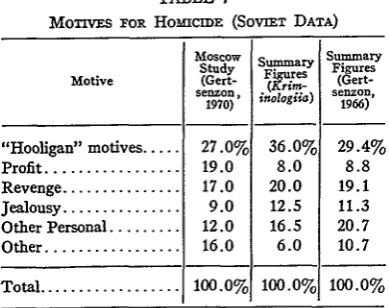
The category of "motive" recommends itself as a starting point in the search for an answer. Yet as Table 7 shows, the labels attached to motiva-tions are rather general, and of relatively little help. The large percentages of "hooligan" motives (khuliganskie pobuzhdeniia) tell us little except that the homicides occurred in a context of public-order violations. The relatively few offenses com-mitted for profit, as compared to those comcom-mitted for revenge, jealousy or other personal motives, testifies to the essentially impulsive nature of most homicides. (The divergence of the first-column figures may be due to the inclusion of only homi-cides under "aggravating circumstances.") The management of impulse, the insulation from stress-producing problems on a daily basis, are commodi-ties in relatively short supply among those Soviet citizens, mainly the urban semiskilled and unskilled working class, whose lives are "beset by ... high rates of desertion, separation, promiscuity, drink-ing, brutality, and incompatibility. ' 34 These, it may be argued, make up the main part of the recruiting pool of homicide offenders.
Beyond these considerations lies the problem of prevention. As we have already noted, firearms control, though strict, does not preclude the assign-ment of one-fifth of Soviet homicides in recent years to firearms. Important as well are the ca-pacities of police and the public to intervene before the fact, or early enough "in the act" to prevent its termination in death. Here, the problems are formidable, and the capacities and public will to act, lacking. Gertsenzon, reviewing a sample of Moscow cases in which the homicide failed, reports that in 4.0 percent of the cases, failure was due to interference with the offender by a citizen in a non-official capacity. Only one percent were pre-vented by the intervention of police officials. The other 95.0 percent were assigned to the victim's escape, a missed shot, or the victim's failing to die from the injuries received. 5
Failure of anyone to intervene is readily under-standable in the large number of cases which take place in the home. Such crimes, arising rapidly and unpredictably out of domestic quarrels, etc., are virtually "unpoliceable." However, 30 percent of those which take place on the street, or in other public places, have "noninterference by
eyewit-34
See Field & Anderson, Family and Social Problems in PROSPECTS FOR SovrET SocieTY, 396-97 (A. Kassof, ed. 1968).
11 A. GERTSENZON, supra note 2, at 68.
nesses to the crime" as a contributing factor.6 This is despite the USSR's emphasis on citizen responsibility, expressed both in propaganda and in organizational form through the druzhiny, the people's volunteer auxiliary militia. It seems that the typical Soviet city dweller shares with his Western counterpart a fear of injury and a desire not to "get involved." As there are many social and psychological forces operating to thrust some .Soviet citizens into homicide, just as in the West, there are also similarities in the lack of effective resources to deal preventively with the potenfial
offender.
36 KIMKNOLOGnA, at 413.
CONCLUSION
This has been a preliminary attempt to consider the nature and causes of criminal homicide in its Soviet context. Going further requires data of a nature and quantity not yet available. Most of what has been written here must be regarded as extremely tentative, and approached with caution. It is hoped, however, that the material presented has given some indication of the shared charac-teristics of Soviet and American homicide, as well as the points of divergence, and thus has thrown a small amount of light on a hitherto dark area of