Journal of Criminal Law and Criminology
Volume 65 | Issue 4
Article 15
1975
Self-Reported Delinquency: A Comparison of
Structured Interviews and Self-Administered
Checklists
Marvin Krohn
Gordon P. Waldo
Theodore G. Chiricos
Follow this and additional works at:
https://scholarlycommons.law.northwestern.edu/jclc
Part of the
Criminal Law Commons
,
Criminology Commons
, and the
Criminology and Criminal
Justice Commons
This Criminology is brought to you for free and open access by Northwestern University School of Law Scholarly Commons. It has been accepted for inclusion in Journal of Criminal Law and Criminology by an authorized editor of Northwestern University School of Law Scholarly Commons.
Recommended Citation
SELF-REPORTED DELINQUENCY: A COMPARISON OF STRUCTURED
INTERVIEWS AND SELF-ADMINISTERED CHECKLISTS
MARVIN KROHN,* GORDON P. WALDO,**
ANDTHEODORE G. CHIRICOS *
A critical issue in the study of deviant be-havior is the operational definition of the de-pendent variable. Such definitions are central not only to the process of measuring deviant phenomena, but also to the process of assign-ing meanassign-ing to data. The implications of this issue have been clearly drawn for the study of juvenile delinquency by Hirschi and Selvin who note that "how one defines delinquency determines in 'large part how one will explain delinquency." ' While a variety of empirical referents2 have been employed in operational definitions, the major source of discussion and controversy has been the distinction between official and self-report indices of delinquency.
Early studies employed operational defini-tions of delinquency that were coextensive with the availability of official data for arrests or court appearances among juveniles.8 These and similar studies frequently reported inverse relationships between social class and juvenile delinquency which prompted theorists to expli-cate the conditions of lower-class life that dis-pose, if not constrain, toward delinquency.4
The recognition that "official" rates of delin-quency are as informative about the results of frequently arbitrary and inconsistent patterns of law enforcement as they are about
delin-*Department
of Sociology, Western Illinois University** School of Criminology, Florida State
Univer-sity
***
School of Criminology, Florida State Uni-versityT. HiascHi & H. SELVIN, DELINQUENCY RE-SEARCH: AN APPRAISAL OF ANALYTIC METHODS
185 (1969).
2 For a discussion of this issue, see HiRScHI & SELVIN, supra note 1, at 177-200.
3See, e.g., R. PAPx, E. BURGESS & R. Mc-KENZIE, THE CITY (1925); C. SHAW & H. McKAY, JUVENILE DELINQUENCY AND URBAN AREAS (1942).
2See, e.g., R. CLOWARD & OHLIN, QUENCY AND OPPORTUNITY: A THEORY OF DELIN-QUENT GANGS (1960); A. COHEN, DELINQUENT
Boys: THE CULTURE OF THE GANG (1955);
Miller, Lower Class Culture as a Generating
Mi-lieu of Gang Delinquency, 14 J. SOCIAL ISSUES 5
(1958).
quent behavior has led to the increased em-ployment of self-report measures of delin-quency such as those pioneered by Nye and Short.5 Studies using a self-report technique6 have cast doubt upon the presumption of an in-verse relationship between delinquency and so-cial class, and have sharpened the distinction between delinquent behavior and delinquent be-havior that has been responded to by official agents of social control.7 While this distinction has increased concern for the processes of sanctioning and labelling, it has not resolved the issue of how to measure delinquency. Re-cent empirical research includes notable exam-ples of both official8 and self-reporting9
meas-ures of juvenile delinquency.
If the argument for rejecting self-report measures of delinquency is expediency or theo-retical concern,'0 resolution of the issue
will
Nye & Short, Scaling Delinquent Behavior, 22 Am. SOCIOLOGICAL REv. 326 (1957); Short & Nye,
The Extent of Unrecorded Juvenile Delinquency: Tentative Conclusions, 49 J. CRIm. L.C., & P.S.
296 (1958) ; Short & Nye, Reported Behavior as a
Criterion of Deviant Behavior, 5 SOCIAL PROBLEMS
207 (1957).
6 See, e.g., Akers, Socio-economic Status and Delinquent Behavior, 1
J.
REs. CRIME & DEIN-QUENCY 38 (1964); Clark & Wenninger,Socio-economic Class and Areas as Correlates of Illegal Behavior Among
Juveniles,
27 Ama. SOCIOLOGICALIEv. 826 (1926); Erickson & Empey, Class
Posi-tion, Peers and Delinquency, 49 SOCIOLOGY &
SO-CIAL RES. 269 (1965); Gold, Undetected
Delin-quent Behavior, 3
J.
REs. CRImE & DELINQUENCY 27 (1966) ; Vaz, Self-Reported Juvenile Delin-quency and Socio-economic Status, 8 CAN. J. CORRECTIONS 20 (1966) ; Voss, Socio-economic Status and Reported Delinquent Behavior, 13 So-CIAL PROBLEMS 314 (1966); Williams & Gold,Prom Delinquent Behavior to Official Delinquency,
20 SocIAL PROBLEMS 209 (1972).
7 Williams & Gold, supra note 6.
S M. WOLFGANG, R. FIGLIO & T. SELLIN, DE-LINQUENCY IN A BIRTH COHORT (1972).
9 HIRSCHI & SELVIN, supra note 1; Williams &
Gold, supra note 6.
:O Expediency in this context refers to the
KROHN, WALDO AND CHIRICOS
reflect the professional perspective or bias of the individual researcher. However, if the ar-gument is offered that variable conditions of the self-reporting process directly affect the amount and types of delinquency reported, then the issue is subject to empirical consideration. Specifically, it has been suggested that both the method of self-reporting (anonymous question-naire versus interview) and the quality of re-spondent-researcher interaction can have seri-ous consequences for the self-reporting process."1 The present research offers empirical evidence bearing upon the question of whether different alternatives in the self-reporting methodology create a difference in the amount and type of delinquency reported. The context of the present findings is briefly elaborated in the following discussion of related methodolog-ical considerations.
QESTIONNAIRE VERSUS INTERVIEW METHODS
OF SELF-REPORTING
The issue of the relative merits of question-naire and interview methods of self-reporting delinquency has been forcefully joined by Gold who argued that such distinctions in methodol-ogy have had implications for the apparent re-lationship between social class and delinquent behavior.'2 Gold argues that higher status re-spondents to a self-administered questionnaire tend to report more non-chargeable offenses, thereby negating the expected inverse relation-ship between social class and delinquent behav-ior. Gold suggests that interviewing partially mitigates this problem by assuring the inter-viewer that the behavior being reported is, in-deed, delinquent behavior.
Voss argued that the conclusion could not be drawn that the method of self-reporting was principally responsible for findings of "no rela-tionship" between social status and delin-quency,'3 inasmuch as Slocum and Stone had utilized interviews and had similarly
discov-so labeled by discov-society. H. BECKER, OUTSIDERS: STUDIES IN THE SOCIOLOGY OF DEVIANCE (1963).
"1 See Erickson & Empey, supra note 6; Gold,
Undetected Delinquent Behavior, 3 J. RES. CRIME
& DELINQUENCY 27 (1966); Williams & Gold,
supra note 6.
12 Gold, On Social Status and Delinquency, 15 SOCIAL PROBLEMS 115 (1967).
13 Voss, A Reply to Gold, 15 SOCIAL PROBLEMS
116 (1967).
ered no significant relationship.'4 This argu-ment is further supported in a more recent study by Williams and Gold which employed the interview technique on a nationwide sam-ple and found no relationship between social class and delinquent behavior.', Voss further suggests that while interviews may enhance validity by providing the opportunity to probe, anonymous questionnaires could afford more frank responses than could be elicited in the
presence of an interviewer.'
Efforts to provide external validity checks for interview or questionnaire data are difficult and costly-a fact which probably accounts for
the infrequency of such attempts. Neither
Ball's interview study of narcotic addicts' 7 nor Hackler and Lautt's questionnaire study of ju-venile delinquents'8 provided definitive evi-dence for the invalidity of either measure. More systematic validation has proved similarly inconclusive. For example, Gold attempted to validate the responses he obtained from inter-views by using informants as an external criterion.'9 He did this for a small percentage of his sample and found that 72 per cent of his subjects could be considered "truthtellers." Clark and Tifft attempted to utilize a poly-graph examination as an external validity check on questionnaire data.20 The results
indi-cated that all respondents underreported the frequency of at least one behavior, and
one-half of the respondents overreported on at least one behavioral item. However, the overall
pro-portion of correct answers was 81.5 per cent.2'
14 Slocum & Stone, Family Culture Patterns
and Delinquent-Type Behavior, 25 MARRIAGE AND FAMILY LIVING 202 (1963).
15 Williams & Gold, supra note 6.
16 Voss, A Reply to Gold, 15 SOCIAL PROBLEMS 116 (1967).
'1 Ball, The Reality and Validity of Interview
Data Obtained from 59 Narcotic Drug Addicts, 7Z
Am. J. SOCIOLOGY 650 (1967).
18 Hackler & Lautt, Systematic Bias in
Measur-ing Self-Reported Delinquency, 6 CAN. REV.
Soci-OLOGY & ANTHROPSoci-OLOGY 92 (1969).
19 M. Gold, DELINQUENT BEHAVIOR IN AN AMERICAN CITY (1970).
20 Clark & Tifft, Polygraph and Interview
Vali-dation, of Self-Reported Deviant Behavior, 31 AMi.
SOCIOLOGICAL REV. 516 (1966).
21 It should be noted that Defleur has offered several criticisms concerning the methodology
em-ployed by Clark and Tifft which reduce the mag-nitude of their findings. Defleur, The Polygraph
and Interview Validation, 32 AM. SOCIOLOGICAL REV. 114 (1967).
A related issue in the comparison of
inter-iew and questionnaire formats of self-reporting involves the problem of assuring anonymity of tesponses.22 While it is generally argued that anonymity is more convincingly assured in questionnaire, as opposed to interview, set-tings,2 3 Hyman has cautioned that "the literal fact of anonymity provides no necessary
psy-chological anonymity."24
The -presumption that anonymity is desirable or essential for delinquency research25 has not received a great deal of support from available empirical evidence. For example, assurances of anonymity have been shown to make no signif-icant difference in responses to attitude ques-tionnaires.26 Similarly, some delinquency re-searchers have concluded that anonymity is unnecessary,27 overemphasized28 or of little consequence.2 9
A recent study by Bowers provides some data on the question of anonymity.30 Bowers' i-esearch design provided for three distinct lev-"els of anonymity: (1) Guaranteed Anonymity:
wherein respondents were specifically requested
22 There is some confusion in the literature be-tween the terms anonymity and confidentiality. There is a question in most research designs of Whether true anonymity can ever be assured. In 1nost instances it is only guaranteed that the data Will be treated in a confidential manner which pre-umably assures the anonymity of the respondent.
23
See C.
SELLITZ, M. JAHODA,M.
DEUTSCH & S. Coox, RESEARCH METHODS IN SOCIAL RELA-TIONS (1965).24 R. HYMAN, INTERVIEWING IN SOCIAL RE-SEARCH (1954).
2
5R. HARD'r & H. BODINE, DEVELOPMENT OF SELF-REPORT INSTRUMENTS IN DELINQUENCY RE-PORT: A CONFEENCE REPORT,
1965
(YouthDevel-opment Center, Syracuse University) ; Akers,
-supra note 6.
26 See, e.g., Corey, Signed Versus Unsigned
At-titude Questionnaires,
28J.
EDUCATIONALPsy-'CHOLOGY 144 (1937) ; Pearlin, The Appeals of
An-.onymity in Qiwstionnaire Response, 25 PtBLIc OPINION Q. 640 (1961); Rosen, Anonymity and
Attitude
Measurement, 24 PUBLIC OPINIONQ. 75
(1960).
27
M. GOLD,
DELINQUENT BEHAVIOR IN ANAmFai-'CAN CITY (1970) ; Dentler, Report of Participant in HAIUyr & BODINE, supra note 25, at 7-8.
28 Kulick, Stein & Sarbin, Disclosure of
Delin-quent Behavior Under Conditions of Anonymity
-and
Nonanonymity, 32J.
CONSULTING CLINICALPSYCHOLOGY 506 (1968).
29 Christie, Report of Participant in HARmT & :B0DINE, supra note 25, at 1-3.
30 W. BOWERS, QUESTION SEQUENCING EFFE cTS ON RESPONSE TO SENSITIVE QUESTIONS IN THE SELF-ADMIINISTERED QUESTIONNAIRE (Russell B.
Steams Research Center, 1971).
not to sign their questionnaires; (2) Volun-tary Identification: wherein respondents could choose to sign or not sign their question-naires; and (3) Mandatory Identification: wherein respondents were specifically requested to sign the questionnaires. Bowers found that less serious cheating offenses were more often reported by those who received "Guaranteed Anonymity." However, more serious cheating offenses were less often reported under condi-tions of "Guaranteed Anonymity" than under conditions of "Voluntary Identification." The author concluded that perhaps the request of respondents not to sign their questionnaires created a sense of apprehension for serious cheaters.3 1
Unfortunately, there has been little research directed to an examination of the differences in data collected by questionnaire and inter-view techniques within the same research set-ting. A conference held at Syracuse University to discuss the methodological problems encoun-tered in self-report techniques concluded that it was vital that systematic comparisons from interviews and questionnaires be undertaken.32 The comparisons that do exist neither involve delinquent behavior nor provide definitive re-sults. McDonough and Rosenblum,3 3 as well as Gibson and Hawkins,34 suggest that little dif-ference exists in the responses to question-naires and interviews when the items are not "threatening" and require little in the way of "personal revelation." The data on responses to "threatening" items are less consistent. Whereas Cannell and Fowler35 report that the type of data collection has no effect, both Young36 and Ellis3 7 provide evidence which
31 This issue is related also to the
characteris-tics of the researcher who is collecting the data. In the present research both "hip" and "straight" data collectors were used in an attempt to address this issue.
32 HARuT & BODINE, supra
note 25.
33 McDonough & Rosenblum, A Comparison of
Mailed Questionnaires and Subsequent Structured
Interviews,
29 PUBLIC OPINIONQ. 131 (1965).
34 Gibson & Hawkins, Interviews Versus
Ques-tionnaires, 12 Am. BEHAVIoRIAL SCIENCE
NS9-11
(1968).
35 Cannell & Fowler, Comparison of a
Self-Enu-vieration Procedure and a Personal Interview: A Validity Study, 27 PUBLIC OPINION Q. 250
(1963).
36 P. YOUNG, SCIENTIFIC SOCIAL SURVEYS AND
RESEARCH (1966).
Meth-KROHN, WALDO AND CHIRICOS
suggests that respondents more frequently pro-vide answers to personal questions when a questionnaire is used. Ellis notes that female subjects were more explicit and self-condemna-tory in questionnaires as opposed to interview responses with regard to questions about their love relationships.
In brief, existing comparisons of question-naire and interview techniques of self-report-ing are neither extensive nor conclusive. Moreover, the research providing an explicit comparison of the two techniques does not in-volve deviant behavior. Indeed, there appears to be no study which compares the two data gathering techniques for delinquent behavior.
INTERVIEWER INTERACTION EFFECTS
A corollary question raised in discussing the method of eliciting valid self-report informa-tion is that of the interacinforma-tion between the re-spondent and the researcher. While it appears that such interaction effects should be greater in the interview as opposed to the question-naire situation, Cannell and Fowler have noted that the issue is salient for both methodologies since both methods usually require some con-tact between the researcher and respondent.38 Existing research on interviewer effects sug-gests that responses are in some measure ef-fected by: the friendliness of the interviewer ;3 the social distance between the interviewer and respondent;40 and the threat which the inter-viewer represents to the respondent.4 1 Of these variables Williams regards threat as the most crucial.42 This would seem especially true for self-reporting of potentially sensitive
infor-ods in the Study of Human Love Relationships, 12 Ami. SOCIOLOGICAL REv. 541 (1947).
38 Cannell & Fowler, A Note on Interviewer
Effect in Self-Enumerative Procedures, 29 Am. SOCIOLOGICAL REV. 270 (1964).
39 See Pfouts & Rader, The Influence of Inter-viewer Characteristics on the Initial Interview, 43 SOCIAL CASEWORK 548 (1962); Dohrenwood, Wil-liams & Weiss, Interviewer Biasing Effects
To-ward a Reconciliation of Findings, 33 PUBLIC
OPINION Q. 121 (1969).
40 See Katz, Do Interviews Bias Poll Results?,
6 PUBLIC OPINION Q. 248 (1954); Williams,
In-terviewer-Respondent Interaction: A Study of
Bias in the Information Interview, 27 SOCIOMETRY
338 (1964).
41 See A. CIcouRa., METHOD AND MEASURE-MENT IN SOCIOLOGY (1964); Williams, supra note
40.
42 Williams, supra note 40.
mation such as delinquent activities. Similarly,
Hardt and Bodine have reported on a study by James Coleman wherein high school students admitted significantly higher participation rates for smoking and drinking when the question-naires were administered by a teenage girl than when the administrator was an adult male social scientist.4 3 These results suggest that if the interviewer is less threatening, the re-spondents are more likely to report deviant be-havior. 'In general, the Syracuse Conference concluded that the entire question of inter-viewer interaction effects was one that re-quired additional empirical research-a need which the present research will attempt to ad-dress.
THE PRESENT STUDY
The purpose of this study is to provide em-pirical evidence that is currently unavailable in discussions of self-reporting methodologies for
research in deviant behavior. Specifically, a re-view of existing literature suggests that while there has been much debate concerning the rel-ative merits of questionnaire versus interview formats for self-reporting, there has been no systematic comparison of findings generated by the two methods within a single research set-ting. The present study partially addresses this issue. That is, the study will determine whether two random samples of college stu-dents report significantly different participatiory in delinquent activity when responding to an interview as opposed to a self-administered checklist.
In addition, this study will consider the question of whether self-reporting of delin-quent behavior is affected by the appearance of the investigator at the time of the interview or administration of the questionnaire. Specifi-cally, there will be a comparison of delinquent admissions made in the presence of two types of investigators: straight, conservative, mid-dle-class and "hip," "radical," "freaky."
It has been hypothesized that no significant differences will be found in the frequency of
delinquent activity admitted by respondents to interview and self-administered checklists. Fur-thermore, no significant differences will be found in the frequency of delinquent activity
43 HARDT & BODINE, supra note 25.
:admitted by respondents to "straight" as op-:posed to "hip" investigators.
METHOD
Data for the present study were generated as -part of a larger study concerned with a variety -of research questions dealing with respondent -perceptions of the law and crime, as well as :admissions of their own criminal activities.4 4 *The total number of respondents represent 82 -per cent of an original 3 per cent random sam--pie (stratified by school year) of the under-graduate population in a Southeastern -university.4 5
Potential respondents were randomly as-signed to five interviewers and were also ran--domly assigned (for each interviewer) into ei-ther an interview or checklist format. No -decisions were made by the interviewers at the time of data collection concerning which for-maat would be used. The interviewers made the initial contact by phone. They used a carefully Tehearsed procedure in requesting the student to participate in the study. The interviewer :and the respondent met in a setting designed to maximize privacy and comfort. After assur-ing the respondent of anonymity,4 6 the inter-viewer asked the student several demographic questions. Upon completion of these questions, one of the following procedures was followed for the purpose of securing self-reports of the respondent's delinquent or criminal activity.
In the first procedure a checklist containing eight criminal or delinquent offenses, ranging in seriousness from underage drinking to grand larceny was handed to each respondent in the "checklist group." The checklist asked the following questions for each offense: (a) How many times have you done this? (b) How old were you the first time you did this?
(c) How many people were you with the first time you did this? (d) How many times have you done this in the past year? (e) How
44Waldo & Chiricos, Perceived Penal Sanction
and Self-Reported Criminality: A Neglected Ap-proach to Deterrence Research, 19 SOCIAL
PROB-LE.S 522 (1972).
4"For a further discussion of the sampling pro-cedure, see Waldo & Chiricos, supra note 44.
46 Although the instructions read to the subjects gave assurances of anonymity, it is obvious that confidentiality would have been the more accurate term to use.
many people are you generally with when you do this? Having completed the checklist, the respondent was allowed to inspect the question-naire and a postage-paid envelope for any identifying characteristics. After the comple-tion of the remainder of the interview, the re-spondent, at his discretion, mailed the complete interview and checklist to the researchers. Re-spondents were told prior to beginning the checklist that they would be permitted to do this.
In the second procedure a checklist contain-ing the aforementioned questions was read to each respondent in an interview format, and the responses to the self-report items were rec-orded by the interviewer. The self-report checklist always remained in the interviewer's possession.
It should be noted that in both situations the respondent was verbally assured of the ano-nymity of his responses. The crucial differ-ence lies in the fact that in the checklist for-mat, the respondent could prevent the interviewer from seeing his responses on the checklist. Consequently, the respondent had the opportunity to anonymously mail the checklist, along with the remainder of the interview, to the researchers. In the interview format, delin-quencies were reported directly to the investi-gator, and total anonymity may have seemed less assured to the respondents.
KROHN, WALDO AND CHIRICOS
the "hip" or "radical" interviewers in the fol-lowing analysis.4 7
It is impossible to determine which of the two types of interviewers should be regarded as "more threatening," if indeed either could be so. regarded. On the one hand, one might argue that the "hip" interviewers would appear more deviant, and may be therefore less threat-ening in a situation wherein admissions of de-viance'are being made. On the other hand, for some respondents on a predominantly conserv-ative campus, the neat, conservconserv-ative interview-ers may appear more compatible and 'less so-cially distant than the "hip" or "radical" interviewers.
It is recognized that in terms of the possible variation in the appearance of interviewers that a small proportion of the range is in-cluded among the five interviewers in this study. Obvious restrictions are in terms of age, race, and sex since the interviewers are very homogenous in these respects. Because of the nature of the study, we had little control over these factors. However, since it was impossible to include sub-categories from all of the rele-vant characteristics, it is best that these factors remain constant. With a predominantly white college population, the age and race restric-tions would be those that most closely match respondents and data collectors. The fact that there were no female interviewers was acciden-tal and perhaps unfortunate, but since the data being collected had minimal sexual overtones, this may not be a serious liability.
The data have been analyzed in contingency tables, with measures of self-reported delin-quency dichotomized to reflect whether the re-spondent had committed the act within the past year.48
Chi-square tests for statistical
signifi-47 The labels of "hip" and "straight" as applied in this study might be disputed by those who have studied more extreme groups of deviants. These terms are used only in a relative sense to connote different sides of the liberal-conservative contin-uum among college students. The student popula-tion in this study would be considered on the con-servative side of this continuum and consequently the interviewers considered "hip" on this campus might be "moderate" or "straight" in a different context.
48 The offense variables were dichotomized due
to the nature of the data. When asked for the fre-quency of committment of a particular offense, a significant proportion could only provide answers such as "yes," "occasionally" or "frequently." It
TABLE 1
Percentage of Respondents Admitting Various Criminal Offenses In the Past Year by Interview
and Checklist Formats
Percent Percent Contin-Criminal Admitting Admitting gency
Offense Offense By Offense By x' 2 Coe-Interview Checklist ficient
Format Format
Alcohol
Under Age 64.8 69.8 .6898 .05
Drunken
Driving 32.1 37.0 .6676 .05
Marijuana
Use 25.8 36.4 3.7491 .11
Fighting 02.5 02.5 .1097 .02
Petty Theft 11.3 16.7 1.4848 .07
Grand
Larceny 0.0 01.9 1.3085 .06
Property
Damage 03.1 06.2 1.0419 .06
Illegal Entry 03.8 08.0 1.8966 .08
* All X tables presented have 1 degree of freedom
re-quiring a value of 3.84 for significance at the .05 level.
cance and contingency coefficients for a meas-ure of association have been computed.
FINDINGS
Table 1 summarizes the results of contin-gency analyses involving type of checklist ad-ministration and admission of delinquent activ-ity within the past year for eight offenses. The percentage of respondents admitting to a particular activity within the past year is. shown for both interview and checklist formats of the self-reporting process along with chi-square values and contingency coefficients. It can be observed in Table 1 that for seven of the eight offenses, checklist self-reports elicited a higher rate of admitted delinquency than in-terview self-reports. For the remaining offense (fighting) equivalent rates of delinquency were reported in both formats. However, despite the consistent direction of findings in Table 1, there is no instance wherein the differences produced
was felt that since these responses could not be accurately translated into frequencies, and because they represented a significant proportion of re-spondents admitting to the behavior, it would be better to dichotomize in this fashion rather than to use frequencies.
-by interview and checklist formats are
statis-tically significant at the .05 level or greater. It is interesting to note that the offense cate-gory which reflected the greatest difference by type of self-reporting format was marijuana use. This is not surprising, inasmuch as the re-maining offense categories involve behaviors which were not, for a student population, the subject of on-going surveillance and investiga-tion by law enforcement agencies. Indeed, in the months surrounding the data collection, drug arrests among university students were relatively frequent and highly publicized. Thus, if a respondent was apprehensive about reveal-ing delinquent behavior, and if interview self-reports were actually more threatening, it is reasonable to expect the greatest self-reporting reluctance to be manifested for drug related of-fenses.
Having discovered no statistically significant differences in the rates of delinquent admis-sions produced by written and oral self-reports, the possibility was explored that greater differ-ences might be elicited within categories of certain respondent characteristics. In this re-gard, several variables have been cited as poten-tially relevant. These include the respondent's level of education,4 9 sex,5 0 social class5 1 and intelligence.5 2 Each of these variables were separately controlled and the relationship be-tween the self-reporting format and criminal offenses was examined within the sub-catego-ries of each variable. None of these tables pro-duced significant differences in the rates of ad-mitted delinquency elicited by interview and checklist format.53
4 See
Cannell & Fowler,
Comparison of a Self-Enumeration Procedure and a PersonalInter-view:
A Validity Study, 27 PUBLIC OPINION Q.250 (1963).
to
Cahalon, Correlates of Respondent Accuracym the Denver Validity Survey, 32 PUBLIC
OPIN-ION
Q.
607 (1969).51 Social class was measured by the method
de-veloped by Nam and Powers and recorded empiri-cally into three categories which represent lower, middle and upper classes of the present sample, not of the population. Nam & Powers, Changes in
the Relative Status Levels of Workers in the United States: 1950-1960, 47 SOCIAL FORCES 158
(1968).
52 Because of the nature of the self-reporting
data collection process, it was impossible to obtain a measure of intelligence such as IQ. Conse-quently, grade point average was used in this study.
53 The tables for such computations were
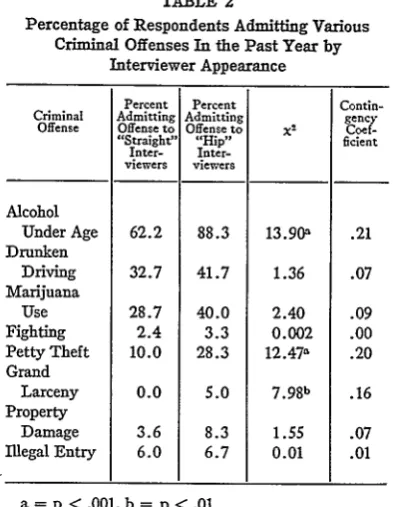
con-TABLE 2
Percentage of Respondents Admitting Various Criminal Offenses In the Past Year by
Interviewer Appearance
Percent Percent Contin-Criminal Admitting Admitting enc?
Offense Offense to Offense to x 2 C "Straight" "Hip" ficient
Inter- Inter-viewers viewers
Alcohol
Under Age 62.2 88.3 13.90P .21 Drunken
Driving 32.7 41.7 1.36 .07
Marijuana
Use 28.7 40.0 2.40 .09
Fighting 2.4 3.3 0.002 .00
Petty Theft 10.0 28.3 12.473 .20 Grand
Larceny 0.0 5.0 7.98b .16
Property
Damage 3.6 8.3 1.55 .07
Illegal Entry 6.0 6.7 0.01 .01
a
= p<.001,
b = p < .01The second principal question addressed by this research concerns the impact of "straight" versus "hip" interviewers on the rates of ad-mitted delinquency. Table 2 summarizes the re-sults of contingency analyses and explores this issue for the eight aforementioned offenses. For all eight offenses, the "hip" or "radical" interviewers received a greater percentage of delinquency admissions than the "straight" or "conservative" interviewers. Two offenses (un-derage drinking and petty larceny) were sig-nificant at the .001 level and grand larceny was significant at the .01 level. These data would suggest that type of interviewer may have consequences for the self-reporting
proc-ess.
To further examine the possible interviewer effects on the self-reporting process, the rela-tionship between type of interviewer and self-reported delinquent behavior was examined within the interview and checklist formats. It was surmised that if the "hip" interviewer elic-ited more self-reported delinquent acts, the ef-fect would be greater in the interview
[image:8.454.223.420.40.294.2]KROHN, WALDO AND CHIRICOS
TABLE 3
Percentage of Respondents Admitting Various Criminal Offenses in the Past Year
By Interviewer Appearance within Interview and Checklist Formats
Interview Format Checklist Format
Percent Percent Percent Percent
Criminal Offense Admitting Admitting Contin- Admitting Admitting Contin-Offense to Contin-Offense to x2 gency Offense to Offense to X2 genc "Straight" "Hip" Coef- "Straight" "Hip"
Ce-Inter- Inter- ficient Inter- Inter- ficient
viewers viewers viewers viewers
Alcohol Under Age ... 59.2 84.4 5.95c .19 64.9 92.9 7.29b .21 Drunken Driving ... 31.7 31.3 0.03 .01 33.6 53.6 3.14 .14
Marijuana Use ... 23.3 31.3 0.48 .06 33.6 50.0 2.02 .11 Fighting ... 2.5 3.1 0.18 .03 2.3 3.6 0.07 .02
Petty Theft ... 10.0 12.5 0.01 .01 9.9 46.4 19.89% .33
Grand Larceny ... 0.0 0.0 0.0 10.7 9.1ob .23
Property Damage ... 0.8 9.4 4.25 .16 6.1 7.1 0.50 .02
Illegal Entry ... 4.2 3.1 0.06 .02 7.6 10.7 0.026 .01
a = p <.001, b = p < .01, c = p < .05.
tration than in the checklist. The data exploring this question are examined in Table 3.
In comparing the relationships between the criminal offenses and interview type for both modes of checklist administration, it is observed that while none of the relationships are gener-ally very great, the association is stronger in the checklist format than in the interview for-mat. This is directly opposite to what had been expected.
Although there are no data which adequately explain this finding, it might be suggested that in an oral administration a skeptical respond-ent will not be as assured of anonymity as he might be in a written format. This might hold true no matter how non-threatening the inter-viewer happens to be. Given the fact that the checklist was in the interviewer's hands at all times, and that the interviewer necessarily had to know the respondent's name in order to contact him, the assurance of anonymity might lose much of its face validity. However, in the written administration, the respondent was permitted to mail in his questionnaire when he completed it. The claim of anonymity through
confidentiality in the written administration was somewhat more believable than it was in the oral administration. Therefore, for the skeptical respondent, the type of interviewer might have more effect in the written
adminis-tration since the respondent has a greater op-portunity for believing in the assurance of an-onymity.
CONCLUSION
The present research posited two methodolo-gical question concerning the administration of delinquency self-report instruments. The first was whether there would be any difference in the number of respondents who admitted to delinquent behavior when compared by whether the data were collected by an interview or by a written checklist. The results indicated that there was no statistically significant difference between the responses to the two types of administration.5 4 On the basis of these findings, it could be suggested that the issue of whether a researcher employing a self-report instrument should administer it orally or in a written man-ner, is not a crucial question. Unfortunately, the present research provided no external vali-dation and, therefore, a recommenvali-dation of which method will elicit more valid responses cannot be offered. Since the two groups were
54 However, the data did consistently indicate
that respondents who were allowed to record their own answers tended to report more offenses than did those who had verbally responded to the checklist. Perhaps one might interpret this trend as indicating that there might be some difference, albeit, not a statistically significant one.
randomly selected, however, and no differences in the percentage reporting criminal acts were apparent, there is no reason to assume that one technique is any more valid than the other.
The second question addressed by this re-search was whether the type of interviewer would have an effect on the subject's re-sponses. It was determined that for three of-fense categories, the type of interviewer did have an effect. Furthermore, the interviewer effect was greater in the checklist administra-tion than in the interview administraadministra-tion. These findings might be interpreted as an indi-cation that a non-threatening interviewer will have greater influence on the response rate when the assurance of anonymity is perceived as being valid.
There are at least four issues raised by the present study which serve as suggestions for future research. One limitation of this project was the absence of a true questionnaire group to compare with the interview group and the self-administered checklist group. A question-naire group was considered in the design of the original project and pragmatic considera-tions prevented the inclusion of this category in the study. Unless considerable resources are available for a follow-up study on mailed ques-tionnaires, there are obvious problems in the biased sample obtained by those who return questionnaires versus those who do not. In ad-dition, most forms of follow-up studies require either open or surreptitious knowledge of who has returned a questionnaire and who has not. This creates problems relating to anonymity
and confidentiality of the data.
A second issue concerns the homogeneity represented in the typical college student sam-ple. In order to properly address the questions being raised in this study, a random sample of a larger and more representative population would be desirable. It is unrealistic to antici-pate that there could be a generalization from a student group to the larger community in re-gard to the questions addressed in this study.
A third issue concerns the relative homo-geneity of the interviewers in the present study. As noted earlier, there are several major demographic characteristics which did not vary among the interviewers. These char-acteristics would include such factors as race, sex and age. Within a limited sample there are obvious advantages in having these factors constant. However, there are a multitude of re-search questions that could be examined if a study could be of sufficient scope to vary some of these variables and examine different combi-nations of characteristics.