BIROn - Birkbeck Institutional Research Online
Bullock, Joshua M.A. and Sen, N. and Thalassinos, Konstantinos and Topf,
Maya (2018) Modeling protein complexes using restraints from Crosslinking
Mass Spectrometry. Structure 26 (7), 1015-1024.e2. ISSN 0969-2126.
Downloaded from:
Usage Guidelines:
Please refer to usage guidelines at
or alternatively
Crosslinking Mass Spectrometry
Graphical Abstract
Highlights
d
A scoring function that outperforms more commonly used
crosslink scoring methods
d
A comparison of methods to calculate the distance between
crosslinked residues
d
Combining low-resolution 3D-EM and crosslinking
information improves scoring
Authors
Joshua Matthew Allen Bullock,
Neeladri Sen,
Konstantinos Thalassinos, Maya Topf
Correspondence
[email protected]
In Brief
Bullock et al. present a scoring function
for modeling protein complexes based on
crosslink data (cMNXL) that outperforms
other functions currently in use. They also
combine this method with a 3D-EM fitting
score to create a combined scoring
function that outperforms each
score alone.
SASD
Pr
ob.
x
H O2H O2
H O2
Expected
distance
Violating
cross-links
Solvent
Accessibility
32 ÅcMNXL
+
+
+
combined
score
Bullock et al., 2018, Structure26, 1–10
July 3, 2018ª2018 The Author(s). Published by Elsevier Ltd.
Structure
Resource
Modeling Protein Complexes Using Restraints
from Crosslinking Mass Spectrometry
Joshua Matthew Allen Bullock,1Neeladri Sen,3Konstantinos Thalassinos,1,2and Maya Topf1,4,*
1Institute of Structural and Molecular Biology, Birkbeck College, University of London, Malet Street, London WC1E 7HX, UK 2Institute of Structural and Molecular Biology, Division of Biosciences, University College London, London WC1E 6BT, UK 3Indian Institute of Science Education and Research Pune, Pashan, Pune 411 008, India
4Lead Contact
*Correspondence:[email protected]
https://doi.org/10.1016/j.str.2018.04.016
SUMMARY
Modeling macromolecular assemblies with
re-straints
from
crosslinking
mass
spectrometry
(XL-MS) tends to focus solely on distance violation.
Recently, we identified three different modeling
features inherent in crosslink data: (1) expected
dis-tance between crosslinked residues; (2) violation of
the crosslinker’s maximum bound; and (3) solvent
accessibility of crosslinked residues. Here, we
implement these features in a scoring function.
cMNXL, and demonstrate that it outperforms the
commonlyused crosslink distance violation. We
compare the different methods of calculating the
distance between crosslinked residues, which
shows no significant change in performance when
using Euclidean distance compared with the
sol-vent-accessible surface distance. Finally, we create
a combined score that incorporates information
from 3D electron microscopy maps as well as
cross-linking. This achieves, on average, better results
than either information type alone and demonstrates
the potential of integrative modeling with XL-MS and
low-resolution cryoelectron microscopy.
INTRODUCTION
Protein complexes play a critical role in the cell, either through transient cell signaling complexes or via the specialized func-tions of macromolecular machines. Determining the structures of protein complexes is therefore essential for a mechanistic un-derstanding of the cell. Unfortunately, protein complexes can be problematic to study with traditional structural techniques, such as X-ray crystallography, nuclear magnetic resonance (NMR), or cryo electron microscopy (EM), due to their size, heterogeneity, or resistance to crystallization (Leitner et al., 2016; Thalassinos et al., 2013). A recently established paradigm, integrative modeling, sidesteps issues arising from individual structural techniques by integrating orthogonal information from a range of experimental sources (Ward et al., 2013). This information is combined into a scoring function that determines how well a given model satisfies the input information.The sources of
infor-mation can range from traditional structural methods such as
X-ray crystallography, NMR, and 3D-EM (Lasker et al., 2012;
Russel et al., 2012; Simon et al., 2010) to methods that generate sparse structural information, such as small-angle X-ray scat-tering (Michie et al., 2016), fluorescence resonance energy trans-fer (Bonomi et al., 2014), native mass spectrometry (MS) (Politis et al., 2014), ion-mobility MS (Politis et al., 2010), and Crosslink-ing MS (XL-MS) (Chen et al., 2010; Erzberger et al., 2014; Leitner et al., 2012).
XL-MS is a technique typically used to generate distance re-straints, which can be used for protein modeling. The concept of protein crosslinking has been around a long time, although it is not until recently that its popularity has increased, due to tech-nical advances in detector design (Hu et al., 2005), crosslink
spectra identification software (Leitner et al., 2014a; Yang
et al., 2012), crosslinking reagents (Ihling et al., 2006; Leitner et al., 2014b; Rivera-Santiago et al., 2015), and modeling meth-odologies (Ferber et al., 2016; Russel et al., 2012). XL-MS re-straints can be used exclusively to generate models, or validate
models fitted into medium-resolution cryo-EM maps (Wang
et al., 2017) or low-resolution subvolume averages from cryo electron tomography (cryo-ET) (Dodonova et al., 2015).
A typical crosslinking experiment consists of first reacting the protein complex with crosslinker, which covalently binds specific amino acids (either lysine, aspartic or glutamic acid, or cysteine) within a given distance (from 0 to 50 A˚) depending on the length of the crosslinker. The crosslinked complex is then digested by proteases and the crosslinked peptides are analyzed and identi-fied via MS (Rappsilber, 2011). From this, one can establish which two amino acids are within the crosslinker maximum bound in the native structure, which can be encoded into dis-tance restraints used for modeling.
Another aspect of crosslinking that is commonly overlooked is that crosslinks can only form on residues that are solvent sible; therefore, crosslinks can act as a proxy for solvent acces-sibility. We previously made use of this solvent accessibility information by defining a non-accessible crosslink, i.e., a cross-link that has been experimentally observed but where one or both of the crosslinked residues are non-solvent accessible in the model. Incorporating this solvent accessibility information was shown to be very beneficial to the modeling of protein monomers (Bullock et al., 2016).
The distance between two crosslinked residues is usually calculated in one of two ways. The most common method is the Euclidean distance (ED), i.e., a direct line between the two
Structure26, 1–10, July 3, 2018ª2018 The Author(s). Published by Elsevier Ltd. 1
This is an open access article under the CC BY license (http://creativecommons.org/licenses/by/4.0/).
crosslinked residues. By virtue of its simplicity, it is a very quick calculation to perform; however, as this does not take into ac-count the fact that a crosslinker cannot travel through protein mass, it can be inaccurate. This is in contrast to the solvent-accessible surface distance (SASD), defined as the shortest path between two residues across the surface of the protein (Kahraman et al., 2011), which can be calculated using the soft-ware Jwalk (Bullock et al., 2016). Additional accuracy can be ob-tained by considering the flexibility of crosslinked residues’ side chains (Degiacomi et al., 2017).
Previously, when crosslinking restraints have been used for scoring models of protein monomers and complexes the most common approach has been to use only violation of the maximum bound of the crosslinker (number of violations [NoV]). This scoring can be done either via a step function, i.e., a crosslink is either violating or not (Leitner et al., 2012; Politis et al., 2014; Thalassinos et al., 2013), a smoothed scoring func-tion (Belsom et al., 2015; Hofmann et al., 2015) or a probabilistic Bayesian approach (Russel et al., 2012). In all these cases, the only crosslink information used pertains to the crosslinker maximum bound. The expected distance between crosslinked residues (taken from an experimentally observed distribution) can also be used to sample and score models, again imple-mented in a Bayesian framework in the software XL-MOD (Ferber et al., 2016). It is also possible to use crosslinking data as a proxy for solvent accessibility, which has been previously
used in a ROSETTA-based docking protocol (Kahraman
et al., 2013).
To improve upon existing crosslink scoring regimes, here we combine the three potential types of modeling restraint encoded in crosslinking information: (1) the maximum bound of cross-linker; (2) the expected distance between crosslinked residues; and (3) the solvent accessibility information of crosslinked resi-dues. Previously, we incorporated these three sources into the
scoring function Matched and Non-accessible Crosslink
(MNXL) score, and showed it to outperform the NoV method
when modeling protein monomers (Bullock et al., 2016). Here
we extended the MNXL scoring function to score protein com-plexes (cMNXL) by incorporating all of the previous information as well as handling intra-subunit and inter-subunit crosslinks differently, in order to maximize modeling performance. We then tested our new scoring function on a simulated benchmark of 68 protein dimers and a separate benchmark of 9 protein com-plexes, with associated experimental crosslinks taken from XLinkDB2.0 (Schweppe et al., 2016), and compared it with the performance of using either the maximum bound or expected distance alone. We were also able to compare the effects on modeling performance when using SASD or ED to measure the distance between crosslinked residues. Finally, to investigate how crosslinking can be integrated with other structural tech-niques such as cryo-EM or -ET, we combined cMNXL with 3D-EM density information to generate a combined score, which adds mutual complementary modeling information.
RESULTS
Theory
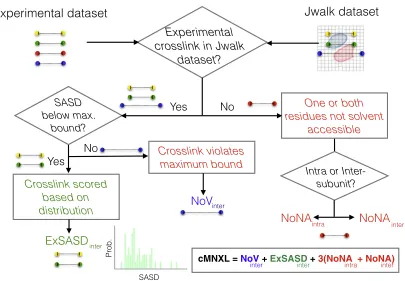
We updated our previous scoring function to create cMNXL. cMNXL is made up of the number of non-accessible (NoNA)
feature of both intra- and inter-subunit crosslinks and the num-ber of violations and expected SASD of inter-subunit crosslinks (NoV and ExSASD, respectively).
The cMNXL score is defined as follows:
cMNXL=ExSASD+NoV+3 3ðNoNAinter+NoNAintraÞ;
where ExSASD is the expected SASD between inter-subunit
crosslinked residues,NoVis the number of inter-subunit cross-links that violate the theoretical maximum bound of the
crosslinker, NoNA is the number of crosslinks that are
non-accessible (i.e., one or both of the crosslinked residues is not solvent accessible), and the subscriptsinterandintrarefer to in-ter-subunit and intra-subunit crosslinks, respectively. During the study, the score from each of these terms was calculated sepa-rately and a systematic investigation into the different weighting
was performed in order to return the best results (seeSTAR
Methods). The optimum scoring regime for each crosslink feature is described below.
ExSASD: if it is possible to calculate the SASD in the model
and the SASD is below the maximum bound, it is scored for in-ter-subunit crosslinks as follows:
ExSASD½SASD=
Nð21:92; 4:87Þ SASD%32 A
0 else ;
Where N is a normal distribution fitted to the distribution of SASDs for inter-subunit crosslinks under 32 A˚ taken from the XLdb (Bullock et al., 2016).
In the comparison between SASD and ED,ExEDis substituted
forExSASD.ExEDis scored as follows:
ExED½ED=
Nð18:35;4:11Þ ED%30 A
0 else ;
where N is a normal distribution fitted to the distribution EDs for inter-subunit crosslinks under 30 A˚ taken from the XLdb (Bullock et al., 2016; Leitner et al., 2012).
NoV: if it is possible to calculate the SASD in the model but the SASD exceeds the crosslinker maximum bound, it is scored as follows:
NoV½SASD= 0:1 SASD >32 A
0 else ;
or in the case of ED,
NoV½ED= 0:1 ED >30 A
0 else :
NoNA: if no SASD for a pair of either inter- or intra-crosslinked residues can be calculated, because one or both of the cross-linked residues are no longer solvent accessible, this crosslink is defined as non-accessible, respectively, and is scored a flat penalty of0.1. cMNXL score belongs to the setfcMNXL˛Rg.
cMNXL Scoring Workflow
dataset is then compared against either the experimental MS da-taset (crosslinks taken from the XLinkDB2.0 [Schweppe et al., 2016]) or a theoretical MS dataset (i.e., all the SASDs calculated with Jwalk [Bullock et al., 2016] under the maximum bound of 32 A˚). Each crosslinked pair of residues, in either the experi-mental or theoretical MS datasets, is then compared against the test dataset based on which the crosslinks are scored. The score for each crosslink is then totaled into a final score for each model (Figure 1).
Performance of cMNXL
Theoretical Benchmark
To statistically evaluate this scoring function, we tested cMNXL on a theoretical benchmark of 68 protein dimers, each with 100 models at a range of qualities. The models were scored us-ing theoretical crosslinks. To replicate a more realistic scenario, we bootstrapped crosslinks at 15% recovery with a minimum of 2 inter-subunit crosslinks (seeSTAR Methods).
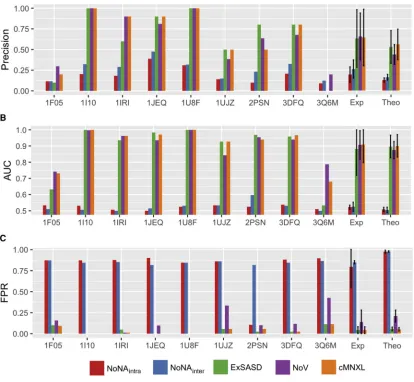
Overall, cMNXL achieves an average precision of 0.560 and
average area under the curve (AUC) of 0.901 (Figure 2 and
Table S1). This is a significant improvement over the more commonly used NoV score, which has an average precision of
0.438 and AUC of 0.875 (p values 4.11e12 and 2.835e06,
respectively). cMNXL also has a significantly lower false-positive rate (FPR) than NoV (0.050 versus 0.207) making cMNXL a more reliable score (p < 2.2e16).
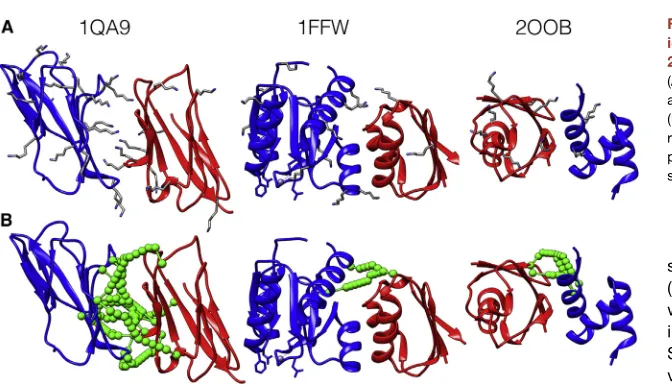
There is a range of performance across the benchmark. Cases that can be modeled successfully tend to have high frequency of lysine residues on the surface, for example PDB: 1QA9 or 1FQJ,
which contain 27 and 38 lysines across the complex, respec-tively (Figure 3andTable S1). Cases that perform badly include PDB: 1FFW, in which one subunit has only two lysines and there-fore one subunit position cannot be triangulated against the other (Figure 3). If the complex is too small for the length of re-straint used, the results will also be bad, as in the case of PDB: 2OOB, because significant deviations from the native structure can be made without violating any of the distance restraints ( Fig-ure 3). Testing cMNXL at different levels of recovery confirms that an increase in crosslink recovery improves performance, although this performance starts to plateau at a theoretical re-covery of50% (Figure S1).
The best-performing term of cMNXL is theExSASD score,
which alone achieves an average precision and AUC of 0.529 and 0.897, respectively. This is followed by the NoV term, which achieves a lower precision and AUC of 0.428 and 0.875, respectively. The non-accessible crosslink terms (NoNAintraand
NoNAinter) perform the least, with low precisions when used on
their own (0.128 and 0.161 forNoNAintraandNoNAinter,
respec-tively) (Figure 2andTable S1). However, when combined with the other scoring terms there is a small but significant improve-ment in precision (from 0.557 to 0.560, p = 0.0329) but not in AUC.
Experimental Benchmark
To discover how cMNXL performed with experimental crosslink-ing data, we then tested cMNXL on a second benchmark of 9 protein complexes, each with 100 models at a range of quality, using experimental crosslinks taken from the XLinkDB2.0.
cMNXL achieves a higher average precision of 0.644 and AUC of 0.908. Although overall on this small benchmark the
SASD
Pr
ob.
Experimental dataset
Jwalk dataset
Experimental
crosslink in Jwalk
dataset?
One or both
residues not solvent
accessible
Intra or
Inter-subunit?
SASD
below max.
bound?
Crosslink violates
maximum bound
Crosslink scored
based on
distribution
Yes
No
Yes
No
NoNA
intraNoNA
inter
ExSASD
interNoV
intercMNXL = NoV +
ExSASD
+
3(NoNA + NoNA)
intra inter
[image:5.603.99.504.97.378.2]inter inter
Figure 1. Flowchart Detailing the Scoring Workflow of cMNXL
cMNXL is the total of the scores for each individual experimental crosslink.
Structure26, 1–10, July 3, 2018 3
NoV score performs similarly to cMNXL, with non-significant increase in precision and a non-significant decrease in AUC (0.656 and 0.907 for precision and AUC, respectively),
the FPR is significantly worse (from 0.138 to 0.040,
p = 0.018). In the 3 out of 9 individual cases where NoV
out-performs cMNXL, NoV has a much higher FPR (Figure 2and
Table S2).
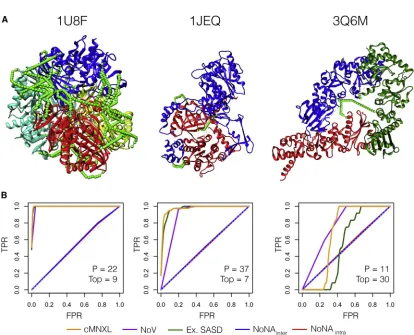
Generally across the benchmark, the higher the number of crosslinks, the more successful the modeling, as is the case for PDB: 1U8F, which has 162 crosslinks (42 inter- and 120
intra-subunit) (Figure 4). However, PDB: 1JEQ also performs
very well, which is surprising given the lower count of crosslinks (4 inter- and 5 intra-subunit crosslinks). Here, the inter-subunit crosslinks are located in three discrete regions across the pro-tein interface, which triangulates the propro-tein orientation and optimizes the scoring.
When there are not enough inter-subunit crosslinks to trian-gulate the protein orientation, modeling performance (with
either cNMXL or NoV alone) is severely affected. With PDB: 1F05 (Figure 2) there are only 2 inter- and 10 intra-subunit crosslinks. Without a third inter-subunit crosslink to triangulate the orientation, many bad models do not violate any crosslinks at all. The top scoring model is mostly correct in terms of orien-tation; however, the subunits are rotated so that the two inter-subunit crosslinks are closer together than in the native structure, as this maximizes the ExSASD scoring aspect. PDB: 3Q6M is the worst performing in the benchmark because there are only three inter-crosslinks between three subunits and as a result, large deviations in orientation are tolerated ( Fig-ure 4). In this case, the NoV appears to outperform cMNXL; however, this is an artifact of the way precision and AUC are
calculated in NoV (seeSTAR Methods), given that 49 models
[image:6.603.99.513.110.492.2]across a range of mean root-mean-square deviations (RMSDs) (0.00–29.41 A˚) only violate one crosslink and as a result all are ranked second. The poor FPR of NoV (0.427) reflects this ( Fig-ures 2andS2).
Figure 2. Performance of cMNXL Terms
Comparison of SASD and ED
Next, we compared the effect on modeling performance when using either SASD or ED to calculate the distance between crosslinked residues. While SASD is theoretically more correct, using Jwalk to calculate SASD is around 5 orders of magnitude slower than ED (despite significant speed improvements due to parallelization). This can become prohibitive when dealing with large numbers of models and crosslinks.
We substituted ED for SASD in cMNXL (cMNXLED) to make a
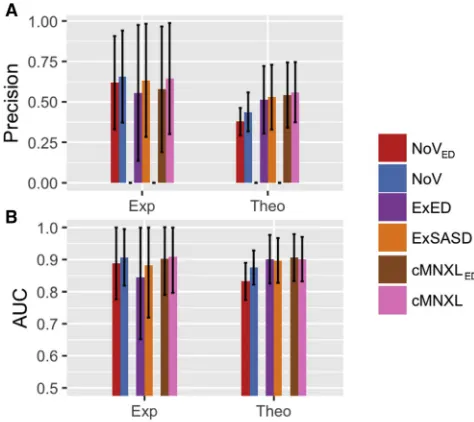
direct comparison between the distance types and retain the solvent accessibility information that would otherwise be lost when solely using ED. Upon use of ED, there is no significant change in precision (from 0.560 to 0.542 for cMNXL to
cMNXLED, respectively) or AUC (from 0.901 to 0.906 for
cMNXL to cMNXLED, respectively) (Figure 5 and Table S1).
Looking specifically at ExSASD and substituting in the ED (ExED) also gave only a small non-significant decrease in both precision and AUC. Surprisingly, substituting ED into NoV (NoVED) and comparing with NoV does result in a signifi-cant decrease in performance, in both precision and AUC
(p values 1.141e09 and 2.321e12 for precision and AUC,
respectively).
This trend is generally also observed in the experimental benchmark, where there are non-significant decreases in
precision and AUC when switching from cMNXL to cMNXLED
(Figure 5andTable S2). The performance difference between
NoV and NoVED is larger but also remains insignificant.
Surprisingly, the comparison between ExSASD and ExED shows a much larger drop in performance, where the decrease in AUC is significant (0.882–0.844, p = 0.0281). This can be attributed to two benchmark cases, PDB: 1UJZ and 2PSN,
whose performances decrease more dramatically (Figure 6).
The poor performance of 1UJZ is a result of the protein complex being very small (9.9 and 14.5 kDa each), and therefore the crosslink restraints tolerate a large range of non-native models. When the ED is used the tolerance is increased further, therefore accepting an even greater range
of non-native models (Figure 6A). In the case of 2PSN, the
[image:7.603.55.391.93.289.2]precision drops from 0.800 to 0.400 because 14/18 inter-subunit crosslinks lie very close to the dimer interface, all
Figure 3. Specific Cases from the Theoret-ical Benchmark, PDB: 1QA9, 1FFW, and 2OOB
(A) Protein structures with all lysine side-chain atoms are shown in gray.
(B) Protein structures with a representative theo-retical crosslink benchmark (sampled at 15% of all possible crosslink combinations under 32 A˚) are shown in green.
stemming from either K53 and K59 (Figure 6B). The ExSASD performs well because a large number of the
inter-subunit crosslinks have native
SASDs very close to the mean SASD
value (m = 21.92 A˚). However, this
performance halves when using the ExED because the ED distribution does not accurately reflect the distances between crosslinked lysines.
Combination with 3D-EM Data
To explore the power of combining crosslinking and 3D-EM infor-mation, we combined cMNXL with the fitness score (F score) from
g-TEMPy (Pandurangan et al., 2015), a genetic algorithm for gener-ating models of protein complexes using 3D-EM density. To this end, we simulated 3D-EM density maps at 10-, 15-, and 20-A˚ res-olution from both the theoretical and experimental benchmarks (seeSTAR Methods, note that for the experimental benchmark only the crosslinks are ‘‘experimental,’’ not the density maps).
Scoring the theoretical benchmark with each scoring function (F score and cMNXL) separately reveals that on average the F score performs significantly better than cMNXL at each
resolu-tion in terms of both AUC (p values 4.288e4, 1.628e3, and
9.451e3 for 10, 15, and 20 A˚, respectively) and precision
(p values 2.2e16, 3.197e15, and 4.706e15 for 10, 15, and 20 A˚, respectively). However, the combination of F score with cMNXL significantly improves the average performance at every resolution compared with F score alone in terms of AUC (p values
2.942e10, 2.976e11, and 9.747e13 for 10, 15, and 20 A˚,
respectively) and precision (p values 1.22e05, 5.663e05,
and 5.458e06 for 10, 15, and 20 A˚, respectively) (Figure 7
andTable S3).
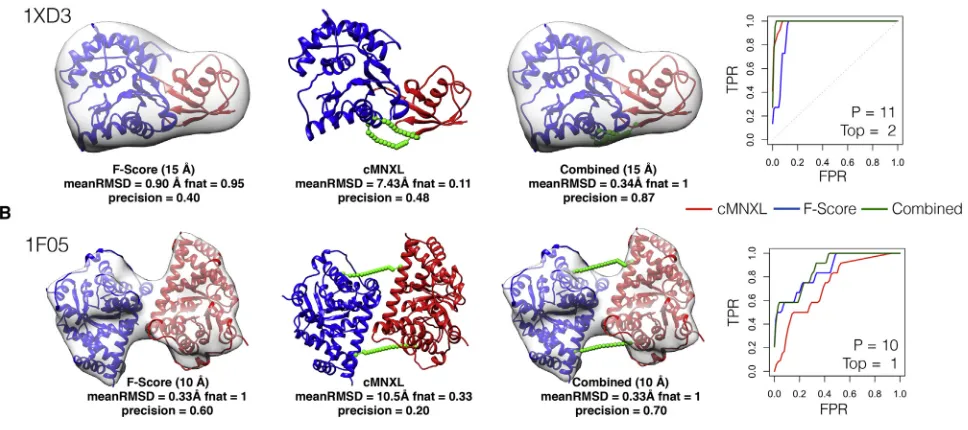
Crosslinks are especially useful in cases such as PDB: 1XD3 from the theoretical benchmark, where globular subunits are diffi-cult to orientate accurately (Figure 8A). Here, the F score ranks many models with completely incorrect interfaces (fnatof 0) in the top 10, resulting in a precision of 0.40. The combination of crosslinking and 3D-EM, even when the crosslinking alone is un-able to successfully model the protein complex, improves the orientation of the subunits, increasing the precision to 0.90.
In the experimental benchmark this trend is repeated, with the combined score significantly outperforming the F score at every resolution in terms of average AUC (p values 0.0140, 0.0160, and 0.0161 for 10, 15, and 20 A˚, respectively). In terms of precision, the F score alone already performs excellently so there is little
room for additional improvement (Figure 7 and Table S4). In
benchmark case PDB: 1F05, cMNXL alone performs badly
Structure26, 1–10, July 3, 2018 5
because it has only 2 inter-subunit crosslinks (see above) ( Fig-ure 8B). Again, the combined score is able to improve the perfor-mance of F score despite the crosslinking alone being insuffi-cient, as one of the models ranked in the top10 by the F score violates a crosslink restraint, which results in a precision increase from 0.600 to 0.700 (F score to combined score, respectively).
DISCUSSION
General Approach to Crosslinking Data
Our previous investigation into modeling monomeric proteins (Bullock et al., 2016) and our current investigation into protein complexes highlights three separate, but complementary, scoring properties of crosslinks: (1) the expected SASD between two crosslinked residues (ExSASD); (2) the number of violations of the crosslinker maximum bound between two crosslinked residues (NoV); (3) the solvent accessibility of the crosslinked residues (NoNA). By making use of all three of these aspects, we were able to create a scoring function that improves upon the commonly used inter-subunit NoV or the expected distance between inter-subunit ExSASD.
We tested our score on both an experimental and a theoretical benchmark. The theoretical benchmark was scored at a 15%
re-covery rate in order to more accurately replicate an experimental scenario (the average experimental recovery rate of the experi-mental benchmark was 13.7%). Scanning of the recovery rates
shows us, however, that at50% recovery the modeling
preci-sion begins to plateau. Future technical improvements in the collection of crosslinks should therefore increase the perfor-mance of XL-MS modeling.
Lysine crosslinkers are also able to crosslink serine and thre-onine residues, albeit at much lower frequencies (Sinz et al., 2015). As of yet, no serine or threonine crosslinks are listed in the XLinkDB2.0. However, cMNXL is applicable to any cross-linked residue that is crosscross-linked using a crosslinker of 11.4 A˚ length.
Previously we showed that non-accessible crosslinks play an important role in modeling the structure of monomeric proteins (Bullock et al., 2016). In a benchmark containing only protein
monomers, NoNA contributed the most performance to the
scoring function, whereasNoV and ExSASDcontributed only
[image:8.603.98.512.87.422.2]smaller gains. Interestingly, this has not been the case with our current results on protein complexes, where out of all the scoring aspects,NoNAcontributes the least (and the inter-subunit ones less than the intra-subunit), while bothNoVandExSASDdeliver similar high performance.
Figure 4. Performance of cMNXL and Its Components Demonstrated on Three Benchmark Cases, PDB: 1U8F, 1JEQ, and 3Q6M
These results highlight the differences between the require-ments of the data for the two types of modeling: proteins versus protein complexes. In modeling complexes using proteins as rigid bodies, distance information from crosslinks can effectively constrain the conformational space as opposed to solvent accessibility (if two rigid bodies are far enough removed, their surfaces would be fully exposed and all solvent accessibility re-straints would be satisfied). However, solvent accessibility can in theory guide subunit orientation once rigid bodies reach close proximity (both inter- and intra-), which may explain the small but significant increase in performance seen when incorporating non-accessible crosslinks into cMNXL. This is in contrast to modeling different conformations of protein monomers, whereby the distance between crosslinked residues is unlikely to differ dramatically between models, and backbone flexibility opens up the possibility of burying or exposing different residues. In
this instance, non-accessible crosslinks markedly increase the
performance while NoVand ExSASD contribute less (Bullock
et al., 2016).
Estimation of the Distance between Crosslinked Residues: SASD versus ED
In our previous study on monomers, the effect of using SASD over ED was pronounced, especially in the comparison between
MNXL and NoVED, where the latter’s performance collapsed
completely (precision of 0.06). However, in this benchmark on protein complexes, the difference in performance is much less marked. This is likely because in protein monomers, physically the crosslink must curve around the protein surface, which cre-ates a larger discrepancy between the ED and SASD. In the case of complexes, there is a higher chance of the crosslink to be more ‘‘linear’’ when connecting two residues, thereby making the ED a reasonable approximation for inter-subunit crosslinker paths in protein complexes. This would be even more so when using crosslinkers shorter than BS3 (e.g., BS2) or zero-length crosslinkers (e.g., EDC). These results again highlight how rigid-body modeling of protein complexes has information re-quirements different from those of the flexible modeling of pro-tein monomers.
In our theoretical benchmark, the performance between SASD and ED only differs significantly when using the NoV term (i.e., NoVSASD and NoVED). This is similar to the observation
made by Kahraman et al. (2013) whereby they found the
numbers of models satisfying a threshold of crosslinking
re-straints to decrease dramatically when switching from NoVED
to NoVSASD. This observation contrasts with what is seen in our experimental benchmark, where the performance is significantly different only in the expected distance term (ExED performing worse than ExSASD). However, as shwon, this result is due to two specific cases (PDB: 1UJZ and 2PSN) that perform badly, and is therefore not indicative of a more general trend.
[image:9.603.53.290.101.312.2]Another consideration when deciding which distance calcula-tion to use is the computacalcula-tional expense of calculating SASD, which is too high to implement in a sampling-based methodol-ogy. Possible alternatives include calculating the ED between the Nzatoms of lysines after considering their flexibility ( Degia-comi et al., 2017).
Figure 5. Performance of Scores Using ED versus SASD
Bar plots showing the performance of both the experimental (Exp) and theo-retical (Theo) benchmarks, when scored with either NoV, ExSASD, or cMNXL using either ED or SASD, in terms of (A) precision and (B) AUC. The error bars represent the standard deviation.
Figure 6. Comparison of Performance be-tween SASD and ED
(A) Crystal structure of benchmark case PDB: 1UJZ placed inside a 30-A˚ radius sphere centered on the center of mass, demonstrating how ED loses its ability to score small protein complexes. (B) Left: crystal structure of benchmark case PDB: 2PSN with experimental inter-subunit crosslink SASDs mapped on the surface in green. Inter-sub-unit crosslinks are clustered in two regions close to the dimer interface. Right: distributions of expected SASD and ED in blue and orange, respectively. Histograms of SASD (blue) and ED (orange) of inter-subunit crosslinks for benchmark case 2PSN overlaid. More SASDs score at the maximum of the expected SASD distribution than EDs score on the expected ED distribution, which results in better modeling performance for ExSASD.
Structure26, 1–10, July 3, 2018 7
[image:9.603.57.371.577.688.2]Considering the above, if the NoV is the scoring method being
used, we recommend using SASD (Kahraman et al., 2013). This
is because NoVEDremains the worst crosslink scoring
proced-ure, performing significantly worse than cMNXLSASDand also
NoVSASD. If using other types of scoring functions (e.g., cMNXL or expected distance [Ferber et al., 2016]) are used, as the non-significant gain generated from modeling with SASD is offset by its computational expense, we recommend using ED
(especially when considering using sampling methods with crosslink information [Erzberger et al., 2014; Ferber et al., 2016]).
Conflicting Crosslinks and False Positives
[image:10.603.64.550.107.296.2]As the crosslinking experiment happens in solution at room tem-perature, it is possible that crosslinking datasets are capturing more than one conformation of the complex. This could be a result of the protein complex adopting multiple native
Figure 7. Performance of cMNXL, F Score, and the Combined Score
Bar plots showing the performance of each individual member of the experimental benchmark as well as the average performance of both the experimental (Exp) and theoretical (Theo) benchmarks, when scored with cMNXL, F score, and the combined score using 3D-EM maps at 10, 15, and 20 A˚ resolution, in terms of (A) precision and (B) AUC. The error bars represent the standard deviation.
Figure 8. Performance of cMNXL, F Score, and Combined Score
[image:10.603.65.549.467.682.2]conformations, but it could also be due to crosslinks capturing a partly dissociated complex. Consequently, this might lead to conflicting sets of crosslinks that correspond to (in terms of dis-tance restraints and solvent accessibility information) two or more structural states. Modeling procedures that use crosslink-ing in the samplcrosslink-ing stage are more likely to identify these events, either by specifically processing these events during sampling (Ferber et al., 2016) or by clustering the output to see whether multiple scoring minima are observed (Erzberger et al., 2014). In this study, we used cMNXL only to validate models and, as such, we were unable to deal with conflicting crosslink datasets. Nevertheless, the use of crosslinks to validate models generated by 3D-EM fitting is commonly seen in the literature (Dodonova et al., 2015; Wang et al., 2017).
Additionally, during the crosslink identification process it is likely that a small percentage of the identified crosslinks will be false pos-itives. Experimental methods for assessing the quality of crosslinks are becoming more rigorous (Iacobucci and Sinz, 2017); however, currently the most effective way to incorporate this information is to use the crosslink identification score (e.g., Xquest ID score [Rinner et al., 2008]). Unfortunately, these data are not available in the XLinkDB2.0 or XLDB, so we were unable to include this in cMNXL. However, we plan to explore this in future studies.
Combining Crosslinking and 3D-EM Information
Finally, we wanted to demonstrate that crosslinking and 3D-EM information at resolution range of 10–20 A˚ are complementary to each other in the modeling process. By combining cMNXL with
the fitness score (F score) fromg-TEMPy, we created a
com-bined score that performed better overall on the benchmark
than each score alone. Even though the 3D-EM maps were
simu-lated, which gave the F score an advantage over the crosslinking
data (which was either experimental or was bootstrapped at 15% for the theoretical benchmark, i.e., more realistic than the noise-free EM data), the results confirmed that the combination of crosslinking and 3D-EM information is complementary at all resolutions and can capture subunit orientation better than 3D-EM alone. This is most notable in certain cases such as PDB: 1XD3, where models ranked in the top 10 by the F score have completely incorrect interfaces. Even in cases where the cross-linking information is insufficient to successfully model protein complexes on its own (experimental benchmark case PDB: 1F05), the combination of crosslinking with 3D-EM information still generates an improvement.
Using a combination of crosslinks and 3D-EM data could be especially relevant to applications in cryo-ET where the maps resulting from subtomogram averaging are still often in the intermediate- to low-resolution range (Thalassinos et al., 2013). Combining bothin-cellcrosslinking and cryo-ET should improve the structural characterization of macromolecular complexes within the native environment.
STAR+METHODS
Detailed methods are provided in the online version of this paper and include the following:
d KEY RESOURCES TABLE
d CONTACT FOR REAGENT AND RESOURCE SHARING
d METHOD DETAILS
B cMNXL Score
B cMNXL Weighting
B Protein Complex Benchmarks
B Experimental and Theoretical Cross-Links
B 3D-EM Data
d QUANTIFICATION AND STATISTICAL ANALYSIS
B Measuring Model Accuracy
B Score Assessment
d DATA AND SOFTWARE AVAILABILITY
SUPPLEMENTAL INFORMATION
Supplemental Information includes three figures and six tables and can be found with this article online athttps://doi.org/10.1016/j.str.2018.04.016.
ACKNOWLEDGMENTS
We thank Dr. David Houldershaw for computer support, Dr. Madhusudhan Mallur Srivatsan, Dr. Agnel Joseph, the Topf group, and Thalassinos group for helpful discussions. This work was supported by BBSRC London Interdis-ciplinary Doctoral Programme (to J.B.), CSIR-SPMF and Newton Bhbabha PhD Placement Fellowship (to N.S.), MRC MR/M019292/1 (to M.T.), and Welcome Trust Collaborative Award (209250/Z/17/Z) (to M.T. and K.T.).
AUTHOR CONTRIBUTIONS
Conceptualization, J.M.A.B., M.T., and K.T.; Methodology, J.M.A.B., N.S., and M.T.; Software, Validation, and Formal Analysis, J.M.A.B.; Investigation, J.M.A.B., N.S., and M.T.; Resources, M.T.; Writing – Original Draft, J.M.A.B.; Writing – Review & Editing, J.M.A.B., M.T., and K.T.; Visualization, J.M.A.B.; Funding Acquisition, M.T. and K.T.
DECLARATION OF INTERESTS
The authors declare no competing interests.
Received: June 8, 2017 Revised: March 5, 2018 Accepted: April 25, 2018 Published: May 24, 2018
REFERENCES
Belsom, A., Schneider, M., Fischer, L., Brock, O., and Rappsilber, J. (2015). Serum albumin domain structures in human blood serum by mass spectrom-etry and computational biology. Mol. Cell. Proteomics15, 1105–1116.
Bonomi, M., Pellarin, R., Kim, S.J., Russel, D., Sundin, B.A., Riffle, M., Jaschob, D., Ramsden, R., Davis, T.N., Muller, E.G.D., et al. (2014). Determining protein complex structures based on a Bayesian model of in vivo Fo¨rster resonance energy transfer (FRET) data. Mol. Cell. Proteomics13, 2812–2823.
Bullock, J.M.A., Schwab, J., Thalassinos, K., and Topf, M. (2016). The impor-tance of non-accessible crosslinks and solvent accessible surface disimpor-tance in modelling proteins with restraints from crosslinking mass spectrometry. Mol. Cell. Proteomics15, 2491–2500.
Chavez, J.D., Schweppe, D.K., Eng, J.K., and Bruce, J.E. (2016). In vivo conformational dynamics of Hsp90 and its interactors. Cell Chem. Biol.23, 716–726.
Chen, Z.A., Jawhari, A., Fischer, L., Buchen, C., Tahir, S., Kamenski, T., Rasmussen, M., Lariviere, L., Bukowski-Wills, J.-C., Nilges, M., et al. (2010). Architecture of the RNA polymerase II-TFIIF complex revealed by cross-linking and mass spectrometry. EMBO J.29, 717–726.
Degiacomi, M.T., Schmidt, C., Baldwin, A.J., and Benesch, J.L.P. (2017). Accommodating protein dynamics in the modeling of chemical crosslinks. Structure25, 1751–1757.e5.
Structure26, 1–10, July 3, 2018 9
Dodonova, S.O., Von Appen, A., Hagen, W.J.H., Beck, R., Beck, M., Wieland, F., and Briggs, J.A.G. (2015). A structure of the COPI coat and the role of coat proteins in membrane vesicle assembly. Science349, 195–198.
Erzberger, J.P., Stengel, F., Pellarin, R., Zhang, S., Schaefer, T., Aylett, C.H.S., Cimermancic, P., Boehringer, D., Sali, A., Aebersold, R., et al. (2014). Molecular architecture of the 40S,eIF1,eIF3 translation initiation complex. Cell158, 1123–1135.
Farabella, I., Vasishtan, D., Joseph, A.P., Pandurangan, A.P., Sahota, H., and Topf, M. (2015). TEMPy: a python library for assessment of 3D electron micro-scopy density fits. J. Appl. Crystallogr.48, 1314–1323.
Ferber, M., Kosinski, J., Ori, A., Rashid, U.J., Moreno-Morcillo, M., Simon, B., Bouvier, G., Batista, P.R., Muller, C.W., Beck, M., et al. (2016). Automated structure modeling of large protein assemblies using crosslinks as distance re-straints. Nat. Methods13, 515–520.
Herzog, F., Kahraman, A., Boehringer, D., Mak, R., Bracher, A., Walzthoeni, T., Leitner, A., Beck, M., Hartl, F.-U., Ban, N., et al. (2012). Structural probing of a protein phosphatase 2A network by chemical cross-linking and mass spec-trometry. Science9114, 1348–1352.
Hofmann, T., Fischer, A.W., Meiler, J., and Kalkhof, S. (2015). Protein structure prediction guided by crosslinking restraints—a systematic evaluation of the impact of the crosslinking spacer length. Methods89, 79–90.
Hu, Q., Noll, R.J., Li, H., Makarov, A., Hardman, M., and Cooks, R.G. (2005). The Orbitrap: a new mass spectrometer. J. Mass Spectrom.40, 430–443.
Iacobucci, C., and Sinz, A. (2017). To be or not to be? Five guidelines to avoid misassignments in cross-linking/mass spectrometry. Anal. Chem. 89, 7832–7835.
Ihling, C., Schmidt, A., Kalkhof, S., Schulz, D.M., Stingl, C., Mechtler, K., Haack, M., Beck-Sickinger, A.G., Cooper, D.M.F., and Sinz, A. (2006). Isotope-labeled cross-linkers and Fourier transform ion cyclotron resonance mass spectrometry for structural analysis of a protein/peptide complex. J. Am. Soc. Mass Spectrom.17, 1100–1113.
Kahraman, A., Malmstro¨m, L., and Aebersold, R. (2011). Xwalk: computing and visualizing distances in cross-linking experiments. Bioinformatics 27, 2163–2164.
Kahraman, A., Herzog, F., Leitner, A., Rosenberger, G., Aebersold, R., and Malmstro¨m, L. (2013). Cross-link guided molecular modeling with ROSETTA. PLoS One8, e73411.
Lasker, K., Fo¨rster, F., Bohn, S., Walzthoeni, T., Villa, E., Unverdorben, P., Beck, F., Aebersold, R., Sali, A., and Baumeister, W. (2012). Molecular archi-tecture of the 26S proteasome holocomplex determined by an integrative approach. Proc. Natl. Acad. Sci. USA109, 1380–1387.
Leitner, A., Joachimiak, L.A., Bracher, A., Mo¨nkemeyer, L., Walzthoeni, T., Chen, B., Pechmann, S., Holmes, S., Cong, Y., Ma, B., et al. (2012). The mo-lecular architecture of the eukaryotic chaperonin TRiC/CCT. Structure20, 814–825.
Leitner, A., Walzthoeni, T., and Aebersold, R. (2014a). Lysine-specific chemi-cal cross-linking of protein complexes and identification of cross-linking sites using LC-MS/MS and the xQuest/xProphet software pipeline. Nat. Protoc.9, 120–137.
Leitner, A., Joachimiak, L.A., Unverdorben, P., Walzthoeni, T., Frydman, J., Fo¨rster, F., and Aebersold, R. (2014b). Chemical cross-linking/mass spec-trometry targeting acidic residues in proteins and protein complexes. Proc. Natl. Acad. Sci. USA111, 9455–9460.
Leitner, A., Faini, M., Stengel, F., and Aebersold, R. (2016). Crosslinking and mass spectrometry: an integrated technology to understand the structure and function of molecular machines. Trends Biochem. Sci.41, 20–32.
Lensink, M.F., and Wodak, S.J. (2010). Docking and scoring protein interac-tions: CAPRI 2009. Proteins78, 3073–3084.
Lensink, M.F., and Wodak, S.J. (2013). Docking, scoring, and affinity predic-tion in CAPRI. Proteins81, 2082–2095.
Michie, K.A., Kwan, A.H., Tung, C.S., Guss, J.M., and Trewhella, J. (2016). A highly conserved yet flexible linker is part of a polymorphic protein-binding domain in myosin-binding protein C. Structure24, 2000–2007.
Pandurangan, A.P., Vasishtan, D., Alber, F., and Topf, M. (2015).g-TEMPy: simultaneous fitting of components in 3D-EM maps of their assembly using a genetic algorithm. Structure23, 2365–2376.
Pettersen, E., Goddard, T., Huang, C., Couch, G., Greenblatt, D., Meng, E., and Ferrin, T. (2004). UCSF Chimera—a visualization system for exploratory research and analysis. J. Comput. Chem.25, 1605–1612.
Politis, A., Park, A.Y., Hyung, S.-J., Barsky, D., Ruotolo, B.T., and Robinson, C.V. (2010). Integrating ion mobility mass spectrometry with molecular model-ling to determine the architecture of multiprotein complexes. PLoS One5, e12080.
Politis, A., Stengel, F., Hall, Z., Herna´ndez, H., Leitner, A., Walzthoeni, T., Robinson, C.V., and Aebersold, R. (2014). A mass spectrometry-based hybrid method for structural modeling of protein complexes. Nat. Methods 11, 403–406.
Rappsilber, J. (2011). The beginning of a beautiful friendship: cross-linking/ mass spectrometry and modelling of proteins and multi-protein complexes. J. Struct. Biol.173, 530–540.
Rinner, O., Seebacher, J., and Walzthoeni, T. (2008). Identification of cross-linked peptides from large sequence databases. Nat. Methods5, 315–318.
Rivera-Santiago, R.F., Sriswasdi, S., Harper, S.L., and Speicher, D.W. (2015). Probing structures of large protein complexes using zero-length cross-linking. Methods89, 99–111.
Russel, D., Lasker, K., Webb, B., Vela´zquez-Muriel, J., Tjioe, E., Schneidman-Duhovny, D., Peterson, B., and Sali, A. (2012). Putting the pieces together: integrative modeling platform software for structure determination of macro-molecular assemblies. PLoS Biol.10, e1001244.
Sali, A., and Blundell, T. (1993). Comparative protein modelling by satisfaction of spatial restraints. J. Mol. Biol.234, 779–815.
Schweppe, D.K., Zheng, C., Chavez, J.D., Navare, A.T., Wu, X., Eng, J.K., and Bruce, J.E. (2016). XLinkDB 2.0: integrated, large-scale structural analysis of protein crosslinking data. Bioinformatics32, 2716–2718.
Simon, B., Madl, T., Mackereth, C.D., Nilges, M., and Sattler, M. (2010). An effi-cient protocol for NMR-spectroscopy-based structure determination of pro-tein complexes in solution. Angew. Chem. Int. Ed.49, 1967–1970.
Sinz, A., Arlt, C., Chorev, D., and Sharon, M. (2015). Chemical cross-linking and native mass spectrometry: a fruitful combination for structural biology. Protein Sci.24, 1193–1209.
Thalassinos, K., Pandurangan, A.P., Xu, M., Alber, F., and Topf, M. (2013). Conformational States of macromolecular assemblies explored by integrative structure calculation. Structure21, 1500–1508.
Vasishtan, D., and Topf, M. (2011). Scoring functions for cryoEM density fitting. J. Struct. Biol.174, 333–343.
Vreven, T., Moal, I.H., Vangone, A., Pierce, B.G., Kastritis, P.L., Torchala, M., Chaleil, R., Jime´nez-Garcı´a, B., Bates, P.A., Fernandez-Recio, J., et al. (2015). Updates to the integrated protein-protein interaction benchmarks: docking benchmark version 5 and affinity benchmark version 2. J. Mol. Biol. 427, 3031–3041.
Wang, X., Cimermancic, P., Yu, C., Schweitzer, A., Chopra, N., Engel, J.L., Greenberg, C., Huszagh, A.S., Beck, F., Sakata, E., et al. (2017). Molecular details underlying dynamic structures and regulation of the human 26S protea-some. Mol. Cell. Proteomics16, 840–854.
Ward, A.B., Sali, A., and Wilson, I.A. (2013). Integrative structural biology. Science339, 913–915.
STAR
+
METHODS
KEY RESOURCES TABLE
CONTACT FOR REAGENT AND RESOURCE SHARING
Further information and requests for data should be directed to and will be fulfilled by the Lead Contact, Maya Topf (m.topf@cryst. bbk.ac.uk)
METHOD DETAILS
cMNXL Score
The theory behind the cMNXL score is described in the main text. cMNXL is freely available as a python package from
http://topf-group.ismb.lon.ac.uk/Software.htmland in the TEMPy software (http://tempy.lon.ismb.ac.uk)
cMNXL Weighting
The weighting of each scoring aspect in the final cMNXL scoring function was reached via a systematic scan of weights for each aspect from 0 to 1 (in steps of 0.1), simultaneously. This scan was performed on the larger theoretical benchmark (see below) and the weights that gave the highest precision were chosen.
Protein Complex Benchmarks
There are two benchmarks in this study. One theoretical, which consists of 68 protein dimers, taken from rigid body dataset created by Vrevenet al. (Vreven et al., 2015) and a second experimental, consisting of 9 complexes (2-mers to 4-mers) containing proteins only (i.e. not including complexes consisting of DNA/RNA) taken from the XLinkdb2.0 (Schweppe et al., 2016).
The dimer dataset was created in order to have a dataset large enough to generate statistically significant conclusions. The cross-links for the dimers were generated theoretically, taking a 15% recovery, i.e. 15% of all possible theoretical cross-cross-links (see below). The minimum criteria for selecting a set of theoretical cross-links was for it to have at least 2 inter-subunit cross-links. The choice of 15% recovery reflects the typical recovery from an XL-MS experiment (the average recovery of the experimental benchmark is 13.7%). This process was repeated 1000 times and the average precision and AUC taken. The performance of cMNXL on this bench-mark was also tested at 1/5/10/20/30/40/50/60/70/80/90 and 100% recovery (Figure S1).
The experimental benchmark, taken specifically from XLinkDB2.0 based on the in-cell cross-linking datasets (Herzog et al., 2012) and (Chavez et al., 2016), was used to test the scoring functions on genuine experimental cross-linking data. These datasets were chosen as they are the only datasets that have corresponding PDB structures, solved using X-ray crystallography. The minimum criteria for selecting a protein complex from the databases was for it to have at least 2 inter-subunit cross-links and at least 5 cross-links in total. The number of subunits in each complex range from 2 to 4.
Using TEMPy (Farabella et al., 2015), for each protein complex, subunits were iteratively translated and rotated a random distance and angle between5 and 5 A˚ and 0 to 180, respectively. Models were then filtered for clashes, allowing a maximum of 20 main-chain atom clashes. 100 models were selected to be as close to uniform distribution of meanRMSD (seeMeasuring Model Accuracy) as possible. In order to generate near-native models for some of the complexes, loop regions had to be cleaved (Table S5).
For the purposes of this study, all homo-complexes in the benchmark have been treated like hetero-complexes, i.e. all identical subunits and associated cross-links were treated as unique subunits, with individual cross-links specified to each subunit (this is currently not possible experimentally). In order to determine if a homo-complex cross-link should be intra- or inter-subunit, the SASDs of all the possible combinations were calculated and the lowest SASD was chosen (if no SASD under 32 A˚ was present in the native the lowest SASD was still taken). All reciprocal crosslink combinations were reproduced.
REAGENT or RESOURCE SOURCE IDENTIFIER
Deposited Data
Experimental cross-linking data this paper Table S6
Theoretical benchmark cMNXL Theoretical benchmark http://topf-group.ismb.lon.ac.uk/Software.html
Experimental benchmark cMNXL Experimental benchmark http://topf-group.ismb.lon.ac.uk/Software.html
Software and Algorithms
cMNXL cMNXL version 1.0 http://topf-group.ismb.lon.ac.uk/Software.html
Structure26, 1–10.e1–e2, July 3, 2018 e1
Experimental and Theoretical Cross-Links
All the cross-links in the experimental datasets (Table S6) were either BS3 or DSS – both with a linker arm of 11.4 A˚. SASDs and Euclidean distances (EDs) between cross-linked residues were calculated using Jwalk (Bullock et al., 2016). Theoretical cross-links are defined as all the lysine residue pairs that have an SASD below the maximum bound of the cross-linker (32 A˚). The maximum
bound of 32 A˚ was reached by scanning the experimental benchmark performance usingNoVat different maximum bounds. The
precision peaks at 32 A˚ (Figure S3). Models and cross-links were visualised using the molecular graphics program Chimera
(Pettersen et al., 2004).
3D-EM Data
The function we used to score the models based on their fit to simulated 3D-EM density was taken fromg-TEMPy – a genetic algo-rithm for the simultaneous fitting of components in 3D-EM maps. We used the fitness function from that algoalgo-rithm (F-score) which combines a mutual information (MI) score and a clash penalty score (PS):
F=ðn3MIÞ PS
wherenrefers to the number of subunits. The MI score calculates how well a simulated map fits the experimental data (Vasishtan and Topf, 2011). The PS is a term to penalize for clashes. Further details can be found in the original paper (Pandurangan et al., 2015). The combination of cMNXL and F-score is as follows:
Combined=F+ð0:53cMNXLÞ
The weighting of cMNXL was chosen as a result of a systematic scan of weightings between 0 and 2.
QUANTIFICATION AND STATISTICAL ANALYSIS
Measuring Model Accuracy
Models are assessed via mean Ca-RMSD (meanRMSD) calculated using an in-house script and MODELLER-v9.18 (Sali and Blundell, 1993). Iteratively, the whole model is superposed onto the native structure, one subunit at a time, and the Ca-RMSD is calculated. The meanRMSD is the mean value of all of these Ca-RMSD values. Models are also evaluated using the fnat criterion, i.e. the proportion of native inter-subunit residue interactions maintained in the model (Lensink and Wodak, 2013). Residues are considered to be inter-acting if any of their atoms are within 5 A˚ of each other. The fnat score was calculated using an in-house script.
Score Assessment
We assessed the effectiveness of our scoring function using Precision and Area-Under-Curve (AUC) taken from the Receiver-Oper-ating-Characteristic (ROC) curve. Precision is calculated as TP/(TP + FP), where TP (True Positive) is defined as a model that is scored in the top 10 by the scoring function and has a meanRMSD of%4 A˚andan fnat score ofR0.3, and FP (False Positive) is defined as a model that is scored in the top 10 by the scoring function but has a meanRMSD > 4 A˚orfnat%0.3. The False Positive Rate (FPR) is calculated as FP/(FP+TN) where TN (True Negative) is defined as a model that is not scored in the top 10 by the scoring function and has a meanRMSD > 4 A˚orfnat%0.3. The fnat criteria matches the criteria for a medium model in CAPRI (Lensink and Wodak, 2010). In the case where there are more than 10 models with the same top score, 10 models are randomly sampled from those models and the precision is calculated. This process is then repeated 1000 times to bootstrap an average precision.
ROC curves were calculated with a model being defined as Positive if the meanRMSD is%4 A˚andfnatR0.3. ROC systematically lowers the scoring threshold to assess whether a model is a true positive, instead of the top 10 ranked models. ROC and AUC cal-culations were calculated using the ROCR package in R (https://www.r-project.org/).
Calculating Statistical Significance
The statistical significance between the precision and AUC of different scoring methods was calculated using a one-sided paired t-test, as implemented in R (www.r-project.org/). For example, the precision values of each benchmark case for the NoV score
were compared directly to the precision values for each benchmark case for cMNXL (i.e. each case waspairedtogether instead
of simply combining them into one distribution). The alternative hypothesis was that the mean of the precision of cMNXL was greater than the mean of the precision of the NoV score (i.e.one-sided). In all cases, a significance threshold p-value of 0.05 was used, how-ever p-values were often much smaller. Relevant p-values have been included in the main text.
DATA AND SOFTWARE AVAILABILITY
The experimental cross-links used to score the experimental benchmark can be found in theSupplemental Information. cMNXL is