BIROn - Birkbeck Institutional Research Online
Arenas, M. and Botoeva, E. and Calvanese, D. and Ryzhikov, Vladislav
(2016) Knowledge base exchange:
the case of OWL 2 QL. Artificial
Intelligence 238 , pp. 11-62. ISSN 0004-3702.
Downloaded from:
Usage Guidelines:
Please refer to usage guidelines at
or alternatively
Knowledge Base Exchange: The Case of OWL 2 QL
Marcelo Arenas
Pontificia Universidad Cat´olica de Chile, Chile
Elena Botoeva, Diego Calvanese, Vladislav Ryzhikov
Free University of Bozen-Bolzano, Italy
Abstract
In this article, we define and study the problem of exchanging knowledge between a source and a target knowledge base (KB), connected through mappings. Differently from the traditional database exchange setting, which considers only the exchange of data, we are interested in exchanging implicit knowledge. As representation formalism we use Description Logics (DLs), thus assuming that the source and target KBs are given as a DL TBox+ABox, while the mappings have the form of DL TBox assertions. We define a general framework of KB exchange, and study the problem of translating the knowledge in the source KB according to the mappings expressed in OWL 2 QL, the profile of the standard Web Ontology Language OWL 2 based on the description logicDL-LiteR. We develop novel game-and automata-theoretic techniques, game-and we provide complexity results that range from NLogSpaceto ExpTime.
Keywords: Description Logic, Knowledge Exchange, DL-Lite, Data Exchange, Query Inseparability
1. Introduction
Ontologies are at the heart of various Computer Science disciplines, among which the most prominent ones are Semantic Web, Biomedical informatics, and of course, Artificial Intelligence and Knowledge Representation. Here, for simplicity, byontologywe mean a formal representation of the knowledge about a domain in terms of concepts (unary predicates) and roles (binary predicates). In the biomedical domain, e.g., Pneumonia and Lungcould be concepts, andfinding sitecould be a role, and the knowledge about the domain could be asserted in an axiom of the form“The finding site of pneumonia is lungs”[1, 2]. The advantages of using ontologies are that, on the one hand, they provide a framework for organizing and structuring information, and on the other hand, they are equipped with capabilities to reason about concepts and roles.
When representing the knowledge about a domain of interest in terms of an ontology, on the one hand the designer is free to choose the formalism in which to express the ontology, among a variety of different alternatives (e.g., a relational database possibly with constraints, Datalog, or Description Logics). On the other hand, she can select the specific terminology she considers more appropriate to convey the domain semantics. For instance, when creating a biomedical ontology about deseases, the lungs can be modeled asPair of lungsorBoth lungs. This leads to having complex forms of information, maintained in different formats and organized according to different structures. Often, this information needs to be shared between agents: to reuse the existing ontologies, to integrate knowledge from different agents, and so on. Therefore in recent years, both in the data management and in the knowledge representa-tion communities, several settings have been investigated that address this problem from various perspectives: (i)in
information integration, uniform access is provided to a collection of data sources by means of an ontology (or global schema) to which the sources are mapped [3];(ii)inpeer-to-peer systems, a set of peers declaratively linked to each other collectively provide access to the information assets they maintain [4, 5, 6];(iii)inontology matching, the aim
Email addresses:[email protected](Marcelo Arenas),[email protected](Elena Botoeva),[email protected]
ΣΣ1
source schema
I1
ΣΓ1
target schema
I2
mappingM
[image:3.595.205.394.109.193.2]solution
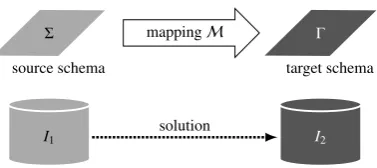
Figure 1: Data Exchange Framework.
is to understand and derive the correspondences between elements in two ontologies [7, 8, 9];(iv)inontology modu-larity, the aim is to extract independent, possibly small, subsets of an ontology, so called modules [10, 11, 12];(v)in
knowledge translation, axioms are being translated from one representation (i.e., logical language and vocabulary) into another [13, 14, 15]; and, finally, (vi)indata exchange, the information stored according to a source schema needs to be restructured and translated so as to conform to a target schema [16, 17]. The work we present in this article is inspired by this latter setting investigated in databases.
Data exchangeis a field of database theory, motivated by several applications from industry [18, 19], that deals with transferring data between differently structured databases. In the seminal article [16], the data exchange problem was defined as the problem of transforming data structured under a source schema into data structured under a target schema, given a mapping specifying how to translate data from the source to the target schema. This problem is depicted in Figure 1, where the obtained target data instance is referred to as asolution. The data exchange problem has been studied for different combinations of languages used to specify the source schema, the target schema and the mapping [17, 20, 21]. Most of the results in the literature consider source-to-target tuple generating dependencies (tgds) as the language to specify mappings. The dependencies in this class allow one to express containment of conjunctive queries: if a conjunction of several predicates holds, then a conjunction of some other predicates must hold as well. For example, the tgd
∀a,b.AuthorOf(a,b)→ ∃y,g.BookInfo(b,a,y)∧BookGenre(b,g) (1)
says that ifais the author of a bookb, then there existyandgsuch thatbis a book with authorathat was published in yeary, and bhas genreg. Many database integrity constraints can be expressed by tgds, so these dependencies have been widely used in databases. Source-to-target tgds (st-tgds) are tgds of a special shape: the conjunction on the left-hand side uses only symbols from a source schema, while the conjunction on the right-hand side uses only symbols from a target schema.
A fundamental assumption in the (traditional) data exchange framework is that the source is a complete database: every fact is either true or false. On the other hand, a target instance can be incomplete and a source instance can have many different solutions, as incomplete information can be introduced by the mapping layer (see also [22]).
Example 1.1. If we consider the mapping consisting of the constraint (1), and a source instance consisting of one entryAuthorOf(tolkien,lotr), encoding that Tolkien is the author of ‘The Lord of the Rings’, then the following two target instances,I2andI20, are solutions:
I2 = {BookInfo(lotr,tolkien,1937), BookGenre(lotr,fantasy)}, I0
2 = {BookInfo(lotr,tolkien,null1), BookGenre(lotr,null2)}.
Note that here incompleteness is caused by the existential restriction∃y,g. . ., which can be satisfied by introducing new objects: either named individuals (or constants), likefantasy, or anonymous objects, likenull1. Note also that
null1andnull2arelabeled nulls, which are widely used in databases to represent anonymous objects.
To characterizegoodtransformations, several criteria have been considered [23]. We emphasize two types of good translations,universal solutions andquery solutions. Universal solutions are the most general solutions: any other solution is more specific (I0
2in Example 1.1 is a universal solution), while query solutions are good solutions from the
Data exchange with incomplete information. As mentioned before, in the (traditional) data exchange frame-work, source instances are assumed to contain complete information. However, there are natural scenarios where source instances may contain incomplete information, as shown in [24, 25, 21]. In particular, the problem of data exchange with incomplete source data was extensively studied in [25], where an incomplete specification is under-stood as an object with (possibly infinitely) many interpretations. A simple example of such an object is a database with nulls: assume that we have a table storing information about book genres, and that ‘The Lord of The Rings’ is a book whose genre is unkown. In this case, the table would consist of an entry of the formBookGenre(lotr,null), which represents all different instances containing a concrete value for the genre of ‘The Lord of The Rings’:
BookGenre(lotr,fantasy),BookGenre(lotr,history),BookGenre(lotr,scifi), etc.
A knowledge base is another example of an object with multiple interpretations. A knowledge base (KB) is a description of a domain of interest that includes two kinds of information: (i) ground facts, i.e., extensional information of the form“John is a student”,“Databases is a course”,“John attends the Databases course”, etc., which assert properties of individual objects that are part of the domain; and(ii) logical axioms, i.e., intensional information of the form“Every course must be taught by somebody”,“A student cannot be a professor”, etc., which structure the knowledge about the domain. We also call the second type of information anontology. It is implicit in the standard semantics of a KB that the knowledge it describes is only a partial description of a domain of interest, which means that the KB represents many actual states of the world. For instance, if we consider the KB consisting of the five axioms mentioned above, then it could represent one possible state of the world, where John also attends the Statistics course, David teaches Databases and Peter teaches Statistics. The framework proposed in [25] is general enough to accommodate KBs. In fact, a generalknowledge exchange framework is proposed in [25], for the case where the source is a KB as opposed to a relational database. Moreover, it is shown in that work that some natural problems (such as query answering over the target schema) become undecidable if KBs are specified by tgds and mappings are specified by source-to-target tgds. Thus, some decidability results are obtained in [25] by considering some restricted fragments of the class of tgds when specifying KBs.
An alternative to the approach proposed in [25] to achieve decidability is to consider less expressive ontological languages when specifying both KBs and mappings. A good candidate for that role is the formalism of Description Logics, which come in variants that provide fair expressive power, and at the same time possess good computational properties.
Description Logics as ontology language.Description Logics (DLs) [26] are a family of formal languages, more precisely, fragments of first-order logic, that are specifically designed to serve as ontology languages. They exhibit a reasonable tradeoffbetween their expressive power and the computational complexity of logical inference tasks. Nice computational properties in DLs are achieved by restricting attention to unary and binary predicates, calledconcepts
androles, respectively, and to restricted forms of axioms. Ground facts in DLs are encoded in the form of anABox, which is a set of membership assertions, and logical axioms are encoded in the form of aTBox, which is a set of concept and role inclusions. For instance, the DL KB containing the five axioms describing the university domain mentioned before looks as follows:
Student(john)
Course(databases)
attends(john,databases)
Coursev ∃teaches− Studentv ¬Professor
Notice that both inclusions above are between concepts.
Thus, the starting point for our work is the knowledge exchange framework defined in [25], and the main moti-vation is to find ontology and mapping specification languages where the fundamental problem ofknowledge base exchangecan be solved, and which are both natural and useful in practice. For this purpose, we focus on the Descrip-tion Logic underlying OWL 2 QL, which is the profile [27] of the standard Web Ontology Language OWL 2 [28] that has been specifically designed for efficient query answering. Next we describe our contributions in this respect.
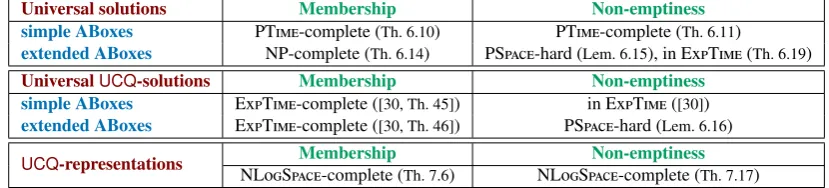
Universal solutions Membership Non-emptiness
simple ABoxes PTime-complete (Th. 6.10) PTime-complete (Th. 6.11)
extended ABoxes NP-complete (Th. 6.14) PSpace-hard (Lem. 6.15), in ExpTime(Th. 6.19)
UniversalUCQ-solutions Membership Non-emptiness
simple ABoxes ExpTime-complete ([30, Th. 45]) in ExpTime([30]) extended ABoxes ExpTime-complete ([30, Th. 46]) PSpace-hard (Lem. 6.16)
UCQ-representations Membership Non-emptiness
[image:5.595.88.503.112.206.2]NLogSpace-complete (Th. 7.6) NLogSpace-complete (Th. 7.17)
Table 1: Complexity results for the membership and non-emptiness problems.
universalUCQ-solutions, andUCQ-representations. Universal solutionsare the most precise solutions: a target KB Ktis a universal solution for a source KBKsunder a mappingMif it preserves all the interpretations ofKs with
respect toM. UniversalUCQ-solutionsis a relaxation of the notion of universal solutions: a target KB Kt is a
universalUCQ-solution for a source KBKsunder a mappingMif it preserves all answers to unions of conjunctive
queries (UCQs) formulated over the target signature. UCQ-representationsare similar to universalUCQ-solutions, but they do not depend on the source ABox, only on the source TBox and the mapping: a target TBoxT is aUCQ -representation of a source TBoxSunder a mappingMif for each possible source ABoxAs, it holds thatT,M, and Asgive the same answers toUCQs asS,M, andAs. The rationale behind the notion ofUCQ-representation is to maximize the implicit knowledge translated to the target. Thus, aUCQ-representation of a source TBox captures at best the intensional information that can be extracted from this source TBox according to a mapping and usingUCQs. Second, we study each one of the three notions of solution just described, and their relationship to each other for the case of KBs and mappings defined usingDL-LiteR. We provide examples that justify the need for target ABoxes with labeled nulls in order for universal solutions and universalUCQ-solutions to exist, as the language ofDL-LiteR is capable of implying the existence of new objects. Such ABoxes mentioning anonymous objects are calledextended ABoxes, as opposed tosimple ABoxes, which mention only named individuals (or constants).
Finally, in order to obtain a good understanding of the knowledge base exchange problem, we study the compu-tational complexity of themembershipandnon-emptinessproblems for universal solutions, universalUCQ-solutions andUCQ-representations. For universal solutions (resp., universalUCQ-solutions), the membership problem verifies, given a source KBKs, a mappingM, and a target KBKt, whetherKtis a universal solution (resp., universalUCQ
-solution) forKsunderM; instead, the non-emptiness problem addresses the question whether there exists a universal solution (resp., universalUCQ-solution) for a given source KBKsand a given mappingM. ForUCQ-representations, the membership problem verifies, given a source TBoxS, a mappingM, and a target TBoxT, whetherT is aUCQ -representation forS under M; instead, the non-emptiness problem addresses the question whether there exists a
UCQ-representation for a given source TBoxSand a given mappingM, that is, whetherSisUCQ-representable un-derM. Notice that the non-emptiness problem is directly related to the task of materializing a translation; moreover, determiningUCQ-representabilityis a crucial task, since it allows one to use the obtained target TBox to infer new knowledge in the target, thus reducing the amount of extensional information to be transferred from the source.
It should be noticed that in the non-emptiness problem mentioned before, the target signature is assumed to be part of the input. Thus, the constructed solutions (i.e., universal solutions, universalUCQ-solutions andUCQ -representations) are not allowed to use any new concept or role symbols not included in the given target signature. The problem of allowing additional symbols in these constructions is certainly interesting and worth investigating in the future. However it is a different problem from the one we are studying here. In fact, the problem we are investigating is a natural one, fully in line with the work done in data exchange [16, 17, 20, 25, 21]. Moreover, there are several reasons why it may be undesirable or even impossible to allow for additional concepts or roles in the target. First, the target signature might be given and not under control of the user, therefore it might not be extensible. Second, there might be privacy issues that prevent the use of all the information in a source KB, so only the information about some concepts and roles have to be displayed. This problem can be viewed as a knowledge exchange problem where the target signature stores the symbols to be displayed, and which cannot include some new concepts or roles. Third, a source signature might be very large, hence the user would like to switch to a smaller target signature. In this case, it is not desirable to add new symbols that can make the target signature to grow. Finally, an instance of data exchange could be part of the more general problem of schema evolution [31, 32], where one needs to consider a sequence of several instances of data exchange. In this context, allowing for keeping existing symbols or adding new symbols at each step, might result in an unacceptable (and undesired) growth of the signature.
Organization of the article.The rest of the article is structured as follows. We start with related work in Section 2, and then we provide in Section 3 the preliminary notions and terminology needed in the rest of the article. In Section 4, we introduce our knowledge base exchange framework: we formally define the three notions of solution, and we set up the space of computational complexity-related problems that we consider. Section 5 gives some intuition and basic results about each kind of solution, and provides several examples about these notions. Then, the complexity results and the technical development are presented in Section 6 for universal solutions, and in Section 7 forUCQ -representations. Finally, we provide in Section 8 some concluding remarks. Detailed proofs of many of the results are provided in an appendix, so as to ease the presentation in the main body of the article.
2. Related Work
Data exchange, including the case with incomplete information, which is the most important area related to our work, has already been discussed in the introduction. Below we discuss other related areas.
Knowledge Translation. The problem ofknowledge translationwas addressed in [13] with the goal of formalizing the task of reusing/sharing existing encoded knowledge in the process of the development of new intelligent systems. This problem had emerged already in the early nineties, and in [33] an interlingua-based methodology for this problem was proposed, where logical theories encoded in one representation (source) are translated to another representation (target).Interlinguais a mediating first-order logic based language designed for communicating knowledge between the source and the target representations, where arepresentationis formed using a declarative language, a vocabulary, and a base theory (associated with the language). In [34, 35, 36], the authors devised a formalism for producing translations based on a theory of contexts; a translation is specified as a set of first-order logic sentences, each of which describes a rule for deriving a formula in a target output context that is a translation of a formula in a source input context. Such an approach, first, provides a formal semantics for translation, and second, enables translations to be computed by standard theorem provers.
A decade later there has been a revival of interest in knowledge translation in the context of the Semantic Web, where the problem of communicating knowledge between heterogeneous agents is especially relevant [14, 37, 15]. The focus of these works is to translate axioms represented in a rule-based formalism, where the mapping axioms, that is, the axioms defining how the source and target vocabularies are related, are represented in a simple fragment of first-order logic. In this context, algorithms for translating axioms have been developed and implemented.
While the first work [13] gives a rather abstract and high-level view on the problem of knowledge translation, the more recent contributions [14, 37, 15] are more on the practical side and lack solid theoretical foundations. Thus, none of these results provides a precise understanding of the complexity of the problems related to translating knowledge.
problem is relevant in many real-world applications, both in commercial and scientific domains [42]. The problem of data integration is addressed by defining aglobal schema(i.e., a schema available to the user) and mappings between the schemas of the data sources and the global schema. While the combination of the schemas of the sources to be integrated naturally corresponds to the source schema in data exchange, the global schema plays the role of the target schema.
Information integration has also been studied under the assumption that the global schema is expressed by means of an ontology, which provides a layer that captures the semantics of the domain of interest and that helps to overcome the semantic heterogeneity of the data sources [43, 44]. In fact, the problem of integration has also been considered when applied to ontologies themselves, i.e., when the sources to be integrated are incompletely specified, in terms of logical constraints encoded in an ontology [45].
Although the data and ontology integration settings bear similarity to the one we are studying here, the techniques developed there are not applicable towards our goals, due to the difference in focus between information integration and exchange: while in information integration the aim is to query the source through the target via the mappings, possibly without materializing any data at the target, the aim of exchange is precisely to understand which data to materialize and how to do this efficiently.
Ontology and Knowledge Base Maintenance. There are various scenarios where one ontology or KB needs to be compared against another or against its own part. On one hand, this occurs when an ontology was updated and the update needs to be verified. On the other hand,modularization(or module extraction) aims at splitting a given ontology into smaller sub-ontologies, each of which can be used autonomously, when only a subset of the ontology signature is of interest [10, 12, 46, 47]. Such sub-ontologies are calledmodules, and since they are typically of a small size (compared to the entire ontology, which can be very large), it is easier to understand them and perform reasoning with them. Another mechanism to extract information relevant to a subset of the ontology signature, is
uniform interpolation, also known asforgetting[48, 49, 50]. As opposed to modules, uniform interpolates are not restricted to subsets of the original ontology, but can be arbitrary sets of axioms over the restricted signature that at best capture the semantics. It is important to observe that, in general, the restriction to a smaller signature can lead to a much larger ontology [49].
In the Description Logics domain, ontology modularity and uniform interpolation rely on the notion of insepara-bility for a signatureΣ, orΣ-inseparability, as a main technical tool. This notion has been studied for expressive DLs [51, 47, 52] and for Horn variants of DLs [53, 54, 55, 30]. Two major forms of inseparability have been considered in the literature. First, two KBs are said to beΣ-model inseparable, if every model of one of these KBs can be extended to a model of the other one in such a way that they agree on the symbols fromΣ, and vice-versa. In other words, these KBs cannot be logically distinguished in the signatureΣ. The second notion is query-based: two KBs areΣ-query inseparable if they give the same answers to all queries formulated overΣ. So intuitively, such KBs cannot be distin-guished as far as answering queries formulated overΣis concerned. This work is relevant for our investigation, as the notions ofΣ-model andΣ-query inseparability are tightly related to some of the concepts studied in this paper. We formally define these notions in Section 3, and make these connections precise in Section 4.
3. Preliminaries
3.1. The Description Logic DL-LiteR
In this work we are concerned with OWL 2 QL, which is grounded on the lightweight DLs of theDL-Lite fam-ily [29]. Such DLs are characterized by the fact that conjunctive query answering is first-order rewritable and that standard reasoning can be done in polynomial time. Specifically, the formal counterpart of OWL 2 QL isDL-LiteR, for which we present now syntax and semantics.
Let NC, NR, Na, N` be pairwise disjoint countably infinite sets of concept names, role names,constants, and
labeled nulls, respectively. Assume in the following that A ∈ NC andP ∈ NR; inDL-LiteR,B andC are used to denote basic and arbitrary (or complex) concepts, respectively, andRandQare used to denote basic and arbitrary (or complex) roles, respectively, which are defined as follows:
R ::= P | P− Q ::= R | ¬R
From now on, for a basic roleR, we useR−to denoteP−whenR=P, andPwhenR=P−.
A TBox, usually denotedO, is a finite set ofconcept inclusions BvCandrole inclusions RvQencoding relevant domain knowledge. We call an inclusion of the formB1 v ¬B2orR1 v ¬R2adisjointness axiom. An ABoxAis a
finite set ofmembership assertions B(a),R(a,b), wherea,b∈Na, indicating which individuals belong to the concepts and how they are related by the roles in the ontology. We useind(A) to denote the set of constants appearing inA.
Example 3.1. We define now an ontologyPhotoCameraabout digital photo cameras, underlying the structure of an electronics selling website. Specifically, we want to capture the fact that DSLR (digital single lens reflex) cameras have exchangeable lenses, and that there are different types of connectors between the camera and the lens, which are calledmounts. For instance, some camera manufacturers have proprietary mounts, which allow one to connect to a camera only lenses of that manufacturer. Instead other manufacturers adopt standard mounts, e.g., the Micro Four Thirds system, that work across camera and lens models of different manufacturers. We define first a TBox Ocam introducing some concepts and roles that are relevant for this domain. For clarity, we use strings beginning with capital letters to denote concepts, and strings beginning with lowercase letters to denote roles. The concept
DigitalCameradenotes digital cameras, whileDSLRCameradenotes digital reflex cameras. ExchangeLensdenotes exchange lenses that can be mounted onto DSLR cameras through lens mounts, which in turn are grouped together in the conceptMount. The rolecameraMountsrelates DSLR cameras to their mounts, and hence hasMountas its range. The rolelensMountsrelates exchange lenses to their mounts, and its domain isExchangeLens. Moreover, we require that everyMountis the mount of someExchangeLensto which it is connected via the inverse of the rolelensMounts. This knowledge is captured by the followingDL-LiteRTBoxOcamof the ontologyPhotoCamera:
DSLRCameravDigitalCamera, DSLRCamerav ∃cameraMounts, ∃cameraMounts−vMount
Mountv ∃lensMounts−, ∃lensMountsvExchangeLens
The ABoxAcam={DSLRCamera(canon5d)}ofPhotoCamerasimply introduces an instance of a DSLR camera.
In this paper, we also consider extended ABoxes, which are obtained by allowing labeled nulls in membership assertions. Formally, anextended ABoxis a finite set of membership assertionsB(u) andR(u,v), whereu,v∈(Na∪N`). Moreover, a(nextended)KBK is a pairhO,Ai, whereOis a TBox andAis an (extended) ABox. When we need to emphasize the distinction between ABoxes and extended ABoxes, we might also use the termsimple ABoxto refer to an ABox that is not extended; likewise forsimple KBs. Note that labeled nulls are quite natural in the Semantic Web, since RDF (and hence OWL) in fact supports “extended ABoxes” by allowing blank nodes to occur in membership assertions. Similarly to labeled nulls, blank nodes are used to refer to unnamed objects.
AsignatureΣis a finite set of concept and role names. A KBKis said to bedefined over(or simply,over)Σif all the concept and role names occurring inK belong toΣ(and likewise for TBoxes, ABoxes, concept inclusions, role inclusions and membership assertions). Moreover, aninterpretationIofΣis a pairh∆I,·Ii, where∆Iis a non-empty domain and·Iis apartialinterpretation function overN
C∪NR∪Na, such that: (1)AIis defined andAI⊆∆I, for every concept nameA ∈ Σ; (2)PIis defined andPI ⊆ ∆I×∆I, for every role nameP ∈ Σ; and (3)aI ∈ ∆I, for every constanta∈Na, such thataIis defined (such constants are calledinterpreted). Function·Iis also extended to interpret concept and role constructs:
(∃R)I = {o∈∆I| ∃o0∈∆Isuch that (o,o0)∈RI}; (P−)I = {(o,o0)∈∆I×∆I|(o0,o)∈PI};
(¬B)I = ∆I\BI; (¬R)I = (∆I×∆I)\RI.
Note that, consistently with the semantics of OWL 2 QL, we donotmake the unique name assumption (UNA), i.e., we allow distinct constantsa,b∈Nato be interpreted as the same object, that is,aI=bI. Observe also that labeled nulls arenotinterpreted byI. Finally, note that interpretations do not have to interpret all constants inNa. This is required first of all to avoid that both the canonical model and the generating structure (as defined in Section 3.2) are forced to be infinite. Moreover, this allows for finite interpretation domains without the need for interpreting an infinite number of constants as the same object.
LetI=h∆I,·Iibe an interpretation of a signatureΣ. ThenIis said tosatisfya concept inclusionBvCoverΣ, denoted byI |= B vC, ifBI ⊆CI;Iis said tosatisfya role inclusionR v QoverΣ, denoted byI |=R v Q, if
such that for everya∈Na, (1)hI(a) is defined if and only ifaIis defined; and (2) ifhI(a) is defined, thenhI(a)=aI. Then,Iis said tosatisfyan (extended) ABoxA, denoted byI |=A, if there exists a substitutionhIoverIsuch that:
– for everyB(u)∈ A, it holds thathI(u) is defined andhI(u)∈BI; and
– for everyR(u,v)∈ A, it holds thathI(u) andhI(v) are defined and (hI(u),hI(v))∈RI.
Finally,Iis said tosatisfya(n extended) KBK =hO,Ai, denoted byI |=K, ifI |=OandI |=A. SuchIis called amodelofK, and we use Mod(K) to denote the set of all models ofK. We say thatKisconsistentif Mod(K),∅.
As is customary, given a(n extended) KBKover a signatureΣand a membership assertion or an inclusionαover Σ, we use notationK |=αto indicate that for every interpretationIofΣ, ifI |=K, thenI |=α. Similarly, we use O |=αfor a TBoxO, andA |=α, for an ABoxA.
3.2. The Canonical and Generating Models
Throughout this section we consider only simple KBs. Horn logics in general, andDL-LiteRin particular, enjoy thecanonical model property. It means that, given a KBK, ifKis consistent, then it is possible to construct a model ofK that is more general than any of the other models of this KB. We now introduce this notion formally, and show how the canonical model can be constructed for aDL-LiteRKB.
The canonical model.LetK=hO,Aibe a consistent simpleDL-LiteRKB. To define the canonical model ofK, we need to introduce some terminology. For every basic roleRinK, we define the equivalence class [R] as
[R]={S |S is a basic role,O |=RvS, andO |=S vR}.
We introduce a witnessw[R] for each [R], and write [R] vO [S] ifO |= R v S. Then thegenerating relation K between the setNa∪ {w[R]|Ris a basic role}and the set{w[R] |Ris a basic role}is defined as follows:
– a K w[R], if (1)K |=∃R(a); (2)K 6|=R(a,b), for everyb∈ Na; and (3) [R0]=[R], for every [R0] such that [R0]vO[R] andK |=∃R0(a).
– w[S] K w[R], if (1)O |=∃S−v ∃R; (2) [S−],[R]; and (3) [R0]=[R] for every [R0] such that [R0]vO[R] and O |=∃S−v ∃R0.
Intuitively, the generating relation defines when an existing object can be reused to satisfy an axiom of the form
Bv ∃R, or a new object has to be generated.
A sequenceaw[R1]. . .w[Rn], wherea ∈ ind(A),n ≥0,a K w[R1]andw[Ri] K w[Ri+1] fori∈ {1, . . . ,n−1}, is
called aK-path. We denote bypath(K) the set of allK-paths, and bywit(K) the set of allw[R]such thataw[R1]. . .w[Rn]
is aK-path,n≥1 andw[R]=w[Rn]. AK-pathaw[R1]. . .w[Rn]withn≥1 encodes an object that has to be generated to
satisfy all axioms inK, and which is called ananonymous individualas it is distinct from any named individual (i.e., constant). Finally, for everyσ∈ path(K), denote bytail(σ) the last element inσ. With this we have the necessary ingredients to define thecanonical(or,universal)modelofK, which is denoted byuni(K). Formally, uni(K) is defined as an interpretation such that:
∆uni(K) = path(K), auni(K) = a,
Auni(K) = {a∈ind(A)| K |=A(a)} ∪ {σ·w[R]∈path(K)| O |=∃R−vA}, Puni(K) = {(a,b)∈ind(A)×ind(A)| K |=P(a,b)} ∪ {(σ, σ·w[
R])|tail(σ) K w[R]and [R]vO [P]} ∪ {(σ·w[R], σ)|tail(σ) K w[R]and [R−]vO[P]},
wherea∈ind(A),Ais a concept name, andPis a role name occurring inK.
Notice that the part ofuni(K) formed by the anonymous individuals is tree shaped. On the other hand, individuals inind(A) can be connected in an arbitrary way inuni(K), and they are the only individuals that are interpreted by
uni(K).
a aw[R] aw[R]w[R] aw[R]w[R]w[R]
A R R R
In this figure, dots represent domain elements, a labelAon a nodexrepresents the factx∈Auni(K), and a labelRon an arrow betweenxandyrepresents the fact (x,y)∈Runi(K).
Example 3.3. Assume thatKcam =hOcam,Acami, whereOcamandAcamare as in Example 3.1. Then the canonical
modeluni(K) can be depicted as follows:
canon5d
DSLRCamera DigitalCamera
canon5d·w[cameraMounts] Mount
canon5d·w[cameraMounts]·w[lensMounts−] ExchangeLens
cameraMounts lensMounts
The interpretation uni(K) is called the canonical model because every other model of K is less general than
uni(K). We formalize generality in terms of homomorphisms. For an interpretation Iand a signatureΣ, theΣ -typestIΣ(o) andrIΣ(o,o0) foro,o0 ∈ ∆I are given by the set of concepts B(respectively, rolesR) overΣ, such that
o ∈ BI(respectively, (o,o0) ∈ RI). We also usetI(o) andrI(o,o0) to refer to the types over the signature of all concepts and roles names. Then, aΣ-homomorphismfrom an interpretationItoJis a functionh :∆I 7→∆J such that: (1) for everya ∈ Nasuch thataIis defined, it holds thataJ is defined andh(aI)=aJ; (2)tIΣ(o) ⊆tJΣ(h(o)) andrI
Σ(o,o0) ⊆r
J
Σ(h(o),h(o0)) for allo,o0 ∈ ∆I. We say thatIisΣ-homomorphically embeddableintoJif there
exists aΣ-homomorphism fromItoJ, andIisΣ-homomorphically equivalenttoJ, if they areΣ-homomorphically embeddable into each other. IfΣ is the set of all concepts and roles names, we call aΣ-homomorphism simply
homomorphism.
The theorem below establishes the relationship between the canonical modeluni(K) and an arbitrary model ofK.
Theorem 3.4([55]). IfKis consistent, thenuni(K)is a model ofK. Moreover, for every modelIofK, there exists a homomorphism fromuni(K)toI.
The generating structure. In general, the canonical model of aDL-LiteR KBK can be infinite, which makes it impossible to deal with it in practice. Thus, we define here an alternative notion that is called thegenerating structure
ofK. This structure is always finite and can be used for deciding various reasoning tasks efficiently. Formally, given a simple KBK =hO,Ai, thegenerating structuregen(K)=h∆gen(K),·gen(K)iofK, is defined as:
∆gen(K) = ind(A)∪wit(K), agen(K) = a,
Agen(K) = {a∈ind(A)| K |=A(a)} ∪ {w[
R] ∈wit(K)| O |=∃R−vA}, Pgen(K) = {(a,b)∈ind(A)×ind(A)| K |=P(a,b)} ∪ {(x,w[
R])|x K w[R]and [R]vO[P]} ∪ {(w[R],x)|x K w[R]and [R−]vO[P]},
wherea ∈ ind(A), Ais a concept name, andPis a role name occurring inK. It is easy to see thatgen(K) is of polynomial size in the size ofK. Note that the canonical modeluni(K) can be obtained by unraveling [56, Ch.2] the generating structuregen(K), i.e., by introducing a new domain element for every path starting from (the interpretation of) a constant.
3.3. Queries and Certain Answers
In this paper, we deal with conjunctive queries and their unions. Aconjunctive query(CQ) (ofarity k≥0) over a signatureΣis a formula of the formq(~x)=∃~y. ϕ(~x,~y), where~x,~yare tuples of variables,~x=(x1, . . . ,xk) is the tuple of free variables ofq(~x), andϕ(~x,~y) is a conjunction of atoms of the formA(z) andP(z,z0), whereAis a concept name in Σ,Pis a role name inΣ, and each ofz,z0is a variable from~x∪~y. Given an interpretationI=h∆I,·IiofΣand ak-tuple
~oof elements of∆I, we writeI |=q[~o], if there exist a tuple~o
1of elements of∆Isuch thatI, ξ|=ϕ(~x,~y), whereξ
is the substitution that assigns~xto~oand~yto~o1, and we writeI 6|=q[~o] otherwise. Aunion of conjunctive queries
(UCQ) over a signatureΣis a first-order formula of the formq(~x)=Wn
CQoverΣ. Then,I |=q[~o] ifI |=qi[~o] for somei∈ {1, . . . ,n}, andI 6|=q[~o] otherwise. Ifk=0, thenqis said to be aBoolean query, and we simply writeI |=qifI |=q[()], andI 6|=qotherwise.
Given a queryqof aritykand a KBKdefined over a signatureΣ, thecertain answerstoqoverKare defined as:
cert(q,K)={(a1, . . . ,ak) | {a1, . . . ,ak} ⊆NaandI |=q[aI1, . . . ,a
I
k], for everyI ∈Mod(K)}.
Each tuple~a=(a1, . . . ,ak) incert(q,K) is called acertain answerforqoverK, and we writeK |=q[~a]. Notice that, by definition, the certain answers to a query do not contain labeled nulls. Ifqis a Boolean query, thencert(q,K)={()} (representing the value true) if I |= q for everyI ∈ Mod(K), and cert(q,K) = ∅ (representing the value false) otherwise. Observe also that, ifK is unsatisfiable, thencert(q,K) is trivially the set of all possible tuples (a1, . . . ,ak) of constants inNa, which we denote byAllTup(q).
It is important to notice that the notion of certain answers can be characterized through the notion of canonical model. The following lemma establishes that the canonical model can be used for checking certain answers toUCQs.
Lemma 3.5. LetKbe a consistent KB, q(~x)aUCQ, and~a a tuple of constants. ThenK |=q[~a]iffuni(K)|=q[~a].
Proof. Let~a=(a1, . . . ,ak) forai∈Na, andq(~x)=∃y1· · · ∃ym. ϕ(x1, . . . ,xk,y1, . . . ,ym).
(⇒) AssumeK |=q[~a]. Then for each modelIofK, we have thatI |=q[aI1, . . . ,aIk]. Sinceuni(K) is a model of K, andaunii (K) =ai, for each constantai, it follows thatuni(K)|=q[~a].
(⇐) Assumeuni(K)|=q[~a]. Then there existσ1, . . . , σm∈∆uni(K)such thatuni(K)|=ϕ[a1, . . . ,ak, σ1, . . . , σm]. LetIbe a model ofK. By Theorem 3.4, there exists a homomorphismhfromuni(K) toI. Then it is easy to see that I |=ϕ[aI1, . . . ,aIk,h(σ1), . . . ,h(σm)], henceI |=q[a1I, . . . ,aIk]. Thus, asIis an arbitrary model ofK, we conclude thatK |=q[~a].
3.4. Σ-Query Entailment
We refine the notion ofΣ-query entailment studied in [55]. LetK1andK2be KBs, andΣa signature. Then,K1Σ -query entailsK2if for eachUCQqoverΣ,cert(q,K2)⊆cert(q,K1). Moreover,K1andK2areΣ-query inseparable, if theyΣ-query entail each other. Note that we defineΣ-query entailment and inseparability with respect toUCQs, whereas in [55] these notions are defined with respect toCQs. SinceDL-LiteRenjoys the canonical model property, it is easy to see that our definitions and the previous ones coincide.
It is well known that homomorphisms preserve answers to UCQs [57], in particular, if uni(K2) is Σ
-homomorphically embeddable intouni(K1), thenK1 Σ-entailsK2. However, for a characterization ofΣ-query
en-tailment one has to consider finiteΣ-homomorphisms, as illustrated in the following example.
Example 3.6([55]). Let K1 = hO1,Ai andK2 = hO2,Ai, whereA = {A(a)},O1 = {A v ∃R,∃R− v ∃R} and
O2={Av ∃S,∃S−v ∃R−,∃Rv ∃R−}, andΣ ={A,R}. The canonical models ofK1andK2are as follows:
a aw[R] aw[R]w[R] aw[R]w[R]w[R]
A
uni(K1):
R R R
a aw[S] aw[S]w[R−] aw[S]w[R−]w[R−] aw[S]w[R−]w[R−]w[R−]
A
uni(K2):
S R R R
In this case there is noΣ-homomorphism fromuni(K2) touni(K1), althoughK1Σ-query entailsK2.
Given an interpretationIover a signatureΣ, we say thatI0is a finitesub-interpretation ofI(induced by a finite setD) if: (1) ∆I0 = ∆I ∩D; (2) AI0 = AI∩Dfor every concept name A ∈ Σ; (3) PI0 = PI∩(D×D) for every role nameP ∈ Σ; and(4) aI0 =aIfor everya ∈ Nasuch thataIis defined andaI ∈ ∆I
0
. We say thatIis
finitelyΣ-homomorphically embeddableinto an interpretationJif there exists aΣ-homomorphism from every finite sub-interpretationI0ofItoJ.
Lemma 3.7([55]). LetK1andK2be consistent KBs, andΣa signature. ThenK1Σ-query entailsK2iffuni(K2)is finitelyΣ-homomorphically embeddable intouni(K1).
By using this lemma, we can confirm that KBK1Σ-query entails KBK2in Example 3.6, asuni(K2) is finitely
4. Knowledge Base Exchange
The goal of this section is to generalize the setting proposed in [25] to considerDL-LiteR, and to formalize the problems studied in this paper. The former is done in Section 4.1, while the latter is done in Section 4.2.
4.1. A knowledge base exchange framework
We start by defining the fundamental notion of mapping, which plays a key role in both data and knowledge exchange. Assume thatΣ,Γare signatures with no concepts or roles in common. An inclusionEs vEtis said to be
fromΣtoΓ, ifEsis a concept or a role overΣandEtis a concept or a role overΓ. Then we have that
Definition 4.1([16, 58]). Amappingis a tupleM=(Σ,Γ,B), whereBis a TBox consisting of inclusions fromΣtoΓ.
Example 4.2. Consider the ontology PhotoCameradefined in Example 3.1, and a second ontology DigitalPhoto talking about digital photo camera. This new ontology uses the following vocabularyΓcam:
DigitalPhotoCamera(·), ReflexCamera(·), InterchangeableLens(·), MountType(·),
hasMountType(·,·), mountsOn(·,·)
Then we can specify the relation between the terms in the different ontologies by means of a mapping. Formally, letMcam =(Σcam,Γcam,Bcam), whereΣcamis the vocabulary from Example 3.1, andBcamconsists of the following
inclusions:
DigitalCameravDigitalPhotoCamera DSLRCameravReflexCamera ExchangeLensvInterchangeableLens
MountvMountType cameraMountsvhasMountType
lensMountsvmountsOn
Thus,Mcam relates the concepts and roles of the PhotoCamera ontology with the concepts and roles of the Digi-talPhoto ontology.
The semantics of such a mapping was initially defined in [58]. Here we adapt it to the setting without the unique name assumption (and, more generally, without the standard name assumption). More specifically, given interpreta-tionsI,JofΣandΓ, respectively, the pair (I,J)satisfiesTBoxB, denoted by (I,J)|=B, if
– for everya∈Nasuch thataIoraJ is defined, it holds that bothaIandaJ are defined andaI=aJ,
– for every concept inclusionBvC∈ B, it holds thatBI⊆CJ, and
– for every role inclusionRvQ∈ B, it holds thatRI⊆QJ.
Notice that the connection between the information inIandJis established through the constants that move from source to target according to the mapping. For this reason, we require constants to be interpreted in the same way in IandJ, i.e., they preserve their meaning when they are transferred. Besides, notice that this is the only restriction imposed on the domains ofIandJ (in particular, we require neither that∆I = ∆J nor that∆I ⊆ ∆J). Finally, SatM(I) is defined as the set of interpretationsJofΓsuch that (I,J)|=B, and given a setXof interpretations ofΣ, SatM(X) is defined asSI∈XSatM(I).
The main problem studied in the knowledge exchange framework is the problem of translating a KB according to a mapping. We formalize this problem through three different notions of translation introduced below (see Section 5 for a comparison of these different notions of solution). We start by introducing the concepts of solution and universal solution. More precisely,
Definition 4.3. Given a mappingM=(Σ,Γ,B)and KBsKs,KtoverΣandΓ, respectively,Ktis asolution(resp.,
universal solution) forKsunderMifMod(Kt)⊆SatM(Mod(Ks))(resp.,Mod(Kt)=SatM(Mod(Ks))).
Thus,Ktis a solution forKsunderMif every interpretation ofKtis a valid translation of an interpretation of Ksaccording toM. Although natural, this is a mild restriction, which gives rise to the stronger notion of universal solution. More precisely, ifKtis a universal solution forKsunderM, thenKtis designed to exactly represent the space of interpretations obtained by translating the interpretations ofKs under M. It should be noticed that this definition of universal solution can be restated in terms of the notion of model inseparability presented in Section 2. More precisely, we have thatKtis a universal solution forKs = hS,Asi underM =(Σ,Γ,B) if and only ifKtis
Example 4.4. Let Kcam = hOcam,Acami whereOcam andAcam are respectively the TBox and the ABox of the
PhotoCameraKB from Example 3.1, andMcamthe mapping from Example 4.2. ThenK0
cam =hO0cam,A0camiis a
universal solution forKcamunderMcam, whereO0
cam=∅andA0camcontains the following assertions:
ReflexCamera(canon5d), DigitalPhotoCamera(canon5d), hasMountType(canon5d,m),
MountType(m), mountsOn(l,m), InterchangeableLens(l).
Heremandlare distinct labeled nulls. For more examples of universal solutions see Section 5.1.
A second class of translations is obtained by observing that solutions and universal solutions are too restrictive for some applications, in particular when one only needs a translation storing enough information to properly answer some queries. For the particular case ofUCQ, this gives rise to the notions ofUCQ-solution and universalUCQ-solution.
Definition 4.5. Given a mappingM=(Σ,Γ,B), a KBKs=hS,AsioverΣand a KBKtoverΓ,Ktis aUCQ-solution
forKsunderMifKtΓ-query entailshS ∪ B,Asi. Moreover,Ktis auniversalUCQ-solutionforKsunderMifKt
andhS ∪ B,AsiareΓ-query inseparable.
Example 4.6. ConsiderKcamandMcamfrom Example 4.4. ThenKcam00 =hO00cam,A00camiis a universalUCQ-solution
forKcamunderMcam, whereA00
cam={ReflexCamera(canon5d)}andO00camis the following TBox:
ReflexCameravDigitalPhotoCamera, ReflexCamerav ∃hasMountType,
∃hasMountType−vMountType, MountTypev ∃mountsOn−, ∃mountsOnvInterchangeableLens.
This can be straightforwardly verified using Lemma 3.7 and the fact that the canonical models ofhOcam∪ Bcam,Acami andK00
camare finite. Note that, the universal solution Kcam0 of Example 4.4 is also a universalUCQ-solution. This
holds in general, as shown in Section 5.2.
Finally, a last class of solutions is obtained by considering that users want to translate as much of the knowledge in a TBox as possible, as a lot of effort is put in practice when constructing a TBox. This observation gives rise to the notion ofUCQ-representation, which formalizes the idea of translating a source TBox according to a mapping. We present an alternative to the formalization of this notion given in [58], which is appropriate for our setting where disjointness axioms are considered.1
Definition 4.7. Assume thatM = (Σ,Γ,B)and S,T are TBoxes overΣand Γ, respectively. Then T is aUCQ -representationofSunderMif for every ABoxAs overΣthat is consistent withS, it holds thathS ∪ B,Asi and
hT ∪ B,AsiareΓ-query inseparable.
Notice thatAsis required to be consistent withSin this definition, which avoids the trivialization of the notion of certain answers because of the use of an inconsistent knowledge base (ifhS,Asiis inconsistent,cert(q,hS ∪ B,Asi) contains every possible tuple of constants). Below we provide a simple example of aUCQ-representation in the digital camera scenario.
Example 4.8. ConsiderMcam=(Σcam,Γcam,Bcam) from Example 4.2 andScam={DSLRCameravDigitalCamera}. ThenTcam ={ReflexCameravDigitalPhotoCamera}is aUCQ-representation ofScamunderMcam.
We would like to emphasize why we are interested inUCQ-representations. First of all,UCQ-representations are designed to preserve in the target the implicit information from the source, which conforms to the idea of knowledge base exchange as opposed to plain data exchange. Second,UCQ-representations allow to minimize the amount of extensional information that has to be transferred from the source (which can be very large in size). Third, if there exists aUCQ-representationT of a source TBoxSunder a mappingM, then we obtain a straightforward algorithm to construct a universalUCQ-solution for a given source KBhS,Asi: take a target ABox obtained by “translating”
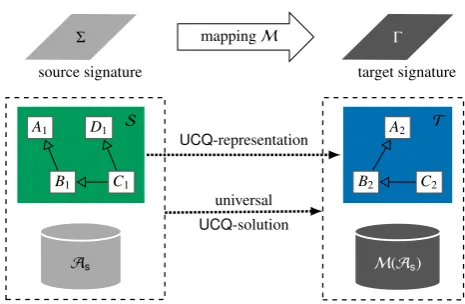
the source ABoxAswith respect toMand denote it byM(As),2thenhT,M(As)iis a universalUCQ-solution for hS,AsiunderM(see Figure 2). Finally, notice thatUCQ-representations do not depend on the actual data, so if in the
previous case ABoxAsis updated, then it is sufficient to updateM(As) in order to obtain a universalUCQ-solution
forhS,AsiunderM.
1If disjointness axioms are not allowed, then this new notion can be shown to be equivalent to the original formalization ofUCQ-representation.
2Observe thatM(A
S T ΣΣ1
source signature
As
A1
B1 C1
D1
Σ1 Γ
target signature
M(As)
A2
B2 C2
mappingM
UCQ-representation
universal
[image:14.595.180.413.107.259.2]UCQ-solution
Figure 2:UCQ-representations in the context of knowledge base exchange.
A natural question at this point is why in knowledge base exchange the source KB is not mapped as it is, thus simplifying the problem of computing solutions (under any of the notions given before). Notice that this can be easily done by including some additional concept and role symbols in the target signature, which represent the corresponding concepts and roles in the source signature. We would like to conclude this section by providing evidence why this is not desirable, or it could even be impossible, in some scenarios. First, the target signature might be given and not under control of the user, therefore it might not be extensible. Second, there might be privacy issues that prevent the use of all the information in a source KB, so only the information about some concepts and roles have to be displayed. This problem can be viewed as a knowledge exchange problem where the target signature stores the symbols to be displayed, and which cannot include some new concepts or roles. Third, a source signature might be very large, hence the user would like to switch to a smaller target signature. In this case, it is not desirable to add new symbols that can make the target signature to grow. Finally, an instance of data exchange could be part of the more general problem of schema evolution [31, 32], where one needs to consider a sequence of several instances of data exchange. In this context, allowing for keeping existing symbols might result in an unacceptable (and undesired) growth of the signature.
4.2. On the problem of computing solutions
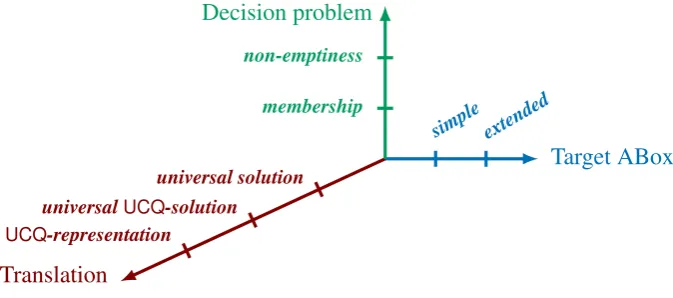
In this section, we present the space of reasoning problems that naturally arise in the framework introduced in this paper. The problem space has three dimensions and can be depicted as in Figure 3. First, one is interested in the task of computing a translation of a KB or a TBox according to a mapping, which is arguably the most important problem in knowledge exchange [25, 58], as well as in data exchange [16, 59]. Thus, the first dimension in Figure 3 defines the type of translation, which as mentioned in the previous section can be either: (1) a universal solution, or (2) a universalUCQ-solution, or (3) aUCQ-representation. Second, as it will become clear in Section 5, in order to be able to compute a translation, in some cases it is necessary to use extended ABoxes. Therefore, the second dimension is along the type of ABoxes allowed to be used in translations: (1) simple ABoxes, or (2) extended ABoxes. Finally, to study the computational complexity of knowledge exchange, we consider two classical decision problems: the membership problem and the non-emptiness problem, which constitute the third dimension.
As usual, the membership problem is concerned with deciding whether a particular instance (a target KB or target TBox, in our case) belongs to a class of instances (all solutions for a given source KB or TBox under a given mapping, in our case). Since we consider three classes of translations, we need to deal with three membership problems. The
membershipproblem for universal solutions (resp. universalUCQ-solutions) has as input a mappingM=(Σ,Γ,B) and KBsKs,KtoverΣandΓ, respectively. Then the question to answer is whetherKtis a universal solution (resp.
universalUCQ-solution) forKsunderM. Moreover, the membership problem forUCQ-representations has as input
a mappingM=(Σ,Γ,B) and TBoxesS,T overΣandΓ, respectively, and the question to answer is whetherT is a
UCQ-representation ofSunderM.
Translation
Target ABox
Decision problem
universal solution
universalUCQ-solution
UCQ-representation
simple extended
[image:15.595.129.466.115.264.2]membership non-emptiness
Figure 3: The space of reasoning problems.
given mapping?). Again, we consider three non-emptiness problems, one for each class of translation. Formally, the
non-emptinessproblem for universal solutions (resp. universalUCQ-solutions) has as input a mappingM=(Σ,Γ,B) and a KBKsoverΣ. Then the question to answer is whether there exists a universal solution (resp. universalUCQ -solution) forKsunderM. Moreover, the non-emptiness problem forUCQ-representations has as input a mapping M=(Σ,Γ,B) and a TBoxSoverΣ, and the question to answer is whether there exists aUCQ-representation ofS underM. In the case it exists, we say thatSisUCQ-representableunderM, otherwise,Sis notUCQ-representable under this mapping.
Observe thatUCQ-representations do not depend on target ABoxes, therefore, in total we have defined 10 different reasoning problems: 4 for universal solutions, 4 for universalUCQ-solutions, and 2 forUCQ-representations. We investigate in Sections 6 and 7 the computational complexity of the reasoning problems for universal solutions and
UCQ-representations, respectively. As for universalUCQ-solutions, the main results, summarized in Table 1, have been established in [30]. We prove here only, in Section 6.4, that the non-emptiness problem for universalUCQ -solutions for extended ABoxes is PSpace-hard. A lower bound for simple ABoxes has yet not been established.
5. The shape of different notions of solutions
The goal of this section is to provide examples and some facts about universal solutions, universalUCQ-solutions andUCQ-representations, which can help the reader to understand their advantages and limitations.
5.1. Universal solutions
We start by giving some simple examples of universal solutions.
Example 5.1. LetM = (Σ,Γ,B), where Σ = {A,B},Γ = {A0,B0}, andB = {A v A0, B v B0}. If S = {} and As = {A(a),B(a)}, then the KB Kt = hT,Ati, whereT = ∅andAt = {A0(a),B0(a)}is a universal solution for Ks = hS,Asi underM. Moreover, ifS = {A v B} andAs = {A(a)}, then Kt is again a universal solution for Ks=hS,AsiunderM.
Universal solutions are the preferred solutions to materialize when exchanging relational databases [16, 60, 23, 17], even in the case of incomplete information [25]. However, universal solutions were not thought to take into account source data including implicit knowledge (in the form of TBoxes), which is demonstrated in the following example.
Example 5.2. LetM = (Σ,Γ,B) be as in Example 5.1, and assume thatKs = hS,Asi, whereS = {A v B}and As = {A(a)}. Furthermore, suppose that Kt = hT,Ati, whereT = {A0 v B0}andAt = {A0(a)}. Then we have thatKtis a solution forKs underM. However,Kt is not a universal solution forKsunderM. To see why this is the case, consider an interpretationIof Σsuch thataI = 1, AI = {1}andBI ={1}, and an interpretationJof Γ such thataJ = 1, B0J = {1}andA0J = {1,2}. Then we have thatIis a model ofK
sand (I,J) |= B, and thus J ∈ SatM(Mod(Ks)). Thus, given thatJ is not a model of Kt (since it does not satisfy inclusion A0 v B0), we
All the universal solutions shown in the previous examples have empty TBoxes. In the following proposition, we prove that this is the case in general, which shows that universal solutions are not appropriate to represent implicit knowledge. We say that a TBoxOover a signatureΣistrivialif for every interpretationIofΣ, it holds thatI |=O (or, in other words, ifOis equivalent to the empty set of formulas).
Proposition 5.3. LetM = (Σ,Γ,B)be a mapping,Ks = hS,Asia KB overΣ, andKt =hT,Atia KB overΓ. If
hS ∪ B,Asiis consistent andKtis a universal solution forKsunderM, thenT is a trivial TBox.
The proof of Proposition 5.3 can be found in the appendix. Notice that this proposition shows that universal solutions can be viewed as target ABoxes with empty TBoxes. We denote byAa KB of the formh∅,Ai.
We continue our investigation by showing that extended ABoxes are necessary to guarantee the existence of universal solutions in certain cases.
Example 5.4. LetM = {A,R},{B},{∃R− v B} andK
s = hS,Asi, whereS = {A v ∃R}andAs = {A(a)}. A
natural way to construct a universal solution forKsunderMis to “populate” the target with all the facts implied by
uni(S ∪ B,As) (as it is usually done in data exchange [16, 17, 20]). In this case, we have that Auni(S∪B,As) = {a},
Runi(S∪B,As) ={(a,aw
[R])}andBuni(S∪B,As) ={aw[R]}, whereaw[R] is an object different from any of the constants in Na, which is used to represent a null value. Thus, the ABoxAt ={B(n)}, wherenis a labeled null, is a universal
solution forKsunderMif nulls are allowed, which can be readily checked using the definition of universal solution.
Nevertheless, a universal solution with simple ABoxes does not exist in this case, as substitutingnby any constant is too restrictive, ruining universality.
A natural question at this point is whether the use of null values guarantees the existence of universal solutions. Unfortunately, the following example shows that this is not the case. In fact, this example shows two different sit-uations in which universal solutions do not exist; in the first case this is due to the impossibility of representing an infinite number of facts in a finite ABox, while in the second case this is due to the the use of disjointness axioms and the absence of the UNA (which has to be given up to comply with the OWL 2 QL standard).
Example 5.5. Let M = (Σ,Γ,B), where Σ = {A,R}, Γ = {Q}, andB = {R v Q}. Furthermore, assume that Ks=hS,Asi, whereAs={A(a)}andS={Av ∃R, ∃R−v ∃R}. In this case,uni(S ∪ B,As) is infinite:
a aw[R] aw[R]w[R] aw[R]w[R]w[R]
R,Q R,Q R,Q
so in principle one would need an infinite number of labeled nulls to construct a universal solution. It can be easily proved that ifAtis an (extended) ABox overΓ, thenAtcannot be a universal solution forKsunderM.
Example 5.6. Now letM =(Σ,Γ,B) be defined as in Example 5.1. Moreover, assume thatKs = hS,Asi, where S={Av ¬B}andAs ={A(a),B(b)}, and assume thatAt={A0(a),B0(b)}. As in Example 5.1, it is possible to show thatAtis a universal solution for KBh∅,AsiunderM. However, with the addition of the disjointness axiomAv ¬B,
KBAtis no longer a universal solution (not even a solution) forKsunderM. The reason for this is the lack of the
UNA on the one hand, and the presence of the disjointness axiom that forcesaandbto be interpreted differently in the source, on the other hand. More precisely, for a modelJofAtsuch thataJ =bJ,A0J =B0J ={aJ}, there is no
modelIofKssuch that (I,J)|=B, as this forcesaI=aJandbI=bJ, which is not possible sinceaI,bI. It can
be straightforwardly proved that in this case there is no universal solution forKsunderM.
From the previous examples, we conclude that:
Proposition 5.7. There exists a mappingM=(Σ,Γ,B)and a KBKs=hS,AsioverΣsuch that there is no universal solution forKsunderM(even if extended ABoxes are allowed).
LetM =(Σ,Γ,B) be a mapping andKs =hS,Asibe a KB overΣ. As pointed out in the previous examples, a natural way to construct a universal solution forKs underMis to populate the target with all the facts implied by
uni(S ∪ B,As). In Example 5.5, this procedure generates an infinite chain that cannot be represented in a finite ABox,
wonder whether the finiteness ofuni(S ∪ B,As) is a necessary condition for the existence of universal solutions. The following example shows that this is not the case, and also gives evidence that checking whether a universal solution exists can be a computationally hard task (the complexity of this problem is studied in Section 6).
Example 5.8. LetM=(Σ,Γ,B), whereΣ ={A,R,S},Γ ={Q}andB={S vQ,RvQ}. Moreover, letKs=hS,Asi, whereS={Av ∃R,∃R−v ∃R}andA
s={A(a),S(a,a)}. Notice thatuni(S ∪ B,As) as well as its projection overΓ
are infinite. However, we can conclude thatAt={Q(a,a)}is a universal solution forKsunderM, as if the projection
ofuni(S ∪ B,As) overΓis transformed into an infinite ABox, then the resulting ABox has the same interpretations as
At. Or, in other words, it is possible to conclude thatAtis a universal solution forKsunderMasuni(At) is contained
in the projection ofuni(S ∪ B,As) overΓ, and there exists a homomorphismhfrom the projection ofuni(S ∪ B,As)
overΓtouni(At):
uni(At) :
a Q projection ofuni(S ∪ B,As) overΓ:
a aw[R] aw[R]w[R] aw[R]w[R]w[R]
Q Q Q
Q
h
We conclude this section by demonstrating that universal solutions can be of exponential size, thus indicating that it can be difficult to deal with them in practice. We use|M| and|K |to denote the sizes (number of symbols) of a mappingMand a KBK, respectively.
Example 5.9. We show that there exists a family of mappings{Mn =(Σn,Γn,Bn)}n≥1 and a family of KBs{Ksn}n≥1
such that every Ksn is defined over Σn (n ≥ 1), and the smallest universal solution forKsn under Mn is of size 2c(|Mn|+|Ksn|), for some constantc>0.
Indeed, letn≥1 be a natural number. Then mappingMn=(Σn,Γn,Bn) is defined as follows:
Σn = {A} ∪ {Rk
i |i∈ {1, . . . ,n},k∈ {0,1}}, Γn = {Qk|k∈ {0,1}}
Bn = {Rki vQk|i∈ {1, . . . ,n},k∈ {0,1}}.
Moreover, knowledge baseKn
s is defined ashSn,Ansi, whereSnis defined as:
{Av ∃Rk1|k∈ {0,1}} ∪ {∃Rki−v ∃R`i+1|i∈ {1, . . . ,n−1},k∈ {0,1}and`∈ {0,1}}, andAnsis defined as{A(a)}.
For everyn≥1, a universal solutionAnt forKsnunderMn exists. This universal solutionAnt is an edge-labeled full binary tree of depthn(containing 2nleaves). Below we depictA3
t, wheren1,. . .,n14are null values:
a
n1 n2
n3 n4 n5 n6
n7 n8 n9 n10 n11 n12 n13 n14
Q0 Q1
Q0 Q1 Q0 Q1
Q0 Q1 Q0 Q1 Q0 Q1 Q0 Q1
It can be proved that|An
t| ≥2
c(|Mn|+|Kn
s|)(for everyn≥1) for somec>0. Moreover, it is straightforward to prove that
5.2. UniversalUCQ-Solutions
Our first observation is that the notion of universalUCQ-solution is a relaxation of the notion of universal solution, as shown in the following proposition.
Proposition 5.10. LetM=(Σ,Γ,B)be a mapping,Ksa KB overΣ, andKta KB overΓ. IfKtis a universal solution
forKsunderM, thenKtis a universalUCQ-solution forKsunderM.
Proof. LetKtbe a universal solution forKs=hS,AsiunderMandqaUCQoverΓ.
First, we showcert(q,hS ∪ B,Asi)⊆cert(q,Kt). AssumeJis a model ofKt. SinceKtis a solution forKsunder M, there exists a modelIofKssuch that (I,J) |= B. LetH be the interpretation ofΣ∪Γdefined as the union
ofIandJ, that is,H =h∆H,·Hi,∆H = ∆I∪∆J,aH =aIfor eacha ∈ Na such thataIis defined,AH = AI for each concept nameA ∈ Σ,AH = AJ for each concept name A ∈ Γ,PH = PIfor each role name P ∈ Σ, and
PH =PJfor each role nameP∈Γ. ThenHis a model ofhS ∪ B,Asi. Suppose~a∈cert(q,hS ∪ B,Asi), it implies H |=q(~a). Next, asqis a target query, we have thatJ |=q(~a). Given thatJis an arbitrary model ofKt, we conclude that~a∈cert(q,Kt).
Now, we showcert(q,Kt)⊆cert(q,hS ∪ B,Asi). LetH be a model ofhS ∪ B,Asi. FromH we can construct interpretationsIandJ of ΣandΓ, respectively, such that H is the union ofIandJ. ThenIis a model of Ks and (I,J) |= B. SinceKt is a universal solution forKs under M, it follows thatJ is a model ofKt. Suppose
~a ∈ cert(q,Kt), it implies that J |= q(~a), and sinceq is a target query, andJ andH agree on the constants and
target symbols, it follows thatH |= q(~a). Given thatH is an arbitrary model ofhS ∪ B,Asi, we have that~a ∈
cert(q,hS ∪ B,Asi).
However, the converse direction of Proposition 5.10 does not hold, as shown in the following example.
Example 5.11. LetKs,MandKtbe as in Example 5.2. As pointed out in that example,Ktis not a universal solution
forKsunderM. However, it is easy to see thatKtis a universalUCQ-solution forKsunderM.
Notably, the previous example also shows that, as opposed to universal solutions, universalUCQ-solutions can have non-trivial TBoxes. As a consequence of this, we obtain that universal UCQ-solutions can be smaller than universal solutions, as there is no need to materialize all facts (since they can be derived using the target TBoxes).
In the following example, we show that there are cases where universal solutions do not exist but universalUCQ -solutions do. More precisely, we focus on the two cases provided in Example 5.5, and show that certain infinite chains that cannot be encoded in a universal solution can be finitely represented if the more relaxed notion of universalUCQ -solution is considered, and also show that disjointness axioms in the source or the mapping do not have any impact on universalUCQ-solutions.
Example 5.12. Let M = (Σ,Γ,B), where Σ = {A,R}, Γ = {Q}, and B = {R v Q}. Furthermore, assume that Ks =hS,Asi, whereAs ={A(a)}andS={Av ∃R, ∃R− v ∃R}. It can be verified that KBKt =hT,Ati, where T ={∃Q− v ∃Q}andAt ={∃Q(a)}, is a universalUCQ-solution forKs underM, as the aforementioned infinite
chain (c.f. Example 5.5) can be finitely represented by combining∃Q(a) with∃Q−v ∃Q.
Example 5.13. Now letM =(Σ,Γ,B) be defined as in Example 5.1. Moreover, assume thatKs =hS,Asi, where S={Av ¬B}andAs ={A(a),B(b)}, and assume thatAt ={A0(a),B0(b)}. In Example 5.6, we show thatAtis not
a universal solution for KBKsunderM. On the other hand, it can be shown thatAtis a universalUCQ-solution for KsunderM. In fact, this holds independently of whether the unique name assumption is employed.
From the previous examples, we conclude that:
Proposition 5.14. There exists a mapping M = (Σ,Γ,B) and a KBKs = hS,Asi over Σsuch that, there is no universal solution forKsunderM, but there exists a universalUCQ-solution forKsunderM.
Unfortunately, we show in the following example that there are cases where universalUCQ-solutions do not exist.
Example 5.15. Let M = (Σ,Γ,B), where Σ = {A,R,S}, Γ = {Q} and B = {R v Q,S v Q}. Moreover, let Ks=hS,Asi, whereS={Av ∃R,∃R−v ∃R}andAs={A(a),S(a,b)}. Then the projection overΓof the canonical