N A N O E X P R E S S
Open Access
Enhanced efficiency of inverted polymer solar
cells by using solution-processed TiO
x
/CsO
x
cathode buffer layer
Xiaodong Zhou
1*, Xi Fan
2, Xianke Sun
1, Yunli Zhang
1and Ziqiang Zhu
1Abstract
In this work, a double-buffer film of TiOxcoated with CsOx(TiOx/CsOx) was solution prepared to be applied in poly (3-hexylthiophene):indene-C60bisadduct (P3HT:ICBA) and P3HT:[6,6]-phenyl-C61-butyric acid methyl ester (PCBM) inverted polymer solar cells (PSCs). Compared with TiOxfilms and CsOxfilms, the TiOx/CsOxdouble-buffer film exhibited a favorable energy-level alignment among TiOx, CsOx, and the electron acceptor of PCBM or ICBA a better surface morphology; and an enhanced wetting and adhesion property with a contact angle of 21.0°, leading to a higher electron mobility of 5.52 × 10⁻³cm2V−1·s−1. Moreover, the P3HT:ICBA and P3HT:PCBM photovoltaic devices with the double-buffer film showed the best power conversion efficiency up to 5.65% and 3.76%, respectively. Our results not only present that the double-buffer film is superior than the single film of TiOxand CsOx, but also imply that the solution-processed film has a potential to be generally used in roll-to-roll processed organic photovoltaic devices.
Keywords:Inverted polymer solar cell; Solution processed; Cathode buffer layer
Background
Polymer solar cells (PSCs) have been a hot research topic due to their advantages of low cost, light weight, and large area [1-4]. Recently, normal (not inverted) PSCs with a considerable power conversion efficiency (PCE) of 7% ~ 9% have been reported [5-15]. In such normal PSCs, however, aqueous poly(3,4-ethylenediox-ythiophene):poly(styrenesulfonate) (PEDOT:PSS) disper-sion is acidic at pH 1 and corrosive to indium tin oxide substrates [16]; In addition, PSS and Al could diffuse into active layers and react with organic active layers [17]; therefore, instability of PSC devices caused by the anode buffer layer of PEDOT:PSS and the Al cathode has become a main concern for practical applications. To overcome the problems, stable inverted PSCs are widely developed by using metal oxides as buffer layers, e.g., zinc oxide (ZnO) [18-20] and titanium oxide (TiOx) [21-23] were widely selected as a cathode buffer layer (CBL), whereas MoO3was usually employed as an anode
buffer layer to replace PEDOT:PSS and to prevent the diffusing of Al atoms into active layers in inverted PSCs [24].
In inverted PSCs, CBLs play a key role of determining device performance. Generally, for efficient PSCs, a good CBL often satisfies several criteria: high transparency, low work function (WF), and favorable energy levels matched well with those of electron acceptors. 1) High-transparency benefits to large light absorption of active layers, thereby leading to more exciton dissociation at the interface of donor/acceptor and an increase in short current density (JSC). 2) As reported in previous litera-tures [25-27], open circle voltage (VOC) is determined mostly by the energy-level difference between the high-est occupied molecular orbital (HOMO) of the donor and the lowest unoccupied molecular orbital (LUMO) of the acceptor [11,12] and the work function difference of the cathode/anode [25-27], as well as the weight ratio of the donor and acceptor [28]. Low work functions of film could increase the work function difference of the cath-ode/anode and thus leading to an increase in VOC of PSCs [25-27]. Afterwards, the films of low WFs facilitate electron collection by cathodes and restrain the charge
* Correspondence:[email protected] 1
School of Physics and Electromechnical Engineering, Zhoukou Normal University, Zhoukou 466001, People’s Republic of China
Full list of author information is available at the end of the article
carrier recombination at the interface of the active layer and film [25,27]. 3) Energy levels of the films, matched well with LUMO and HOMO energies of the compo-nents of active layers, could effectively select electrons and block holes, leading to an increase in JSC of PSCs [18-23]. However, is there another factor of the films that has a significant effect on the device performance? Will the contact property of interfaces between active layer droplets and cathode buffer layers be changed when the buffer layer is modified? How will the changes of the interfacial contact property affect the charge car-rier mobility and the device performance?
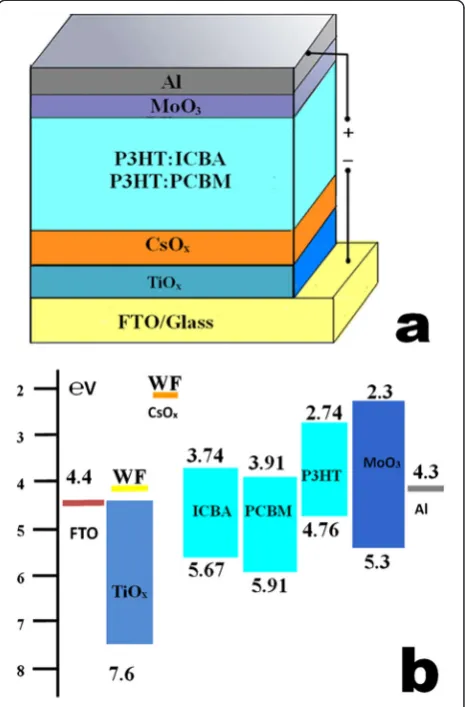
Recently, many films, such as TiOx [21-23], ZnO [18-20], cesium oxide (CsOx) [29], Ca [30,31], LiF [32], and self-assembled monolayers [18,33], are widely employed to modify the cathode surfaces in inverted PSCs. Among these films, much attention in the devel-opment of inverted PSCs has been focused on TiOx, which has the advantages of excellent chemical and ther-mal stability, environmentally friendly, high-electron mobility, and easy fabrication [34]. The TiOx film is often prepared by sol-gel synthesis [22], atomic layer de-position [23], and thermal-annealed titanium chelate [16]. Moreover, the film can serve as an effective hole-and exciton-blocking layer because of its conduction band of approximately 4.4 eV, which is much higher than the HOMO values of electron acceptor materials [35,36] (seen in Figure 1b). However, challenges still re-main for the film, re-mainly due to the film work function of 4.14 to 4.22 eV [37] still not being low enough for a high VOC in inverted PSCs. The work function com-monly affects the work function of cathode and the work function difference of cathode/anode. Thus, the VOC of poly(3-hexylthiophene):[6,6]-phenyl-C61-butyric acid me-thyl ester (P3HT:PCBM) inverted PSCs with a TiOx film was usually limited to a small range of 0.55 to 0.58 V under simulated 100-mW cm−2(AM 1.5 G) solar irradi-ation [23,38], which blocks its practical applicirradi-ation in high-efficiency inverted PSCs.
Besides, a CsOx thin film is commonly prepared by evaporating deposition of Cs2CO3particles or spin coat-ing the Cs2CO3 solution. Attributed to the CsOx is a much lower WF of approximately 2.20 eV as reported in previous literature [27]; it not only can modify the work function of the cathode and cathode buffer layer, but also facilitates electron transportation from electron ac-ceptor materials to the CsOx surfaces. Therefore, it is believed that CsOx could be an effective cathode buffer layer for PSCs.
In the work, a solution-processed CsOx film was inserted at the interface of the active layer/TiOx. The MoO3film with a thickness of 8 to 10 nm was found to be an optimized value [39]. Here, the Al modified by a 10-nm-thick MoO3 film was evaporated. By increasing
[image:2.595.306.539.90.444.2]the work function difference of the cathode/anode, a lar-ger VOCand an enhanced PCE were achieved in P3HT: indene-C60 bisadduct (ICBA)-based inverted PSCs and in P3HT:PCBM-based inverted PSCs. First, atomic force microscopy (AFM) measurements present that the double film exhibits a smoother surface with a roughness of just 4.9 nm, as compared with the TiOx film and the CsOx film. And, the double film provides a better adhesion with P3HT:ICBA blend solutions, evidenced by measurements of solution contact angles, which was found at the inter-face between P3HT:ICBA blend droplets and the CBLs. Afterwards, it is found that the highest electron mobility (μe) of 5.52 × 10⁻³ cm2 V−1·s−1 is achieved in inverted electron-only devices with TiOx/CsOxfilm measured with space-charge-limited current (SCLC) method. Moreover, current density-voltage (J-V) measurements show that the P3HT:ICBA inverted PSCs and the P3HT:PCBM inverted PSCs with TiOx/CsOx film exhibit a PCE of 5.65% and 3.76%, respectively, under the illumination of AM 1.5, 100
mW cm−2, which is higher than that of the PSCs with TiOxfilm and the PSCs with CsOxfilm. The results indi-cate that the TiOx/CsOxis superior than the TiOxand the CsOx, not only for the better interfacial contact, but also for the achievement of the higher electron mobility, and thereby leading to an enhanced device performance. Finally, the TiOx/CsOx film possesses many advantages, such as 1) solution processability with ethanol and isopro-panol solvents, which promote the application of solution-processing technologies, e.g., spin coating and role-to-role printing and 2) low cost since both TiOx and CsOx are cheap to produce and commonly used materials in organic photovoltaic and light-emitting fields, which suggests their huge potential for practical applications.
Methods
P3HT (4002-E) and PCBM were purchased from Rieke Metals Inc. (Lincoln, NE, USA) and Nano-C (Westwood, MA, USA), respectively. Indene-C60 bisadduct was pur-chased from Solarmer Inc. (El Monte, CA, USA). The TiOxfilm was prepared by spin coating TiOxsol-gel solu-tion [22] on fluorinated tin oxide (FTO) substrate and then was thermally treated at 200°C for 30 min in air. Whereas, the CsOxfilm was prepared by spin coating iso-propanol solution of Cs2CO3on FTO substrate and then thermal annealing at 160°C for 10 min in a glove box filled with Ar atmosphere. When spin coating the Cs2CO3 solu-tion on FTO/TiOx substrate and then thermal annealing at 160°C for 10 min, it forms the TiOx/CsOxfilm.
All the inverted PSCs were fabricated on FTO-coated glass. First, the different film was spin coated and then baked on FTO. Then, the blend solution of P3HT:PCBM and P3HT:ICBA in dichlorobenzene (1:1,w/w, 36 mg ml−1) was spin coated at 800 rpm. The active layers were then placed into glass petri dishes to undergo solvent annealing and annealed at 150°C for 10 min on a hot plate in a glove box. Subsequently, MoO3(10 nm) and Al (100 nm) were evaporated as an anode buffer layer and anode, respectively, under the pressure of≤1.0 × 10⁻⁴Pa. Transmittance spectra were taken on a Hitachi U-3010 UV-visible spectrophotom-eter (Hitachi, Ltd., Chiyoda-ku, Japan). The surface morph-ology of active layers was characterized by AFM (SPM-9500J3, Shimadzu, Kyoto, Japan). TheJ-Vmeasurement of the inverted PSCs was conducted on a computer-controlled Keithley 236 Source Measure Unit (Keithley Instruments, Inc., Cleveland, OH, USA). Device characterization was carried out in a glove box under illumination of AM 1.5 G, 100 mW cm−2using a xenon-lamp-based solar simula-tor (from Newport Co., LTD., Irvine, CA, USA).
Results and discussion
To investigate the effect of the cathode buffer layers on the performance of the inverted PSCs, we designed six types of inverted PSC devices with different structures:
(A). FTO/CsOx/P3HT:ICBA (200 nm)/MoO3(10 nm)/Al
(100 nm),
(B). FTO/TiOx(80 nm)/P3HT:ICBA (200 nm)/MoO3
(10 nm)/Al (100 nm),
(C). FTO/TiOx(80 nm)/CsOx/P3HT:ICBA
(200 nm)/MoO3(10 nm)/Al (100 nm),
(D). FTO/CsOx/P3HT:PCBM (200 nm)/MoO3
(10 nm)/Al (100 nm),
(E). FTO/TiOx(80 nm)/P3HT:PCBM (200 nm)/MoO3
(10 nm)/Al (100 nm),
(F). FTO/TiOx(80 nm)/CsOx/P3HT:PCBM
(200 nm)/MoO3 (10 nm)/Al (100 nm).
[image:3.595.306.539.357.691.2]Device performance
Figure 2a shows theJ-Vcharacteristic curves of the P3HT: ICBA inverted PSCs with a film of TiOx, CsOx, and TiOx/ CsOxunder simulated AM 1.5 G solar illumination of 100 mW cm−2. For comparison, more than 30 solar cells were fabricated and characterized to confirm the performance trends. It presents that the inverted PSCs with CsOx film (devices A) show a relatively poor PCE of 4.91%
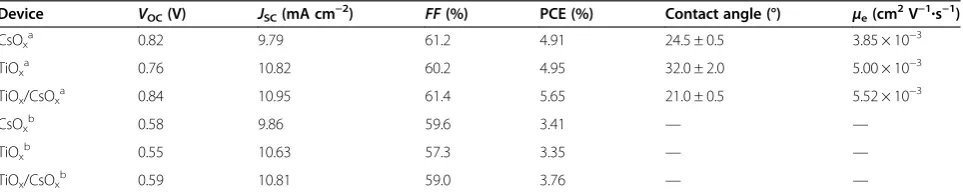
withVOCof 0.82 V,JSCof 9.79 mA cm−2, and fill factor (FF) of 61.2%. Compared with the devices A, the PSCs with TiOx film (devices B) yield an equipotent PCE of 4.95%, with a lowerVOCof 0.76 V, a higherJSCof 10.82 mA cm−2, and a FFof 60.2%. It is considered that the higher JSC of 10.82 mA cm−2 is attributed to the exciton- and hole-blocking ability of the TiOx film re-sulted from its favorable conduction band, as shown in Figure 1b. For the PSCs with the TiOx/CsOx film (de-vices C), the highest PCE of 5.65% is achieved withVOC of 0.84 V,JSCof 10.95 mA cm−2, andFFof 61.4%, dem-onstrating a good combination of TiOxand CsOx, which compensates the loss inVOC of devices B as well as in JSC of devices A, respectively. Such photovoltaic per-formance parameters of the inverted PSCs are summa-rized in Table 1.
To further investigate the general suitability of the TiOx/CsOx film in inverted PSCs, the other electron ac-ceptor material of PCBM was used instead of ICBA for fabricating P3HT:PCBM inverted PSCs. TheJ-V charac-teristic curve is shown in Figure 2b. As expected, for the inverted PSCs with CsOx film (devices D), a PCE of 3.41% is achieved withVOCof 0.58 V,JSCof 9.86 mA cm−2, and FFof 59.6%. Compared with that of the devices D, the PCE and FF of the inverted PSCs with TiOx film (devices E) just change a little, whereas theJSCis enhanced significantly from 9.86 to 10.63 mA cm−2 and the VOC drops severely from 0.58 to 0.55 V. The inverted PSCs with TiOx/CsOx film (devices F) exhibit a PCE of 3.76%, better than that of the devices D and the devices E, which may be due to more electron extraction from the P3HT: PCBM active layer to the FTO cathode. Note that compared with the devices D, the devices E yield an en-hanced short-circuit current, maybe due to a better hole-transporting and electron-blocking property of the TiOx than that of the CsOx. When TiOx/CsOx was used as a cathode buffer layer, it did not induce an increase inJSC; however, a significant increase inVOCfrom 0.76 to 0.84 V was observed clearly, attributed to the insert of CsOxfilm with a low work function. The changes inJSCandVOCof the P3HT:PCBM inverted PSCs agree with those of the P3HT:ICBA inverted PSCs.
Optical properties and surface morphology of the films
Figure 3 shows the optical transmittance of CsOx, TiOx, and TiOx/CsOx on FTO substrates. The CsOx film is highly transparent in the visible range, and the minimum light transmittance is not less than 90% between 400 and 800 nm. Compared with the CsOxfilm on FTO sub-strate, the TiOx film exhibits a decreased optical trans-mittance in the range of 300 to 800 nm, whereas the TiOx/CsOx has a decrease optical transmittance of 350 to 450 nm, as compared with the TiOx, suggesting an ultra-thin film of CsOxon the TiOxsurface.
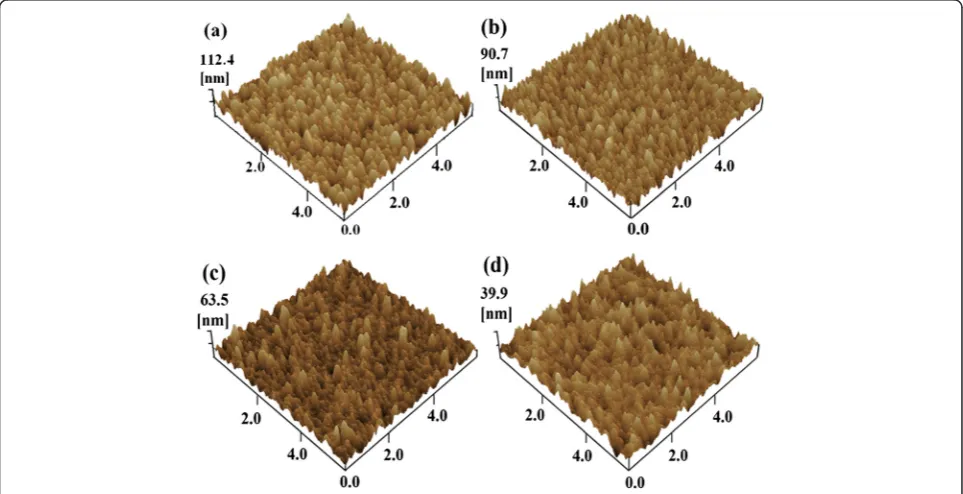
To investigate the surface morphology of FTO modified by the film, atomic force microscopy measurements were carried out. Figure 4 shows the surface images of the four samples, including the FTO substrate, TiOx, CsOx, and TiOx/CsOx film on FTO substrate. It presents that the FTO substrate without any modification by CsOxor TiOx shows a lot of large ‘valleys’ and the root mean square (RMS) is about 15.7 nm. After spin coating Cs2O3solution on the FTO substrate and then thermal annealing, it forms a CsOxthin film, which exhibits a lower RMS of 12.5 nm; however, there is not any apparent change in surface morphology between the FTO and the CsOx-modified FTO. Due to the modification of TiOxon FTO substrate, the TiOx film exhibits a decreased RMS of about 7.6 nm. Moreover, it shows smaller ‘valleys’ on the surface and becomes much smoother than the CsOx film, whereas the TiOx/CsOx film presents a RMS of just 4.9 nm, indicating the CsOxcombines well with the TiOxfilm.
Note that it is difficult to directly measure the thick-ness of the CsOx film on the top of TiOx film because the thickness of the CsOxfilm is much smaller than the RMS of either the FTO substrate or the TiOxfilm. How-ever, the varieties of surface morphology in the four samples have been probed by AFM measurements, im-plying the presence of the CsOxlayer on FTO substrates as well as TiOx-modified FTO substrates.
Droplet contact angle measurements
[image:4.595.58.540.627.724.2]Due to the device performance being significantly dependent on the interfacial contact property of the
Table 1 Summary of performance of the P3HT:ICBA inverted PSCs and the P3HT:PCBM inverted PSCs with different film
Device VOC(V) JSC(mA cm−2) FF(%) PCE (%) Contact angle (°) μe(cm2V−1·s−1)
CsOx a
0.82 9.79 61.2 4.91 24.5 ± 0.5 3.85 × 10⁻³ TiOx
a
0.76 10.82 60.2 4.95 32.0 ± 2.0 5.00 × 10⁻³ TiOx/CsOx
a
0.84 10.95 61.4 5.65 21.0 ± 0.5 5.52 × 10⁻³ CsOx
b
0.58 9.86 59.6 3.41 — —
TiOx b
0.55 10.63 57.3 3.35 — —
TiOx/CsOx b
0.59 10.81 59.0 3.76 — —
a
film/active layer [40], which contributes to surface en-ergy, it is necessary to observe the surface energy of the film. In this work, the surface energy of the film is studied with measurements of solution contact angles between a drop of P3HT:ICBA solution and the differ-ent film. For observing distinctly the interfacial contact angles, we used directly the P3HT and ICBA blend so-lution (1:1, w/w, 36 mg ml−1) in dichlorobenzene as the‘solution’and measured the contact angles between the solution drop and the different film. Figure 5 shows the droplet images of P3HT:ICBA solutions on FTO substrate, CsOx, TiOx, and TiOx/CsOx film, respect-ively. It presents that the contact angle of the FTO
surface to the P3HT:ICBA blend solution is 46.5° ± 2.5°, indicating a poor binding of the blend droplet to the FTO surface. Moreover, compared with the droplet on the FTO substrate, the smaller contact angle of 32.0° ± 2.0° and 24.5° ± 0.5° is observed for the droplet on the TiOxand the CsOx film, respectively, indicating a better wetting of the solvent, whereas the blend drop-let has the smallest contact angle of just 21.0° ± 0.5° to the TiOx/CsOx film, suggesting the best affinity of the P3HT:ICBA active layer to the TiOx/CsOx film, which will be electrically/energetically favorable to the elec-tron extraction and hence facilitates the fabrication of efficient inverted PSCs [29].
The RMS value of the TiOx, CsOx, and TiOx/CsOx is 12.5, 7.6, and 4.9 nm, respectively, and the correspond-ing P3HT:ICBA solution contact angle is 32.0° ± 2.0°, 24.5° ± 0.5°, and 21.0° ± 0.5°, respectively, suggesting that the contact angle decreases with the decrease of the RMS value. The change of the solution contact angle is partially resulted from the morphology variation induced by the CsOx modification. In the work, the factor of RMS alters the interfacial contact angles and induces an enhancement of wetting and adhesion by changing sur-face energy, as also reported in previous literature [40].
Electron mobility measurements
[image:5.595.57.291.88.260.2]The electron-extraction ability by the different film may be significantly dependent on the interface contact prop-erty and the energy-level alignment. To precisely assess the correlation among the factors, we have carefully ex-amined the μe of electron-only devices with different
Figure 3Optical transmittance of the films of TiOx, CsOx, and TiOx/CsOx, respectively.
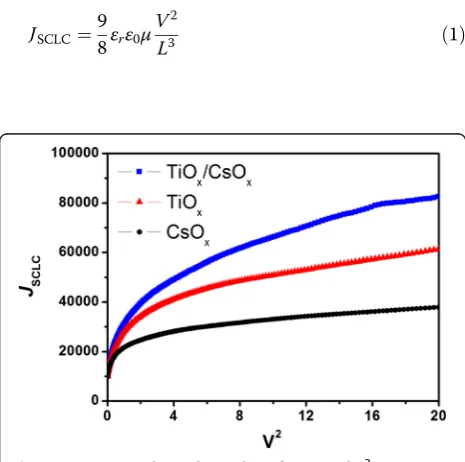
[image:5.595.57.539.470.717.2]film by using the SCLC method. In the work, the electron-only devices with an architecture of ITO/CBL/P3HT: ICBA/CsOx/Al were fabricated to measure theμe. In such electron-only devices, the TiOx, CsOx, and TiOx/CsOx is used as a CBL, whereas the CsOxlayer on the active layer surface is employed as a hole-blocking layer. Note that it is spin coated with Cs2CO3 solution and then thermally annealed for 160°C for 10 min in glove box filled with Ar. Generally, high performance of PSCs commonly accom-panies with a high-electron mobility, which is mainly influ-enced by exciton dissociation, as well as charge-carrier recombination at the interfaces of donor/acceptor and the interfaces of CBL/acceptor. The single-carrier mobility can be obtained from the JSCLC-V2 curve (Figure 6) by the SCLC method using the Mott-Gurney square law [41]:
JSCLC¼ 9 8εrε0μ
V2
L3 ð1Þ
[image:6.595.58.540.89.249.2]where εr is the dielectric constant of the material; ε0is the permittivity of free space; Lis the distance between the cathode and anode, which is equivalent to the film thickness; and V is the applied voltage. Figure 6 shows the SCLC curves of the P3HT:ICBA-based electron-only devices with different film. It demonstrates the corre-sponding relationship of JSCLC with V2, where JSCLC is the dark current density. The μe of the devices with CsOx film is only 3.85 × 10⁻³ cm2 V−1·s−1. Compared with the device with a CsOx film, however, the devices with TiOx/CsOx film show an enhanced remarkable μe of 5.52 × 10⁻³ cm2 V−1·s−1, suggesting an enhanced electron-extraction ability by the TiOx/CsOx film and hence leading to the enhancement inJSCand PCE of the inverted PSCs. It should be noted that the μe values of the inverted PSCs were higher than those of normal PSCs in previous work [42]. The data are summarized in Table 1. In the work, the increase of the μe should be also related to the reduction in work function of the TiOx surface modified by CsOx. Li et al. reckoned that a thin layer of CsOxis capable of lowering the work func-tion of the underlying layer of ITO [27]. Moreover, Xu et al. reported inverted PSCs with a component film of Cs2CO3:4,7-Diphenyl-1,10-phenanthroline (BPhen) [43]. The work function of pristine BPhen on the ITO sub-strate was determined to be 3.1 eV by ultraviolet photo-electron spectroscopy, while the corresponding work function of the Cs2CO3:BPhen component layer was re-duced to about 2.6 eV, thereby leading an increase inVOC from 0.40 to 0.64 V and JSCfrom 7.3 to 9.4 mA cm−2of inverted PSCs with Cs2CO3:BPhen film as compared to inverted PSCs with BPhen film [43]. Combining all the above and our mentioned results, it is believed that the CsOx (or Cs2CO3)-modified film can reduce the WF of the film and provide a better wetting property of the blend solvent on the TiOx/CsOxfilm surface, as well as a favor-able energy-level alignment, which facilitate electron
Figure 5Droplet images of P3HT:ICBA solution.Droplet images of P3HT:ICBA solution on the surface of FTO substrate(a), CsOx(b), TiOx(c),
[image:6.595.57.290.480.711.2]and TiOx/CsOx(d), respectively. The length of the FTO-coated glass substrate is 3.0 cm.
injection from electron acceptor to cathode, and thus leading to a remarkable improvement inVOCandJSC.
Conclusions
In summary, high-efficiency inverted polymer solar cells are demonstrated with a solution-processed TiOx/CsOx layer as a cathode buffer layer. By inserting a CsOx film at the interface of the TiOx/active layer, the power conver-sion efficiency up to 5.65% and 3.76% has been achieved in inverted PSCs with P3HT:ICBA and inverted PSCs with P3HT:PCBM, respectively, under 100-mW cm−2 AM 1.5 G simulated solar illumination, suggesting that the TiOx/CsOx is superior than the TiOx and the CsOx. Moreover, this work not only provides a new option for the selection of the solution-processed cathode buffer layer in designing efficient and stable inverted PSCs, but also presents that the improvement of the interface con-tact property is also an essential factor for efficient poly-mer solar cells when preparing cathode buffer layers.
Competing interests
The authors declare that they have no competing interests.
Authors’contributions
XZ and XF designed the experiments and carried out the synthesis and characterization of the samples. XZ analyzed the results and wrote the first draft of the manuscript. XF and XS participated in analyses of the results and discussion of this study. YZ and ZZ revised the manuscript and corrected the English. All authors read and approved the final manuscript.
Acknowledgements
This work was supported by the National Nature Science Foundation of China (No. 11405280), the Foundation from Education Department of Henan Province of China (No. 14B140021), and the Startup Foundation for Doctors of Zhoukou Normal University of China (zksybscx201210).
Author details
1
School of Physics and Electromechnical Engineering, Zhoukou Normal University, Zhoukou 466001, People’s Republic of China.2Hubei Collaborative
Innovation Center for Advanced Organic Chemical Materials, Faculty of Physics and Electronic Science, Hubei University, Wuhan 430062, People’s Republic of China.
Received: 26 November 2014 Accepted: 13 January 2015
References
1. Peet J, Heeger AJ, Bazan GC.“Plastic”solar cells: self-assembly of bulk heterojunction nanomaterials by spontaneous phase separation. Acc Chem Res. 2009;42:1700–8.
2. Li G, Tao Y, Yang H, Shrotriya V, Yang G, Yang Y.“Solvent annealing”effect in polymer solar cells based on poly(3-hexylthiophene) and
methanofullerenes. Adv Funct Mater. 2007;17:1636–44.
3. Mauger SA, Chang LL, Friedrich S, Rochester CW, Huang DM, Wang P, et al. Self-assembly of selective interfaces in organic photovoltaics. Adv Funct Mater. 2013;23:1935–46.
4. Krebs FC. Fabrication and processing of polymer solar cells: a review of printing and coating techniques. Solar Energy Materials Solar Cells. 2009;93:394–412.
5. Chen JW, Cao Y. Development of novel conjugated donor polymers for high-efficiency bulk-heterojunction photovoltaic devices. Acc Chem Res. 2009;42:1709–18.
6. Chen YJ, Yang SH, Hsu CS. Synthesis of conjugated polymers for organic solar cell applications. Chem Rev. 2009;109:5868–923.
7. Li YF. Molecular design of photovoltaic materials for polymer solar cells: towards suitable electronic energy levels and broad absorption. Acc Chem Res. 2012;45:723–33.
8. Fan X, Wang JZ, Huang HH, Wang H. Binary additives regulate the PC71BM
aggregate morphology for highly efficient polymer solar cells. ACS Photonics. 2014;1:1278–84.
9. Chen HY, Hou JH, Zhang SQ, Liang YY, Yang GW, Yang Y, et al. Polymer solar cells with enhanced open-circuit voltage and efficiency. Nat Photonics. 2009;3:649–53.
10. Liang YY, Xu Z, Xia JB, Tsai ST, Wu Y, Li G, et al. For the bright future-bulk heterojunction polymer solar cells with power conversion efficiency of 7.4%. Adv Mater. 2010;22:E135–8.
11. Huo LJ, Zhang SQ, Guo X, Xu F, Li YF, Hou JH. Replacing alkoxy groups with alkylthienyl groups: a feasible approach to improve the properties of photovoltaic polymers. Angew Chem Int Ed. 2011;50:9697–702. 12. Price S, Stuart A, Yang L, Zhou H, You W. Fluorine substituted conjugated
polymer of medium band gap yields 7% efficiency in polymer-fullerene solar cells. J Am Chem Soc. 2011;133:4625–31.
13. Chu T, Lu J, Beaupre S, Zhang Y, Pouliot J, Wakim S, et al. Bulk heterojunction solar cells using thieno [3, 4-c] pyrrole-4, 6-dione and dithieno [3, 2-b: 2′, 3′-d] silole copolymer with a power conversion efficiency of 7.3%. J Am Chem Soc. 2011;133:4250–3.
14. Small CE, Chen S, Subbiah J, Amb CM, Tsang SW, Lai TH, et al. High-efficiency inverted dithienogermole-thienopyrrolodione-based polymer solar cells. Nat Photonics. 2012;6:115–20.
15. Dou L, You J, Yang J, Chen CC, He Y, Murase S, et al. Tandem polymer solar cells featuring a spectrally matched low-band gap polymer. Nat Photonics. 2012;6:180–5.
16. Irwin MD, Buchholz DB, Hains AW, Chang RPH, Marks TJ. p-type semiconducting nickel oxide as an efficiency-enhancing anode interfacial layer in polymer bulk-heterojunction solar cells. Proc Natl Acad Sci U S A. 2008;105:2783–7.
17. Jørgensen M, Norrman K, Krebs FC. Stability/degradation of polymer solar cells. Solar Energy Materials Solar Cells. 2008;92:686–714.
18. Hau SK, Cheng YJ, Yip HL, Zhang Y, Ma H, Jen AKY. Effect of chemical modification of fullerene-based self-assembled monolayers on the performance of inverted polymer solar cells. ACS Appl Mater Interfaces. 2010;2:1892–902.
19. Gadisa A, Liu Y, Samulski ET, Lopez R. Role of thin n-type metal-oxide interlayers in inverted organic solar cells. ACS Appl Mater Interfaces. 2012;4:3846–51.
20. Shao SY, Zheng K, Pullerits T, Zhang FL. Enhanced performance of inverted polymer solar cells by using poly(ethylene oxide)-modified ZnO as an electron transport layer. ACS Appl Mater Interfaces. 2013;5:380–5. 21. Kuwabara T, Iwata C, Yamaguchi T, Takahashi K. Mechanistic insights into
UV-induced electron transfer from PCBM to titanium oxide in inverted-type organic thin film solar cells using AC impedance spectroscopy. ACS Appl Mater Interfaces. 2010;2:2254–60.
22. Salim T, Yin ZY, Sun S, Huang X, Zhang H, Lam YM. Solution-processed nanocrystalline TiO2buffer layer used for improving the performance of
organic photovoltaics. ACS Appl Mater Interfaces. 2011;3:1063–7. 23. Lin ZH, Jiang CY, Zhu CX, Zhang J. Development of inverted organic solar
cells with TiO2interface layer by using low-temperature atomic layer
deposition. ACS Appl Mater Interfaces. 2013;5:713–8.
24. Fan X, Fang GJ, Guo SS, Liu NS, Gao HM, Qin PL, et al. Controllable synthesis of flake-like Al-doped ZnO nanostructures and its application in inverted organic solar cells. Nanoscale Res Lett. 2011;6:546.
25. Zhang FL, Ceder M, Inganäs O. Enhancing the photovoltage of polymer solar cells by using a modified cathode. Adv Mater. 2007;19:1835–8. 26. Jiang CY, Sun XW, Zhao DW, Kyaw AKK, Li YN. Low work function metal
modified ITO as cathode for inverted polymer solar cells. Solar Energy Materials Solar Cells. 2010;94:1618–21.
27. Li G, Chu CW, Shrotriya V, Huang J, Yang Y. Efficient inverted polymer solar cells. Appl Phys Lett. 2006;88:253503.
28. Cui CH, Fan X, Zhang MJ, Zhang J, Min J, Li YF. A D–A copolymer of dithienosilole and a new acceptor unit of naphtho[2,3-c]thiophene-4,9-dione for efficient polymer solar cells. Chem Commun. 2011;47:11345–7.
29. Cheng G, Tong WY, Low KH, Che CM. Thermal-annealing-free inverted polymer solar cells using ZnO/Cs2CO3bilayer as electron-selective layer.
30. Fan X, Cui CH, Fang GJ, Wang JZ, Li SZ, Cheng F, et al. Efficient polymer solar cells based on poly(3-hexylthiophene):indene-C70bisadduct with a
MoO3buffer layer. Adv Funct Mater. 2012;22:585–90.
31. Fan X, Fang GJ, Cheng F, Qin PL, Huang HH, Li YF. Enhanced performance and stability in PBDTTT-C-T:PC70BM polymer solar cells by optimizing
thickness of NiOxbuffer layers. J Phys D Appl Phys. 2013;46:305106.
32. Cheng F, Fang GJ, Fan X, Huang HH, Zheng Q, Qin PL, et al. Enhancing the performance of P3HT:ICBA based polymer solar cells using LiF as electron collecting buffer layer and UV–ozone treated MoO3as hole collecting buffer
layer. Solar Energy Materials Solar Cells. 2013;110:63–8.
33. Heo SW, Lee E, Seong KW, Moon DK. Enhanced stability in polymer solar cells by controlling the electrode work function via modification of indium tin oxide. Solar Energy Materials Solar Cells. 2013;115:123–8.
34. Li SS, Chen CW. Polymer–metal-oxide hybrid solar cells. e. 2013;1:10574–91. 35. He YJ, Chen HY, Hou JH, Li YF. Indene-C60bisadduct: a new acceptor for
high performance polymer solar cells. J Am Chem Soc. 2010;132:1377–82. 36. He YJ, Zhao GJ, Peng B, Li YF. High yield synthesis, electrochemical and
photovoltaic properties of indene-C70bisadduct. Adv Funct Mater.
2010;20:3383–9.
37. Schmidt H, Zilberberg K, Schmale S, Flügge H, Riedl T, Kowalsky W. Transient characteristics of inverted polymer solar cells using titaniumoxide interlayers. Appl Phys Lett. 2010;96:243305.
38. Kuwabara T, Nakayama T, Uozumi K, Yamaguchi T, Takahashi K. Highly durable inverted-type organic solar cell using amorphous titanium oxide as electron collection electrode inserted between ITO and organic layer. Solar Energy Materials Solar Cells. 2008;92:1476–82.
39. Yang Q, Yang D, Zhao S, Huang Y, Xu Z, Liu X, et al. The improved performance of solution-processed SQ:PC71BM photovoltaic devices via
MoO3as the anode modification layer. Appl Surf Sci. 2013;284:849–54.
40. Kyaw AKK, Sun XW, Jiang CY, Lo GQ, Zhao DW, Kwong DL. An inverted organic solar cell employing a sol–gel derived ZnO electron selective layer and thermal evaporated MoO3hole selective layer. Appl Phys Lett.
2008;93:221107.
41. Jung JW, Jo WH. Annealing-free high efficiency and large area polymer solar cells fabricated by a roller painting process. Adv Funct Mater. 2010;20:2355–63. 42. Fan X, Li SZ, Guo SS, Fang GJ. Understanding the phase separation
evolution in efficient P3HT : IC70BA-based bulk-heterojunction polymer solar cells. J Phys D Appl Phys. 2013;46:055502.
43. Xu ZQ, Yang JP, Sun FZ, Lee ST, Li YQ, Tang JX. Efficient inverted polymer solar cells incorporating doped organic electron transporting layer. Org Electron. 2012;13:697–704.
Submit your manuscript to a
journal and benefi t from:
7Convenient online submission
7Rigorous peer review
7Immediate publication on acceptance
7Open access: articles freely available online 7High visibility within the fi eld
7Retaining the copyright to your article