BIROn - Birkbeck Institutional Research Online
Kikot, Stanislav and Kontchakov, Roman and Rapisarda, Salvatore and
Zakharyaschev, Michael (2018) STYPES: nonrecursive datalog rewriter for
linear TGDs and conjunctive queries. In: Panetto, H. and Debruyne, C. and
Proper, H. and Ardagna, C. and Roman, D. and Meersman, R. (eds.) On
the Move to Meaningful Internet Systems. OTM 2018 Conferences. LNCS
11230. Springer, pp. 441-460. ISBN 9783030026707.
Downloaded from:
Usage Guidelines:
Please refer to usage guidelines at
or alternatively
ST
YPE
S: Nonrecursive Datalog Rewriter
for Linear TGDs and Conjunctive Queries
Stanislav Kikot1, Roman Kontchakov2, , Salvatore Rapisarda2, and
Michael Zakharyaschev2
1
University of Oxford, UK [email protected] 2
Birkbeck, University of London, UK {roman,srapis01,michael}@dcs.bbk.ac.uk
Abstract. We present STYPES, a system that rewrites ontology-mediated queries with linear tuple-generating dependencies and conjunctive queries to equivalent nonrecursive datalog (NDL) queries. The main feature of STYPES is that it pro-duces polynomial-size rewritings whenever the treewidth of the input conjunctive queries and the size of the chases for the ontology atoms as well as their arity are bounded; moreover, the rewritings can be constructed and executed in LOGCFL, indicating high parallelisability in theory. We show experimentally that Apache Flink on a cluster of machines with 20 virtual CPUs is indeed able to parallelise execution of a series of NDL-rewritings constructed by STYPES, with the time decreasing proportionally to the number of CPUs available.
1
Introduction
First-order (FO) query rewriting (or reformulation) lies in the core of ontology-based data access [24, 28] and data integration [22]. An abstract formulation of the problem is as follows: given a setO of tuple-generating dependencies (tgds), called here an
ontology, and a conjunctive queryq(x)with a tuplexof answer variables, construct an FO-formulaq0(x), called anFO-rewritingof the ontology-mediated query (OMQ)
(O,q(x)), such that, for any data instanceDand any tupleaof constants in it,
q(a)holds in every model ofO ∪ D iff ais an answer toq0(x)overD. (1)
Thus, FO-rewriting is a reduction of the certain answer reasoning problem to database query evaluation, and so it can only be possible for OMQs given in carefully chosen lan-guages. For ontology-based data access, the W3C standardised theOWL 2 QL profile of the Web Ontology LanguageOWL 2 [23], which guarantees FO-rewritability of all OMQs with conjunctive queries (CQs) and ontologies in theOWL 2 QLprofile [3]. Fol-lowing the database tradition, more expressive, yet still ensuring FO-rewritability, lan-guages have been suggested, including fragments of Datalog±such as linear tgds [11] (also known as atomic-body existential rules [5]) or sticky sets of tgds [12, 13]. We remind the reader that atuple-generating dependency(tgd) is an FO-sentence of the form
∀X γ(X)→ ∃Y γ0(X0,Y)
whereγandγ0are conjunctions of atoms with variablesXandX0∪Y, respectively, and the variables ofX0 are contained inX. A tgd islinearifγ(X)is a single atom. As an illustration, we show how OMQs with linear tgds could be used in the system ETAP [10, 27] designed to answer natural language questions by translating them into SPARQL and executing—along with background knowledge—over RDF data extracted from texts.
Example 1. Suppose we have a data instance with atomspurchased(john,BD51SMR)
andCar(BD51SMR)representing the sentence ‘John purchased carBD51SMR’. To an-swer the question ‘Which cars have been sold?’ ETAP utilises the ontology rules
∀xy
purchased(x, y)→
∃vz Purchase(v)∧hasAgent1(v, x)∧hasObject(v, y)∧hasAgent2(v, z)
,
∀vxyz
Purchase(v)∧hasAgent1(v, x)∧hasObject(v, y)∧hasAgent2(v, z)→
∃v0 Sale(v0)∧hasAgent1(v0, z)∧hasObject(v0, y)∧hasAgent2(v0, x)
,
wherev andv0 represent the acts of purchase and sale, respectively. These rules are beyond the limitations ofOWL 2 QL; however, the knowledge they represent can also be captured by means of linear tgds with ternary predicates:
∀xy
purchased(x, y)→ ∃zPurchase(x, y, z) ,
∀xyz
Purchase(x, y, z)→Sale(z, y, x) ,
which are sufficient for answering the CQq(y) =∃xz(Car(y)∧Sale(x, y, z))to obtain the answerBD51SMR. The resulting OMQ can be rewritten into the following FO-que-ry (or equivalently, an SQL queFO-que-ry), which can then be evaluated directly over the data:
∃xz
Car(y)∧ Sale(x, y, z)∨Purchase(z, y, x)∨purchased(z, y) .
FO-rewritability means, in particular, that OMQ answering is in the class AC0for
data complexity, that is, as complex as standard database query evaluation. It has been discovered [21, 19], however, that the shortest FO-rewritings can be of superpolynomial size compared to the given CQ, which makes reduction (1) impractical. Further inves-tigations [7–9] revealed that, by restricting the class of linear tgds to those of bounded arity and bounded existential depth and the class of CQs to those of bounded treewidth, one can achieve polynomial-size rewritings in the form ofnonrecursive datalog(NDL) queries (rather than FO-formulas). In the context of Example 1, the following is a rewrit-ing in the form of an NDL query with the goal predicateG:
G(y)←Car(y)∧Sale0(x, y, z), Sale0(x, y, z)←Sale(x, y, z),
Sale0(x, y, z)←Purchase(z, y, x), Sale0(x, y, z)←purchased(z, y).
FO-rewritings exist iff LOGCFL/poly⊆NC1, which is highly doubtful.) The exper-iments in [8] compared the size of the optimal NDL-rewritings constructed manually for a series of OMQs having the following fixed ontology:
∀XY
P(X, Y)→S(X, Y)
, ∀X
A(X)→ ∃Y P(X, Y) ,
∀XY
P(X, Y)→R(Y, X)
, ∀X
B(X)→ ∃Y P(Y, X) ,
with the rewritings produced by three known NDL-rewriters: Clipper [17], Presto [25] and Rapid [16], and established that, while the latter three grew exponentially, the for-mer displayed linear growth.
The main distinguishing feature of the optimal NDL-rewritings from [9] is that, in theory, their evaluation can be performed by an efficient parallel algorithm because LOGCFL⊆NC2[26]. However, it has remained unclear whether such NDL-queries, which encode possibly exponentially large unions of CQs (UCQs), can be executed efficiently by a standard data management system, and whether the system can utilise the inherent parallelism of the NDL-rewritings.
The general aim of this paper is to give a positive answer to these questions. More specifically, we present a system STYPES that constructs an NDL-rewriting of any OMQ(O,q(x))with a set of linear tgdsOand a CQq(x). The rewritings are of poly-nomial size if the treewidth of CQs and the arity and the size of the chase for ontology atoms are bounded. Moreover, in this case, they can be constructed and executed in LOGCFL. Our rewriting algorithm takes a tree decomposition of the CQ as input in order to generate a plan for constructing an NDL-rewriting. Another input of the algo-rithm is a set of chases for the ontology atoms that occur in the rule bodies. In STYPES, the chases are constructed by the Graal library [4]. We use STYPES to produce NDL-rewritings for the OMQs from [8] mentioned above and then execute the NDL-rewritings by means of Apache Flink on a cluster of machines with 20 virtual CPUs. The experiments show that Flink is indeed able to parallelise execution of these NDL-rewritings, with the execution time decreasing proportionally to the number of CPUs available.
The plan of the remaining part of the paper is as follows. Section 2 provides def-initions of the main notions we use and illustrates them with examples. Section 3 is the main technical contribution of this paper describing the NDL-rewriting algorithm implemented in STYPES. Section 4 presents and discusses our experimental results.
2
Preliminaries
LetΣbe arelational schema. By writingP(x), for a predicate namePand ann-tuplex of variables (with possible repetitions), we mean thatPisn-ary. Also, by writingγ(x)
we mean that xare the free variables of formula γ, where the tuple xcontains no repetitions. When it is clear from the context, we use the set-theoretic notation for lists. In the series of examples below, we use relational schemaΣ0with binary predicatesR,
SandT.
Example 2. For our running example, we use the Boolean CQ
q0 = ∃xyz R(x, y)∧T(y, z)∧R(z, v)
, (3)
which can be depicted as follows:
x y z v
R T R
AnontologyOis a finite set oflinear tuple-generating dependencies(linear tgds), that is, sentences of the form
∀X γ(X)→ ∃Y γ0(X0,Y),
whereγis an atom andγ0a conjunction of atoms with predicate symbols fromΣand X0 ⊆X, for disjoint setsXandY of variables (Y is possibly empty); as a convention, we will use capital letters for variables in tgds. When writing tgds, we omit both the universal and existential quantifiers. An ontology-mediated query (OMQ)Q(x) is a pair(O,q(x)), whereOis an ontology andq(x)a CQ. The variablesxare called the
answer variablesofQ(x), and an OMQ without answer variables is calledBoolean.
Example 3. For our running example, we use the Boolean OMQQ0= (O0,q0), where
the CQq0is given by (3) andO0consists of the following linear tgds:
S(X, Z)→R(X, Y)∧T(Y, Z), (4)
T(X, Z)→R(X, Y). (5)
Note thatX andZare universally quantified andY is existentially quantified in both tgds (4) and (5).
Adata instance DoverΣis any finite set of ground atoms P(a)with predicate symbolsP fromΣ. We denote byind(D)the set of individual constants inD. A tuple a∈ind(D)|x|is acertain answerto an OMQQ(x) = (O,q(x))overDif
M|=q(a), for every modelMofO ∪ D;
in this case we write O,D |= q(a). IfQis Boolean, then the certain answertoQ overDis ‘yes’ ifM|=q, for every modelMofO ∪ D, and ‘no’ otherwise.
Canonical Models. An important property of tgds is the fact [1] that, for anyOandD, there is a (possibly infinite)canonical(oruniversal)modelCO,Dsuch that
O,D |=q(a) iff CO,D|=q(a), for every CQq(x)anda∈ind(D)|x|. (6)
Remark 1. There are variants of the chase procedure with various termination condi-tions. In our running examples, we follow a particular variant called theSkolem chase. However, STYPES can employ any type of chase as a black box. Obviously, the class of OMQs for which STYPES terminates depends on this choice. In particular, it would ter-minate forweakly-acyclic lineartgds if it were supplied with a restricted chase engine. Note that the ontology from Example 3.8 in [18], serving there as the main motivating example for introducing weakly-acyclic tgds, falls into this class. Moreover, since lin-ear tgds satisfy the polynomial witness property [19], for each fixed OMQ, one could construct the chases only up to the depth that guarantees completeness of answers for the particular CQ, rather than for all CQs; cf. (6). Therefore, such a modification of our NDL rewriting algorithm would terminate onallOMQs with linear tgds.
Example 4. In the context of Example 3, consider a data instanceD0 = {S(a, b)}.
Then, tgd (4) is applicable toD0 because h withh:X 7→ a andh: Z 7→ b is a
homomorphism from the bodyS(X, Z)of the tgd toD0. An applicationof the tgd
produces a fresh anonymous individuale0for its existential quantifier and results in
D1 = D0 ∪ {R(a, e0), T(e0, b)}.
Next, tgd (5) is applicable toD1via a homomorphismhwithh: X7→e0andh:Z7→b
from the body T(X, Z)of the tgd toD1. So, its application produces another fresh
anonymous individual,e1, and results in
D2 = D1 ∪ {R(e0, e1)}.
In this example, the chase terminates at step 2 because all tgds are satisfied inD2(and so
there are no defects to repair). In general, however, the chase does not have to terminate.
NDL-rewritings. Adatalog program,Π, is a finite set of Horn clauses of the form
∀z(γ0←γ1∧ · · · ∧γm),
where eachγiis an atomP(y)withy ⊆ z or an equality(z = z0)withz, z0 ∈ z. (As usual, we omit the universal quantifiers from clauses.) The atomγ0is theheadof
the clause, andγ1, . . . , γmitsbody. All variables in the head must occur in the body, and=can only occur in the body. The predicates in the heads of clauses inΠ areIDB predicates, the rest (including=)EDB predicates. A predicateQdependsonPinΠif Π has a clause withQin the head andP in the body. A programΠ is anonrecursive datalog(NDL)programif the (directed)dependence graphof the dependence relation is acyclic. The size|Π|ofΠ is the number of symbols in it.
AnNDL queryis a pair(Π, G(x)), whereΠis an NDL program andGa predicate. A tuplea∈ind(D)|x|is ananswer to(Π, G(x))overa data instanceDifG(a)holds
An NDL query(Π, G(x))is an NDL-rewriting of an OMQQ(x) = (O,q(x))in case
O,D |=q(a) iff Π,D |=G(a), for anyDand anya∈ind(D)|x|. Every OMQ is known to have an NDL-rewriting [6, 11].
Example 5. For the OMQQ0 in Example 3, the following program with the nullary goal predicateP1is an NDL-rewriting:
P1←R(x, y)∧T(y, z)∧P2(z), (7)
P1←S(x, z)∧P2(z), (8)
P2(z)←R(z, v), (9)
P2(z)←S(z, Z), (10)
P2(z)←T(z, Z). (11)
In Section 3, we describe an algorithm for computing such NDL-rewritings.
H-completeness. A data instance Dis said to beH-completewith respect to an on-tologyOifDvalidates allfull tgdsτ such thatO |=τ (full tgds have no existential variables). By default, STYPES produces an NDL-rewriting that is correct only for H-complete data instances (rather than over all data instances). An essentially NDL-rewriting that is correct for all data instances can be obtained by adding to it all full tgdsτwithO |=τ. A proof of these statements is given in the extended version of [9].
3
NDL Rewriting
Our query rewriting algorithm takes two inputs, an ontologyO, which is a set of linear tgds, and a tree decomposition of a CQq(x).
Tree Decompositions. Abagβ for a CQq(x)is a pair(ν,α), whereνis a subset of the variables in the CQ andαis a subset of query atoms with variables fromν; we refer to the two components asν(β)andα(β), respectively.
Atree decompositionof a CQq(x)is a pair(T, λ)consisting of a (rooted directed) tree T = (V, E) and a mapλ associating a bag to each vertex in T such that the following conditions hold:
– for any atomR(z)inq, there is a vertexv∈V withR(z)∈α(λ(v)); – for any variablezinq, the set{v∈V |z∈ν(λ(v))}is connected inT.
Thewidthof the tree decomposition(T, λ)ismaxv∈V |ν(λ(v))| −1. Thetreewidth of qis the minimum width over all tree decompositions ofq. Tree decompositions can be computed byhtd[2], which is an open-source application written in C++3.
Example 6. A tree decomposition forq0in Example 2 can look as follows:
β1 β2 β3
x y y z z v
R T R
Atomic Canonical Models. The algorithm begins by extracting from the ontologyOa set of atomic canonical models. Given a linear tgdγ(X)→γ0(X0,Y), we callγ(X)a
generating atomand the canonical modelCO,DforD={γ(X)}anatomic canonical
modelfor O, where (somewhat abusing notation) we treatX as a tuple of individual constants. We assume thatOis fixed and denote the atomic canonical model byCγ(X).
The implementation of the algorithm in STYPES uses theGraal[4]4library to construct
the atomic canonical models forOby chasing its generating atoms.
Example 7. The ontologyO0 in Example 3 has two generating atoms,S(X, Z)and
T(X, Z), and the following atomic canonical models:
generating atom atomic canonical model
S(X, Z) T(e0, Z),R(e0, e1),R(X, e0),S(X, Z)
T(X, Z) R(X, e0),T(X, Z)
wheree0ande1are the anonymous individuals; see Example 4.
3.1 Bag Types
We useterm typesto indicate how query variables can be mapped into canonical mod-elsCO,Dfor possible data instancesD. Thenon-anonymousterm typeεis used when a
variable is mapped to an individual constant fromD. Ananonymousterm type is a pair of the form(γ(X), e), whereγ(X)is a generating atom andean anonymous individ-ual from the atomic canonical modelCγ(X)forγ(X). For a givenγ(X), we denote by
Tγ(X)the set of all term types of the form(γ(X), e)andε. In the sequel, we silently
assume that term types of all answer variables are alwaysε.
Example 8. As follows from Example 7, O0 has four term types: ε, (S(X, Z), e0), (S(X, Z), e1)and(T(X, Z), e0).
Apartial typesis a map that assigns term types to a subset of query variables. The domain of sis denoted bydom(s). Given a partial types, we denote by var(s)the tuple of variables that contains, forz∈dom(s),
the variablez, ifs(z) =ε, and the variablesXz, ifs(z)∈Tγ(X)\ {ε},
where, for a tupleX = (X1, . . . , Xn)of variables and a decorationk, we denote by Xk the tuple(X1k, . . . , Xnk)of variables in which every component is decorated byk.
Given a bagβ= (ν,α)forq, we say that a partial typesis abag type forβifνis the domain ofsand, for every atomR(z)∈α, one of the following applies:
(d) s(z)⊆ {ε}(in which case the variables of the atom are mapped to the individuals in the data instance, and the atom itself is in the data instance);
(b) s(z)⊆Tγ(X), for some (uniquely determined)γ(X), withzε6=∅andz\zε6=∅, and there is agrounding functiong:zε→Xsuch thatR(c)∈Cγ(X), where
zε={z∈z|s(z) =ε} and c(z) = (
g(z), ifs(z) =ε, e, ifs(z) = (γ(X), e)
(in which case the variables inzεare mapped to the individuals in the data instance, whereasz\zεare mapped to the anonymous individuals, that is, the atom is on the boundary of the data instance and the anonymous part of the chase);
(i) s(z) ⊆Tγ(X)\ {ε}, for some (uniquely determined)γ(X), andR(c)∈ Cγ(X),
wherec(z) = e for z with s(z) = (γ(X), e) (in which case all variables are mapped to the anonymous individuals, that is, the atom is in the interior of the anonymous part of the chase).
Given a bag typesfor a bagβ= (ν,α), we denote by≡νthe smallest equivalence relation onνsuch thatz≡νz0ifs(z)6=ε,s(z0)6=εandzandz0occur inR(z)and R0(z0), respectively, such that the two atoms share a variablez00withs(z00)6=ε. For a variablez, we denote by[z]its≡ν-equivalence class; also, for a setz of variables occurring in an atom fromαwiths(z)⊆Tγ(X)\ {ε}, let[z]be the≡ν-equivalence
class of some (equivalently, any)z∈z.
TheMakeAtomsfunction in the code of STYPES produces the formulaAts(var(s))
by mapping each atomR(z)inαto
(d0) R(z)ifs(z)⊆ {ε}; (b0) γ(X[z\zε])∧ _
g:zε→X
is a grounding function
h ^
z∈zεandg(z)=X
(z=X[z\zε])i
ifs(z)⊆Tγ(X)but neithers(z)⊆Tγ(X)\ {ε}nors(z)⊆ {ε};
(i0) γ(X[z])ifs(z)⊆Tγ(X)\ {ε}.
We also add to the formulaAts(var(s))the equalitiesX[z] =Xz, for allz∈dom(s)
such thats(z)∈Tγ(X)\ {ε}andX∈X.
Example 9. There are four possible bag types forβ3 = ({z, v},{R(z, v)}). The bag
typet3={z7→ε, v7→ε}trivially gives rise to the followingAt-formula, see(d0):
Att3(z, v) =R(z, v).
For the bag typet4 ={z 7→ε, v 7→(T(X, Z), e0)}, we have neithert4(z, v)⊆ {ε}
nort4(z, v) ⊆TT(X,Z)\ {ε}, and the only grounding function isg:z 7→ X. Thus,
by(b0), we obtain
For the bag typet5 = {z 7→ ε, v 7→ (S(X, Z), e0)}, theAt-formula is constructed
similarly, withS(X, Z)in place ofT(X, Z).
Finally, for the bag types ={z 7→(S(X, Z), e0), v 7→ (S(X, Z), e1)}, we have s(z, v)⊆TS(X,Z)\ {ε}. So, by(i0), we obtain the followingAt-formula:
Ats(Xv, Xz, Zv, Zz) =S(X[v,z], Z[v,z])∧
(X[v,z]=Xv)∧(X[v,z]=Xz)∧(Z[v,z] =Zv)∧(Z[v,z]=Zz).
3.2 Splitters
Asplitter S is a (rooted) directed tree and a map that associates a bag to each node of the tree, which is constructed by the following recursive algorithm. The constructor receives a tree decomposition(T, λ)of the given CQ and proceeds as follows. First, we find the splitting vertex ofT by computing, for every vertexvofT, the size|Tv| of the subtree atv, and then recursively moving from the rootrof T to the child of the maximal size until we reach a vertexvwith|Tv| ≤ |Tr|/2 + 1. Then the root ofS is associated with the bagλ(v), which is called thesplitting bag of S. The vertexv splitsT into subtrees, whose induced tree decompositions are then used to recursively construct children inS. We will often refer to subtrees ofSalso as splitters.
For each splitterS, we define a set of itsboundary variables bv(S)by induction on the tree structure: for the root splitter,bv(S)is the set of all answer variables of the given CQ, and, ifS0is a child ofS andβ is the splitting bag ofS, thenbv(S0)is the restriction ofbv(S)∪ν(β)to the set of all variables in the bags of the nodes ofS0. A
boundary typefor a splitterSis a partial type defined on its boundary variablesbv(S).
Example 10. In our running example, we have the following root splitterS1with two
children,S2andS3:
S3
S1
S2
x y
y z
z v R
T
R
y z
The sets of boundary variables forS1,S2andS3are∅,{y}and{z}, respectively.
With any splitterSand a boundary type wforS, we associate a fresh IDBPS,w with variablesvar(w). In Example 10, we associate
– nullary predicateP1withS1and the empty boundary type{};
– unary predicateP2(z)withS2and the boundary type{z7→ε};
– binary predicateP3(Xy, Zy)withS
3and the boundary type{y7→(S(X, Z), e0)};
– and finally, unary predicateP4(y)withS3and the boundary type{y7→ε}
3.3 Bag Type Extender
Asplitting typefor a splitterS and its boundary typew is a typesfor the splitting bagβ ofS that agrees withw on their common domain.TypeExtenderproduces all splitting types for a given bagβ = (ν,α)and a given partial typewby constructing a rooted type extender tree with a labelling function`that assigns to each nodeva partial type`(v)such that the root is labelled withw, and`(u)is an extension of`(v) when-everuis a child ofv. More precisely, the recursive algorithm maintains the following parameters when constructing the tree:
– the current node label, in other words, the partial typew0being extended (currentType); – the subsetα0of atomsαthat are yet to be processed (atomsToBeMapped); – the subsetν0of variablesνon whichw0is yet to be defined (varsToBeMapped).
For the root of the type extender tree, we setw0 =w,α0 =αandν0 =ν\dom(w0).
Then, the constructor proceeds by recursion on decreasing sets α0 andν0 using the
following three rules in the given order:
(I) Ifν0is empty, then, in functionfilterThroughAtoms, we check whether each atom inα0 satisfies one of the three conditions,(d),(b)or(i), assuming thatw0is a bag type forβ. We mark the current leaf asvalidif it is the case, andinvalidotherwise. (II) Ifα0contains an atomR(z)such thatw0is defined on somez ∈zandw0(z)is an anonymous individual fromTγ(X), then we say thatR(z)connected tow0and,
usingCγ(X), extendw0to all variableszon which it is not defined. More precisely,
in functionextendToAnAtom, we useGraalto execute the queryR(z)onCγ(X)and
then extract all possible extensions from its output.
(III) If a connected atom cannot be found, then we pick a variable fromν0 and, in functionExtendToATerm, assign all possible term types to it.
Thus, the extension tree is constructed using the following procedure:
1 /* R e c e i v e s a n o d e of the t y p e e x t e n d e r t r e e u n d e r c o n s t r u c t i o n
2 R e t u r n s a t u p l e ( status , e x t e n s i o n s ) , w h e r e
3 - s t a t u s is the s t a t u s of the node , and
4 - e x t e n s i o n s is the c h i l d r e n of the c u r r e n t n o d e . */
5
6 g e t E x t e n s i o n s ( c u r r e n t T y p e , v a r s T o B e M a p p e d , a t o m s T o B e M a p p e d ) {
7 if ( v a r s T o B e M a p p e d is E m p t y ) {
8 r e t u r n ( f i l t e r T h r o u g h A t o m s ( c u r r e n t T y p e , a t o m s T o B e M a p p e d ) ,
9 E m p t y L i s t )
10 }
11 else if ( a t o m s T o B e M a p p e d c o n t a i n s
12 an a t o m c o n n e c t e d to the c u r r e n t T y p e ) {
13 r e t u r n (true, E x t e n d T o A n A t o m ( c u r r e n t T y p e , a t o m ))
14 }
15 else {
16 r e t u r n (true,
17 E x t e n d T o A T e r m ( c u r r e n t T y p e , v a r s T o B e M a p p e d . h e a d ))
18 }
When the type extender tree is fully constructed, all bag typessforβthat extendw can be collected from the labelsw0of valid tree leaves that satisfydom(w0) =ν.
Example 11. In the running example, initially,w0is empty, and so we apply rule(III) and create four children of the root for four possible term types fory. Then, we apply rule(III) to the node{y 7→ ε}and create four children for four possible term types forz. Then, by(I), we apply theFilterThroughAtomsprocedure to these four children and conclude that only{y7→ε, z7→ε}is valid, while the other three siblings are not.
The three remaining children of the tree root have an atomT(y, z)connected to its partial type, and so we apply rule(II)to them.
First, consider{y 7→ (S(X, Z), e0)}. We execute the queryT(y, z)onCS(X,Z),
which yileds{y7→e0, z7→Z}. Since the obtained value forymatches the partial type
{y7→(S(X, Z), e0)}, we create a single child{y7→(S(X, Z), e0), z7→ε}, which is
valid becauseα0is empty whenFilterThroughAtomsis called.
Second, consider{y 7→ (S(X, Z), e1)}. The execution of the query T(y, z) on
CS(X,Z)gives the answer{y 7→ e0, z 7→ Z}, which does not match the partial type,
and so the node{y7→(S(X, Z), e1)}has no children.
Third, the same happens with the remaining node{y7→(T(X, Z), e0)}.
y→ε y7→(S(X, Z), e0)
y7→(S(X, Z), e1)
y7→(T(X, Z), e0)
y7→ε z7→ε
valid
y7→ε z7→(S(X, Z), e0)
invalid
y7→ε z7→(S(X, Z), e1)
invalid
y7→ε z7→(T(X, Z), e0)
invalid
y7→(S(X, Z), e0)
z7→ε
valid
Finally, we collect the partial types from the valid leaves of the tree: note that the last two nodes considered do not give rise to any partial types because their labelsw0 do not satisfydom(w0) =ν. To sum up, there are two splitting types forS1and its empty
boundary type that are compatible withT(y, z):
t1={y7→ε, z7→ε} and t2={y7→(S(X, Z), e0), z7→ε}.
3.4 Generating Rewriting
(see Section 3.2) and produces aRuleTemplate, which describes clauses, whose head isPS,w(var(w))and whose body includesAts(var(s))and the atomsPS0,w0(var(w0))
for childrenS0ofS, wherew0is the restriction ofw∪sto the boundary variablesbv(S0)
ofS0. The nameRuleTemplaterefers to the fact that theAts(var(s))formulas in gen-eral contain disjunctions and therefore, each RuleTemplatemay give rise to several clauses. Next, function GenerateRewriting(S0,w0) is called recursively for all chil-drenS0ofSand their induced boundary typesw0.
Example 12. We continue Example 11. ForS1and its empty boundary type, the
split-ting typest1andt2, give rise to the following:
P1←T(y, z)∧P2(z)∧P4(y),
P1←S(Xy, Zy)∧P2(z)∧P3(Xy, Zy)∧(z=Zy).
For readability, we do not distinguish between variablesVuandV[u]and omit the
re-spective equalities of the formVu=V[u]. Note that in these cases (and in the cases
be-low) theAts(var(s))formulas contain no disjunctions, and so we actually have clauses. ForS2and its boundary type{z7→ε}, the splitting typest3,t4andt5(see
Exam-ple 9) give rise to the clauses
P2(z)←R(z, v),
P2(z)←T(Xv, Zv)∧(z=Xv), P2(z)←S(Xv, Zv)∧(z=Xv).
Next, for the splitterS3and its boundary type{y 7→(S(X, Z), e0)}, the only splitting
type{y7→(S(X, Z), e0), x7→ε}yields the clause
P3(Xy, Zy)←S(Xy, Zy)∧(x=Xy).
Finally, forS3and its other boundary type,{y 7→ε}, the only possible splitting type
{y7→ε, x7→ε}gives
P4(y)←R(x, y).
Example 13. In Example 12,P3 andP4 have single definitions, and so, they can be
eliminated. This gives us the following NDL program:
P1←T(y, z)∧P2(z)∧R(x, y),
P1←S(Xy, Zy)∧P2(z)∧(z=Zy)∧(x=X),
P2(z)←R(z, v),
P2(z)←T(Xv, Zv)∧(z=Xv), P2(z)←S(Xv, Zv)∧(z=Xv).
After removing equalities and replacing variables accordingly, we obtain the final NDL-rewriting given in Example 5.
4
Experiments
To understand whether the NDL-rewritings computed by STYPES are efficient in prac-tice and whether a standard data management system is capable of taking advantage of their inherent parallelism, we conducted a few experiments with the ontology and CQs designed in [8]. The ontology was given in the introduction and the CQs are path queries with up to 15 atoms that correspond to words in the language{R, S}∗. For
ex-ample, the CQq(x0, x7)for the wordRSRRSRRis shown below (with black nodes
representing answer variables):
x0 x1 x2 x3 x4 x5 x6 x7
R S R R S R R
We used STYPES to compute NDL-rewritings for OMQQ15with a CQ of 15 atoms, Q22with 7 atoms, andQ45with 15 atoms. The queries are available at
http://github.com/srapisarda/stypes/tree/master/src/test/resources/ODBASE. Their NDL-rewritings have, respectively, 25, 5 and 30 clauses. Thus, forQ15, the
con-structed NDL-rewriting looks as follows, wherep1is the goal predicate:
1 p1 ( x0 , x15 ) : - p35 ( x0 , x7 ) , r ( x7 , x8 ) , p2 ( x8 , x15 ).
2 p1 ( x0 , x15 ) : - p3 ( x0 , x8 ) , a ( x8 ) , p2 ( x8 , x15 ).
3 p3 ( x0 , X ) : - p19 ( x0 , x3 ) , r ( x3 , x4 ) , p28 ( x4 , X ).
4 p3 ( x0 , x2 ) : - r ( x0 , x1 ) , r ( x1 , x2 ) , a ( x2 ) , p28 ( x2 , x2 ).
5 p3 ( x0 , x6 ) : - p19 ( x0 , x6 ) , b ( x6 ) , a ( x6 ) , r ( x6 , x6 ).
6 p28 ( x4 , x4 ) : - a ( x4 ).
7 p28 ( x4 , x6 ) : - s ( x4 , x5 ) , r ( x5 , x6 ) , a ( x6 ).
8 p2 ( x8 , x15 ) : - p5 ( x10 , x8 ) , r ( x10 , x11 ) , p14 ( x11 , x15 ).
9 p2 ( x8 , x15 ) : - r ( x8 , x9 ) , a ( x9 ) , p14 ( x9 , x15 ).
10 p14 ( x11 , x15 ) : - r ( x11 , x12 ) , s ( x12 , x13 ) , p7 ( x13 , x15 ).
11 p14 ( x11 , x15 ) : - b ( x11 ) , p7 ( x11 , x15 ).
12 p7 ( x15 , x15 ) : - a ( x15 ).
13 p7 ( x13 , x15 ) : - s ( x13 , x14 ) , r ( x14 , x15 ).
14 p5 ( x8 , x8 ) : - b ( x8 ).
15 p5 ( x10 , x8 ) : - s ( x9 , x10 ) , r ( x8 , x9 ).
17 p35 ( x0 , x7 ) : - p19 ( x0 , x3 ) , r ( x3 , x4 ) , p43 ( x7 , x4 ).
18 p35 ( x0 , x7 ) : - p40 ( x7 , x3 ) , p19 ( x0 , x3 ) , b ( x3 ).
19 p19 ( x0 , x3 ) : - r ( x0 , x3 ) , b ( x3 ).
20 p19 ( x0 , x3 ) : - r ( x0 , x1 ) , r ( x1 , x2 ) , s ( x2 , x3 ).
21 p43 ( x7 , x4 ) : - s ( x4 , x5 ) , r ( x5 , x6 ) , s ( x6 , x7 ).
22 p43 ( x7 , x4 ) : - a ( x4 ) , s ( x4 , x7 ).
23 p43 ( x7 , x4 ) : - s ( x4 , x7 ) , b ( x7 ).
24 p40 ( x7 , x5 ) : - b ( x5 ) , r ( x5 , x6 ) , s ( x6 , x7 ).
25 p40 ( x5 , x5 ) : - b ( x5 ).
It is to be noted [8] that UCQ-rewritings of these OMQs are very large. STYPES en-codes these UCQs as ‘deep’ yet polynomial-size NDL-queries. Thus, in the example above,p1 depends onp2, which depends onp14, which in turn depends onp7, with each of these predicates having at least two defining clauses. This makes STYPES dif-ferent from all other existing rewriters. Neither Rapid nor Clipper terminate on this OMQ within 15 minutes, while Presto (in the NDL mode) produces an NDL-rewriting with 2723 clauses (see [8] for details). The aim of our experiments was to understand whether the optimal NDL-rewritings computed by STYPES are(i)executable and(ii)
efficiently parallelisable.
We executed the NDL-rewritings on Apache Flink [14], a highly scalable modern tool for parallel streaming and batch processing based on estimated cost-based choice of the optimal physical execution plan.
For our experiments, we created a Hadoop cluster with six nodes, where each virtual machine had four Intel(R) Xeon(R) E5-2640 v3 CPUs @ 2.60GHz and 16GB RAM. Each machine served as a data node equipped with Hadoop HDFS of 250GB on SDD. For Flink, we used a stand-alone cluster configuration.
We represented clauses of NDL-rewritings using thejoin-where-equalTo-map se-quences of standard Flink functions. For example, for the clause
p(x,z) :- w(x,y), v(z,x,y).
we produced the following Flink script:
val p = w.join(v).where(0,1).equalTo(1,2).map(t => (t._1._1, t._2._1))
In Flink, thejoinof two relations consists of all composite tuples(w, v)constructed from their tupleswandv. In the example above,w.join(v)consists of all composite tuples((w0, w1),(v0, v1, v2))for tuples(w0, w1)inwand tuples(v0, v1, v2)inv. The
0 1 2 3 4 5 6 7 8
1 2 3 4 5 6 7 8 9 10 11 12 13 14 15 16 17 18 19 20
4 9
[image:16.612.138.473.119.282.2]dataset
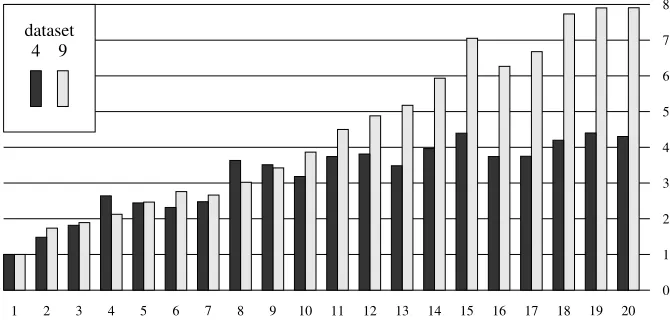
Fig. 1.Speed-up factor due to parallelisation forQ15.
We used the following randomly generated datasets for the binary relationRand unary relationsAandB:
dataset |V| p q avg. degree #atoms ttl size csv size
1.ttl 1 000 0.050 0.050 50 61K 1MB 0.5MB
2.ttl 5 000 0.002 0.004 10 64K 1.2MB 0.7MB
3.ttl 10 000 0.002 0.004 20 257K 5MB 3MB
4.ttl 20 000 0.002 0.010 40 1M 20MB 12MB
5.ttl 30 000 0.002 0.010 60 2M 47MB 28MB
6.ttl 40 000 0.002 0.010 80 5M 84MB 51MB
7.ttl 50 000 0.002 0.010 100 6M 130MB 70MB
8.ttl 60 000 0.002 0.010 120 9M 190MB 100MB
9.ttl 70 000 0.002 0.010 140 13M 260MB 140MB
The parameterpis the probability of anR-edge between two points fromV;qis the density of unary conceptsAandB. The first four datasets come from [8], the last five were generated to create a significant load on the system. We intentionally decided to make the relationSempty in order to leave some margin for optimisation for the NDL-query planner, and also because empty relations are typical in the OBDA scenario.
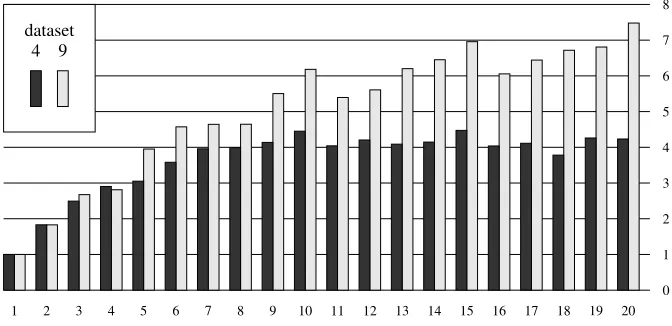
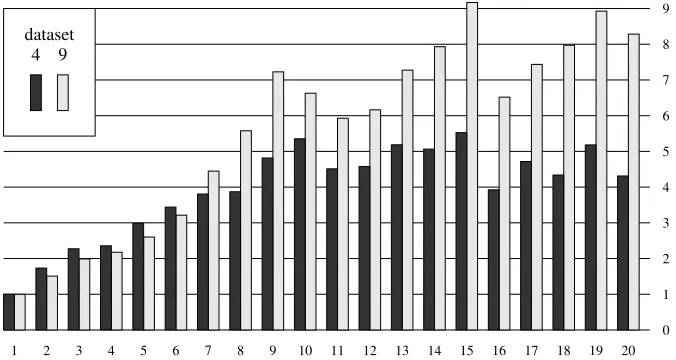
We executed the constructed NDL-rewritings of the OMQsQ15,Q22andQ45over
0 1 2 3 4 5 6 7 8
1 2 3 4 5 6 7 8 9 10 11 12 13 14 15 16 17 18 19 20
4 9
[image:17.612.138.474.119.282.2]dataset
Fig. 2.Speed-up factor due to parallelisation forQ22.
5
Conclusion
The contribution of this paper is twofold. First, it presents an OMQ rewriter STYPES that transforms conjunctive queries mediated by ontologies given as sets of linear tgds (in particular,OWL 2 QLconcept and role inclusions) into equivalent nonrecursive dat-alog queries over the data. A distinctive feature of STYPES is that, if the treewidth of the input conjunctive queries and the size of the chases for the ontology atoms as well as their arity are bounded, then the resulting rewritings are theoretically optimal in the sense that they can be constructed and executed in LOGCFL. Second, the paper ex-perimentally demonstrates that optimal NDL-rewritings computed by STYPES can be efficiently executed by Apache Flink, whereas other existing rewriters struggle even to produce rewritings for the same OMQs. It is also shown that Fink is capable of par-allelising the execution of STYPES’s NDL-rewritings proportionally to the number of available CPUs, although it remains to be seen how exactly Flink utilises the structure of the rewritings and whether further improvements are possible.
References
1. Abiteboul, S., Hull, R., Vianu, V.: Foundations of Databases. Addison-Wesley (1995) 2. Abseher, M., Musliu, N., Woltran, S.: htd - A free, open-source framework for (customized)
tree decompositions and beyond. In: Proc. of the 14th Int. Conf. on Integration of AI and OR Techniques in Constraint Programming, CPAIOR 2017. LNCS, vol. 10335, pp. 376–386. Springer (2017). https://doi.org/10.1007/978-3-319-59776-8_30
3. Artale, A., Calvanese, D., Kontchakov, R., Zakharyaschev, M.: The DL-Lite fam-ily and relations. Journal of Artificial Intelligence Research (JAIR) 36, 1–69 (2009). https://doi.org/10.1613/jair.2820
0 1 2 3 4 5 6 7 8 9
1 2 3 4 5 6 7 8 9 10 11 12 13 14 15 16 17 18 19 20
4 9
[image:18.612.138.476.117.297.2]dataset
Fig. 3.Speed-up factor due to parallelisation forQ45.
5. Baget, J.F., Leclère, M., Mugnier, M.L., Salvat, E.: Extending decidable cases for rules with existential variables. In: Proc. of the 21th Int. Joint Conf. on Artificial Intelligence (IJCAI 2009). pp. 677–682. IJCAI (2009)
6. Baget, J.F., Leclère, M., Mugnier, M.L., Salvat, E.: On rules with existential vari-ables: Walking the decidability line. Artificial Intelligence175(9–10), 1620–1654 (2011). https://doi.org/10.1016/j.artint.2011.03.002
7. Bienvenu, M., Kikot, S., Kontchakov, R., Podolskii, V., Zakharyaschev, M.: Ontology-mediated queries: Combined complexity and succinctness of rewritings via circuit complex-ity. Journal of the ACM65(5), 28:1–28:51 (2018). https://doi.org/10.1145/3191832 8. Bienvenu, M., Kikot, S., Kontchakov, R., Podolskii, V.V., Ryzhikov, V., Zakharyaschev,
M.: The complexity of ontology-based data access with OWL 2 QL and bounded treewidth queries. In: Proc. of the 36th ACM SIGMOD-SIGACT-SIGAI Sympo-sium on Principles of Database Systems, PODS 2017. pp. 201–216. ACM (2017). https://doi.org/10.1145/3034786.3034791
9. Bienvenu, M., Kikot, S., Kontchakov, R., Ryzhikov, V., Zakharyaschev, M.: Optimal non-recursive datalog rewritings of linear tgds and bounded (hyper)tree-width queries. In: Proc. of the 30th Int. Workshop on Description Logics, DL 2017. CEUR Workshop Proceedings, vol. 1879. CEUR-WS.org (2017)
10. Boguslavsky, I., Dikonov, V., Iomdin, L., Lazursky, A., Sizov, V., Timoshenko, S.: Semantic analysis and question answering: a system under development. In: Computational Linguistics and Intellectual Technologies (Papers from the Annual Int. Conf. Dialogue 2015, vol. 1), pp. 62–79. RSUH (2015)
11. Calì, A., Gottlob, G., Lukasiewicz, T.: A general datalog-based framework for tractable query answering over ontologies. Journal of Web Semantics 14, 57–83 (2012). https://doi.org/10.1016/j.websem.2012.03.001
12. Calì, A., Gottlob, G., Pieris, A.: Advanced processing for ontological queries. PVLDB3(1), 554–565 (2010). https://doi.org/10.14778/1920841.1920912
https://doi.org/10.1016/j.artint.2012.08.002
14. Carbone, P., Katsifodimos, A., Ewen, S., Markl, V., Haridi, S., Tzoumas, K.: Apache flink™: Stream and batch processing in a single engine. IEEE Data Eng. Bull.38(4), 28–38 (2015) 15. Chekuri, C., Rajaraman, A.: Conjunctive query containment revisited. Theoretical Computer
Science239(2), 211–229 (2000). https://doi.org/10.1016/S0304-3975(99)00220-0
16. Chortaras, A., Trivela, D., Stamou, G.: Optimized query rewriting for OWL 2 QL. In: Proc. of the 23rd Int. Conf. on Automated Deduction, CADE-23. LNCS, vol. 6803, pp. 192–206. Springer (2011). https://doi.org/10.1007/978-3-642-22438-6_16
17. Eiter, T., Ortiz, M., Šimkus, M., Tran, T.K., Xiao, G.: Query rewriting for Horn-SHIQ plus rules. In: Proc. of the 26th AAAI Conf. on Artificial Intelligence, AAAI 2012. pp. 726–733. AAAI Press (2012)
18. Fagin, R., Kolaitis, P.G., Miller, R.J., Popa, L.: Data exchange: semantics and query answering. Theoretical Computer Science 336(1), 89–124 (2005). https://doi.org/10.1016/j.tcs.2004.10.033
19. Gottlob, G., Kikot, S., Kontchakov, R., Podolskii, V.V., Schwentick, T., Zakharyaschev, M.: The price of query rewriting in ontology-based data access. Artificial Intelligence213, 42–59 (2014). https://doi.org/10.1016/j.artint.2014.04.004
20. Gottlob, G., Leone, N., Scarcello, F.: Computing LOGCFL certificates. In: Proc. of the 26th Int. Colloquium on Automata, Languages and Programming, ICALP-99. LNCS, vol. 1644, pp. 361–371. Springer (1999). https://doi.org/10.1007/3-540-48523-6_33
21. Kikot, S., Kontchakov, R., Podolskii, V.V., Zakharyaschev, M.: Exponential lower bounds and separation for query rewriting. In: Proc. of the 39th Int. Colloquium on Automata, Lan-guages and Programming, ICALP 2012. LNCS, vol. 7392, pp. 263–274. Springer (2012). https://doi.org/10.1007/978-3-642-31585-5_26
22. Lenzerini, M.: Data integration: A theoretical perspective. In: Proc. of the 21st ACM SIGACT-SIGMOD-SIGART Symposium on Principles of Database Systems, PODS’02. pp. 233–246. ACM (2002). https://doi.org/10.1145/543613.543644
23. Motik, B., Cuenca Grau, B., Horrocks, I., Wu, Z., Fokoue, A., Lutz, C.: OWL 2 Web Ontology Language Profiles. W3C Recommendation (2012),http://www.w3.org/TR/ owl2-profiles
24. Poggi, A., Lembo, D., Calvanese, D., De Giacomo, G., Lenzerini, M., Rosati, R.: Linking data to ontologies. Journal on Data Semantics 10, 133–173 (2008). https://doi.org/10.1007/978-3-540-77688-8_5
25. Rosati, R., Almatelli, A.: Improving query answering over DL-Lite ontologies. In: Proc. of the 12th Int. Conf. on Principles of Knowledge Representation and Reasoning, KR 2010. pp. 290–300. AAAI Press (2010)
26. Ruzzo, W.L.: Tree-size bounded alternation. Journal of Computer and System Sciences
21(2), 218–235 (1980). https://doi.org/10.1016/0022-0000(80)90036-7
27. Rygaev, I.: Rule-based reasoning in semantic text analysis. In: Proc. of the Doctoral Consor-tium, Challenge, Industry Track, Tutorials and Posters @ RuleML+RR 2017. CEUR Work-shop Proceedings, vol. 1875. CEUR-WS.org (2017)
28. Xiao, G., Calvanese, D., Kontchakov, R., Lembo, D., Poggi, A., Rosati, R., Za-kharyaschev, M.: Ontology-based data access: A survey. In: Proc. of the 27th Int. Joint Conf. on Artificial Intelligence, IJCAI-ECAI 2018. pp. 5511–5519. IJCAI/AAAI (2018). https://doi.org/10.24963/ijcai.2018/777