N A N O E X P R E S S
Open Access
Reducing and Uniforming the Co
3
O
4
Particle Size by Sulfonated Graphenal
Polymers for Electrochemical Applications
Xin Zhang
1,2†, Xubo Liu
2,3†, Sha Zeng
2, Jianhui Fang
1, Chuanling Men
3, Xiaohua Zhang
2*and Qingwen Li
2Abstract
A novel two-dimensional (2D) nanomaterial, namely sulfonated graphenal polymer (SGP), is used to tune the hydrothermal growth of Co3O4nanoparticles. SGP provides abundant nucleation sites to grow Co3O4nanoparticles and effectively reduces the particle size and dimension. As a result, with considering the improved size uniformity of Co3O4and the tight wrapping of SGP around Co3O4as well, the Co3O4/SGP hybrid electrode exhibits a high specific electrochemical capacitance of 234.28 F/g at a current density of 0.2 A/g, 237% higher than that of the pure Co3O4 electrode. By using the hybrid as the anode of an all-solid-state asymmetric supercapacitor, the capacitance can be well maintained up to 93% after 5000 cycles even at 2 A/g.
Keywords: Sulfonated graphenal polymer, Cobalt oxide, Hydrothermal growth, Electrochemical
Background
Owing to their high power density, cycle efficiency, and charge/discharge rate, supercapacitors are considered as promising candidates in energy storage applications [1–4]. There are two types of supercapacitors accord-ing to their different charge storage mechanisms, namely electric double-layer capacitors and pseudocapacitors [5]. Electric double-layer capacitor stores energy by interfacial charge separation between its electrode and the elec-trolyte, while pseudocapacitor realizes the charge storage mainly through the pseudo-faradaic reactions [6]. The for-mer usually has a high performance in power density and the latter is preferred to approach a high energy density. To further improve the energy density, and specific capac-itance as well, transition metal oxides, e.g., Co3O4, MnO2,
NiO, and RuO2, are widely used in the electrodes of
super-capacitors [7–10]. In general, these transition metal oxides should be small sized (towards a high surface area), uni-formly distributed, and highly crystallized. Obviously, the synthesis and assembly of these particles are of great
*Correspondence: [email protected] †Equal contributors
2Suzhou Institute of Nano-Tech and Nano-Bionics, Chinese Academy of
Sciences, Suzhou 215123, China
Full list of author information is available at the end of the article
importance for the electrode performances, especially for the energy density and rate of capacitance [11].
Hydrothermal process is a common way to grow metal oxide nanoparticles [12]. To control the particle size, crystallinity, and particle morphology, the introduction of nanoplatelets has been proved as an efficient strategy [13–16]. For example, graphene oxide (GO) has exhibited exciting effects as it can provide rich active sites to anchor the nanoparticles, prevent their agglomeration, and avoid the overgrowth. This is owing to its two-dimensional (2D) nanostructure, abundant functional groups, and high spe-cific surface area [15, 16]. As a result, needle-like Co3O4
nanoparticles with a size of 10–50 nm or cross-like NiO nanoflakes with a thickness of∼15 nm were grown on GO [17, 18].
In this study, we report a facile way to precisely con-trol the size and distribution of Co3O4 nanoparticles
on a new type of 2D nanostructure, namely sulfonated graphenal polymer (SGP), by a hydrothermal process. On the one hand, the abundant sulfonic acid groups of SGP make it superhydrophilic and thus allow efficient adsorption of metal cations [19]. Therefore, there exist rich anchor sites for the growth of Co3O4. On the other
hand, the polymeric characteristics of SGP [20], due to its irregular or branched 2D planar structure, result in high flexibility and thus tight wrapping of SGP around
the Co3O4 nanoparticles.The Co3O4/SGP hybrid
elec-trode can exhibit a high specific capacitance of 234.28 F/g at a current density of 0.2 A/g, which was 237% higher than that of the pure Co3O4electrode (69.5 F/g). By using
the Co3O4/SGP electrode as the anode of an
all-solid-state asymmetric supercapacitor, a high reversibility was achieved due to the reduced and uniformized particle size and intimate contact between the Co3O4/SGP hybrid with
the conducting fillers. After 5000 cycles even at 2 A/g, the capacitance was still maintained up to 93%. As compared to GO, this study demonstrates an interesting potential of SGP in the electrochemical applications.
Methods
Materials Synthesis
The SGP nanostructures in this study were purchased from Suzhou Graphene-Tech Co., Ltd. and were used as received. They were synthesized by a “bottom-up” strat-egy [20] where the reaction between polyethylene and fluorosulfuric acid were conducted [21]. After the fluo-rosulfuric acid (concentration over 99%) was heated up to 70–80 °C, polyethylene was added to trigger the reac-tion. The polymer-to-acid weight ratio was within 1:10 to 1:15. After 10 min, the reaction product was separated by water to obtain SGP dispersions, which can be further dried to obtain SGP powders. In this study, the as-received SGP powder was dispersed in deionized water to obtain a 0.1 wt% SGP solution.
For the Co3O4 growth, 1 mmol cobalt acetate
(Co(CH3COO)2·4H2O or Co(OAc)2·4H2O) was dissolved
in 45 ml water, mixed with 5 ml 0.2 M aqueous NaOH solution, and then stirred for 5 min. The solution was transferred into Teflon-lined stainless steel autoclave and then maintained at 120 °C for 12 h to start the Co3O4
growth. After the reaction, the solution was cooled natu-rally to room temperature and then dried at 80 °C for 12 h. The SGP-assisted Co3O4growth had the same treatment
sequence, except additional 5 ml 0.1 wt% SGP solution was added into the mixture (the total volume was still 50 ml just by dissolving the same amount of Co(OAc)2
into 40 ml water). In order to study the effect of the solution basicity, the similar Co3O4growth was also
per-formed in an NH3solution. Here, NaOH was replaced by
9 ml NH3·H2O without tuning the amounts for the other
compounds (the total volume was also fixed to 50 ml). By using these two different growths, Co3O4/SGP hybrid or
composite powders were obtained.
Electrode and Supercapacitor Preparations
Five milligrams of Co3O4 or Co3O4/SGP powder was
added to ethanol, and then blended with 0.5 mg multiwall carbon nanotubes (MWCNTs) which acted as the con-ductive agent. The mixture was dried at 80 °C for 1 h and then packaged with a 1-cm2Ni foam. The foam was dried
at 110 °C for 12 h under a vacuum oven, and then pressed under 10 MPa to form a working electrode.
To better evaluate the electrochemical performance, a supercapacitor was made by assembling the Co3O4
electrode as the anode, active carbon as the cath-ode, and poly(vinyl alcohol) (PVA)/KOH as the separa-tor. The gravimetric specific capacitance for the whole supercapacitor cell was calculated from the galvanostatic charge/discharge (GCD) curve by considering the total mass of Co3O4, SGP, and CNT, namely, the mass increase
of the Ni foam.
Electrochemical Measurements
The electrochemical performance of electrode was mea-sured using a three-electrode test in a 6 M KOH solu-tion at room temperature, with a Chenhua CHI-660C electromechanical workstation. A platinum mesh and a saturated Hg/HgO electrode were used as the counter and reference electrodes, respectively. Cyclic voltammetry (CV), GCD, and electrochemical impedance spectroscopy (EIS) were carried out using conventional three-electrode configurations at a potential range of 0–0.4 V or in a frequency range of 100 kHz to 0.01 Hz. The specific capac-itance (Cs) was calculated from the GCD data byCs =
It/mV, whereIis the applied current,tthe time for the discharge process,mthe mass of the active material, and Vthe potential range [22, 23].
Characterizations
The Co3O4structure was characterized by a Quanta 400
FEG field emission scanning electron microscope (SEM) equipped with an Apollo 40 SDD energy-dispersive X-ray spectroscope (EDS) for element determination and by an FEI Tecnai G2 F20 S-Twin transmission electron microscope (TEM). Lateral dimensions and thickness of SGP nanosheets were characterized using tapping-mode atomic force microscope (AFM; Bruker Instru-ments Dimension Icon) with a silicon-tip cantilever (40 N/m). The Fourier transform infrared spectroscopy (FTIR) (500–4000 cm−1) was measured using a Nicolet 6700 FTIR spectrometer. The surface area was measured by the Brunauer-Emmett-Teller (BET) method with a Micromeritics ASAP 2010 sorptometer. The crystal struc-ture was examined by a Bruker AXS D8 Advance X-ray diffraction (XRD) system.
Results and Discussion
Structure of SGP
highly porous film with the aid of intermolecular adhe-sion by PVA [24]. To show the nanostructure of SGP, SEM and AFM were performed, see Fig. 1a, b. SGP showed a 2D planar structure while the 2D plane was quite irregular as porous and branched structures were widely observed (Fig. 1a). This was a result of the bottom-up synthesis procedure [20]. The SGP nanosheets were about 4–5 lay-ered according to the thickness of∼4 nm (Fig. 1b). The Raman spectrum showed two peaks centered at 1585 and 1382 cm−1which were typically the G- and D-peaks for the carbon sp2structure (Fig. 1a, inset).
Further, the sulfonic acid group (−SO3H), carboxyl
group (−COOH), and hydroxyl group (−OH) were detected as strong absorption peaks with FTIR, as shown in Fig. 1c. Besides the wide absorption band for −OH centered around 3200–3550 cm−1, the absorption bands
at 1043 and 1171 cm−1 were due to the SO2
sym-metric and asymsym-metric stretching, and the absorption between 1650–1720 cm−1 was related with −COOH. Based on these structural characteristics, such 2D nanos-tructure was named as sulfonated graphenal polymer. Furthermore, the abundant sulfonic acid and carboxyl groups resulted in superhydrophilicity for SGP, as these molecules can be dispersed in water at high concentra-tions even up to 26 wt%. As shown in Fig. 1d, the 20 wt% SGP dispersion still showed a high fluidity while the 2 wt% GO dispersion nearly became a hydrogel.
SGP-assisted Co3O4Growth
Co3O4 nanoparticles were fabricated with a
hydrother-mal approach by using Co(OAc)2as the source material.
Under a basic environment (0.02 M NaOH solution), Co(OAc)2 converted into Co3O4 after several hours,
according to the following reactions [14, 25, 26]:
Co2++2OH− −→ Co(OH)2, (1)
Co(OH)2+O2 −→ Co3O4+H2O. (2)
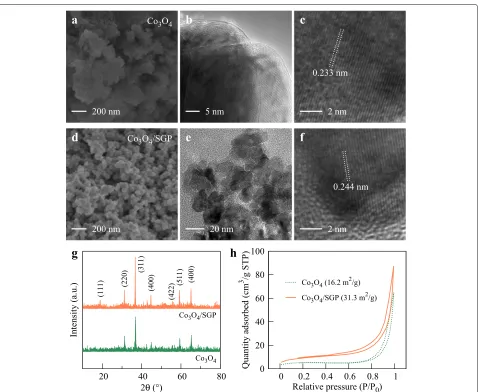
SGP can strongly influence the Co3O4growth. Without
SGP, the particle size was quite diverse, ranging from 50 to 200 nm (Fig. 2a and b). The large-sized Co3O4
nanopar-ticles were the agglomeration of small-sized parnanopar-ticles due to the lack of nucleation sites [27]. On the contrary, the presence of SGP can provide sufficiently more nucleation sites to anchor Co(OH)2 clusters for the direct Co3O4
growth on SGP, owing to the abundant−OH groups [28]. These groups can also reduce the divergence in growth rate at different sites and hinder the overgrowth due to the space limit. As a result, the SGP-assisted growth showed an improved uniformity in particle size, see Fig. 2d, e. In general, even after a 12-h growth, the Co3O4
[image:3.595.59.544.435.700.2]parti-cles on SGP were still about 20–30 nm in diameter, while the free growth just in 3 h could cause a particle size over 100 nm.
Fig. 2 a–cSEM and TEM images showing that the Co3O4particles were 50–200 nm sized and the interplanar distance of 0.233 nm corresponded to
the stacking of (311) planes.d–fSGP reduced the particle size down to sub-20 nm, while the similar (311) stacking was observed with an interplanar distance of 0.244 nm.g,hXRD patterns and N2adsorption-desorption isotherms for the Co3O4and Co3O4/SGP powders
The reduced particle size did not affect the crystallinity. Figure 2c, f compares the TEM results for the free and SGP-assisted growths. Both structures showed an inter-planar spacing of 0.233–0.244 nm, by averaging the length of 20 lattices, corresponding to the (311) plane of fcc Co3O4. XRD measurements (Fig. 2g) also showed
diffrac-tion peaks at 18.9°, 31.1°, 36.8°, 44.7°, 55.6°, 59.3°, and 65.1°, which were assigned to (111), (220), (311), (400), (422), (511), and (440) crystal planes. For both growths, the (311) diffraction peak was the most strongest one, in agreement with the TEM characterization.
The reduced particle size increased significantly the specific surface area. Figure 2h shows a comparison of the BET surface area. The presence of SGP increased the spe-cific surface area from 16.2 m2/g for the free growth up to 31.3 m2/g. The improved surface area could increase
the contact area between the electrode and electrolyte, provide more surface reaction sites, and thus benefit the electrochemical performance.
Electrode Performance
The electrochemical properties of the Co3O4 and
Co3O4/SGP electrodes were investigated with a
three-electrode test in a 6 M KOH solution. The three-electrodes were prepared in a conventional way by using MWCNTs as conductive additives. 0.5 mg MWCNTs were blended with 5 mg Co3O4 or Co3O4/SGP powders, and then
packaged inside 1-cm2Ni foam. In electrochemical mea-surement, the potential window was 0–0.4 V against the Hg/HgO reference electrode [8, 29]. The redox reactions at the Co3O4electrode can be described by the following
Co3O4+H2O+OH−←→3 CoOOH+e−, (3)
CoOOH+OH−←→CoO2+H2O+e−. (4)
The reduced particle size and increased surface area of Co3O4benefited the electrochemical properties. As
com-pared to the free-grown Co3O4, the Co3O4/SGP hybrid
electrode exhibited enhanced CV and GCD performances (Fig. 3a, b). The specific capacitance of the Co3O4/SGP
[image:5.595.57.292.228.661.2]hybrid electrode was up to 100.3 F/g at a current density of 0.2 A/g, which was 144% higher than that of the Co3O4
Fig. 3 aCV curves at a scan rate of 40 mV/s for the Co3O4and
Co3O4/SGP hybrid electrodes. The mass of activate materials was
5 mg. For a comparison, the CV curves for SGP and CNT (mass 0.5 mg) were provided, with a magnification factor of 10.bGCD behaviors at a current density of 2 A/g.cEIS spectra measured at a frequency range of 100 kHz to 0.01 Hz
electrode (69.5 F/g at 0.2 A/g). The charge/discharge time at 2 A/g also increased from 19 to 28 s after the SGP-assisted growth. Notice that both SGP and CNT did not contribute to the electrochemical activity by themselves as they are much less active than Co3O4. In Fig. 3a, the CV
curves for SGP and CNT are also provided for compar-ison, where these carbon materials were packed into Ni foams at a mass of 0.5 mg.
To better understand the improved performance of the Co3O4/SGP electrode, EIS was employed to investigate
the reaction kinetics. The Nyquist plots of different sam-ples, which were characterized by a semicircle in the high-frequency region and a straight line in the low-high-frequency region, are shown in Fig. 3c. In general, the bigger diame-ter of the semicircle, the bigger charge transfer resistance between the electrode and electrolyte [30]. Obviously, the hybrid sample showed a lower charge transfer resistance, corresponding to the improved electric conductivity.
Effect of Solution Basicity
NaOH is a strong base and can induce rapid growth of Co3O4, as the highly polar OH−groups can easily
coor-dinate with Co2+. As a result, the as-produced Co3O4
nanoparticles were spherical in shape even under the SGP-assisted growth, see Fig. 2d–f. In order to suspend the growth rate and thus restrict the particle shape or size, a less basic solution, a 2.36 M NH3solution, was used to
produce the Co3O4/SGP hybrids. The synthetic processes
were based on the relatively weak coordination between Co2+ and NH
3, as described by the following reactions
[31–33]:
Co2++6 NH3−→[Co(NH3)6]2+, (5)
4Co(NH3)6 2++
O2+2 H2O−→4
Co(NH3)6 3+
+4 OH−. (6)
Then, these coordinate ions decomposed at a certain temperature (usually via a hydrothermal process), and finally, Co3O4nanomaterials were obtained [31].
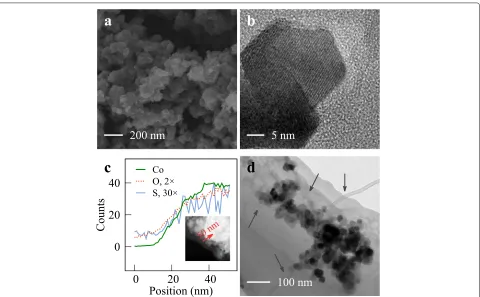
Figure 4a shows the agglomeration morphology of Co3O4 nanoparticles obtained in the NH3 solution. As
compared to Fig. 2d, the particle did not have a smooth surface but looked like assemblies of low-dimensional nano-structures. TEM characterization showed that 2D Co3O4nanoplatelets with lateral size of 25–30 nm were
grown in the NH3solution (Fig. 4b). Clearly, the particle
size was well controlled both in the particle size due to the presence of growth substrate of SGP and in the particle dimension due to the decreased basicity.
Nevertheless, a general structure was obtained despite the different basic solutions. By tracing from an empty place to the surface of a Co3O4 nanoparticle, the
Fig. 4 aThe Co3O4/SGP nanoparticles grown in NH3solutions were agglomerations of 2D nanoplatelets.bThe Co3O4nanoplatelets had a lateral
dimension of 25–30 nm.cEDS characterization showed that the Co3O4nanoparticles were tightly wrapped by SGP.dAfter blending, the Co3O4
nanoplatelets had an intimate contact with MWCNTs, labeled byarrows
in Fig. 4c. This means that the Co3O4 nanoparticles
were tightly wrapped by SGP, clearly due to its irreg-ular and flexible 2D structure. Notice that, from SEM or TEM images in Figs. 2 and 4, it was difficult to observe any planar nanostructures as shown in Fig. 1. This was another important observation to show the high flexibility of SGP. Such tight wrapping can reduce the charge transfer distance from the surrounding solution to the inside of the nanoparticle, and thus is impor-tant for the electrochemical performance. Furthermore, these Co3O4/SGP hybrid nanoparticles formed intimate
contact with MWCNTs after the blending to prepare electrodes, see the TEM image in Fig. 4d. This also indi-cated that the small-sized and low-dimensional Co3O4
nanoplatelets could exhibit superior electrochemical performances.
Notice that, the SGP-assisted growth can be directly compared with the Co3O4 growth on GO [32], by
using the same source material (Co(OAc)2) and basic
solution (NH3·H2O). Due to the reduced basicity, both
growths produced Co3O4 nanoparticles with a particle
size no larger than 25 nm, attributed to the coordi-nation between Co2+ and NH3 in reducing the Co3O4
particle size [31, 32]. However, clear difference could
be observed at the particle dimension. The less func-tionalization level of GO, as compared to SGP, still causes the formation of 3D Co3O4 nanospheres,
differ-ent from the SGP-induced dimension reduction of Co3O4
nanoplatelets.
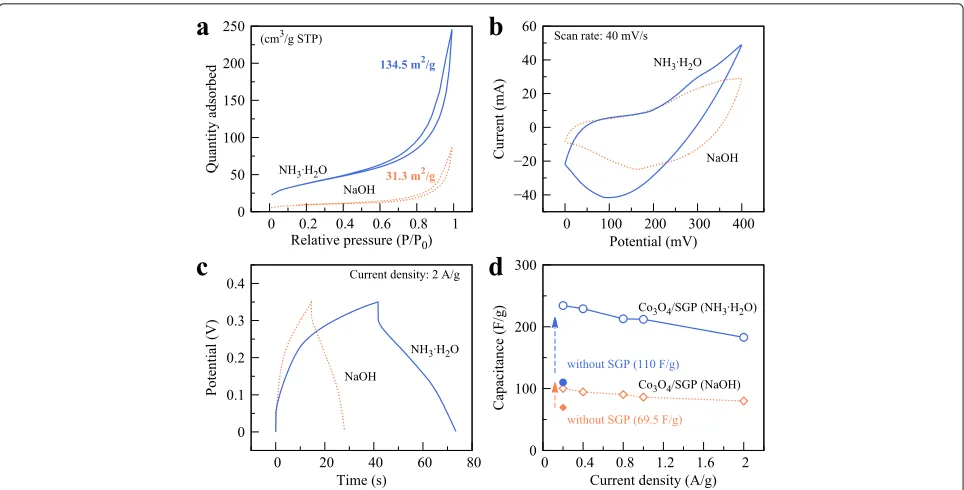
The reduction in particle dimension could greatly ben-efit the specific surface area. Figure 5a compares the BET measurements of the Co3O4nanoparticles obtained from
the two solutions. Surprisingly, the dimension reduction increased the specific surface area significantly from 31.3 to 134.5 m2/g. Based on such advantage, the electrode per-formance was also improved remarkably by NH3. Under
a scan rate of 40 mV/s, the internal area of CV curve for Co3O4/SGP composite grown in NH3was apparently
larger than that of Co3O4/SGP composite grown in NaOH
(Fig. 5b), implying that the specific capacitance could be improved remarkably by NH3. The current intensity at
Fig. 5 aN2adsorption-desorption isotherms for the Co3O4nanoparticles grown in the NaOH and NH3solutions.b,cComparisons in CV and GCD
for different Co3O4growths.dSpecific capacitances at current densities ranging from 0.2 to 2 A/g. For a comprehensive comparison, the
capacitances at 0.2 A/g for the free growth in different solutions were also plotted
increased from 28 to 32 s by changing the basic envi-ronment from NaOH to NH3. As a result, the specific
capacitance of the Co3O4/SGP (obtained by NH3) hybrid
electrode was up to 234.28 F/g at a current density of 0.2 A/g (Fig. 5d), which was 134% higher as compared to the SGP-assisted growth in NaOH (100.3 F/g), and was 3.37 and 2.13 times those of the pure Co3O4
elec-trodes obtained from NH3(69.5 F/g) and NaOH (110 F/g),
respectively.
Notice that, the electrode capacitance was not as high as up to about 500–1000 F/g in many recent litera-ture [8, 12, 14, 16]. The possible reasons could be the un-intimate contact between the activate material with Ni foam, the low electrical conductivity of CNT, and the un-uniform distribution of Co3O4 with CNT, due
to the physical blending. This was similarly reported in some other literature where the capacitance was only up to about 150–270 F/g [17, 34, 35]. Nevertheless, as all the electrodes were prepared under the same method, the present study could still show the exciting advantage of SGP in improving the deposition of metal oxides.
Application in Supercapacitors
To further investigate the Co3O4/SGP electrode
perfor-mance, the hybrid was assembled with active carbon and PVA/KOH electrolyte to an all-solid-state asymmetric supercapacitor, where the Co3O4/SGP, active carbon, and
PVA/KOH acted as the anode, cathode, and separator, respectively. The two electrodes were integrated with Ni foams for a better current collection. The gravimetric spe-cific capacitance for the whole supercapacitor cell was calculated from the GCD curve by considering the total mass of the two electrodes.
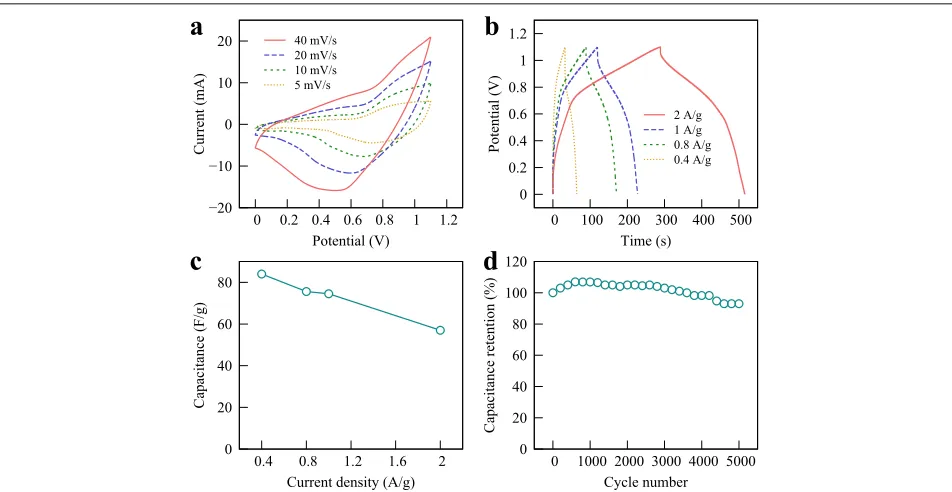
In the supercapacitor, the Co3O4/SGP electrode
exhib-ited explicit redox peaks of pseudocapacitor and excel-lent cycle stability. With increasing the scan rate from 5 to 40 mV/s, the current intensity at oxidation peaks of CV increased correspondingly from 2.5 to 9.7 mA (Fig. 6a). The GCD curves of the Co3O4/SGP at
differ-ent currdiffer-ent densities showed the Faradaic characteristics, in agreement with the CV curves (Fig. 6b). The specific capacitance was 84.0, 75.6, 74.5, and 57.0 F/g at current densities of 0.4, 0.8, 1, and 2 A/g, respectively, reflecting the common performance in the three-electrode system (Fig. 6c).
Furthermore, the cycle charge/discharge test was employed at a current density of 1 A/g, as shown in Fig. 6d. Owing to the small-sized Co3O4 and the SGP
Fig. 6 aCV curves for an asymmetric supercapacitor with the Co3O4/SGP acting as the anode.b,cGCD curves and specific capacitances at different
current densities.dCycling performance at a current density of 1 A/g
reports [17], where ∼70% capacitance was maintained after 4000 cycles, the present results obviously demon-strate an exciting potential for the application in energy storage devices.
Conclusions
SGP-wrapped Co3O4nanoparticles with uniform particle
size were synthesized with a hydrothermal process. As a result of the reduced particle size and wrap-ping assembly, the Co3O4/SGP hybrid exhibited
supe-rior electrochemical performance due to the increased BET surface area and the improved interfacial electrical conductivity. By tuning the basic solution from NaOH to NH3, the particle dimension was further reduced,
as reflected by the production of Co3O4 nanoplatelets
with lateral size of 25–30 nm. For the electrochemi-cal performance, excellent stability was observed both in the improved rate capacity of single electrode and the capacitance maintenance of supercapacitor. This study provides a new approach to produce uniformly sized Co3O4nanoparticles for the application in energy storage
devices.
Abbreviations
AFM: Atomic force microscopy; BET: Brunauer-Emmett-Teller; CV: Cyclic voltammetry; EIS: Electrochemical impedance spectroscopy; EDS: Energy-dispersive X-ray spectroscopy; FTIR: Fourier transform infrared spectroscopy; GO: Graphene oxide; GCD: Galvanostatic charge/discharge; MWCNTs: Multiwall carbon nanotubes; PVA: Poly(vinyl alcohol); SEM: Scanning electron microscopy; SGP: Sulfonated graphenal polymer; TEM: Transmission electron microscopy; XRD: X-ray diffraction
Acknowledgements
Financial supports from the National Natural Science Foundation of China (11302241, 11404371, 51561145008), Youth Foundation of Natural Science Foundation of Jiangsu Province (BK20140390), Youth Innovation Promotion Association of the Chinese Academy of Sciences (2015256), and National Key Research and Development Program of China (2016YFA0203301) are acknowledged.
Authors’ contributions
XHZ prepared the manuscript and supervised all of the study. XZ and XBL performed the experiment. SZ helped in the technical support for the experiments. All the authors discussed the results and approved the final manuscript.
Competing interests
The authors declare that they have no competing interests.
Author details
1Department of Chemistry, College of Sciences, Shanghai University, Shanghai 200444, China.2Suzhou Institute of Nano-Tech and Nano-Bionics, Chinese Academy of Sciences, Suzhou 215123, China.3School of Energy and Power Engineering, University of Shanghai for Science and Technology, Shanghai 200093, China.
Received: 15 November 2016 Accepted: 26 February 2017
References
1. Simon P, Gogotsi Y (2008) Materials for electrochemical capacitors. Nat Mater 7(11):845–854
2. Dunn B, Kamath H, Tarascon JM (2011) Electrical energy storage for the grid: a battery of choices. Science 334(6058):928–935
3. El-Kady MF, Kaner RB (2013) Scalable fabrication of high-power graphene micro-supercapacitors for flexible and on-chip energy storage. Nat Commun 4(2):1475
5. Wang H, Liang Y, Mirfakhrai T, Chen Z, Casalongue HS, Dai H (2011) Advanced asymmetrical supercapacitors based on graphene hybrid materials. Nano Res 4(8):729–736
6. Zhi M, Xiang C, Li J, Li M, Wu N (2013) Nanostructured carbon-metal oxide composite electrodes for supercapacitors: a review. Nanoscale 5(1):72–88 7. Chen H, Zhou S, Wu L (2014) Porous nickel hydroxide-manganese
dioxide-reduced graphene oxide ternary hybrid spheres as excellent supercapacitor electrode materials. ACS Appl Mater Interfaces 6(11):8621–8630
8. Dong XC, Xu H, Wang XW, Huang YX, Chan-Park MB, Zhang H, et al (2012) 3D graphene-cobalt oxide electrode for high-performance supercapacitor and enzymeless glucose detection. ACS Nano 6(4):3206–3213
9. Luan F, Wang G, Ling Y, Lu X, Wang H, Tong Y, et al (2013) High energy density asymmetric supercapacitors with a nickel oxide nanoflake cathode and a 3D reduced graphene oxide anode. Nanoscale 5:7984–7990 10. Susanti D, Tsai DS, Huang YS, Korotcov A, Chung WH (2007) Structures
and electrochemical capacitive properties of RuO2vertical nanorods encased in hydrous RuO2. J Phys Chem C 111(26):9530–9537 11. Garakani MA, Abouali S, Zhang B, Xu ZL, Huang J, Huang JQ, et al (2015)
Controlled synthesis of cobalt carbonate/graphene composites with excellent supercapacitive performance and pseudocapacitive characteristics. J Mater Chem A 3:17827–17836
12. Wang H, Zhang L, Tan X, Holt CMB, Zahiri B, Olsen BC, et al (2011) Supercapacitive properties of hydrothermally synthesized Co3O4 nanostructures. J Phys Chem C 115(35):17599–17605
13. Li Y, Zhao N, Shi C, Liu E, He C (2012) Improve the supercapacity performance of MnO2-decorated graphene by controlling the oxidization extent of graphene. J Phys Chem C 116(48):25226–25232
14. Yang W, Gao Z, Ma J, Wang J, Wang B, Liu L (2013) Effects of solvent on the morphology of nanostructured Co3O4and its application for high-performance supercapacitors. Electrochim Acta 112:378–385 15. Kumar R, Kim HJ, Park S, Srivastava A, Oh IK (2014) Graphene-wrapped and
cobalt oxide-intercalated hybrid for extremely durable super-capacitor with ultrahigh energy and power densities. Carbon 79:192–202 16. Liao Q, Li N, Jin S, Yang G, Wang C (2015) All-solid-state symmetric
supercapacitor based on Co3O4nanoparticles on vertically aligned graphene. ACS Nano 9(5):5310–5317
17. Guan Q, Cheng J, Wang B, Ni W, Gu G, Li X, et al. (2014) Needle-like Co3O4 anchored on the graphene with enhanced electrochemical performance for aqueous supercapacitors. ACS Appl Mater Interfaces 6(10):7626–7632 18. Huang ML, Gu CD, Ge X, Wang XL, Tu JP (2014) NiO nanoflakes grown on
porous graphene frameworks as advanced electrochemical pseudocapacitor materials. J Power Sources 259:98–105
19. Zhao G, Li J, Ren X, Chen C, Wang X (2011) Few-layered graphene oxide nanosheets as superior sorbents for heavy metal ion pollution management. Environ Sci Technol 45(24):10454–10462
20. Li X, Song Q, Hao L, Zhi L (2014) Graphenal polymers for energy storage. Small 10(11):2122–2135
21. Jiang Y, Li J, Hao J Suzhou Graphene-Tech Co., Ltd. Chinese Patent. 201410244717.0
22. Meher SK, Rao GR (2011) Ultralayered Co3O4for high-performance supercapacitor applications. J Phys Chem C 115(31):15646–15654 23. Xiang C, Li M, Zhi M, Manivannan A, Wu N (2013) A reduced graphene
oxide/Co3O4composite for supercapacitor electrode. J Power Sources 226:65–70
24. Liu X, Men C, Zhang X, Li Q (2016) An extraordinary sulfonated-graphenal-polymer-based electrolyte separator for all-solid-state supercapacitors. Small 12(36):4973–4979
25. Deori K, Deka S (2013) Morphology oriented surfactant dependent CoO and reaction time dependent Co3O4nanocrystals from single synthesis method and their optical and magnetic properties. CrystEngComm 15(42):8465–8474
26. Ujjain SK, Singh G, Sharma RK (2015) Co3O4@reduced graphene oxide nanoribbon for high performance asymmetric supercapacitor. Electrochim Acta 169:276–282
27. Wu ZS, Zhou G, Yin LC, Ren W, Li F, Cheng HM (2012) Graphene/metal oxide composite electrode materials for energy storage. Nano Energy 1(1):107–131
28. Sun CY, Zhu YG, Zhu TJ, Xie J, Cao GS, Zhao XB (2013) Co(OH)2/graphene sheet-on-sheet hybrid as high-performance electrochemical
pseudocapacitor electrodes. J Solid State Electrochem 17(4):1159–1165
29. Yang Q, Lu Z, Chang Z, Zhu W, Sun J, Liu J, et al (2012) Hierarchical Co3O4 nanosheet@nanowire arrays with enhanced pseudocapacitive performance. RSC Adv 2:1663–1668
30. Zhu YG, Wang Y, Shi Y, Wong JI, Yang HY (2014) CoO nanoflowers woven by CNT network for high energy density flexible micro-supercapacitor. Nano Energy 3:46–54
31. Dong Y, He K, Yin L, Zhang A (2007) A facile route to controlled synthesis of Co3O4nanoparticles and their environmental catalytic properties. Nanotechnology 18(43):435602
32. Liang Y, Li Y, Wang H, Zhou J, Wang J, Regier T, et al (2011) Co3O4 nanocrystals on graphene as a synergistic catalyst for oxygen reduction reaction. Nat Mater 10(10):780–786
33. Feng C, Zhang J, He Y, Zhong C, Hu W, Liu L, et al (2015) Sub-3 nm Co3O4 Nanofilms with Enhanced Supercapacitor Properties. ACS Nano 9(2):1730–1739
34. Chang MS, Kim T, Kang JH, Park J, Park CR (2015) The effect of surface characteristics of reduced graphene oxide on the performance of a pseudocapacitor. 2D Mater 2(1):014007
35. Li T, Li S, Zhang B, Wang B, Nie D, Chen Z, et al (2015) Supercapacitor electrode with a homogeneously Co3O4-coated multiwalled carbon nanotube for a high capacitance. Nanoscale Res Lett 10:208
36. Lu X, Zheng D, Zhai T, Liu Z, Huang Y, Xie S, et al (2011) Facile synthesis of large-area manganese oxide nanorod arrays as a high-performance electrochemical supercapacitor. Energy Environ Sci 4:2915–2921
Submit your manuscript to a
journal and benefi t from:
7Convenient online submission
7Rigorous peer review
7Immediate publication on acceptance
7Open access: articles freely available online
7High visibility within the fi eld
7Retaining the copyright to your article