N A N O E X P R E S S
Open Access
Effects of acid on the microstructures and
properties of three-dimensional TiO
2
hierarchical
structures by solvothermal method
Jing Zhou
1,3†, Bin Song
2*, Gaoling Zhao
1*and Gaorong Han
1†Abstract
Three-dimensional (3D) TiO2hierarchical structures with various microstructures have been successfully synthesized via a surfactant-free and single-step solvothermal route, in which hydrochloric acid (HCl), nitric acid (HNO3), and acetic acid (HAc) are employed as the acid medium, respectively. The effects of acid medium on the
microstructures and properties of 3D TiO2hierarchical structure have been studied. The results indicate that 3D dandelion-like microspheres assembled of radial rutile nanorods are obtained in the sample prepared with HCl. Both the fraction of rutile and the diameter of nanorod enhance with the increasing HCl concentration. For the
products derived from either HNO3or HAc, 3D spheres composed of anatase nanoparticles are present. The 3D
dandelion-like TiO2hierarchical structures show low reflectance and efficient light harvesting since this ordered rod geometry offers a light-transfer path for incident light as well as multiple reflective and scattering effects. Moreover, 3D TiO2with this unique topology shows superior photocatalytic activity despite low surface area, which can be ascribed to the enhanced light harvesting, fast electron transport, and low electron/hole recombination loss.
Keywords:Three-dimensional, TiO2, Acid, Solvothermal, Optical properties, Photocatalytic activity PACS:60, 61.46.Km, 62.23.St
Background
Titania (TiO2) is widely used in various applications such as photocatalysis of pollutants, catalyst for selective catalytic reduction, photosplitting of water, transparent conducting electrode for dye-sensitized solar cells, elec-trolyte for proton exchange membrane fuel cells, etc. be-cause of its nontoxicity, low-cost, and chemical stability [1-9]. In the past decades, many efforts have been exerted to the research of nanostructured TiO2[10-12]. Numerous studies have revealed that the properties and performance definitely depend on the crystal structures, grain sizes, and morphologies of the TiO2 nanostruc-tures [13-15]. Therefore, controlled preparation of TiO2 nanostructures is of great scientific and industrial
importance. Solvothermal synthesis provides an easy route to prepare a controllable oxide in one step in a tightly closed vessel [16]. TiO2 with different structural forms and morphologies has been yielded under diverse solvothermal conditions [17]. Among the various para-meters, acid medium and its amount in a solvothermal reaction have been proved to play a substantial role in the control of the morphology and crystal structure of TiO2[16,18,19].
On the other hand, it becomes more and more evident
that three-dimensional (3D) TiO2 assembled with
ordered nanostructures under well control may bring some novel and unexpected properties because of its di-mension and unique topology [20,21]. For instance, when used as a photocatalyst, 3D microscale TiO2 pow-der is less likely to aggregate and easy to be separated from the solution as compared to nanometer-scale pow-ders [22]. Moreover, the optical properties and photo-catalytic activity have been proven to be significantly dependent on the microstructure of 3D TiO2. Recently, synthesis of 3D ordered TiO2assemblies of nanoparticles, * Correspondence:[email protected];[email protected]
†Equal contributors
2
Department of Physics, Zhejiang University, Hangzhou 310027, People's Republic of China
1
State Key Laboratory of Silicon Materials and Department of Materials Science and Engineering, Zhejiang University, Hangzhou 310027, People's Republic of China
Full list of author information is available at the end of the article
nanorods, nanowires, and nanotubes have been reported [23-26], for instance, interesting dandelion-like structures [23,26], but the performance and properties are rarely investigated. In our previous work, 3D dandelion-like TiO2 structures self-assembled of nanorods have been synthesized in nonpolar solvent based on the water-nonpolar solvent interface via a surfactant-free and single-step solvothermal route [27]. Lately, our subsequent study revealed that the acid medium is essential to the micro-structures, optical absorption, diffuse reflectance proper-ties and, consequently, photocatalytic activiproper-ties of the synthesized 3D TiO2 structures. However, the effects of acid medium on the microstructures and properties of 3D TiO2hierarchical structures have not been reported.
Herein, 3D TiO2 hierarchical structures with distinct microstructures have been synthesized in various acid media via a surfactant-free and single-step solvothermal route. Hydrochloric acid, nitric acid, and acetic acid were employed in the present systems as the acid medium, re-spectively. The effects of acid media, including the type and concentration, on the microstructures of TiO2 pro-ducts were studied. The optical absorption and diffuse reflectance as well as photocatalytic performance of 3D TiO2hierarchical structures were investigated.
Methods
Synthesis
The synthesis of TiO2samples was based on our previ-ous report with some modifications [27]. All the chemi-cals were of analytic grade and used without further purification. Titanium n-butoxide (TNB) (Ti(OC4H9)4) and n-hexane (CH3(CH2)4CH3) were used as the titan-ium precursor and the solvent, respectively. The acid medium introduced in this study includes hydrochloric acid (HCl) (36.5 to 38 wt.%), nitric acid (HNO3) (65 to 68 wt.%), and acetic acid (HAc) (CH3COOH). In a typ-ical synthesis, 0.45 M TNB and 0.90 M solution of acid were added ton-hexane in a total volume of 26 ml. The mixture was loaded into a Teflon-lined autoclave of 50 ml capacity under magnetic stirring and then tightly closed. Subsequently, the autoclave was maintained at 180°C for 4 h followed by natural cooling to room temperature. Afterward, the products were centrifugated and washed with absolute ethanol several times. The final products were dried under vacuum at 80°C for 12 h. The HCl concentration was also tuned from 0 to 1.35 M, keeping all other experimental parameters and procedures unchanged.
Characterization
The morphologies of TiO2samples were investigated by field emission scanning electron microscopy (FESEM) (S-4800, Hitachi, Ltd., Chiyoda, Tokyo, Japan) and trans-mission electron microscopy (TEM) (C200, Philips,
Germany). The crystal phases of the products were char-acterized by X-ray diffraction (XRD) (PANalytical X'Pert Pro, Holland, The Netherlands), in a 2θ range from 10° to 80°, using Cu Kαradiation. The microstructure of the product was further analyzed using a high-resolution transmission electron microscopy (HRTEM) (Tecnai G2 F-30, FEI Company, Holland, The Netherlands). The diffuse reflectance was performed on a UV-visible (UV– vis) spectrophotometer (TU-1901, Puxi Analytic Instru-ment Ltd., Beijing, China) using an integrating sphere with an incident angle of 8°. The optical absorption measurement was calculated by transforming the diffuse reflectance data by the program in apparatus. All the samples for diffuse reflectance measurements are pow-der samples. The Brunauer-Emmett-Teller (BET) surface areas (SBET) of the powder samples were determined by nitrogen adsorption-desorption isotherm measurements at 77 K on a Micromeritics TriStar II 3020 nitrogen ad-sorption apparatus (Micromeritics Instrument Corpor-ation, Norcross, GA, USA). All the samples were degassed at 180°C before the actual measurements.
Photocatalysis tests
The photocatalytic activity tests were carried out by dis-persing TiO2 samples in rhodamine B (RhB) solutions and then examining the change of RhB absorbance after UV light irradiation. In a typical procedure, 10 mg TiO2 powder was dispersed in 10 mL RhB aqueous solution with an initial concentration of 10−5 M. This reaction dispersion was magnetically stirred in the dark for 60 min prior to irradiation to establish the adsorption/ desorption equilibrium. The TiO2/RhB solution was then exposed to UV light from an 80 W xenon arc lamp with a 420 nm cutoff filter, and the irradiance on the samples is 70μW cm−2. After illumination, the TiO2powder was removed from the suspension by centrifugation before the absorption spectrum was taken by a UV–vis spectro-photometer. The photocatalytic activity could be charac-terized by an apparent first-order rate constant k, which could be calculated using the following equation:
k¼ ln AA0
t ; ð1Þ
whereA0is the absorbance of the initial RhB solution at
553 nm, and A is the absorbance of RhB at 553 nm
when the irradiation time is 5, 10, 15, and 20 min, respectively.
Results and discussion
Effects of acid media on the microstructures of TiO2
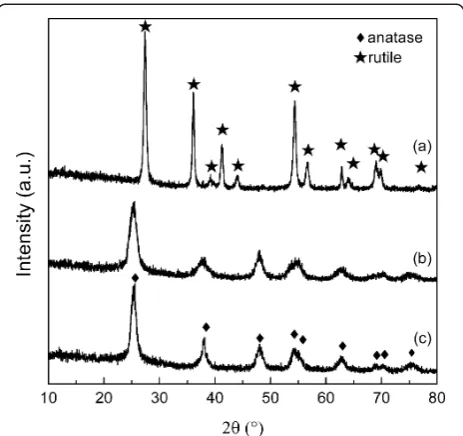
Pure rutile (JCPDS no. 21–1276) is formed in HCl medium, while pure anatase (JCPDS no. 21–1272) is generated in both HNO3 and HAc media. The crystal sizes are calculated from either rutile (110) or anatase (101) diffraction using Scherrer's equation [28]. The results show that the estimated crystal sizes of the sam-ples from HCl, HNO3, and HAc medium are 15.4, 5.4, and 8.5 nm, respectively.
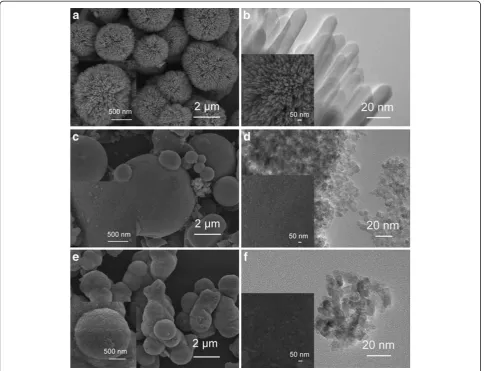
Figure 2 shows the typical FESEM and TEM images of the products synthesized with various acid media at a concentration of 0.90 M. For the sample prepared with HCl, numerous nanorods are highly aggregated into 3D dandelion-like spheres in mean diameter of 2.1 ± 0.2 cm (N= 8,Nis the number of measurements) (see Figure 2a and inset), forming a hierarchical structure. Figure 2b and inset show the magnified FESEM and TEM images of the nanorods, indicating that the nanorods possess a
rectangular shape with an average diameter of
15.1 ± 1.3 nm (N= 12) and smooth side wall. For the samples derived from either HNO3or HAc, 3D spheres with a nonuniform size distribution are present (see Figure 2c for HNO3and Figure 2e for HAc). Magnified TEM and FESEM images of the surfaces (see Figure 2d for HNO3 and Figure 2f for HAc) show that both the spheres are composed of nanoparticles, and the primary
particle sizes are about 5.0 ± 0.5 (N= 12) and
8.2 ± 0.9 nm (N= 12), respectively.
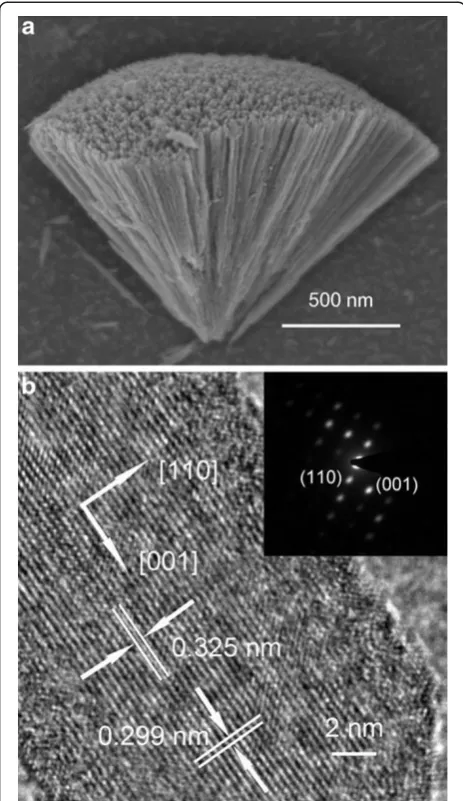
Further characterization of the 3D dandelion-like structure synthesized in 0.90 M HCl medium is provided by the FESEM and HRTEM images shown in Figure 3. The typical section of a sector from a sphere (Figure 3a)
confirms that the microsphere is composed of numerous nanorods of about 1 μm in length, radiating from the center to form a spherical dandelion-like structure. In the HRTEM image (Figure 3b), the distances between the adjacent lattice fringes are measured to be 0.325 and 0.299 nm, which agree well with the interplanar dis-tances of rutile TiO2 (110) and (001) (JCPDS no. 21– 1276), indicating the growth direction of [001], parallel to c-axis. The corresponding selected area electron dif-fraction (SAED) pattern (inset in Figure 3b) demon-strates that the nanorod is single crystalline and could be indexed to the pure rutile TiO2 phase. Combined with the XRD data and HRTEM image, such features imply the single crystal with the exposed surface of (110) crystal plane [29-31].
The results reveal that the precursor containing HCl as the acid medium has a tendency to form rod-shaped rutile titania, whereas anatase particles are obtained when either HNO3or HAc is used. The formation of the two different morphologies and crystal structures depends on the presence of diverse ions (Cl−, NO3−, or CH3COOH−) during the synthesis. It is known that ana-tase nucleates and grows first according to Ostwald's law, and rutile nuclei appears eventually when the suc-cessive reaction is taking place since rutile is the thermodynamically most stable phase [16]. Thereafter, rutile quickly grows epitaxially at the expense of mother anatase crystallites via a dissolution and precipitation process [32]. This is also the reason why the crystalline sizes of rutile are always greater than anatase, as shown in Figures 1 and 2.
Both rutile and anatase belong to the tetragonal crystal system, consisting of TiO6 octahedra as a fundamental structural unit. Their crystalline structures differ in the as-sembly of the octahedral chains [19,33]. Anatase results from face-shared linking of octahedra, while rutile is built by edge-shared linking [34]. Rutile has 42screw axes along the crystallographicc-axis. The screw structure promotes crystal growth along this direction, resulting in a crystal morphology dominated by the {110} faces [35]. Therefore, rutile nanoparticles are usually rod-like.
The structural rearrangement of octahedral TiO6units is essential during the phase transformation. It has been known that Cl− anions show weaker affinity to a
titan-ium atom in an aqueous solution than NO3− and
[image:3.595.58.290.88.306.2]CH3COO− anions do [16]. Therefore, pure rutile phase could be obtained in HCl aqueous solution more easily. On the other hand, n-hexane is used as the solvent, which is a nonpolar solvent. The liquid-liquid (nonpolar solvent-water) interface in the present system provides an ideal place for self-assembly of 3D nanostructures [36,37]. In HCl medium, nanorods self-assemble into 3D dandelion-like spheres. Their radial assembly in a good geometrical match to the spherical structure could
Figure 1XRD patterns of the products.Products synthesized using various acid media at a concentration of 0.90 M:(a)HCl,
significantly reduce the total free energy [17]. For both
HNO3 and HAc, the strong affinity of NO3− and
CH3COO−anions to titanium inhibits the structural re-arrangement and, subsequently, the phase transform-ation [16]. Accordingly, pure anatase is present in both HNO3and HAc media due to stronger chemical coord-ination to titanium. Irregular 3D microspheres com-posed of anatase nanoparticles are obtained in either HNO3or HAc medium (see Figure 2c,d,e,f ).
Effects of hydrochloric acid concentration on the microstructures of TiO2
According to the above experimental results with inor-ganic acid media, it can be concluded that 3D spherical structure composed of rutile nanorods can be formed in HCl. Therefore, HCl solution was selected as a representa-tive acid medium to investigate the growth of 3D dandelion-like structure under various acidity conditions.
Figure 4 shows XRD patterns of the products synthe-sized at various HCl concentrations. Pure anatase (JCPDS no. 21–1272) is formed in the sample without addition of any acids (Figure 4a). At an HCl concentra-tion of 0.45 to 0.68 M, anatase (JCPDS no. 21–1272) and rutile (JCPDS no. 21–1276) coexist in the product (Figure4b,c). The intensity of characteristic peaks of ru-tile becomes stronger with increasing HCl concentra-tion. Pure rutile (JCPDS no. 21–1276) is obtained when HCl concentration is 1.12 to 1.35 M (Figures 1a and 4d,e). The results indicate that higher HCl concentration favors rutile crystallization. The rutile ratio (χR) of each sample is estimated from XRD intensity data using the formula expressed as follows:
χR¼ 1þ 0:8IA
IR
1
[image:4.595.57.543.89.460.2]; ð2Þ
Figure 2Typical FESEM and TEM images of the products.Products synthesized using various acid media at a concentration of 0.90 M:
(a and b)HCl,(c and d)HNO3, and(e and f)HAc.(a),(c), and(e)are overview FESEM images.(b),(d),(f)and the insets are enlarged TEM and
where IA and IR are the integrated intensity of anatase (101) and rutile (110) diffraction peaks, respectively [13,38]. The fraction of rutile tends to be greater at higher HCl concentrations (Figure 5a). Pure rutile phase could be ultimately obtained at an HCl concentration of 0.90 M or higher. The concentration of HCl affects not only the frac-tion of rutile but also the nanocrystal size in the products. The crystal sizes of the TiO2 samples were determined from the diffraction peak broadening using the Scherrer formula shown in Figure 5b,c. Larger crystalline sizes of either anatase or rutile are obtained at higher HCl concen-trations, which can be confirmed by the FESEM and TEM results.
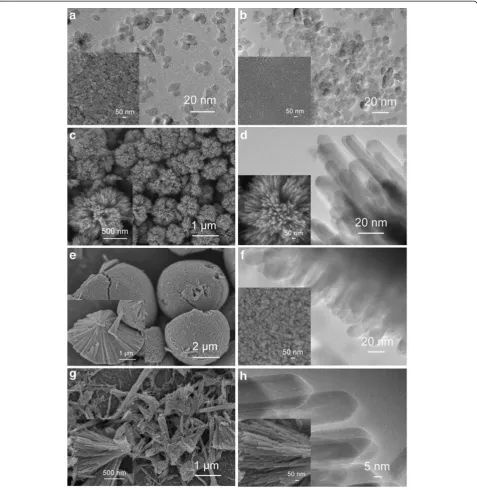
Figure 6 shows the typical FESEM and TEM images of the products synthesized at various HCl concentrations. The samples prepared at HCl concentrations of 0 and 0.45 M assume bulky aggregation of nanoparticles with an average size of 6.1 ± 1.2 (N= 12) and 11.4 ± 0.7 nm (N= 12) (see Figure 6a,b), respectively. At higher HCl
concentration (0.68 or 1.12 M), 3D hierarchical
[image:5.595.305.539.87.306.2]dandelion-like spherical structures generate. The mean diameters of the nanorods are 13.5 ± 1.4 (N= 12) and 17.8 ± 1.7 nm (N= 8) at HCl concentrations of 0.68 and 1.12 M (Figure 6d,f ), respectively. Meanwhile, together with the sample synthesized with 0.90 M HCl (see Figure 2a,b), it can be found that the rod diameter, rod density, and size of spheres gradually enhance with
Figure 3FESEM and HRTEM images and corresponding SAED
pattern. (a)FESEM image of a sector and(b)HRTEM image and
corresponding SAED pattern (inset) of an individual nanorod in the product using HCl acid medium at a concentration of 0.90 M.
Figure 4XRD patterns of the products.Products synthesized at various HCl concentrations:(a)0,(b)0.45,(c)0.68,(d)1.12, and
(e)1.35 M.
[image:5.595.57.289.89.490.2] [image:5.595.305.539.548.706.2]increasing HCl concentration. The 3D spheres become noticeably not so round when the HCl concentration reaches as high as 1.12 M. Further elevating the HCl concentration to 1.35 M, 3D dandelion-like structures are collapsed into sectors composed of nanorods with an average diameter of 19.8 ± 1.8 nm (N= 5).
It has also been widely reported that higher acid con-centration favors the formation of rutile phase since the transformation from anatase to rutile could also be
[image:6.595.60.538.89.580.2]promoted by strong acidity [13,19,35]. In this study, the fraction of rutile enhances with increasing HCl con-centration. Bulky aggregated rounded particles are present in the samples of pure anatase or mainly com-posed of anatase for the low concentration of HCl. When the HCl concentration is 0.68 or higher, rod-like particles are obtained in the sample mainly composed of rutile or pure rutile. Pure rutile is obtained at the HCl concentration of 0.90 M or higher. Acid can
Figure 6Typical FESEM and TEM images of the products.Products synthesized at various HCl concentrations:(a)0,(b)0.45 M,(c and d)
accelerate not only phase transformation but also crys-tal growth [16]. Cryscrys-tal growth of both anatase and rutile particles can be facilitated in stronger acid solu-tion, respectively. In the present case, either anatase or rutile nanocrystals tend to be larger at higher HCl con-centration. Meanwhile, the rod density in the 3D dandelion-like spheres gradually enhances with increas-ing HCl concentration. Furthermore, both highly acid condition and selectively adsorption of Cl− on rutile (110) plane accelerate the anisotropic growth along [001] orientation [13,35]. Therefore, 3D dandelion-like structures are destroyed when the HCl concentration reaches as high as 1.35 M, resulting in sectors composed of nanorods.
Optical properties of 3D TiO2structures
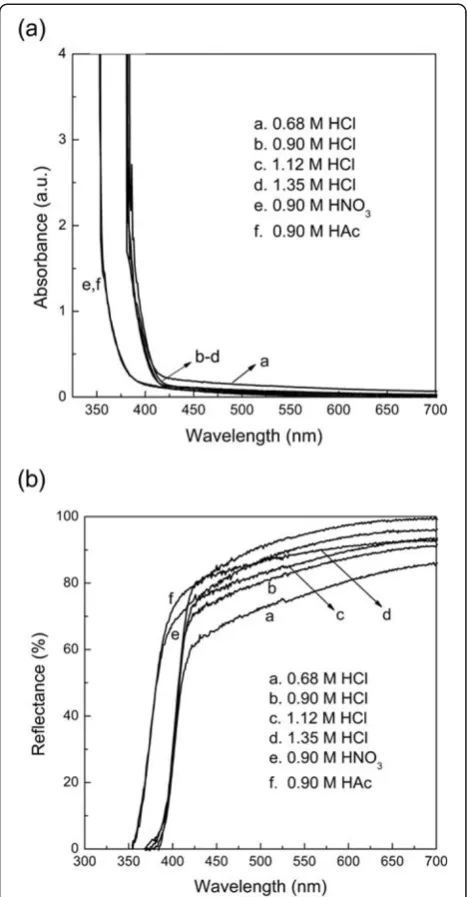
The optical absorption and diffuse reflectance spectra of 3D TiO2structures synthesized with various acid condi-tions are shown in Figure 7. As seen in Figure 7a, all the samples exhibit low absorption in the visible light range since nanosized TiO2 is a visible-light-transparent ma-terial. The slight visible light response for the sample prepared with 0.68 M HCl might be due to the presence of defects in the rutile-anatase mixed structures [39]. The abrupt increase below 400 nm was due to the ab-sorption of light caused by the excitation of electrons from the valence band to the conduction band of TiO2. The absorption edge wavelength of the samples derived from HCl is shorter than that of the samples prepared with either HNO3 or HAc, which can be ascribed to their different crystal phase structures and the narrower band gap of rutile TiO2 (3.0 eV) compared with that of anatase (3.2 eV). The diffuse reflectance spectra shown in Figure 7b also show the red shift in the band gap transition to longer wavelengths for samples prepared with HCl. In UV light region (<420 nm), TiO2prepared with 0.68, 0.90, or 1.12 M HCl exhibits lower reflectance than that prepared with either HNO3or HAc. This can be ascribed to the unique 3D dandelion-like structure in which the interspace between ordered rods act as a light-transfer path for introducing incident light into the inner surface of TiO2. This allows UV light waves to penetrate deep inside the TiO2 structure. The nanorods also offer multiple reflective and scattering effects of UV light, preventing the incident waves from bouncing back to the free space [40,41]. Both of these give rise to a lower reflectance and more efficient light harvesting.
Among them, TiO2 prepared with 0.68 M HCl shows
lowest reflectance since tapered tips are beneficial to lower reflectance in comparison with densely arranged flat tops [41,42]. The increase in reflectance for TiO2 prepared with 1.35 M HCl can be due to the collapse of 3D dandelion-like structure [40].
Photocatalytic activity of 3D TiO2structures
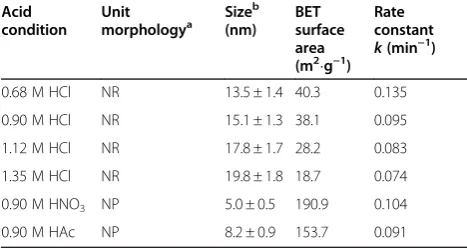
[image:7.595.305.539.88.537.2]The photocatalytic activity of TiO2samples can be quan-titatively evaluated by comparing the rate constants k, which is calculated by the plots of photocatalytic degrad-ation of RhB as shown in Figure 8. In order to eliminate the influence of adsorption, the typical plot of photo-catalytic degradation of RhB without illumination of the TiO2/RhB solution is given in Figure 8. It can be seen that without illumination, the RhB absorptance remains almost unchanged. This assures that the reduction of RhB absorptance comes from the photocatalytic effect of
Figure 7Optical absorption (a) and diffuse reflectance spectra (b) of 3D TiO2structures.Structures synthesized with various acid
the TiO2samples rather than powder adsorption. Higher value ofk indicates better photocatalytic activity. The k values for the degradation of RhB and BET surface areas are presented in Table 1. It is commonly accepted that mesoporous TiO2with a large surface area is a superior photocatalyst since a larger surface area provides more active adsorption sites. That is why the sample prepared with HNO3shows a slightly greater photocatalytic cap-acity than that with HAc. However, it is difficult to ex-plain the high activity of 3D dandelion-like TiO2 solely based on its surface area. It can be seen that the BET surface area of TiO2synthesized with HCl is much lower than that with HNO3 or HAc, while the 3D TiO2 pre-pared with 0.68 or 0.90 M HCl exhibits higher or com-parable kvalue compared with that derived from HNO3 or HAc. Such higher photocatalytic performance than expected can be ascribed to the unique topologies and optical properties of the 3D dandelion-like TiO2. The
[image:8.595.60.540.89.266.2]overall photocatalytic activity is governed by light har-vesting efficiency, efficiency of the reaction of photogen-erated electron/hole (e−/h+), and the rate of e−/h+ recombination. Firstly, the absorbance is strongly influ-enced by the topologies of photocatalyst. For 3D dandelion-like TiO2, the interspaces between ordered nanorods serve as a light-transfer path, making it pos-sible to illuminate even the core TiO2particles. Consid-ering the improved light absorption, reduced reflectance, and scattering within such a hierarchical system, the ef-fective light-activated surface area can be significantly enhanced. This would improve the photoabsorption effi-ciency of the photocatalyst. On the other hand, only the surface layer contributes to the light harvesting for spheres composed of nanoparticles. Moreover, the oriented 1D geometry provides a direct pathway for photogenerated electron transport, which allows highly efficient photogenerated electron transport through the 3D dandelion-like structure and a lowere−/h+ recombin-ation loss. For nanoparticles, when particle size becomes extremely small, i.e., several nanometers in diameter, surface recombination instead of volume recombination becomes a dominant regime. Most of the e−/h+ are gen-erated sufficiently close to the surface. They may quickly reach the surface and undergo rapid surface recombin-ation mainly due to abundant surface-trapping sites and the lack of driving force for e−/h+ separation. Another reason for the high photocatalytic activity of the sample prepared with 0.68 M HCl might be a mixed phase con-sisting of rutile and anatase types of TiO2that prohibits the e−/h+ recombination [43]. For the heterogeneous anatase/rutile TiO2system, photogenerated electrons are effectively accumulated in the rutile phase without recombining with the holes in the anatase valence band,
Figure 8Plots of photocatalytic degradation of RhB using 3D TiO2structures.Structures synthesized with various acid conditions: 0.68 M
HCl, 0.90 M HCl, 1.12 M HCl, 1.35 M HCl, 0.90 HNO3, and 0.90 M HAc, respectively. The plot‘without illumination’represents the typical plot of
photocatalytic degradation of RhB without illumination of the TiO2/RhB solution for TiO2sample prepared with 0.68 M HCl since all the samples
show almost the same plot without illumination.
Table 1 Morphology, BET surface area, and rate constant of products synthesized with various acid conditions
Acid condition
Unit morphologya
Sizeb
(nm) BET surface area (m2g−1)
Rate constant
k(min−1)
0.68 M HCl NR 13.5 ± 1.4 40.3 0.135
0.90 M HCl NR 15.1 ± 1.3 38.1 0.095
1.12 M HCl NR 17.8 ± 1.7 28.2 0.083
1.35 M HCl NR 19.8 ± 1.8 18.7 0.074
0.90 M HNO3 NP 5.0 ± 0.5 190.9 0.104
0.90 M HAc NP 8.2 ± 0.9 153.7 0.091
a
The morphology of the unit in the hierarchical structure where NR and NP refer to nanorod and nanoparticle, respectively;b
[image:8.595.56.290.584.708.2]resulting in the enhancement of the photocatalytic ac-tivity. Besides, less aggregation for the dandelion-like morphology facilitates higher photocatalytic activity. As expected, the nanorod fragments fabricated with 1.35 M HCl present lower photocatalytic degradation owing to the collapse of dandelion-like structure as well as severe aggregation and therefore lower surface area.
Conclusions
3D TiO2hierarchical structures with various microstruc-tures have been successfully synthesized by solvothermal method, in which HCl, HNO3, and HAc is used as the acid medium, respectively. The acid medium significantly affects the microstructures, optical properties, and photo-catalytic activity of TiO2. The samples prepared with 0.68 to 1.12 M HCl possessed 3D dandelion-like spheres assembled of radially arranged rutile nanorods. Both the fraction of rutile and the diameter of nanorod are enhanced with the increasing HCl concentration. For the products derived from either HNO3or HAc, 3D spheres composed of anatase nanoparticles were present. The unique 3D dandelion-like hierarchical structure exhibited low reflectance and efficient light harvesting since the ordered rods provided a light-transfer path for incident light and multiple reflective and scattering effects. 3D TiO2prepared with 0.68 M HCl showed superior photo-catalytic activity due to this unique topology and optical properties as well as anatase/rutile heterogeneous system. Considering the unique morphology of the 3D dandelion-like TiO2structures, the recovery of these 3D TiO2 pow-ders from the solution is believed to be much easier than that of nanoparticle powders.
Competing interests
The authors declare that they have no competing interests.
Authors' contributions
JZ participated in the design of the study, carried out the experiments, collected data, performed data analysis, and drafted the manuscript. GZ, BS, and GH participated in the design of the study, discussion of data, and helped to draft the manuscript.
Acknowledgments
This work is supported by the National Natural Science Foundation of China (51172201) and National "Twelfth Five-Year" Plan for Science & Technology Support, (2011BAE14B02).
Author details
1State Key Laboratory of Silicon Materials and Department of Materials
Science and Engineering, Zhejiang University, Hangzhou 310027, People's Republic of China.2Department of Physics, Zhejiang University, Hangzhou 310027, People's Republic of China.3, Zhejiang Police College, Hangzhou 310053, People's Republic of China.
Received: 25 November 2011 Accepted: 23 March 2012 Published: 13 April 2012
References
1. Oregan B, Gratzel M:A low-cost, high-efficiency solar-cell based on dye-sensitized colloidal TiO2films.Nature1991,353:737–740.
2. Asahi R, Morikawa T, Ohwaki T, Aoki K, Taga Y:Visible-light photocatalysis in nitrogen-doped titanium oxides.Science2001,293:269–271.
3. Colomer MT:Nanoporuous anatase thin films as fast proton-conducting materials.Adv Mater2006,18:371–374.
4. Colomer MT, Maczka M:Mixed conductivity, structural and microstructural characterization of titania-doped yttria tetragonal zirconia polycrystalline/titania-doped yttria stabilized zirconia composite anode matrices.J Solid State Chem2011,184:365–372.
5. Yeredla RR, Xu HF:Incorporating strong polarity minerals of tourmaline with semiconductor titania to improve the photosplitting of water.
J Phys Chem C2008,112:532–539.
6. Ali G, Chen C, Yoo SH, Kum JM, Cho SO:Fabrication of complete titania nanoporous structures via electrochemical anodization of Ti.Nanoscale Res Lett2011,6:332.
7. Cao CB, Zhang GS, Song XP, Sun ZQ:Morphology and microstructure of As-synthesized anodic TiO(2) nanotube arrays.Nanoscale Res Lett2011,
6:64.
8. Kontos AG, Likodimos V, Vassalou E, Kapogianni I, Raptis YS, Raptis C, Falaras P:
Nanostructured titania films sensitized by quantum dot chalcogenides.
Nanoscale Res Lett2011,6:266.
9. Wu W, Xiao XH, Zhang SF, Ren F, Jiang CZ:Facile method to synthesize magnetic iron oxides/TiO(2) hybrid nanoparticles and their
photodegradation application of methylene blue.Nanoscale Res Lett2011,
6:533.
10. Burda C, Chen XB, Narayanan R, El-Sayed MA:Chemistry and properties of nanocrystals of different shapes.Chem Rev2005,105:1025–1102. 11. Sahu M, Biswas P:Single-step processing of copper-doped titania
nanomaterials in a flame aerosol reactor.Nanoscale Res Lett2011,6:1–14. 12. Witharana S, Chen HS, Ding YL:Stability of nanofluids in quiescent and
shear flow fields.Nanoscale Res Lett2011,6:231.
13. Li HB, Duan XC, Liu GC, Jia XB, Liu XQ:Morphology controllable synthesis of TiO2by a facile hydrothermal process.Mater Lett2008,62:4035–4037.
14. Chen X, Mao SS:Titanium dioxide nanomaterials: synthesis, properties, modifications, and applications.Chem Rev2007,107:2891–2959. 15. Suttiponparnit K, Jiang JK, Sahu M, Suvachittanont S, Charinpanitkul T,
Biswas P:Role of surface area, primary particle size, and crystal phase on titanium dioxide nanoparticle dispersion properties.Nanoscale Res Lett
2011,6:27.
16. Wu MM, Lin G, Chen DH, Wang GG, He D, Feng SH, Xu RR: Sol-hydrothermal synthesis and Sol-hydrothermally structural evolution of nanocrystal titanium dioxide.Chem Mater2002,14:1974–1980. 17. Yang XF, Konishi H, Xu HF, Wu MM:Comparative sol-hydro(solvo)thermal
synthesis of TiO2nanocrystals.Eur J Inorg Chem2006,2006:2229–2235.
18. Andersson M, Osterlund L, Ljungstrom S, Palmqvist A:Preparation of nanosize anatase and rutile TiO2by hydrothermal treatment of
microemulsions and their activity for photocatalytic wet oxidation of phenol.J Phys Chem B2002,106:10674–10679.
19. Wang CC, Ying JY:Sol–gel synthesis and hydrothermal processing of anatase and rutile titania nanocrystals.Chem Mater1999,11:3113–3120. 20. Hu WB, Li LP, Tong WM, Li GS, Yan TJ:Tailoring the nanoscale boundary
cavities in rutile TiO(2) hierarchical microspheres for giant dielectric performance.J Mater Chem2010,20:8659–8667.
21. Yoffe AD:Low-dimensional systems: quantum size effects and electronic properties of semiconductor microcrystallites (zero-dimensional systems) and some quasi-two-(zero-dimensional systems.
Adv Phys2002,51:799–890.
22. Bal XL, Xie B, Pan N, Wang XP, Wang HQ:Novel three-dimensional dandelion-like TiO2structure with high photocatalytic activity.J Solid State Chem2008,181:450–456.
23. Liu L, Zhao YP, Liu HJ, Kou HZ, Wang YQ:Directed growth of TiO2
nanorods into microspheres.Nanotechnology2006,17:5046–5050. 24. Yang SW, Gao L:Fabrication and shape-evolution of nanostructured TiO2
via a sol-solvothermal process based on benzene-water interfaces.Mater Chem Phys2006,99:437–440.
25. Luo JQ, Gao L:Large-scale production of monodispersed titania microspheres by surfactant-guided self-assembly.J Alloys Compd2009,
487:763–767.
26. Wu HB, Chen JS, Lou XW, Hng HH:Asymmetric anatase TiO(2) nanocrystals with exposed high-index facets and their excellent lithium storage properties.Nanoscale2011,3:4082–4084.
27. Zhou J, Zhao GL, Song B, Han GR:Solvent-controlled synthesis of TiO2 three-dimensional nanostructures via a one-step solvothermal route.
28. Cullity BD:Elements of X-Ray Diffraction. Reading, MA: Addison-Wesley Publishing Company; 1978.
29. Jiang HB, Cuan QA, Wen CZ, Xing J, Wu D, Gong XQ, Li CZ, Yang HG:
Anatase TiO(2) crystals with exposed high-index facets.Angew Chem Int Edit2011,50:3764–3768.
30. Hosono E, Fujihara S, Kakiuchi K, Imai H:Growth of submicrometer-scale rectangular parallelepiped rutile TiO2films in aqueous TiCl3solutions
under hydrothermal conditions.J Am Chem Soc2004,126:7790–7791. 31. Feng XJ, Zhai J, Jiang L:The fabrication and switchable
superhydrophobicity of TiO2nanorod films.Angew Chem Int Edit2005,
44:5115–5118.
32. Penn RL, Banfield JF:Formation of rutile nuclei at anatase 112 twin interfaces and the phase transformation mechanism in nanocrystalline titania.Am Mineral1999,84:871–876.
33. Li YY, Liu JP, Jia ZJ:Morphological control and photodegradation behavior of rutile TiO2prepared by a low-temperature process.Mater Lett2006,60:1753–1757.
34. Yanagisawa K, Ovenstone J:Crystallization of anatase from amorphous titania using the hydrothermal technique: effects of starting material and temperature.J Phys Chem B1999,103:7781–7787.
35. Li JG, Ishigaki T, Sun XD:Anatase, brookite, and rutile nanocrystals via redox reactions under mild hydrothermal conditions: phase-selective synthesis and physicochemical properties.J Phys Chem C2007,
111:4969–4976.
36. Lin Y, Skaff H, Emrick T, Dinsmore AD, Russell TP:Nanoparticle assembly and transport at liquid-liquid interfaces.Science2003,299:226–229. 37. Velev OD, Furusawa K, Nagayama K:Assembly of latex particles by using
emulsion droplets as templates .1. Microstructured hollow spheres.
Langmuir1996,12:2374–2384.
38. Sreethawong T, Suzuki Y, Yoshikawa S:Photocatalytic evolution of hydrogen over nanocrystalline mesoporous titania prepared by surfactant-assisted templating sol–gel process.Catal Commun2005,
6:119–124.
39. Chen XB, Liu L, Yu PY, Mao SS:Increasing solar absorption for photocatalysis with black hydrogenated titanium dioxide nanocrystals.
Science2011,331:746–750.
40. Tian GH, Chen YJ, Zhou W, Pan K, Tian CG, Huang XR, Fu HG:3D hierarchical flower-like TiO(2) nanostructure: morphology control and its photocatalytic property.CrystEngComm2011,13:2994–3000.
41. Yeh LK, Lai KY, Lin GJ, Fu PH, Chang HC, Lin CA, He JH:Giant efficiency enhancement of GaAs solar cells with graded antireflection layers based on syringelike ZnO nanorod arrays.Adv Energy Mater2011,1:506–510. 42. Diedenhofen SL, Vecchi G, Algra RE, Hartsuiker A, Muskens OL, Immink G,
Bakkers EPAM, Vos WL, Rivas JG:Broad-band and omnidirectional antireflection coatings based on semiconductor nanorods.Adv Mater
2009,21:973–978.
43. Jia JG, Ohno T, Matsumura M:Efficient dihydroxylation of naphthalene on photoirradiated rutile TiO2powder in solution containing hydrogen
peroxide.Chem Lett2000:908–909.
doi:10.1186/1556-276X-7-217
Cite this article as:Zhouet al.:Effects of acid on the microstructures and properties of three-dimensional TiO2hierarchical structures by
solvothermal method.Nanoscale Research Letters20127:217.
Submit your manuscript to a
journal and benefi t from:
7Convenient online submission
7Rigorous peer review
7Immediate publication on acceptance
7Open access: articles freely available online
7High visibility within the fi eld
7Retaining the copyright to your article