BIROn - Birkbeck Institutional Research Online
Wan ghani, Wan aryati and Wilson, David and Sims, Julian (2015) The
performativity of BYOD. In: UKAIS 2015, 16-18 Mar 2015, Oxford, UK.
Downloaded from:
Usage Guidelines:
Please refer to usage guidelines at or alternatively
Association for Information Systems
AIS Electronic Library (AISeL)
UK Academy for Information Systems Conference
Proceedings 2015 UK Academy for Information Systems
Spring 4-1-2015
The Performativity of BYOD
Wan Aryati Wan GhaniBirkbeck University of London, [email protected]
David Wilson
Birkbeck College, University of London, [email protected]
Julian Sims
Birkbeck University of London, [email protected]
Follow this and additional works at:http://aisel.aisnet.org/ukais2015
This material is brought to you by the UK Academy for Information Systems at AIS Electronic Library (AISeL). It has been accepted for inclusion in UK Academy for Information Systems Conference Proceedings 2015 by an authorized administrator of AIS Electronic Library (AISeL). For more information, please [email protected].
Recommended Citation
Wan Ghani, Wan Aryati; Wilson, David; and Sims, Julian, "The Performativity of BYOD" (2015).UK Academy for Information Systems Conference Proceedings 2015.Paper 31.
The Performativity of BYOD
Wan Aryati Wan Ghani
Department of Computer Science and Information Systems, Birkbeck, University of London, London, UK
David W. Wilson
Department of Computer Science and Information Systems, Birkbeck, University of London, London, UK
Julian Sims
Department of Management,
Birkbeck, University of London, London, UK
Abstract
Bring-Your-Own-Device (BYOD) is a trend introduced by a large IT corporation in 2009 realised as a consequence of the consumerization of Information Technology. BYOD is described as the phenomenon of using personal mobile devices connected to corporate networks to perform work. This study aims to understand consumerization of IT and BYOD in the Tertiary Education sector, particularly the context of BYOD in universities in both the United Kingdom and Malaysia. The study will commence with a pilot case study in the Computer Science Department of a UK University to explore its current systems and support for staff and students, gathering insights on the consideration of BYOD for the department. As this is a phenomenological study, Actor Network Theory (ANT) is selected as an initial lens. This seeks to create a ‘timeless snapshot’ of phenomena in time, space and social change. This paper aims to set the scene for the study in terms of the performativity of BYOD by reviewing the literatures pertaining to the history of BYOD, and the implementation of BYOD in the commercial and education sectors.
Keywords: Bring-Your-Own-Device (BYOD), IT Consumerization, ANT, Performativity, Sociomateriality
1.0
Introduction
The rapid and increase in the use of laptop computers, smartphones and other mobile
information and communication technology (ICT) have a huge impact on modern lives.
Mobile devices and technology have become part and parcel of human activity where large
segments of people are dependent for their social existence on these emerging technologies.
Bring-Your-Own-Device (BYOD) is a trend introduced by a large IT corporation in 2009
(Burns-Sardone, 2014; Yin, Liu, & Liu, 2014), realised after the identification of the
Taylor, 2004). This phenomenon is described as using personal mobile devices connected to
the corporate network to perform corporate work.
Moschella et al. (2004) describe consumerization as the ‘dual-use’ of devices both for personal
use on public network infrastructure and at the workplace. Christensen’s disruptive technology
(Clayton, 1997) has been presented in the Computer Science Corporation (CSC) research and
Advisory Services Position Paper (Moschella et al., 2004), where it was predicted that
somewhere in 2003 – 2005 the emergence of new technology could become a ‘threat’ to most
organisations; distracting their normal procedures. They also predicted that the new technology
would actually replace traditional systems; no longer posing a threat to most organisations.
BYOD in this context can be perceived as the phenomena yielded by this consumerization of
technology. The innovation of these technology driven products attracts many consumers to
own and use them to the fullest, be it from making telephone calls, text messaging, taking
pictures, getting connected virtually to performing business tasks, for example, placing orders
and holding meetings online. This trend is projected to grow in the future. Harkins (2013)
mentions that the number of Intel’s employees owning their own mobile device and using it at
work has increased from 10,000 – 30,000 in 2010 and he projects the number would continue
to grow about 56,000 in 2014. Law (2013) concludes that this phenomenon introduces a new
ecosystem which influences human activity systems at most organisations, higher education
sectors and almost every one of us on an individual basis.
Nowadays, many people own mobile devices which make them accessible in terms of social
networking. People are virtually interconnected through ICT based constructs such as
Facebook, Twitter, LinkedIn, WhatsApp, Instagram and many other social network channels.
Hinchcliffe (2011) describes this as “a tectonic technology shift” introducing a massive change
in this transition of technology, likely to persist as the future digital era.
In order to understand both people, technology and their relationship, it is important to know
how people ‘interpret’ the technology. This can be done through the Actor Network Theory
(ANT) (Callon, 1986a; Latour, 2005) and a socio-materialist perspective (Orlikowski & Scott,
2008). This study intends to analyse the fundamental associations between human and
material actors, mixing both people (human) and technology (material) (Cecez-Kecmanovic,
Galliers, Henfridsson, Newell, & Vidgen, 2014). From here, the performativity of each aspect
2.0
Literature Review
2.1 Theory Review – IT Consumerization
Moschella et al., (2004) discovered that the growth of IT innovations are targeting a consumer
market. BYOD can be seen where the use of mainframes, minicomputers and other IT platform
in organisations shifted to small enterprises and home users. The emergence of devices such as
laptop computers and mobile phones, amongst others had a tremendous impact on the
consumer market. IT consumerization became a part of business operation in many
organisations. Gartner predicts that consumerization will affect information technology in
many organisations. This can be seen in the success of mobile technology leads to
Bring-Your-Own-Device (BYOD), a consumer driven product that can support many business operations
with low cost (Gartner, 2005). IT consumerization is described as bringing employee-devices,
tools and services into the organization (Thompson, 2010).
When Apple introduced the first smartphone some people went mobile in every aspect of their
lives. Such people carry their smartphone and consider having a smartphone a necessity in
their social groups. Steve Jobs described the iPhone as a “magical product” as it does many
essential things for people (Apple Press Info, 2007). Gartner (2013) asserts that smartphones
will become smarter than people by 2017.
2.2 BYOD in the industry sectors
The BYOD Working Group of the USA’s Digital Services Advisory Group and Federal Chief
Information Officers Council, has considered the BYOD trend and conducted three case studies
that highlighted the successful execution of BYOD at a government agency (The White House,
2013). This trend is rapidly moving forward and has attracted many other organisations in
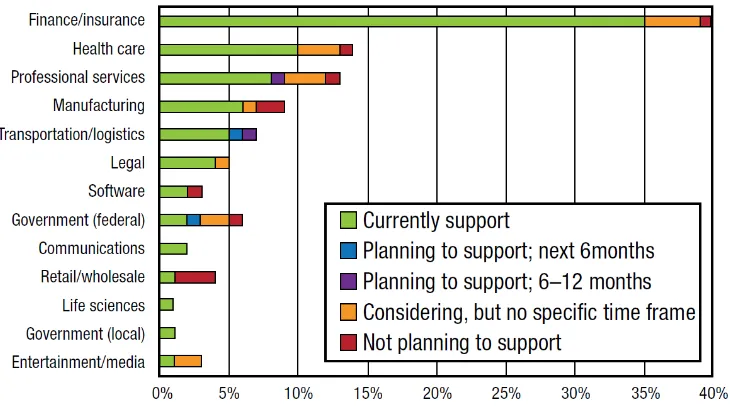
Figure 1: BYOD supported by various types of industries. (Source: ISACA journal, 2013)
2.3 BYOD in the education sectors
UCAS (2012) reports that more than 80% university students in the UK own smartphones. The
BYOD uptake among the university community is increasing. In 2012, undergraduate
smartphone owners that used devices for academic purposes had increased to 62% (Dahlstrom
& DiFilipo, 2013). Pogar, Gligora, & Davidovi (2013) indicates almost half of the users are
ready to use personal devices for educational purposes. Further, the adoption of BYOD to
support teaching will supplement eLearning and mLearning initiatives as BYOD provides a
ubiquitous learning environment in education.
New Media Consortium (NMC) reported in 2013 that, some significant universities support
and implement BYOD. King’s College London has implemented a private cloud platform
through JANET (Joint Academic Networks) and students and staff can use their personal
devices to access a virtual desktop from 150 countries. Students and faculties in Parkland
Community College, USA can securely use their personal devices to connect to the College’s
wireless network and Learning Management System (LMS). The University of
Wisconsin-Oshkosh offers a virtual desktop infrastructure as part of its BYOD program (Johnson, L.,
Adams Becker, S., Cummins, M., Estrada, V., Freeman, A., and Ludgate, 2013). At Paris
Descartes University the interactive lectures using the moodle LMS, running on BYOD gets
the lecturers (Badeau-mahmoud, Bouziane, Alvarez, & Harent, 2014). Universities cite this
emerging trend because of its robustness, usability, availability and reliability in conjunction
with the consumerization of technology (Gartner, 2005). BYOD has become the official
method of delivery for 170 programs offered at Algonquin College, Canada since late 2014,
and students are required to use personal devices during the program of study
(www7.algonquincollege.com/byod/). These examples show some acceptance of BYOD in the
university sector.
2.4 BYOD Benefits and Challenges in the University Sector
There are still many higher education sectors that haven’t taken up BYOD completely. BYOD,
at some point, has positive and negative implications among education institutions.
Badeau-mahmoud et al. (2014) evaluates that BYOD could improve the communication among
lecturers and students as well as the interaction among students. It enthuses and inspires the
students, and they are motivated to become more engaged in the learning process (Al-Okaily,
2013; Badeau-mahmoud et al., 2014). Similarly, students perceived smartphones as a useful
tool in teaching and learning as they are used to the smartphone functions. Having said that, it
can increase the level of confidence among students and could also ease the teachers’ tasks in
the classroom (Burns-Sardone, 2014). In addition, BYOD-ing could reduce the operating costs
(Afreen, 2014; Al-Okaily, 2013; Burns-Sardone, 2014; Dahlstrom & DiFilipo, 2013; Emery,
2012). However, despite the upside of BYOD, issues are varied from many different
perspective. In general, implementing BYOD can be difficult as the issue of “inequality” arises
(Hockly, 2012; Sharples et al., 2013; Walsh, 2012). Security remains a factor of whether or not
to consider using BYOD. Bradford Networks (2013) reported that most of the education
institutions denied personal devices connecting to the campus network due to inability to scan
the devices for security software and updates. The abuse of mobile devices usage in the
classroom by the students can also be difficult to manage (Hockly, 2012).
3.0
BYOD performativity
Applying Actor Network Theory (ANT) is appropriate in this research as BYOD associates
humans and the technology. The interaction between both technology and humans appears to
essentially looking at the building of relationships between identified actors (Callon, 1986b).
Latour (2005) suggests that social interaction among actors creates ‘social ties’ and
‘association’ which are both different. Social ties are often fragile. ANT looks at the
association among actors as ‘a movement’, ‘a displacement’, ‘a transformation’, ‘a translation’
and ‘an enrolment’ which then create a strong ‘network’. Networks of association in BYOD
study in the university sector can be examined by first identifying the actors in such networks.
Actors comprise humans and non-human actors (Latour, 2005). Human actors in BYOD
networks in the university sector particularly can be divided into the students (part-time and
full-time), the teaching staff, and the IT managers while the non-human actors are the IT
department facilities, the university facilities, personal mobile devices as well as the network.
Their relationship and interactions are significant to each other as it will provide the
performance of the interactions; the performativity of the BYOD trend in the university sector.
A pilot case study will be initiated in the Computer Science and Information Systems
Department in a UK University to explore its current systems and support for staff and students,
also to elicit some insight on BYOD implementation at the department. Performativity of
BYOD at the university sectors is viewed as the ‘enactment’ (Orlikowski & Scott, 2008). This
study will also incorporate BYOD with the socio-material approach (Cecez-Kecmanovic et al.,
2014; Orlikowski & Scott, 2008) as the relationships between both human and non-human
actors are situated in both social and material ontologies.
4.0
Discussion and Conclusion
In a rapidly changing digital society displacing the traditional social and material constructs
where some emerging technologies are rapidly and widely accepted, many people – older and
younger generations are taking the opportunity to make extensive use of these technology in
almost every aspect of their lives. Almost every student in the university own a smartphone,
tablet, laptop computer and other forms of mobile devices. This research aims to understand
consumerization of IT and BYOD in the university sector. Pilot interviews were conducted to
develop the project’s epistemology with the IT Manager, two lecturers and some students at
the Department of Computer Science and Information Systems in a UK University. It shows
that most respondents are aware of the BYOD acronym and Bring-Your-Own-Device.
According to the IT manager of the Department, it seems that his staff has discussed the
will take some kind of assessment if they want to consider this in the future, such as different
techniques and questionnaires, looking at what other universities and other departments are
doing, discussion among groups of staff, the needs of computer science students and some pilot
study may be conducted. Undoubtedly, when the IT department periodically refreshes its
laboratories, and software, they have thought of something like BYOD, but it is not really being
considered as a feasible solution at the moment. In contrast, the students from the foundation
degree and undergraduate programmes said that they use their mobile devices to look for
meanings and descriptions of new terms and concepts when the lecturers introduce them during
the lectures. They normally do it during the short break given in the lectures. One of the
students added the only setback is there are some cases where the students have no interest in
the teaching topic, they misuse and abuse this BYOD to something which is irrelevant to the
topic such as updating their Facebook, chatting and browsing. A few of postgraduate students
see BYOD is crucial in the teaching and learning in the university as they can benefit in many
ways. Part-time students particularly found the use of their devices to audio record the lectures.
From the perspectives of the lecturers, one had never seen the abbreviation of BYOD before.
The lecturer seemed to understand BYOD after the definition of this construct was given.
Based on the interview, it can be concluded that with the advanced technology, mobile devices
are equipped with free apps audio and video recorders which can support teaching and learning
in the classroom. Many realised that audio and video recordings of lectures are popular among
students and they certainly have allowed it in the past. The emerging technology presents some
difficulties. For example with students using their own device in the programming class, it can
be difficult to ensure that the whole class is equipped with the same device with the same
appropriate software. When asked about pursuing BYOD, whether it can be accepted or
resisted, the reply was “I think it would be useful, but I think it is an unsurmountable problem to ensure that everybody has a tablet. I don’t see that is going to be solved”. Another lecturer in the department is well aware of BYOD. He has never thought and considered BYOD-ing in
his lecture as he thinks that it has happened naturally. In the programming subjects, students
are allowed to bring their own laptops running on Windows, Linux or Mac; students also use
the desktops provided by the department. There are no restrictions from the lecturer. He has
seen that the students brought their own devices since at least three years ago. The idea of
BYOD is not new, but it seems that the lecturers have never thought or considered it as they
have well established way of lecturing with a particular style and with particular materials.
BYOD in the teaching and learning, the question “Is it worth the overhead?” arose. The issues
are such as ensuring 100% of the class bring their own device as well as attendance is a
problem. According to another lecturer, he sees potential challenges on the security front, but
it’s not difficult to deal with as the systems group has been very professional and competent in
dealing with security issues. When asked about considering complete BYOD setup, he said
that without the provision of desktops by the IT department, many issues ranging from
maintenance, software licenses, anti-virus and so forth can arise. Pushing students to bring
their own laptop without having the computers in the lab will give the institution a bad image
– “They may look like a stingy or cheap institution ….” There is a slight disconnection between human and non-human actors in this area and it appears to be useful to adopt sociomateriality
approach to tackle this issue.
To start off in materialising a sociomateriality approach and ‘letting the technology (material)
speak for itself’ (Cecez-Kecmanovic et al., 2014), this research will investigate issues on
BYOD interacting with campus networks. It will also provide new insights and understanding
with regard to BYOD for the university sector and the enablers and barriers that leads to BYOD
in the university sector will be identified. The research will then conceptualize the BYOD
phenomenon in the university sector and the impact it has for the identified actors will be
studied. The performativity of BYOD will be relevant to sociomateriality and ANT method
used to follow and observe the actors. This research is intended to contribute and cultivate the
understanding of entanglement of sociomateriality in the future.
This research will further entail future case studies to look at broader perspective of BYOD
from the UK University’s IT services as well as selected universities in Malaysia.
References
Afreen, R. (2014). Bring Your Own Device (BYOD) in Higher Education: Opportunities and Challenges. International Journal of Emerging Trends & Technology in Computer Science (IJETTCS), 3(1), 1–4. Retrieved from
http://www.ijettcs.org/Volume3Issue1/IJETTCS-2014-02-25-117.pdf
Al-Okaily, R. (2013). Mobile learning and BYOD: implementations in an Intensive English Program. Learning and Teaching in Higher Education: Gulf Perspectives, 10, 1–17. Retrieved from http://lthe.zu.ac.ae/index.php/lthehome/article/view/141
Badeau-mahmoud, S., Bouziane, A., Alvarez, L., & Harent, M. (2014). Interactive lectures with Moodle and students ’ devices : BYOD at Paris Descartes University, 2, 1–10. Bradford Networks. (2013). The impact of BYOD in education. Retrieved from
http://th-ebooks.s3.amazonaws.com/The_Impact_of_BYOD_in_Education.pdf
Burns-Sardone, N. (2014). Making the Case for BYOD Instruction in Teacher Education.
Issues in Informing Science and Information …. Retrieved from
http://iisit.org/Vol11/IISITv11p191-201Sardone0505.pdf?utm_content=buffer48e02&utm_medium=social&utm_source=twi tter.com&utm_campaign=buffer
Callon, M. (1986a). Some elements in the sociology of translation: domestication of the scallops and the fishermen of St. Brieuc Bay. Power, Action and Belief: A New Sociology of Knowledge, 196–223.
Callon, M. (1986b). The sociology of an actor-network: The csase of the electric vehicle.
Mapping the Dynamics of Science and Technology: Sociology of Science in the Real World.
Cecez-Kecmanovic, D., Galliers, R. D., Henfridsson, O., Newell, S., & Vidgen, R. (2014). The sociomateriality of information Systems: current status, future directions. Misq,
38(3), 809–830.
Clayton, M. C. (1997). The innovator’s dilemma: When new technologies cause great firms to fail. Harvard Business School Print.
Dahlstrom, E., & DiFilipo, S. (2013). The consumerization of technology and the bring-your-own-everything (BYOE) era of higher education (Research Report). Educause Center for Applied Research, 1043. Retrieved from http://www.educause.edu/ecar
Digital Services Governance Recommendations | The White House. (2013). Retrieved February 28, 2015, from http://www.whitehouse.gov/digitalgov/digital-services-governance-recommendations
Emery, S. (2012). Factors for Consideration when Developing a Bring Your Own Device (BYOD) Strategy in Higher Education, 1277(July 2012), 1–111.
doi:http://hdl.handle.net/1794/12254
Gartner. (2005). Gartner Says Consumerization Will Be Most Significant Trend Affecting IT During Next 10 Years. Retrieved February 13, 2015, from
http://www.gartner.com/newsroom/id/492209
Gartner. (2013). Gartner Says by 2017 Your Smartphone Will Be Smarter Than You. Retrieved February 28, 2015, from http://www.gartner.com/newsroom/id/2621915 Harkins, M. (2013). Mobile: Learn from Intel’s CISO on Securing Employee-Owned
DevicesWebinar. Retrieved February 28, 2015, from
http://www.govinfosecurity.com/webinars/mobile-learn-fromintels-ciso-on-securing-employee-owned-devices-w-264
Hinchcliffe, D. (2011). The “Big Five” IT trends of the next half decade: Mobile, social, cloud, consumerization, and big data, 1–19. Retrieved from
http://www.zdnet.com/blog/hinchcliffe/the-big-five-it-trends-of-the-next-\nhalf-decade-mobile-social-cloud-consumerization-and-big-data/1811
Hockly, N. (2012). Tech-savvy teaching: BYOD. Modern English Teacher, 21(4), 44–45. Retrieved from http://www.academia.edu/download/29698916/Hockly_MET-21.4.pdf Johnson, L., Adams Becker, S., Cummins, M., Estrada, V., Freeman, A., and Ludgate, H.
(2013). Horizon Report > 2013 Higher Education Edition (pp. 1–40).
Latour, B. (2005). Reassembling the social-an introduction to actor-network-theory.
Law, W. (2013). “Consumerization of IT” - Challenges for IS Education. Information Systems Education Journal, 11(4). Retrieved from
http://isedj.org/2013-11/N4/ISEDJv11n4p4.html
Moschella, D., Neal, D., Opperman, P., & Taylor, J. (2004). The “ Consumerization ” of Information Technology Position Paper. CSC, El Segundo, California,USA., 1–20. Orlikowski, W. J., & Scott, S. V. (2008). 10 Sociomateriality: Challenging the Separation
of Technology, Work and Organization. The Academy of Management Annals,
2(November 2014), 433–474. doi:10.1080/19416520802211644
Pogar, I., Gligora, M., & Davidovi, V. (2013). BYOD : a challenge for the future digital generation. Mipro 13, 748–752.
Ravindran, S., Sadana, R., & Baranwal, D. (2013). BYOD in the Enterprise — A Holistic Approach. ISACA Journal, 1, 1–8.
Sharples, M., Mcandrew, P., Weller, M., Ferguson, R., Fitzgerald, E., & Hirst, T. (2013).
Innovating Pedagogy policy makers.
Thompson, H. H. (2010). Consumerization and Security. Retrieved from
http://download.microsoft.com/download/E/F/9/EF9F24B7-DB49-44D4-8F6A-A49D5020B8B8/Consumerization_Final.pdf
UCAS. (2012). Eight out of ten freshers have smartphones. Retrieved February 28, 2015, from http://www.ucasmedia.com/2014/eight-out-ten-freshers-have-smartphones Walsh, K. (2012). 5 Reasons Why BYOD is a Bad Idea. Retrieved March 3, 2015, from
http://www.emergingedtech.com/2012/07/5-reasons-why-byod-is-a-bad-idea/ Yin, C., Liu, L., & Liu, L. (2014). BYOD Implementation: Understanding Organizational