N A N O E X P R E S S
LiMn
2O
4–yBr
yNanoparticles Synthesized by a Room
Temperature Solid-State Coordination Method
Yudai HuangÆRongrong JiangÆShu-Juan BaoÆ Yali CaoÆDianzeng Jia
Received: 22 July 2008 / Accepted: 8 January 2009 / Published online: 22 January 2009 Óto the authors 2009
Abstract LiMn2O4–yBry nanoparticles were synthesized successfully for the first time by a room temperature solid-state coordination method. X-ray diffractometry patterns indicated that the LiMn2O4–yBry powders were well-crystallized pure spinel phase. Transmission electron microscopy images showed that the LiMn2O4–yBry pow-ders consisted of small and uniform nanosized particles. Synthesis conditions such as the calcination temperature and the content of Br- were investigated to optimize the ideal condition for preparing LiMn2O4–yBry with the best electrochemical performances. The optimized synthesis condition was found in this work; the calcination temper-ature is 800°C and the content of Br
-is 0.05. The initial discharge capacity of LiMn2O3.95Br0.05obtained from the optimized synthesis condition was 134 mAh/g, which is far higher than that of pure LiMn2O4, indicating introduction of Br- in LiMn2O4 is quite effective in improving the initial discharge capacity.
Keywords LiMn2O4–yBryNanoparticles Room temperature solid-state coordination method Lithium–ion battery
Introduction
Development of the cathode materials for lithium–ion bat-tery is vital to meet the demands of portable devices, power tools, e-bikes, future usages of electric vehicles, and so on [1]. Among three promising candidates for cathode mate-rials (LiCoO2, LiNiO2, and LiMn2O4), lithium manganese oxides (LiMn2O4) [2] are inexpensive cathode materials with a high energy density, environmental acceptability, and are more abundant in nature. In spite of these advantages, LiMn2O4has the problem of severe capacity fading during charge and discharge cycles [3,4], which makes it unsuit-able for commercial application. Intensive research has particularly focused on the mechanism of capacity fading and has suggested numerous solutions.
Among these projects, doping [5,6] is considered to be an effective path to improve the electrochemical perfor-mance of spinel LiMn2O4, so several attempts have been made for improving the lithium manganese spinels by doping various metals ions [7–10]. Although such substi-tutions often result in enhancing the stability of spinel, the first discharge capacity of them is considerably lower than that of the parent compound. The reduction in the first discharge capacity is mainly due to the fact that the sub-stituent ions do not contribute to the discharge capacity. In 1999, Amatucci et al. [11] and Palacin et al. [12] reported that the introduction of the anion in spinel structure can reduce the Mn oxidation state and then increase the first discharge capacity. These interesting results derived from the anion doping stimulated our research interest to investigate the effect of other anions doping. To the best of our knowledge, up to now, no Br--doped cathode materials (LiMn2O4–yBry) have been reported.
It is believed that single-phase, homogeneity, uniform particle morphology with nanometer size distribution is the Y. HuangR. JiangS.-J. BaoY. CaoD. Jia (&)
Institute of Applied Chemistry, Xinjiang University, Urumqi 830046, People’s Republic of China e-mail: [email protected]
Y. HuangY. CaoD. Jia
desired feature for achieving a higher electrode activity [13]. Nanometer-scale structured electrode materials are of great interest as potential building blocks for future gen-eration electronic devices with greatly reduced size [14], because they show higher capacity and better cycling performance than conventional electrodes composed of this kind of materials [15]. There have been increased interests in synthesizing nanostructures and their derivative com-pounds for their diverse physicochemical properties and potential applications as cathode materials for lithium–ion batteries [16]. Moreover, it is well known that the prepa-ration methods and post-treatment techniques could influence the structure and electrochemical performance of materials significantly [17–19]. Further, the subtle varia-tion of chemical composivaria-tion [20, 21] will bring great changes in the electrochemical performance of products. Room temperature solid-state coordination method [22,23] possesses the advantages of simple manipulation and better prospects for commercialization as compared to the con-ventional solid-state method [24]. More meaningfully, it achieves homogeneous mixture of the starting components, a low synthesis temperature and small grain size of the powders. Besides this, several nanomaterials have been synthesized using this method [25–27]. In this study, LiMn2O4–yBrynanoparticles were synthesized successfully for the first time by a room temperature solid-state coordination method. The structures, morphologies, and electrochemical properties of these materials were also investigated.
Experimental
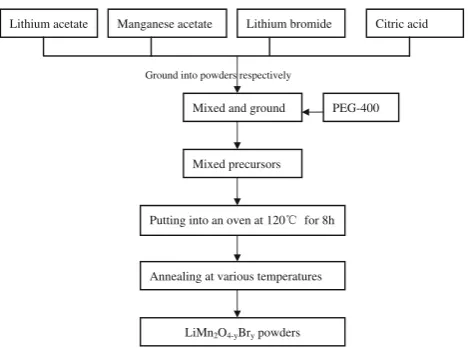
Stoichiometric lithium acetate, manganese acetate, lithium bromide, and citric acid (worked as chelating reagent, molar ratio of citric acid to the total metal ions is 1:1), which were ground into powders separately, were mixed with polyethylene glycol (PEG) 400 (worked as disper-sants) in an agate mortar and ground with a pestle for 1.5 h in order to make them react to reach the best possible homogeneity. Then the mixtures were dried at 120°C for 8 h to form precursors. The obtained precursors were annealed at 500°C for 1 h, after ground, held at 600– 800°C for 10 h in air in a muffle furnace to obtain final LiMn2O4–yBrypowders. Figure 1shows the flowchart.
An X-ray diffractometer (XRD) (MXP18AHF, Mac, Japan) with Cu Karadiation (k=1.54056 A˚ ) was used for the identification of the crystalline phases of the powders. The morphological characteristics of the products were investigated using transmission electron microscope (TEM, H-600, Hitachi, Japan).
The cells consisted of a LiMn2O4-based composite as the positive electrode, a Li disk as the negative electrode,
and an electrolyte of 1 M LiPF6 in a 1:1 (volume ratio) mixture of ethylene carbonate (EC)/dimethyl carbonate (DMC). The cathode was formed by mixing the active material with acetylene black and PVDF binder in 85:10:5 ratio in N-methyl-pyrrolidone (NMP). NMP acts as the solvent for the binder. The paste was applied to an alu-minum foil current collector using a blade. The film was dried at 60°C in air for 1 h and then was vacuum dried at 120 °C for 4 h. Celgard 2300 membrane was used as the separator. The cells were assembled in an argon-filled glove box. All the electrochemical tests were carried out at room temperature. Cyclic voltammetry (CV) (CHI660B Electrochemical Workstation Chenhua Co. of Shanghai, China) experiments were conducted from 3.2 to 4.35 V at a scan rate of 0.1 mV/s, and a Li metal disk served as both counter and reference electrode. Charge/discharge tests were performed at a constant current density of 0.30 mA/cm2 within the potential range of 3.0 and 4.35 V.
Results and Discussion
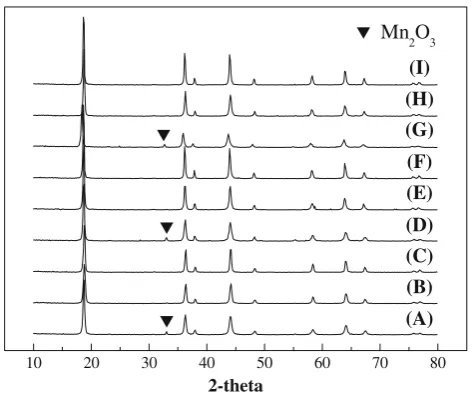
The XRD patterns of LiMn2O4–yBrypowders calcinated at 600–800 °C for 10 h are shown in Fig. 2. The XRD of the powders calcinated at 600°C shows the impurity peaks of Mn2O3 (marked by .). The formation of impurity phase Mn2O3indicates that the temperature is not high enough to reach full crystallization and containing some vacancies in LiMn2O4structure during combustion. When the calcina-tion temperature increases to 700°C, the impurity peaks of Mn2O3 disappear and the pure spinel LiMn2O4 structure forms, which indicates that pure spinel LiMn2O4 can be produced by heat treatment at relatively higher tempera-tures. Moreover, when the temperature increases, the intensity of peaks grows correspondingly, which indicates better crystallization is obtained. The diffraction peaks of
Ground into powders respectively
Lithium acetate Manganese acetate Citric acid
Mixed and ground
Mixed precursors
Putting into an oven at 120 for 8h
Annealing at various temperatures
LiMn2O4-yBry powders
Lithium bromide
PEG-400
Fig. 1 Flowchart showing the synthesis of LiMn2O4–yBrysamples by
[image:2.595.309.544.55.229.2]LiMn2O3.95Br0.05and LiMn2O3.90Br0.10synthesized at 700 and 800°C corresponded to pure phase spinel structure. The results indicate that the structure of the ternary spinel remains when some of the O2- in the spinel phase are replaced by Br-. Doping do not seem to change the spinel structure of the samples because no other impurity peaks are observed in the XRD patterns. The lattice constants of all the samples, which are calculated from the XRD spectra, are summarized in Table1. The samples with the same chemical compositions calcined at different temper-atures have little difference in lattice constants. However, the products doped with Br-have larger lattice constants, which is ascribed to the substitution of O2-by Br-. The Br-has larger ion (1.96 A˚ ) radius than that of O2-(1.4 A˚ )
and Br- substitution leads to reduction of Mn4? to the larger Mn3? cations, which results in improving capacity as reported by Amatucci et al. [21]. Because the powders calcinated at 600°C show the impurity peaks of Mn2O3, we did not do the electrochemistry test of them.
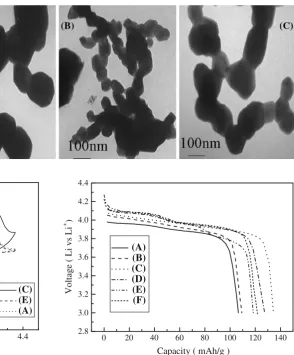
The trend of morphology variation of different LiMn2O4–yBrywith temperature is similar, so the TEM of LiMn2O3.95Br0.05 powders calcinated at 600–800°C for 10 h are given as examples in Fig.3. The sample calcined at 600°C agglomerates severely and its size is about 200 nm. This maybe due to some Mn2O3impurity existing in the sample. As the temperature increases to 700°C, the distribution of the particle size becomes narrow and the average particle size is about 100 nm. The decrease of particle size is due to the breaking of agglomerated powders as the calcination temperature increases, but agglomeration still exists. As the temperature increases further, it presents the spherical particle morphology, homogenous particle composition and narrow distribution of particle size. The extent of agglomeration of particles in the sample is meliorated. The particle size of the sample calcined at 600°C is larger than that of the sample calcined at 700 and 800°C, which indicates the calcination tem-perature has significant effect on the crystallization and morphology of the samples. This agreed well with the result of XRD. Products with nanosized particles would facilitate reducing the diffusion length of the lithium ions during intercalation and deintercalation processes, which would improve the electrochemical performance of the samples [28].
Cyclic voltammograms of the Li/LiMn2O4–yBry cells between 3.2 and 4.35 V at a scan rate of 0.1 mV/s for the first cycle are shown in Fig. 4. The cyclic voltammograms reveal that there are two pairs of redox peaks on each cycle voltammograms. The two pairs of redox peaks correspond to two-step reversible intercalation/deintercalation reac-tion. The samples synthesized at 800°C present higher current peaks than the ones prepared at 700°C. The LiMn2O3.95Br0.05 samples synthesized at 800°C possess the highest current peaks, which indicates that the product calcined at 800 °C might have better electrochemical activity.
Figure5 displays voltage versus discharge capacity curves for LiMn2O4–yBry between 3 and 4.35 V versus Li/LiMn2O4–yBry by applying 0.3 mA/cm2 at room tem-perature. For LiMn2O4–yBrysample prepared at 700 °C, the initial discharge capacity of pure spinel is 106 mAh/g. It increases to 127 mAh/g as y=0.05 and decreases to 118 mAh/g as y=0.10. It is clear that the increase of initial discharge capacity results from Br- doping. This may be explained by the following reasons. The substitu-tion of monovalent Br- for divalent O2- results in the increasing of Mn3?content in spinel which contributes to
10 20 30 40 50 60 70 80
2-theta
Mn2O3
(A) (B) (C) (D) (E) (F) (G) (H) (I)
Fig. 2 XRD patterns of LiMn2O4–yBry: (A) LiMn2O4calcinated at 600°C; (B) LiMn2O4calcinated at 700°C; (C) LiMn2O4calcinated at 800°C; (D) LiMn2O3.95Br0.05calcinated at 600°C; (E) LiMn2 O3.95Br0.05calcinated at 700°C; (F) LiMn2O3.95Br0.05calcinated at 800°C; (G) LiMn2O3.90Br0.10 calcinated at 600°C; (H) LiMn2 O3.90Br0.10calcinated at 700°C; (I) LiMn2O3.90Br0.10calcinated at 800°C
Table 1 Lattice constants calculated from the XRD spectra
Nominal composition
Calcination temperature (°C)
Lattice parameter (a/nm)
LiMn2O4 600 0.8215
700 0.8213
800 0.8210
LiMn2O3.95Br0.05 600 0.8223
700 0.8221
800 0.8220
LiMn2O3.90Br0.10 600 0.8233
700 0.8229
[image:3.595.52.289.56.253.2] [image:3.595.51.292.555.715.2]charge/discharge capacity during intercalation/deintercala-tion of Li?in LiMn2O4. Moreover, Br- doping brings in larger lattice constants of samples, thus Li?can move more
freely in the sample and this might help increase the capacity [21]. When the calcination temperature increases to 800°C, LiMn2O4–yBrysamples deliver initial discharge capacity of 109, 134, and 121 mAh/g as y=0, 0.05, and 0.10, respectively. Samples calcined at relatively higher temperature have higher initial discharge capacity. The LiMn2O3.95Br0.05synthesized at 800°C possess the highest initial discharge capacity. However, with the increase of Br- content in spinel (from 0.05 to 0.10), the initial dis-charge capacity decreases, which maybe due to Br-doping that can improve the initial discharge capacity, but the Br -content has an optimal value. In this work, the optimal value is 0.05.
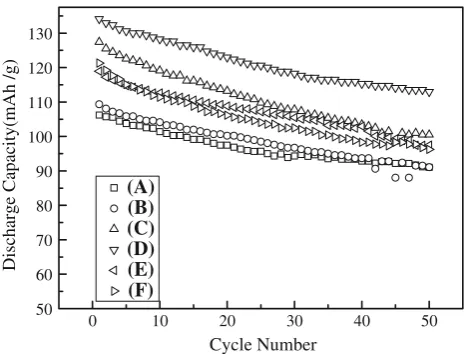
The above-mentioned results show that effective anion doping can result in improvement of initial discharge capacity. Figure6 displays the variations of discharge capacity versus cycle number curves of LiMn2O4–yBry between 3 and 4.35 V versus Li/LiMn2O4–yBryby applying 0.3 mA/cm2 at room temperature. As can be seen from Fig. 3 TEM photographs of
LiMn2O3.95Br0.05: (a) calcinated at 600°C, (b) 700°C, and (c) 800°C
3.2 3.4 3.6 3.8 4.0 4.2 4.4 -0.8
-0.6 -0.4 -0.2 0.0 0.2 0.4 0.6 0.8
(C) (E) (A)
Voltage ( V )
Current (mA)
3.2 3.4 3.6 3.8 4.0 4.2 4.4 -1.2
-0.8 -0.4 0.0 0.4 0.8 1.2
(D) (F) (B)
Voltage ( V )
Current (mA)
Fig. 4 Cyclic voltammogram of Li/LiMn2O4–yBrycells between 3.2
and 4.35 V at scan rate of 0.1 mV/s: (A) LiMn2O4 calcinated at 700°C; (B) LiMn2O4 calcinated at 800°C; (C) LiMn2O3.95Br0.05 calcinated at 700°C; (D) LiMn2O3.95Br0.05calcinated at 800°C; (E) LiMn2O3.90Br0.10calcinated at 700°C; (F) LiMn2O3.90Br0.10 calci-nated at 800°C
0 20 40 60 80 100 120 140
2.8 3.0 3.2 3.4 3.6 3.8 4.0 4.2 4.4
Voltage ( Li vs Li
+ )
Capacity ( mAh/g ) (A)
(B) (C) (D) (E) (F)
Fig. 5 Voltage versus discharge capacity curves of LiMn2O4–yBry:
[image:4.595.247.542.54.410.2] [image:4.595.54.318.62.594.2]Fig.6, the samples doped by Br-have larger initial dis-charge capacity than the pure spinels. However, Br--doped samples present appreciably high capacity loss than the parent compound. For LiMn2O4–yBry sample prepared at 700°C, the capacity retention rate of pure spinel is 86%. It decreases to 79% asy=0.05 and 82% as y=0.10. For LiMn2O4–yBry sample prepared at 800°C, the capacity retention rate of pure spinel is 83%. It decreases to 82% as y=0.05 and 79% as y=0.10. The LiMn2O4–yBry (y=0.05, 0.10) samples have higher initial discharge capacity but lower cycle life than that of the parent com-pound. This is due to the increase of Mn3? content by monovalent Br-substitution for divalent O2-. The high-spin Mn3?ions give rise to the Jahn-Teller distortion which is the origin of the capacity loss. In a word, the increase of Mn3?causes two effects: (1) the increase of initial discharge capacity and (2) the decrease of the capacity retention. As reported by many literatures, surface modification and cat-ion codoping can overcome Jahn-Teller distortcat-ion [29]. Sun et al. [30, 31] reported that LiAl0.34Mn1.76O3.98S0.02 and Li1.03Al0.2Mn1.8O3.96S0.04materials prepared via a sol–gel method showed excellent cyclability in both 4 and 3 V regions. In our lab, the research work of Br- and Al3? codoping for improvement of the electrochemical perfor-mance of spinel LiMn2O4is undergoing.
Conclusion
In this work, LiMn2O4–yBrynanoparticles were synthesized by a room temperature solid-state coordination method for the first time. The powders have homogeneous morphology, small particles, and high crystallinity. The
CV and charge/discharge test revealed that Br- doping improves the initial discharge capacity of the samples. The LiMn2O3.95Br0.05 calcined at 800°C has an initial dis-charge capacity of 134 mAh/g.
Acknowledgments This work was partially supported by the Nature Science Foundation of Xinjiang Province (grant nos. 200821121 and 200721102) and the National Nature Science Foundation of China (grant nos. 20666005 and 20661003).
References
1. J.M. Tarascon, M. Armand, Nature414, 35 (2001). doi:10.1038/ 35104644
2. J.M. Tarascon, E. Wang, F.K. Shokoohi, W.R. McKinnon, S. Colson, J. Electrochem. Soc.138, 2859 (1991). doi:10.1149/ 1.2085330
3. R.J. Gummow, A. de Kock, M.M. Thackeray, Solid State Ionics 69, 59 (1994). doi:10.1016/0167-2738(94)90450-2
4. Y. Xia, Y. Zhou, M. Yoshio, J. Electrochem. Soc. 144, 2593 (1997). doi:10.1149/1.1837870
5. Y.P. Wu, E. Rahm, R. Holze, Electrochim. Acta47, 3491 (2002).
doi:10.1016/S0013-4686(02)00317-1
6. G. Amatucci, A.D. Pasquier, A. Blyr, T. Zheng, J.M. Tarascon, Electrochim. Acta 45, 255 (1999). doi:10.1016/S0013-4686 (99)00209-1
7. S. Komaba, K. Oikawa, S.T. Myung, N. Kumagai, T. Kamiyama, Solid State Ionics 149, 47 (2002). doi:10.1016/S0167-2738 (02)00168-6
8. Y.D. Huang, J. Li, D.Z. Jia, J. Colloid Interface Sci.286, 263 (2005)
9. M. Yoshio, Y. Xia, N. Kumada, S. Ma, J. Power Sources101, 79 (2001). doi:10.1016/S0378-7753(01)00546-8
10. J.H. Lee, J.K. Hong, D.H. Jang, Y.K. Sun, S.M. Oh, J. Power Sources89, 7 (2000). doi:10.1016/S0378-7753(00)00375-X
11. G.G. Amatucci, N. Pereira, T. Zhang, I. Plitz, J.M. Tarascon, J. Power Sources 81–82, 39 (1999). doi:10.1016/S0378-7753(99) 00186-X
12. M.R. Palacin, F.L. Cras, L. Seguin, M. Anne, Y. Chabre, J.M. Tarascon, G. Amatucci, G. Vaughan, P. Strobel, J. Solid State Chem.144, 361 (1999). doi:10.1006/jssc.1999.8166
13. C.Z. Lu, G.T.K. Fey, J. Phys. Chem. Solids67, 756 (2006). doi:
10.1016/j.jpcs.2005.11.008
14. H. Dai, E.W. Wong, C.M. Libeber, Science272, 523 (1996). doi:
10.1126/science.272.5261.523
15. Y.K. Zhou, C.M. Shen, H.L. Li, Solid State Ionics146, 81 (2002).
doi:10.1016/S0167-2738(01)01005-0
16. A. Dobley, K. Ngala, S. Yang, P.Y. Zavalij, M.S. Whittingham, Chem. Mater.13, 4382 (2001). doi:10.1021/cm010518h
17. Y.K. Sun, C.S. Yoon, C.K. Kim, S.G. Youn, Y.S. Lee, M. Yoshio, I.H. Oh, J. Mater. Chem.11, 2519 (2001). doi:10.1039/ b103709a
18. P. Barboux, J.M. Tarascon, F.K. Shokoohi, J. Solid State Chem. 94, 185 (1991). doi:10.1016/0022-4596(91)90231-6
19. G.X. Wang, D.H. Bradhurst, H.K. Liu, S.X. Dou, Solid State Ionics120, 95 (1999). doi:10.1016/S0167-2738(98)00554-2
20. P. Endres, B. Fuchs, S. Kemmler-Sack, K. Brandt, G. Faust-Becker, H.-W. Praas, Solid State Ionics89, 221 (1996) 21. G. Amatucci, J.M. Tarascon, J. Electrochem. Soc. 149, K31
(2002). doi:10.1149/1.1516778
22. X.R. Ye, D.Z. Jia, J.Q. Yu, X.Q. Xin, Z.L. Xue, Adv. Mater.11, 941 (1999). doi:10.1002/(SICI)1521-4095(199908)11:11\941:: AID-ADMA941[3.0.CO;2-T
0 10 20 30 40 50
50 60 70 80 90 100 110 120 130
(A) (B) (C) (D) (E) (F)
Discharge Capacity(mAh /g)
Cycle Number
[image:5.595.54.289.56.233.2]23. R.Y. Wang, D.Z. Jia, L. Zhang, L. Liu, Z.P. Guo, B.Q. Li, J.X. Wang, Adv. Funct. Mater. 16, 687 (2006). doi:10.1002/adfm. 200500549
24. H.M. Wu, J.P. Tu, Y.F. Yuan, Y. Li, X.B. Zhao, G.S. Gao, Mater. Chem. Phys. 93, 461 (2005). doi:10.1016/j.matchemphys.2005. 03.036
25. D.Z. Jia, J.Q. Yu, X. Xia, Chin. Sci. Bull.43, 571 (1998). doi:
10.1007/BF02883641
26. T.Y. Zhou, X.Q. Xin, Nanotechnology 15, 534 (2004). doi:
10.1088/0957-4484/15/5/022
27. Z.P. Sun, L. Liu, L. Zhang, D.Z. Jia, Nanotechnology17, 2266 (2006). doi:10.1088/0957-4484/17/9/032
28. Y.K. Zhou, H.L. Li, J. Mater. Chem. 12, 681 (2002). doi:
10.1039/b107718j
29. D. Capsoni, M. Bini, G. Chiodelli, P. Mustarelli, V. Massarotti, C.B. Azzoni, M.C. Mozzati, L. Linati, J. Phys. Chem. B 106, 7432 (2002). doi:10.1021/jp020220u
30. Y.K. Sun, Y.S. Jeon, J. Mater. Chem. 9, 3147 (1999). doi:
10.1039/a906811b