N A N O E X P R E S S
A new algorithm for computing distance matrix and Wiener index
of zig-zag polyhex nanotubes
Ali Reza AshrafiÆShahram Yousefi
Received: 31 December 2006 / Accepted: 20 February 2007 / Published online: 10 April 2007
to the authors 2007
Abstract The Wiener index of a graph G is defined as the sum of all distances between distinct vertices of G. In this paper an algorithm for constructing distance matrix of a zig-zag polyhex nanotube is introduced. As a consequence, the Wiener index of this nanotube is computed.
Keywords Zig-zag polyhex nanotubeDistance matrix Wiener index
Introduction
Carbon nanotubes form an interesting class of carbon nanomaterials. These can be imagined as rolled sheets of graphite about different axes. These are three types of nanotubes: armchair, chiral and zigzag structures. Further nanotubes can be categorized as single-walled and multi-walled nanotubes and it is very difficult to produce the former.
Graph theory has found considerable use in chemistry, particularly in modeling chemical structure. Graph theory has provided the chemist with a variety of very useful tools, namely, the topological index. A topological index is a numeric quantity that is mathematically derived in a direct and unambiguous manner from the structural graph of a molecule. It has been found that many properties of a
chemical compound are closely related to some topological indices of its molecular graph [1,2].
Among topological indices, the Wiener index [3] is probably the most important one. This index was intro-duced by the chemist H. Wiener, about 60 years ago to demonstrate correlations between physico-chemical prop-erties of organic compounds and the topological structure of their molecular graphs. Wiener defined his index as the sum of distances between two carbon atoms in the mole-cules, in terms of carbon–carbon bonds. Next Hosoya named such graph invariants, topological index [4]. We encourage the reader to consult Refs. [5–7] and references therein, for further study on the topic.
The fact that there are good correlations between and a variety of physico-chemical properties of chemical com-pounds containing boiling point, heat of evaporation, heat of formation, chromatographic retention times, surface tension, vapor pressure and partition coefficients could be rationalized by the assumption that Wiener index is roughly proportional to the van der Waals surface area of the respective molecule [8].
Diudea was the first chemist which considered the problem of computing topological indices of nanostruc-tures [9–15]. The presented authors computed the Wiener index of a polyhex and TUC4C8(R/S) nanotori [16–18]. In
this paper, we continue this program to find an algorithm for computing distance matrix of a zig-zag polyhex nano-tube. As an easy consequence, the Wiener index of this nanotube is computed.
John and Diudea [9] computed the Wiener index of zig-zag polyhex nanotube T = T(p, q) = TUHC6[2p,q], for the
first times. In this paper, distance matrix of these nanotubes are computed. As an easy consequence of our results, a matrix method for computing the Wiener index of a zig-zag polyhex nanotube is introduced. We also prepare an A. R. Ashrafi (&)
Institute for Nanoscience and Nanotechnology, University of Kashan, Kashan, Iran
e-mail: [email protected] S. Yousefi
Center for Space Studies, Malek-Ashtar University of Technology, Tehran, Iran
algorithm for computing distance matrix of these nanotubes. Throughout this paper, our notation is standard. They are appearing as in the same way as in the following [2,19].
Main results and discussion
In this section, distance matrix and Wiener index of the graph T = TUHC6[m,n], Fig.1, were computed. Here m is
the number of horizontal zig-zags and n is the number of columns. It is obvious that n is even and |V(T)| = mn. An algorithm for constructing distance matrix of TUHC6[m,n]
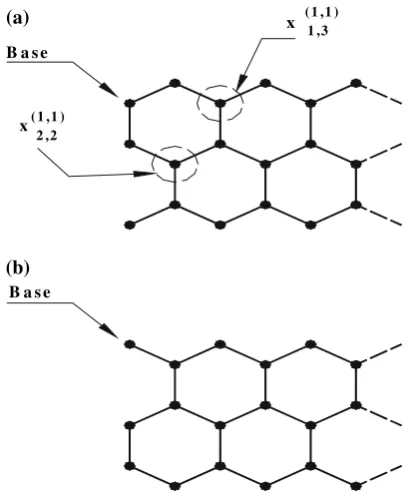
We first choose a base vertex b from the 2-dimensional lattice of T and assume that xij is the (i,j)th vertex of T, Fig.2.
Define Dðm1;1nÞ¼ ½d
ð1;1Þ
i;j ;where d
ð1;1Þ
i;j is distance between (1,1)
and (i,j), i = 1, 2, ..., m and j = 1, 2, ..., n. By Fig.2, there are two separates cases for the (1,1)th vertex. For example in the case (a) of Fig.2, dð11;1;1Þ¼0;dð11;2;1Þ¼dð21;1;1Þ¼1 and in case (b), dð11;1;1Þ¼0;d1ð1;2;1Þ¼1;d2ð1;1;1Þ¼3:In general, we assume that Dðmp;qnÞis distance matrix of T related to the vertex (p,q)
and siðp;qÞis the sum of ith row of Dmðp;qn:Þ Then there are two distance matrix related to (p,q) such that sðip;2k1Þ ¼sðip;1Þ; siðp;2kÞ¼siðp;2Þ;1kn=2;1im;1pm:
By Fig.2and previous notations, if b varies on a column of T then the sum of entries in the row containing base vertex is equal to the sum of entries in the first row of Dðm1;1n:Þ On the other hand, one can compute the sum of entries in other rows by distance from the position of base vertex. Therefore,
sðki;jÞ¼ s ð1;1Þ
ikþ1 1kim; 1jn
sðk1;2iþÞ1 1ikm; 1jn
(
If 2j(i+j)
sðki;jÞ¼ s ð1;2Þ
ikþ1 1kim; 1jn
sðk1;1iþÞ1 1ikm; 1jn
(
If 2-(i + j)
We now describe our algorithm to compute distance matrix of a zig-zag polyhex nanotube. To do this, we define matrices AðmaðÞ n=2þ1Þ¼ ½aij; Bmðn=2þ1Þ¼ ½bij and
AðmbðÞ n=2þ1Þ¼ ½cijas follows:
a1,1= 0 a1,2= 1 ai;j¼
ai;1 2-j
ai;2 2jj
; ai;1¼ai1;1þ1; ai;2¼ai;1þ1; 2ji
ai;2¼ai1;2þ1; ai;1¼ai;2þ1; 2-i
c1,1= 0 c1,2= 1 ci;j¼ ci;1 2 -j ci;2 2jj
; ci;2¼ci1;2þ1; ci;1¼ci;2þ1; 2ji
ci;1¼ci1;1þ1; ci;2¼ci;1þ1; 2-i
bi,1= i–1; bi,j= bi,j–1+1
For computing distance matrix of this nanotube we must compute matrices DðmaÞn¼ ½dai;j and D
ðbÞ
mn¼ ½dbi;j: But by
our calculations, we can see that
dai;j¼ Maxfai;j;bi;jg 1jn=2 di;njþ2 j[n=2þ1
and
dbi;j¼ Maxfai;j;ci;jg 1jn=2 di;njþ2 j[n=2þ1
This completes calculation of distance matrix. Computing Wiener index of TUHC6[m,n]
In previous section, distance matrix Dðmp;qnÞrelated to vertex
(p,q) is computed. Suppose sðip;qÞ is the sum of ith row of Dðmp;qnÞ: Then s
ðp;2k1Þ
i ¼s
ðp;1Þ
i and s
ðp;2kÞ
i ¼s
ðp;2Þ
i ; where
1kn=2; 1im; 1pm: On the other
( 1 ,1 )
( 1 ,1 )
x
1 ,3
2 ,2
x
B a s e
B a s e
(a)
(b)
[image:2.595.323.531.57.307.2] [image:2.595.53.284.467.698.2]sði1;2k1Þ ¼ n2
4 þ(nþi2Þði1Þ in2þ1
n
2(4i5Þ i
n
2þ1
(
sði1;2kÞ ¼
n2
4 þ(nþiÞði1Þ i
n
2þ1
n
2(4i3Þ in2þ1
( ;
1im; 1kn 2: Suppose SðaÞ
p and S
ðbÞ
p are the sum of all entries of
dis-tance matrix Dðmp;qnÞ in two cases (a) and (b). Then
Sð1aÞ¼ (mn/4)(2mþn2Þþðm=3Þðm1Þðm2Þmn=2þ1 (mn/2)(2m3Þþðn=24Þðnþ2Þðnþ4Þ mn=2þ1
;
Sð1bÞ¼ (mn/4)(2mþn2Þþðm=3Þðm21Þmn=2þ1 (mn/2)(2m1Þþðn=24Þðn24Þ mn=2þ1
:
If p is arbitrary then one can see that:
SðpaÞ¼Sð1aÞþX p
i¼2
sði1;2Þ X m
i¼mpþ2
sði1;1Þ
SðpbÞ¼Sð1bÞþX p
i¼2
sði1;1Þ X m
i¼mpþ2
sði1;2Þ
Thus it is enough to compute SðaÞ
p and S
ðbÞ
p : When
m £ n/2, one can see that:
SðpaÞ¼(mn/4)(2mþnþ2Þ þ ðm=3Þm21 p m 2þmnþnþp2(mþn)
SðpbÞ¼(mn/4)(2mþnþ2Þ þ ðm=3Þðmþ1Þðmþ2Þ p m 2þmnþnþ2mþp2(mþn)
To complete our argument, we must investigate the case of m > n/2 + 1. To do this, we consider three cases that p£n/2 + 1, p£ m – n/2 + 1; m£n + 1, m – n/2 + 1 < p£ n/2 + 1 and m > n + 1, p > n/2 + 1.
(I) pn2þ1 and pmn2þ1:In this case we have: SðpaÞ¼mn
2 ð2mþ1Þþ n 24 n
24
þp 12ð3n
224mn12n4Þþ3n
2p
2þp 3
3 SðpbÞ¼mn
2 ð2mþ3Þþ n
24ðn2Þðn4Þ þp
12 3n
224mn24nþ8
þp 2
2ð3n2Þþ p3
3 (II) m£n + 1 and mn2þ1\pn
2þ1:Therefore,
SðpaÞ¼mn
4 (2mþnþ2Þ þ m
3 ðm
21Þ
p m 2þmnþnþp2(mþn) SðpbÞ¼mn
4 (2mþnþ2Þ þ m
3 (mþ1Þðmþ2Þ p m 2þmnþnþ2mþp2(mþn) (III) m > n + 1 and p[n2þ1:In this case,
SðpaÞ¼ n 12 n
24
þn
2(m2pÞð2mþ1Þ þ2np
2
SðpbÞ¼ n 12 n
2þ8
þn
2(m2pÞð2mþ3Þ þ2np
2
Therefore,
Wmn¼ ðn=2Þ
" P
ðm1Þ=2
i¼1
SðaÞi þSðibÞ
þð1=2ÞSððamÞþ1Þ=2þSððbmÞþ1Þ=2
#
2-m
ðn=2ÞP m=2
i¼1
SðiaÞþSðibÞ
2jm
8 > > > > > > > > > > < > > > > > > > > > > :
:
We now substitute the values of SðaÞ
p to compute the
Wiener index of T, as follows:
Wmn¼
mn2
24 4m
2þ3mn4
ð Þ þm122nðm21Þ mn2þ1 mn2
24 8m
2þn26
ð Þ 192n3ðn24Þ m[n2þ1
(
:
Constructing distance matrices of some nanotubes In this section, distance matrices of TUHC6[8,10] and
TUHC6[8,16] together with their Wiener indices are
com-puted. To construct distance matrices of TUHC6[8,10], we
must compute matrices A8ðaÞ6; A8ðbÞ6 and B8· 6. By
defi-nition of these matrices, we have:
Að8aÞ6¼
0 1 0 1 0 1
1 2 1 2 1 2
4 3 4 3 4 3
5 6 5 6 5 6
8 7 8 7 8 7
9 10 9 10 9 10
12 11 12 11 12 11 13 14 13 14 13 14
2 6 6 6 6 6 6 6 6 6 6 6 6 6 4
3 7 7 7 7 7 7 7 7 7 7 7 7 7 5
Að8bÞ6¼
0 1 0 1 0 1
3 2 3 2 3 2
4 5 4 5 4 5
7 6 7 6 7 6
8 9 8 9 8 9
11 10 11 10 11 10 12 13 12 13 12 13 15 14 15 14 15 14
2 6 6 6 6 6 6 6 6 6 6 4 3 7 7 7 7 7 7 7 7 7 7 5
B86¼
0 1 2 3 4 5
1 2 3 4 5 6
2 3 4 5 6 7
3 4 5 6 7 8
4 5 6 7 8 9
5 6 7 8 9 10
6 7 8 9 10 11
7 8 9 10 11 12
2 6 6 6 6 6 6 6 6 6 6 4 3 7 7 7 7 7 7 7 7 7 7 5 :
We now compute matrices Dð8aÞ10 and Dð8bÞ10: By defi-nition, entries of the first n/2 + 1 columns of these matrices are maximum values offAð8aÞ6;B8·6} andfA
ðbÞ
86;B86g;
respectively. Thus,
Dð8aÞ10¼
0 1 2 3 4 5 4 3 2 1
1 2 3 4 5 6 5 4 3 2
4 3 4 5 6 7 6 5 4 3
5 6 5 6 7 8 7 6 5 6
8 7 8 7 8 9 8 7 8 7
9 10 9 10 9 10 9 10 9 10
12 11 12 11 12 11 12 11 12 11 13 14 13 14 13 14 13 14 13 14
2 6 6 6 6 6 6 6 6 6 6 4 3 7 7 7 7 7 7 7 7 7 7 5 ;
Dð8bÞ10¼
0 1 2 3 4 5 4 3 2 1
3 2 3 4 5 6 5 4 3 2
4 5 4 5 6 7 6 5 4 5
7 6 7 6 7 8 7 6 7 6
8 9 8 9 8 9 8 9 8 9
11 10 11 10 11 10 11 10 11 10 12 13 12 13 12 13 12 13 12 13 15 14 15 14 15 14 15 14 15 14
2 6 6 6 6 6 6 6 6 6 6 4 3 7 7 7 7 7 7 7 7 7 7 5
This implies that W(TUHC6[8,10]) = 19,700. To
con-struct distance matrices of TUHC6[8,16], we must compute
matrices Að8aÞ9 and Að8bÞ9: Using a similar argument as above, we have:
Að8aÞ9¼
0 1 0 1 0 1 0 1 0
1 2 1 2 1 2 1 2 1
4 3 4 3 4 3 4 3 4
5 6 5 6 5 6 5 6 5
8 7 8 7 8 7 8 7 8
9 10 9 10 9 10 9 10 9
12 11 12 11 12 11 12 11 12 13 14 13 14 13 14 13 14 13
2 6 6 6 6 6 6 6 6 6 6 4 3 7 7 7 7 7 7 7 7 7 7 5 ;
Að8bÞ9¼
0 1 0 1 0 1 0 1 0
3 2 3 2 3 2 3 2 3
4 5 4 5 4 5 4 5 4
7 6 7 6 7 6 7 6 7
8 9 8 9 8 9 8 9 8
11 10 11 10 11 10 11 10 11 12 13 12 13 12 13 12 13 12 15 14 15 14 15 14 15 14 15
2 6 6 6 6 6 6 6 6 6 6 4 3 7 7 7 7 7 7 7 7 7 7 5
On the other hand,
B89¼
0 1 2 3 4 5 6 7
1 2 3 4 5 6 7 8
2 3 4 5 6 7 8 9
3 4 5 6 7 8 9 10
4 5 6 7 8 9 10 11
5 6 7 8 9 10 11 12
6 7 8 9 10 11 12 13
7 8 9 10 11 12 13 14
2 6 6 6 6 6 6 6 6 6 6 4 3 7 7 7 7 7 7 7 7 7 7 5 ; Therefore,
Dð8aÞ16¼
0 1 2 3 4 5 6 7 8 7 6 5 4 3 2 1 1 2 3 4 5 6 7 8 9 8 7 6 5 4 3 2 4 3 4 5 6 7 8 9 10 9 8 7 6 5 4 3 5 6 5 6 7 8 9 10 11 10 9 8 7 6 5 6 8 7 8 7 8 9 10 11 12 11 10 9 8 7 8 7 9 10 9 10 9 10 11 12 13 12 11 10 9 10 9 10 12 11 12 11 12 11 12 13 14 13 12 11 12 11 12 11 13 14 13 14 13 14 13 14 15 14 13 14 13 14 13 14
2 6 6 6 6 6 6 6 6 6 6 4 3 7 7 7 7 7 7 7 7 7 7 5 ;
Dð8bÞ16¼
0 1 2 3 4 5 6 7 8 7 6 5 4 3 2 1 3 2 3 4 5 6 7 8 9 8 7 6 5 4 3 2 4 5 4 5 6 7 8 9 10 9 8 7 6 5 4 5 7 6 7 6 7 8 9 10 11 10 9 8 7 6 7 6 8 9 8 9 8 9 10 11 12 11 10 9 8 9 8 9 11 10 11 10 11 10 11 12 13 12 11 10 11 10 11 10 12 13 12 13 12 13 12 13 14 13 12 13 12 13 12 13 15 14 15 14 15 14 15 14 15 14 15 14 15 14 15 14
2 6 6 6 6 6 6 6 6 6 6 4 3 7 7 7 7 7 7 7 7 7 7 5 :
By our calculations, it is easy to see that W(TUHC6[8,16]) = 59,648.
Acknowledgements We would like to thank from referees for their helpful remarks and suggestions. This work was partially supported by the Center of Excellence of Algebraic Methods and Applications of the Isfahan University of Technology.
References
1. R. Todeschini, V. Consonni,Handbook of Molecular Descrip-tors, (Wiley, Weinheim, 2000)
3. H. Wiener, J. Am. Chem. Soc.69, 17 (1947) 4. H. Hosoya, Bull. Chem. Soc. Japan44, 2332 (1971) 5. A.A. Dobrynin, Comput. Chem.23, 43 (1999)
6. A.A. Dobrynin, R. Entringer, I. Gutman, Acta Appl. Math.66, 211 (2001)
7. A.A. Dobrynin, I. Gutman, S. Klavzˇar, P. Zigert, Acta Appl. Math.72, 247 (2002)
8. I. Gutman, T. Ko¨rtve´lyesi, Z. Naturforsch.50a, 669 (1995) 9. P.E. John, M.V. Diudea, Croat. Chem. Acta77, 127 (2004) 10. M.V. Diudea, M. Stefu, B. Paˆrv, P.E. John, Croat. Chem. Acta77,
111 (2004)
11. M.V. Diudea, J. Chem. Inf. Model.45, 1002 (2005) 12. M.V. Diudea, J. Chem. Inf. Comput. Sci.36, 833 (1996) 13. M.V. Diudea, A. Graovac, MATCH Commun. Math. Comput.
Chem.44, 93 (2001)
14. M.V. Diudea, I. Silaghi-Dumitrescu, B. Parv, MATCH Commun. Math. Comput. Chem.44, 117 (2001)
15. M.V. Diudea, P.E. John, MATCH Commun. Math. Comput. Chem.44, 103 (2001)
16. S. Yousefi, A.R. Ashrafi, MATCH Commun. Math. Comput. Chem.56, 169 (2006)
17. S. Yousefi, A.R. Ashrafi, J. Math. Chem. DOI 10.1007/s10910-006-9158-x
18. A.R. Ashrafi, S. Yousefi, MATCH Commun. Math. Comput. Chem.57, 403 (2007)
19. P.J. Cameron, Combinatorics: Topics, Techniques, Algorithms