Journal of Criminal Law and Criminology
Volume 5 | Issue 3
Article 9
1914
Study of Juvenile Delinquency and Dependency in
Los Angeles County for the Year 1912
Emory S. Bogardus
Follow this and additional works at:
https://scholarlycommons.law.northwestern.edu/jclc
Part of the
Criminal Law Commons
,
Criminology Commons
, and the
Criminology and Criminal
Justice Commons
This Article is brought to you for free and open access by Northwestern University School of Law Scholarly Commons. It has been accepted for inclusion in Journal of Criminal Law and Criminology by an authorized editor of Northwestern University School of Law Scholarly Commons.
Recommended Citation
A STUDY OF JUVENILE DELINQUENCY AND DEPENDENCY IN LOS ANGELES COUNTY FOR THE YEAR 1912.1
EmORY S. BOGARDUS.2
This study covers all the cases which were entered in the Juvenile Court of Los Angeles County for the year 1912. The cases number from "3,645" to "5,124," and hence include 1, 479. Of this 1,479, the writer finds 381 were dismissed (a small part of this number were contributory). Nearly all of the remaining 1,098 cases were placed on probation (a small percentage were sent to the state or other industrial schools).
TABLE I.
Delinquency and Dependency, Los Angeles County, 1912; 1,098 Cases.
Nos. Per Cent.
Delinquent boys ... 374 34.0+ Delinquent girls ... 55 5.0+
Dependent boys ... 342 31.1+
Dependent girls ... 327 29.8+
Total ... 1,098 100.0
Table I shows that of the 1,098 cases in which the court
sus-tained the charge, 716, or 65.2 per cent, are credited to boys and 382, or 34.7 per cent, are credited to girls. The proportion of boys to girls is almost exactly two to one.
The writer has taken the 1,098 cases for the year 1912 in which the charge was sustained and analyzed them from a sociological point of view. Many cases which for legal purposes would be classified as dependency for sociological purposes would come under the term
'This study was initiated by Mr. E. Guy Talbot, formerly of Los Angeles, now (1914) of Sacramento. The court records were made available through the courtesy of Mr. Hugh Gibson, chief probation officer, and Judge Curtis D. Wilbur. Much of the tabulation and classification was done by students in the Department of Economics and Sociology, the University of Southern Califor-nia. A considerable part of the credit for the work involved in this paper be-longs to Miss Martha Dresslar and Miss Romaine L. Poindexter. They were assisted by Mr. Wilson McEuen, Mr. Ross Hodson, Mr. William Malan, Miss Josephine Rogers, Miss Martha Steele and Mr. C. J. Pfaffenberger.
'Professor of Sociology in the University of Southern California.
delinquency. In other words, the legal term "dependency" is inter-preted by the court to include certain cases of delinquency.
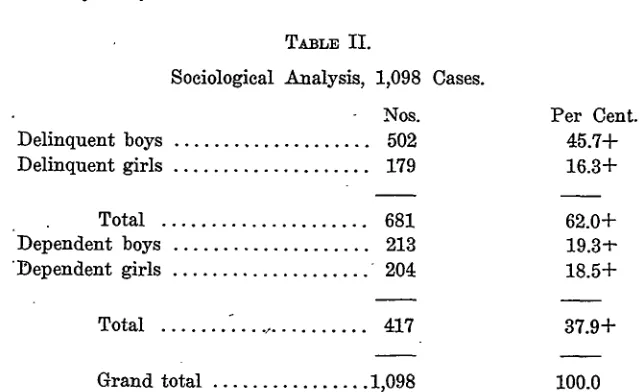
Some boys and girls seems to be both delinquent and dependent, but in nearly every case it was evident that one condition was more or less primary to the other. Table II gives the results of the pre-liminary analysis.
TABLE II.
Sociological Analysis, 1,098 Cases.
Nos. Per Cent. Delinquent boys ... 502 45.7+ Delinquent girls ... 179 16.3+ Total ... 681 62.0+ Dependent boys ... 213 19.3t Dependent girls ... 204 18.5+
Total ... 417 37.9+ Grand total ... 1,098 100.0
Of the 1,098 charges that were upheld, 681, or 62.0 per cent, may be classed as delinquency (sociologically) and 417, or 37.9 per cent, as dependency. The proportion is not quite two to one. With refer. ence to delinquency, 502 cases were boys and 179 were girls. The proportion of boys to girls is not quite three to one. Dependency is rather evenly divided between boys and girls, a result that might be expected, since dependency is a state more directly related to environ-ment (largely social) than is delinquency and since dependency hence would fall alike upon both boys and girls. Delinquency is also vitally a matter of social environment, but it depends very definitely upon the personal equation, temperament and so forth; hence boys, either
by virtue of a different reaction or as a result of having a different
social environment than girls, appear to be in nearly three times as great a danger of becoming delinquent as are girls.
[image:3.619.49.370.155.351.2]A STUDY OF JUVENILE DELINQUENCY
TABLE III.
Delinquency Age Statistics.
Age.
Years. Nos.
8 ... 6
9 ... 10
10 ... 16
11 ... 23
12 ... 34
13 ... 24
14 ... 53
15 ... 81
16 ...107
17 ... 101
18 ... 28
19 ... 11
20 ... 3
Others ... .5
Boys. Per Cent. 1.1+ 1.9+ 3.1+ 4.5+ 6.7+ 4.7+ 10.5+ 16.1+ 21.3+ 20.1+ 5.5+ 2.1+ 0.5+ 0.9+
Girls. Total. Nos. Per Cent. Nos. Per Cent.
6 0.8+ 10 1.4+ 16 2.3+ 23 3.3+
3 1.6+ 37 5.4+
4 2.2+ 28 4.1+ 20 11.1+ 73 1.0+ 37 20.6+ 118 11.3+ 33 18.4+ 140 20.5+ 39 21.3+ 140 20.5+
28 15.6+ 56 8.2+
11 6.1+ 22 3.2+
4 2.2+ 7 1.0+
5 0.7+
Totals ... 502 100.0 179 100.0 681 100.0
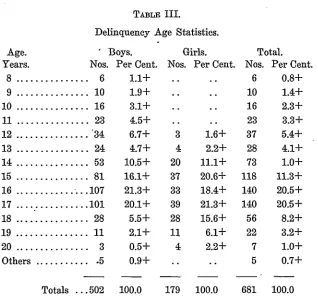
The table shows that the period from fifteen to seventeen years of age is especially dapgerous for boys. Bodily development comes ahead of the corresponding mental control. There is insufficient con-trol or inhibition of instinctive impulses. The adolescent is unusually susceptible to suggestion of all kinds, without possessing needed dis-criminatory power.
As far as Table II presents typical facts, it shows that delin-quency begins later with girls than with boys, perhaps due to longer protection in the home.
[image:4.616.23.341.77.373.2]4o"
-/0
-SV
85-2S 70
-
65-60
X0
-
.5--o
/5-
-4'0
-.5
--F
~~A~~"51
6ge-I I I I I I £ I I I I .
7 i /1 / ' # ' 6 / t.' 2
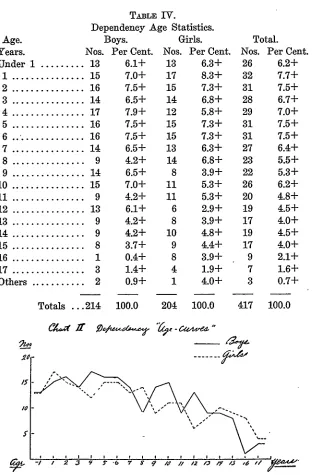
Table IV, which gives the dependency age statistics, shows that the numbers in the age column for dependent boys run remarkably parallel 'with the numbers in the age column of dependent girls. The causes in both cases are to be found outside the lives of both boys and girls; namely, with parents. The "high" years are from birth until the beginning of the "teens."- From birth until the child can begin to earn his own living he is in especial danger of becoming the victim of his parents' inability or unwillingness to support him.
[image:5.612.65.348.59.454.2]A STUDY OF JUVENILE DELINQUENCY TABLE IV.
Dependency Age Statistics. Age.
Years.
Boys. Nos. Per Cent.
Under 1 ... 13
1 ... 15
2 ... 16
3 ... 14
4 ... 17
5 ... 16
6... 16
7 ... 14
8 ... 9
9 ... 14
10 ... 15
11 ... 9
12 ... 13
13 ... 9
14 ... 9
15 ... 8
16 ... 1
17 ... 3
Others ... 2
Totals ...214
6.1+ 7.0+ 7.5+ 6.5+ 7.9+ 7.5+ 7.5+ 6.5+ 4.2+ 6.5+ 7.0+ 4.2+ 6.1+ 4.2+ 4.2+ 3.7+ 0.4+ 1.4+ 0.9+ 100.0 Girls. Nos. Per Cent.
13 17 15 14 12 15 15 13 14 8 11 11 6 8 10 9 8 4 1 204 6.3+ 8.3+ 7.3+ 6.8+ 5.8+ 7.3+ 7.3+ 6.3+ 6.8+ 3.9+ 5.3+ 5.3+ 2.9+ 3.9+ 4.8+ 4.4+ 3.9+ 1.9+ 4.0+ 100.0 Total. Nos. Per Cent.
26 6.2+
32 7.7+
31 7.5+
28 6.7+
29 7.0+
31 7.5+
31 7.5+
27 6.4+
23 5.5+
22 5.3+
26 6.2+
20 4.8+ 19 4.5+
17 4.0+
19 4.5+
17 4.0+
9 2.1+
7 1.6+
3 0.7+
417 100.0
if ~ ~ .C~W~S"
Chart II is based on Table IV and shows the comparative age curves for dependent-boys and dependent girls. Chart III is based on columns 5 and 6 of Tables III and IV and shows in a comparative
391
[image:6.612.26.353.65.540.2]/10
/JO
I410-PC 0
60
20
way the age curves for juvenile dependency and for juvenile delin-quency. When the dependency curve begins to fall, the delinquency curve begins to rise. It should be noted that the curves cross at about the eleven year age point, and that they begin distinctly c separate at the beginning of the "teens."
Hence, it may be inferred from this study that many children of the congested centers of our large cities are in danger of suffering from poverty until they reach their years of adolescence. But at the beginning of adolescence the danger-of poverty is replaced by rela-tively twice as great a danger-that of delinquency-due to the appeal made by the environment to the feelings and passions bWfore adoles-cents have had opportunity to acquire control over those passions.
A STUDY OF JUVENILE DELINQUENCY
TABi V.
Charges Against Delinquent Boys.
Offense. Nos. Per Cent.
Petty larceny ... 98 19.3+ Burglary ... 84 16.7+ Incorrigible ... 72 14.3+ Speeding ... 46 9.1+
Immorality ... 35 6.9+
Grand larceny ... 34 6.7+
Disturbing the peace ... 27 5.3+
Assault ... ... 23 4.2+ Forgery ... 14 2.7+ Vagrancy ... 8 1.5+ Destroying property ... 8 1.5+ Highway robbery ... 4 0.7+ Murder ... 3 0.5+ Gambling ... 2 0.3+ Unclassified ... 44 9.1+
Total ... 502 100.0 Petty larceny and burglary head the list for boys and offenses against property stand high in the total. In the adolescent boy the desire to acquire things is strong, the things which-satisfy these desires are at hand, but, as would be expected, sufficient individual self-control has not yet developed, and delinquency is the result. In the fact that self-control is slow in developing, or in being developed by the parents in the adolescent, the modern complex city life and condi-tions have much for which to answer.
TABLE. VI.
Charges Against Delinquent Girls.
Offense, Nos. Per Cent.
Being lewd and dissolute ... 114 63.0+
Incorrigible ... 49 27.3+-Petty larceny ... 5 2.7+ Vagrancy ... 3 1.6+
Burglary ... 2 1.1+ Disturbing the peace ... 2 1.1+ Unclassified ... * ... 4 2.2+
Total ... 179 100.0
From Table VI it will be seen that the charge of "being lewd and dissolute" among delinquent girls is very prominent. This fact has been found to be paralleled in an interesting way by the results of a study of women offenders.' This study included the cases of 183 women offenders who were received into the city jail of Los Angeles from MVarch 1, 1914, to April 25, 1914. Of the 163 offenses which were given in the records, 90, or 55 per cent, were for prostitution in one form or another. Hence the high percentage of immorality charges against delinquent girls is paralleled by the fact that among women offenders the same charges are larger in numbers than all other charges combined.
~Jz
~d&~e~r ~d
/.'
64
£3
-27
0.7
o.8
22_ MI6 %
A
'Made by Miss Alice Bates an advanced student in the Department of Economics and Sociology, The University of Southern California.
A STUDY OF JUVENILE DELINQUENCY
It should be noted, also, that girls cannot escape the results of their acts as readily as boys and that probably there is a higher per-centage of immorality among boys than Table IV indicates. A marked percentage of disobedience and incorrigibility is shown in both the boys' and girls' records. There are many modern city conditions which tend to distract the parents' attention from the adolescent and to draw the adolescent away from the influences of parental control at an abnormally early age. Charts IV and V are based on Tables V and VI respectively.
The records concerning the marital condition of the parents of delinquent and dependent boys and girls afford a basis for interesting statistics. Table VII refers to the parents in the delinquency cases.
TABE VII.
Marital Condition of Parents of Delinquent Boys and Girls. Boys. Pet. Girls. Pet. Total. Pet. Parents living together .... 262 52.1+ 63 35.1+ 325 47.7+ Father dead ... 50 9.9+ 18 10.0+ 68 9.9+ Father away ... 24 4.7+ 10 5.5+ 34 4.9+ Both parents dead ... 22 4.4+ 7 3.9+ 29 4.2+ Both parents away., ... 12 2.3+ 8 4.4+ 20 2.9+
Mother dead ... 22 4.4+ 14 7.8+ 36 5.2+
Parents separated ... 12 2.3+ 9 5.0+ 21 3.0+
Parents divorced ... 11 2.1+ 6 3.3+ 17 2.4+ Step-father ... 14 2.7+ 7 3.9+ 21 3.0+
Step-mother ... 5 0.9+ 3 1.6+ 8 1.1+ Unclassified ... 68 13.5+ 34 18.9+ 102 14.9+
Totals ... 502 100.0 179 100.0 681 100.0
of the parents in juvenile dependency cases. Chart VI is based on Tables VII and VIII.
TABTL VIII.
Marital Condition of Parents of Dependent Boys and Girls. Boys. Pet. Girls. Pet. Total. Pet. Parents living together .... 60 28.1+ 46 22.5+ 106 23.0+ Parents separated ... 41 19.2+ 42 20.5+ 83 19.9+ Never married ... 17 7.9+ 31 15.1+ 48 11.5+ Parents divorced ... 15 7.0+ 12 5.8+ 27 6.4+ Mother dead ... 15 7.0+ 19 9.3+ 34 8.1+
Father dead ... 14 6.5+ 14 6.8+ 28 6.7+
Father away ... 9 4.2+ 10 4.9+ 19 4.5+
Both parents away ... 9 4.2+ .. .. 9 2.1+
Both parents dead ... 8 3.7+ 8 3.9+ 16 3.3+ Step-mother ... 3 -1.4+ 3 1.4+ 6 1.4+ Step-father ... 2 0.9+ 4 1.9+ 6 1.4+ Unclassified ... 20 9.3+ 15 7.3+ 35 8.3+
Totals ... 213 100.0 204 100.0 417 100.0 In only 106 cases, or 23.0 per cent, of the 417 dependent cases were the parents found to be living together. It would seem that a broken-up home is even a greater factor in juvenile dependency than in the delinquency cases. In this table the item "parents never mar-ried" stands high with its accompanying implications of illegitimacy and child abandonment. In both Tables VII and VIII the item "fa-ther living, but away" figures noticeably, but, on the o"fa-ther hand, in both groups of figures the item "mother living, but away" is almost negligible.
The study of the Los Angeles Juvenile Court records for the year
1912 implies the existence of other interesting and valuable facts..
Data, however, for the other implied facts are not to be found in the records in a high enough percentage of cases to justify the drawing of conclusions.
M..raaZ-C I , * I I I I I I I I