ISSN: 1992-8645 www.jatit.org E-ISSN: 1817-3195
THE IMPACT OF CONTROL OBJECTIVES OF
INFORMATION AND RELATED TECHNOLOGY (COBIT)
DOMAIN ON INFORMATION CRITERIA AND
INFORMATION TECHNOLOGY RESOURCES
1
MO'TAZ AMIN AL-SA'EED, 2 SOUD M. AL-MAHAMID, 3 RIZIK M. H. AL-SAYYED 1
Asstt Prof., Department of Accounting and Accounting Information Systems, Al-Balqa' Applied University.
2
Assoc. Prof., Department of Business Administration, Al-Hussein Bin Talal University.
3
Asstt. Prof., Department of Business Information Systems, The University of Jordan. E-mail: [email protected], [email protected], 3 [email protected].
ABSTRACT
This research paper proposes and empirically examines the impact of Control Objectives of Information and related Technology (COBIT) domains on achieving the information criteria and on information technology resources of information systems to be considered reliable. This study aims mainly at answering the question: “Does Control Objectives of Information and related Technology (COBIT) domain have an impact on Information criteria and IT resources?” Questionnaires were distributed to 38 Jordanian banks. Our results indicated that there is a strong relationship between the three domains: planning and organization (PO), acquisition and implementation (AI), delivery and supporting (DS) on information technology resources (ITR) and people, information and application; where it is weak with infrastructure. The relationship, however, between monitoring and evaluation (ME) domain and people, application and infrastructure that is weak and where it is supported with adequate information. Also, the four COBIT domains: PO, AI, DS and ME have high impact on Information Technology Resources (ITR) with respect to people, information, application and infrastructure. The results indicated also that there is a strong relationship of PO on Information Criteria (IC) and the variables: effectiveness, efficiency, confidentiality, integrity, availability, compliance and reliability. For the AI domain, it was found that there is a strong relationship between (AI) and compliance, reliability and efficiency where there was found an average relationship along with the remaining variables. We noticed a very strong relationship between the (DS) domain and the seven variables. Moreover, the analysis indicated that the (ME) domain has a very good relationship with effectiveness, integrity and reliability; whereas an average relationship is noticed between the (ME) domain and confidentiality, availability and compliance and a weak relationship between the (ME) domain and efficiency. The four COBIT domains: PO, AI, DS and ME have high impact on IC with respect to effectiveness, efficiency, confidentiality, integrity, availability, compliance and reliability.
Keywords: COBIT, Information Criteria, IT Resources, Control, Accounting Information Systems, and IT Governance.
1. INTRODUCTION
In recent years, it has become increasingly evident that there is a need for a reference framework for security and control in information technology (IT). Successful organizations require an appreciation for and a basic understanding of the risks and constraints of IT at all levels within the enterprise in order to achieve effective direction and adequate controls. Management has to decide what is needed in order to reasonably invest in security and control in IT and how to balance risk and control investment in an often unpredictable IT environment. While information systems security and control help manage risks, they do not eliminate them. In addition, the exact level of risk can never be known as there is always some degree
ISSN: 1992-8645 www.jatit.org E-ISSN: 1817-3195
Evaluation Criteria (ITSEC), Trusted Computer System Evaluation Criteria (TCSEC), International Standardization Organization (IS0 9000) evaluations, an emerging Committee Of Sponsoring Organizations (COSO) internal control evaluations, etc. As a result, users need a general foundation in order to establish a first step. Frequently, auditors have taken the lead in such international standardization efforts because they are continuously confronted with the need to substantiate their opinion on internal control to management. Without a framework, this is an exceedingly difficult task. Furthermore, auditors are increasingly being called on by management to proactively consult and advise on IT security and control-related matters. To the extent that COBIT is applicable as a dual use framework; organizations can achieve efficiencies in either operations and/or IT audits through its use (Tuttle and D. Vandervelde, 2007). Internal audit functions can use COBIT with increased confidence as a framework for any type of IT audit they perform, whether it is an operational audit, compliance audit, or financial audit. It is possible that examining COBIT's conceptual model is a first step toward the development of a more general theory of internal control. Although no academic theory of internal control exists, the profession is essentially proposing COBIT as a process oriented theory of internal control based on IT processes, IT domains, information criteria (IC) and the IT resources (ITR) employed to generate information. Further development of a formal theory of internal control, especially as it relates to IT, should lead to more effective compliance and operational audits. The framework starts from a simple and pragmatic premise. In order to provide the information that the organization needs to achieve its objectives, ITR needs to be managed by a set of naturally grouped processes. Building on this premise; we proposed and empirically examined the impact of COBIT domains on achieving the Information Criteria and on IT Resources of information systems in order to be considered reliable. This study has chosen Jordanian Banks to as the study population, due to the quick response of those banks to the most recent updates in IT.
The rest of this paper is organized as follows: Section II introduces the importance of the study; section II also covers the information criteria, IT resources and Problem Definition; Section III details the background and literature review of the study; The study model, hypothesis development and research methodology are covered in section
IV; Data analysis and research findings are covered in section V: The conclusion is drawn in section VI.
2. THE IMPORTANCE ON THE STUDY
Efficiencies should result in having IT departments and auditors sharing the same framework. Any framework that is acceptable from not only a financial audit perspective but also from an operational perspective is preferred to one that is only useful in the financial audit. COSO appears to serve this need at a relatively general level. At an operational level, we note that COBIT was initially developed as an IT benchmark consisting of best practices. From that context, we investigate the appropriateness of COBIT to an audit setting. To the extent that COBIT is applicable as a dual use framework; organizations can achieve efficiencies in either operations and/or IT audits through its use (Tuttle and D.Vandervelde, 2007). Internal audit functions can use COBIT with increased confidence as a framework for any type of IT audit they perform, whether it is an operational audit, compliance audit, or financial audit. It is possible that examining COBIT's conceptual model is a first step toward the development of a more general theory of internal control. Although no academic theory of internal control exists, the profession is essentially proposing COBIT as a process oriented theory of internal control based on IT processes, IT domains, IC and the ITR employed to generate information. Further development of a formal theory of internal control, especially as it relates to IT, should lead to more effective compliance and operational audits. We proposed and empirically examined the impact of COBIT domain on achieving the IC of information systems and on ITR so as to be considered reliable. This study has chosen Jordanian Banks as the study population, due to the quick response of these banks to the most recent updates in IT.
ISSN: 1992-8645 www.jatit.org E-ISSN: 1817-3195
means that the Information System is more reliable and beneficial.
The four COBIT domains that are the core of our study are: Planning and Organization (PO), Acquisition and Implementation (AI), Delivery and Supporting (DS) and Monitoring and Evaluating (ME). These COBIT domain levels are individually explained below (Etzler, 2007, P18-26):
1- Planning and Organization (PO) describes how the business objectives are best reached through the use of IT. This domain administrates the use of tactics and strategy to plan, communicate and manage the different perspective throughout the organization.
2- Acquisition and Implementation (AI) depicts the identifying and acquiring of IT solutions. Furthermore, this domain explains the solutions integration to the business processes and how to manage and upkeep the existing systems.
3- Delivery and Supporting (DS) handles the actual delivery of the information at hand and see to the management of service levels, performance and capacity, configurations, operations and the physical environment, to name a few. This domain is also responsible for the identification and allocation of costs and the training of users.
4-Monitoring and Evaluation (ME) describes the monitoring and evaluation of all the processes employed by the IT organization. This domain also delivers the final statement to provide it governance.
3. INFORMATION CRITERIA, IT RESOURCES AND PROBLEM DEFINITION.
Information Criteria: To satisfy business objectives, information needs to conform to certain control criteria, which COBIT refers to as business requirements for information. Based on the broader quality, fiduciary and security requirements, seven distinct (and certainly overlapping) information criteria are defined as follows: (Romney and Stainbart. 2009, pp, 273) (ITGI- COBIT Framework, 2000):
Effectiveness deals with information being relevant and pertinent to the business process as well as being delivered in a timely, correct, consistent and usable manner.
Efficiency concerns the provision of information through the optimal (most productive and economical) use of resources.
Confidentiality concerns the protection of sensitive information from unauthorized disclosure.
Integrity relates to the accuracy and completeness of information as well as to its validity in accordance with business values and expectations.
Availability relates to information being available when required by the business process now and in the future. It also concerns the safeguarding of necessary resources and associated capabilities.
Compliance deals with complying with those laws, regulations and contractual arrangements to which the business process is subject, i.e., externally imposed business criteria, as well as internal policies.
Reliability relates to the provision of appropriate information for management to operate the entity and exercise its fiduciary and governance responsibilities.
IT Resources: The IT resources identified in COBIT can be defined as follows:
Applications are the automated user systems and manual procedures that process the information.
Information is the data in all their forms input, processed and output by the information systems, in whatever form is used by the business.
Infrastructure is the technology and facilities (hardware, operating systems, database management systems, networking, multimedia, etc., and the environment that houses and supports them) that enable the processing of the applications.
People are the personnel required to plan, organize, acquire, implement, deliver, support, monitor and evaluate the information systems and services. They may be internal, outsourced or contracted as required. (Tuttle and D. Vandervelde, 2007)
ISSN: 1992-8645 www.jatit.org E-ISSN: 1817-3195
resources need to be managed by a set of naturally grouped processes. The Framework continues with a set of 34 high-level Control Objectives, one for each of the IT processes, grouped into four domains: planning and organization, acquisition and implementation, delivery and support, and monitoring. The COBIT Framework provides a tool for the business process owner that facilitates the discharge of this responsibility. This structure covers all aspects of information and the technology that supports it. By addressing these 34 high-level control objectives, the business process owner can ensure that an adequate control system is provided for the IT environment. Thus; the following question has been emerged from the COBIT processes in an IT Governance Model, as follows:
“Do Control Objectives of Information and Related Technology Domain have an impact on Information criteria and IT resources?”
The above question can be further divided into more detailed questions:
1. Do COBIT domain of AI, PO, DS, and ME have an impact on ITR with respect to people, information, application and infrastructure?
2. Do COBIT domain of AI, PO, DS, and ME have an impact on IC with respect to effectiveness, efficiency, confidentiality, integrity, availability, compliance, and reliability?
Note that the first question can be further divided into four more questions and the second question can be further divided into seven more questions.
4. STUDY BACKGROUND AND LITRATURE REVIEW.
It was believed that this governance model would result in: 1. High flexibility for the organization, 2. Effective allocation of the IT resources and, 3. Economies of scale and specialization through centralization of IT knowledge. Effective IT governance is of course determined by the way the IT function is organized and where the IT decision-making authority is located within the organization. Organizations are restructuring to streamline operations and simultaneously take advantage of the advances in IT to improve their competitive position. Business re-engineering, right-sizing, and outsourcing, empowerment, flattened organizations
and distributed processing are all changes that impact the way that business and governmental organizations operate. These changes are having, and will continue to have, profound implications for the management and operational control structures within organizations worldwide. IT governance provides the structure that links IT processes, IT resources, and information to enterprise strategies and objectives. IT governance integrates and institutionalizes optimal ways of planning and organizing, acquiring and implementing, delivering and supporting, and monitoring IT performance. Looking at the interplay of enterprise and IT governance processes in more detail, enterprise governance, the system by which entities are directed and controlled, drives and sets IT governance.( ITGI- COBIT Framework,2000).
ISSN: 1992-8645 www.jatit.org E-ISSN: 1817-3195
COBIT are specific enough to be easily implemental; yet general enough to be applicable to various types of audits (e.g., operational, compliance, and financial) (Tuttle and D. Vandervelde, 2007).
As mentioned in above, the ultimate goal of COBIT, as a model of IT governance, is to achieve strategic information criteria, and strategic alignment between the business and IT to make sure that money spent in IT deliver value for the business through utilizing various IT Resources. This alignment discussion is certainly not new. The study of (Trautman and Altenbaumer, 2011) has reached that COBIT contends because Information Technology governance integrates and institutionalizes good practices to ensure that the enterprise‘s Information Technology supports the business objectives. Information Technology governance enables the enterprise to take full advantage of its information, thereby maximizing benefits, capitalizing on opportunities and gaining competitive advantage. (Singh, H, 2010) has argued that many organizations that use COBIT do not implement the entire framework. Instead, they focus their efforts on only some of COBIT’s control objectives. This could be due to the limited rationality of IT managers, which affects their ability to assess the outcomes of control, and the diminishing returns from implementing controls, because of enforcement costs incurred to control shirking. While (Heier and et al, 2009) indicate that companies that are willing to dedicate the necessary resources to an IT governance application implementation can utilize the tool better and eventually create a much larger benefit in the form of a measurable business value. Meanwhile; (Goeken and Alter, 2009) have developed a framework representation with this technology which allows the flexible navigation within framework structures and the implementation of various views over the components. (Singh. H, 2009) has aimed to provide a theoretical wrapping for Information System (IS) governance based on practice theory). (Ribeiro and Gomes, 2008) have found that COBIT is a suitable framework for the implementation of the ISO 9001 certification standard and for IT Governance in Public Educational Institutions in the IS and IT field. In addition to that; achieving the COBIT information criteria has important implications for financial statement assertions as well as broader implications for the efficiency and effectiveness of operations. (Ndilula, 2008) has found that the good IT governance in an organization results in more
ISSN: 1992-8645 www.jatit.org E-ISSN: 1817-3195
Commission's Committee of Sponsoring Organizations (COSO) evaluation framework (IT Governance Institute, 2005; see also Colbert and Bowen, 1996; Netegrity, 2004; Ramos, 2004). (Fedorowicz and Gelinas, 1998) have stated that COBIT complements the COSO framework for assessing the internal controls and overall corporate governance of an organization. Likewise, (Lain hart, 2001) states that COBIT is a tool that “helps enterprises balance IT risk and investment in controls.” In contributing to the understanding of IT governance and how it can be achieved in practice (De Haes and Grembergen. V, 2004) have found that the key element in IT governance is the alignment of the business and IT to lead to the achievement of business value. This high-level goal can be achieved by acknowledging IT governance as a part of enterprise governance and by setting up an IT governance framework with best practices. Such a framework and practices should be composed of a variety of structures, processes and relational mechanisms.
5. STUDY MODEL, HYPOTHESIS DEVELOPMENT AND RESEARCH METHODOLGY.
Our COBIT study model consists of four domains: Acquisition & Implementation, Planning & Organization, Delivery & Supporting and Monitoring & Evaluation. The impact of each of these four domains on information criteria & IT resources will be evaluated with respect to factors of that area; the factors of the IT resources are people, information, application and infrastructure and the factors of the information criteria are effectiveness, efficiency, confidentiality, integrity, availability, compliance, and reliability.
Based on the study questions and reviewing the related literatures a hypothesis can be developed as follows: Control Objectives of Information and related Technology Domain do not have impact on Information criteria and IT resources.
The study has developed a sub-hypothesis that match the study sub-questions (Problem elements) as follows:
1. Control Objectives of Information and related Technology Domain of Acquisition and Implementation (AI) do not have impact on Information criteria and IT resources.
2. Control Objectives of Information and related Technology Domain of Planning
and Organization (PO) do not have impact on Information criteria and IT resources. 3. Control Objectives of Information and
related Technology Domain of Delivery and Supporting (DS) do not have impact on Information criteria and IT resources. 4. Control Objectives of Information and
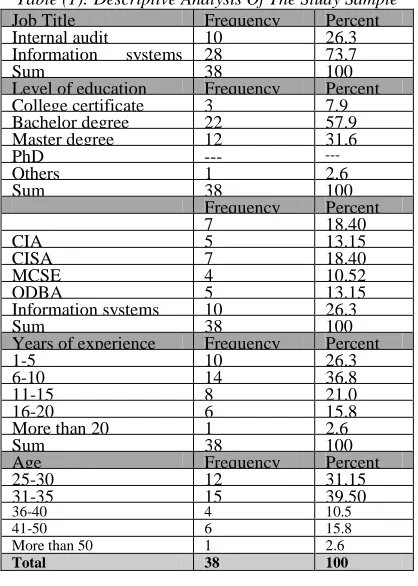
related Technology Domain of Monitoring and Evaluation (ME) do not have impact on Information criteria and IT resources. To do the research, a postal questionnaire survey was deemed as the most appropriate research tool for answering the study questions. Questionnaires are believed to effective tools to seek opinions, attitudes and descriptions about COBIT domains impact. A listing of all Jordanian banks was available from the Central Bank of Jordan as of 31st December, 2011. It was decided to distribute the questionnaire to all those banks, with a confidence level of 95% and an interval level of 10. The response rate of the questionnaire survey was (90%), where only (38) out of (42) questionnaires were returned.
Table (1): Descriptive Analysis Of The Study Sample Percent Frequency Job Title 26.3 10 Internal audit 73.7 28 Information systems 100 38 Sum Percent Frequency
Level of education
7.9 3 College certificate 57.9 22 Bachelor degree 31.6 12 Master degree --- --- PhD 2.6 1 Others 100 38 Sum Percent Frequency 18.40 7 13.15 5 CIA 18.40 7 CISA 10.52 4 MCSE 13.15 5 ODBA 26.3 10 Information systems 100 38 Sum Percent Frequency
Years of experience
26.3 10 1-5 36.8 14 6-10 21.0 8 11-15 15.8 6 16-20 2.6 1
More than 20
100 38 Sum Percent Frequency Age 31.15 12 25-30 39.50 15 31-35 10.5 4 36-40 15.8 6 41-50 2.6 1
More than 50
100 38
Total
6. DATA ANALYSIS AND RESEARCH FINDINGS.
A. Descriptive Analysis
[image:6.612.314.523.364.657.2]ISSN: 1992-8645 www.jatit.org E-ISSN: 1817-3195
the rest (10) were Internal Audit Managers (26.3%) (See Table: 1 above). In the meantime; it was found that the respondents hold professional certificates relevant to the study objectives. Of the research sample, 22 respondents have bachelor degrees, and 12 respondents have their masters. Therefore; it is more likely that the research sample has a sufficient level of education to respond to the research questionnaire. Also, a total of (73.6%) of respondents have 6 to 20 years of experience, which indicates that the respondents have high levels of experience in which to answer the research questionnaires without difficulty. Among the respondents there were five discrete categories of age. The range of age groups was 25 to more than 50 years, with the majority aged between 25 to 40 years old (27 respondents), which indicates that our respondents can provide objective and thorough data that enriches the research results. Overall, the demographic features of the research respondents show that the target sample is appropriate for answering the research questions.
B. Reliability Statistics
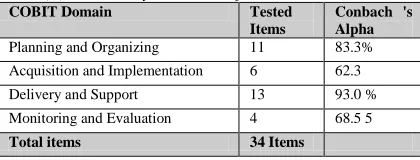
Cronbach's Alpha was used to test the reliability of the scale with (34) tested items divided into four domains (see table :2), which is good because it is greater than the accepted percentage of (0.60), and means that if the questionnaire will be distributed to another sample, we will get similar reliable responses as displayed in the percentages below.
Table (2): Reliability Statistics Of The Measurement Tool
COBIT Domain Tested
Items
Conbach 's Alpha
Planning and Organizing 11 83.3%
Acquisition and Implementation 6 62.3
Delivery and Support 13 93.0 %
Monitoring and Evaluation 4 68.5 5
Total items 34 Items
C. Test of Hypothesis
To test the hypothesis and analyze the results,
correlation and ANOVA tests were performed. In order to answer the main research question “Does Control Objectives of Information and related Technology Domain have impact on Information criteria and IT resources?” of the study, we re-phrased the research questions into two questions: (1) “Does Control Objectives of Information and related Technology Domain have an impact on IT resources?” (2) “Do Control Objectives of Information and related Technology Domain have an impact on Information Criteria?” SPSS-17 has been used to analyze the data collected. We have summarized the results calculated into four tables;
Table 3, Table 4, Table 5 and Table 6. Table 3 and Table 4 are related to the first question while Table 5 and Table 6 are related to second question. Table (3) shows the correlation analysis (R & R square) between the four COBIT domains: Planning and Organization (PO_ITR), Acquisition and Implementation (AP_ITR), Delivery and Supporting (DS_ITR) and Monitoring and Evaluation (ME_ITR) with respect to people, information, application and infrastructure and their impact on Information Technology Resources (ITR).
Table 3: Correlation Analysis Of The COBIT Domains On ITR
COBIT Domain
People Information
R R2 R R2
PO_ITR 0.93 0.86 0.86 0.74
AI_ITR 0.81 0.65 0.80 0.64
DS_ITR 0.92 0.84 0.90 0.81
ME_ITR 0.59 0.34 0.81 0.66
COBIT Domain
Application Infrastructure
R R2 R R2
PO_ITR 0.92 0.85 0.58 0.33
AI_ITR 0.88 0.78 0.62 0.46
DS_ITR 0.96 0.92 0.75 0.57
ME_ITR 0.48 0.23 0.64 0.40
As shown in Table (3), there is a strong relationship between PO and people, information and application, but demonstrates a weak relationship between the PO and the infrastructure (R = 0.576, R2 = 0.332).The PO relationship with the variables is close to the relationship of the AI with respect to the same variables. The relationship between DS domain and the first three variables (People, Information, and Application) in the table is also strong whereas the relationship between AI and the infrastructure can be described as moderate(R = 0.618, R2 = 0.464). The relationship between ME and people, application and infrastructure is weak, yet there is a good relationship between M and the information. (R = 0.810, R2 = 0.657).
[image:7.612.91.301.471.551.2]ISSN: 1992-8645 www.jatit.org E-ISSN: 1817-3195
[image:8.612.317.527.109.187.2]means that when banks conduct acquisition and implementation Domain, they are well equipped and ready to effectively install and operate the new Information systems. In addition to that, the weak relationship between Monitoring and Evaluation (ME) and People and Application, could be further interpreted through the descriptive analysis of the study sample, (see table: 1) which shows that the study sample has sufficient levels of education, professional certificates and a satisfactory level of experience indicating that people and application are well prepared and strategically aligned to monitor and evaluate the new acquired information systems. These results are lined with ((Trautman and Altenbaumer, 2011), on the other hand; (Singh, H, 2010) has argued that many organizations that use COBIT do not implement the entire framework. Instead, they focus their efforts on only some of COBIT’s control objectives. This could be due to the limited rationality of the IT managers, which affects their ability to assess the outcomes of control, and the diminishing returns from implementing controls, because of enforcement costs incurred to control shirking. Managers would thus find it useful if the various control objectives could be ranked, so that they could prioritize their efforts. The study has used network analysis to identify the most central control objectives in COBIT. Some literature has argued that the IT governance project was perceived as a project imposed by IT which created resistance in the business to adopt the model. (De Haes and Van Grembergen, 2005). In order to find which one of the variables has an effect on the relationship or to find out the direction of the relation, one way analysis of variance (ANOVA) has been performed as shown in Table (4). We omitted all the F values from the results and simply show the significance level since they are reflective. As shown in Table (4), the four COBIT domains: PO, AI, DS and ME have high impact on ITR with respect to people, information, application and infrastructure. This is noticed by looking at all the significance (Sig.) values that lie below the 0.05 p value (i.e. < 0.05); actually all values are 0.000 except just for application which is 0.002 that is almost zero. Table (4) is another proves that the four COBIT domains have high impact on ITR in addition to the results collected in Table (3) that shows the high correlation analysis of the COBIT domains on ITR.
Table 4: ANOVA of the COBIT domains on ITR
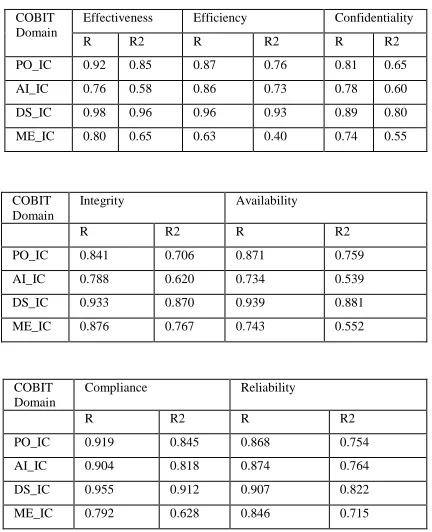
[image:8.612.314.530.308.574.2]As indicated above, Table 5 and Table 6 data help in answering question 2. Table (5) shows the correlation analysis between the four COBIT domains: PO, AP, DS and ME with respect to effectiveness, efficiency confidentiality, integrity, availability, compliance and reliability and their impact on information criteria (IC).
Table 5: Correlation Analysis of the COBIT domains on IC
In order to study the relationship between the COBIT domains with the variables: Effectiveness, Efficiency, Confidentiality, Integrity, Availability, Compliance and Reliability, a correlation analysis has been performed as shown in Table 5. The calculations indicated that there is a strong relationship between PO and all variables mentioned above ranged from 0.808 to 0.923. With respect to the second domain (AI) and the other seven variables, it was noticed that there is a strong relationship between (AI) and compliance, reliability and efficiency whereas the analysis showed an average relationship between (AI) and
COBIT Domain
People Information Application Infrastructure
Sig. Sig. Sig. Sig.
PO_IT 0.000 0.000 0.000 0.000 AI_IT 0.000 0.000 0.000 0.000 DS_IT 0.000 0.000 0.000 0.000 M_IT 0.000 0.000 0.002 0.000
COBIT Domain
Effectiveness Efficiency Confidentiality
R R2 R R2 R R2
PO_IC 0.92 0.85 0.87 0.76 0.81 0.65 AI_IC 0.76 0.58 0.86 0.73 0.78 0.60 DS_IC 0.98 0.96 0.96 0.93 0.89 0.80 ME_IC 0.80 0.65 0.63 0.40 0.74 0.55
COBIT Domain
Integrity Availability
R R2 R R2
PO_IC 0.841 0.706 0.871 0.759 AI_IC 0.788 0.620 0.734 0.539 DS_IC 0.933 0.870 0.939 0.881 ME_IC 0.876 0.767 0.743 0.552
COBIT Domain
Compliance Reliability
R R2 R R2
ISSN: 1992-8645 www.jatit.org E-ISSN: 1817-3195
[image:9.612.82.303.412.571.2]the rest of the variables. We noticed a very strong relationship between the (DS) domain and the seven variables ranged from 0.894 to 0.978. Moreover, the analysis indicated that the (ME) domain has a very good relationship with effectiveness, integrity and reliability; whereas an average relationship is noticed between the (ME) domain and confidentiality, availability and compliance and a weak relationship between the (ME) domain and efficiency. Also, these results are supported by (Ribeiro and Gomes, 2008) who have argued that there is a need to create mechanisms to guarantee the management and control of IS in particular to IT Governance. The researchers found that COBIT is a suitable framework for the implementation of the ISO 9001 certification standard and for IT Governance in Public Educational Institutions in the IS and IT field. In addition to that; achieving the COBIT information criteria has important implications for financial statement assertions as well as broader implications for the efficiency and effectiveness of operations. Supporting to these results; (Nedilula, 2008) has found that the good IT governance in an organization results in more accurate and timely financial reporting.
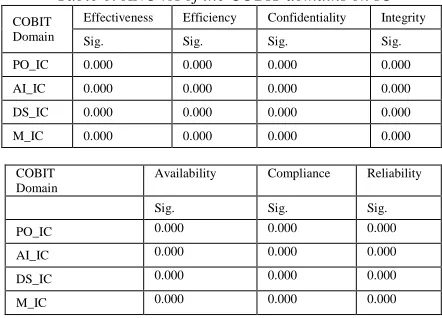
Table 6: ANOVA of the COBIT domains on IC
COBIT Domain
Effectiveness Efficiency Confidentiality Integrity
Sig. Sig. Sig. Sig.
PO_IC 0.000 0.000 0.000 0.000 AI_IC 0.000 0.000 0.000 0.000 DS_IC 0.000 0.000 0.000 0.000 M_IC 0.000 0.000 0.000 0.000
The same procedure performed to produce Table 4 is repeated for Table 6. In order to find which one of the variables has an effect on the relationship or to find out the direction of the relation, ANOVA has been performed as shown in Table 6. Again, we omitted all the F values from the results and just show the significance level.
As shown in Table 6, the four COBIT domains: PO, AI, DS and ME have high impact Information Criteria (IC) with respect to effectiveness, efficiency, confidentiality, integrity, availability, compliance and reliability. This is noticed by
looking at all the significance (Sig.) values that lie below the 0.05 p value (i.e. < 0.05); actually all values are zeros. Table 6 is another proves that the four COBIT domains have high impact on IC in addition to the results collected in Table 5 that shows the high correlation analysis of the COBIT domains on IC.
7. CONCLUSION
In this research, we empirically examined the impact of COBIT domains (PO, AI, DS, and ME) on IC with respect to people, information, application and infrastructure. We also empirically examined the impact of the same COBIT domains on ITR with respect to effectiveness, efficiency, confidentiality, integrity, availability, compliance and reliability. The results indicated that there is a strong relationship between the three domains: PO, AI, DS on ITR and people, information and application; where it is weak with infrastructure. The relationship, however, between ME domain and people, application and infrastructure is weak; though strong with information. Also, the four COBIT domains: PO, AI, DS and ME have high impact on ITR with respect to people, information, application and infrastructure. The results indicated also that there is a strong relationship of PO on IC and the variables: effectiveness, efficiency, confidentiality, integrity, availability, compliance and reliability. For the AI domain, it was found that there is a strong relationship between AI and compliance, reliability and efficiency where we found an average relationship and the remaining variables. We noticed a very strong relationship between the DS domain and the seven variables. Moreover, the analysis indicated that the ME domain has a very good relationship with effectiveness, integrity and reliability; whereas an average relationship is noticed between the ME domain and confidentiality, availability and compliance and a weak relationship between the ME domain and efficiency. The four COBIT domains have high impact on IC with respect to effectiveness, efficiency, confidentiality, integrity, availability, compliance and reliability.
REFERENCES
.
3T
[1]Buckby, S and Best, P, (2007), Development of a board IT governance (ITG) review model. In: 2007 Accounting & Finance Association of Australia and New Zealand Conference (AFAANZ 2007), 1-3 Jul 2007, Gold Coast, Australia.
COBIT Domain
Availability Compliance Reliability
Sig. Sig. Sig.
PO_IC 0.000 0.000 0.000
AI_IC 0.000 0.000 0.000
DS_IC 0.000 0.000 0.000
ISSN: 1992-8645 www.jatit.org E-ISSN: 1817-3195
3T
[2]Colbert J. L, Bowen PL. A comparison of Internal Controls: COBIT, SAC, COSO, and SAS 55/78. IS Audit Control J 1996; 4:26–35.
3T
[3]COSO. Enterprise risk management—integrated framework." The Committee of Sponsoring Organizations of the Treadway Commission". 2004. http://www.coso.org.
3T
[4]COSO. Internal control—an integrated framework. "The Committee of Sponsoring Organizations of the Treadway Commission". 1992. http://www.coso.org.
3T
[5]Gerry H. Grant, Karen C. Miller, Fatima Alali, (2008), "The effect of IT controls on financial reporting" , Managerial Auditing Journal, Vol. 23 Iss: 8, pp.803 – 823.
3T
[6]Goeken. M. and Alter. S. (2009). "Towards Conceptual Meta modeling of IT Governance Frameworks Approach - Use – Benefits". Frankfurt School of Finance & Management. Proceedings of the 42nd Hawaii International Conference on System Sciences – 2009).
3T
[7]Grembergen. W. Van, De Haes. Steven and Jan Moons, (2005), Linking Business Goals to IT Goals and COBIT Processes.
3T
[8]Haes S.D and Grembergen.W.V. (2005). "IT Governance Structures, Processes and Relational Mechanisms: Achieving IT/Business Alignment in a Major Belgian Financial Group”, University of Antwerp Management School. P.P 4.
3T
[9]Haes. S.D and Grembergen.W.V (2004). "IT Governance and Its Mechanisms. Information Systems Audit and Control Association.
3T
[10]Heier. H. et al. (2009). “Examining the Relationship between IT Governance Software, Processes, and Business Value: A Quantitative Research Approach Accenture”. Information Systems, 9(52). http://sprouts.aisnet.org/9-52.
3T
[11]IT Governance Institute. “Control objectives, management guidelines, maturity models” in CobiT 4.0. Rolling Meadows, IL: IT Governance Institute; 2005.
3T
[12]Etzler,J (2007), IT Governance According to COBIT.
3T
[13]KPMG. S-O rules finalized. Frontiers in finance for decision makers in financial services; 2003. 10–15. November.
3T
[14]Lainhart IV JW.(2004)." An IT assurance framework for the future". Ohio CPA J 2001 19–23. January–March. Netegrity. Sarbanes– Oxley. Regulatory compliance handbook; 2004.
3T
[15]Ramos M. (2004). “Evaluate the control environment”. J Account 2004; 197:75–8 May.
3T
[16]Ribeiro. J, Gomes. R. (2008). "IT Governance using COBIT implemented in a High Public Educational Institution – A Case Study". School of Technology and management. Polytechnic Institute of Viana do Costello. Portugal. http://www.ipvc.pt.
3T
[17]Singh, H. (2009). "A Practice Theory View of IS Governance," Proceedings >
3T
[18]Singh, Harminder, (2010). "Selecting IT Control Objectives and Measuring IT Control Capital". ACIS 2010 Proceedings. Paper 89.http://aisel.aisnet.org/acis2010/89.
3T
[19]Summerfield B. (2005).” EU selects CobiT as an auditing standard”. http://www.certmag.com.
3T
[20]Trautman Lawrence J. and Altenbaumer .Kara, (2011)," The board's' responsibility for information technology governance.
3T