Digital
Technical
Journal
I
AU D IO AND VIDEO T ECHNOLOG IES
UNIX AVAILABLE SERVERS, REAL- T I M E DEBUGG ING TOOLS
Editorial
jane C. BLlkc, JVLl1L1ging Editor Kathleen M. Stetson, Editm Helen L. Patterson, Editor
Circulation
Cnherine M. Phillips, Administrator Dorothea B. C1ssady, Secretary
Production
Terri Autieri, Pmduction Editor AnneS. Kat1.dl, ·ryrogpphcr Peter R. \Voodbury, Illustrator
Advisory Board
Samuel H. fuller, Chairman Richard W. Beane
Donald Z Harbert William R. Hawc Richard J. 1-!ollingswmth Willic1m A. L1ing Richa1·d F l .ary Alan G. Ncmerh !'au line A. Nist Robert M. Supnik
Cover Design
The concept t(Jr the cmn graphic is dcri 1 eel fmm the Video Odvsse\· screen Scl\"cr arpli cation, which allows uscr.s to displav fu\1-rnorion ,·ideo images on their screens in a varietv of modes. The screen saver applica tion wcJS built to test a soft11·crrc cJrchitecturc rhat ur�.mi1.es the h111ction:Jiitv ofs·ideo com
presso
;
s and renderers into �1 �mit�·ing soft ll'cJrc imcrLKe. 'This soltwarc-onlv approach to digit.1l 1ideo is one of the topics in the teature section Audio :1nd Video Technol ogies in this issue.The cover wc1s designed by l.ucinda 0'01cill ofDigiral's Design Group. Our rhanks go to cluthms Vict<H· Bc1hl c111d l'cllll <_;.Juthicr f(H· providinp; the screen saver, and to author Bill Hallahan t(Jr the DEC:t;J\k Sotrw:rrc synthetic speech SIKCtmgrcJnl used in the cover gr.1phic.
Correction fo1· Vol. 7 No. 3 Cover Design Description In describing rhc cover of the prc\'ious issue, vol. 7 no. 3, we neglected to properly credit the sources of the cover imap;es. The visualiutions 011 the ti·ont and b:1ck covers were cre:Jtcd lw jon:1th:1n Shade using the comput.Hional resources of the Sc111 Diego Supercomputer C:cmcr. \Vc thank )onat!J.rn cmd the C:elltcr ti>r the usc of these im;Jges.
The f)(qital Tl'chuical{oumaiis a retereed journal published quarterly by Digital Equipment Catvoration, 30 Porter Road L)02/D lO, Litderon, Massachusetts 0 l 460. Subscriptions to the.fouma/ are $40.00
(non-U.S. $60) tor tour issues and $75.00 (non-U.S. $115) for eight issues and must be prepaid in U.S. funds. University and college professors and Ph.D. students in the electrical engineering and computer science tielcls receive complimentary sub scriptions upon request. Orders, inquiries, and address changes should be sent to the /Jigito/ [echnical[ourna/at the published by address. Inquiries can also be sent elec tronically ro dtj@digital .com. Single copies and back issues arc available for $16.00 each by calling DECclirect at 1-800-DIGITAL ( 1-800-344-4825 ). Recenr back issues of thejournalare also available on the lmernet at http:/ jwww.digital.com/info/DTJ/home. html. Complete Digital Internet listings can be obtained by sending an electronic mail message ro [email protected].
Digital employees may order subscriptions through Readers Choice bv entering vrx P ROFILE at the system prompt.
Comments on the content of anv paper arc 11·elcomed and mav be sent to the managing editor at the published-lw or network :1ddress.
Copvright © 1996 Digital Equipment Corporation. Copving 11ithout fee is per mitted pro,·ided that such copies arc made t(Jr usc in educational institutions bv burltl' membas and are nor distributed tor com mercial advanragc. Abstracting with credit of Digit,JI Equipment Corporation's author ship is permitted.
The int(mnation in the journal is subJeCt to dJ
<
Jngc without notice and should nor be consnued as a commitmem bv Digitcll Equipment Corporation or by the compa nies herein reptTsented. Digital Equipmem Corporation assumes no responsibility t(Jr any errors that may appear in thcjourl/al.ISSN 0898-901X
Documentation Number EY-U002E-Tj Book production was done by Quantic Communications, Inc.
·rhc tclllo11·ing arc tradem.1rks of Digitcll Equipmem Corporation: AccuLook, AccuVideo, Alphcl(;cneration, AlphaStation, DEC:, DEC: OSI'/1, DECchip, DEC:sak, DEC:st:Jtion, DECtalk, Digital, the Dil;II't\1.\ogo, Digital C:\IX, FuiiVicko, OpcnV,viS,
PDP, RZ, TURBOchanncl, UI TRIX,
;111d VMSclustcr.
C-Cube and CI.550 :1re tr:1dem:1rks of
C-Cube Micmsysrems.
I-IA/6000, IBM, Powerl'C, c111d PS/2 arc registered trJdcmarks of Inrnnational Business Machines Corporation. 1-lewlctt-Packard and HI' c11·e registered trademarks and Switch Over UX is a trade mark of f-lewlcrr-!';1ckard Comp.111y. INDEO is a registered trackm;Jrk and Pentium is a trademark of !nrc\ Corporation. Micmsoft is a registered n·ademark and Video tcJr Windows, Windows, and Windows NT
:1re trademarks of Microsoft Corporation. MIPS, R3000, and R4000 arc registered trademarks ,,f Ml l'S Technologies, Inc. MotoroLJ is a 1-cgistcrcd trademark of Motorola, Inc.
:sJI'S is a registered tradcm,Jrk ;llld SI'ARC:clusterl is a trademark of Sun lvlicros�'srcms, Inc.
ORAC:I.J-:7 is a trademark ofOr;Jcle Corporation.
Parasight is .1 trademark of Encore Compute!· Corporation.
QuickTime is a trcJdemark of Apple Comrutcr, Inc.
Sl'EC:�J, Sl'EC:int, ;Jnd Sl'FC:mark .1re trcJdcmarks of the Stamhrd Pcrt(>rnlance EvalucHion Council.
Contents
Foreword
AUDIO AND VIDEO TECHNOLOGIES
DECtalk Software: Text-to-Speech Technology and Implementation
The J300 Family of Video and Audio Adapters: Architecture and Hardware Design
The J300 Family of Video and Audio Adapters:
Software Architecture
Software-only Compression, Rendering, and Playback of Digital Video
Integrating Video Rendering into Graphics Accelerator Chips
Robert A. Ulichnn·
William I. Hallahan
Kcnncrh W. Correll and Robert A. Ulichncy
Paranwir Bahl
p,ll·anwir Bahl, PaulS. Gauthier, cmd Robert A. Ulichncv
LatTI' D. . Seiler and Robert A. UlichiJCI' .
3
20
34
S2
76
UNIX AVAILABLE SERVERS, REAL-TIME DEBUGGING TOOLS
Technical Description of the DECsafe Available Server Environment
Parasight: Debugging and Analyzing Real-time Applications under Digital UNIX
LJIITCnce S. Cohen and John H. WilliJms 89
i'vlichael Palmer and )efti·cy M. Russo
Di)2,it.11 Teclmic<li )ourn.1l
10 l
2
Editor's
Introduction
This issue's opening section features audio and video technologies that exploit the power of Digital's 64-bit RISC Alpha systems. Papers describe new software and hardware designs that make praerical such applications as text-to-speech conversion and ti.JIJ motion video on the desktop. A sec ond set of papers shifrs the tows to the UNIX environment with discus
sions ofbigh-availability services and of Encore Computer Corporation's new real-time debugging tool.
The opening paper tor the audio and video section references an audio technology that physicist Stephen H:nvking uses to convert the text
he types to highly intelligible syn thetic speech. Recently, engineers h:ll'e ported this mature
10-year-old hardware technology, called DECtalk, ro text-to-speech sofrware. Bill Hallahan explains that the com putational power of Digital's Alpha systems now makes ir possible tor a software speech synthesizer to simul taneously convert many text streams to speech without overloading a work station. After revie11�ng relevant speech terminology and popular synthesis techniques, he describes OECtalk Sofrware multithreaded processing and the new text-to-speech applica tion programming interf.1ce for
UNIX and NT workstations. Video technologies-full-motion video on workstations-also capital ize on the high performance of Alpha systems. In the first of four papers f(JCused on digital video, Ken Correll and Bob Ulichney present the J300 video and audio ad<lpter architecture. To improve on past full-motion \'ideo implementations, designers sought
to allow video data to be treated rhe
Digiral Technical )ournJI
same as am· other data type in a \\'Ork
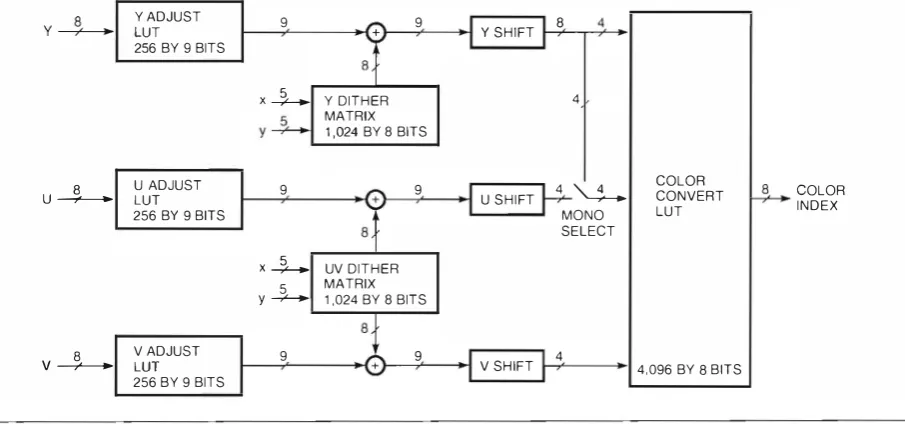
station. The authors review the J300 features, including a versatile color map rendering system, and the sub system design decisions made to keep product costs low.
Victor Bahl then presents the ]300 software that controls the hardware. The challenge for sofrware designers was ro obtain real-rime performance
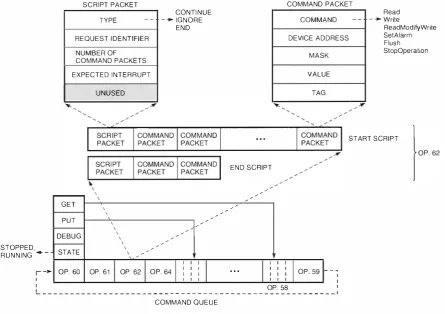
fi·om a non-real-time operating sys tem. A description ofrhe video sub system highlights the video library and an innovative use of queues in achieving good performance. This software architecture has been imple mented on Open VMS, Windows NT, and Digital UNIX platforms.
A third paper on video technology looks Jt delivering video without spe cialized hardware, that is, a sofrware only architecture for general-purpose computers that provides access to video codecs and renderers through a flexible application programming inrerf.1ce. Again, taster processors make a software-only solution possi ble :It low cost. Authors Victor Bah I,
Paul G:wrhier, and Bob Ulichney prdace the paper with an overview of industry-standard codecs and compression schemes. They then discuss the creation of the software video library, its an:hitecture, and its implementation of video render ing that parallels the ]300 hardware.
The final paper in the audio and video technologies secrion explicitly raises the question of what features are best implemented in hardware and what in software. The context ti:>r the question is a gr<lphics accelerator chip design that integrates traditional synthetic graphics features and video image display f<::atures-umil now,
Vol. 7 No.4 1995
implemented separately. Larry Seiler and Bob Ulichney describe the video processing implemenn.:d differently in two chips, both of which offer sig nificantly higher performance with minimal additional logic.
The common theme of our second section is the UNIX operating system.
Larry Cohen and John Williams pre sent the DECsafe Available Server
Environment (ASE), which provides higb availability tor applications run ning on Digital UNIX systems. They
describe the ASE design for detection and dynamic reconfigur<ltion around host, storage device, and nenvork fail ures, and review key design trade-offs that favored software reliability and data integrity.
Mike Palmer and Jeff Russo then contrast Encore Computer Corpora tion's set of debug and analysis tools for real-rime applications, called Parasight, with conventional UNIX
tools. They examine the Ceatures that are critical in an effective real-time debugging tool, for example, the abil ity to att3ch to a running program and to analyze several programs simul taneously. A description follows of the Parasighr product, which includes the features necessary for real-time debug and analysis in J set of graphi cal user interface tools.
Upcoming in our next issue are papers on a variety of topics, includ ing Digital UNIX clusters, eXcursion for NT, <lnd network services.
Foreword
Robert A. Ulichney Senior Consullinp, h:np,ineer
J<esearch and Ad�·unced Decelopment.
Cambric(u,e Research Lah
"Can you dig it ... New York State Throughway's closed, Man. Far
out, Man," announced a young Arlo Guthrie in rhe vernacular on the stage ar Woodstock in 1969. Reading these words may evoke a mental picture of rhe evem, but it sure is a lot more hm to hear :md see Arlo deliver this mes sage. Audio and video technology is the featured theme of this issue of the
Digital Technicai.Jounzctl.
Four yearsbefore
Arlo's traffic report, in rhe year that a young Digital Equipment Corporation introduced the PDP-8, an interesting forecastwas made. Gordon Moore, who was yet to co-found Intel, asserted in a lit tle-noticed paper that the power and complexity of the silicon chip would double every year (later revised to every 18 months). This prediction has been generally accurate for 30
years and is today one of the most celebrated and remarkable "laws" of the computer industry.
While we enjoyed rhis exponential hardware ride, there was always some question about the ability of applica tions and software to keep up. If any thing, rhe opposite is rrue. Software has been described as a gas that imme diately fills rhe expanding envelope of hardware. Ever since the hardware envelope became large enough to begin to accommodate crude forms of audio and video, the pressure ofrhe software gas has been great indeed. Digitized audio and video represent enormous amounts of data and stress the capacities of real-rime processing and transmission systems.
Digital has particip;1red in expand ing rhe envelope and in tilling ir;
irs hardware performance is record breaking and its audio and video tech nologies are srare-ofrhe-arr. Looking specifically at the tour categories into which computer companies segment audio and video technologies, Digital is making contributions in each of these: analysis, synthesis, compression, and input/output.
MIT's Nicholas Negroponre believes that practical analysis, or interpretation, of digitized audio and video will be the next big advance in the computer industry, where noth ing has changed in human input (key board and pointing device) since, well, the Woodstock era. Digital is actively investigating methods tor speaker independent speech recognition and, in the area of video analysis, means to automatically detect, track, and recognize people.
The synthesis of still and motion video, more commonly referred to as computer graphics, has traditionally been a much larger area of focus tlun the handling of sampled video. Syn thesis of audio, or text-to-speech conversion, is the topic of one of the papers in this issue; DECtalk is largely considered to be the best such synthesis mech:mism available.
W hen audio or video data are rep resented symbolically, :IS is the case after analysis, or prior to synthesis, a most efficient form of compression is implicitly employed. However, the task of storing or transmitting the raw digitized signal can be overwhelm ing, especially at high sampling rates. Compression techniques are relied upon to ease the volume of this datJ in two ways:
( l)
reducing statistical4
redun,hncy and (2) pruning data that ll'ill not be noticed bv exploiting ll'hat is kno"'n about hum:m percep tual systems. In this climate ofinreroper abilitv and open svstems, Digital recognizes the imporrance of adher ing to accepted st;mdards for audio ;lnd video compression versus the promotion of some propriet;lrv reprcscnt<ltion.
Th�.: last category is that of
l/0.
Audio :-tJH.J video input require ameans f(>r signal acquisition and ;lnalog-to-digital conversion. The focus here is on preserving the integ ritY of the signal Js opposed to inter preting the data. Proper rendering is needed for good-quality output, ;llong ll'ith digit;ll-to-;malog con \'ersion. �or both ;ludio and video, trade-ofrs must be made to accom modJtc the highest degree ofs:�mpling resolution in time and amplirude.
Digital is a leader in the ;lrea of video rendering with our AccuVideo technologv, aspects of which aJT
described in p:1rr in three papers in this issue. Video rendering incorpo rates ;111 processing that is required to tailor \·ideo to a p;1rricular target dis play. This includes soling and filter ing, color adjustment, dithering, and color-space com·crsion from video's J u mi nance-chromi nance represen ration to R.CB. In irs most general form, Digital's rendering tedmology ll'ill optimize displav qualit\' �i\·cn an)' number of available colors.
The c.1rliest form ofAccuVidco :�ppeared in a 1989 testbed, known imern;llh· as Picror. This led to the widely distributed research prototype called )video in I 991. )video w;lS
a TUR130ch;mnel bus option with J PEG compression and decompres sion and \\·as the first prototvpe to combine dithering with color-space conversion. }\·ideo was the basis for design of the Sound & Motion
J
300 product, which incJ uded a rem:1rbblv improved dither method. A f(>llow-onro }300 is a PCJ-bus \·crsion c1lled ruiiVideo Supreme.
In products th;lt render RG B data instead of video, Digit<ll's rendering tcchnolog\' is reterrcd to :1s Accu Look; except tix this one difkrcnce, the rest of the rendering pipeline is idcntic:li ro AccuVideo. Accu Look products include gr;lphics options tor ll'ork
stations: ZLX-E
(S�B+)
designed for the TU RBOchanncl and ZLXp-1-:(TGA) designed as an cntr\·-in·cl product r(Jr the PCl bus.
Accu Video rendering is a key tcarurc in the DECchip 21130 PC graphics chip and in the TGA2 high-end workstation graphics chip. While noted f(>r irs high image qual it\', A.ccuVideo is also cfticientk implemented in software; it is av:�il able as p:-�rr of a tool kit with evcrv Digital UNJX, Open VMS, Jnd Windcms �T platfim11.
vVith Moore's law on the loose, ir can be <lrgued that hardware imple mentations oh·ideo rendering arc not justified ;ls so!tw;1rc-only versions grow in speed. Although toci:ly's pro cessors c:-�n indeed handle the pl:l\' bxk of video bv both decompressing and rendering at :1 qu:�rrer of hill size, little is lett f(Jr doing anvthing else.
Moreo\·cr, users will want. to scale up the dispby sizes, <lnd perh;lps add multiple \'ideo stre;1ms-and still be
Vol. 7 0\io. 4 1995
:-�ble to usc their processors to do other things. for rhe nc;lr term, h�lrd \\·are \·ideo rendering is justified.
The five p:1pcrs that make up rhc ;ludio and video technology theme of this issue :tre bur a sndl sampling of the \\·ork under \\;1\. in rbis are:t at Digital; look tor more p<lpers to t(>lloll' in subsequent issues of this
Journal.
As rhc audi,, .md \·ideo g.JsDECtalk Software:
Text-to-Speech
Technology and
Implementation
DECtalk is a mature text-to-speech synthesis technology that Digital has sold as a series of hardware products for more than ten years. Originally developed by Digital's Assistive Tech nology Group (ATG) as an alternative to a character-cell termi nal and for telephony applications, today DECtalk also provides visu ally handicapped people access to information. DECtal k uses a digital formant synthesizer to simulate the human vocal tract. Before the advent of the Alpha processor, the com puta tional demands of this synthesizer placed an extreme load on a workstation. DECtalk Software has an application program ming interface (API) that is supported on multiple platforms and multiple operating systems. This paper describes the various text-to-speech technologies, the DECtalk Software architecture, and the API. The paper also reports our experi ence in porting the DECtalk code base from the previous hardware platform.
I
William I. Hallahan
Du ring the past ten years, advances in computer power
have created opporruniries for \'Oice input and our
pur. Many major corpor;nions, including Digita l ,
provide database access through the telephone. The
advent of Digital's Alpha prou.:ssor has ch:mged the
economics of speech synthesis. I nstead of an expen
sive, dedic:1ted circuit card that supports onlv ��single
ch annel of symhesis, svstem developers can usc an
Alpha- b:1sed workstation to su pport many channels
simul taneously. In add ition, since text-to-speech con
version is a light load tor an Alpha processor, appli ca
tion developers can tl·eely integrate text to speech i nto
their products.
Digital's DECtalk SoiT\\"are provides natu ral -sound
ing, highly inteJligible text-to-speech syntl1esis. It is
available tor
the Digital UNIX operati ng system on
Digital's Alpha-based platt(mns and tor Microsoft's
Windows NT operating system on both Alpha and
Intel processors. DEC:talk Software provides an easy
ro-use application program ming intert:1ce
(API)
that is
fu lly integLH<.:d with the computer's audio subsystem.
The
text-to-speech code was ported ti·om the software
t(>r
the DEC:talk
PC card, a lm·dware product m�1de bv
Digital's Assisrive Technolot,')' Group . This software
COIJStiturcs over 30
man ye:1rs of develo�1111enr
effort
:1nd contains approximatdy
160,000
lines of
Cpro
grammi ng language code.
This paper begins by d iscussing rhe
k:nun:sof
DEC:ral k Software and bridly describing the various
text-to-speech t<.:dmologies. It then presents a descrip
tion of the DECtalk Software architecrurc and the
API . Final ly, the paper relates our cxperiwce in port
ing the DEC:talk code b<lSe.
Features of DECtal k Software
The DECtalk Software development ki t consists of a
shared li br:trv (a dvnamic l i nk librarv on Windows
NT),
alink librarv, a header tile that defines the
symbols and nlllctions used by DECralk Software, SJ111ple
applications, and sample source code that demo n
stt·ates t h e A P I .
6
DECtal k Software supports nine preprogrammed
voices: tou r male, t(Ju r female, and one child's voice .
Both the API and in-line text commands can control
the voice, the speaking rate, and the audio volu me.
The volume command supports stereo by provid ing
i ndependent control of the left and right cbannds.
Other in-line commands play wave audio files, gen
erate singl e tones, or generate dual-tone multiple
frequency (DTMf) signals for telephony applications.
Using the tex
t
-
to-spe
e
ch API, applications can play
speech through the computer's audio system, write
the speech samples to a wave audio tile, or write the
speech samples to buffers supplied by the appl ication.
DECtalk Software produces speech in
3
audio formats:
16-bit pulse code modulation (PCM) samples at an
ll,025-hertz ( Hz) sample rate, 8-bit PCM samples at
an 1 1,02 5 - H z sample rate, and J.-L
-
law encoded 8-bit
samples at an 8,000-Hz sample rate. The first two f(x
mats are standard multimedia audio formats for per
sonal computers (PCs). The last format is the stand ard
encod ing and rate used tor telephony appl ications.
The API can also load a user
-
g
enerated dictionary
that def-ines the pron unciation of application-specific
words. The development kit provides a window- based
too
l to generate these d ictionaries. The kit also con
.
rai ns a window-based application to speak text and an
electronic mail-notitlcation program. Sample sou rce
code includes a simple window-based application that
speaks text, a command l ine application to speak text,
and a speech -to-memory sample program .
The version o f D ECtal k Software for Windows
NT
also provides a text-to-speech dynamic data exchange
(DOE) server. T h is server i ntegrates with other appli
cations such as Microsoft \Vord . Users can select text
i n a Word document and then proofread the text
merely by clicking a button. This paper was prootre:td
usi n g DECtalk Sofhvare running a native version of
Microsoft Word on an AlphaStation workstatio n .
Speech Terms and DECtalk Software
Hum:m speech is produced by the vocal cords i n the
larynx, the trachea, the nasal cavity, the oral cavity, the
tongue, and the lips. Figure
lshows tbe human
speech organs. The glottis is the space between the
vocal cords. For voiced sounds such as vowels, the
vocal cords produce a series of pulses of air. The pu lse
repetition frequency is cal led the glottal pitch. The
pulse train is reterrcd to as the glottal waveform. The
rest of the articulatory organs filter this waveft>rm.'
The trachea, in conjunction with the oral cavity, the
tongue, and the l ips, acts l i ke a cascade of resonant
tubes of varying widths. The pulse energy reflects
backward and forward i n these organs, which causes
energy to propagate best at certain fr-equencies. These
are called the f()fmant ti-equencies.
DigiLll Technical )oumcli Vol. 7 No.4 1995
NASAL CAVITY
Figu re
1
The Speech Organs
LARYNX
VOCAL CORDS
TRACHEA
The primary discrimi nation cues for different vowel
sounds are tbe values of the first and second tormant
frequency. VO\vels are either t!-ont, mid, or back vow
els, depending on the place of articulation. They arc
either rounded or unrounded, depending on the posi
tion of the lips. American English has 12 vowel
sounds. Diphthongs are sou nds that change smoothly
from one vowel to another, such as in
hoy, bow,and
bay.Other voiced sounds include the nasals
m, 11,and
np,
(as in
ing).
To produce n asals,
�1person opens the
velar tlap, which con nects the tl1roat to the nasal cavity.
Liqu ids are the vowel-like sounds
I and r.Glides are
the sounds y (as i n
you) and
w(as i n we).
Breath passin g through a constriction creates tur
bulence and produces unvoiced sounds. fand
sare
unvoiced sounds cal led ti·icat.ives. A stop (also called
:1pl osive) is a mome ntary blocking of the breath
stream tcJIIowed by a sudden release . The consonants
p,
h.t.
d, 1?.,and
garc stop consonants. Openin g the
mouth and exhaling rapidly produces the conson ant
h.
The
h
soun d is called an aspirate. Other conso
nant s such asp.
t,and
kfrequen tly end in aspiration,
especially when t hey start a word.
Anaffricativc is a
stop i mmediately followed by a fricative. The English
sounds
ch
(as in
chett'andj(as
i njar) are at1i-icatcs.
These sounds arc all American English phonemes.
Phonemes are the smallest u nits of speech that d istin
guish one uttera nce from another in a particular
language2 An
allophone is an acoustic manifestation
of a phoneme. A particular phoneme may have many
al lophones, but each <lllopho nc (in context) will
sound l ike the same phoneme to a speaker of t h e lan
guage that detines the phoneme. A n other way of say
ing this is, if two sounds have differen t acoustic
Phones are the sets of all phonemes and allophones
tor all languages. Linguists have developed an interna
tional phonetic alphabet ( I PA) that has symbols for
almost all phones. This alphabet uses many Greek
letters that are difficult to represent on a computer.
American li ngu ists have developed the Arpabet
phoneme alphabet to represent American English
phonemes using normal ASCII characters. DECtalk
Software supports both the IPA symbols tor American
English and the Arpabet alphabet. Extra symbols are
provided that either combine certain phonemes or
speci�r certain al lophones to al.low the control of fine
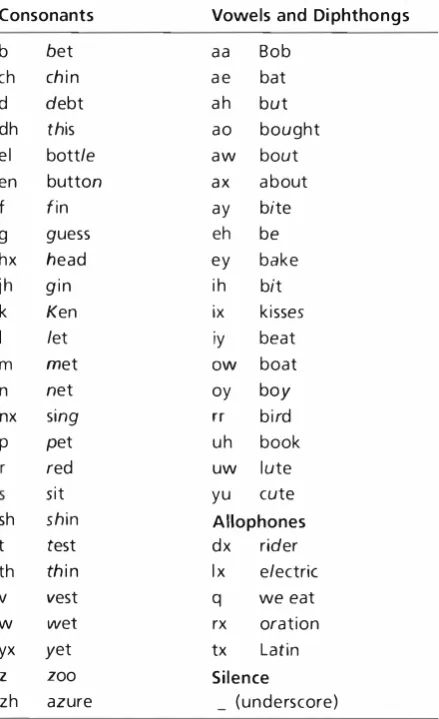
speech features. Table 1 gives the D ECtalk Software
p honemic symbols.
Speech researchers often use the short-term spec
trum to represent the acoustic manifestation of a
sound. The short-term spectrum is a measure of the
h·equency content of a windowed (time-limited ) por
tion of a signal. For speech, the time wi ndow is typi
cally between 5 mil liseconds and 2 5 milliseconds, and
Table 1
DECta lk Software Phonemic Symbols
Consonants Vowels and Di phthongs
b
bet
a a
Bob
ch
chi na e
bat
d
debt
a h
but
dh
this
ao
bought
el
bottle
aw
bout
en
button
ax
a bout
f
fin
ay
bite
g
guess
eh
be
hx
head
ey
bake
jh
g i n
i h
bit
k
Ken
ixkisses
I
let
iy
beat
m
met
OWboat
n
net
oy
boy
nx
sing
rrbird
p
pet
u h
book
red
uw
lute
sit
yu
cute
sh
shin Allophonest
test
dx
rider
th
thi nl x
electric
v
vest
q
we eat
w
wet
rx
oration
yx
yet
tx
Latinz
zoo
Silencezh
azure
_(underscore)
the pitch frequency of voiced sounds varies from 80
Hz to 280 Hz. As a result, the time window ranges
tl-om slightly less than one pitch period to several pitch
periods. The glottal pitch frequency changes very litrle
in this interva l . The other articulatory organs move
so l ittle over this time that their ti ttering effects do
not change appreciably. A speech signal is said to be
stationary over this interval .
The spectrum h as two components for each fre
quency measured, a magnitude and a phase shift.
Empirical tests show that sounds that have identical
spectral magnitudes sound similar. The relative phase
of the individual frequency components plays a lesser
role in perception. Typically, we perceive phase differ
ences only at the start of low frequencies and only
occasional ly at the end of a sound. Matchi ng the spec
tral magnitu de of a synthesized phoneme (al lophone)
with the spectral magnitude of the desi red phoneme
( ta ken from hu man speech recordings) always
improves intelligibility 3 This is the synthesizer
calibr3-tion technique used tor DECtal k Software.
A spectrogram is a plot of spectral magnitude slices,
with frequency on the y axis and time on the
.xaxis.
The spectral magnitudes are specified either by color
or by saturation for two-color plots. Depending on the
time interval of the spectrum window, either the pitch
frequency harmonics or the tormant structure of
speech may be viewed . It is even possible to ascertain
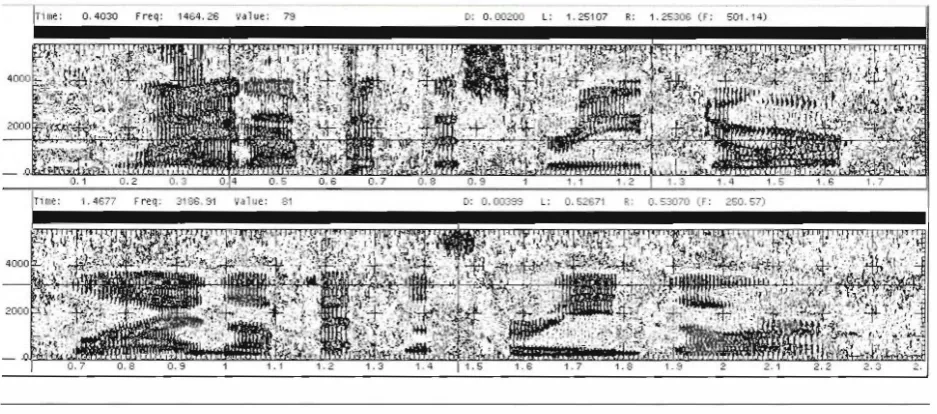
what is said tl·om a spectrogram. Figure 2 shows spec
trograms of both synthetic and human speech for the
same phrase . The tormant frequencies are the dark
regions that move up and down as the speech organs
change position. Fricatives and aspiration are charac
terized by the presence of high fi:equencies and usually
have much less energy than the fclrmants.
The bandwidth of speech signals extends to over
10 ki lohertz ( k Hz) although most of the energy is
confined below 1 ,500 Hz. The m inimum in telligible
bandwidth for speech is about 3 kHz, but using this
bandwidth, the quality is poor. A tel ephone's band
width is 3.2 kHz. The DECtalk PC product has a
speech bandwidth just under 5 kHz, which is the same
<lS
the audio bandwidth of an AM broadcast station .
The sample rate of a digital speech system must be at
least t\vice the signal bandwidth (and might have to be
higher if the signal is a bandpass signal ), so the
D ECtalk PC uses a 10-kHz sample rate . This band
width represents a trade-off berween speech quality
and the amount of calcu lation (or CPU loading). The
DECtalk Software synthesizer rate is
l l
,025 Hz,
which is a standard PC sample rate. An 8-kHz rate is
provided to support telephony applications.
People often perceive acoustic events that have
different short- term spectral magnitudes as the same
phoneme. For example, the k
sound i n the words kill
[image:9.584.45.265.355.715.2]8
Figure
2
T"·o Spectrograms of rile Crrerancc " Line up at the sncen door." Tile upper spectrogl·c\111 is the au thm's �pee ell. The l o\\·cr spcctrogr:un is sYnthetic speech produced b1· D ECt:llk Soft\\·a n:.
and cool have ver y diHcrent magnitude spectra . An American percei1·cs the two spectra as the same sound; IH)II CI'cr, the sounds :1rc very d i frc re n t to someone tt·om Saudi Arabia. A Japanese person does nor per
ceive :my d i fference between the words car and call.
To clll Engl ish spea
k
er, the r and the I sound difkrcnt c1·cn though they have nearlv identical magn itu d e spcctLl . The I sou nds in the 1\'0rds w/1 :md /eo/arc d i f krcnt spectra l ly ( acoustical l v ) b u t ha1·e the ScllllC sound. Thus they arc the same phoneme in English . Several a llophones a re requ i red to represent t h e r�phoneme. Most consonant phonemes req u i re sc1-cral difkrcnt : tllophoncs because the vol\'cl sounds nnt to them cha nge their acoustic manifestations. This dkct, Gll lcd coarricu lation , occurs because it is often un nec essary rc>r the articulatory orga ns to reach the ti nal position used to generate a phoneme; they merdv need to gesture to\\'ard the tined position . Another
type of coarriculation is part o f the grammar of :� L111gu:1gc . For example, the phrase dou ·/ you is often pronou nced doct il choo.
A l l allophones that n:prcscnt rhc phon eme k arc prod uced lw closing the 1·e l u m and then suddenly opening it and releasing the broth strc:�m. Speakers of the English la nguage perceive all these J!l ophoncs as the s:1mc sou nd, which suggests that synthesis may be modeled by an articulato ry model of speech prod uc tion . This model ll'ould p resun1Jblv handle coarricula tion efkcts that are not due to gram m:1r. I t is currcnrlv nor known how to consistently determine speech org�1n positions ( or control strategies) directly h·om acoustic speech data, so articu latory models have had l ittle success tor text-to-speech synrhcsis 4
Di�iral Tcchnicll )ound Vol. 7 No. 4 1 <)<)5
For English, the voicing pitch provides cues to cbusc boundaries and mcJ ning. ChJnging the ti·c qu cncv of the 1 i brarion of the I'OCll cords ,·aries rhc pitc h . I ntonation is the shape of the pitc h l'ariarion across :1 d:tllse. The sentence " Ti m is leaving.'' is pro nou nced differently than "Tim is leavi ng>" The l :ntcr torm req u i res difkrcnt intonation, depending on 11 hcthcr the inrcnt is to emphasize th:1 t it is "Tim" ll'ho is le:wing, or tbar "leaving" is 11·h ar Tim i s ro do. A word or p h rase is stressed bv increasing irs pitc h , amplitude, o r duration, o r some com bination of these . In tonation incl udes p i tc h ch<lngcs due ro stress and norm<ll p i tch \'ariarion :�cross a clause . Correct i n toJJ:l rion is not J!II'J\"S possible because i t requires speech understanding.
O ECrJik
Software pcrt(>nllS an an<llysis of clause structure that i ncludes tl1ct(mn
classes of both words and pu nctuation and then applies a pitc h contour to a clause . ·rhct(mn
class defini tions include sym bols tor the p:urs of speech ( :� rticlc, adjecti1·c, adve rb, conju nction , noun, preposition, verb, etc . ) and sym bols to indic:�tc i f the 1vord is a number, Jn abbreviation, a homograph, or a special word ( requir ing special propricrar\' processing ) . for the scnrcncc, "Tim is lcal'i ng)" rhc question mark u uses D FCr:1lkSoftware to raise the ti na! p i tch, bur no stress is pur on "Tim" or " l eaving." Neutral i ntonation sometimes sounds boring, but at least it docs not sou nd foolish.
Text-to-Speech Synthesis Techniques
f n continuous speech , word durations are ofi-en short ened and coarriculation efkcrs can occur between adja cent words. There is also no way ro adjust the intonation of recorded words. A huge word database is req uired , and words th;n :tre nor in rhe d:trabase cannot be pro nounced . The resulting speech sou nds choppy.
Another word concatenation technique uses record ings of the �i.>rmanr patterns of words . A �i.m11ant synthesizer smoorhes �(>rnl:tllt transitions ar the word bou ndaries. A 1·:-triation of this technique uses linear prcdictiw coded ( LPC) words. An ad1·a ntagc of the t(>rmanr symhcsizer is that the pitch and du r:ttion of words may be varied . UntiJrtu nately, since the p honeme bound aries within a word are difficu l t to determine, the pitch and d u r;nion of the individual phonemes un nor be ch:mged . This technique also requires a L1rge database. Again, a word can be spoken on ly if it is in the database. In genera l , the quality is poor, although this technique has been used with some success ro speak numbers.
A popular technique today is ro store actu:tl speech segments that contain phonemes and p honeme pairs. These sp..:cch segments, known as diphones, are obtained trom recordings of human speec h . They con rain all coarricularion drects that occur tor a particular language. Diphones are concJtcnatcd to produce words and sentences. This solves the coa rticu larion problem, bur it is impossibk to accuratelv modi�)• the pitch of a tly s<.:gmenr. The intonation :tcross a clause is gencr :tl ly incorrect. Even worse, the pitch varies trom s<.:g mcnt to segment within a word . The resulting speech sounds unn<Hural, u nless the system is spea king a phrase that tht di phones came from ( this is a dc1·ious marketing plov ) . Nevertheless, d iphone synthesis pro d uces speech that is fai rly i mclligible. D i phonc syn thesis requir<.:s rc btively l ittle compute power, but it is memory intensive. American Engl ish requi res :tpprox imately 1 ,500 dip hones; diphonc synthesis wou ld have to provide a large database of approximatelv
3
m<.:ga bvres tor each 1·oicc i ncluded bv rhe svstem . . .DECtalk Software uses a d igital tc>rmant symhesizcr. The syn thesizer in put is derived from phonemic sym bols instead of stored
t<.mn:tnt
patterns as in :1 conve n tional t<.m11ant svmhesizer. I ntonation i s based on clause structure. Phonetic rules detcrmi nc coarticu la tion cfkcts. The synrhcsizer req uires only two rabies, one t()r each gend<.:r, to map al lophonic variations of each phoneme to <Koustic events. Modification of vocal tr:tct parameters in the synthesizer allows the system to gmcratc multiple voic<.:s without a signiticant increase in stor•lge requircmcms. (The D ECtJI k code and data occupy less than 1 . 5 m<.:gabyres. )Poor-q uality spetch is d i fticu l t to understand and causes tatigue. Linguists usc standard phoneme recog nition tests and comprehension tests to measure the i ntell igi bility of synthetic speech . The D FCta l k tamilv of prod ucts achieves the highest test. scores of a l l text to-speech systems on the market.; Visually handi capped individuals prdcr D ECtalk ovn all other text-to-speech systems.
How DECta/k Software Works
DECulk Software consists of eight processing threads:
(
1 )
the text-queuing thread, (2) the command parser,( 3)
the letter-to-sou nd converter,(
4) the phonetic and
prosodic processor, ( 5 ) the vocal traer model( V T M )
thread,
(
6) t h e :tudio rhn.::td ,
( 7 )
t h e synchronization thread , and ( 8 ) the timer thread. Tht tex t,VTM,
audio, synchronization , and rimer threads ::1re nor part of the DECta l k PC soft,vare (the D ECtalk PC
VTM
is on a sptcial Digi t:tl Sign<li Processor) and have been addtd to DECtalk Sofuvare. The audio th read creates the timer thread 1\'htn the text-to-speec h S\'Stem is i nitialized . Since tht audio thread docs not usuallv open the audio dcvic..: u nt i l a suftici<.:IH number of audio samples are qu..:ucd, rhe timer th read serves to t(lrcc the audio to play in case any sampks have been in the qu eu<.: too long. The DECta l k Software th reads pert(xm serial processi ng of data as sholl'n in Figu re
3.
CALLBACK FUNCTION FOR UNIX MESSAGE FOR WI NDOWS NT POLL AUDIO POSITION
CALLBACK FUNCTION FOR UNIX. MESSAGE FOR WINDOWS NT
�'";""'"
SYNCHRON IZATION EVENT�
�
�
���
ONIZATION
f-1
COMMANDAPPLICATION
�
TEXT QUEUING -· PARSER , ... THREADTHREAD
I
ASCII TEXT ASCII TEXT ASCII TEXT
KEY:
INDICATES PIPES
Figure 3
The DEC:r;llk Soft\\'arc Archir..:crurc tor \.VindO\\'S NT
SYNCHRONIZATION
•
MESSAGES
_,
LETIER·TO· PHONETIC AND
PROSODIC VOCAL TRACT SOUND ,
... PROCESSING , ... MODEL THREAD
�
AUDIO THREAD THREADTHREAD
PHONEMES VTM
COMMANDS
Digital Tcchnicc1l Journal
SPEECH SAMPLES
1 0
Multithreading al lows a simple a n d efficient means of throttling data in m ultistage, real -time systems. Each thread passes its output to the next thread through pipes. Each thread has access to nvo pipe han d les, one for input and one for output. Most th reads consist of a main loop that has one or more calls to a read_pipe fu nction tollowed by one or more calls to a write_ pipe function . The write_pipe function wil l block processing and suspend the th read if the speci fied pipe does not have enough free space to receive the specified amount of data. The read_ pipe function will block processing and suspend the thread if the specified pipe docs not contain the requested amount of data. Thus a n active th read will eventually become idle, either because there is not enough i nput data, or because there is no place to store its output.
The pipes are implemented as ring buffers. The ring bu ffer item cou nt is protected by mutual-exclusion objects on the Digi ta l U N I X operating system and by critjcal sections on the Windows NT operati ng system. The pipes are created at text- to-speech initialization and destroyed during shutdown . The DECtalk Software team implemented these pipes because the pipe cal ls supplied with the Digital UNIX and Windows NT operati ng systems are f()f interprocess communication and arc not as efficient as our pipes.
The DECtalk Software threads all used different amou nts of CPU time. The data bandwidth increases at the output of every thread between the command thread and the VTM thread. Since the VTM produces audio samples at a rate exceeding 1 1 ,025 samples per second, it is no su rprise that the VTM uses the most
CPU time of all threads. Tab le 2 gives the percentage of the total application time used by each thrc<�d when the Windows NT sample application "say" is continu ously speaking a large text tile on <�n Alpha AX P 1 5 0
PC product. The output sample rate is 1 1 ,025 Hz. Note that the "say" program main thread blocks and uses virtually no CPU time after queuing the text block. These percentages have been calculated from times obtained using the Windows NT ped(xmance monitor tool.
Because the data bandwidth i ncreases at the output of successive threads, it is desirable to adjust the size of each of the pipes ring bu ffers. If one imagines that all the pipes had an i n fi nite length (and the audio queue was intinite ) and that the operating system switched thread context only when the active thread yielded, then the text thread wou ld process al l the ASCII text data before the letter-to-sound thread wou ld ru n . Likewise, each successive thread would r u n t o comple tion before the next thread became active. The system l atency would be very high, but the thread switch ing woul d be minimized . The system wou ld use 1 00 percent of the CPU until all the text was converted to audio, and then the CPU usage would become
Digital T�chnical Journal
Vol. 7 No. 4 1995Table 2
DE Ctalk Software Th read Loading
T h read
Appl ication (say.exe) Text queue Command parser Letter-to-sound processing Prosod ic and phonetic process ing Vocal tract model Audio
Sync hron ization Timer
System
Percentage of Total Application CPU Time
1 .0
0.2 1 .4 2.4
1 8.3
7 1 . 9 2.9 0.0 0.0 1 .9
very low as the audio played out at a fixed rate. Alternatively, if all the pipes are made verv short, the system latency is low. I n this case, a l l but one of the thre<Jds will become blocked i n a very short time and the startup transient i n the C P U loadi n g wil l be mini mized. Untortunately, the threads wi ll constantly switch, resulting in poor efficiency. What is needed is a trade-off benveen these nvo extremes.
For a speciticd latency, the opti m u m pipe si zes that m i n imize m e mory usage for a given efficiency are in a ratio such that each pi pe contains the same temporal amount of data . For example, let us assu me that 64 text characters ( requ iri n g 64 bytes) are i n the command thread . They p roduce approxi mately 100 phonemes (requiring 1 ,600 bytes) at the output of the l etter-to-sound thread a nd approximately 750 VTM control commands ( requiring 1 5 ,000 byres) at the output of the prosodic and p hon etics thread. I n such a case, the size o f the input pipes for the com mand, l etter- to-sound, and prosod ic and p honetic threads cou l d be made
64,
1 ,600, ;:md 1 5 ,000 bytes, respectively, to minimize pipe memory usage t(>r the speci tied latency. ( A l l numbe rs are h ypotheticaI . )
The pipe sizes i n DECta l k Software actua l ly increase at a s l ightly faster rate than necessary. We chose the E:�ster rate because memory usage is not critical since a l l the pipes Jre small relative to other data struc tures. The size of the VTM input pipe is the m ost critical : it is the largest pipe because it supports the largest data bandwidth.The Text Thread
null-terminated text strin g to the system. This API function copies the text ro a bu ffer and passes the buffer ( using a special message structure ) to the text thread . This is done using the operatin g system's PostMessage function for vVindows NT and a thread-sat-e linked l ist for Digital U NIX . After the text th read pipes the enti re text stream to the command thread, it ti·ees the text buff-er and the message structure.
The Command Processing Thread
The command processing th read parses in- l i ne text commands. These com mands control the text-to speech system voice selection, speaking rate, and audio volume, and adjust many other system stare parame ters. For OECtalk, most of these commands <lre of the torm [ : command <parameters> ] . The strin g " [ : " specifies rh:n a command stri ng �allows . The stri ng "]" ends a comma nd. The toll owi ng stri ng ill ustrates sev eral in-line commands.
[ :nb][ :ra 200] My name is Betty. [ :play aud io.wav]
[ :dial 5 5 5- 1 2 1 2 ] [ : tone 700 1 ,000]
This text will select the speaker voice �()r " Betty," select a speaking rare of 200 words per minute, speak the text "My name is Berty. " and then p!Jy a wave audio �i le named "audio.wav." Final ly, the DTMF tones for the number 5 5 5 - 1 2 1 2 are played followed by a 700-Hz rone �or
l ,000 milliseconds.
Because the text-to-speech system may be speaking while simultaneously processing text i n the command thread, it is necessary to synchronize the command pro cessing with the audio. The DECtal k PC product ( from which we ported the code) did not perform synchro nization unless the application placed a special string bdore the vol u me command . For DECralk Software, asynchronous control of all fu nctions provided by the in-line commands is already available through the text-to-speech APT cal ls. For this reason, the DECtalk Software in-line commands are all synchronous.
The D ECt:tlk command [ :vol ume set 70] wil l set the audio volume l evel to 70. Synchronization is per formed by i nserting a synchronization sym bol in the text stream . This symbol is passed through the system u ntil it reaches the
VTM
thread. When theVTtvl
thread receives a synchronization sym bol , it pipes a message to the synchronization thread . This message causes the synchronization thread to signal an event as soon as all audio ( that was queued before the message) has been played . The volu me control code in the com mand thread is blocked until this event is signaled . The synchronization thread also handles commands of the form [ : i ndex mark 1 7 ] . Index mark commands may be used to send a message value ( i n this case 1 7 ) back to an application when the text up to the index mark command has been spoken.The command thread passes control messages such as voice selection and speaking rate to the letter-to soun d and the prosodic and phonetic processing threads, respectively. Tone commands, index mark commands, and synchronization symbols are format ted i nto messages and passed to the letter-to-sound thread . The command thread also pipes the input tex t string, with the bracketed command strings removed, to the letter-to-sound thread .
The Letter-to-Sound Thread
The letter- to-sound
( LTS)
thread converts ASCTI text seq uences to phoneme sequences. This is done using a rule- based system and a dictionary tor exceptions. It is the single most complicated piece of code i n a l l of DECtalk Sot-i:ware. Pronu nciation of English language words is complex. Consider the dif'ferent pronu ncia tions of rhe stri ng ough in the words rough, through, hough. thought. dough, cough, and hiccough -" Even though theLTS
thread has more than 1 ,500 pronun ciation rules, it requires an exception dictionary with over 1 5 ,000 words.Each phoneme is actually represented by a structure that contains a phonemic symbol and phonemic attri butes that include duration, stress, and other propri etary tags that control phoneme synthesis. This is how allophonic variations of a phoneme are handled. In the descriptions that tal low, the term phoneme refers either to this structure or to the particular phone spec i�ied by the phonemic sym bol in this structure.
The
LTS
thread first separates the text stream into clauses. Clause separation occurs in speech both to encapsulate a thought and because of our limited lung capacity. Speech run together with no breaks causes the listener (and the speaker) to become fatigued . Correct clause separation is important to achieve natural into nation. Clauses are deli neated by commas, periods, exclamation marks, question marks, and special words. Clause separation requires simultaneous analysis of the text stream. For example, an abbreviated word does not end a clause even though the abbreviation ends in a period . If the text stream is sufficiently long and no clause delimiter is encou n tered , an artificial clause boundary is inserted into the text stream.After clause separatjon, the LTS thread perkmns text normalization . For this, the
LTS
thread provides spe cial processing rules tor numbers, monetary amounts, abbreviations, rimes, in-line phonemic seq uences, and even proper names. Text normalization usually refers to text replacement, but i n many cases theLTS
thread actually inserts the desired phoneme sequence directly into irs output phoneme stream instead of repl acing the text.The LTS thread converts the remai ning unprocessed words to phonemes by using either the exception dic tionary or a rule-based " morph" lexicon . (The term
morph is derived from morpheme, the minimum u nit
1 2
o f meaning
tor
a hl11guage . ) B r combining these t\:vo :1pproaches, me mory utilization is minimized . A user ddinable d ictiona ry may also be loaded ro detlnc application-specific terms. During this conversion, theLTS
thread assigns one or more f-(xm class�.:s to each word . As memioncd previously, form class ddinitions include symbols For abbreviations and homographs. A homograph is a word that h:�s more than one pro nunciJtion, such as a/tenwte or console. DECta l k SoFtware prono,Jnces most abbreviations a n d homo gra phs correcrly in context. An alternate pronu ncia tion of a homograph may be fort.:ed bv inserting the in-line command [ : pron alt] in fi·ont ot· the word. D ECralk Sorhvarc speaks the phrase " Dr. Smith lives on Smith Dr." correctly, as " Doctor Smith lives on Smith Drive ." It uses the correct pron unciation of the homograph liws.Before applying ru les, the
LTS
thread pcrt(mns a di ctionary lookup f-or each unprocessed word in a clause . If the lookup is successfu l , the word'sf(m1l
classes and a stored p honeme seq uence are extracted from the dictionary. Otherwise, the word is rested for an English suftl x, using a su fri x ta ble. If :1 s u nl x isfound , sometimes the form class of the word can be in terred . Suffi x rules are applied , and the dictionary lookup is repeated with the new suff-Ix-stripped word . For example, ti1L word test ing r�.:quires the rule, locate the suHix ing and remove it; whereas the word C/1'/a�)IZ ing req uires the rule, locate rht.: suffix ing and replace it with e. The su fti x rules and the dictionary lookup are recursive to handle words that end in m u l tiple suffixes such as endless!)'.
If the word is not in the d ictionary, rbe
LTS
th read performs a decomposition of the word using morphs. D ECtal k uses <I morph table to look up the phonemic representation of portions of words. A morph :tl\\'a\'S maps onto one or more English words and can be represented by a letter string. Morphs generally consistCLAUSE TEXT
of one or more roots that may contain aftl xcs and suf fixes. AJthough ne\\' words m:�y tl·equcn th' be added to a language, new morphs :1re rarelv added . Thcv arc essential ly sound groupings that make up many of the words of a Lmguage . DEC:ta l k contains a table with
hu ndreds of morphs and their p honemic representa tions. Either a single character or a set of characters that resu lts in a single phoneme is rcrcrred to as <I grapheme. Thus this portion of the lcrrcr-ro-sound conversion is referred to as the grap heme-to-phoneme translator. Figu re 4 shows the architectu re of the l . .TS
thread .
J\tiorphcmcs are abstract grammatical units and \\'ere originally ddined to descri be words that can be s�.:g me nted , such as tall. tollc1; and tallest. The word
tallest is made
ti·om
the morphemes tall and est. The word tccnt decomposes i n to the morphemes go andPAST.
Thus a morpheme does not nccessari lv m:�p directly onto :1 derived word . Many of the pronuncia tion rules arc based on the morphemic represe ntations of words.Manv morphs have multiple phonemic representa tions that G i l l depend on t.:ithcr word or phonemic con
text. The correct phonemic symbols a1T determined by morphophonemic rules. For cx:�mplc, plur<11 words th<H end in the morpheme s arc spoken bv appending ei ther the s. the z. or the eh z plural morphemes (expressed
as Arpabcr phonemic sym bols) :�t the end ofrhe \\'ord . ' Which allomorph i s used depends o n the tim! phoneme of the word . A l lomorphs arc morphemes with altern:t tc phonetic t(>rr11S. For :llH>thcr example requiring a morphophone mic rule, consider the t-ina l phoneme of t h e word the when pronouncing "the apple," and "the boy."
After :�ppl\'ing manv morphophonemic ru les to the phonemes, the
LTS
threadpertim11s
s\'l l abitication, :�pplies stress to cert:�in syllables, Jnd pcrr<.mns allo phonic recod ing of the phoneme stream. The LTSTEXT
-SEPARATION - NORMAL IZATION - DICTIONARY
.--- GRAPHEM E-TO· PHONEME RULES
L
SYLLABIFICATIONf.--
STRESS - ALLOPHONIC-S U B-STITUTION P H O N E M E S
Nore that the gr<lpheme-to-phom:me rules �re used onlv if the dictionary .loo kup bi ls.
Fig ure 4
Block Diagram of the Letter· to-Sound Processing Thread
thread groups phone mes into syllables, using tables of legal phoneme clusters and special rules. The syllab ification must be accurate, because the ITS th read applies stress berween syl lable boundaries.
The
LTS
thread then assigns either primary stress, secondarv stress, or no stress to each syllahk. The stress ru les are applied i n order. Thev assign stress only to syl lables that have nor had stress previously assigned. These rules rake i nto account the nu mber of syllables in a word �•nd the positions of aftixes that \\Tt-c t()lJnd d u ring morph decomposition of a word. Al lophonic rules arc the last r u l es theLTS
thread applies to the phoneme stream . These arc really pho netic rules. Most a l l ophonic rules are described as foll ows: "if phoneme A is fol l owed bv phoneme B, then modit\·
( o r d e lete ) phoneme A ( orB ) . "
Most all ophonic ru les arc not applied across morpheme bou ndaries. These rules hand le many specific cases; for example, the p i n the wordspit
is aspirated, whereas the p in rhe wordpi!
is not. The s phoneme modifies the articu lation of rhcp.
The s phoneme is differe nt in the wordsslop
and s/rC!el
because the r sound is antici pated and mod i fies the s in the word street. This l ast example is called distant assimiL:nion .The
LTS
thread passL·s the p honemes that include du rations and lexiul information to the prosodi c and phonetic processing thread . Tone, dial, index mark, and svnch ronization messages arc passed unmod i fied through theL TS
th rcKi .The Phonetic and Prosodic Processing Thread
The phonetic and prosod ic processing ( P H ) thread, shown in Figure 5, converts the phoneme stream to a series of vocal tract con trol comma nds. Both prosodic ru les and addi tional phonetic rules arc applied to the input phoneme stream -" Prosody refers to clause based stress, intonation, and voice quality in speech . 'Norcis �•rc stressed to add meaning to a clause. Stress is achieved by i ncreasi ng one or more of either the pitch, the duration, or the amplitude of an ttttenmce . The phonetic rules handle coarticu lation effects and adjust phoneme d urations based on the
t<m11
class, rhc cl ause posi tion, and the speaking rate . One example is a rule th:tt increases the duration of the final stressed p honeme i n a clause . Addition�•! context-dependent phonetic coarticu lation ru les can adjust the d u rations ofphoncn��:s or delete them .VTM
PHONEMES CONTROL
COMMANDS
PHON E MES
Fig ure 5
The
Phom:ric and l'rmod ic Pnxess i n g; ThreadThe correct application of stress, l i ke intonation, requires understanding, so DECtalk Sof'rware gener ally applies syllabic stress only as part of an i n tonation contour across a c l ause. Intonation contours are gen erated by tixed rules. In most clauses, the pitch rises J.t the start of the clause and t:llls at the end of the clause . This basic t()rm is changed tor questions, prepositional phrases, exc!J mations, compound nouns, and n u m bers. This intonation i s also changed based on the syl labic stress assigned by the
LTS
thread . The PH thread can also process pitch control symbols that are pi<Ked i n - l ine with text. These pitch commands are parsed in the command thread and pass through theLTS
thread .The P H thread uses each phoneme symbol and its context to generate anv a llophonic variation of the phoneme. The resulting al lophone sym bol indexes i nto one of two tables, one table tor each gender. E:1ch allophone symbol indexes a set of parameters that includes voicing source amplitude, noise source ampl i tude, formant frequencies, and formant bandwidths. These, along with voicing source pitch �md a number of fi xed speaker-dependent parameters, make up the
VTM
parameters. A new set of parameters is generated tor every 6 .4 milliseconds of speech . TheVTM
thread uses these parameters, which are collectively cal l ed J voice packet, to generate the speech waveform.In addition to sending voice packets to the
VTM
thread, the PH thread can send a spe:�ker packer to select a new speaking voice. The voice is selected either by an in-line text command or by the appl ication cal l ing a specific A P I fu nction . T h e PH thread has fixed tables of parameters tor eac h voice . There are many voice parameters, but some of the more interesting ones include the gender, the average pitch, the pitch range, the :tsseniveness, the breathiness, and the for mant scale factor. The gender is used by some of the PH rules and bv the PH thread to select the table used to generate voice packets. The average pitch and the pitch range are used by the PH thread to set the pitch characteristics tor theVTM
's \'Oicing source. The assertiveness parameter sets the rate of fal l of the pitch at the end of a clause. A high assertiveness t:Ktor res u l ts i n a n emphatic voice. The breath iness parameter sets the amou nt of noise that is mixed with the \'Oiced path signal . The formant scale factor eftcc tively scales the size of the speaker's trachea.Tone, dial, index mark, and synchron ization nJCs sages arc p:�ssed un modi fied through the PH th read .
The Vocal Tract Model Thread
The Vocal Tract Model
( VTM )
th read processes speaker packets, voice packets, tone messages, and synchronization messages. Speaker packets set the speaker-voice-dependent parameters of theV T M .
14
One of these, the formant scale factor, is multiplied
by the first, second, and third tormant frequencies in
each voice packet. Other parameters include the values
for the frequencies and bandwidths
of
the fourth and
fifth formants, the gains tor the voiced path of the
VTM,
the ti·ication gain for the unvoiced path of the
VTM,
the speaker breathiness gain, and the speaker
aspiration gain.
Each voice packet produces one speech fi·ame of
data. The output sample rate tor D ECtalk Software
is either
8 ,000 Hz or
1 1 ,0 2 5 Hz.
For each of these
sample rates, a fi·ame is 5 1 and
71samples respectively.
Each voice packet i ncludes fi-equencies and band
widths for the first, second, and third formants, the
nasal antiresonator frequency, the voicing source gain,
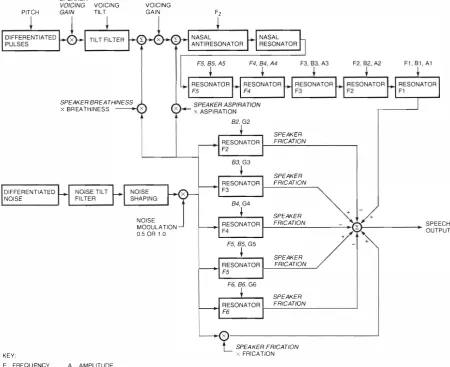
and gains f()f each of the paral lel resonators. Figure 6
shows the basic architectu re of the
VTM .y
The
VTM,
in conjunction with the
PH
rules, simulates the speech
organs.
The
VTM
consists of two major paths, a voiced path
and an unvoiced path . The voiced path is excited by a
pulse generator that simu lates the vocal cords. A num
ber of resonant filters i n series simulate the trachea.
These cascaded resonators simu late a cascade of tu bes
of varying widths. 10 A nasal filter in series with the res
onant tube mode l simulates the dominant resonance
and antiresonance of the nasal cavity. 1 1 The cascade
resonators and the nasal filter complete the "voiced "
path of the
VTM.
Unvoiced sounds occur as a result of chaotic turbu
lence produced when breath passes through a con
striction . This turbulence is difficult to model. In our
approach, the
VTM
matches the spectral magnitude of
filtered noise with the spectral magnitude of the
desired unvoiced phoneme ( al lophone). The noise
source is realized by fi lteri ng the output of a uniform
distribution random number generator. Unvoiced
sounds contain both resonances and antiresonances.
Another approach to obtain an appropriate fi·e
quency characteristic is to fi lter the noise source signal
using a series of parallel resonators. A consequence of
DIFFERE NTIA TED PULSE
GENERATOR
PITCH AND GAIN
GAIN
NOISE SOURCE
Figure 6
VOICED PATH FILTERS
FORMANTS, BANDWIDTH, AND GAINS
UNVOICED PATH F I LTERS
SPEECH
Basic Archi tecture of rhe Vocal Traer Model
Digiral Tct"hnic1l J ournal
Vol . 7 1o. 4 1 995putting resonators in parallel is to create antircso
naoces. The positions of these antiresonances are
dependent on the parallel formant frequencies, but it
has been empirically determ ined that this model pro
vides more than enough degrees of freedom to closely
match the spectral magnitude of any unvoiced sound .
The noise source generates fricatives, such as
s.plosives,
such as p, and aspirates, such as
h.
The noise source also
contribu tes to some voiced sounds, such as
h, J<,and
z.The noise source ou tput may also be added to the
input of the voiced path to produce aspiration . To gen
erate breathy vowels, the parallel formant fi·equencies
are set equal to the cascade fclrmant t!·equencies.12
The radiation characteristic of the lips approximates
a differentiation (derivative) of the acoustic pressure
wave. Since a l l the fi lters in the
VTM
are l i nor and
time
-invar
ian
t, the rad iation effects can be incorpo
rated in the signal sources instead of at the output.
Therd(Jre the glottal source (pulse source) prod uces
differentiated pulses. The differentiated noise signal is
the filtered first difference of a uniform-distri bution
random number generator.
The DECtalk Software
VTM
( also known as the
Klatt Synthesizer) is shown in Figure
7. The italicizedterms arc either speaker-dependent parameters or con
stant values. All other parameters are updated every
frame. Depending on the system mode, the audio
samples generated tor each fl-ame arc passed to the
output routine and subsequently are either queued to
the audio device, written to a wave audio file, or writ
ten to a buffer provided by the application. Alter gen
erating a speech frame, the
VTM
code i ncreases the
audio sample coun t b)' the frame size. This cou nt is
sent to the synchronization thread whenever a syn
chronization symbol or an index mark is received by
the
VTM
thread . The cou nt is reset to zero at startup
and whenever the text-to-speech system is reset.
Tone messages are processed by the
VTM
thread.
Tone messages are for single tones or
DTM t-:
signals.
Each tone message includes two fi·eq uencies, two
amplitudes (one tor each h-cquency), and one duration.
For a single tone message, the amplitude for the second
frequency is zero. Tone synthesis code generates tone
frames and queues them to the output routine. The
first
2
milliseconds and the last
2
milliseconds of a tone
signal arc multiplied by either a rising
ora filling
cosine-squared shaping function to limit the out-of
band pulse energy. Each tone sample is synthesized
using a sinusoid look-up tablc.1'
The Synchronization Thread