RESEARCH ON FAULT-TOLERANT ROUTING WITH HIGH
SUCCESS PROBABILITY IN MESH INTERCONNECTION
NETWORKS AND IMAGE
1WANG QI, 2WANG ZILI 1
Department of Electrical Engineering, School of Normal, Beijing Union University, Beijing, China
2
Zhumadian Vocational and Technical College, Zhumadian, China
ABSTRACT
Mesh networks have been applied to build large scale multicomputer systems and Network-on-Chips (NoCs) extensively. Mesh networks perform poorly in tolerating faults in the view of worst-case analysis, so it is practically important for multicomputer systems and NoCs manufactures to determine that how much success probability to construct a fault-free path between two non-faulty nodes for the mesh network when the node failure probability and the network size are given. In this paper, we mainly focus on fault-tolerant routing algorithm on mesh networks from probabilistic view, and provide a probabilistic method for studying routing algorithm. We propose two simple and novel routing algorithms based on the concept of k-submesh. We apply probabilistic analysis on the fault tolerance of our routing algorithms. Suppose that each node fails independently with given probability, we can derive the probability that our routing algorithms successfully return a fault-free routing path. For example, we formally prove that our routing algorithms succeed in finding a fault-free routing path with success probability at least 99% for a mesh network of up to twenty-thousand nodes as long as the node failure probability is bounded by 1.87%. Our routing algorithms run in liner time. Simulation results show that the length of the routing paths constructed by our algorithms is very close to the optimal length. On the other hand, the results also show that the mul-ticomputer systems and NoCs based on mesh networks are quite reliable and trustable in theory and prac-tice.
Keywords: Mesh Networks; K-Submesh; Fault-Tolerant Routing; Probabilistic Analysis; Image
1. INTRODUCTION
With the size of computer networks increasing rapidly, dealing with networks with faulty compo-nents has become unavoidable. Fault tolerant rout-ing is to construct a fault-free path between source and destination nodes, and carry out reliable point to point communication and data exchange pattern in a network. In this paper, we will concentrate on the fault tolerant routing of mesh networks. The advantages of mesh networks include their simplici-ty, regularity and good scalabilisimplici-ty, so mesh net-works are among the most important and attractive interconnection network topologies for large multi-computer systems. A number of large research and commercial multicomputer systems have been built based on mesh topologies, including Infiniband, Myrinet, Illiac IV, Intel Paragon, Stanford DASH, Goodyear MPP, Tera Computer System, Intel Touchstone Delta, MIT Alewife, Cray T3D, Blue Gene Supercomputer, and MasPar series [1], [2],
[3], [4]. In particular, cur- rent VLSI technology allows to fabricate large scale Network-on-Chips (NoCs) devices, integrating thousands of cores into a single chip based on mesh inter- connection net-works, such as Intel Corp’s TeraFLOPS and Tilera Corp’s TILE64 [5],[6].It operates as a wireless in-terface that forwards Internet data packets to/from other stations. Many current academic papers and industry deployments assume that stations are with-in one hop radio transmission range of such an ac-cess point. In ad-hoc mode there is no centralized device. All stations, or nodes, operate in a peer-to-peer mode, and they compete for the shared wire-less channel. In this way, they are able to com-municate among the domain, but are unable to ac-cess outer networks.
expensive to deploy for various reasons, including low utilization or expense of cabling. For example, in existing buildings, cable deployment is the major portion of the cost for network setup. Similarly, in a conference there will be high utilization, but only for the period of the conference. The cost of de-ployment just for the conference is expensive. In such situations, the stations have relatively fixed positions (within one room, for example), and are required to forward others’ packets in a peer-to-peer mode, while they communicate to Internet via ac-cess points. In such cases, the acac-cess point that is connected to the Internet is more frequently referred to as a gateway, and the network is called a wireless mesh network (WMN) [2] [6] [8].
In this paper we discuss the unique aspects of wireless mesh networks, and their differences from ad-hoc networks. In particular, we propose an algo-rithm for routing in such networks that is able to take advantage of the capabilities of such networks that are not present in ad-hoc networks. We pro-vide some epro-vidence that the approach we propose is likely to perform noticeably better than existing ad-hoc routing protocols.
This remainder of this paper is organized as fol-lows. In Section II we introduce wireless mesh net-works and our diverse-routing algorithm. We de-scribe its advantages, and give evidence that it will be a superior approach. In Section III we study the power-aware network connectivity problem. Sec-tion IV briefly discusses the impact of gateway se-lection on network performance. Finally, in Section V, we conclude the paper.
2. CONCEPTS AND DEFINITIONS
Wireless mesh networks have the potential to play a critical role as an alternative technology for last-mile broadband Internet access. They can be viewed as a special case of wireless multi-hop ad-hoc networks, in which each node operates both as a host and as a router. However, WMNs have a number of features that distinguish them from pure ad-hoc networks. First, the positions of different nodes of a WMN are relatively fixed. By relatively fixed position, we mean that, although the nodes may not be absolutely immobile, any change of position is limited within certain range. The impli-cation of this is that routing paths can be created that are likely to be stable. This substantially re-duces the need for routing packet overhead. Indeed, such routing packets are likely only needed at ini-tialization and when traffic volume is sufficiently low that a node cannot be sure that its neighbour is
still present, as opposed to having crashed. Second, unlike pure ad-hoc networks, where the traffic flows between arbitrary pairs of nodes, in WMN, all traffic is either to or from a designated gateway, which connects the wireless mesh network to the Internet. The relevance of this point is that the traf-fic may be split over multiple gateways, so as to reduce the load within any given portion of the network. Third, the nodes will typically have ac-cess to a power source, and so power consumption is not a critical issue. Finally, such systems can be created within a single domain of authority, and so many security issues present in ad hoc networks are no longer relevant.
The most commonly used topology for wireless mesh networks is a grid layout, due to the layout of buildings. Since each node would communicate with the gateway, it must do so either directly, if it is within the radio transmission range, or indirectly, which requires other nodes to forward packets. In order to minimize the collision probability, each node should adjust its power to a level that is able to reach its four direct neighbors, and no more. This, thus, forms a grid network. Therefore, we can adopt a quasi-xy-routing algorithm in WMN. Xy-routing is commonly used in mesh or torus topology parallel computers to avoid deadlock in wormhole routing [1]. In WMN with this grid topology, each node routes to its direct neighbours. For example, a node (x, y) in Fig. 1 has direct neighbors (x-1, y), (x+1, y), (x, y-1), (x, y+1). Each node performs packet forwarding for its neighbors to and from the gateway.
Packet delay is caused by various reasons, in-cluding collision resolution during packet forward-ing, packet bufferforward-ing, and different scheduling algo-rithms. However, the most critical cause is packet delay in WMN is path length. Under the same traf-fic intensity, a smaller number of hops would lead to less packet delay. For two nodes, S (xS, yS) and D (xD, yD), in a grid network, their shortest dis-tance is given by:
d = | xS – xD | + | yS – yD | (1)
Step 2 enables the current node to acquire a pic-ture of local network traffic. We presume this may be achieved by promiscuous snooping of the medi-um. While in a pure ad-hoc network the cost of such snooping may be too high, in terms of energy consumption, in the WMN context this should be quite feasible. Step 3 is then a simple matter of selecting the lightest-load node. There will, in gen-eral, be just two choices for any given destination, presuming that a shortest path route is desired. Al-ternately, the current node can skip step 2 and simp-ly randomsimp-ly alternate between the two choices (e.g. right or down in Fig. 1). In this manner our proto-col achieves diverse routing. The number of paths available is then determined according to the fol-lowing theorem.
Theorem 1: For any two given node S (xS, yS) and D (xD, yD) in a wireless mesh network, there exists
Different routes that have distance d, given in Eq. 1.
Proof: We prove the theorem by induction.
Without loss of generality, assume xS ≤ xD and yS
≤ yD.
Step 1. From S (xS, yS) to (xS, yS+1), there is only one path; Likewise for S (xS, yS) to (xS+1, yS). The number of shortest paths between S (xS,
yS) to (xS+1, yS+1) is 2, which is a summation of the above 2.
Step 2. Suppose from S to T (xT, yT), the number of shortest paths is
Again, suppose xS ≤ xT and yS ≤ yT.
Step 3. From S to (xT+1, yT), the number of shortest paths can be calculated recursively as
From S to (xT, yT+1), the number of paths is
Therefore, from S to (xT+1, yT+1), the paths are a sum of the above two, because the paths must go through either (xT+1, yT) or (xT, yT+1). That is,
which is
The question then arises as to how useful our ap-proach would be. Jones [9] has performed exten-sive experiments in multipath WMN routing algo-rithms, using source-based routing. In particular, his work demonstrated the following. First, single-flow multipath routing to/from separate gateways can improve the performance by up to a factor of two over single-path routing, as is used in AODV and DSR. Second, in grid networks of 10*10 nodes, with sources and destinations selected ran-domly, using multipath routing aggregate through-put increased by between 5% and 61%, with an average increase of 27%. This indicates that the multipath routing can improve the performance of grid networks. We expect that our approach will yield better results than Jones because we dynami-cally adjust the path on route, based on current load.
Apart from routing issues, many researchers are concerned with scheduling algorithms in WMN [4] [5]. Jakubczak et al. [3] observed that nodes close to a gateway tend to have better chance for trans-mission when competing for the shared wireless channel with others that are further away from the gateway. Both Jakubczak et al. [3] and Munawar [7] offer scheduling algorithms that achieve both fairness and high throughput.
1. if the next hop is a gateway, compete
for transmission with it; else
2. determine neighbour nodes’ load;
3. select a lightly-loaded path for next
hop and transmit;
4. go to step 1.
S 1 1 1 1 1
1
1
1
1
1 2
3 3
4
4
6
5
6
5 6
10 10
15
15 21
20
21 35
35 56
56 70
126 126
252 D
3. A NOVEL FAULT-TOLERANT ROUT-ING ALGORITHM
In the previous section, we discuss routing issues for wireless mesh networks. For a relatively station-ary topology, it is easy to find a route from an indi-vidual node to a gateway, as compared to ad-hoc network routing. This section addresses the route-maintenance problem.
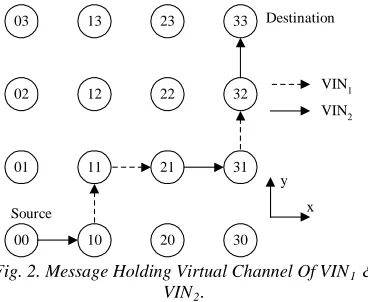
In ad-hoc networks, route failure is mainly caused by node mobility or power-off. Most routing algorithms would produce a route-error message, and trigger re-routing. In wireless mesh networks, where nodes tend not to move, route failure is most probably caused by power-off or system failure. Under this circumstance, we may re-route with an-other diverse path. Note that for stations on the boundary of a mesh network, we do not need to strictly follow the shortest-distance diverse path. If a node’s only adjacent neighbor fails, the node be-comes an island. We would then increase its power level so that it can reach other neighbors. This sce-nario is illustrated in Fig. 2.
03
02
01
00
13
12
11
10
23
22
21
20
33
32
31
30 Source
Destination
y
x VIN1
[image:4.612.106.290.377.528.2]VIN2
Fig. 2. Message Holding Virtual Channel Of VIN1 &
VIN2.
Our scheme is to keep the power level as low as possible. Although a higher power level can reach a longer distance, and thus require fewer hops, it will also lead to more interference with other nodes, increasing the collision probability. In an extreme situation, where each node can hear every other node, a lot of collision will happen, and will have to be resolved with a much longer back-off time, es-pecially in heavy-traffic situations. There is always a trade-off between network capacity and through-put [4]. Therefore, we try to keep the power to a low level. When the gateway is not the perfor-mance bottleneck, multiple packet-forwarding paths with fewer collisions can improve network throughput.
However, if a station is unable to reach other nodes, it will have to increase its power level to find some neighbours. In the same way, if a node joins the network, it will first look for its neighbors. Some island nodes might restore their power upon a new node’s appearance, which could connect them to gateway in a normal mesh. How to find an alter-native path during network failure is critical in wireless mesh networks.
4 . GATEWAY’S EFFECT ON
PERFOR-MANCE
Due to the traffic pattern, most of the data pack-ets are to or from designated gateway. As such, it is difficult or impossible to balance the load between nodes close to gateway and other nodes. With di-verse routing, we have tried to balance the load among different routing paths to the gateway in order to avoid interference. Further, we presume nodes can use multi gateways. Finally, we note that placement of gateways at different positions in the mesh can have a direct effect on network through-put. For example, in Fig. 1, a gateway at a corner, rather than at the center, will more likely result in a higher delay and lower throughput for the mesh.
throughput
number of gateways
0
optimal case
poor performance
Fig. 3. Throughput Increase With Number Of Gateways
When traffic increases to certain amount that the existing gateways cannot handle any more, adding new gateways in mesh network could greatly alle-viate congestion. For example, in a conference cen-ter when several conferences are held simultaneous-ly, the organizers might place additional gateways to meet the increasing Internet traffic. In this situa-tion, maintaining a balanced load among all gate-ways is important. The throughput of a load-balanced network would ideally grow linearly with the increment of gateway numbers.
for-warded by other nodes. This would further allow multiple WMN subscribers to share limited number of IP addresses, if gateways can do address conver-sion.
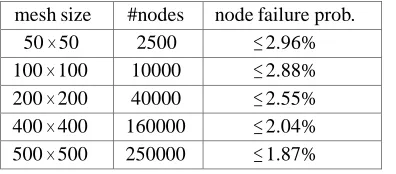
Table 1. Node Failure Probability When The Success Probability Of The Algorithm MPR Is Q0= 99%
We are able to obtain a lower bound (1 − (1 −
C1)2(1 − C2)2) · C2 which is the success
proba-bility of the algorithm MPR. Let (1 − (1 − C1)2(1 −
C2)2 · C2) ≥ Q0 if we require that the success
probability of the algorithm MPR is more than a value Q0. Therefore, we will calculate an upper bound of node failure probability p and guarantee the success probability Q0 of the algorithm MPR. Let Q0 = 99%, we calculate node failure probabil-ity p for different size mesh networks, the results are shown in Table 1.
Table 1 provides strong evidence that the success probability is further improved. For example, the success probability of the algorithm MPR is at least 99% if the node failure probability is bounded by 1.87% (which should be considered as a very big failure probability in theory and practice) in mesh
network with 25000 nodes (e.g.M500×500). All
these results, which are formally proved based on mathematical analysis, show the efficiency of our algorithms in mesh networks with very large size. On the other hand, our discussion and conclusion are also based on precise and quantitative calcula-tion and analysis.
Clearly, being able to compute the connectivity provability of submesh for further larger k will lead to even better conclusions for the success probabil-ity of the algorithms SPR and MPR.
In the aspect of multicomputer systems, R. Bop-pana and S. Chalasani proposed the most classical fault block model and fault-tolerant routing algo-rithm with two virtual channels [9]. Subsequently, the results have further been extended, fault block model maybe solid faulty shape, such as “+”, “L” and “T”, but the new algorithm must use four virtual channels without overlapping fault chain. C. Chen and C. Chiu improved the results, and their algo-rithm only uses three virtual channels with overlap-ping faults chain [10]. R. L. Hadas proposed a
fault-tolerant model called “Origin” concept for mesh networks [11]. The algorithm can tolerate
at least (k − 1)n−1 faulty nodes in n-dimensional mesh networks. Glass and Ni considered an adap-tive fault-tolerant routing algorithm based on a “Turn” model [12]. The Turn model produces rout-ing algorithms which are deadlock-free, adaptive, minimal or non-minimal, and livelock-free for di-rect networks no matter whether they involve virtu-al channels or not. In addition, the routing virtu- algo-rithms produced by the Turn model can deal with dynamic faulty nodes. Practical deadlock-free fault-tolerant routing is proposed based on the pla-nar network fault model [13].
In the aspect of NoCs, the authors utilize the region concept to design fault tolerant algorithms in [14], [15]. In [16], the authors discussed the im-plementation of techniques for detection and re-covery of faults in a NoC. In [17], a routing scheme called MinFT is proposed, which adapts as per-link failures while following the minimal path and reserving bandwidth as per QoS requirement in NoCs. The highlight of the scheme is the con-tinuation of functioning of NoCs even in case of link failure as well as node failures for different types of traffic. In [18], the authors enhanced avail-able message-based approach for NoCs architec-tures without using virtual channels. In [19], the authors proposed a novel routing control algorithm for non-VC router of irregular 2D-mesh NoCs. In [20], the authors proposed a distributed routing al-gorithm for NoCs, allowing a network to reconfig-ure around faulty components. Experimental results showed an average reliability of over 99.99% when
10% of the network links have failed under
differ-ent networks sizes.
In general, fault-tolerant routing mechanism de-pends on the following factors: (1) Fault-tolerant model, such as fault block model, Origin-based, Turn model and extended safety levels; (2) Faulty nodes distribution information, such as algorithm is based on local-information, global-information or limited-global-information; (3) Path length by fault-tolerant algorithms constructed is optimal, minimal or not. (4) Fault-tolerant algorithms need virtual channels or not and how many number of faults can be tolerated by algorithms. For existing algo-rithms, adding virtual channels is not free, it would involve more buffer space and complicated logic control to the nodes. In fact, the extra buffer space and logic circuits not only make mesh’s nodes to be prone to failure and become more unreliable, but also virtual channels can’t be efficiently utilized and at the same time result in increasing the cost to
mesh size #nodes node failure prob.
50 × 50 2500 ≤ 2.96%
100 × 100 10000 ≤ 2.88%
200 × 200 40000 ≤ 2.55%
400 × 400 160000 ≤ 2.04%
[image:5.612.93.291.177.264.2]construct fault-tolerant routing. And that, many non-faulty nodes will be sacrificed if the shape of faulty nodes block is restricted.
5.CONCLUSIONS
Mesh networks are a kind of very important net-work topologies in massively multiprocessor paral-lel systems and NoCs. Many researchful and com-mercial multicomputer systems and NoCs have been built based on mesh networks up to thousands of processors. For this kind of systems with a large number of nodes, fault tolerance and fault-tolerant routing are among the most important and interest-ing topic.
In this paper, we mainly focus on fault-tolerant routing algorithm on mesh networks. Based on the concept of k-submesh, we propose two simple and novel routing algorithms for mesh networks. We apply probabilistic model on the fault tolerance of our routing algorithms. Suppose each node fails independently with given probability, we are able to derive the probability that our routing algorithms successfully return a fault-free routing path. Our research provides formally proven results that show the success probability of our algorithms is very high. For example, we formally prove that our ing algorithms succeed in finding a fault-free rout-ing path with success probability at least 99% for a mesh network of up to twenty-thousand nodes as long as the node failure probability is bounded by 1.87%. It is entirely possible that the node failure probability is controlled within 1.87% under mod-ern integrated circuit technology.
In fact, the scheme established in this paper is obviously not only restricted to lower dimensional mesh networks. For high dimensional mesh, such as 3-D mesh networks, the scheme can get the same efficient fault tolerant routing algorithms. Moreo-ver, the technique developed here is very general and can be applied to any hierarchical network structures (i.e., the network structures in which larger networks can be decomposed into smaller sub-networks of similar structure). Finally the tech-niques given in the current paper are also applicable to the study of network fault tolerant routing algo-rithm under other probability distributions of node failures.
REFERENCES
[1] A. Agarwal, R. Bianchini, D. Chaiken, K. John-son, D. Kranz, J. Kubiatowicz, B.-H. Lim, K. Mackenzie, and D. Yeung, The MIT Alewife Machine: architecture and performance . Proc.
22nd IEEE/ACM International Symp. On Com-puter Architecture, pp. 2-13, 1995.
[2] F. Allen, G. Almasi, W. Andreoni, et.al, Blue Gene: A vision for proteinScience using a peta-flop supercomputer. IBM Systems Journal, 40, pp. 310-337, 2001.
[3] Jose Duato, Interconnection Networks: An En-gineering Approach, IEEE Computer Society: Los Alamitos, LA, USA, 1997.
[4] J. J. Garcia-Luna-Aceves, Chane L. Fullmer, Ewerton Madruga, David Beyer, Thane Frivold, “Wireless Internet Gateways (WINGS)”, Pro-ceedings of MILCOM’97, vol. 3, pp1271-1276, 1997.
[5] Simon Jakubczak, Alex T.K. Lau, Lily Li, and Paul A.S. Ward, “An Explicit Rate-Control Fairness Algorithm for Wireless Mesh Net-works”, Technical Report, University of Water-loo, 2004.
[6] Jangeun Jun and Mihail L. Sichitiu, “The Nom-inal Capacity of Wireless Mesh Networks”, IEEE Wireless Communications (October 2003) 8-14.
[7] Jangeun Jun and Mihail L. Sichitiu, “Fairness and QoS in Multihop Wireless Networks”, Pro-ceedings of IEEE Vehicular Technology Con-ference (VTC), pp2936-2940, 2003.
[8] R. Luo, D. Belis, R. M. Edwards, G. A. Man-son, “A Simulation Design for Link Connec-tion-oriented Wireless Mesh Networks”, Inter-national Workshop on Mobile and Wireless Communications Network, pp665-669, 2002. [9] Mohammad A. Munawar, “Multi-interface
Mul-ti-channel Wireless Mesh Networks”, Master’s thesis, University of Waterloo, Waterloo, Ontar-io, 2004.
[10] Brad Schrick, Michael J. Riezenman, “Wireless Broadband in a Box”, IEEE Spectrum (June 2002) 41-43.
[11] Even Jones, “Multipath Load Balancing in Mul-ti-hop Wireless Networks”, Technical Report, University of Waterloo, 2004.
[12] R. Alverson, The Tera computer system. Proc. International Conf. Supercomputing, pp. 1-6, 1990.
[13] Y. Hoskote, S. Vangal, A. Singh, et al, A 5-GHz mesh interconnect for a Teraflops proces-sor, IEEE Micro, 27(5),pp.51-61, 2007.
[15] D. Xiang, Y. L. Zhang, Y. Pan, Practical dead-lock-free fault tolerant routing in meshes based on the planar network fault model, IEEE Trans-actions on Computers, 58(5),pp.620-633, 2009. [16] R. Holsmark, M. Palesi, S. Kumar, Deadlock
free routing algorithms for irregular mesh to-pology NoC systems with rectangular regions, J. system architecture, 54(3-4), pp.427-440, 2008.
[17] S.Y. Lin, C. H. Huang, C. H. Chao, K. H. Huang, A. Y. Wu, Traffic-balanced routing al-gorithm for irregular mesh-based on-Chip net-works, IEEE Transactions on Computers, 57(9),pp: 1156-1168, 2008.
[18] F. Veiga, C. A. Zeferino, Implementation of Techniques for fault tolerance in a Network-on-Chip, 11th Symposium on Computing Systems, pp. 80-87, 2010.
[19] N. Rameshan, V. Laxmi, M. S. Gaur, M. Ah-med, K. K. Paliwal, Minimal path, fault toler-ant, QoS aware routing with node and link fail-ure in 2-D mesh NoC, IEEE 25th International Symposium on Defect and Fault Tolerance in VLSI Systems, pp.60-66, 2010.
[20] Y. Fukushima, M. Fukushi, S. Horiguchi, Fault tolerant routing algorithm for Network on Chip without virtual channels, 24th IEEE Interna-tional Symposium on Defect and Fault Toler-ance in VLSI Systems, pp.313-321, 2009 [19] Y. Fukushima, M. Fukushi, I. E. Yairi, T.
Hat-tori, A hardware-oriented fault tolerant routing algorithm for irregular 2D-mesh Network-on-Chip without virtual channels, IEEE 25th Inter-national Symposium on Defect and Fault Toler-ance in VLSI Systems, pp.52-59, 2010