ISSN: 1992-8645 www.jatit.org E-ISSN: 1817-3195
ANALYSIS OF WIRELESS AD HOC SENSOR NETWORK
FOR SELECTION COMBINING AND THRESHOLD-HYBRID
SELECTION/MAXIMAL RATIO COMBINING
1NAGESH K. N, 2SATYANARAYAN D, 3M.N GIRI PRASAD
1Lecturer. Department of Electronics & Communication Engineering, MEC, Muscat, Oman
2Prof, & HOD. Department of ECE, RGMECT, Nandyal- 528502, A.P, India.
3Prof, & HOD. Department of ECE, JNTUCE, Anantapur, A.P, India.
E-mail: [email protected], [email protected], [email protected]
ABSTRACT
The presented paper discusses and presents the analytical as well as simulated performance analysis allied with network connectivity and key problems of network coverage in Wireless Sensor Networks (WSN). The issue of network connectivity may be considered as one of the most significant problem in wireless network. The connectivity issue or coverage problem significantly influences the network capability and overall network efficiency. In the presented paper, we propose a research work oriented towards computation of node isolation probability and to perform analysis of network connectivity in the presence randomness in channel behavior, while considering of fading effects like Rayleigh fading of threshold-based hybrid selection/maximal-ratio combining (T-HS/MRC). In this paper, the analysis of selection combining has been done while considering the independent communication paths and even with correlated paths. On the basis of predetermined normalized threshold parameter a T-HS/MRC combiner selects the combined branches and it finds the potency of the instant signal-to-noise ratio (SNR) of individual network branch. Consequently, the number of combined branches is always a random variable, to a certain extent than a predetermined number, as in conformist hybrid selection mechanism/ maximal-ratio combining (H-S/MRC) technique. The present analytical and simulated work motivates to design more practical and reliable system.
Keywords: Ad-hoc Network, Hybrid Selection, Maximal-Ratio Combining, Rayleigh Fading, Selection
Combining.
1. INTRODUCTION
In the last few years, a number of researches have been done for self-organizing, infrastructure less wireless multi-hop network protocol. In this kind of self-configuring networks, the communication between mobile transceivers takes place in a peer-to-peer fashion without requiring any kind of infrastructure or base stations. In order to explore, investigate and optimize the fundamental behaviors like network connectivity and distribution of degree and of course the performance of network, a skilled and optimized modeling is required.
In practical aspects, the network
connectivity refers a precondition for providing consistent applications or uses for users of ad hoc network.
As per best of our knowledge the first paper dedicated for deep rooted study and investigation of network connectivity in ad hoc network. In this work, it has analyzed and
relaying the information collected back to data sink or network controllers. In order to accomplish the goal of a well-connected ad hoc network, it is required to have a communication path from any specific node to other node in network. Such network path might be of single hop or multi-hops in nature. In case of the absence of path in at least one source-destination pair, the network is referred to as disconnected. Even a disconnected network might be in the form of small nodal clusters and the largest cluster in communication network might be referred to as a giant component [6].
In order to accomplish the goal of connected coverage, in reference [7] author has studied the problem of deterministic node placement that is in fact sensing the area of interest with minimum sensor nodes in connected mode. In this work, it has been assumed that the sensor node follows unit disk model behavior while possessing homogeneous or similar sensing areas. In the similar way to optimize the protocol, author in literature [8] illustrates the approximation of network connectivity by means of node isolation probability. The realization of noise links was first analyzed in literature [9] employing the realization framework of graph theory and percolation. Here,
the author demonstrates that the overall
connectivity can be improved whenever new network links ahead of the range make up for broken links. In reference [10], the network connectivity was studied and analyzed in a finite network disk and was defined as a sub-section of an intact vast network at a steady node density. Since, the nodes present outside the network disk can support in creating network connectivity with nodes active in inside disk, therefore this definition is considerably different.
A number of approaches have been proposed for connectivity analysis in Ad hoc network. Most of them do analyze connectivity with different approaches like, k- connectivity, border effects scheme etc. Some other techniques are there that can be very significant in connectivity analysis of connectivity analysis in not only homogenous network, but also the networks of heterogeneous types. Selection combining can be one of the efficient approaches for the same objective. Selection combining can be an efficient approach for connectivity analysis where the nodes have been distributed randomly but in homogenous Poisson point process. The mentioned selection combining approach [11] for signal that selects a specific diversity branch possessing the highest posteriori probability is a highly effective approach
in network analysis. This approach of selection combining do performs in the same way as it does in maximal ratio combining (MRC)[11][12]. The different is only that the MRC approach selects or chooses the diversity branch possessing highest signal power. A further application oriented research for Rayleigh fading channel was observed in [18] where this approach advocates and even proved its robustness for channel estimation and network analysis. The various researches conducted
for selection combining approach [13]
implementation in Ad hoc networks has illustrated that the aforementioned technique might be highly effective and would yield a better analysis and accurate result for node analysis in homogenous as well as heterogeneous network.
Further reviews have depicted that the threshold based hybrid selection combining approach might be highly effective in network analysis and even might be significant for channels with nakagami-m fading [14]. The mean value of error rate in threshold based hybrid selection/MRC approach with encompassing Nakagami-m fading can be easily obtained for (+) integers of fading parameters few specific correlation approach [15]. Few more researches were conducted for satisfying the minimum transceiver chains in network region by employing a new approach called Hybrid
Selection and Maximum-Ratio Combining
approach [16]. The significance and robustness of this approach could be visible in this work as this approach does minimizes the dependencies on channel estimation and is effective for self-configurable networks as in our proposed Ad hoc network. The similar work was done in reference [17] where various performance and network components were investigated and this approach illustrated a sound technique for channel estimation and further connectivity optimization. Thus considering these robust approaches for system design for network analysis might be an effective and optimistic approach for system optimization. Here, in this paper, the author has selected these approaches together and a hybrid system has been developed for connectivity analysis in Ad hoc network and its optimistic prediction might ensure the optimization of existing approaches like border effect based schemes.
ISSN: 1992-8645 www.jatit.org E-ISSN: 1817-3195
isolation probability or 1-connectivty for diversity scheme where number of branch is random.
In this presented research work, the estimation of node isolation probability has been done and the analysis of network connectivity has been done in the presence of channel randomness taking into account the effects of Rayleigh fading of threshold-based hybrid selection/maximal-ratio combining (T-HS/MRC). We have also done the analysis for selection combining (SC) considering independent paths as well as correlated paths. The other sub-sections of the presented manuscript are as follows: Section 2 discusses the dominant assumptions considered and the developed system models for research realization. The ascending section (Section 3) presents the mathematical or analytical evaluation of node isolation probability in the presented research which is followed by presentation of the numerical and simulation results in Section 4. The last section (Section 5) discusses the conclusion of presented research.
2. SYSTEM MODEL
Considering a wireless multi-hop communication network encompassing actives nodes distributed randomly in homogenous way. The homogeneously node distribution in region of interest is done according to Poisson point process (PPP) with node
density depicting the anticipated number of
active nodes per unit square and lying in range 0
∞. Consider, refers the probability of node
isolation. The assumption that the transmission
between two constituting nodes ℓ and ℓ takes
place in the case only when the signal to noise ratio
(SNR) γ at the destination node becomes higher
than the minimum valueψ, becomes the basis of a
switched link model. In case of received mean SNR value, consider the probability that the received SNR γ is higher than threshold , is presented by a
variable Py. In case of long code
implementation, the expression for Py reaches to
a step function, mentioned in [20]. Supplementary, consider that the communication range of particular
node is given by in such a way that this specific
node is capable of communicating with all other constituting nodes available within communication
range . For a deterministic channel model, is
always deterministic. But, in contrary, the same
parameter R (communication range) varies
randomly with
!" #"!" $%& &'
and second moment ()* in case of lognormal
shadowing and small scale fading.
As communication range of a node is always is
non-negative,
()* + , 2''&
' (1)
Where &' is the complimentary$%&.
The node isolation probability can be presented as follows [10, 19]:
+ (2)
Expressions for computing node isolation probability for various channel conditions are presented in the next subsections.
2.1.Combined Path-Loss and Lognormal
Shadowing Model
Consider, all the active nodes do transmit
power at a constant level given as and the total
white noise power available at receiver terminal or
node is given as. . The average path loss stated
by /' where ' represents transceiver separation;
path loss exponent is given by 0 and K refers a
constant associated with considered path loss model.
The signal to noise power ratio at receiver terminal for such channel model can be presented
by expression1' + '/., where the path
loss occurred between transmitter and receiver node
is given by'. The extent where the SNR value
falls down to predefined threshold can be used or
consider for estimation of communication range.
Now, considering mentioned parameters,
the variables &' and ()* can be presented by
following expressions [19]:
&' + )1' 3 * + 4' 3 5 + 1 7
, # 89
(3)
()* + ,2'' , # 8
9
(4)
Where # 8
9 refers the probability density
function %& of path loss under lognormal
shadowing and can be given as:
# 89 +√
(5)
In above mentioned expression the
variable : refers the standard deviation of the
fundamental Gaussian process illustrating the shadowing observable fact.
2.2.Small Scale Fading and Lognormal
Shadowing
If small scale fading should be taken into consideration while ignoring lognormal shadowing,
let 1 be the received instantaneous SNR and ; +
()1*, its average. Given that the
transmitter-receiver separation is ' and for average SNR which
; + </. ='
Let us assume that
P y
S( )
is the probability whichthe received SNR 1 with PDF # >? ;@ A is greater
than a threshold. Now !; is given by:
!; + , # >? ;@ A? (6)
Then the quantity ()* is computed as follows:
()* + ,2''
!8"
9 (7)
When the lognormal shadowing is superimposed over the small scale fading effect the calculation of &' and ()* can be done as follows:
&' + 1 7 , !;# > '@ A (8)
()* + ,
,
2''!89 # > '@ A (9)
3. ANALYTICAL EVALUATION OF NODE
ISOLATION PROBABILITY
3.1.SC With Independent Nakagami Fading
If taken in to the consideration the diversity combining techniques Selection Combining (SC) is one of the least complex, the branch having the highest SNR only is chosen and then processed by the combiner. If the independent Nakagami fading is taken into consideration the CDF of selection
combiner output SNR
γ
with respect to it can becalculated as follows [21]:
& ? ;@ + B1 7 ∑ #
$
%! '
%( D
)
+ ∑ 71)*( * n
M
C
?E 8 *'+ 9 B∑
#$ %! '
%( D
*
+ F71*
)
*( n
M
C
?E <7"; = F G%*<; =
% * ,'
%(
(10)
Here m = Nakagami fading factor, M = number of
branch, and G%* is determined as:
G%*+ ∑%/(% '0.,% /-! H, ,* -,' -,*-; G+ G* + 1, G%+ %!
H,2,*-+ J1, 3 " 3 0, KLM (11) The probability which signifies that the SNR in minimum one branch is having the higher value
than
ψ
is known as the success probability and canbe calculated as:
!; +
7 ∑ 71) *
*( n
M
C
exp 8 *'+ 9
∑ G%*8'+ 9
% * ,'
%(
(12) And it is the complement of the probability which
represents SNR lower than
ψ
.Expression for ()* is obtained by substituting (5)
and (12) in (9) and is computed as follows:
()* + , , ' 2'
3
4
5
F71*
n
M
C
*(
*'6 (
+ 720 <MQ
=
7√ 8
F h
M
C
)
9( ∑9,' -( G9L #0$ R 8
S 9 (13) If the presented expression (2) and (13) are taken into the consideration the node isolation probability can be calculated as:
+
?E T U
V7W
8
'6
%9
∑ 719
h MC )
9(
∑ G9L #
$0
9,'
-( R <89 S = X Y
Z
(14)
3.2.Dual selection combining scheme with
Correlated Nakagami Fading
When the Nakagami fading effect is correlated with
the dual selection combiner output SNR
γ
the PDFcan be mathematically presented as follows [21]:
#1 +
.
;,'- ?E < '
= . 41 7
\'8]^2'1 ]^2195 S
.
;,'- ?E <
'
= . 41 7
\'8]^2'1 ]^2195 (15)
Where
]+ _ '
, -
And, ' + G is the correlation coefficient. Refers
the Nakagami fading factor Let 1+ 1+ 1 + ;
ISSN: 1992-8645 www.jatit.org E-ISSN: 1817-3195
#1 + 2
#$
;,'- . `' . ?E 8 '
+ 9 7
.
,0 -
' ?E < ' < 3.= ,
+ =a (16) The mathematical expression (16) leads to:
H+ 2 #
$
;,'- ' . ?E 8
'
+ 9 (17) And
H+
,0 +- 2 #$
;,'-' ?E <
'< 3= ,
+ = (18) The probability which signifies that the SNR in minimum one branch is having the higher value
than
ψ
is known as the success probability and forH it can be calculated as:
> ;⁄1 #! H+ 2 ∑ # $ ! '
( (19)
By putting the equations (5), (19) in equation (9)
we can simply calculate the equation for
E R
[
2]
and is follows as:
Similarly, for I2 the success probability can be
calculated as: > ;⁄ 1 +
,0 -< , -< 3==
'
! ∑ 7
! 8 ! ' ( (20) Similarly, by putting the equations (5), (20) in equation (9) we can simply calculate the equation
for
E R
[
2]
which follows as:
( !# H
+ <20= b2>1 7 ^'AM1 7 'Q
c
FR 820 S 9! ' ( . ` ,0 -<
, -< 3==
' a
(21) From equation (19) and (21) we can write
( + 2 89 8'6%
9
∑ ;#0$
! '
( B1 7
,0 -< < 3=
, - =
#0'$
D (22)
In order to calculate the node isolation probability the equations (2) and (22) needs to get combine and the result will be as follows:
+
#$" ∑'( #$%! A
7 ! 8 $% B (23)
3.3.Threshold-Based Hybrid
Selection/Maximal-Ratio Combining
Scheme
When the Nakagami fading effect is correlated to the Threshold-Based Hybrid
Selection/Maximal-Ratio combining method output SNR
γ
the PDFcan be obtained as [22]: #>1 ;@ A +
e < L N
C
= F 8p
L−1
C
9C
D(
71D1C ; RC$De 7 1!
S e < L
N
C
= F F 8q L
-N
C
9C
D(
8 p
L−1
C
9E C
F(
71D0F0C $DC
;fgC
` )*,,) 7 - ∑ , FG-
'! <+H)= C
'( a (24)
Let
h + e < L N
C
= ∑ 8p
L−1
C
9C
D( ,
-)
H),C -! (25)
i + e < L
N
C
= ∑ ∑ 8q L
-N
C
9C
D( 8 p
L−1
C
9E C
F( ,
-)*.H).
,FG-.
(26) From equation (24), (25) and (26) we can write the probability in which SNR in at least one branch is
higher than
ψ
i.e. the success probability, which iscalculated as follows:
!; + h e 7 1! 8 %9 ∑ ;#0$
! S
C (
i ` I 8 9 8 I%
9
R 89 7 j k 8+9' S
! 8 9 8 %9 ∑ ;#0$ ! '
( la (27)
Where p
p
C
q
A
C
µ
+
=
, L = number of diversitybranch,
0
<
µ
<
1
and1 (1
)
(
1)
p
C
= +
−
µ
p
+
µ
L
−
Again, by putting Equations (5) and (27) in the
( + m S i ` I 8
9 8
I
%9
R 8C9 7
j k8 9 R 8S 9 8 %
9
#$ S
! 8 9 8 %9 ∑ ;#.0$ ! '
( la (28)
Where m + e < L
N
C
= ∑ , -)H),C -! 8 p
L−1
C
9C
D( e 7
1! 8 9 8 %
9
∑ ;#0$
! C
( (29)
From equation (28) and (29) we can write
( +
e < L N
C
= 89 8
%9
∑ , -H)) 8 p
L−1
C
9C
D( ;#
0D$
D!
+ i B H)
H)0FG 8 9 <
<H)0FG=
H)% =
R 89 7
∑ , FG-'! H ) C
'( k8 9 R 8S 9 8 %9
S
! 8 9 8 %
9
∑ ;#0$
! '
( lD (30)
For further simplification of node isolation probability equation (2) and (30) needs to get combined and the result will be as follows:
( J/0e < L
N
C
= 89 8
%9
∑ , -H )
) 8 p
L−1
C
9C D(
+i B H)
H)0FG 8 9 <
<H)0FG=
H)% =
R 89 7
∑ , FG-'! H ) C
'( k8 9 R 8S 9 8 %9
S
! 8 9 8 %
9
∑ ;#0$
! '
( lD (31)
4. NUMERICALANDSIMULATION
RESULTS
An analytical model has been developed using MATLAB and the simulation framework and numerical results are attained from them keeping into consideration that the constraints are selected
as / + 10n, ? + 1., . + 0.01., +
1 .. After that we properly choose the other
constraints which are , , 0, and :. A constant
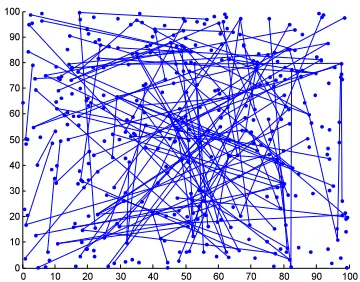
dimension of 100mX100m has been used for the simulation purpose. Finally to obtain the node isolation probability 1000 simulation runs has been performed. Fig.4.1a – 4.1b represents the simulated
network architecture for various channel
conditions.
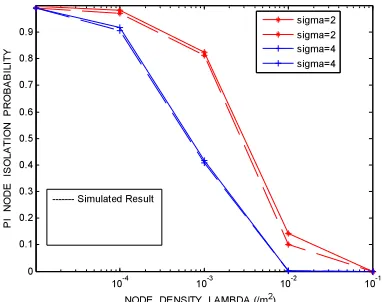
Figure 4.2 gives the plot for impact of lognormal shadowing standard deviation sigma over node isolation probability for dual selection combining. Result of 4.2 shows that sigma is having positive impact on connectivity that is if sigma will increase correspondingly node isolation probability will decrees. Where result 4.3 concludes that branch
correlation is having negative impact on
connectivity and node density lambda is having positive relation to connectivity. Figure 4.4 gives the plot for impact of Nakagami fading factor ‘m’ over node isolation probability for dual selection combining. Result of 4.4 shows that ‘m’ is having positive impact on connectivity that is if ‘m’ will increase correspondingly node isolation probability will decrees. Figure 4.5 gives the plot for impact of lognormal shadowing standard deviation sigma
over node isolation probability for T-HS/MRC
scheme where number of branch will select corresponding to threshold value. Result of 4.5 shows that sigma is having positive impact on connectivity that is if sigma will increase correspondingly node isolation probability will decrees. Where result 4.6 concludes that number of branch is having positive impact on connectivity and also node density lambda is having positive relation to network connectivity.
Fig. 4.1(a): Simulated network topology (sigma=2).
0 10 20 30 40 50 60 70 80 90 100 0
[image:6.595.86.300.460.585.2] [image:6.595.321.501.480.621.2]ISSN: 1992-8645 www.jatit.org E-ISSN: 1817-3195
[image:7.595.90.521.74.297.2]
Fig. 4.1(B): Simulated Network Topology (Sigma=4).
Fig. 4.2: Simulated Network Topology (Sigma=2).
Fig. 4.3: Simulated Network Topology (Sigma=2).
[image:7.595.328.514.321.459.2]Fig. 4.4: Simulated Network Topology (Sigma=2).
[image:7.595.98.289.343.494.2]Fig. 4.5: Simulated Network Topology (Sigma=2).
Fig. 4.6: Simulated Network Topology (Sigma=2). 0 10 20 30 40 50 60 70 80 90 100
0 10 20 30 40 50 60 70 80 90 100
10-4 10-3 10-2 10-1
0 0.1 0.2 0.3 0.4 0.5 0.6 0.7 0.8 0.9
NODE DENSITY LAMBDA (/m2)
P I N O D E IS O L A T IO N P R O B A B IL IT Y sigma=2 sigma=2 sigma=4 sigma=4
--- Simulated Result
0 0.1 0.2 0.3 0.4 0.5 0.6 0.7 0.8 0.9 0 0.1 0.2 0.3 0.4 0.5 0.6 0.7 0.8 0.9
BETA (CORRELATION COEFFICIENT)
PI N O D E I SO L ATI O N P R O B ABI LI
TY lambda =.001
lambda = .001 lambda = .01 lambda = .01
--- Simulated Result
10-4 10-3 10-2 10-1 0 0.1 0.2 0.3 0.4 0.5 0.6 0.7 0.8 0.9
NODE DENSITY LAMBDA (/m2)
P I N O D E IS O L A T IO N P R O B A B IL IT Y
fading factor, m=1 fading factor, m=1 fading factor, m=5 fading factor, m=5
--- Simulated Result
10-4 10-3 10-2 10-1
0 0.1 0.2 0.3 0.4 0.5 0.6 0.7 0.8 0.9
NODE DENSITY LAMBDA (/m2)
P I N O D E IS O L A T IO N P R O B A B IL IT Y
sigma = 2 sigma = 2 sigma = 3 sigma = 3
--- Simulated Result
10-4 10-3 10-2 10-1
0 0.1 0.2 0.3 0.4 0.5 0.6 0.7 0.8 0.9
NODE DENSITY LAMBDA (/m2)
P I N O D E I S O LA T IO N P R O BA B IL IT Y
Number of branch = 1 Number of branch = 1 Number of branch = 3 Number of branch = 3
[image:7.595.316.503.489.642.2] [image:7.595.98.277.524.667.2]5. CONCLUSION
The node isolation probability has been studied and analyzed in this paper and further by using it the investigation of connectivity characteristics of wireless multi-hop network has been done. The derivation of mathematical expression for node isolation probability has been done further. By contrasting the earlier research work related to this field we use lognormal shadowing and T-HS/MRC method. By combining the simulation based method and analytical method, we come to know the impact of path loss exponent, Nakagami-m effect, node density and lognormal spread on the node isolation probability. What is the outcome of
varying diversity branch on the network
connectivity has also been explored in the paper. The values of node density which are calculated are used in practical significance for wireless multi-hop networks for designing and simulation purpose. To get a total covered network containing a certain area a minimum node density is required which we can obtain from the results in the paper for a given channel model and parameters.
REFERENCES
[1] Sayandev Mukherjee and Dan Avidor,
"Connectivity and Transmit-Energy
Considerations between Any Pair of Nodes in a Wireless Ad Hoc Network Subject to Fading" IEEE Transactions on Vehicular Technology, Vol. 57, No. 2, March 2008 [2] D. J. Baker and A. Ephremides "The
organization of a mobile radio network via a
distributed algorithm", IEEE Trans.
Commun., vol. COM-29, 1981
[3] P. Santi and D. M. Blough “The critical transmitting range for connectivity in sparse wireless ad hoc networks” IEEE Trms. on Mob Camp., vol. 2, no. I, pp. 25-39. Jan-Mar 2003.
[4] Bettstetter, C. and Zangl, J. “How to achieve a connected ad hoc network with homogeneous range assignment: an analytical study with consideration of border effects” Mobile and Wireless Communications Network, 2002. 4th International Workshop on Digital Object Pub: Year: 2002, Page(s): 25 – 129 Cited by: Papers 14
[5] R. Albert and A. L. Barab´asi, “Statistical mechanics of complex networks,” Reviews of Modern Physics, vol. 74, pp. 47–97, Jan. 2002.
[6] Peter Grindrod, “Range-dependent random graphs and their application to modeling large small-world Proteome datasets”. PHYSICAL REVIEW, 2002
[7] Koushik Kar, Suman Banerjee “Node
Placement for Connected Coverage in Sensor
Networks” WiOpt'03: Modeling and
Optimization in Mobile, Ad Hoc and Wireless Networks (2003) 2 pages
[8] Mehmet Ali, M.K. and Khabazian, M. “A performance modeling of connectivity in ad hoc networks” Wireless Communications and Networking Conference, 2006 WCNC 2006 IEEE Volume: 1: 2006, Page(s): 361 - 366 [9] Pinto, P.C. and Win, M.Z. “Continuum
percolation in the intrinsically secure
communications graph” Information Theory
and its Applications (ISITA), 2010
International Symposium on 2010, Page(s): 349 – 354
[10] Pitsiladis, G.T. , Panagopoulos, A.D. and Constantinou, P. “Improving connectivity in indoor millimeter wave wireless networks using diversity reception” Antennas and Propagation (EUCAP), 2012 6th European Conference on 2012 , Page(s): 510 - 514 [11] Ning Kong; “Performance Comparison Among
Conventional Selection Combining, Optimum Selection Combining and Maximal Ratio Combining”, Communications, 2009. ICC '09. IEEE International Conference on 14-18 June 2009, Page(s):1 – 6.
[12] Loskot, P; Beaulieu, N.C.; “Maximum ratio
combining with arbitrary correlated
generalized Ricean branches”, Wireless
Communications and Networking
Conference, 2004. WCNC. 2004
IEEE (Volume:1 ) on 21-25 March 2004, Page(s): 333 - 338 Vol.1.
[13] Polychronos, T; Hippenstiel, R. ; Ha, T.T.; “Performance analysis of non-coherent BFSK using first, second, and third order selection combining in a Nakagami fading channel ”,
Military Communications Conference
Proceedings, 1999, MILCOM 1999.
IEEE (Volume:1), 1999, Page(s): 65 - 69 vol.1
[14] Zhang Xiaodi; Beaulieu, N.C.;
“Threshold-based hybrid selection/maximal-ratio
ISSN: 1992-8645 www.jatit.org E-ISSN: 1817-3195
[15] X. Zhang; Beaulieu, N.C.; “SER of
threshold-based hybrid selection/maximal-ratio
combining in equicorrelated Nakagami
fading’, Communications Letters, IEEE
(Volume: 8, Issue: 9 on 27 September 2004, Page(s): 552 – 554.
[16] Yannian Wang; Yaolin Zhu ; Wei Zhou;
“Hybrid Selection and Maximum-Ratio
Combining without Excessive Channel
Estimation ”, Knowledge Acquisition and Modeling Workshop, 2008. KAM Workshop 2008. IEEE International Symposium on 21-22 Dec. 2008, Page(s): 540 – 543.
[17] Schmitt, L; Grundler, T. ; Schreyoegg, C. ; Viering, I.; “Maximum ratio combining of correlated diversity branches with imperfect channel state information and colored noise”,
Spread Spectrum Techniques and
Applications, 2004 IEEE Eighth International Symposium on 30 Aug.-2 Sept. 2004, Page(s): 859 – 863.
[18] Annavajjala, R.; Milstein, L.B.; “Analysis of selection combining schemes on Rayleigh
fading channels with noisy channel
estimates”, Wireless Communications and Networking Conference, 2004. WCNC. 2004 IEEE (Volume:1), 21-25 March 2004, Page(s): 322 - 327 Vol.1.
[19] Daniele Miorandi and Eitan Altman “Coverage and Connectivity of Ad Hoc Networks in
Presence of Channel Randomness”
INFOCOM 2005 24th Annual Joint
Conference of the IEEE Computer and Communications Societies Proceedings IEEE (Volume: 1)
[20] Bettstetter C., and Hartmann C. “Connectivity of wireless multihop networks in a shadow fading environment” ACM Proc. of MSWiM San Diego, CA, 2003.
[21] Chethana Gosal.S and Dr.J.P.Picha Muthu
“Probability Analysis of Mean
Communication Range for Nakagami Fading
in Wireless Adhoc Sensor Network”
International Journal of Engineering Research and Applications (IJERA) ISSN: 2248-9622 www.ijera.com Vol. 2, Issue 3, May-Jun 2012, pp.2824-2828
[22] Zhang Xiaodi Beaulieu, N.C. “Performance Analysis of Generalized Selection Combining
in Generalized Correlated Nakagami-m
Fading” Communications, IEEE Transactions on Publication Year: 2006, Page(s): 2103 - 2112 Volume: 54, Issue: 11