THE STATIC SECTORIZATION OF AIRSPACE VIA GENETIC
ALGORITHM APPROACH
1KAIDI RACHID, 2ELMOUTAOUAKIL KARIM, 3ETTAOUIL MOHAMAD
1,3
Modeling and Scientific Computing Laboratory, Faculty of Science and Technology, Fez. 2National School of Applied Sciences (ENSA) of Al Hoceïma.
MOROCCO
E-mail: [email protected] ,[email protected] ,[email protected]
ABSTRACT
The sectorization of airspace has become one of the most important problems of operational research; saturation and non-optimality of this system are the main reasons behind a new sectorization. The objective of SAP is to minimize the workload coordination between adjacent sectors and the controller’s workload which is balanced among the sectors. The main purpose of this work is to suggest a new method to solve the SAP problem. The proposed method is divided into two steps: the first one involves modeling the SAP problem in terms of 0-1 quadratic programming model subject to linear constraints. The second one concern solving this model via the Genetic Algorithm approach. Finally, some experimental results are introduced.
Key words: Sectorization of Airspace Problem (SAP), Air Traffic Control (ATC), Operational Research (OP), Quadratic Programming Problem (QPP), Genetic Algorithm (GA)
1. INTRODUCTION
According to the european commission, the european airports and air routes reach saturation [30]. that is why, a new sectorization of the airspace is become a necessary task. in this context, the airspace beacons are classified into a number of sectors; each of them is assigned to a team of controllers. these allocations take into a count the capacity of the controller to manage several aircrafts simultaneously [10],[11].
Delahaye and al. [11] have tried the (SAP) problem via the Genetic Algorithm approach. A sector is defined by a set of connected vertices of the network and the chromosome contains all information needed to define the sectors. However, sectors built by synthesis of connected vertices do not ensure the convexity constraint. Other investigations on this problem have been published in [28], but without the connectivity constraint.
Huy Trandac and Philippe Baptiste have proposed a constraint programming approach to optimize the sectorization that shall satisfy all specific constraints [3],[29], the Airspace is modeled by a valueted graph and a sector in a solution of (SAP) is defined as a set of vertices, without geometrical boundaries. A genetic
algorithm to solve ASP has been proposed in [10] .
BICHOT Charles-Edmond have proposed a fusion-fission method [7], allows to find the best airspace partitioning for our objective function. To diversify its applications, the fusion-fission method has also been applied to image segmentation and documents clustering.s
Genetic Algorithm (GA) belongs to a class of probabilistic methods called «evolutionary algorithms » based on the principles selection, crossover and mutation. It was introduced by J. HOLLAND that it’s based on natural evolution theory of Darwin [14], [6]. The GA method has been applied in a large number of optimization’s problems in several domains telecommunication, routing, scheduling, and it proves it’s efficiently to obtain good solutions [11].
The paper falls in six sections. The second introduces the Sectorization of Airspace Problem (SAP). In the third section, we model the problem in terms of 0-1 quadratic programming model subject to linear constraints. In the forth section, we use the Genetic Algorithm to solve the proposed model. Finally, some computational experiences are shown in the fifth section.
2. PRESENTATIONT SECTRORIZATION
OF AIRSPACE PROBLEM
In this part, we give a succinct description of the components of the airspace; then, we will present the Sectorization of Airspace Problem (SAP).
Presentation of the airspace and Air Traffic ControllersThe airspace is composed of a set of beacons or network connecting these beacons (Fig.1); this area is under the responsibility of air traffic controllers.
Air traffic is currently controlled by human operators (Air Traffic Controllers) who monitor aircraft trajectories and give instructions to pilots so as to avoid mid-air collisions and dangerous situations. The airspace is partitioned into managerial units, Air Traffic Control Centers (ATCC), which are themselves partitioned into elementary airspace modules. These basic airspace modules may be combined together so as to form air traffic control (ATC) sectors each operated by a small team of 2–3 controllers.
Fig.1:Air Route Network
Nowadays, air traffic increases throughout the world; thanks to safety, the sectorization of airspace has become one of the most important solutions of Air Traffic Control; in this context, the airspace is divided into a number of sectors; each of them is assigned to a team of controllers. The sector number is then determined by the capacity of a controller to manage N aircraft simultaneously: In practice, the average seems to be 10 to 15 aircrafts, when this limit is attaining we say that the sector is saturated [10], [11].
Modelling the Controllers WorkloadGenerally, there exist three kinds of controller’s workload [11], [9], [7]:
• Monitoring Workload :
This charge is proportional to crossing time of an aircraft in the sector. If this route passes through two sectors, the load is distributed across the sectors in proportion to the part of the edge in the sector.
• Conflict Workload :
This charge is proportional to the total number of potential conflicts that can occur on a crossing point.
• Coordination Workload :
This is proportional to the number of the aircraft which pass along a road section, each of which ends charge are located in different sectors.
The airspace is formed by together airways and
∈ beacons
, … , will be divided into
∈ sectors
, … , .
We define the -matrix of coordination and n-vector of workload in beacons as follows:
W
O if beacons band b
are directly connected ∀ i, j ∈ &1, … , n( p, q ∈ &1, … , k(
0 else
-C/
M
2 2 ∀ ∈ &1, … , (
In the next part, we will model the SAP problem in terms of 0-1 quadratic programming problem subject to linear constraints [26], [15].
3. MODELING OF THE (SAP) PROBLEM
The goal of this part is modelling the problem (SAP) in terms of 0-1 quadratic programming problem subject to linear constraints.
Definition 1:
We define the total workload of controllers in the all airspace by following formula:
3
/ 3 3
Definition 2:
The number of sectors is defined by the capacity of controllers to manage N aircraft simultaneously; in practice, the means seems to be 10 to 15 aircrafts, so:
∑ / ∑ ∑
12 512
• Binary variables
First, we define the following binary variables:
∀ ∈ &1, … , ( 67 ∀ 8 ∈ &1, … , (
9
1 :;<= =6>?@ @ 86A; ?: @=>;?A
0 =B@=
We convert these suits of variables:
9 -9, … , 9, … , 9, … , 9, … , 9, … , 92
In the next, we use this vector to define the objective function and the constraints of the problem under study.
• Objective function
The objective function of the mathematical programming model consists to minimize the total workload coordination:
1 1
ୀଵ
ୀଵ
ୀଵ
ୀଵ
The Boolean C is the Kroenecker delta.
C D1 @ E 0 @ F E
• The family of the allocation constraints:
Each beacon must be allocated to only one sector; in this context, we obtain the following family constraints:
3 9 1 ∀ ∈ &1, … , (
We remark that we associate one constraint to each beacon.
• The balance constraints
For each vector x, the controller of the sector p has to manage the next workload:
3 9
To make an equitable allocation between the airspace controllers, we impose the next family of constraints:
3 9 G
∀ 8 ∈ &1, … , (
Where:
G H∑I
J
From now on, we call this quantity the desired workload. Since it is difficult to realize the later family of constraints, we prefer, only, to control the total error produced by an allocation of the beacons to the various sectors; thus, we replace the objective function by the following one:
f 1 δ1 δ
W
λ w
C
Based on the binary variables, on the objective function f and the family of on the allocation constraints, the mathematical form of the Sectorization of Airspace Problem is given by:
:
1 δ୧୨1 δ୮୯
୩ ୯ୀଵ ୬ ୨ୀଵ ୩ ୮ୀଵ ୬ ୧ୀଵ
୧୮ W୧୮୨୯
λ
ipw
ipn i1 Ck 2 k p1 ! " " " # $%&'() )*:
1
ୀଵ
+), ∀ ∈ /1, … , 2, ∀ 3 ∈ /1, … , 42 56 ∈ /0,12
The matrix form of the SAP problem is the following:
SAP:
-2 ܶ8 9ܶ
$%&'() )*:
L9 9 ∈ &0,1(
Where:
M
N O @ 6 M M Symmetric matrix, for
, E ∈ &1, … , ( 67 8, P ∈ &1, … , (, G is a real vector, ∈ O is a real vector and L is a M matrix. Without loss of generality, we assume that all diagonal terms of Q are equal to 0.
Quadratic 0-1Programming (QP) with linear constraints is a general model that allows formulating numerous important problems in combinatorial optimization including, for example: quadratic assignment, graph partitioning, task allocation, capital budgeting and densest k-subgraph.
The difficulty of quadratic problems is mainly due to the non-linearity of the function and the integrity of the variables. That’s why most of the techniques proposed to solve it consist first to break the non-linearity of the functions and to relax the integrity constraints.
Various heuristics and exact methods have been proposed to solve QP. Due to the non-convexity of the objective function, QP is often reformulated before searching for its optimal solution. So, several methods have been developed to solve it exactly through 0-1 linear reformulations [1], [16] or 0-1 convex quadratic reformulations [19], [27].
Although 0-1 linear reformulations of QP are the most common approaches, other methods have been proposed. Let us cite, for example, algebraic and dynamic programming methods [8], reformulation to a continuous concave minimization problem [23] and enumerative methods based on different types of relaxations as lagrangian relaxation, semidenite relaxation or convex quadratic relaxation [4],[5], [17], [21].
In this paper we reformulate SAP by an equivalent zero-one quadratic program with a convex objective function. Consequently, we can solve the transformed problem using general purpose optimization software which implements the Genetic Algorithm (GA).
4. GENETIC ALGORITHM: APPLICATION
TO SOLVE THE (SAP) PROBLEM
In this part, we use the Genetic Algorithm approach to solve the problem SAP. Genetic Algorithm belongs to a class of probabilistic methods called « Evolutionary Algorithms » based on the principles selection, Crossover and mutation. GA was introduced by J. HOLLAND [22] that it’s founded on natural evolution theory of Darwin [7].
Fig.3: Genetic Algorithm
The different step of the GA is given by [6]:
1. Choose the initial population of individuals 2. Evaluate the fitness of each individual in
that population
3. Repeat on this generation
4. Select the best-fit individuals for reproduction
a. Crossover and Mutation operations b. Evaluate the individual fitness of new Individuals
c. Replace least-fit population with new Individuals
Until termination (time limit, fitness achieved, etc.).
The criterion of convergence can be of diverse nature, for example:
–
Minimum rate that wants to reach to adapt the population to problem.–
Limit the time of calculation in thealgorithm.
–
Or a combination of the two points.• Coding
Fig.4: Coding Principle
In our application, we have encoded an individual by 1 chromosome represents the vector
Q H9I of binary variable, which the variable
9who takes 1 if the beacon belongs to a sector
and 0 other.
Fig.5: Chromosome
• Initial Population
The first step in the functioning of a GA is, then, the generation of an initial population. Each member of this population encodes a possible solution to a problem. The individual of the initial population are randomly generated, and Q H9I take the value 0 or 1. The is a matrix takes random values in space Rand the
symmetric matrix with diagonally null, because takes random values in R.
Where: , E ∈ &1, … , (
• Evaluating individuals
the most adapted to the problem. The fitness suggested in our work is the following function:
S;=@@-2 1 / T E=>;U=-21
Minimize the value of the objective function « Objective » is equivalent to maximize the value of the fitness function.
• Selection
The selection method used in this paper is the Roulette Wheel Selection (RWS) which is a proportional method of selection. In this method,
individuals are selected according to their fitness. The principle of the RWS method can be
summarized in the following schema:
P
9 9 9 9 9 9 9 9 9 9 0 1
Number chosen randomly in [0, 1]
Fig.6: Selection By WRS
Where:
∑
• Crossover
The crossover is very important in the algorithm, in this stage, new individuals called children are created by individuals selected from the population called parents. Children are constructed as follows: We fix a point of crossover, the parents are cuted switch this point, the first part of parent 1 and the second of parent 2 go to child 1 and the rest go to child 2 in the crossover that we adopted, we choose one crossover point, for the matrix
ܺ ൌ ൫ݔ
:;൯
of binary variable.
Fig.7: Slicing Crossover
This operation is effected with a probability of crossover Pc.
• Mutation
The role of mutation is to keep the diversity of solutions in order to avoid local optimums. It corresponds on changing the values of one (or several) value.
Fig.8: Principle Of The Mutation Operator
This operation is effected with probability of mutation V.
5. COMPUTATIONAL EXPERIMENTS
All of these simulations terminated in a valid sectorization. The quality of obtained solutions has been measured by means of the performance ratio:
From this fig.9, we remark the beacons are uniformly allocated to the different sectors.
W X3HGY G I
Where:
G, the calculate workload in the sector p:G 3 9 ∀ 8 ∈ &1, … , (
G, the total workload calculated:
G 3 3 99
,
,
G , the average workload desired in the sector k.The database of airspace supposed confidential; so, we generate randomly the matrix and the vector as follows:
∀ , E ∈ &1, … , ( , ∈ Z10, 100[
The sector number is estimated from the total workload of controllers,according to expert studies, in the domain of navigation, a controller has the capacity to manage in average 10 to 15 aircraft simultaneously.
[image:7.595.89.531.86.536.2]Fig.9: Classification Of The Beacons On The Sectors.
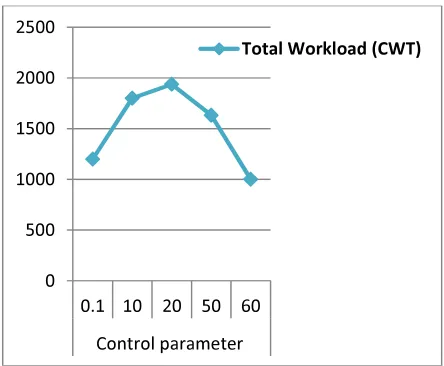
Fig.10: The Total Workload Versus Control Parameter
TABLE I: The Total Coordination Workload And Error Versus Control Parameter .
0 500 1000 1500 2000 2500
0.1 10 20 50 60
Control parameter
Total Workload (CWT)
n K λ=0.1 λ=10 λ=20 λ=50 λ=60
E C WT E C WT E C WT E CWT E CWT
20 3 10.1 570.0 4.3 740 10.4 587 33.2 634.2 37.50 630.33
50 4 15.3 600.4 5.8 830 18.4 645 37.1 598 40.23 600.03
80 5 35.1 750.1 13.2 904.3 22.2 893.2 43.1 700 58.01 810.43
100 6 38.7 980.1 15.1 1035 30.4 950 44.2 807.2 53.04 882.35
150 7 42.2 1003.5 17.8 1102.5 38.7 983.4 58.2 897.3 60.20 890.50
200 8 48.5 1032.8 20.2 1345.2 40.1 1123.7 60.2 984.8 65.50 950.73
250 10 49.8 1150.1 28.2 1641.2 34.01 1508 65.2 1300 68.04 989.70
[image:7.595.89.281.128.530.2] [image:7.595.305.527.341.524.2]Fig .11:Error Functions According To Control
Parameter .
From the TABLE I, Fig.10 and Fig.11, the curve of W-K267 G-K2 is a parabolic function of K. In addition, the curve of a function E is concave, against the function G which is convex.
Concerning the selection of the parameter λ, such select must make a balance between the Error E and the calculated of a total workload. In our case, when λ is closed in the interval [10, 50] we obtain a classification with acceptable Error E and admissible total coordination workload G.
The values ‖‖ and ‖‖ are respectively the norm of the matrix W and the vector w .In practice, when W and w decrease some sectors are regrouped with the other ones. In the future, we will propose a dynamic model, which is determining automatically the sectors number.
6. ONCLUSION
In this work, the problem of sectorization is formulated as 0-1 quadratic programming subject to linear constraints. We have used the Genetic Algorithm approach to solve the proposed model. In this regard, all of these simulations terminated in a valid sectorization. To compare the proposed sectorization with present one, some numerical results are introduced. In this context, the proposed methods make balance, in terms of workload, between different sectors in comparison with the previews sectorization.
In future direction of this research we will propose a dynamic sectorization by determining automatically the number of sectors.
REFERENCES
[1] W.P. Adams, R. Forrester, and F. Glover, “Comparisons and enhance-ment strategies for linearizing mixed 0-1 quadratic programs”.
Discrete Optimization. 1(2):99-120, 2004. [2] J.M. Alliot and H Gruber, “Using Genetic
Algorithm for solving ATC conflict”. Dans proceedings of the Ninth IEEE Conference on Artificiel Intelligence for application.IEEE, 1993.
[3] P. Baptiste and H. TranDac, Sectorisation dynamique de l’espace aérien européen. In Proc. of. 5e Congrès de la Société Française de Recherche Opérationnelle et d’Aide à la Décision, Avignon, France, 2/2003.
[4] A. Billionnet and E. Soutif, “An exact method based on lagrangian decomposition for the 0-1 quadratic knapsack problem”. European J. of Operational Research, 157(3):565-575, 2004. [5] P. Carraresi and F. Malucelli, “A new lower
bound for the quadratic assignment problem problem”. Operations Research, 40(Suppl. No1):S22-S27, 1992.
[6] R.CERF: “Une théorie asymptotique des algorithmes génétiques’’. Thèse de doctorat, université de Montpellier II, 1994. Cité p 75. [7] Charles-Edmond BICHOT, Jean-Marc
ALLIOT, Nicolas DURAND et Pascal BRISSET, “Optimisation par fusion et fission. Application au problème du découpage aérien européen’’, Journal Européen des Systèmes Automatisés (JESA), 38(9-10):1141–1173, Cité p 62, 90, 109, 2004.
[8] Y. Crama, P. Hansen, and B. Jaumard, “The basic algorithm for pseudo-Boolean programming revisited”. Discrete Applied Mathematics, 29 (2-3):171-185,
1990.
[9] D. Delahey, J.M Alliot M. Schoener, and J.LFarge, “Genetic algorithm automatic for regrouping of air traffic sectors”. Dans proceeding of the European conference on Artificial Intelligence. ECAI, 1994.
[10] D. Delahaye,”Optimization of airspace sectorization via the genetic algorithm’’. Ph.D: computer ENSAE, 1995.
[11] D. Delahaye, M. Schoenauer and J. M. Alliot, “Airspace Sectoring by Evolutionary Computation”. IEEE International Congress on Evolutionary Computation, 1998.
[12] M. Ettaouil, M. Lazaar and Y. Ghanou, “Architecture Optimization Model For The Multilayer Perceptron And Clustering”.
Journal of Theoretical and Applied 0
10 20 30 40 50 60 70
0,1 10 20 50 60
Control parameter
Information Technology, Vol. 47 No.1, pp. 64-72, January 2013.
[13] M. Ettaouil and Y. Ghanou, “Neural architectures optimization and Genetic algorithms”. Seas Transactions On Computer, Issue 3, Volume 8, pp. 526- 537, 2009. [14] M. Ettaouil, R. Kaidi, K. El Moutaouakil,
“Sectorization of Airspace Problem via Continuous Hopfield Network”. Workshop FOD, Higher School of Technology of Meknes, 2012.
[15] M. Ettaouil, C. Loqman, ‘’Sectorisation de l’espace aérien et réseaux de contraintes’’. pp. 150--152, In Proceedings in premier congrès international de la société marocaine de mathématiques appliquées, 2008.
[16] F. Glover and E. Woolsey, “Further reduction of 1 polynomial programming problems to 0-1 linear programming problems”. Operations Research, 21:156-161, 1973.
[17] M.X. Goemans, “Semidefenite programming in combinatorial optimization”. Mathematical Programming, pages 143-161, 1997.
[18] D.E Goldberg, “Genetic Algorithms in Search, Optimization, and Machine Learning”.
Addison-Wesley, 1989.
[19] P .L. Hammer and A. Rubin, “Some remarks on quadratic programming with 0-1 variables”,
RAIRO, 3:67 - 79, 1970.
[20] D.A Hasu, “the evaluation of aircraft collision probabilie at intersecting air route”. Journal of Navigation, 34:78-102, 1981.
[21] C. Helmberg and F. Rendl, “Solving quadratic (0,1)-problems by semidefinite programs and cutting planes”. Math. Programming, 8(3):291-315, 1998.
[22] J .Holland, “Adaptation in natural and artificial systems”, AnnArbor, MI: University of Michigan Press, 1992.
[23] B. Kalantari and A. Bagchi, “An algorithm for quadratic zero-one programs”. Naval Research Logistics, 37:527-538, 1990.
[24] V. Letrouit, “Optimisation du réseau des routes aériennes en Europe“. Thèse de doctorat, Institut National Polytechnique de Grenoble, 1998.
[25] S. Manuel, M. L. José, M. B. Victor, M.R. José, GENES, “a Genetic Algorithms and Fast Time Simulation’’, 3nd ATM R&D Symposium, Spain, 2002.
[26] M. Minoux. ‘’Programmation mathématique, théorie et algorithmes’’. Paris, Dunod, 1983. [27] M.C. Plateau, A. Billionnet, and S. Elloumi,
“Eigenvalue methods for linearly constrained quadratic 0-1 problems with application to the
densest k-subgraph problem”. In 6éme congres
ROADEF, Tours, 14-16 février, presses Universitaires Francois Rabelais, pages 55-66, 2005.
[28] H. TranDac, P.Baptiste, V.Duong, ‘’A Constraint Programming Formulation for Dynamic Airspace Sectorization’’, Proc. of 21st Digital Avionics Systems Conference, 2002.
[29] H. TranDac, P. Baptiste, and V. Duong, “Optimized sectorization of airspace with Constraints”. In Prosc. of 5th Europe/USA ATM R&D Seminar, Budapest, Hungary, 6/2003.