Journal of Theoretical and Applied Information Technology 31st July 2013. Vol. 53 No.3
© 2005 - 2013 JATIT & LLS. All rights reserved.
ISSN: 1992-8645 www.jatit.org E-ISSN: 1817-3195
COMPARING E-COMMERCE CONTENT MANAGEMENT
SYSTEMS
1AMAL A. ALRASHEED, M.Sc., 2SAMIR D. EL-MASRI, Ph.D
1Information Systems Department, Princess Noura Bint Abdul Rahman University, Riyadh, Saudi Arabia 2Information Systems Department, King Saud University, Riyadh, Saudi Arabia
E-mail: [email protected], [email protected]
ABSTRACT
Content Management Systems (CMS) are popular ways for e-commerce to set up websites as they provide easy editing of website content. Popular generic CMSs are of a race to provide the best solution for e-commerce. At the same time, some customized CMSs for e-commerce are evolved. This paper compares and evaluates three open source CMSs solutions for e-commerce: VirtueMart from Joomla!, Ubercart from Drupal, and Magento. We compare these products according to many aspects: hosting and installation, performance, support/community, content management, add-on modules, and functional features. The aim of the paper is to find the best CMS solution for e-commerce which encompasses the best of both CMS and store management. Finally, we propose some improvements to these products.
Keywords: Content Management System (CMS), E-commerce , Plug-in, Add-on module, Features
1. INTRODUCTION
Content Management System is one of the massive areas in IT computing world, which is a group of techniques and facilities for handling shared data and its’ related workflow management [1]. The fundamental function of a CMS is to enable non-technical web users to edit the content shown on their website within an easy way [2]. Open source CMS is very much important in today’s competitive world because it delivers tailored content management solutions without the high licensing or management fees associated with commercially-licensed or hosted software [3].
E-commerce stands for purchases between companies and customers by the use of Internet [4]. It is the most important web application on the internet along with email, chat, blogging and social networks. However, in the last few years a whole new world started in e-commerce CMS. There is a variety CMS solutions available in the industry, but choosing the most appropriate one, which is fitting with user requirements, determines the level of success in developing a strong solution.
In this paper, we take a look at three different open source CMS's for e-commerce. Two of them (VirtueMart and Ubercart ) are e-commerce solutions for popular generic CMS and one (Magento) is customized CMS for e-commerce. We
compare them among a variety of criteria, including: hosting and installation, performance, support/community, content management, add on modules and functional features. We chose these systems because they’re of the most popular products in this sector. We have tried to provide a detailed look at the important features and useful differences between the systems. We rate them upon these criteria. We tried to investigate whether one of these combines the best of both CMS and e-commerce.
Despite a general agreement that CMS has a significant impact on the success of e-commerce, as we know, there is no studies to analyze these CMS solutions for e-commerce and investigate the pros and cons of each one. This study adds to the literature by carefully analyzing three well-known CMS solutions. Thus, the question this research
intends to answer is: which is the best CMS
solution for e-commerce which encompasses the best of both CMS and store management? To answer this question, this study presents an extensive, detailed comparison and evaluation of three open source CMS's solutions for e-commerce: VirtueMart from Joomla!, Ubercart from Drupal, and Magento.
e-Journal of Theoretical and Applied Information Technology 31st July 2013. Vol. 53 No.3
© 2005 - 2013 JATIT & LLS. All rights reserved.
ISSN: 1992-8645 www.jatit.org E-ISSN: 1817-3195
commerce and CMS's. Section 3 lists the e-commerce features that should exist in e-e-commerce solution. A detailed comparison between the three products is conducted in section 4. Section 5 analyses the results of the comparison. Finally, the conclusions are listed in section 6.
2. LITERATURE REVIEW
2.1 E-Commerc
Electronic commerce or e-commerce refers to a wide range of online business activities for products and services [4]. It also relates to “any form of business transactions in which the parties interact electronically rather than physically exchanges or direct physical contact.” [5] E-commerce is usually associated with buying and selling over the Internet, or conducting any transaction involving the transfer of ownership or
rights to use goods or services through a
computer-mediated network [6]. One of the most important types of e-commerce is business-to-consumer (B2C), or commerce between companies and consumers. It is the largest and the earliest form of e-commerce, involves customers gathering information; purchasing physical goods (i.e., tangibles such as books or consumer products) or information goods (or goods of electronic material or digitized content, such as software, or e-books); and for information goods, receiving products over an electronic network[7].
2.2 CMS and e-commerce
This section is an overview of some of the popular open-source CMSs for ecommerce.
2.2.1 Joomla!
Joomla! [11] is a general open-source CMS system built over PHP and MySQL. The first version of Joomla! has released in 2005. It features a wide variety of modules that provide several different functionalities. Joomla! was built to allow administrators to add base functionalities through the use of components, plugins, and modules without requiring recompilation of the platform. Joomla! is used for building multiple types of web sites, including e-commerce sites. There are several components for adding e-commerce functionalities to a Joomla! site. Components and modules cover many forms of e-commerce activities like: selling products, running affiliate shops, charging money for access to premium content, running an auction
site, and so on. The VirtueMart is one of the
widely used components for building a multipurpose online shop. Like Joomla!,
VirtueMart is also developed using PHP and uses MySQL as a backend database. It is an open source e-commerce component for Joomla!. It enables Joomla! site administrators to build a product catalog, configure payment and shipping methods, manage customers and orders, and allows the selling of products online. VirtueMart runs as part of Joomla! CMS. It is fully integrated to a Joomla! site, shares the same authentication and authorization mechanism, and also the same look and feel of the Joomla! site. VirtueMart cannot run independently (it runs as a component of Joomla!) [8].
2.2.2 Drupal
Drupal is an open source CMS or platform that uses PHP and MySQL. It is platform and web server independent, and can be deployed on any environment (Windows, Unix, and Mac OS X) in single instances. It is database independent and can easily be linked with any major open source database. It allows an individual user or even a community of users to publish, manage and maintain a website. Drupal ships with basic core functionality, and additional functionality is gained by the installation of modules. Drupal is designed to be customized, but customization is done by overriding the core or by adding modules, not by modifying the code in the core. It separates content management from content presentation. It can be used to build an Internet portal; a personal, departmental, or corporate web site; an e-commerce site; a resource directory; an online newspaper; an image gallery; and an intranet [12]. Drupal has many modules for e-commerce that can be plugged into it. These modules are concentrated on creating online stores to sell both physical and digital goods
from the website. Ubercart is an open source
e-commerce solution fully integrated with Drupal. Developers can add to or alter Ubercart features to accommodate virtually any e-commerce need without changing the source code. Ubercart functionality focuses on three areas: store configuration, product and catalog creation, and order administration. Ubercart has built in support for accepting payments via a variety of popular payment gateways including PayPal, Authorize.net, and PayFlowPro [9].
2.2.3 Magento
Journal of Theoretical and Applied Information Technology 31st July 2013. Vol. 53 No.3
© 2005 - 2013 JATIT & LLS. All rights reserved.
ISSN: 1992-8645 www.jatit.org E-ISSN: 1817-3195
functionality of their ecommerce site. It is multilingual & also supports multiple stores to be managed from one admin interface which is unique. It has lots of marketing/promotion methods to make sales easier. Magento is integrated with PayPal, Google Checkout and many other e-payment systems [10,13].
3. E-COMMERCE FEATURES
This section discusses the basic features that are involved in success e-commerce websites [14]. These features are as follows:
• Payments: facilitate the acceptance of electronic payment for online transactions.
• Shipping: manage the delivery of orders.
• Tax: calculate the sales tax.
• Affiliate Tracking: helps online business owners monitor sales data. It also redirects traffic to specific website when a visitor clicks on the referring links or banners.
• Inventory Management: helps record and track products on the basis of both quantity and value.
• Shopping Cart: allows customers to do things such as searching for a product in store's catalog, adding a selected product to a basket, and placing an order for it.
• Point of Sale: allows retailers to calculate sales and operate the cash drawer; it is the computerized cash register. It adds up the sales total, figures the state sales tax, calculates the change back from the amount tendered, and automatically adjusts the store's inventory levels to debit the amount of inventory sold.
• Subscriptions: manages all aspects of subscription-based websites including real-time authorization and payment acceptance in the form of electronic checks or credit cards, password and login management, real-time reporting, and customized process-driven emails.
• Wish Lists: allows users to store any particular item in a cart to buy later or to wait for the upcoming discount offer.
Joomla! and Drupal tend to cover the basic e-commerce features in their products. Each of the platforms has all the listed features except for one element. Drupal lacks the point of sale feature that lets users merge their store sales and invoices with their online transactions and inventory. Besides that one exception Drupal and Joomla both incorporate shopping carts, subscriptions, wish lists, plug-in
tax, plug-in shipping, plug-in payments, inventory management, and affiliate tracking commerce features. On the other hand, Magento also has the same features but since it is customized for e-commerce, the basic features are built in the core of the product.
What is plug-in?
Open source CMS's are designed to be modular. CMS contains a set of features that comprises the base level of functionality which is called the “core” of the system. However, CMS's extend their functionality using plug-ins. In computing, a plug-in (or plugin) is a set of software components that adds specific abilities to a larger software application [15]. They are also called add ins which are used to extend CMS's core capabilities and add new features or customize CMS's behavior and appearance.
4. COMPARING VIRTUEMART, UBERCART AND MAGENTO
We will compare the three products according to many criterias:
4.1 Technical requirements:
VirtueMart runs as part of Joomla! CMS. It uses a CGI application server which is compatible with any web server. It is fully integrated to a Joomla! site, shares the same authentication and authorization mechanism, and also the same look and feel of Joomla! site. VirtueMart cannot run independently and it is developed using PHP programming language and uses MySQL database. Ubercart is also not a standalone application. It is a module for Drupal CMS. It uses Apache application server as well as an Apache web server. It is designed to be a totally integrated cart system programmed in PHP/MySQL. However, Magento is a standalone CMS platform. It runs on Apache server and uses Zend PHP as a programming language. It uses MySQL databases as the other products. Overall, all these platforms are quite popular, and there is a community of users and developers around them.
4.2 Ease of Hosting and Installation :
a dedicated one [16]. Virtuemart can be hosted easily on a shared server. Installing and configuring Joomla & Virtuemart together is straightforward. On the Virtuemart web site, there is a combined installer that installs Virtuemart with Joomla in one step. In spite of that Ubercart can be hosted on a shared server also, it is a bit more complex that VirtueMart. Installation of Drupal with Ubercart requires a professional web developer. Magento is some extent a different category. It requires a special and more expensive hosting environment. It has a variety of settings and many php files that need editing. So, it is necessary to get the installation done by an experienced and professional web developer.
4.3 Performance:
Performance is a critical element in e-commerce success. Slow page loads and response times can be fatal for e-commerce. VirtueMart and Ubercart run at considerable fast. On the other hand, Magento's performance is very low comparing to other open source solutions. The problem with Magento is that it doesn't not perform well on a traditional “cheap” PHP hosting where other open source solutions work very well. Magento requires more resources to maximize its performance.
4.4 Support/Community Strength:
One of the important criteria in choosing CMS is the strength of support. It is essential that you can easily get answers to questions; hire someone professional to help you; and can find enough add-on modules to meet your needs. If the system is not widely used, it will be hard to find support for it. VirtueMart and Ubercart have strong developer and user communities with tons of free support available from a diversity of community. Besides, both systems have an extensive network of developers, designers and consultants that provide paid support. Several good books about each system are available that are suitable for beginning users as well as developers. However, Magento community is not somewhat active as other systems, the technical support is not free and it has limited documentation.
4.5 Content management:
Simplicity is an important feature when updating text and images in a CMS. It is important that non-technical staff members find, add and edit pages easily and quickly as well as add an image or a link to a document [16]. VirtueMart and Ubercart are not difficult to use, but they require a bit of training for non technical people. Yet, Magento is a
poor CMS. It is hard to manage content. It requires technical people to deal with the content.
4.6 Add-on modules:
CMS tends to widen their functionalities by adding extensions. There are limited number of extensions available for Virtuemart and Ubercart. On the other hand, the main strength of Magento is its variety of extensions. It has nearly 2000 extensions.
4.7 Functional features:
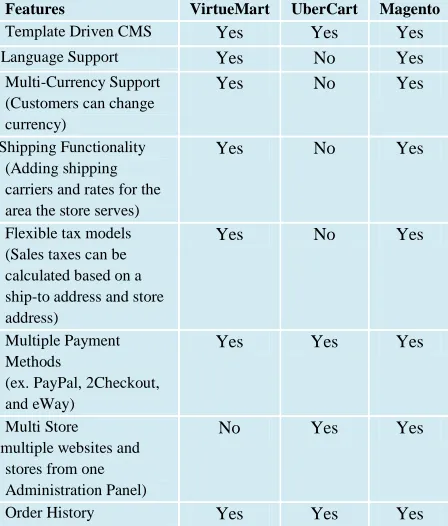
Table 1 compares the features of each cart. Sometimes a cart uses available add-on module to install the feature listed.
VirtueMart is fully integrated with Joomla! and shares the common features of it. It uses the security architecture of Joomla! and also has the capability of using Secure Sockets Layer (SSL) encryption, up to 128-bit. This encryption of HTTPS communication is to make VirtueMart much safer for the buyers and sellers. It supports a large number of shipping, payment and checkout options that are quite simple to configure. VirtueMart has many options for displaying products, offering coupons, and other features expected from any shopping cart software. One of the weaknesses of VirtueMart is that it doesn't support single page checkout. Customer needs to follow many steps to place an order. Generally, people tend to abandon the cart if there are too many steps involved in buying the product. Another weakness of VirtueMart is its limited ability to deal with the complexity of the stock management requirement where it can’t handle multiple SKUs (stock keeping units) per product to handle the different sizes. Other weakness is the inability to restrict access to selected categories to registered users only. Virtuemart also, lacks the possibility to create invoices according to the respective rules and regulations. The client will only be sent a confirmation of order.
Ubercart is the main e-commerce shopping cart solution for Drupal. It shares the advantages of Drupal's major core and contributed systems. Drupal's secure application framework and search engine optimization features are expanded to
Ubercart also. One of Ubercart features
Journal of Theoretical and Applied Information Technology 31st July 2013. Vol. 53 No.3
© 2005 - 2013 JATIT & LLS. All rights reserved.
ISSN: 1992-8645 www.jatit.org E-ISSN: 1817-3195
process of improving the traffic to a web site using special techniques. Such techniques aim to make a high listing search result, thus with a higher probability of attracting visitors. On the other hand, Ubercart has some shortcomings: it has a complex invoice system which can manage more than one invoice at a time per customer. This choice is not applicable for small shops. Inventory management is restricted. The default interface is not attractive nor straightforward. Default templates for the catalog and product need reconfiguration and using key modules such as views, imagecache, wysiwyg, and some sort of lightbox for getting better displays. It also lacks of important features in e-commerce web sites like promotions and discounts.
Magento, is a fast emerging e-commerce script. It has many advanced features: It supports marketing promotions like discounts and coupons to increase sales. It has search engine optimization to increase the visibility in search engines. It can manage many stores at one place. It supports a variety of shipping types and addresses, even send to multiple address in one order. Although Magento is a great open source tool that can be used for free, this platform has some drawbacks. There is no single way to add module like "best seller" or "most viewed products". Backup and recovery is complicated. Another drawback of Magento is that it is not entirely user friendly.
Features VirtueMart UberCart Magento
Template Driven CMS Yes Yes Yes
Language Support Yes No Yes
Multi-Currency Support (Customers can change currency)
Yes No Yes
Shipping Functionality (Adding shipping carriers and rates for the area the store serves)
Yes No Yes
Flexible tax models (Sales taxes can be calculated based on a ship-to address and store address)
Yes No Yes
Multiple Payment Methods
(ex. PayPal, 2Checkout, and eWay)
Yes Yes Yes
Multi Store l multiple websites and
stores from one Administration Panel)
No Yes Yes
Order History Yes Yes Yes
(shopper can view their previous orders) Configurable Products (includes catalog pages
and a block to display product categories)
Yes Yes Yes
Retail Goods Yes Yes Yes
Downloadable Goods Yes Yes Yes
Rentable Goods No No Yes
Stock Inventory (Stock level tracking and notification)
Yes Yes Yes
Coupons/Discounts (Flexible pricing rules)
Yes No Yes
Backup and Restore Facility
No Yes Yes
Marketing Promotions and Tools
No No Yes
Courier Tracking (Customers can track their order via the couriers website)
No No Yes
Customer Registration (Shoppers can manage their user accounts)
Yes Yes Yes
Integrated with Google Analytics
No No Yes
SEO (Search Engine Optimized)
No Yes Yes
SSL (Secure Sockets Layer encryption)
Yes Yes Yes
[image:5.612.83.307.463.726.2]Single page checkout No Yes Yes
Table 1. Features of VirtueMart, Ubercart and Magento
5. DISCUSSION
VirtueMart seems to be a good solution for whom is familiar with Joomla! VirtueMart provides a simple shopping cart and contains the necessary shopping cart features. It is easy to install and to customize; well integrated with Joomla! and can be improved by other Joomla plug-ins. However, there are some limitations in VirtueMart: A major drawback of Virtuemart is the slow development and the lack of advanced functionalities. Another drawback is that there are not many extensions available for Virtuemart itself. Therefore, It is often only possible to pay for an extension or have one developed. In most cases no support for these extensions can be found within the community as one has to pay for support.
payment and (simple) order processing. As with many Drupal based solution, it may be harder if you don't already have a Drupal background. Ubercart is easy to setup and has very active community, it’s quite easy to get help in their forums and they have a lot of documentation. One of the weak points of Ubercart is that it is not customizable; the existing features are sometimes difficult to pick; requiring you to overwrite them, which can be frustrating. Ubercart is still in development which means that there are still plenty of bugs to work out. Finally, there are not as many modules as some other products.
Magento is a great solution for e-commerce and marketing. When we search for a huge cart which can manage thousands of products, Magento seems to be the best solution. It has vast features over Virtuemart and Ubercart. It can manage a product in multiple stores, different languages, prices and location. It provides a powerful search engine optimization facilities built-in. In spite of these good features, Magento suffers from many problems: setting up a Magento website tends to be more complex and involved; the platform is novel so, website developers are still finding a few bugs in the system and some of these need long time to be fixed; Magento sites need more powerful hosting solutions due to using a lot of server resources; the Magento community is not quite active as other solutions; and the technical support is not free. When we consider Magento as a CMS, we find that it is not as good as other CMS platforms like Joomla! and Drupal. It may take time to learn the CMS features and the limited documentation may make it a little harder.
In conclusion, VirtueMart is a good solution for small to medium size stores, especially when setting up an online store for the first time. It is easy integration with Joomla and offers many features with store layout and setup, but for advanced functionality, it is not recommended . Even if Joomla is one of the best CMSs, Virtuemart is not the best shopping cart system. It is not as fully featured as the other customized solutions. It can handle simple shops, but when we look for e-commerce, it is not the best choice. Ubercart is as VirtueMart integrates with one of the best CMSs, but once again, it isn't easy to make changes to it and the functionality available is limited. Magento can be a good choice. It can manage a huge shopping cart site with thousands of products. It has all the advanced features for e-commerce, but on the other hand is a poor CMS.
We found that each one of these products is unique and provide a good solution to CMS and e-commerce. Choosing one of them depends on the user requirements and available resources. We summarized the result of comparison in Table 2, and we gave scores to each criteria. These scores are from one to five. Five is the best and one is the lowest.
Criteria Joomla/
VirtueMart
Drupal/ Ubercart
Magento
Ease of hosting and installation
5 4 2
Performance 4 4 1
Support/community strength
3 4 2
Content Management 5 5 2
Add-on modules 2 2 5
[image:6.612.311.525.201.326.2]Functional features 3 3 5
Table 2. Rating the criteria of VirtueMart, Ubercart and Magento
Finally, We tried to investigate whether one of these popular open source products combines the best of both CMS and e-commerce? We can decide that by looking at table 2. We found that the product that has the best functional feature is poor in CMS and vice versa. As a result, we found that there is no optimal solution that contributes the best features of both CMS and e-commerce.
Consequently, we propose some suggestions to improve these products:
• Extending the functionality of VirtueMart
and Ubercart by developing new e-commerce extensions to acquire the advanced e-commerce features.
• Improving the performance of Magento by
making multiple editions addressed to different businesses. Each edition contains the requirements of a specific business. This can decrease the slow of the system by setting just the needed requirements.
• Integrating one of the best e-commerce
Journal of Theoretical and Applied Information Technology 31st July 2013. Vol. 53 No.3
© 2005 - 2013 JATIT & LLS. All rights reserved.
ISSN: 1992-8645 www.jatit.org E-ISSN: 1817-3195
6. CONCLUSION
Despite the importance of CMS on the success of e-commerce, there is no studies to analyze these CMS solutions for e-commerce and investigate the pros and cons of each one. In this paper, we compared three of the most popular open source CMSs products for e-commerce: VirtueMart from Joomla!, Ubercart from Drupal, and Magento. We compared these products according to many aspects: hosting and installation, performance, support/community, content management, add on modules and functional features.
The analysis we made in the previous Section states clearly that, overall, VirtueMart and Ubercart can be considered the best choices for small to medium shops. They scored high most of criteria except the existence of advanced e-commerce features. On the other hand, Magento is regarded the best choice for big shops that contains thousands of products. It scores high for the criteria that relates to extending the functionality and having advanced features. Its main drawbacks are the low performance and the limited CMS. We concluded that there is no optimal solution that contributes the best features of both CMS and e-commerce at the same time and we suggested some improvements.
REFRENCES:
[1] Barnes, Stuart; Goodwin, Steve; and
Vidgen,Richard, "Web Content Management" (2001). BLED 2001 Proceedings. Paper 47 [2] Farooq, ,Amjad; Fatima, Mahwish and Fahim,
Abuzar, "Design and Development of a Web Content", International journal of
multidisciplinary sciences and engineering, vol. 1, no. 1, sepetember 2010
[3] Gottlieb, Seth, "Content Management Problems
and Open Source Solutions", Optaros, 2006.
[4] Anita Rosen, "The E-commerce Question
andAnswer Book "(USA: American Management
Association, 2000)
[5] MK, Euro Info Correspondence Centre (Belgrade, Serbia), “E-commerce-Factor of Economic Growth”
[6] Thomas L. Mesenbourg, "Measuring Electronic Business: Definitions, Underlying Concepts, and Measurement Plans".
[7] Emmanuel Lallana, Rudy Quimbo, Zorayda Ruth Andam, ePrimer: An Introduction to eCommerce (Philippines: DAI-AGILE, 2000)
[8] Sarkar, Suhreed, "Joomla! E-Commerce with VirtueMart", 2009
[9] Papadongonas, George; Doxaras, Yiannis, " Drupal e-commerce with Ubercart 2.x", 2010 [10] Magento User Guide, 2009
[11] http://docs.joomla.org/
[12] http://drupal.org/documentation [13] http://www.magentocommerce.com/
[14]http://ezinearticles.com/?Comparing-Content-Management-Systems&id=4964438
[15]http://en.wikipedia.org/wiki/Plug-in_(computing) [16]Comparing open source content management