The Design and Improvement of a Software Project
Management System Based on CMMI
Guoping Zhou, Weimin Shao
College of Computer Engineering and Science, Shanghai University, Shanghai, China Email: [email protected]
Received August 19, 2012; revised September 19, 2012; accepted September 26,2012
ABSTRACT
The paper researched and analyzed the characteristics, deficiencies and reasons of a management system of a software enterprise project to design a software project management system based on CMMI 1.2, thus helping the enterprise to improve development and management efficiency of software project and reduce the risks and costs on project devel- opment. It studied CMMI model version 1.3 which is recently released by SEI, analyzed its characteristics and told the difference between version 1.2 and version 1.3. In addition, an improvement proposal and a solution of the software project management system were given from multiple perspectives.
Keywords: CMMI; KPAs of CMMI Level 3; Software Engineering; Project Management
1. Introduction
Because of the complexity, large-scale and diverse pro- jectors, the process of software manufacture urgently needs scientific management and definition. Meanwhile, the increased size of the project which leads to the expo- nential growth of the project data makes the traditional manual controlled project management methods ap- peared to be inadequate. The research on the new man- agement system and new process is urgently needed to effectively enhance the company’s management capabil- ity [1]. These special requirements of the software indus- try promote the rapid development of enterprise project management tools.
CMMI can help enterprises to integrate their original independent functional system, to identify the goals and steps for process improvement, to strongly guide the quality control process, and to provide scientific and ra- tional reference data used during the assessment of the current process[2,3]. Therefore, it is significant for a software enterprise on improving the project manage- ment and the efficiency of product development to make the CMMI theoretical system be well reflected in the project management tools and effectively assist the en- terprise to improve management system and project de- velopment process.
2. The Basic Structure of CMMI
2.1. Capability Maturity Model of Integration (CMMI)
In 2003, Software Engineering Institute of Carnegie
Mellon University (SEI) released the new generation version of Software Capability Maturity Model (SW- CMM)-integrated Capability Maturity model (CMMI) based on the research of SW-CMM and combined with the development characteristics of today’s software in- dustry. The biggest difference of CMMI and CMM is that more key practices of highly application values have been added to CMMI to perfect the process improve- ment.
5 maturity levels of CMMI are: Initial level, repeatable level, defined level, managed level and optimized level.
2.2. CMMI Three Level Process Areas
The CMMI process areas are divided into four categories: Process management, project management, engineering, support.
Compared with SW-CMM, following process areas are added to CMMI:
Process area added to Capability Maturity level 2: Measurement and analysis;
Process area added to Capability Maturity level 3: Re- quirements development, technical solutions, product integration, validation, decision analysis and solutions.
In order to meet CMMI Capability Maturity level 3, the process areas of CMMI levels 1, 2 and 3 are needed to be achieved in the same time.
the request of CMMI and combined with the characteris-tics of the staff in domestic software enterprises, the SPP model has divided into 20 kinds of SPP major roles. When using SPP, the enterprises can map the roles of SPP to the original positions in the enterprise or establish new positions based on SPP roles.
3. The Design of Software Project
Management System Based on CMMI
3.1. Project Management System Workflow
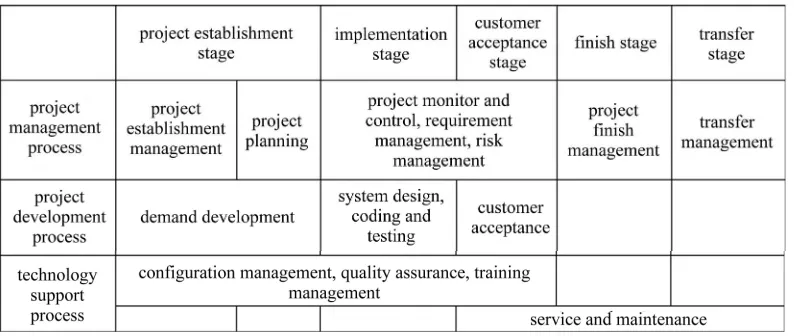
Based on the relationship among the 3 level process areas of CMMI and the key practices set by CMMI level 3, combined with the original business structure of a soft- ware enterprise’s R & D department, we define a set of new project management system workflow which can both meet the CMMI level 3 specifications and realize smooth transition from current management system of the software R & D department, as shown in Figure 1.
3.2. The Entire Functional Structure of the Project Management System
The software project management system consists of project management functional area and system func- tional area. The project functional area consists of six modules: Project management module, project develop- ment module, technology support module, document ma- nagement module, daily management module and em- ployee management module. The system functional area consists of user management module, document man-agement module and role manman-agement module.
3.3. The Design of Main Modules of the Software Project Management System Based on CMMI
According to the requirements of the entire project structure and CMMI 3, the system mainly consists of
system management module, project management mo- dule, project development module, technology support module, document management module, staff manage- ment module and daily management module. The re- quirements of CMMI 3 are reflected during the realized process of each specific module.
3.3.1. Project Establishment Management
Project establishment management is the beginning of the system workflow as the product concept stage. Mean- while, project establishment management belongs to project management in CMMI. The purpose of project establishment management is to adopt the project es- tablishment proposal in keeping with the best interests for the agency and make the proposal become a formal project through project establishment management. Pro- ject establishment management can also avoid project establishment proposal be adopted without best interests for the agency and avoid wasting resources, money and time of the agency. The key practices of project esta- blishment management stage of project management consist of project establishment proposal, project esta- blishment evaluation and project preparation. Depart- ment managers and project managers are involved as staff roles in the project establishment management stage.
3.3.2. Project Planning
[image:2.595.102.499.549.717.2]Project planning is in the product definition stage of the system workflow and belongs to project management in CMMI. Project planning is directly corresponded to the project planning process area (PP). The purpose of project planning is to draft an action programme (project plan) for project R & D and management, thus helping all relevant people work according to the plan orderly. The key practices of project planning stage of project management consist of project estimation, project plan
making, project plan approval, etc. Department managers and project managers are involved as staff roles in the project planning stage.
3.3.3. Requirement Development
Requirement development crosses through the product concept stage and product definition stage of system workflow and belongs to project development in CMMI. Requirement development is directly corresponded to the requirement development process area (RD). The pur- pose of requirement development is to get the needs of user and define the requirements of the product through surveys and analysis. The key practices of requirement development consist of requirement validation, require- ment traceability and requirement change control. Re- quirement analysts are mainly involved as staff roles in the requirement development stage.
3.3.4. System Design
System design is in the product development stage of the system workflow and is related to technology support area (TS) and product integration area (PI). It belongs to engineering. The task and purpose of system design is to design the system structure, user interface, database and modules of the software system in order to build bridge between requirements and codes and guide developers of software products to meet user’s requirements. The key practices of system design consist of system structure design, user interface design, database design and mo- dule design. System designers are involved as staff roles in the system design stage.
3.3.5. Coding and Testing
Coding and testing cross through the product develop- ment stage and product testing stage of system workflow. They are involved in technology support (TS), product integration (PI), verification (VER) and confirm (VAL) process areas. They belong to engineering in CMMI. Coding and testing write and test the codes of the whole system based on system design documents. The key practices of coding and testing consist of programming, code review unit testing, integration testing, defect ma- nagement and error correction. System test is a final and fully test on the whole system to ensure the final system to meet product requirements and follow the system design. Coding controllers, coders, test controllers and testers are involved as staff roles in the coding and test- ing module.
Iteration and repeatability frequently exist in the coding and testing stage. It is difficult for the system to define the degree of task completion. In addition, the design of the module becomes more difficult because the specific arrangements and completion of coding and testing tasks (including code quality and required time,
etc.) will be used as basis for scoring in staff scoring subsystem.
We have designed a judgment method for iterative task state, which is to set an information record for each coding or testing task to record and judge the current state of the coding or testing task. Then we set different time slices for the state of project task. We can judge the state of the coding or testing tasks by testing and cal- culating these time slices. At the same time, the system provides the coding controllers or test controllers with the entrance to subjective scoring, which help them to further understand the distribution of tasks of coders and testers.
3.3.6. Project Monitoring and Controlling
Project monitoring and controlling is in the project management stage and is related to project monitoring and controlling (PMC) and measurement and analysis (MA) process area. It belongs to project management and support. The key practices of project monitoring and controlling in SPP consist of project plan tracing, de- viation controlling and project progress summary. De- partment managers and project managers are involved as staff roles in the project monitoring and controlling stage.
According to the analysis, the progress of the project has the following two characteristics: Firstly, the pro- gress of the project is mainly reflected in the progress of the submitted documents, that is, the progress of the submitted document reflects the progress of the project; secondly, the documents submitted by the different modules are different, so we can represent the progress of each module based on the progress of the submitted document. We have designed two methods in figure to display and control the status of the project: “Figure of project progress—document submitted” and “figure of project progress—module progress”.
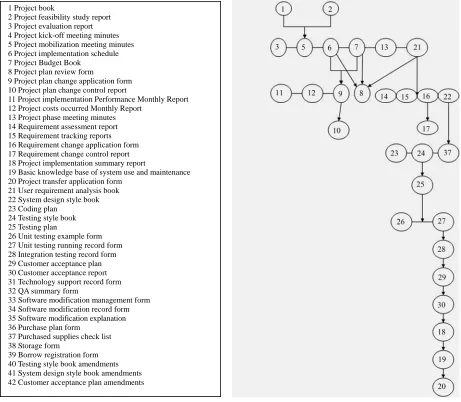
3.3.6.1. Figure of Project Progress—Document Submitted We analyzed 42 standard documents involved in the project development process to find out the dependencies among these documents and produce a figure of docu- ment dependency relationship, see Figure 2.
1 Project book
2 Project feasibility study report 3 Project evaluation report 4 Project kick-off meeting minutes 5 Project mobilization meeting minutes 6 Project implementation schedule 7 Project Budget Book
8 Project plan review form
9 Project plan change application form 10 Project plan change control report
11 Project implementation Performance Monthly Report
nance 12 Project costs occurred Monthly Report
13 Project phase meeting minutes 14 Requirement assessment report 15 Requirement tracking reports 16 Requirement change application form 17 Requirement change control report 18 Project implementation summary report 19 Basic knowledge base of system use and mainte 20 Project transfer application form
21 User requirement analysis book 22 System design style book 23 Coding plan
24 Testing style book 25 Testing plan
26 Unit testing example form 27 Unit testing running record form 28 Integration testing record form 29 Customer acceptance plan 30 Customer acceptance report 31 Technology support record form 32 QA summary form
33 Software modification management form 34 Software modification record form 35 Software modification explanation 36 Purchase plan form
37 Purchased supplies check list 38 Storage form
39 Borrow registration form 40 Testing style book amendments 41 System design style book amendments 42 Customer acceptance plan amendments
[image:4.595.68.529.86.488.2]
Figure 2. Project document diagram.
We change the color of the small circle of the do- cument number to reflect the status of the document: Not submitted, submitted and approved. For the document which is not submitted, the color is gray. For the submitted but not reviewed, the color is orange. For the reviewed, the color is green.
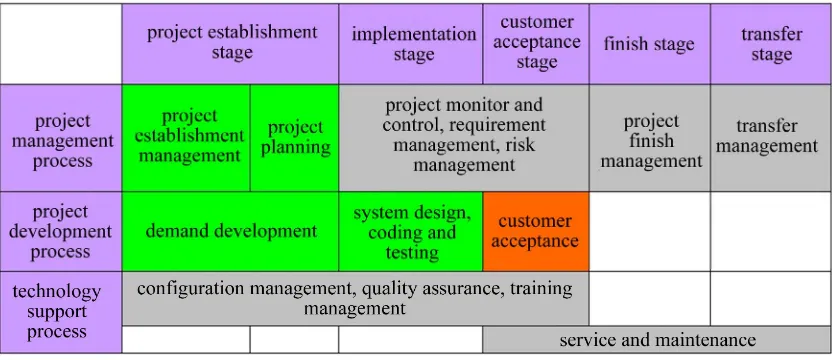
3.3.6.2. Figure of Project Progress—Module Progress Process area involved by each module is fixed, and the type of the document happened during the practices in these areas are fixed. So we can get a figure of project status for the units of project management system mod- ules by judging and analyzing the information of each module. The appearance of the module progress table is shown in Figure 3. The running state of the module is reflected by the state of the documents involved by the module. Changing colors are used to indicate the status of the module.
Three states are used to indicate the running state of
the module:
State 1: Not in the progress (gray). The documents involved in the module have not been submitted;
State 2: In progress (red). More than one document involved in the module has been submitted, but baseline documents have not wholly passed the audit yet;
State 3: Finished (green). All the baseline documents of the module have been submitted and passed the audit.
4. The Necessity and Feasibility for System
Improvement
4.1. The Necessity for System Improvement
Above we have described the unique charm and opera- tion principle of an excellent improvement tool for pro- ject management process, CMMI, and demonstrate a build process of a software project management system hich is based on CMMI and meets the level 3 maturity. w
Figure 3. Figure of project progress—module progress.
For an enterprise which attempt to improve the process management by CMMI, the system can help to achieve the desired results during the improvement of software development management process. However, for resear- chers, such improvements may be just the beginning. As previously described, an enterprise must establish a con- tinuous improving culture in order to truly establish a complete set of integrated continuous improving system. No matter how an enterprise is successful, the staff must feel a sense of crisis and make efforts to do a better job, which is the premise of maintaining the competitiveness of the enterprise. In order to improve software project management system, we considered the following ways: Firstly, convert representation; secondly, enlarge struc- ture scope; thirdly, improve maturity level; fourthly, im- prove based on a later version.
4.2. The Feasibility for System Improvement
Analysis of the necessity and feasibility of above so- lutions.
4.2.1. Convert Representation
Now the system uses a staged representation. Will it be better if using continuous representation? In fact, it is an argued issue in the industry on the choice of the CMMI representation. On one hand, if all other things being equal, a single-number scoring and a standard path for process improvement seem to bring many potential be- nefits. Many enterprises pointed out that the continuous representation look gives a disorderly sense as “all is OK”. On the other hand, an assessment profile may reflect actual results and implementation of a variety of practices than a single number [5]. In practical work, the enterprises consider more about practical problems when they choose between the two methods. In other words, the measurement for the choice should depend on which
representation method is easier to be accepted by the staff or project managers, or which one is more suitable to the enterprise. Because the company is on the be- ginning of building CMMI system for project manage- ment, the visual and operational stronger stage represen- tation method is clearly easier to be accepted by the staff and to be studied in relevant training.
4.2.2. Enlarge Structure Scope
4.2.3. Improve Maturity Level
This solution is the most direct and effective way to improve software project management system. To achi- eve CMMI 4 or even higher level, improvement or innovation must be implemented in hardware and soft- ware. To achieve CMMI 4, for example, two process areas as organizational process performance (OPP) and quantitative project management (QPM) are added com- pared to level 3, but level 4 requires all stages of soft- ware process should have quantified elements. There- fore, if we want to improve the present project ma- nagement system based on CMMI 3 to CMMI 4 in the future, we should take into account to retain adequate interfaces for the system evolution when designing the current system, especially the system interfaces which can provide various project information and data sta- tistics.
CMMI 4 is called quantitative management. The en- terprises hope to strongly control the software produc- tion process, thus quantitative management will be naturally listed to the agenda. The projects carried out quantitative management must be similar in nature and production process, so that it may accumulate a pile of similar comparable data in a period of time and get the baseline using for project management by statistical analysis. The so-called quantitative management is to use indicators derived from empirical data to manage future projects. Therefore, the two PA which achieved maturity level 4 are complex. Take OPP for example, the work- load to establish the SP1.4 function baseline and SP1.5 function model could be the same workload of several PA of maturity levels 2 and 3. The cost of human re- source, material and time is enormous for the enterprises. To an enterprise which just experienced CMMI system reform, it is clearly too early.
4.2.4. Improvement Based on Later Versions
We think this solution is the most realistic and feasible improvement. In October 2010, the SEI official released CMMI 1.3 version. Because the R & D was earlier than the release of the version, the system R & D team was still based CMMI 1.2 when they designed the software project management system. Next, we will focus on the new guidelines of the maturity level 3 model based on the new version for system improvement.
4.3. Improvements Based on CMMI 1.3
As previously stated, the new version of the CMMI model is highly concerned about the definition of high maturity levels (4, 5) and has made significant adjust- ment in its process area. But it does not mean that the new version of the model has no strong points in the low maturity level. Let us take a look at the improvements which CMMI 1.3 make in the process areas and practices
of maturity levels 2 and 3, and how these changes can help to improve the software project management sys- tem.
Firstly, the process areas change in the maturity levels 2 and 3 [6], as shown in Table 1:
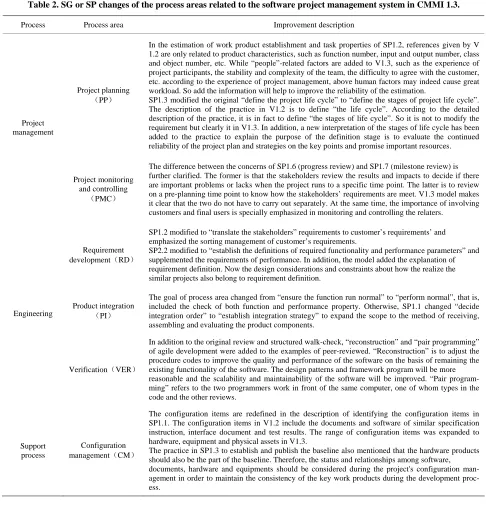
There are 11 maturity 2 and 3 process areas have sig- nificantly changed. Combined with the SSP model and further streamlining results, the process areas involved in software project management system are 6. The major changes of these process areas are shown in Table 2.
Based on the above improvements in CMMI 1.3, we can try to improve the software project management sys- tem from the following aspects:
In the sub-module of project establishment manage- ment, add the document “qualification assessment on staff of project R & D” to ensure that each R & D team is allocated with equally staff in the aspects of age structure, educational background, fields of knowl- edge, etc.
In the sub-module of project monitoring and control, add the document “report on project progress” to highlight the importance of milestone review. At the same time, add the document “report on customer participation and feedback” and create relevant roles to ensure that the customers or final users can fully participate in the project monitoring and controlling process and have enough rights to make advices on project development process.
[image:6.595.308.540.544.735.2] In the sub-module of requirement development, add the document “table of user needs sorting” to sort the needs according to the user’s attention to the product functional and nonfunctional requirements on the basis of analysis of the survey report. The document should be implemented by the role of project manager and timely tracing during the project development process.
Table 1. The change of maturity levels 2 and 3 process areas in CMMI 1.3.
Process area Level
Configuration management (CM) 2
Project planning (PP) 2
Project monitoring and controlling (PMC) 2
Requirement management (REQM) 2
Supplier agreement management (SAM) 2
Measurement management (MA) 2
organization process definition (OPD) 3
integrated project management (IPM) 3
Requirement development (RD) 3
Product integration (PI) 3
Verification (VER) 3
Table 2. SG or SP changes of the process areas related to the software project management system in CMMI 1.3.
Process Process area Improvement description
Project planning (PP)
In the estimation of work product establishment and task properties of SP1.2, references given by V 1.2 are only related to product characteristics, such as function number, input and output number, class and object number, etc. While “people”-related factors are added to V1.3, such as the experience of project participants, the stability and complexity of the team, the difficulty to agree with the customer, etc. according to the experience of project management, above human factors may indeed cause great workload. So add the information will help to improve the reliability of the estimation.
SP1.3 modified the original “define the project life cycle” to “define the stages of project life cycle”. The description of the practice in V1.2 is to define “the life cycle”. According to the detailed description of the practice, it is in fact to define “the stages of life cycle”. So it is not to modify the requirement but clearly it in V1.3. In addition, a new interpretation of the stages of life cycle has been added to the practice to explain the purpose of the definition stage is to evaluate the continued reliability of the project plan and strategies on the key points and promise important resources. Project
management
Project monitoring and controlling
(PMC)
The difference between the concerns of SP1.6 (progress review) and SP1.7 (milestone review) is further clarified. The former is that the stakeholders review the results and impacts to decide if there are important problems or lacks when the project runs to a specific time point. The latter is to review on a pre-planning time point to know how the stakeholders’ requirements are meet. V1.3 model makes it clear that the two do not have to carry out separately. At the same time, the importance of involving customers and final users is specially emphasized in monitoring and controlling the relaters.
Requirement development(RD)
SP1.2 modified to “translate the stakeholders” requirements to customer’s requirements’ and emphasized the sorting management of customer’s requirements.
SP2.2 modified to “establish the definitions of required functionality and performance parameters” and supplemented the requirements of performance. In addition, the model added the explanation of requirement definition. Now the design considerations and constraints about how the realize the similar projects also belong to requirement definition.
Product integration (PI)
The goal of process area changed from “ensure the function run normal” to “perform normal”, that is, included the check of both function and performance property. Otherwise, SP1.1 changed “decide integration order” to “establish integration strategy” to expand the scope to the method of receiving, assembling and evaluating the product components.
Engineering
Verification(VER)
In addition to the original review and structured walk-check, “reconstruction” and “pair programming” of agile development were added to the examples of peer-reviewed. “Reconstruction” is to adjust the procedure codes to improve the quality and performance of the software on the basis of remaining the existing functionality of the software. The design patterns and framework program will be more reasonable and the scalability and maintainability of the software will be improved. “Pair program-ming” refers to the two programmers work in front of the same computer, one of whom types in the code and the other reviews.
Support process
Configuration management(CM)
The configuration items are redefined in the description of identifying the configuration items in SP1.1. The configuration items in V1.2 include the documents and software of similar specification instruction, interface document and test results. The range of configuration items was expanded to hardware, equipment and physical assets in V1.3.
The practice in SP1.3 to establish and publish the baseline also mentioned that the hardware products should also be the part of the baseline. Therefore, the status and relationships among software, documents, hardware and equipments should be considered during the project's configuration man-agement in order to maintain the consistency of the key work products during the development proc-ess.
In the sub-module of configuration management, fur- ther improve the document “configuration manage- ment” to involve project R & D environment, impor- tant property, etc.
Further clarify or improve the relevant systems in corporate employee handbook or training handbook, including: Organizational structure of the project, rights and responsibilities of the project manager and members, rules of team behavior, allocation checking mechanism of inside plan and task, communication method, report method to outside and the customers, etc. The purpose is to build organizational level
writing “key documents” to the project management sys- tem in order to thoroughly reduce the number of tedious documentation tasks on project members.
5. Conclusions
The system has 3 prominent features in functional design: Firstly, control and management technology of the de- velopment process based on the information of the pro- ject development document is used. We also produced the figure of the document dependency relationship. Then we use the figure to realize the control of the pro- ject development workflow by analyzing the information of project documents which meet the requirements of CMMI. Secondly, the authors designed and implemented a task management module based on the time slices of cross-iterative coding and testing. Finally, according to the scoring rules of software development department staff given by the software company, we designed and realized a staff management module which could auto- matically score the staff depending on how the employee completes the project, their daily performance and eva- luation by the project manager.
Further improvements proposed in this paper for the system provides some researches and reference for the
next phase of work of the project R&D team to provide. The specific improvement solution and its feasibility need to be studied by the team. The team should make decision-making and implement the solution on the basis of further research of the inside company system running state.
REFERENCES
[1] P. Weaver, “Effective Project Governance the Tools for Success,” Project Management Institute of New Zealand, Annual Conference, Auckland, 2005.
[2] Software Engineering Institution, “What is CMMI?” 2011. http://www.sei.cmu.edu/cmmi/general
[3] Pragma, “ProcessMax for CMMI Level 3,” 2007. http://www.pragmasystems.com/news/97
[4] R. Lin, “The Improvement Method and Standard of CMMI 3 Software Process,” Electronic Industry Press, Beijing, 2003.
[5] D. M. Ahern, A. Clouse and R. Turner, “CMMI Distilled,” 3rd Edition, Addison-Wesley Professional, New York, 2008.
[6] S. C. Zhong, “A Junior Analysis of the Change of CMMI- DEV1.3 in Process Area Level 2 and 3,” 2011.