ISSN Online: 2152-7261 ISSN Print: 2152-7245
DOI: 10.4236/me.2017.812096 Dec. 8, 2017 1441 Modern Economy
Study on the Peer Effect of Unrelated M&As
Decisions
Lina Yu
School of Business Administration, South China University of Technology, Guangzhou, China
Abstract
This paper takes 7464 pieces of M&As events for A-share listed companies in China from 2010 to 2015 as samples and investigates the industry peer effect of unrelated M&As decisions. The research shows that there exists the peer effect when companies make unrelated M&As decisions in the same industry. This paper also makes further examinations and finds that the M&As expe-rience and scale of companies enhance the peer effect. Moreover, companies with more industry competitions have more obvious industry peer effect. This paper enriches the M&As decisions theory and has guiding significance in practice.
Keywords
M&As Decisions, Unrelated M&As, Peer Effect
1. Introduction
On April 19th, 2016, But’one Information Corporation announced the acquisi-tion of Nanjing Xinchuanhui Electronic Technology Co., Ltd. and entered the field of Internet of Things and Electronic Information System for the achieve-ment of diversified developachieve-ment. In order to achieve the diversified layout, Guangdong Highsun Group Co., Ltd. announced the acquisition of Chenzhou Xintianhan Culture Management Co. Ltd. and entered into the entertainment industry on October 11st of the same year. Nowadays, M&As have become a trend as many companies make M&As in recent years and many M&As are strategic. Companies merger and acquire companies from other industries so as to enter into new growing markets. Some studies show that unrelated M&As can significantly affect the value of company so that the selection between related M&As and unrelated M&As in the face of M&As type decisions becomes an important link for M&As decisions.
How to cite this paper: Yu, L.N. (2017) Study on the Peer Effect of Unrelated
M&As Decisions. Modern Economy, 8,
1441-1454.
https://doi.org/10.4236/me.2017.812096
Received: November 10, 2017 Accepted: December 5, 2017 Published: December 8, 2017
Copyright © 2017 by author and Scientific Research Publishing Inc. This work is licensed under the Creative Commons Attribution International License (CC BY 4.0).
http://creativecommons.org/licenses/by/4.0/
DOI: 10.4236/me.2017.812096 1442 Modern Economy The existing literature on company M&As type decision mainly studies the cause and economic consequences from the perspective of corporate entities. The research of unrelated M&As motivations is an immense number of books. Jensen and Murphy (1990) consider that the agents of companies choose diversi-fication decision in order to increase their compensation [1]. Wernerfelt (1988) believes that enterprises in growth process can balance the effective utilization of existing resources and the exploitation of new resources through the way of di-versification and M&As [2]. There are also some literatures which focus on the decisions of M&As from the perspective of industry. Bettis and Hall (1982) sug-gest that industry opportunities can make the company choose related cation, and the company without opportunities may choose unrelated diversifi-cation [3]. Li (2009) finds that industry opportunities can promote the imple-mentation of unrelated mergers and acquisitions, that is, companies enter into a strong profitability of the industry by means of mergers and acquisitions [4]. There has been a wealth of literatures to study the types of M&As decisions from individual to industry, but a little about the interaction between firms. This pa-per will discuss the influencing factors of M&As decisions from the pa-perspective of interaction.
The peer effect is a kind of theories commonly used in the study of sociology and pedagogy. The peer effect defined by Winston and Zimmerman (2003) re-ferred that individual behaviors and results were not only affected by their own characteristics but also influenced by those who had the same status, namely, people in the same group [5]. In recent years, some literatures have introduced the peer effect theory into the field of financial research. Shue (2013) found in the study that the financial policies among companies led by MBA graduates of Harvard Business School had the peer effect and companies led by graduates in the same group had significant interaction in financial policies of salary, M&As financing and cash holding [6]. Wan (2016) found that there was the industry peer effect as Chinese listed companies made M&As decision [7], but there were rare literatures that analyzed M&As type decisions from the perspective of the peer effect.
This paper takes the M&As events of China’s listed companies from 2010 to 2015 as the sample and investigates the peer effect of unrelated M&As decision among companies in the same industry. The study results show that there is the peer effect as listed companies in the same industry make unrelated M&As deci-sion and the M&As experience of company and industry competition can en-hance the impacts of the peer effect.
DOI: 10.4236/me.2017.812096 1443 Modern Economy small amount of literature examines the effects of recent company specific fi-nancial decisions, but there is still no direct examination of unrelated M&As de-cisions, and this paper extends the research scope with group effect in a certain extent; Finally, this paper also has practical significance and makes some com-plementary explanations for the reasons behind the existing unrelated M&As in China so that investors can reasonably evaluate enterprise mergers and acquisi-tions activities.
The structure of the paper is organized as followed: Section 1 is an introduc-tion of this paper. In Secintroduc-tion 2, I discuss literature reviews and theoretical analy-sis. In Section 3, I discuss the sample selection, variables and models. Empirical results and analysis have been developed in Section 4. Conclusions have been discussed in Section 5.
2. Literature Review and Theoretical Analysis
According to the strategic fitness of both parties in M&As, M&As can be divided into related M&As and unrelated M&As. In the case of established M&As strat-egy, what type of M&As should be selected becomes the another major decision of company.
It can be seen from the overseas researches that there are only few literatures that directly study the factors of company M&As type decision. Most literatures have studied the economic consequences of M&As in different types and dis-prove the rationality of certain M&As behavior. Such literatures that directly studied M&As type decisions as that Aggarwal and Baxamusa (2013) studied the selection of company M&As types based on the asymmetric information theory. They found that companies with lower cash holdings, higher capital costs, great-er financing restraint level and more sgreat-erious asymmetric information are more inclined to carry out unrelated M&As rather than select related M&As [8]. The existing literatures do not reach a consistent conclusion on the economic con-sequences of M&As in different types. Most studies disprove the rationality of M&As behavior from economic consequences. Morck, Shleifer and Vishny (1990) found that the performance of related M&As is superior to the unrelated M&As’, and that unrelated M&As harm the value of company and there is so-called “Diversified Discount” [9]. However, there are also different opinions in some researches. Aggarwal and Baxamusa (2013) believed that the internal capital market advantage brought by unrelated M&As can promote the value of company.
compa-DOI: 10.4236/me.2017.812096 1444 Modern Economy ny owners can spread risks by diversifying their stock portfolios but company managers can only reduce the operational risks by diversifying the company
[10]. Resource-based hypotheses believe that abundant resources tend to exist in diversified companies. Penrose (1959) argued that an effective organizational form of implementing economic activities in diversified companies is the scope economy [11]. Based on the market power theory, Villalonga (2000) proposed three motivations for the diversification of companies. The first was the diversi-fication of companies was to achieve the predatory pricing in other industries so as to realize cross- subsidies. The second was companies ally with other compa-nies achieve multidimensional competition in other markets. The third is that companies take advantage of diversification to ally with large companies to conduct mutual purchase so as to push out small competitors in the market [12].
In China, there are a lot of researches on the motivation of M&As decision. Hong (2006) believed that the assumption of free cash flow and overconfidence theory would affect the unrelated M&As decision [13]. According to the pros-pect theory, Li and Zhou (2007) argued that the profitability of companies would affect the unrelated M&As decisions and the property of companies might affect the unrelated M&As decisions [14]. Fang (2008) argued that intervention of lo-cal governments would affect the unrelated M&As decision of enterprises [15]. Li, Zhao and Liu (2009) found in the study that industry opportunities and po-litical connection would influence companies making unrelated M&As decisions
[16]. Wang and Wei (2013) argued that the industry restructuring pressure and the resource endowment of companies were related to unrelated M&As deci-sions. However, all above studies do not analyze the unrelated M&As from the interaction among groups of companies. This paper tries to introduce the peer effect theory of social psychology to explain the motivation of unrelated M&As.
The peer effect theory refers to the theory that individual behaviors are not only affected by his own factors but also influenced by behaviors of people in the same group, which results in the change of his own behaviors, namely, who lies down with dogs must rise up with flea. Extensive studies of the peer effect ex-isted in studies of pedagogy and sociology in the early years. Sacerdote (2001) found in the study that the performance of American college students was in-fluenced by behaviors of other students in the same dormitory [17]. Studies from Lazear (2001) showed that a good student could have positive impacts on other students and students would gain more benefits by staying with good students
[18]. There are also similar studies in China. The study from Men (2013) im-plied that there was the peer effect in the labor market of Chinese college gra-duates and the skills and knowledge of college students in the labor market were influenced by other students in their class. Recently, studies that take advantage of the peer effect appear in the financial field. Shue (2013) found in the study that the financial policies among companies led by MBA graduates of Harvard Business School had the peer effect. Leary (2014) found that the peer effect ex-isted in the financing decisions of companies.
DOI: 10.4236/me.2017.812096 1445 Modern Economy on the peer effect. Organizational learning theory and institutional theory be-lieve that organizations are more likely to study as facing the uncertain envi-ronment. Information asymmetry is a kind of manifestations for environmental uncertainty and M&As activities usually have very high information asymmetry and unrelated M&As have higher information asymmetry than that of related M&As. Aggarwal and Baxamusa (2013) found in the study that unrelated M&As had higher information asymmetry than that of related M&As, while Ellison and Fudenberg (1993) showed that the peer effect was based on information asym-metry and limited rationality [19]. In conclusion, unrelated M&As need more learnings from people in the same group for their higher information uncertain-ty, based on which Hypothesis 1 is proposed:
H1: Companies in the same industry have the peer effect when making unre-lated M&As decisions.
In order to further explore the influence mode of the industry peer effect in the unrelated M&As decisions, this paper further tests peer effect with the theory of learning and information asymmetry.
In the field of social learning and research, studies conducted by Galef (1996) showed that direct involvement in the process of making decisions could leave profound impacts and memories, which could be easily recalled later and by which subsequent similar decisions would be affected [20]. Based on this, this paper assumes that companies that have the experience of M&As or experience of unrelated M&As are more likely to be affected by the industry peer effect of unrelated M&As decision. Besides, Park (2003) found that the enterprise’s scale before M&As was significantly and positively related to M&As of company [21]. Moreover, companies with larger enterprise scale own stronger abilities to access information so that this paper assumes that they have more obvious industry peer effect of unrelated M&As decisions. Select the enterprise scale as a regula-tory factor to make regression. Based on this, Hypothesis 2 is proposed:
H2: In the same industry, companies obtaining more information have en-hancement effects on the peer effect of unrelated M&As decisions among com-panies, namely, companies with the experience of uncorrelated M&As will en-hance the peer effect and companies with larger scale will enen-hance the peer effect. Studies made by Aggarwal and Baxamusa (2013) showed that companies with unrelated M&As have higher information asymmetry than companies with re-lated M&As or without M&As. while Ellison and Fudenberg (1993) found in the study that the emergence basis of the peer effect was information asymmetry and limited rationality as companies made decisions. Therefore, in industries with high industry competition, in order to cope with the fierce competition in the industry, companies would tend to imitate M&As decision of group members in the industry. This paper defines that one subtracts Herfindahl index of industry revenue as the industry competition (Competition). and the larger this value, the fiercer competition for industry of companies. Based on this, Hypothesis 3 is proposed:
DOI: 10.4236/me.2017.812096 1446 Modern Economy effect of unrelated M&As decisions.
3. Study Design
3.1. Sample Selection
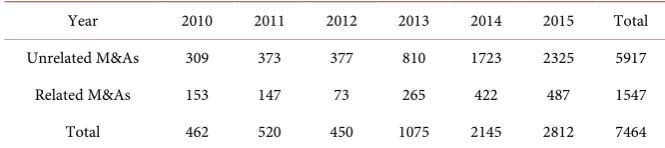
This paper selects M&As events of Chinese A-share listed companies from 2010 to 2015 as research samples. The data of M&As events comes from Wind Information database and all other variables are from CSMAR database. Ex-cluding financial industry samples and M&As events with transaction value of less than one million yuan, M&As classified by M&As targets of “Diversifica-tion Strategy” and “Business Transforma“Diversifica-tion” in Wind Informa“Diversifica-tion database are defined as unrelated M&As and others are related M&As. And this paper removes samples with missing data. There are 1547 unrelated M&As events and 5917 related M&As events, totally 7464 samples. All continuous variables are processed by 1% winsorization. The annual distribution of samples is as follow (Table 1).
3.2. Variables and Models
[image:6.595.205.538.635.709.2]This paper makes regression with the binary logit model and the dependent va-riable is the dummy vava-riable Div(i p t, ,), which indicates the probability that the sample company i in industry p make unrelated M&As in year t. The explanato-ry variable Unrelate(−i p t, ,−1) indicates the M&As frequency of the same industry and refers to the mathematical expectation of probability for unrelated M&As made by companies other than company i in industry P in year t-1. If the unre-lated M&As decision made by the sample company is significantly influenced by the irrelevant unrelated M&As decision of other companies in the group, name-ly, the regression coefficient β1 for Unrelate(−i p t, ,−1) is significantly positive, and then it indicates there is the industry peer effect of unrelated M&As decisions. This paper refers to the literature from Aggarwal and Baxamusa (2013) and a se-ries of factors that affect the types of M&As decisions includes: whether the company is acquired by a related company(Related), whether the chairman and the CEO are dual (Dual), the nature of company’s property (Property), share-holdings of first majority shareholder (First), independent director ratio (Lndep), board size (ESH), shareholdings of the management(Board), overcon-fidence degree of executives (Overcon), cash stock ratio (Cash), intangible assets
Table 1. Annual samples distribution.
Year 2010 2011 2012 2013 2014 2015 Total
Unrelated M&As 309 373 377 810 1723 2325 5917
Related M&As 153 147 73 265 422 487 1547
Total 462 520 450 1075 2145 2812 7464
DOI: 10.4236/me.2017.812096 1447 Modern Economy ratio (Intang), Tobin’s Q (Tobinq), operating cash flow ratio (OCF), asset size(Size), total asset and net profit ratio (ROA), asset-liability ratio (Lev), growth rate of operation revenue (Growth), discretionary accruals of company (Accrual), financing restraint level (FC) and diversification level before M&As (Bedrivers). All above control variables lag by one year. This paper also controls the annual fixed effects. Table 2 elaborates the definition of all variables. Model 1 is as follows:
Table 2. Definition of variables. Type of
variables Variables Name of variables Measurement
Dependent
Variable Div(i p t, ,) Unrelated M&As
If company i in industry p makes unrelated M&As in year t, take the value of 1; if not, 0
Explanatory
variable Unrelate(−i p t, , 1−)
Mathematical expectation of probability for unrelated M&As in the same industry
The mathematical expectation of probability for unrelated M&As made by companies other than company i in industry P in year t − 1
Control variables
Related M&As of related parties Related parties make M&As, take the value of 1; if not, 0
Dual Duality Duality of chairman and general manager, take the value of 1; if not, 0
Property Nature of property State-owned enterprise, take the value of 1; if not, 0
First first majority shareholder The shareholding ratio of Shareholding quantity of first majority shareholder/total number of shares
Lndep Proportion of independent directors Number of independent directors/the number of board members
Board Board size The total number of board members
ESH Management shareholding Management shareholding quantity/total number of shares
Overcon The overconfidence degree of executives Remuneration of top three executives/total remuneration of executives
Cash Cash stock ratio Cash stock/total assets
Intang Intangible assets ratio Intangible assets/total assets
Tobinq Tobin’s Q Market value/replacement cost
OCF Operating cash flow ratio Operating net flows/total assets
Size Asset size The natural logarithm of total assets
ROA Total asset and net profit ratio Net profit/Total assets
Lev Asset-liability ratio Liabilities/Total assets
Growth Growth rate of operation revenue
(operation revenue in current year-operation revenue in the previous year)/operation revenue in the previous year
Accrual Discretionary accruals of company Manipulated accrual profit calculated with the modified Jones model/total assets
FC Financing restraint level KZ index
DOI: 10.4236/me.2017.812096 1448 Modern Economy
( ) ( ) ( ) ( )
( ) ( ) ( ) ( )
( ) ( ) ( ) ( )
0 1 2 3
, , , , 1 , , , ,
4 , , 5 , , 6 , , 7 , ,
8 , , 9 , , 10 , , 11 , ,
i p t i p t i p t i p t
i p t i p t i p t i p t
i p t i p t i p t i p t
Div Unrelate Related Dual
Property First Lndep Board
ESH Overcon Cash Intang
β β β β
β β β β
β β β β
− − = + + + + + + + + + + + ( ) ( ) ( ) ( ) ( ) ( ) ( ) ( ) ( )
12 , , 13 , , 14 , , 15 , ,
16 , , 17 , , 18 , , 19 , ,
20 , , ,
i p t i p t i p t i p t
i p t i p t i p t i p t
t i t i p t
Tobingq OCF Size ROA
Lev Growth Accrual FC
Bedrivers
β β β β
β β β β
β ϕ ν ε
+ + + +
+ + + +
′
+ + +
(1)
In order to test Hypothesis 2, this paper defines M&As experience as that if unrelated M&As has been made in first three years before M&As, take value of 1; if not, 0. Asset size is the total assets of the company. Construct model 2 and model 3:
( ) ( ) ( ) ( ) ( )
( ) ( ) ( ) ( )
( ) ( ) ( )
0 1 2 3
, , , , , , , , , ,
4 , , 5 , , 6 , , 7 , ,
8 , , 9 , , 10 , , 11
Re
Pr
i p t i p t i p t i p t i p t
i p t i p t i p t i p t
i p t i p t i p t
Div Urelate Size Experience lated
Dual operty First Lndep
Board ESH Overcon Ca
β β β β
β β β β
β β β β
−
= + ∗ + +
+ + + +
+ + + + sh(i p t, ,)
( ) ( ) ( ) ( )
( ) ( ) ( ) ( )
( ) ( )
12 , , 13 , , 14 , , 15 , ,
16 , , 17 , , 18 , , 19 , ,
20 , , 21 , , ,
tan
i p t i p t i p t i p t
i p t i p t i p t i p t
t i t
i p t i p t
In g Tobingq OCF Size
ROA Lev Growth Accrual
FC Bedrivers
β β β β
β β β β
β β ϕ ν ε
+ + + + + + + + ′ + + + + (2) ( ) ( ) ( ) ( ) ( ) ( ) ( ) ( ) ( ) ( ) ( )
0 1 , , ) 2 3
, , , , , , , ,
4 , , 5 , , 6 , , 7 , ,
8 , , 9 , , 10 , , 11
r
i p t
i p t i p t i p t i p t
i p t i p t i p t i p t
i p t i p t i p t
Div Urelate Size Size Related
Dual P operty First Lndep
Board ESH Overcon Cash
β β β β
β β β β
β β β β
−
= + ∗ + +
+ + + +
+ + + +
(
(i p t, ,)
( ) ( ) ( ) ( )
( ) ( ) ( ) ( )
( ) ( )
12 , , 13 , , 14 , , 15 , ,
16 , , 17 , , 18 , , 19 , ,
20 , , 21 , , ,
i p t i p t i p t i p t
i p t i p t i p t i p t
t i t
i p t i p t
Intang Tobingq OCF Size
ROA Lev Growth Accrual
FC Bedrivers
β β β β
β β β β
β β ϕ ν ε
+ + + +
+ + + +
′
+ + + +
(3)
In order to test Hypothesis 3, this paper defines that one subtracts Herfindahl index of industry revenue as the industry competition (Competition), and the larger this value, the fiercer competition for industry of companies. Structure model 4:
( ) ( ) ( ) ( )
( ) ( ) ( ) ( )
( ) ( ) ( )
0 1 2
, , , , , , , ,
3 , , 4 , , 5 , , 6 , ,
7 , , 8 , , 9 , , 10
Re Pr
i p t i p t i p t i p t
i p t i p t i p t i p t
i p t i p t i p t i
Div Urelate Competition Competition
lated Dual operty First
Lndep Board ESH Overcon
β β β
β β β β
β β β β
−
= + ∗ +
+ + + +
+ + + + (, ,p t)
( ) ( ) ( ) ( )
( ) ( ) ( ) ( )
( ) ( )
11 , , 12 , , 13 , , 14 , ,
15 , , 16 , , 17 , , 18 , ,
19 , , 20 , , 21 , ,
tan
i p t i p t i p t i p t
i p t i p t i p t i p t
i p t i p t i p
Cash In g Tobingq OCF
Size ROA Lev Growth
Accrual FC Bedrivers
β β β β
β β β β
β β β
+ + + +
+ + + +
+ + + ( t)+ϕ ν ε′ t+ i t,
(4)
4. Empirical Results and Analysis
4.1. Descriptive Statistics
DOI: 10.4236/me.2017.812096 1449 Modern Economy
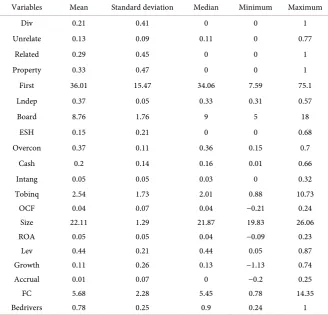
Table 3. Descriptive statistics.
Variables Mean Standard deviation Median Minimum Maximum
Div 0.21 0.41 0 0 1
Unrelate 0.13 0.09 0.11 0 0.77
Related 0.29 0.45 0 0 1
Property 0.33 0.47 0 0 1
First 36.01 15.47 34.06 7.59 75.1
Lndep 0.37 0.05 0.33 0.31 0.57
Board 8.76 1.76 9 5 18
ESH 0.15 0.21 0 0 0.68
Overcon 0.37 0.11 0.36 0.15 0.7
Cash 0.2 0.14 0.16 0.01 0.66
Intang 0.05 0.05 0.03 0 0.32
Tobinq 2.54 1.73 2.01 0.88 10.73
OCF 0.04 0.07 0.04 −0.21 0.24
Size 22.11 1.29 21.87 19.83 26.06
ROA 0.05 0.05 0.04 −0.09 0.23
Lev 0.44 0.21 0.44 0.05 0.87
Growth 0.11 0.26 0.13 −1.13 0.74
Accrual 0.01 0.07 0 −0.2 0.25
FC 5.68 2.28 5.45 0.78 14.35
Bedrivers 0.78 0.25 0.9 0.24 1
The above data is calculated by the author.
4.2. Regression Results
4.2.1. Regression Results of Hypothesis 1
DOI: 10.4236/me.2017.812096 1450 Modern Economy
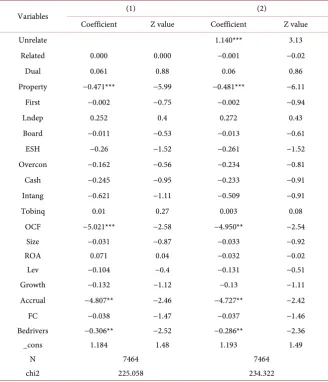
Table 4. Regression results for Hypothesis 1.
Variables (1) (2)
Coefficient Z value Coefficient Z value
Unrelate 1.140*** 3.13
Related 0.000 0.000 −0.001 −0.02
Dual 0.061 0.88 0.06 0.86
Property −0.471*** −5.99 −0.481*** −6.11
First −0.002 −0.75 −0.002 −0.94
Lndep 0.252 0.4 0.272 0.43
Board −0.011 −0.53 −0.013 −0.61
ESH −0.26 −1.52 −0.261 −1.52
Overcon −0.162 −0.56 −0.234 −0.81
Cash −0.245 −0.95 −0.233 −0.91
Intang −0.621 −1.11 −0.509 −0.91
Tobinq 0.01 0.27 0.003 0.08
OCF −5.021*** −2.58 −4.950** −2.54
Size −0.031 −0.87 −0.033 −0.92
ROA 0.071 0.04 −0.032 −0.02
Lev −0.104 −0.4 −0.131 −0.51
Growth −0.132 −1.12 −0.13 −1.11
Accrual −4.807** −2.46 −4.727** −2.42
FC −0.038 −1.47 −0.037 −1.46
Bedrivers −0.306** −2.52 −0.286** −2.36
_cons 1.184 1.48 1.193 1.49
N 7464 7464
chi2 225.058 234.322
The above data is calculated by the author.
4.2.2. Regression Results of Hypothesis 2
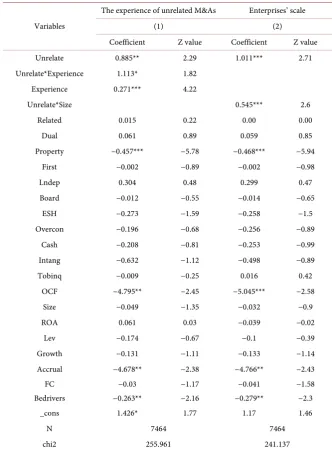
The column (1) of Table 5 is the regression result of M&As experience as a moderating variable. This paper finds that the coefficient of Unrelate *Experience is significantly positive, which indicates that the M&As experience can enhance the peer effect of unrelated M&As decisions in the same industry. If this paper defines the M&As experience as that M&As events occurs within first three years before M&As, their regression results are similar. In addition, col-umn (2) of Table 5 is the regression result of company’s asset size as a moderat-ing variable. We find that the asset size can enhance the peer effect of unrelated M&As decisions in the same industry. The above results show that the compa-nies with stronger learning ability have the more obvious industry peer effect of unrelated M&As decisions.
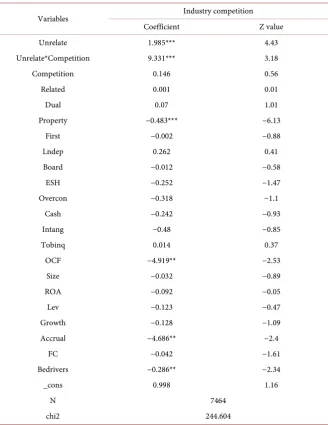
4.2.3. Regression Results of Hypothesis 3
DOI: 10.4236/me.2017.812096 1451 Modern Economy
Table 5. Regression results of Hypothesis 2.
Variables
The experience of unrelated M&As Enterprises’ scale
(1) (2)
Coefficient Z value Coefficient Z value
Unrelate 0.885** 2.29 1.011*** 2.71
Unrelate*Experience 1.113* 1.82
Experience 0.271*** 4.22
Unrelate*Size 0.545*** 2.6
Related 0.015 0.22 0.00 0.00
Dual 0.061 0.89 0.059 0.85
Property −0.457*** −5.78 −0.468*** −5.94
First −0.002 −0.89 −0.002 −0.98
Lndep 0.304 0.48 0.299 0.47
Board −0.012 −0.55 −0.014 −0.65
ESH −0.273 −1.59 −0.258 −1.5
Overcon −0.196 −0.68 −0.256 −0.89
Cash −0.208 −0.81 −0.253 −0.99
Intang −0.632 −1.12 −0.498 −0.89
Tobinq −0.009 −0.25 0.016 0.42
OCF −4.795** −2.45 −5.045*** −2.58
Size −0.049 −1.35 −0.032 −0.9
ROA 0.061 0.03 −0.039 −0.02
Lev −0.174 −0.67 −0.1 −0.39
Growth −0.131 −1.11 −0.133 −1.14
Accrual −4.678** −2.38 −4.766** −2.43
FC −0.03 −1.17 −0.041 −1.58
Bedrivers −0.263** −2.16 −0.279** −2.3
_cons 1.426* 1.77 1.17 1.46
N 7464 7464
chi2 255.961 241.137
The above data is calculated by the author.
is significantly positive at the level of 1%, which indicates that the more fierce competition in the industry of sample company i, the stronger industry peer ef-fect of unrelated M&As decisions is.
5. Conclusions and Policy Suggestion
DOI: 10.4236/me.2017.812096 1452 Modern Economy
Table 6. Regression results of Hypothesis 3.
Variables Industry competition
Coefficient Z value
Unrelate 1.985*** 4.43
Unrelate*Competition 9.331*** 3.18
Competition 0.146 0.56
Related 0.001 0.01
Dual 0.07 1.01
Property −0.483*** −6.13
First −0.002 −0.88
Lndep 0.262 0.41
Board −0.012 −0.58
ESH −0.252 −1.47
Overcon −0.318 −1.1
Cash −0.242 −0.93
Intang −0.48 −0.85
Tobinq 0.014 0.37
OCF −4.919** −2.53
Size −0.032 −0.89
ROA −0.092 −0.05
Lev −0.123 −0.47
Growth −0.128 −1.09
Accrual −4.686** −2.4
FC −0.042 −1.61
Bedrivers −0.286** −2.34
_cons 0.998 1.16
N 7464
chi2 244.604
The above data is calculated by the author.
industry peer effect of unrelated M&As decision, and industry competition can promote the industry peer effect of unrelated M&As decisions.
DOI: 10.4236/me.2017.812096 1453 Modern Economy for enterprises to optimize M&As decisions and applies the peer effect theory to the evaluation of M&As behaviors so as to help investors make more reasonable assessment of company’s M&As activities. For future researches, the geographi-cal peer effect of unrelated M&As and economic consequences caused by unre-lated M&As peer effect are the directions for discussion.
References
[1] Jensen, M.C. and Murphy, K.J. (1990) Performance Pay and Top-Management In-centives. Journal of Political Economy, 98, 225-264. https://doi.org/10.1086/261677
[2] Montgomery, C.A. and Wernerfelt, B. (1988) Diversification, Ricardian Rents, and Tobin’s q. Rand Journal of Economics, 19, 623-632.
https://doi.org/10.2307/2555461
[3] Bettis, R.A. and Hall, W.K. (1982) Diversification Strategy, Accounting Determined Risk, and Accounting Determined Return. Academy of Management Journal, 25, 254-264.https://doi.org/10.2307/255989
[4] Li, S.M., Zhao, J.J. and Liu, Y. (2009) Industry Opportunities, Political Connections and Diversified Mergers and Acquisitions. Major Management Research, No. 4, 1-17.
[5] Winston, G.C. and Zimmerman, D.J. (2003) Peer Effects in Higher Education. Dis-cussion Paper. Academic Achievement, 39, 43.
[6] Shue, K. (2013) Executive Networks and Firm Policies: Evidence from the Random Assignment of MBA Peers. Social Science Electronic Publishing, 26, 1401-1442.
https://doi.org/10.1093/rfs/hht019
[7] Wan, L.Y., Liang, C.J. and Rao, J. (2016) Study on the Industry Peer Effect of M&A Decisions in Listed Companies. Nankai Business Review, 19, 40-50.
[8] Aggarwal, R.K. and Baxamusa, M.H. (2012) Unrelated Acquisitions. SSRN Elec-tronic Journal, 1, 324-338.
[9] Morck, R., Shleifer, A. and Vishny, R.W. (1990) Do Managerial Objectives Drive Bad Acquisitions? The Journal of Finance, 45, 31-48.
https://doi.org/10.1111/j.1540-6261.1990.tb05079.x
[10] Amihud, Y. and Lev, B. (1981) Risk Reduction as a Managerial Motive by Conglo-merate Managers. Bell Journal of Economics, 12, 605-617.
https://doi.org/10.2307/3003575
[11] Penrose, E.T. (1959) The Theory of the Growth of the Firm. Southern Economic Journal, 27, 151.
[12] Villalonga, B. (2004) Diversification Discount or Premium? New Evidence from the Business Information Tracking Series. The Journal of Finance, 59, 479-506.
https://doi.org/10.1111/j.1540-6261.2004.00640.x
[13] Hong, D.L., Liu, L. and Xiong, D.H. (2006) Diversified Acquisitions, Firms’ Long-Term Performance Loss and Motivations. Economy Science, 28, 63-73. [14] Li, S.M. and Zhou, X.C. (2007) Empirical Study on Company Characteristics,
In-dustry Characteristics and Types of M&As Strategy. Management World, No. 3, 130-137.
[15] Fang, J.X. (2008) Government Intervention, Nature of Ownership and Enterprise Merger and Acquisition. Management World, No. 9, 118-123.
Re-DOI: 10.4236/me.2017.812096 1454 Modern Economy source Endowment and Diversified Mergers and Acquisitions. China Annual Fi-nancial Conference.
[17] Sacerdote, B. (2001) Peer Effects with Random Assignment: Results for Dartmouth Roommates. Quarterly Journal of Economics, 116, 681-704.
https://doi.org/10.1162/00335530151144131
[18] Lazear, E.P. (1999) Educational Production. Social Science Electronic Publishing, 116, 777-803.https://doi.org/10.3386/w7349
[19] Ellison, G. and Fudenberg, D. (1993) Rules of Thumb for Social Learning. Journal of Political Economy, 101, 612-643.https://doi.org/10.1086/261890
[20] Galef, B.G. (1996) The Adaptive Value of Social Learning: A Reply to Laland. Ani-malBehaviour, 52, 641-644.https://doi.org/10.1006/anbe.1996.0206
[21] Park, C. (2003) Prior Performance Characteristics of Related and Unrelated Ac-quirers. Strategic Management Journal, 24, 471-480.