A method for assessing the use of flood models in the
operational phase of flood calamity management
Are flood models used?
A method for assessing the use of flood models in the
operational phase of flood calamity management
Are flood models used?
A method for assessing the use of flood models in the
operational phase of flood calamity management
Alexander Hoff
Nelen & Schuurmans
Postbus 1219 3500 BE Utrecht
www.nelen-schuurmans.nl
Graduation research
Alexander Hoff
Master student Civil Engineering a [email protected]
Committee of supervisors
UT supervisor External and daily
A method for assessing the use of flood models in the
operational phase of flood calamity management
Department of Water Engineering and Management
University of Twente
7500 AE Enschede, The Netherlands
Nelen & Schuurmans
3500 BE Utrecht
schuurmans.nl
Graduation research
Alexander Hoff
ster student Civil Engineering and Management [email protected]
of supervisors
UT supervisor and head committee: Dr. M.S. Krol
External and daily supervisor: Ir. J.G. Leskens (Nelen & Schuurmans)
Are flood models used?
A method for assessing the use of flood models in the
operational phase of flood calamity management
MASTER THESIS Civil Engineering and Management
Department of Water Engineering and Management
University of Twente P.O. Box 217 7500 AE Enschede, The Netherlands
(Nelen & Schuurmans)
Are flood models used?
A method for assessing the use of flood models in the
operational phase of flood calamity management
MASTER THESIS nd Management
Summary
In flood calamity management
operational phase and the post calamity phase. Th
phase, lasting from three days before an event right until the event occurs. In this phase actions taken are reactive to the situation.
preparatory phase of flood calamity manage models are barely used
The last few years the 3Di
the operational phase of flood calamity management. However, it is still unsure if this tool will effectively improve the decision making process
available to assess
this research is to develop a method to assess the use of flood models in the operational phase of flood calamity management by establishing a set of specific and measureable indicators which together can be used to
To reach this objective, first the decision making context of flood calamity management in the use of technical information is explored. This
and observing participants at encountered practical constrain
done by analyzing evaluation reports and observing participants
organized by the 3Di consortium. Third, the constraints are represented in specific measurable indicators. This
water boards. Fourth, the representativeness of the indicators verified. This is
Hoogheemraadschap of Delfland The decision making
is determined. The topics of decision making can roughly be divided into t measures against the cause
organizational decisions
flood calamity management can be found in
a decision is usually structured using a predefined decision making structure. Technical information is considered as an external influence on the decision making process. have a limited role, although
Constraints in use of technical information encountered during flood calamities or exercises are determined.
preferred as an advice what decision to make.
barely made during the operational phase of flood calamity management precalculated scenarios are used
the use of technical information. This is supported by the increa
systems. Topics of constraints encountered are, lack of overview, reliability of information, model expectations and pressure of time.
Summary
flood calamity management three phases are distinguished: the preparatory phase, the operational phase and the post calamity phase. This research focuses on the operational phase, lasting from three days before an event right until the event occurs. In this phase actions taken are reactive to the situation. Currently, flood models are used in the
preparatory phase of flood calamity management. However, in the operational phase flood models are barely used (Leskens & Brugnach, 2012).
The last few years the 3Di consortium has worked on a powerful tool that may be usable in operational phase of flood calamity management. However, it is still unsure if this tool will effectively improve the decision making process and there is currently no method
assess this. This thesis focuses on developing such a method.
this research is to develop a method to assess the use of flood models in the operational phase of flood calamity management by establishing a set of specific and measureable indicators which together can be used to assess this.
bjective, first the decision making context of flood calamity management in the use of technical information is explored. This is done by analyzing flood calamity plans and observing participants at a workshop organized by the 3Di consortium. Second,
ntered practical constraints in the use of technical information are collected. This done by analyzing evaluation reports and observing participants at another
the 3Di consortium. Third, the constraints are represented in specific measurable indicators. This is done by interviewing a wide range of professionals from water boards. Fourth, the representativeness of the indicators for a real
done by observing participants at the national flood calamity exercise at Hoogheemraadschap of Delfland on 14 November, 2012.
The decision making context of flood calamity management in use of technical information The topics of decision making can roughly be divided into t
against the causes of floods, measures against the effects of floods
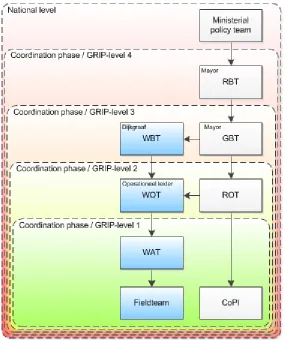
organizational decisions. The network of teams cooperating in the operational phase of flood calamity management can be found in figure 3-1 on page 14. The process of making
n is usually structured using a predefined decision making structure. Technical information is considered as an external influence on the decision making process. have a limited role, although information managers seem to be of increasing importanc Constraints in use of technical information encountered during flood calamities or exercises
. Policy questions determine the technical information required, which is an advice what decision to make. Currently, flood model cal
barely made during the operational phase of flood calamity management
recalculated scenarios are used. Communication of information is a key concern regarding the use of technical information. This is supported by the increasing use of netcentric
Topics of constraints encountered are, lack of overview, reliability of information, model expectations and pressure of time.
he preparatory phase, the research focuses on the operational phase, lasting from three days before an event right until the event occurs. In this phase,
lood models are used in the
ment. However, in the operational phase flood
has worked on a powerful tool that may be usable in operational phase of flood calamity management. However, it is still unsure if this tool
here is currently no method such a method. The objective of this research is to develop a method to assess the use of flood models in the operational phase of flood calamity management by establishing a set of specific and measureable
bjective, first the decision making context of flood calamity management in done by analyzing flood calamity plans
the 3Di consortium. Second, s in the use of technical information are collected. This is
at another workshop the 3Di consortium. Third, the constraints are represented in specific and
ide range of professionals from flood calamity is lamity exercise at
in use of technical information The topics of decision making can roughly be divided into three groups:
measures against the effects of floods and The network of teams cooperating in the operational phase of
The process of making n is usually structured using a predefined decision making structure. Technical information is considered as an external influence on the decision making process. Experts
of increasing importance. Constraints in use of technical information encountered during flood calamities or exercises
Policy questions determine the technical information required, which is lood model calculations are barely made during the operational phase of flood calamity management. Instead, mostly
The method for assessing the use of flood models in the operational phase of flood calamity management consists of twenty indicators
categories, based
Completeness, Accuracy, Acc be found in table 3
Two types of possible importance and questions are suggested
answered using one of three types of
expert elicitation and user interviews. The questions c The representativeness of the indicators for a real
calamity exercise at Hoogheemraadschap Delfland on the 14 November the 3Di flood model to support decision m
the indicators.
In conclusion, it is important to model properties
users. The twenty indicators
operational phase of flood calamity management
presented questions using three types of measurement methods to be of variable importance and s
these indicators. calamity.
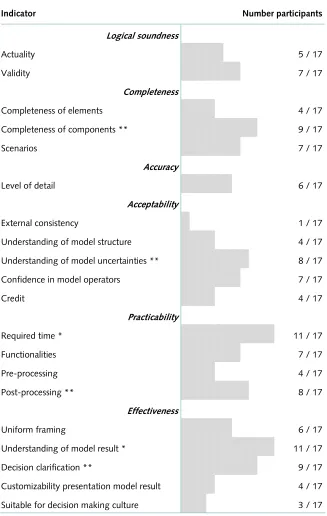
The method for assessing the use of flood models in the operational phase of flood agement consists of twenty indicators. These indicators are grouped in six categories, based on the structure of Covello and Merkhofer (1994): Logical soundness, Completeness, Accuracy, Acceptability, Practicability and Effectiveness.
be found in table 3-2 on page 19.
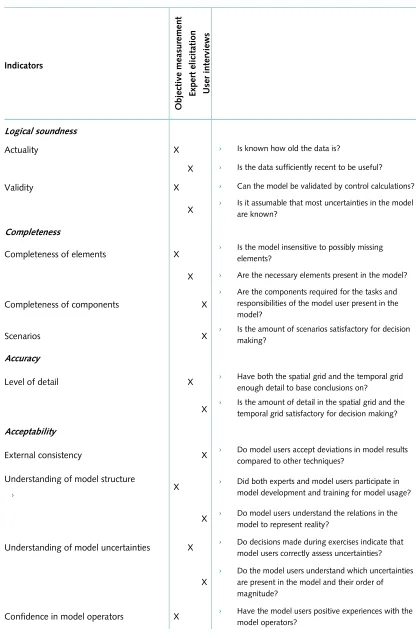
possible relations between two indicators are recognized, ranking by importance and trade-offs between two indicators. To value an indicator, one or more questions are suggested that need to be answered affirmatively. Each question can be answered using one of three types of measurement methods, objective measurement, expert elicitation and user interviews. The questions can be found in table 3
The representativeness of the indicators for a real flood calamity is verified at the flood calamity exercise at Hoogheemraadschap Delfland on the 14 November
the 3Di flood model to support decision making is assessed by the model users based on
it is important to also consider use of flood models in addition to internal model properties, since a model should fit the organizational context and
The twenty indicators identified can be used to assess the use of flood models in the operational phase of flood calamity management. This can be done by answering the presented questions using three types of measurement methods. The indicators appeared
be of variable importance and satisfying two indicators may reveal a trade these indicators. The set of indicators are verified to be representative for a real The method for assessing the use of flood models in the operational phase of flood
. These indicators are grouped in six : Logical soundness,
The indicators can
indicators are recognized, ranking by To value an indicator, one or more
Each question can be , objective measurement, an be found in table 3-4 on page 32.
is verified at the flood calamity exercise at Hoogheemraadschap Delfland on the 14 November, 2012. The use of
aking is assessed by the model users based on
use of flood models in addition to internal should fit the organizational context and appeal model
assess the use of flood models in the . This can be done by answering the
Preface
This thesis is the result of five months of research and Water Engineering
Engineering, I was particularly interested and governmental policy makers. technical solutions in real world problems water management.
My interest in this has led to the subject of this thesis
considered. By explicitly stating requirements for flood model use in
making, I hope to bring the perspectives of technical experts and decision makers closer together.
I am grateful for the opportunity given by Nelen & Schu within their facilities.
office in Utrecht with the company
supportive and collegial atmosphere
I would like to thank my supervisors Anne Leskens and Maarten Krol for their guidance and support. As head of the committee Maarten Krol
the research. Special thanks go out to Anne Leskens, who not only combined the intensive roles of both the daily supervisor and external supervisor, but also ensured that I could easily integrate
All involved employees of the water boards are gr contribution. With
questionnaires taken
friends and family for their support, in Utrecht.
Alexander Hoff Enschede, January 2013
Preface
This thesis is the result of five months of research and is the final piece of my education in ater Engineering and Management. From the first year of the bachelor programme Civil
I was particularly interested in the different perspectives of
and governmental policy makers. The different perspectives lead to failure of great technical solutions in real world problems and is not particularly unknown in integrated water management.
My interest in this has led to the subject of this thesis, in which a very specific context is onsidered. By explicitly stating requirements for flood model use in flood calamity decision
I hope to bring the perspectives of technical experts and decision makers closer together.
I am grateful for the opportunity given by Nelen & Schuurmans to conduct this research within their facilities. Due to the encouraging environment, I found myself most
office in Utrecht working on my research. Everyone there made sure I could get any, got all the means necessary for my research and they supportive and collegial atmosphere.
I would like to thank my supervisors Anne Leskens and Maarten Krol for their guidance and As head of the committee Maarten Krol gave much in depth fe
Special thanks go out to Anne Leskens, who not only combined the intensive roles of both the daily supervisor and external supervisor, but also ensured that I could easily integrate in the company.
employees of the water boards are gratefully acknowledged for their Without the supplied documents, made observations, held
taken, this research would not be possible. Finally, I am thankful to all friends and family for their support, especially my girlfriend Yasmin on the long days I was
Enschede, January 2013
is the final piece of my education in From the first year of the bachelor programme Civil of technical experts failure of great not particularly unknown in integrated
very specific context is flood calamity decision I hope to bring the perspectives of technical experts and decision makers slightly
urmans to conduct this research Due to the encouraging environment, I found myself mostly at the I could get familiar they provided the
I would like to thank my supervisors Anne Leskens and Maarten Krol for their guidance and in depth feedback throughout Special thanks go out to Anne Leskens, who not only combined the intensive roles of both the daily supervisor and external supervisor, but also ensured that I could
Table of contents
Summary ... Preface ...
1 Introduction ...
1.1 Research object... 1.2 Scientific context...
1.3 Scientific context applied to operational phase of flood calamity man 1.4 Research objective ...
1.5 Research questions ... 1.6 Research framework ... 1.7 Research strategy...
2 Methods ...
2.1 What is the decision making context of flood calamity management in use of technical information? 2.2 What constraints in the use of technical
2.3 How can the constraints be represented in specific and measureable indicators? 2.4 How can the representativeness of the indicators for a real flood calamity be verified?
3 Results ...
3.1 What is the decision making context of flood calamity management in use of technical information? 3.2 What constraints in the use of technical information are encountered in practice?
3.3 How can the constraints be represented in specific and measureable indicators? 3.4 How can the representativeness of the indicators for a real flood calamity be verified?
4 Discussion ...
4.1 Research scope ... 4.2 Research framework ... 4.3 Research method ...
5 Conclusions and recommendations
5.1 Conclusions ... 5.2 Recommendations ...
References... Glossary ...
I Interview schedule ... II Indicator checklist verification observation III Trade-off checklist verification observat IV Questionnaire 3Di flood model use V Results analysis of flood calamity plans
VI Workshop ‘beslissing centraal’ ... VII Results analysis of evaluation reports
VIII Workshop ‘vervolg case study 3Di
...
...
...
... ... Scientific context applied to operational phase of flood calamity management ...
... ...
...
...
...
What is the decision making context of flood calamity management in use of technical information? What constraints in the use of technical information are encountered in practice? ... How can the constraints be represented in specific and measureable indicators? ... How can the representativeness of the indicators for a real flood calamity be verified?
...
What is the decision making context of flood calamity management in use of technical information? What constraints in the use of technical information are encountered in practice? ...
e represented in specific and measureable indicators? ... How can the representativeness of the indicators for a real flood calamity be verified?
...
... ...
...
Conclusions and recommendations ...
... ...
...
...
... Indicator checklist verification observations ...
off checklist verification observations ... Questionnaire 3Di flood model use ... Results analysis of flood calamity plans ...
... Results analysis of evaluation reports ... Workshop ‘vervolg case study 3Di Waternet’ ...
... iv
... vi
... 1
... 1
... 2
... 4
... 5
... 5
... 6
... 7
... 8
What is the decision making context of flood calamity management in use of technical information?... 8
... 9
... 10
How can the representativeness of the indicators for a real flood calamity be verified? ... 11
... 13
What is the decision making context of flood calamity management in use of technical information?... 13
... 16
... 17
How can the representativeness of the indicators for a real flood calamity be verified? ... 34
... 39
... 39
... 40
... 40
... 43
... 43
... 46
... 47
... 49
... 50
... 61
... 62
... 63
... 68
... 74
... 78
1
Introduction
This chapter introduces the research and explains
chapter describes the research object. The second paragraph describes the general scientific context. The scientific context is related to the research object in the third paragraph. This leads to the research object
reach this objective are introduced in the fifth paragraph. The framework for the research is described in paragraph six and the seventh paragraph describes the research strategy. 1.1 Research object
The Netherlands have a rich history in water safety, since large parts are situated below sea level. Large populations and high economic value
by a system of dikes, canal rings and pumping stations or sluices.
of safety, recent inspection of safety levels of primary dikes showed that almost one third was insufficient. This implies that more than 1200 kilometres of dunes, dikes and levees are considered to be unsafe
Fortunately, life threatening f
Sea flood of 1953. However, the risks seem to be significant. In the summer of 2003 everyone was surprised by an unexpected failure of the dike at the village of Wilnis. One of the dikes of the rin
(Onderzoekscommissie Wilnis, 2004
main rivers are expected to increasingly impose problems. In 1995 high discharges led to large scale evacuations of the Dutch river area. More recently, at the
apparent failure of the dike at Woltersum due to severe piping led to a situation in which even emergency services fled the location
These examples make
floods. An important concept that addresses this (Kolen & Kok, 2011
reduction of damages by smart spatial planning and flood calamity management. In flood calamity management multiple phases can be identified. For the purpose of this research, three phases are distinguished. The
three days before an event, such as a dike breach. In the preparatory phase there is no short term threat and actions are proactive. The
lasting from three days before an eve taken are reactive to the situation. The the moment the event
Currently all kinds of mo
models are used to calculate normative water levels to determine the required dike height. In the second layer,
In the third layer,
management. However, in the operational phase of flood calamity management models are barely used
Introduction
This chapter introduces the research and explains its relevance. The first paragraph of this chapter describes the research object. The second paragraph describes the general scientific context. The scientific context is related to the research object in the third paragraph. This leads to the research objective presented in the fourth paragraph. The research questions to reach this objective are introduced in the fifth paragraph. The framework for the research is described in paragraph six and the seventh paragraph describes the research strategy.
ject
The Netherlands have a rich history in water safety, since large parts are situated below sea level. Large populations and high economic value are located in polders and
by a system of dikes, canal rings and pumping stations or sluices. Even though
of safety, recent inspection of safety levels of primary dikes showed that almost one third was insufficient. This implies that more than 1200 kilometres of dunes, dikes and levees are considered to be unsafe (Inspectie Verkeer en Waterstaat, 2011).
Fortunately, life threatening floods have not occurred in the Netherlands since the North Sea flood of 1953. However, the risks seem to be significant. In the summer of 2003 everyone was surprised by an unexpected failure of the dike at the village of Wilnis. One of the dikes of the ring canal collapsed by a formerly unknown failure mechanism
Onderzoekscommissie Wilnis, 2004). Also, with assumed climate change discharges of the main rivers are expected to increasingly impose problems. In 1995 high discharges led to large scale evacuations of the Dutch river area. More recently, at the beginning of 2012 apparent failure of the dike at Woltersum due to severe piping led to a situation in which even emergency services fled the location (Veiligheidsregio Groningen, 2012
These examples make clear that water safety should not merely focus on prevention of floods. An important concept that addresses this insight is the multi-layer safety policy
Kolen & Kok, 2011). Herein, three layers of safety are distinguished: prevention of floods, reduction of damages by smart spatial planning and flood calamity management. In flood calamity management multiple phases can be identified. For the purpose of this research, three phases are distinguished. The first phase is the preparatory phase, chosen to last until three days before an event, such as a dike breach. In the preparatory phase there is no short term threat and actions are proactive. The second phase is the operational phase, lasting from three days before an event right until the event occurs. In this phase actions taken are reactive to the situation. The third phase is the post calamity phase, s
the moment the event occurs. It considers the relief efforts in the affected area.
Currently all kinds of models are used in water safety policy. For example, in the first layer models are used to calculate normative water levels to determine the required dike height. In the second layer, flood models are used to adapt spatial planning to possible flood risks.
n the third layer, flood models are used in the preparatory phase of flood calamity management. However, in the operational phase of flood calamity management models are barely used (Leskens & Brugnach, 2012).
relevance. The first paragraph of this chapter describes the research object. The second paragraph describes the general scientific context. The scientific context is related to the research object in the third paragraph. This
ive presented in the fourth paragraph. The research questions to reach this objective are introduced in the fifth paragraph. The framework for the research is described in paragraph six and the seventh paragraph describes the research strategy.
The Netherlands have a rich history in water safety, since large parts are situated below sea located in polders and are protected
Even though the necessity of safety, recent inspection of safety levels of primary dikes showed that almost one third was insufficient. This implies that more than 1200 kilometres of dunes, dikes and levees are
loods have not occurred in the Netherlands since the North Sea flood of 1953. However, the risks seem to be significant. In the summer of 2003 everyone was surprised by an unexpected failure of the dike at the village of Wilnis. One of
g canal collapsed by a formerly unknown failure mechanism
. Also, with assumed climate change discharges of the main rivers are expected to increasingly impose problems. In 1995 high discharges led to
beginning of 2012 apparent failure of the dike at Woltersum due to severe piping led to a situation in which
Veiligheidsregio Groningen, 2012).
clear that water safety should not merely focus on prevention of layer safety policy
prevention of floods, reduction of damages by smart spatial planning and flood calamity management. In flood calamity management multiple phases can be identified. For the purpose of this research,
preparatory phase, chosen to last until three days before an event, such as a dike breach. In the preparatory phase there is no
operational phase, nt right until the event occurs. In this phase actions
post calamity phase, starting on considers the relief efforts in the affected area.
Over the last few years
in the operational phase of flood calamity management. A prototype is tested for making calculations during the national flood calamity ex
is still unsure if this tool will effectively improve the decision making process. This research focuses on the use of
Currently, no assessment
operational phase of flood calamity management. This thesis focuses on the possibilities to develop such a method.
1.2 Scientific context
1.2.1 Model users
In integrated water management model users are often
decision makers. The experts are considered water engineers that try to fully understand the complex system and
expert knowledge and have the main goal o
users have a different perception of the use of models in decision making processes. Experts see the model as the centre of technical information, while decision makers see a model as just one of many source
is also supported by the observation of
makers have no need for complex model output and just asked for “one answer, one model” solutions for their problem.
1.2.2 Role of models
Models can have different roles in integrated water management. According to et al. (2008), four different types of roles can be distinguished
analysis, communication and learning. The role may affect the position the model has in the decision making process.
The predictive role could be considered as the classic role in which the system is partly represented by mathematical equations. The model is used to make quantitative predictions about possible events and measures to support the decision making process with qua data. In this role the model has an advisory purpose and is positioned outside the decision making process. In the exploratory role a model is used to discover unexpected behaviour of complex systems. Earlier unrecognized properties of a system can
about the problem and the solution space. In the communicative role a model is used as a communication tool. A model can make things clear in a way which other communication methods may not. In the learning role a model can contribute
learning. The modeller and the decision maker can together create mutual understanding. As a result the model is situated in the centre of the decision making process.
1.2.3 Uncertainty framework
Uncertainties strongly influence the use of important to consider the topic.
two dimensions to characterize uncertainties
uncertainties. The two dimensions can be found in table
he last few years, the 3Di project has worked on a powerful tool that may be usable in the operational phase of flood calamity management. A prototype is tested for making calculations during the national flood calamity exercise the 14th of November. However, it is still unsure if this tool will effectively improve the decision making process. This research focuses on the use of flood models in the operational phase of flood calamity management.
assessment method is available to the assess use of flood models in the operational phase of flood calamity management. This thesis focuses on the possibilities to develop such a method.
Scientific context
In integrated water management model users are often divided in two groups
decision makers. The experts are considered water engineers that try to fully understand the complex system and its uncertainties. The decision makers are considered to have less expert knowledge and have the main goal of making careful decisions. Both groups of users have a different perception of the use of models in decision making processes. Experts see the model as the centre of technical information, while decision makers see a model as just one of many sources of information (Borowski & Hare, 2007).This different perception is also supported by the observation of Brugnach et al. (2007). They address that decision makers have no need for complex model output and just asked for “one answer, one model” solutions for their problem.
Role of models
can have different roles in integrated water management. According to , four different types of roles can be distinguished: prediction, exploratory analysis, communication and learning. The role may affect the position the model has in the decision making process.
edictive role could be considered as the classic role in which the system is partly represented by mathematical equations. The model is used to make quantitative predictions about possible events and measures to support the decision making process with qua data. In this role the model has an advisory purpose and is positioned outside the decision making process. In the exploratory role a model is used to discover unexpected behaviour of complex systems. Earlier unrecognized properties of a system can be exposed to learn about the problem and the solution space. In the communicative role a model is used as a communication tool. A model can make things clear in a way which other communication methods may not. In the learning role a model can contribute to a process of social learning. The modeller and the decision maker can together create mutual understanding. As a result the model is situated in the centre of the decision making process.
Uncertainty framework
Uncertainties strongly influence the use of models in water management and therefore it is important to consider the topic. Brugnach et al. (2008) have introduced a framework of two dimensions to characterize uncertainties: cause of uncertainties and manifestation of uncertainties. The two dimensions can be found in table 1-1 and are elaborated below
the 3Di project has worked on a powerful tool that may be usable in the operational phase of flood calamity management. A prototype is tested for making
ercise the 14th of November. However, it is still unsure if this tool will effectively improve the decision making process. This research
models in the operational phase of flood calamity management. hod is available to the assess use of flood models in the operational phase of flood calamity management. This thesis focuses on the possibilities to
divided in two groups: experts and decision makers. The experts are considered water engineers that try to fully understand
uncertainties. The decision makers are considered to have less f making careful decisions. Both groups of users have a different perception of the use of models in decision making processes. Experts see the model as the centre of technical information, while decision makers see a model as
different perception . They address that decision makers have no need for complex model output and just asked for “one answer, one
can have different roles in integrated water management. According to Brugnach prediction, exploratory analysis, communication and learning. The role may affect the position the model has in the
edictive role could be considered as the classic role in which the system is partly represented by mathematical equations. The model is used to make quantitative predictions about possible events and measures to support the decision making process with quantified data. In this role the model has an advisory purpose and is positioned outside the decision making process. In the exploratory role a model is used to discover unexpected behaviour be exposed to learn about the problem and the solution space. In the communicative role a model is used as a communication tool. A model can make things clear in a way which other communication
to a process of social learning. The modeller and the decision maker can together create mutual understanding. As a result the model is situated in the centre of the decision making process.
models in water management and therefore it is have introduced a framework of
Table 1-1: Causes and manifestations of uncertainty
Causes of uncertainty
Error in empirical observations
Ambiguity and conflicting knowledge
The first dimension is the
of uncertainties. The first cause of uncertainty, error in empirical observations, is a commonly underst
value and the approximation that is used in the model, for example, the deviation between a measured value and a real value due to a measurement error. Errors in empirical
observations can also be caused by failures of te second cause of uncertainties is complex dynamics.
because they contain chaotic or nonlinear behaviour. Also, natural systems continually evolve and adapt. The dynamic and complex n
causes of uncertainty in models that represent them. The third cause of uncertainty is ambiguity and conflicting knowledge. Ambiguity represents uncertainty caused by different interpretations of the facts, which
disciplinary backgrounds. Also, facts can sometimes be explained
conflicting knowledge can be a cause of uncertainty. The fourth cause of uncertainty is ignorance, in which
Ignorance indicates that certain aspects of the system are not known or ignored, i.e. recognised and total ignorance
is values and beliefs
always be fully objectively valuated, subjectivity of the modeller can be a cause of uncertainty and variation.
The second dimension of uncertainty distinguished by manifestation or the location of uncertainties. The author
uncertainty manifests. The first location where uncertainty can manifest is data and parameter values. The uncertainty is clearly attributable to concrete input data o parameters and
The second location where uncertainties manifest is the structure of the model itself. A model consists of elements that interact with each other and the structure of connections can contain uncertainties. These uncertaint
system works and can indicate flaws in underlying theories on which the model is built. The third location of uncertainties
always framed through a pe
modeller. This subjectivity in the modelling process can be the first moment when uncertainties begin to arise.
Causes and manifestations of uncertainty (Brugnach et al., 2008).
Causes of uncertainty Manifestation of uncertainty
Error in empirical observations Data, parameter values Complex dynamics Structure
Ambiguity and conflicting knowledge Framing Ignorance Values and beliefs
The first dimension is the cause of uncertainties. Brugnach et al. (2008)
of uncertainties. The first cause of uncertainty, error in empirical observations, is a commonly understood cause of uncertainty. It represents a deviation between the real value and the approximation that is used in the model, for example, the deviation between a measured value and a real value due to a measurement error. Errors in empirical
observations can also be caused by failures of techniques, procedures or instruments. The second cause of uncertainties is complex dynamics. Many natural systems are complex, because they contain chaotic or nonlinear behaviour. Also, natural systems continually evolve and adapt. The dynamic and complex nature of natural systems is thus one of the causes of uncertainty in models that represent them. The third cause of uncertainty is ambiguity and conflicting knowledge. Ambiguity represents uncertainty caused by different interpretations of the facts, which can originate from a linguistic difference or different disciplinary backgrounds. Also, facts can sometimes be explained in multiple ways. This way conflicting knowledge can be a cause of uncertainty. The fourth cause of uncertainty is ignorance, in which the extreme case is that you do not know what you do
Ignorance indicates that certain aspects of the system are not known or ignored, i.e. recognised and total ignorance (Walker et al., 2003). The fifth and last cause of uncertainty is values and beliefs. This is a variation due to subjectivity. Where information cannot always be fully objectively valuated, subjectivity of the modeller can be a cause of uncertainty and variation.
dimension of uncertainty distinguished by Brugnach et al. (2008
manifestation or the location of uncertainties. The authors identify three locations where uncertainty manifests. The first location where uncertainty can manifest is data and parameter values. The uncertainty is clearly attributable to concrete input data o parameters and it is uncertainty that is mostly recognised by modellers and model users. The second location where uncertainties manifest is the structure of the model itself. A model consists of elements that interact with each other and the structure of connections can contain uncertainties. These uncertainties show lack of understanding of how the system works and can indicate flaws in underlying theories on which the model is built. The third location of uncertainties is in the framing of the modelling process. Modelled reality is always framed through a perspective of values, beliefs, interests and experience of the modeller. This subjectivity in the modelling process can be the first moment when uncertainties begin to arise.
identify five causes of uncertainties. The first cause of uncertainty, error in empirical observations, is a
sents a deviation between the real value and the approximation that is used in the model, for example, the deviation between a measured value and a real value due to a measurement error. Errors in empirical
chniques, procedures or instruments. The natural systems are complex, because they contain chaotic or nonlinear behaviour. Also, natural systems continually
ature of natural systems is thus one of the causes of uncertainty in models that represent them. The third cause of uncertainty is ambiguity and conflicting knowledge. Ambiguity represents uncertainty caused by different
can originate from a linguistic difference or different n multiple ways. This way conflicting knowledge can be a cause of uncertainty. The fourth cause of uncertainty is
the extreme case is that you do not know what you do not know. Ignorance indicates that certain aspects of the system are not known or ignored, i.e.
. The fifth and last cause of uncertainty is a variation due to subjectivity. Where information cannot always be fully objectively valuated, subjectivity of the modeller can be a cause of
Brugnach et al. (2008) is
three locations where uncertainty manifests. The first location where uncertainty can manifest is data and parameter values. The uncertainty is clearly attributable to concrete input data or specific
sed by modellers and model users. The second location where uncertainties manifest is the structure of the model itself. A model consists of elements that interact with each other and the structure of connections
ies show lack of understanding of how the system works and can indicate flaws in underlying theories on which the model is built. The
1.3 Scientific context applied to operational phase of flood calamity management
1.3.1 Model users in flood calamity management
In flood calamity management also experts and decision makers can be recognized as model users (Leskens & Brugnach, 2012
also state that roles and responsibilities of professionals mean that they have different communication needs. The same problems between the experts and the dec
in general integrated water are to be expected. 1.3.2 Role of flood
In the operational phase of flood calamity management, one may suggest that the predictive role is the most important role of a flood model. T
quantify effects of the calamity event and is used to assess possible measures. The exploratory and learning role of a model is limited during flood calamities, since the available time is limited. The communicative role however, m
situation during a flood calamity can be complex and model representations could contribute to a
The predictive role of
the model in the calamity organization. The modellers are a supporting team to the decision makers, next to other advisory stakeholders, such as emergency services and municipal services.
1.3.3 Functionalities
The functions and properties situation. According to
of the main reasons they are not used in flood up to two hours are too large for
example, in a flood calamity exercise held by Noorderkwartier
2011). Model run time can sometimes be reduced by increasing computational power. However, this not always possible. Innovative or smart design of the computational framework can also decrease model run times. For example, the 3
estimate the required spatial calculation grid to decrease model run time 2012).
1.3.4 Coping with uncertainties in flood calamity management
The presence of uncertainties is unavoidable. Therefore it is important to hav cope with them.
them by using uncertainty and sensitivity analy
computational power led to increased use of ensemble calculations. This is a method to calculate model output uncertainty based on propagation of uncertainties in
parameters. In recent literature, this is suggested as a promising technique for assessing uncertainties (Leskens & Brugnach, 2012
Scientific context applied to operational phase of flood calamity management
el users in flood calamity management
In flood calamity management also experts and decision makers can be recognized as Leskens & Brugnach, 2012; McCarthy et al., 2007). McCarthy et al. (2007 also state that roles and responsibilities of professionals mean that they have different communication needs. The same problems between the experts and the dec
in general integrated water are to be expected.
flood models in flood calamity management
In the operational phase of flood calamity management, one may suggest that the predictive role is the most important role of a flood model. The model is then used to quantify effects of the calamity event and is used to assess possible measures. The exploratory and learning role of a model is limited during flood calamities, since the
time is limited. The communicative role however, may play an important role. The situation during a flood calamity can be complex and model representations could
comprehensible overview of the situation.
The predictive role of flood models in flood calamity management influences
the model in the calamity organization. The modellers are a supporting team to the decision makers, next to other advisory stakeholders, such as emergency services and municipal
Functionalities
and properties of a model are important for its usability in a practical situation. According to Leskens and Brugnach (2012), inflexible use of flood
of the main reasons they are not used in flood calamities. They state that calculation times up to two hours are too large for flood models to be of use during flood calamities. For example, in a flood calamity exercise held by Hoogheemraadschap Hollands
Noorderkwartier intervals between meetings were at a maximum of one hour
. Model run time can sometimes be reduced by increasing computational power. However, this not always possible. Innovative or smart design of the computational framework can also decrease model run times. For example, the 3Di flood model can estimate the required spatial calculation grid to decrease model run time
Coping with uncertainties in flood calamity management
The presence of uncertainties is unavoidable. Therefore it is important to hav cope with them. Experts try to determine all model uncertainties and possib them by using uncertainty and sensitivity analysis. In the last decade increased
computational power led to increased use of ensemble calculations. This is a method to calculate model output uncertainty based on propagation of uncertainties in
parameters. In recent literature, this is suggested as a promising technique for assessing Leskens & Brugnach, 2012; McCarthy et al., 2007).
Scientific context applied to operational phase of flood calamity management
In flood calamity management also experts and decision makers can be recognized as McCarthy et al. (2007) also state that roles and responsibilities of professionals mean that they have different communication needs. The same problems between the experts and the decision makers as
In the operational phase of flood calamity management, one may suggest that the he model is then used to quantify effects of the calamity event and is used to assess possible measures. The exploratory and learning role of a model is limited during flood calamities, since the
ay play an important role. The situation during a flood calamity can be complex and model representations could
influences the position of the model in the calamity organization. The modellers are a supporting team to the decision makers, next to other advisory stakeholders, such as emergency services and municipal
in a practical flood models is one state that calculation times models to be of use during flood calamities. For
Hoogheemraadschap Hollands
at a maximum of one hour (Vinck et al., . Model run time can sometimes be reduced by increasing computational power. However, this not always possible. Innovative or smart design of the computational
Di flood model can estimate the required spatial calculation grid to decrease model run time (3Di Waterbeheer,
The presence of uncertainties is unavoidable. Therefore it is important to have a strategy to Experts try to determine all model uncertainties and possibly quantify
. In the last decade increased
Decision makers often request confidence intervals or bandwidths in order to cope with uncertainties in model results
et al., 2007). This has showed to be of great importance to decision makers (Leskens, 2012). However, a
(2007) observed that the Environmental Agency decision makers had no need for widely diverging results from ensemble calculations, but only asked for the
future floods of specific areas. In addition, process the model results and translate them
makers. This process involves simplification of information and in uncertainties.
As a result complex information about uncertainties is simplified, for example to one statistical range. This may give the false impression that all uncerta
known. There is probably always a loss of information in this process and whether the resulting uncertainty levels are meaningful depends on the decency of the procedure. However, Brugnach et al. (2007
decision makers for information to be of value. Also recent research by
(2012) confirms the importance of communication of uncertainties, but points out that explicit uncertainties c
topic.
This suggests there is a duality in this topic. On one hand, decision makers demand straightforward information suitable for a simple assessment directly supporting the decision making process. On the other hand, model results are mostly complex and demand a careful interpretation by experts. This tension appears to remain and is important considering who deals with
Although both groups of model users are present in flood
McCarthy et al. (2007
decision makers always depend on the experts’ own technically informed judgments or predictions. Decision makers can therefore definitely benefit from understanding model uncertainties.
1.4 Research objective
The objective of this research is to develop a meth
the operational phase of flood calamity management by establishing a set of specific and measureable indicators which together
1.5 Research questions
The research is structured by four key que
for the research strategy and the individual paragraphs in the chapters Methods and Results.
› What is the decision making context of flood calamity management in use of technical information?
› What constrain
› How can the constraints be represented in specific and measureable indicators? › How can the representativeness of the indicators
verified?
Decision makers often request confidence intervals or bandwidths in order to cope with uncertainties in model results (Brugnach et al., 2007; Leskens & Brugnach, 2012
. This has showed to be of great importance to decision makers (Leskens, 2012). However, an overview of uncertainties can easily become complex.
observed that the Environmental Agency decision makers had no need for widely diverging results from ensemble calculations, but only asked for the likelihood of near
of specific areas. In addition, Borowski and Hare (2007) observed that experts model results and translate them into comprehensible information for decisio makers. This process involves simplification of information and interpretation of
As a result complex information about uncertainties is simplified, for example to one statistical range. This may give the false impression that all uncertainties are quantitatively known. There is probably always a loss of information in this process and whether the resulting uncertainty levels are meaningful depends on the decency of the procedure.
nach et al. (2007) state that the uncertainties should be transparent to decision makers for information to be of value. Also recent research by
confirms the importance of communication of uncertainties, but points out that explicit uncertainties can cause confusion when there is a lack of expert knowledge on the
This suggests there is a duality in this topic. On one hand, decision makers demand straightforward information suitable for a simple assessment directly supporting the ng process. On the other hand, model results are mostly complex and demand a careful interpretation by experts. This tension appears to remain and is important considering who deals with the uncertainties in the model.
Although both groups of model users are usually familiar with the fact that uncertainties flood models, it is important to consider who has to cope with them. McCarthy et al. (2007) state that in current flood calamity decision making processes decision makers always depend on the experts’ own technically informed judgments or predictions. Decision makers can therefore definitely benefit from understanding model
Research objective
The objective of this research is to develop a method to assess the use of
the operational phase of flood calamity management by establishing a set of specific and measureable indicators which together can be used to assess this.
Research questions
The research is structured by four key questions. These research questions provide the basis for the research strategy and the individual paragraphs in the chapters Methods and
What is the decision making context of flood calamity management in use of technical information?
What constraints in the use of technical information are encountered in practice? How can the constraints be represented in specific and measureable indicators? How can the representativeness of the indicators for a real flood calamity Decision makers often request confidence intervals or bandwidths in order to cope with
Leskens & Brugnach, 2012; McCarthy . This has showed to be of great importance to decision makers (Leskens,
overview of uncertainties can easily become complex. McCarthy et al. observed that the Environmental Agency decision makers had no need for widely
likelihood of near observed that experts to comprehensible information for decision
terpretation of
As a result complex information about uncertainties is simplified, for example to one inties are quantitatively known. There is probably always a loss of information in this process and whether the resulting uncertainty levels are meaningful depends on the decency of the procedure.
state that the uncertainties should be transparent to decision makers for information to be of value. Also recent research by Van Loenen et al.
confirms the importance of communication of uncertainties, but points out that an cause confusion when there is a lack of expert knowledge on the
This suggests there is a duality in this topic. On one hand, decision makers demand straightforward information suitable for a simple assessment directly supporting the ng process. On the other hand, model results are mostly complex and demand a careful interpretation by experts. This tension appears to remain and is important
usually familiar with the fact that uncertainties models, it is important to consider who has to cope with them.
state that in current flood calamity decision making processes decision makers always depend on the experts’ own technically informed judgments or predictions. Decision makers can therefore definitely benefit from understanding model
od to assess the use of flood models in the operational phase of flood calamity management by establishing a set of specific and
stions. These research questions provide the basis for the research strategy and the individual paragraphs in the chapters Methods and
What is the decision making context of flood calamity management in use of
ts in the use of technical information are encountered in practice? How can the constraints be represented in specific and measureable indicators?
1.6 Research framework
The research is structured using a research framework. The indicators for assessing the use of model based tools in the operational phase of flood calamity management
categorized based on the structure of
contains three internal and three external criteria respectively Completeness and
interpretation of the st
of the six categories is described below. 1.6.1 Logical soundness
Logical soundness comprises the internal consistency theory and legitimacy of fund
procedures to fulfil
interpreted as the correct representation of the relevant part of reality practical aspects
classified by Brugnach et al. (2008 uncertainties under
in the model structure are mainly considered in the category Logical soundness. 1.6.2 Completeness
Completeness is considered in two direction
describes whether parts that are present in the model are completely described. This different from Accuracy
and Accuracy the accurateness of the prese
sufficient parts are present in the model so that is complete. 1.6.3 Accuracy
Accuracy describes if the facts that are presented are precise. Also uncertainties are reviewed under this category, because of the ov
inaccuracies. This is limited to quantitative aspects,
as external criteria. The reason for this is that qualitative aspects of accuracy appear mostly through Acceptability
Brugnach et al. (2008 category.
1.6.4 Acceptability
Acceptability is acceptance of by model users,
Brugnach (2012
aspects, for example understandability and model users’ perspectives and prior experiences. The aspects in this category contribute to the acceptance of the use of the
its results. 1.6.5 Practicability
Practicability is the usefulness of the model users, who are
Brugnach (2012
in a realistic, practical environment and not a perfected laboratory setup. This covers inflexibility issues in functionality as addressed by
Research framework
The research is structured using a research framework. The indicators for assessing the use of model based tools in the operational phase of flood calamity management
categorized based on the structure of Covello and Merkhofer (1994). The structure contains three internal and three external criteria respectively: Logical soundness
and Accuracy; and Acceptability, Practicability and Effectiveness
interpretation of the structure is made to fit the purpose of the research. The interpretation of the six categories is described below.
Logical soundness
ogical soundness comprises the internal consistency. It considers if the model is justified by theory and legitimacy of fundamental assumptions. A logically sound model uses valid procedures to fulfil its purpose in modelling a system. In this research Logical soundness
as the correct representation of the relevant part of reality. S
practical aspects can be classified in this category. The second dimension of uncertainties Brugnach et al. (2008), the location of uncertainties, is used to divide
uncertainties under the framework of Covello and Merkhofer (1994). Uncertainties located in the model structure are mainly considered in the category Logical soundness.
Completeness
Completeness is considered in two directions: depth and broadness. The first direction describes whether parts that are present in the model are completely described. This
Accuracy, because Completeness describes whether elements are present the accurateness of the present parts. The second direction describes whether sufficient parts are present in the model so that is complete.
Accuracy describes if the facts that are presented are precise. Also uncertainties are reviewed under this category, because of the overlap between uncertainties and
inaccuracies. This is limited to quantitative aspects, since qualitative aspects are considered as external criteria. The reason for this is that qualitative aspects of accuracy appear mostly
Acceptability and Effectiveness of flood models. Uncertainties classified by Brugnach et al. (2008) that are located in data and parameter values are mainly in this
Acceptability is acceptance of flood models as a source of information for decision making by model users, who are both experts and decision makers as recognized by
Brugnach (2012) and McCarthy et al. (2007). The category can contain a wide range of aspects, for example understandability and model users’ perspectives and prior experiences. The aspects in this category contribute to the acceptance of the use of the
racticability is the usefulness of the flood model in a practical environment as perceived by who are both experts and decision makers as recognized by
Brugnach (2012) and McCarthy et al. (2007). It reviews that the flood model in a realistic, practical environment and not a perfected laboratory setup. This covers inflexibility issues in functionality as addressed by Leskens and Brugnach (2012
The research is structured using a research framework. The indicators for assessing the use of model based tools in the operational phase of flood calamity management are
. The structure Logical soundness,
Effectiveness. An ructure is made to fit the purpose of the research. The interpretation
the model is justified by sound model uses valid
Logical soundness is . So also more can be classified in this category. The second dimension of uncertainties
, the location of uncertainties, is used to divide
. Uncertainties located in the model structure are mainly considered in the category Logical soundness.
depth and broadness. The first direction describes whether parts that are present in the model are completely described. This
describes whether elements are present The second direction describes whether
Accuracy describes if the facts that are presented are precise. Also uncertainties are erlap between uncertainties and
qualitative aspects are considered as external criteria. The reason for this is that qualitative aspects of accuracy appear mostly
models. Uncertainties classified by that are located in data and parameter values are mainly in this
ls as a source of information for decision making both experts and decision makers as recognized by Leskens and
. The category can contain a wide range of aspects, for example understandability and model users’ perspectives and prior experiences. The aspects in this category contribute to the acceptance of the use of the flood model and
in a practical environment as perceived by both experts and decision makers as recognized by Leskens and
flood model is to be used in a realistic, practical environment and not a perfected laboratory setup. This covers the
these functionalities, limitation category.
1.6.6 Effectiveness
Effectiveness describes the effect of
experts and decision makers as recognized by et al. (2007), on
model output on the decision made and the effect of the usage of the process. Uncertainti
mainly in this category.
1.7 Research strategy
This paragraph figure 1-2. The
[image:17.595.35.568.308.500.2]generating results, verification and conclusions. Each phase is a process consisting of activities represented by blue description boxes.
Figure 1-2: The research strategy used for this research.
these functionalities, limitations in time and resources are an important topic i
Effectiveness describes the effect of flood model usage by model users, experts and decision makers as recognized by Leskens and Brugnach (2012
, on the decision making process. Effectiveness reviews both the effect of the model output on the decision made and the effect of the usage of the flood model
process. Uncertainties as classified by Brugnach et al. (2008) that are located in framing are mainly in this category.
Research strategy
describes the research strategy used, which is represented by the diagram . The research consists of five phases: defining context, acquiring data, generating results, verification and conclusions. Each phase is a process consisting of activities represented by blue description boxes.
: The research strategy used for this research.
in time and resources are an important topic in this
usage by model users, who are both (2012) and McCarthy reviews both the effect of the
flood model on the that are located in framing are
, which is represented by the diagram in defining context, acquiring data,
2
Methods
This chapter explains the research methods used. research method is used.
contributed to answering the research question. Paragraph one to four describes the methods for research question one to four.
2.1 What is the decision making context of flood calamity management in use of technical information?
2.1.1 Approach
Research question one is answered by using two research methods in methodological triangulation (Denzin, 2006
that describe the calamity organization in the operational phase of flood calamity management. The second research
Centraal’ at Waternet on 28 June described below.
Analyzing flood calamity plan
In preparation for possible flood calamities, most water boards have flood calamity plans that describe a wide range of protocols for the operational phase of flood calamity management. Some water boards do not have calamity plans specific for flood calami but use general calamity plans describing the
phase. In case no flood calamity plans describe decision making context. Some flood calamity plans are publicly Otherwise contacts at the water boards plans. The content of the documents maximum, based
Observing participants of workshop ‘Beslissing Centraal’
The workshop was organized by Nelen & Schuurmans on behalf of the 3Di consortium and was held at Waternet on 28 June
necessary technologic potential users of
the decision making process required The goal of making observations at the wor
answering research question one. This research method has therefore a more exploratory character compared to analyzing flood calamity plans. During the workshop the
participants are observed and notes are made, based o
Methods
This chapter explains the research methods used. For each research question an individual research method is used. Each method describes the activities done and how that contributed to answering the research question. Paragraph one to four describes the methods for research question one to four.
What is the decision making context of flood calamity management in use of technical information?
Research question one is answered by using two research methods in methodological Denzin, 2006). The first research method is analyzing flood calamity plans the calamity organization in the operational phase of flood calamity management. The second research is observing participants of the workshop ‘Beslissing Centraal’ at Waternet on 28 June, 2012. The approach to both research methods is described below.
nalyzing flood calamity plans
In preparation for possible flood calamities, most water boards have flood calamity plans that describe a wide range of protocols for the operational phase of flood calamity management. Some water boards do not have calamity plans specific for flood calami but use general calamity plans describing the calamity organization in the operational
In case no flood calamity plans were available, general calamity plans were used to describe decision making context.
Some flood calamity plans are publicly available on the websites of the water boards. Otherwise contacts at the water boards were approached to request the flood calamity plans. The content of the documents is interpreted and summarized on one page maximum, based on the sub questions presented below.
Observing participants of workshop ‘Beslissing Centraal’
The workshop was organized by Nelen & Schuurmans on behalf of the 3Di consortium and was held at Waternet on 28 June, 2012. The goal of the workshop was to identify
necessary technological developments of the 3Di flood model to fit the needs of the potential users of flood models. An additional goal was to identify possible improvements in the decision making process required use the 3Di flood model.
The goal of making observations at the workshop is to acquire knowledge
answering research question one. This research method has therefore a more exploratory character compared to analyzing flood calamity plans. During the workshop the
participants are observed and notes are made, based on the sub questions below.
For each research question an individual s done and how that contributed to answering the research question. Paragraph one to four describes the
What is the decision making context of flood calamity management in use of
Research question one is answered by using two research methods in methodological analyzing flood calamity plans the calamity organization in the operational phase of flood calamity
observing participants of the workshop ‘Beslissing 2012. The approach to both research methods is
In preparation for possible flood calamities, most water boards have flood calamity plans that describe a wide range of protocols for the operational phase of flood calamity management. Some water boards do not have calamity plans specific for flood calamities,
calamity organization in the operational available, general calamity plans were used to
available on the websites of the water boards. approached to request the flood calamity interpreted and summarized on one page
The workshop was organized by Nelen & Schuurmans on behalf of the 3Di consortium and 2012. The goal of the workshop was to identify
to fit the needs of the possible improvements in
kshop is to acquire knowledge to help answering research question one. This research method has therefore a more exploratory character compared to analyzing flood calamity plans. During the workshop the