ISSN Online: 2333-9721 ISSN Print: 2333-9705
DOI: 10.4236/oalib.1104148 Dec. 20, 2017 1 Open Access Library Journal
Ionic Liquid Based Ultrasonic-Assisted
Extraction of Oleanolic Acid from Grape Seeds
Xifeng Zhang
1,2, Xue Li
1, Qian He
1, Bin Zhang
1, Xue Zheng
1,2*1The College of Agriculture and Biotechnology (CAB), Hexi University, Zhangye, China 2Key Laboratory of Hexi Corridor Resources Utilization of Gansu, Zhangye, China
Abstract
Ionic liquid based ultrasonic-assisted extraction (ILUAE) was successfully ap-plied to extract Oleanolic acid (OA) from grape seeds. Different kinds of 1-alkyl-3-methylimidazolium ionic liquids with different kinds of cations and
anions were studied and 1-butyl-3-methylimidazolium chloride ([C4mim]Cl)
solution was selected as extractants. The optimal conditions of ILUAE were determined by single factor experiments and Box-Behnken design as follows: [C4mim]Cl concentration of 0.7 mol/L, extraction time of 4 h, liquid-solid
ra-tio of 15:1 mL/g, ultrasonic power of 195 W, the ultrasonicara-tion time of 13 min, and extraction temperature of 48˚C·min. The extraction yield of OA was 13.4 mg/g, which is well in close agreement with the value predicted by the model. Compared with the regular ultrasonic-assisted extraction (UAE), the proposed approach exhibited 1.64 times higher efficiency, which indicated that ILUAE has a broad prospect for sample preparation of the bioactive compounds.
Subject Areas
Agricultural Science, Food Science & Technology
Keywords
Ionic-Liquid Based Ultrasound-Assisted (ILUAE), Oleanolic Acid, Grape Seeds
1. Introduction
The total production of grapes worldwide is about 60 million·tons per year, par-ticularly in France, Italy, the USA and China. Approximately 80% of this harvest is used in wine production, with the remaining 20% of the processed grape being
How to cite this paper: Zhang, X.F., Li, X., He, Q., Zhang, B. and Zheng, X. (2017) Ionic Liquid Based Ultrasonic-Assisted Ex- traction of Oleanolic Acid from Grape Seeds. Open Access Library Journal, 4: e4148. https://doi.org/10.4236/oalib.1104148
Received: November 13, 2017 Accepted: December 17, 2017 Published: December 20, 2017
Copyright © 2017 by authors and Open Access Library Inc.
This work is licensed under the Creative Commons Attribution International License (CC BY 4.0).
DOI: 10.4236/oalib.1104148 2 Open Access Library Journal
waste [1][2]. Grape seeds are by-products of the wine and grape juice industry. These seeds contain lipid, protein, carbohydrate, polyphenols and triterpenoids
[3][4][5]. Triterpenoids are important due to their high medicinal value; and
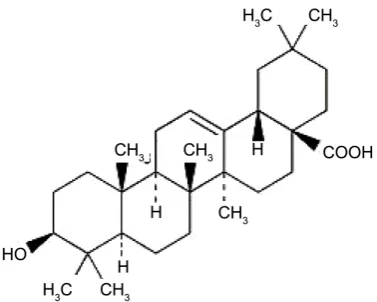
oleanolic acid (OA) which is triterpenoid is major active substance. Figure 1
shows the chemical structure of oleanolic acid. Many researchers have studied
the beneficial effects of OA in grapes and wines on human health [6]. These
benefits include antioxidant activity [7], anti-inflammatory [8], anticancer activ-ity [9], and others [10].
Different techniques have been employed for the extraction of OA such as heat reflux, hydrotropic extraction, microwave assisted extraction, and super-critical fluid extraction [11][12]. Heat reflux extraction and maceration extrac-tion techniques have drawbacks of requiring longer extracextrac-tion time and rela-tively large volumes of solvents. Supercritical fluid extraction method requires expensive high pressure equipment and may also require organic solvents as co-solvents for complete extraction of the bioactives. Therefore, in recent years there is an increasing demand for new eco-friendly extraction techniques with shorter extraction time, maximum extraction efficiency and with reduced re-quirement of organic solvents.
In this study, we report an ionic liquid based ultrasonic-assisted extraction (ILUAE) as an alternative method for the recovery of OA. An ionic liquid (IL) as a design green solvent is regarded as an attractive alternative or replacement to conventional volatile organic solvent. Ionic liquids (ILs) are low melting point salts composed entirely of ions. They have negligible volatility, low flammability, chemical stability, good environmental benignity, good solubility for organic compounds, and they are miscible with water. Moreover, a large number of possible variations in cation and anion features allowing the fine-tuning of the IL properties [13][14]. IL based materials interact with analytes through anion
exchange, hydrogen bonding and hydrophobic interaction [15]. The extraction
[image:2.595.278.467.552.703.2]of bioactive compounds from plants using ILs is promising as a green method, in reducing the environmental pollution and improving the selectivity and ex-traction yields of interesting compounds in sample pretreatment processes
DOI: 10.4236/oalib.1104148 3 Open Access Library Journal
compared to conventional organic solvents. IL-assisted sample pretreatment techniques such as aqueous biphasic systems [16], liquid-liquid extraction [17], liquid-phase microextraction [18] and solid-phase microextraction [19] have al-so been reported. Many researchers have used ILs as al-solvents for the extraction
of the aromatic sulfur compounds [20], henolic compounds [21], flavonoids
from Chamaecyparis obtuse leaves [22].
Ultrasound-assisted extraction has been successfully used for the extraction of the bioactive constituents from the plant materials [23] due to advantages of high reproducibility, reduction in extraction time and minimum solvent con-sumption, temperature and energy output. Recently, ILUAE has been developed, combining the advantages of UAE and beneficial properties of ILS. Therefore, the ILUAE is becoming one of the attractive and promising extraction tech-niques.
Response surface methodology (RSM) is an effective statistical technique for optimizing complex processes because it allows more efficient and easier ar-rangement and interpretation of experiments compared to other methods. In addition, it is less laborious and time-consuming than other approaches that ap-plied to optimize a process. It is widely used for optimization of the extraction process of the bioactive ingredients.
To the best of our knowledge, extraction of OA from grape seeds with ILs as the solvent has not yet been reported in the literature. Ultrasound-assisted ex-traction parameters, such as ionic liquids with different cations and anions con-centration, solvent to solid ratio, ultrasonic power, ultrasonication time, and ex-traction temperature for enhancing the exex-traction efficiency of OA were syste-matically optimized. The aim of this work was to develop a rapid, effective, vali-dated and environmental friendly ionic liquid based ultrasound-assisted ap-proach for extraction of OA from grape seeds, and to compare it with conven-tional solvent extraction.
2. Materials and Methods
2.1. Materials and Reagents
Grape seeds were obtained from the Bin He food industry Co, Ltd. (Gansu, Chi-na). OA (purity > 98% by HPLC) was purchased from the National Institute for the Control of Pharmaceutical and Biological Products (Beijing, China). All the ionic liquids ([C4mim]Cl, [C4mim]Br, [C4mim]BF4, [C4mim]NO3, [C4mim]HSO4,
[C4mim]ClO4) purchased from Lanzhou institute of chemical physics, Lanzhou,
China. Other materials used in this study were of analytical grade.
2.2. Optimization of Parameters for IL Based Extraction of OA
from Grape Seeds
DOI: 10.4236/oalib.1104148 4 Open Access Library Journal
r/min at 35˚C. The extract obtained after IL extraction was filtered using filter paper to remove solid particles and quantified for the content of OA. The ex-traction yield of OA was defined as follow:
(
mg g
)
Y
=
CV M
where C (mg/mL) is the concentration of OA in extract, V(mL) is the volume of the extract, and M(g) is the mass of sample weighed.
Six different ILs ([C4mim]Cl, [C4mim]Br, [C4mim]BF4, [C4mim]NO3,
[C4mim]HSO4, [C4mim]ClO4) were used to screen the most suitable anion to
extract OA from grape seeds at 0.5 mol/L, The selected ILs Cl− and
4
BF
− with different cations (C2mim+, C4mim+, C6mim+, C8mim+) were used at 0.5 mol/L toinvestigate the effect of the cation on the extraction efficiency of OA. For maxi-mum extraction of OA, concentration of [C4mim]Cl (0.1, 0.3, 0.5, 0.7 and 0.9
mol/L), time of extraction (1 - 5 h), solvent to solid ratio (10:1 - 30:1, mL/g), ul-trasonic power (100 - 300 W), ulul-trasonication time (5 - 25 min), and tempera-ture of extraction (30˚C - 70˚C) were optimized. The process of extraction was done as described above in this section. The IL extracts were then estimated for the content of OA. All the analyses were done in triplicates.
2.3. Conventional Reference Extraction Method
The conventional UAE was selected as the reference method for extraction of the
target compounds [24]. 1.0 g sample was extracted under the conditions as
fol-low: ethanol concentration 70% (v/v), extraction temperature 25˚C, solvent to solid ratio of 10:1 (mL/g), ultrasonication time 30 min, repeated two times. UAE was performed as a control for comparison with ILUAE. All samples were pre-pared and analyzed in triplicate.
2.4. Determination of OA Concentration [25]
The OA concentration in the top phase and bottom phase was estimated using the colorimetric method of vanillin perchloric acid under the conditions of OA as a standard. To evaporate sample solvent, the sample residue was reacted with 0.3 mL 5% (w/v) vanillin in glacial acetic acid and 1.0 mL perchloric acid at 70˚C in water bath for 25 minutes, the optical density was measured at 548 nm.
2.5. Experimental Design and Statistical Analysis
RSM was employed for experimental design, data analysis and model building with software Design Expert (Design-Expert 7.0). A Box behnken Design (BBD) with three variables and three levels was used to determine the response pattern and then to establish a model [26]. According the results of single factors expe-riment, three independent variables used in this work with three levels for each variable were ultrasonic power (X1), ultrasonication time (X2), and extraction
temperature (X3), while the dependent variable was the yield of OA. The
DOI: 10.4236/oalib.1104148 5 Open Access Library Journal
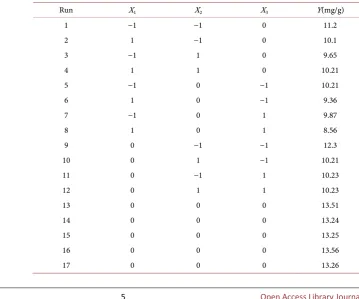
given in Table 1. Experiments were randomized to maximize the effects of
un-explained variability in the observed responses, due to extraneous factors. The
response variable, Y can be expressed as a function of the independent process
variables according to the following response surface quadratic model 2
0
i ii i ij i j
Y =
β
+∑
β
X +∑
β
X Xwhere Yiis the predicted response, XiXj are input varuables which influence the
response variable Y. βo is the offset term; Bi is the ith linear coefficient; Bii is the
iith quadratic coefficient and Bij is the ijth interaction coefficient. Design-expert
package (version 7.0, Stat-Ease, Inc., Minneapolis, MN, USA) was used for the experimental design and regression analysis of the data obtained.
[image:5.595.209.539.341.420.2]The experimental design consisted of twelve factorial points in Table 2, and five replicates at the central point of designed model were used to estimate the pure error sum of squares. The adequacy of the developed model and statistical significance of the regression coefficients were tested using the analysis of va-riance (ANOVA). p-Values of less than 0.05 were considered to be statistically
Table 1. Experimental factors level table for the RSM study in central composite design.
Factors Unit Notation Range and levels
−1 0 1
Ultrasonic power W X1 150 200 250 Ultrasonication time min X2 10 15 20 Extraction temperature ˚C X3 40 50 60
Table 2. Test design and result of response surface method analysis.
Run X1 X2 X3 Y(mg/g)
1 −1 −1 0 11.2
2 1 −1 0 10.1
3 −1 1 0 9.65
4 1 1 0 10.21
5 −1 0 −1 10.21
6 1 0 −1 9.36
7 −1 0 1 9.87
8 1 0 1 8.56
9 0 −1 −1 12.3
10 0 1 −1 10.21
11 0 −1 1 10.23
12 0 1 1 10.23
13 0 0 0 13.51
14 0 0 0 13.24
15 0 0 0 13.25
16 0 0 0 13.56
[image:5.595.174.534.450.749.2]DOI: 10.4236/oalib.1104148 6 Open Access Library Journal
significant. The interaction among the different independent variables and their corresponding effect on the response were studied by analyzing the response surface 3D plots.
3. Results and Discussion
3.1 Screening of ILs
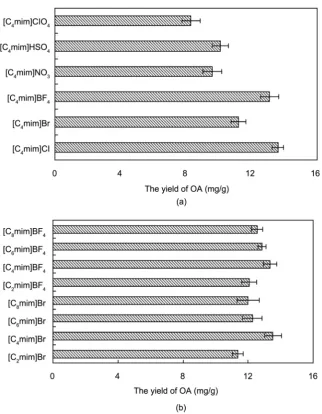
The extraction yield of target compounds might be obviously affected by the physical and chemical properties of ionic liquids, while the two properties can be significantly influenced by their structure [27]. To find the optimal ionic liquid for OA extraction and evaluate its influence on the ultrasonic extraction process, 1-alkyl-3-methylimidazolium-type ionic liquids with different anions and ca-tions were researched.
3.1.1. Influence of the Anion
The anion identity is considered an obvious factor which can influence the cha-racteristic of ionic liquids, especially for water miscibility [28]. Therefore,
N-methylimidazolium based ionic liquids with simple anions (Cl−, Br−) and
complex anions (
BF
4−, 3
NO
−,HSO
4− andCIO
4−) were evaluated. The extrac-tion yields of OA were obviously different, as shown in Figure 2(a). All of the selected ionic liquids were hydrophilic enough to dissolve in any proportionwith water. The results indicated that ionic liquids with
BF
4− and Cl− anions
were more efficient for the extraction of OA. It also confirmed that the OA ex-traction yield is anion-dependent.
3.1.2. Influence of Cation
Six ionic liquids with different cations (C2mim+, C4mim+, C6mim+, C8mim+)
combined with
BF
4−
and Cl− were also screened to obtain the optimal
extrac-tion yield of OA. The results are shown in Figure 2(b). They indicated that for ionic liquids linked with either
BF
4−
and Cl−, the extraction yield of OA first
increased with the increasing alkyl chain length from ethyl to butyl, and then decreased with the alkyl chain length of the cation increasing from butyl to octyl. Consideration these effects on OA extraction, [C4mim]Cl was selected as the
op-timal extraction solvent for the subsequent extraction parameter optimization studies.
3.2. Optimization of Single Factor Extraction Conditions
3.2.1. Effects of [C4mim]Cl Concentration on the Yields of OA
The concentration of [C4mim]Cl is an important factor that could influence the
polarity of solution. The OA concentration affected by [C4mim]Cl amount was
shown in Figure 3(a) different concentrations of [C4mim]Cl were at 0.1, 0.3, 0.5,
0.7, 0.9 mol/L, respectively, while other extraction parameters were: solvent to solid ratio of 15:1, ultrasonic power 200 W, ultrasonication time 15 min, and ex-traction temperature 50˚C. The maximum OA yield of 13.55 (mg/g) was
DOI: 10.4236/oalib.1104148 7 Open Access Library Journal
Figure 2. Influences of ionic liquid anion and cation on the extraction yield of OA.
yield was observed. This may be due to increased viscosity of IL solution at high concentration. High viscosity of IL does not permit its penetration into the plant tissue due to which active compounds cannot be extracted out completely and
quickly [26]. Therefore 0.7 mol/L [C4mim]Cl was considered as the optimum
concentration and used for further experiments.
3.2.2. Effects of Extraction Time on the Yields of OA
To extract target compounds from the cellular structure, a solvent must have access to the cellular compartments of the target compounds. Effect of extraction time was evaluated by varying the extraction time from 2 to 10 h. As shown in
DOI: 10.4236/oalib.1104148 8 Open Access Library Journal
Figure 3. Single factor experiment. (a) Influences of [C4mim]Cl concentration (0.1 mol/L, 0.3 mol/L, 0.5 mol/L, 0.7
mol/L, and 0.9 mol/L); (b) extraction time (1 h, 2 h, 3 h, 4 h, and 5 h); (c) solvent to solid ratio (10 mL/g, 15 mL/g, 20 mL/g, 25 mL/g, and 30 mL/g); (d) Ultrasonic power (100 W, 150 W, 200 W, 250 W, and 300 W); (e) Ultrasonication time (5 min, 10 min, 15 min, 20 min, and 25 min). (f) Extraction temperature (30˚C, 40˚C, 50˚C, 60˚C, and 70˚C).
3.2.3. Effects of Solvent to Solid Ratio on the Yields of OA
The solvent volume must be sufficient to ensure that the entire sample is im-mersed, especially when having a matrix that will well during the extraction process. In this study, five different solvent to solid ratios (10:1, 15:1, 20:1, 25:1 and 30:1 (mL/g)) with 0.7 mol/L [C4mim]Cl, were selected to evaluate the
DOI: 10.4236/oalib.1104148 9 Open Access Library Journal
Figure 3(c) show that the extraction efficiency of OA increased when the solvent to solid ratio was increased from 10:1 to 15:1. It decreased as the ratio was above 15:1. This was probably because a lower solvent to solid ratio was enough for ex-traction, and ultrasonic energy might be absorbed and dispersed by a larger vo-lume of solvent, which was disadvantageous to the ultrasonic assistant extraction
[29]. Therefore, solvent to solid ratio of 15:1 (mL/g) was suitable for the extrac-tion.
3.2.4. Effects of Ultrasonic Power on the Yields of OA
During ionic liquid-based ultrasound assisted extraction (ILUAE), optimization of the ultrasonic power is very important to ensure efficient extraction of the target compounds. The mechanical effects of ultrasound induce a greater pene-tration of solvent into cellular materials and improve mass transfer. Efficient cell disruption and effective mass transfer are reported as major factors leading to
the enhancement of extraction with ultrasonic power [29]. Hence, experiments
were carried out at 100, 150, 200, 250 and 300 W, respectively, while other
ex-traction parameters were: [C4mim]Cl concentration 0.7 mol/L solvent to solid
ratio of 15:1, extraction temperature 50˚C and ultrasonication time 15 min, A
maximum yield of OA of 13.84 (mg/g) was achieved at power of 200 W (Figure
3(d)). The extraction efficiency increased until power of 200 W beyond which
there was smoothly decreased. Hence 150 - 250 W was chosen as the ultrasonic power in the BBD process.
3.2.5. Effects of Ultrasonication Time on the Yields of OA
To optimize the ultrasonication time, experiments were carried out for 5 - 25 min with an interval of 5 min, while the other four factors (extraction tempera-ture, ultrasonic power, solvent to solid ratio and the concentration of
[C4mim]Cl) were fixed at 50˚C, 200 W, 15:1 and 0.7 mol/L, respectively. It
showed that the field of OA increased with the ultrasonication time ascended from 5 to 15 min the maximum concentration of OA was observed when the ul-trasonication time was 15 min, after this point, the concentration of OA started to maintain a dynamic equilibrium with the increasing of ultrasonication time, and OA concentration was growing slowly when the ultrasonication time ex-ceeded 15 min (Figure 3(e)). Therefore, the range of time from 10 to 20 min was chosen as the ultrasonication time in the BBD process.
3.2.6. Effects of Extraction Temperature on the Yields of OA
The yield of OA was increased with the increase of the extraction temperature due to the increase of the mass transfer rate and the solubility of OA. In order to study the effect of different temperatures on the yield of OA, extraction process was carried out by using different temperatures of 20˚C, 30˚C, 40˚C, 50˚C, 60˚C, and 70˚C, while the other extraction conditions were: ultrasonication time 15 min, ultrasonic power 200 W and solvent to solid ratio of 15:1. The yield of OA was increased with enhancing of extraction temperature increased from 20˚C to
DOI: 10.4236/oalib.1104148 10 Open Access Library Journal
observed when temperature was 50˚C. When extraction temperature varied from 60˚C to 70˚C, the OA concentration was smoothly decreased. A coin has two sides: higher temperature can exactly enhance the solubility of OA and the extraction rate; however, the exorbitant extraction temperature also can cause the degradation of OA. Therefore, 40˚C - 60˚C was chosen as the extraction temperature in the BBD process.
3.3. RSM Modeling and Optimization of Reactive Extraction
Process
In this work, the input variables (factors) and their levels were selected, based on single factor experiments mentioned above. The factors and their actual and
coded levels were presented in Table 1. The BBD was employed to carry out
reactive extraction experiments. According to BBD a number of 17 experimental runs were performed to investigate the reactive extraction process. Each run represents a unique combination of factors levels and for each experiment the yield of OA Y(mg/g) was determined as it was shown in Table 2. Based on expe-rimental design (Table 2). Results also showed that the yield of OA ranged from 8.56% to 13.56%. The second order polynomial model in terms of coded va-riables that approximates the yield of reactive extraction process may be written as follow:
Y 13.36 0.34A 0.44B 0.40C 0.41AB 0.11AC
0.52BC 2.16A2 0.92B2 1.71C2
= + − − − + −
+ − − −
The statistical significance of the regression model was checked by F-test and p-value, and the analysis of variance (ANOVA) for the response surface
qua-dratic model was shown in Table 3. The Model F-value of 59.43 implies the
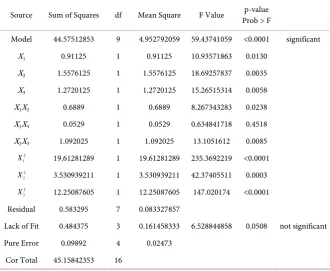
model was significant. The p-value were used as a tool to check the significance of each coefficient, and the smaller the p-value was, the more significant the corresponding coefficient was. There is only a 0.01% chance that a “Model F-value” this large could occur due to noise. p-value less than 0.0500 indicate model terms are significant. It also can be seen that the linear coefficient (X1, X2,
X3), the interaction term coefficients (X1X2, X2X3), and quadratic term
coeffi-cients ( 2
1
X
,X
22,X
32) were significant, with very small p-values (p < 0.05), the results indicated that ultrasonic power, ultrasonication time and extraction temperature were significantly correlated with the yield of OA. The “Lack of Fit p-value” of 0.0508 implies the Lack of Fit is not significant relative to the pure error. There is a 5.08% chance that a “Lack of Fit F-value” this large could occur due to noise.After the response surface regression procedure, the coefficient of determina-tion (R2) of the predicted model was 0.9704, suggesting a good fit, the predicted
DOI: 10.4236/oalib.1104148 11 Open Access Library Journal
Table 3. Variance analysis of regression equations.
Source Sum of Squares df Mean Square F Value Prob > F p-value
Model 44.57512853 9 4.952792059 59.43741059 <0.0001 significant X1 0.91125 1 0.91125 10.93571863 0.0130
X2 1.5576125 1 1.5576125 18.69257837 0.0035 X3 1.2720125 1 1.2720125 15.26515314 0.0058 X1X2 0.6889 1 0.6889 8.267343283 0.0238 X1X3 0.0529 1 0.0529 0.634841718 0.4518 X2X3 1.092025 1 1.092025 13.1051612 0.0085
2 1
X 19.61281289 1 19.61281289 235.3692219 <0.0001
2 2
X 3.530939211 1 3.530939211 42.37405511 0.0003
2 3
X 12.25087605 1 12.25087605 147.020174 <0.0001 Residual 0.583295 7 0.083327857
Lack of Fit 0.484375 3 0.161458333 6.528844858 0.0508 not significant Pure Error 0.09892 4 0.02473
Cor Total 45.15842353 16
R2 = 0.9871. adj R2 = 0.9705.
space. The coefficient of variation (CV) is the ratio of the standard error of esti-mate to the mean value of observed response expressed as a percentage. It is a measure of reproducibility of the models. The CV of the model was calculated as 2.60%. As a general rule, a model can be considered reasonably reproducible if its CV is not greater than 10%.
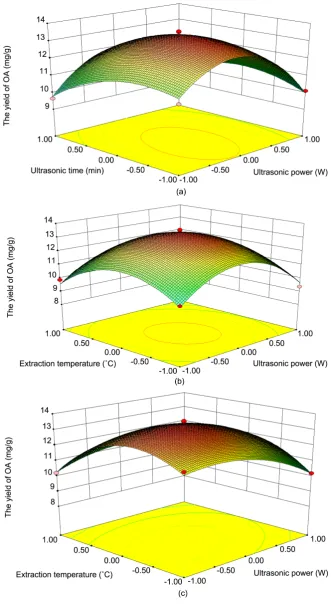
The 3D response surface plots were drawn to illustrate the main and interac-tive effects of the independent variables on the dependent one in Figure 4. They showed the type of interactions between two tested variables and the relationship between responses and experimental levels of each variable. Two variables with-in the third variable were kept constant at zero level. As shown with-in Figure 4, the influencing rule of ultrasonic power, ultrasonication time and extraction tem-perature on the extraction process was similar to the single factor experiments. However, in Figure 4(a) and Figure 3(c), the interaction effect between ultra-sonic power (X1) and ultrasonication time (X2), between ultrasonication time
(X2) and extraction temperature (X3), were obvious than others.
DOI: 10.4236/oalib.1104148 12 Open Access Library Journal
Figure 4. Response surface plots showing the effects of variables on extraction yield of OA.
DOI: 10.4236/oalib.1104148 13 Open Access Library Journal
3.4. Comparison of the Proposed ILUAE Approach with the UAE
Method
In order to compare the extraction field of the [C4mim]Cl solution with organic
solvent, ethanol was used to extract OA from grape seeds under the respective optimal condition. Under the optimal conditions of acetone extraction [24], in-cluding ethanol concentration 70% (v/v), extraction temperature 25˚C, solvent to solid ratio of 10:1 (mL/g), ultrasonication time 30 min, repeated two times.
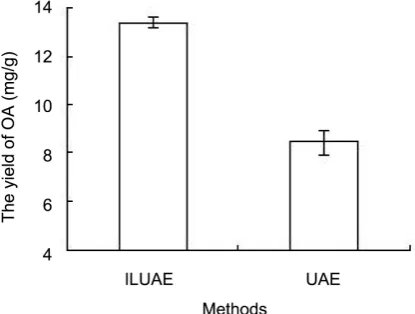
The results of extraction effect of ILUAE and UAE were showed in Figure 5.
The extraction yields of OA obtained by ILUAE and UAE were 13.4 and 8.43 mg/g, respectively. Compared with the regular UAE, the proposed approach ex-hibited higher efficiency (increase 1.59 time), which indicated that ILUAE was an efficient, rapid and simple sample preparation technique for extraction of the OA from grape seeds. This can be attributed to the better solubility of OA in IL solution due to π-π, ionic/charge-charge interactions or hydrogen bonding be-tween both ion and OA [30].
4. Conclusion
In this study, we have come up with a novel ILUAE for extraction of OA from grape seeds. In consideration of the influence of both the anion and cation of
io-nic liquids, [C4mim]Cl was selected for the subsequent analysis. The
ultrason-ic-assisted extraction conditions were optimized using single factor experiments and BBD in detail. Under these optimal conditions (e.g. with 0.7 mol/L [C4mim]Cl, solvent to solid ratio of 15:1, extraction time 4 h, ultrasonic power
[image:13.595.269.477.535.692.2]195 W, ultrasonication time 13 min, and extraction temperature of 48˚C), this approach gained the highest extraction yield of OA 13.4 mg/g. Compared with conventional regular ultrasonic extraction, the proposed approach provides higher extraction efficiency, and obviously reduced extraction time. The pro-posed ILUAE has abroad prospect in sample preparation of bioactive com-pounds.
Figure 5. Comparison of the proposed ILUAE with the
DOI: 10.4236/oalib.1104148 14 Open Access Library Journal
Acknowledgements
The authors would like to acknowledge the financial support by National un-dergraduate training programs for innovation and entrepreneurship (No. 201510740005).
Conflict of Interest
The authors declared that they have no conflicts of interest to this work. We declare that we do not have any commercial or associative interest that represents a conflict of interest in connection with the work submitted.
References
[1] Maier, T., Göppert, A., Kammerer, D.R., Schieber, A. and Carle, R. (2008) Optimi-zation of a Process for Enzyme-Assisted Pigment Extraction from Grape (Vitis vi-nifera L.) Pomace. European Food Research and Technology, 227, 267-275.
https://doi.org/10.1007/s00217-007-0720-y
[2] Özvural, E.B. and Vural, H. (2014) Which Is the Best Grape Seed Additive for Frankfurters: Extract, Oil or Flour? Journal of the Science of Food and Agriculture, 94, 792-797. https://doi.org/10.1002/jsfa.6442
[3] Chemat, F., Li. Y., Tomao, V., Ginies, C. and Cravotto, G. (2013) Optimization of Procedures for In-Line Extraction of Lipids and Polyphenols from Grape Seeds.
Food Analytical Methods, 7, 459-464. https://doi.org/10.1007/s12161-013-9646-0
[4] Gazzola, D., Vincenzi, S., Gastaldon, L., Tolin, S., Pasini, G. and Curioni, A. (2014) The Proteins of the Grape (Vitis vinifera L.) Seed Endosperm: Fractionation and Identification of the Major Components. Food Chemistry, 155, 132-139.
https://doi.org/10.1016/j.foodchem.2014.01.032
[5] Yunoki, K., Sasaki, G., Tokuji, Y., Kinoshita, M., Naito, A., Aida, K. and Ohnishi, M. (2008) Effect of Dietary Wine Pomace Extract and Oleanolic Acid on Plasma Li-pids in rats Fed High-Fat Diet and Its DNA Microarray Analysis. Journal of Agri-cultural and Food Chemistry, 56, 12052-12058. https://doi.org/10.1021/jf8026217
[6] Pensec, F., Pączkowski, C., Grabarczyk, M., Wozniak, A., Bénard-Gellon, M., Bertsch, C. and Szakiel, A. (2014) Changes in the Triterpenoid Content of Cuticular Waxes during Fruit Ripening of Eight Grape (Vitis vinifera) Cultivars Grown in the Upper Rhine Valley. Journal of Agricultural and Food Chemistry, 62, 7998-8007.
https://doi.org/10.1021/jf502033s
[7] Wang, X.X., Ye, L., Liu, R., Chen, H.L., Bai, H., Liang, X. and Hai, C.X. (2010) An-tioxidant Activities of Oleanolic Acid in Vitro: Possible Role of Nrf2 and MAP Ki-nases. Chemico-Biological Interactions, 184, 328-337.
https://doi.org/10.1016/j.cbi.2010.01.034
[8] Lee, W., Yang, E.J., Ku, K., Song, K.S. and Bae, J.S. (2013)Anti-Inflammatory Effects of Oleanolic Acid on LPS-Induced Inflammation in Vitro and in Vivo. Inflamma-tion, 36, 94-102. https://doi.org/10.1007/s10753-012-9523-9
[9] Ghosh, S., Bishayee, K. and Khuda-Bukhsh, A.R. (2014) Oleanolic Acid Isolated from Ethanolic Extract of Phytolacca decandra Induces Apoptosis in A375 Skin Melanoma Cells: Drug-DNA Interaction and Signaling Cascade. Journal of Integra-tive Medicine, 12, 102-114. https://doi.org/10.1016/S2095-4964(14)60015-7
Pharma-DOI: 10.4236/oalib.1104148 15 Open Access Library Journal
ceutical Chemistry Journal, 48, 39-43. https://doi.org/10.1007/s11094-014-1042-6
[11] Wójciak-Kosior, M., Sowa, I., Kocjan, R. and Nowak, R. (2013) Effect of Different Extraction Techniques on Quantification of Oleanolic and Ursolic Acid in Lamii Albi Flos. Industrial Crops and Products, 44, 373-377.
https://doi.org/10.1016/j.indcrop.2012.11.018
[12] Chronopoulou, L., Agatone, A.C. and Palocci, C. (2013) Supercritical CO2
Extrac-tion of Oleanolic Acid from Grape Pomace. International Journal of Food Science & Technology, 48, 1854-1860.
[13] Cláudio, A.F.M., Freire, M.G., Freire, C.S., Silvestre, A.J. and Coutinho, J.A. (2010) Extraction of Vanillin Using Ionic-Liquid-Based Aqueous Two-Phase Systems. Se-paration and Purification Technology, 75, 39-47.
[14] Liu, L., He, L., Jiang, X., Zhao, W., Xiang, G. and Anderson, J.L. (2014) Macrocyclic Polyamine-Functionalized Silica as a Solid-Phase Extraction Material Coupled with Ionic Liquid Dispersive Liquid-Liquid Extraction for the Enrichment of Polycyclic Aromatic Hydrocarbons. Journal of Separation Science, 37, 1004-1011.
https://doi.org/10.1002/jssc.201301062
[15] Wanigasekara, E., Perera, S., Crank, J.A., Sidisky, L., Shirey, R., Berthod, A. and Armstrong, D.W. (2010) Bonded Ionic Liquid Polymeric Material for Solid-Phase Microextraction GC Analysis. Analytical and Bioanalytical Chemistry, 396, 511-524.
https://doi.org/10.1007/s00216-009-3254-2
[16] Gao, J., Chen, L. and Yan, Z.C. (2014) Extraction of Dimethyl Sulfoxide Using Io-nic-Liquid-Based Aqueous Biphasic Systems. Separation and Purification Technol-ogy, 124, 107-116. https://doi.org/10.1016/j.seppur.2014.01.015
[17] Gharehbaghi, M. and Shemirani, F. (2012) A Novel Method for Dye Removal: Ionic Liquid-Based Dispersive Liquid-Liquid Extraction (IL-DLLE). CLEAN-Soil, Air,
Water, 40, 290-297. https://doi.org/10.1002/clen.201100258
[18] Han, D., Tang, B., Ri, Y., Lee, K. and Row, Ho. (2012) Application of Ionic Liquid in Liquid Phase Microextraction Technology. Journal of Separation Science, 35, 2949- 2961. https://doi.org/10.1002/jssc.201200486
[19] Hsieh, Y.N., Huang, P.C., Sun, I.W., Whang T.J., Hsu, C.Y., Huang, H.H. and Kuei, C.H. (2012) Nafion Membrane-Supported Ionic Liquid-Solid Phase Microextrac-tion for Analyzing Ultra Trace PAHs in Water Samples. Analytica Chimica Acta, 557, 321-328. https://doi.org/10.1016/j.aca.2005.10.019
[20] Jiang, W., Zhu, W., Li, H., Wang, X., Yin, S., Chang, Y. and Li, H. (2015) Tempera-ture-Responsive Ionic Liquid Extraction and Separation of the Aromatic Sulfur Compounds. Fuel, 140, 590-596. https://doi.org/10.1016/j.fuel.2014.09.083
[21] Huang, F., Berton, P., Lu, C., Siraj, N., Wang, C., Magut, P.K. and Warner, I.M. (2014) Surfactant-Based Ionic Liquids for Extraction of Phenolic Compounds Combined with Rapid Quantification Using Capillary Electrophoresis. Electropho-resis, 35, 2463-2469. https://doi.org/10.1002/elps.201300589
[22] Tang, B., Lee, Y.J., Lee, Y.R. and Row, K.H. (2013) Examination of 1-Methylimidazole Series Ionic Liquids in the Extraction of Flavonoids from Chamaecyparis obtuse
Leaves Using a Response Surface Methodology. Journal of Chromatography B, 933, 8-14. https://doi.org/10.1016/j.jchromb.2013.06.023
[23] Yang, L., Wang, H., Zu, Y.G., Zhao, C., Zhang, L., Chen, X. and Zhang, Z. (2011) Ultrasound-Assisted Extraction of the Three Terpenoid Indole Alkaloids Vindoline, Catharanthine and Vinblastine from Catharanthus roseus Using Ionic Liquid Aqueous Solutions. Chemical Engineering Journal, 172, 705-712.
DOI: 10.4236/oalib.1104148 16 Open Access Library Journal
[24] Duba, K.S., Casazza, A.A., Mohamed, H.B., Perego, P. and Fiori, L. (2015) Extrac-tion of Polyphenols from Grape Skins and Defatted Grape Seeds Using Subcritical Water: Experiments and Modeling. Food and Bioproducts Processing, 94, 29-38.
https://doi.org/10.1016/j.fbp.2015.01.001
[25] Wang, B.Z. and Xie, H.X. (2014) Determination of Concentration of Total Saponins and Oleanolic Acid of Rubus sachalinensis at Different Collecting Time. Chinese Journal of Experiment Medical Formulae, 20, 77-79.
[26] Harde, S.M., Lonkar, S.L., Degani, M.S. and Singhal, R.S. (2014) Ionic Liquid Based Ultrasonic-Assisted Extraction of Forskolin from Coleus forskohlii Roots. Industrial Crops and Products, 61, 258-264. https://doi.org/10.1016/j.indcrop.2014.07.016
[27] Da Porto, C., Porretto, E. and Decorti, D. (2013) Comparison of Ultrasound-As- sisted Extraction with Conventional Extraction Methods of Oil and Polyphenols from Grape (Vitis vinifera L.) Seeds. Ultrasonics Sonochemistry, 20, 1076-1080.
https://doi.org/10.1016/j.ultsonch.2012.12.002
[28] Huddleston, J.G., Visser, A.E., Reichert, W.M., Willauer, H.D., Broker, G.A. and Rogers, R.D. (2013) Characterization and Comparison of Hydrophilic and Hydro-phobic Room Temperature Ionic Liquids Incorporating the Imidazolium Cation.
Green Chemistry, 3, 156-164. https://doi.org/10.1039/b103275p
[29] Lin, H., Zhang, Y., Han, M. and Yang, L. (2013) Aqueous Ionic Liquid Based Ultra-sonic Assisted Extraction of Eight Ginsenosides from Ginseng Root. Ultrasonics Sonochemistry, 20, 680-684. https://doi.org/10.1016/j.ultsonch.2012.10.003
![Figure 3. Single factor experiment. (a) Influences of [Cmol/L, and 0.9 mol/L); (b) extraction time (1 h, 2 h, 3 h, 4 h, and 5 h); (c) solvent to solid ratio (10 mL/g, 15 mL/g, 20 4mim]Cl concentration (0.1 mol/L, 0.3 mol/L, 0.5 mol/L, 0.7 mL/g, 25 mL/g, an](https://thumb-us.123doks.com/thumbv2/123dok_us/37077.503579/8.595.110.536.72.565/figure-single-factor-experiment-influences-extraction-solvent-concentration.webp)