NONLINEAR WAVE
~GROUPS
IN
DEEP WATER
by
P. J. Bryant
No.
13
August
1978
1.
Nonlinear wave groups in deep water
BY P.J. Bryant
Nonlinear wave groups in deep water consist of wave modes for
which nonlinear interactions and dispersion are in balance. The
evolution equations for the wave modes are derived, and properties
of nonlinear wave groups are found from these equations. It is
shown that the nonlinear wave groups are linearly unstable to
side-band modulations in the sense that the linearised perturbation
theory, in providing a good fit over the initial time interval,
predicts that the growth of the modulations is exponential. Instead
the perturbed wave group is shown to return cyclically to a state·
close to its initial state. The cyclic recurrence is demonstrated
analytically for the simpler wave groups and numerically otherwise.
The interactions between nonlinear wave groups of the same and of
2.
1. Introduction
A wave group in deep water·contairitn9 a narrow waveband of wave
modes propagates, to a first approximation, with the group velocity of
the central wave mode in the waveband. The linear theory predicts that
the wave modes will disperse slowly causing the group to disintegrate
as it propagates. The nonlinear theory shows that weak nonlinear
inter-actions between the wave modes can balance the weak dispersion so that
the envelope of the wave group keeps a permanent shape.
The method of analysis used here is based on the representation of
a wavetrain c:>f periodically spaced wave groups by a Fourier series, the
series consisting of linear wave modes with amplitudes which vary slowly
with time. Evolution equations for the Fourier amplitudes are calculated
in terms of the nearly resonant tertiary interactions between the wave
·modes. This approach has its origins in the investigation by Benney and
Newell [1] of the mechanics of the propagation of nonlinear wave
envelopes. Their method was applied to deep water wave groups by Cohen,
Watson and West [2], and is expanded further in the present investigation.
The alternative approach to nonlinear wave groups is by the use of
model equations [ 3, 4, 5; 6], principally the cubic Schrodinger equation.
A derivation of this equation for a narrow waveband wavetrain is to be
found in (7], §17.7, where it is shown also that such a wavetrain in
deep water is unstable in the sense that small modulations to the
wave-train grow exponentially in time. Yuen and Lake [8] found good agreement
between experiments on deep water narrow waveband nonlinear wave groups
and the corresponding numerical solutions of the cubic Schrodinger
equ~tion, and the initial modulational instability has been demonstrated
experimentally by Lake, Yuen, Rungaldier, and Ferguson
[91.
The latterexperiments were continued to longer times to show that the modulations
3.
atate close to its initial state (in agreement with a previous numerical
calculation by Roskes [10)). These properties are all confirmed by the
present investigation.
The inverse scattering method may be applied to the cubic
Schrodinger equation ([.71, §17 .9), when it is found that the nonlinear
wave groups (soliton envelopes) retain their structure after interactions
with one another. This property has been verified experimentally by
Yuen and Lake
[8].
The method fails for nonlinear wave groups of thesame central wavenumber propagating with the same velocity, so
calculations are made here of the interactions between nonlinear wave
groups of the same and of almost the same central waven\wiDers.
2. Evolution equations
The water surface displacement has the form of periodically spaced
wave groups, the spacing of the groups being 2TIL .. The central wave mode
of each group has wavelength 2TI1, so that ko
=
L/1 is the nondimensionalwavenumber at the centre of the waveband, all wavenumbers being
non-dimensional multiples of 1/L. The space coordinates are x in the
direction of wave propagation, and y vertically upwards from the mean
free surface, both being nondimensional multiples of L The time t is
.a nondimensional multiple of
(1/g)~.
The maximum trough to crest heightof the·wave group envelope is 2a, and E =a/lis the principal small
parameter. The water surface displacement n(x,t) is a·nondimensional
multiple of a, and the velocity potential ~(x,y,t) is a nondimensional
multiple of
a(gl)~.
The governing equations may then.be written
~
+
~...
04> + 0 aa y + - m ,
n
+
«<>t+
en«~> t+
&:ic($2 + «!>~> + l:ir2<rtzcfl )
Y
XY
YY
t+ c2nn t«<> = O(c3) on y = o. x -x
The Fourier series expansions for
n
and «!> aren ...
1:! I: ~ (t) exp i (kx/ko - !1\kt) + i<k
4>
=
~ I: Ck ( t) exp (ky /ko) exp i (kx/ko - wkt) +k
4.
(2.lb)
(2.lc)
(2.1d)
(2. 2a)
(2.2b)
where
*
denotes complex conjugate and the Fourier amplitudes ~, ck areslow functions of t. The linear theory yields
~
=
-i(ko/k)l:i~
+ 0(£)~
"" (k/ko) 1:! •( 2. 3a)
(2.3b)
The quadratic theory describes sum interactions between wave modes
of wavenumbers ~, .k-~ and difference interactions between wave modes of
wavenumbers ~~ k+~ to produce wave modes of wavenumber k. The resulting
contributions to the Fourier amplitude ~ are estimated by
and
respectively. None of the quadratic interactions is near resonance for
the dispersion relation (2.3b), so these contributions to~ are only
0(£) compared with ~ itself •
. The tertiary interactions may be separated into two kinds,· those
·.that are significant because they are near resonance, and those whose
contribution to ~ is not significant because they are not near resonance.
When the three interacting wave modes as well as the resulting wave mode
all have wavenumbers in the ~,eighbourhood of ko, their contribution to
5.
ul
+
Ill - IIJ·0 • - ltlkm k+9,-m •
+
(k+
!1, - m - ko) 2 - ( Jl. - ko) ? - (k - ko) 2) •The above contribution to ~ is 0(1), of the same magnitude as ~ itseu,
when all wavenumbers k in the narrow waveband centred on k0 are such that
(2.4)
The amplitude paramter £ is mucp smaller than 1, so for this relation
to be satisfied,
ko
must be much greater than 1. For this reason, the·present investigation is restricted to narrow wavebands centred on
wave-numbers ko
>
1 for which significant tertiary interactions occur.betweenthe wave modes present.
None of the remaining tertiary interactions ;Lies near resonance, so
none contributes significantly to ~· One such tertiary interaction is
the sum interaction between three of the wave modes present to produce
an 0(£2) wave mode with a wavenumber near 3k0 • A less obvious tertiary
interaction is that between a quadraticaliy generated 0(£) wave mode and
an 0(1) linear wave mode to produce an 0{£2) wave mode, as for example
when the 0(£) correction to equation (2.3a) is multiplied with an 0(1)
amplitude .A in the expansion of the third term of equation (2.lc).
The derivation of the evolution equations is now st'raightforward.
The Fourier series (2~2a,b) are substituted into equations (2.lc,d),
the quadratic terms are neglected completely, and the only tertiary
terms retained arethose for quartets of wavenumbers k, !1,, m, k+Jl.-m in
the neighbourhood of ko, with the Fourier amplitudes
c,
A in the tertiaryterms related by equation (2.3a). Equations (2.lc,d) become (with
6.
k+9..-l
L (
R.w$1, + mol + pw ) A~ A 1\m=l m p m P
X
exp - i (W +
w
-IJ)n -Ill.. ) t. = 0,· m p x, k (2.5a)
2 00 k+fL-1
E: \' \'
+ ::::-2 l. l. { (W11
-w
-w ) (-$1,wn +roW +pW )8k() fL=l m=l Jlv m P . N m p
+ 2 (mw W + iWnW + pW0hl ) }A! A A exp- i (W + W - W0 - W. ) t = 0 ~ ( 2. 5b)
m p· N :m "" p "" m p m p "' .k
The amplitude
Ck
is eliminated now between these two equations, and thesymmetry between m and k+t-m(=p) used to simplify the interaction
coefficient, when the evolution equation for ~
\_s
found to bewhere
-k{ (k+t)w w
R = m P
k$1,m .
+
(3t+m)wtwm+
(3t+p)u.I.II,Wp -2tw
9
~}
ak!
(wm +wp- wt+~)
(2.6a)
(2.6b)
Each w in this formula is given by equation (2.3b). Since the wavenumbers
in, p, !L, k all lie in a narrow waveband near
ko,
the interaction coeffic:ient~tm may be approximated by
R _
.!. (
1 + 9 (k - ko )ktm
=
2 · 8k0 + 11 ( fL - ko ) ) +o(k -k
0 )2
Bko · ko • (2.7)
An envelope function F(x,t) is introduced by rewriting the Fourier
series (2.2a) as
=
~F(x,t) expi(x-t) + = 1)·where
ko+kl ( . )
F(x,t)=
L
~(t)expik~
0
kox-(~-l)t
If
the interaction coefficient 1\ll.m is approximatacl by-~- and thedilperoion relation (2.3b) is approximated by
,
..
l+k-k1)2k0
. 2
(k- ko)
skJ
it is found from equation (2.6a) that F(x,t) satisfies the cubic
Schrodinger equation
7.
(2.8a)
(2.8b)
{2.9)
The first two terms of this equation describe propagation of F with the
gro~p velocity~~
and the last two terms, which from relation (2.4) areof comparable small magnitude, describe the weak dispersion and the weak
nonlinearity respectively. Most previous investigations have discussed
nonlinear wave groups as solutions of the cubic Schrodinger equation
(2.9), but the present investigation concentrates on those properties
of nonlinear wave groups which are obtained from the evolution equati.ons
. (2.6).
· 3 • Wave groups
The wave group solutions of the evolution equations are now
calculated. The two parameters describing .the shape of a wave group
are the.nondimensional amplitude £and the nondimensional central wav~
number kg. Relation (2.4) for the width of the waveband indicates that
the number of wavelengths in each group is proportional to 1/£, and
hence that the ra~io of the length of the group to the distance between
groups is proportional to 1/ (ko £) • The propagation velocity of the
8.
as e:: tends to zero, this velocity being
t
in the nondimensional multiples used. The simplest method of ensuring that in the wave group calculationsthe centre·of the waveband remains in the neighbmirhood of k0 is by
1
setting the propagation velocity equal to
2
for all values of c. Thepeak of the wavenumber spectrum then changes continuously in position as
e: is increased, but remains in the neighbourhood of k0 •
The Fourier series describing nonlinear wave groups pt·opagating
with velocity
t~
containing waves of central wavenumber 1 and centralfrequency 1, is
expi(x-t)exp -ia.e:2t + .,., (3.la)
where from equation (2.2a),
~(t) ak exp 1 ( . wk - 1 - k-ko 2
2ko - a.e: ) t , (3.lb)
The amplitudes ~ are constants, the first three terms of the phase of
~are together O(e:2t}. (from equations (2.4.) and (2.8)), and the unknown
. part of the phase is written a.e:2t to give ~ the slow time dependence
indicated by the evolution equations (2.6).
The equations determining ~ (ko - kt ~ k
<:
ko + k1 ) and a. are thereforeko - kt e;;; k ~ ko + kt , (3.2a)
together with the geometric constraint imposed by the definition of
e:,
namely
(3.2b)
For any given ko and e:, theS'P.J 2k1 + 2 equations are solved for the
9.
Newton-Raphson technique. The bandwidth 2kt is increased step by step
until no further change occurs in all variables to the precision
required (usually l0-4).
The nonlinear wave group for ko
=
40, £=
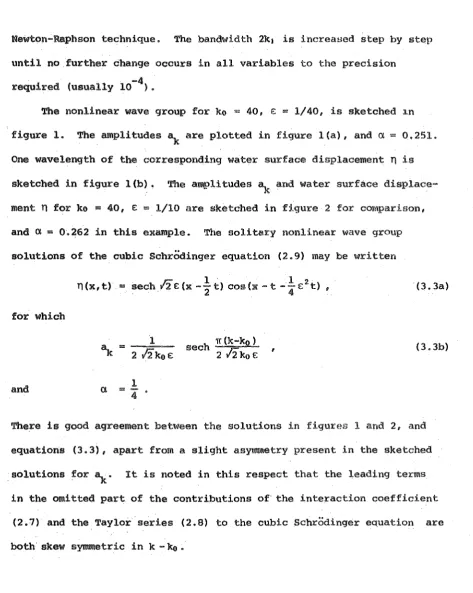
1/40, is sketched 1nfigure 1. The amplitudes~ are plotted in figure l(a), and a= 0.251. One wavelength of the corresponding water surface displacement
n
iss~etched in figure l(b). The amplitudes ~·and water surface
displace-ment
n
for ko=
40, E=
1/10 are sketched in figure 2 for comparison,and a
=
0.262 in this example. The solitary nonlinear wave groupsolutions of the cubic SchrOdinger equation (2.9) may be written
for which
and
sech TI (k-ko )
2 fiko E
(3.3a)
(3.3b)
The.re is good agreement between the solutions in figures l and 2, and
equations (3.3), apart from a slight asymmetry present in the sketched
solutions for ~· It is noted in this respect that the leading terms
in the omitted part of the contributions of the interaction coefficient
(2.7) and the Taylor series (2.8) to the cubic Schrodinger equation are
[image:10.595.77.551.48.642.2]tel,
4 ~ ·Linear inetahi l i
.!:X
Benjamin and Feir [11] showed that a progressive wavetrain in
deep water is unstable, in the sense that a sideband modulation grows
exponentially in time during the initial time interval in which the
amplitude of the modulation remains small •. Lake et al [9] found more
recently that over longer times the amplitude of the modulation increases
and decreases, with the modulated wavetrain returning cyclically close
to its initial state.
Benjamin and Feir analysed a wavetrain of fundamental wavenumber k
and frequencyw interacting with sideband wave modes of wavenumbers
k(l
±
K) and frequencies W(l±
6) where K' ando
are sn1all fractions. Theessence of the instability mechanism is that a significant interaction
occurs within the qu~rtet with wavenumbers k, k, k ( 1 + K) , k ( 1 - K) and
frequencies w,
w,
W(l +o),
W(l-o)
respectively, causing the twoside-band wave modes to grow at the expense of the fundamental wave mode.
In a nonlinear wave group, significant interactions occur within all
quartets with wavenumbers k, 1, m, k+t-m in the neighbourhood of ko.
If one such wave mode is perturbed or is.itself a small amplitude
modulation, it can be expected therefore that the significant interaction
with the other three wave modes will cause this perturbation or modulation
to grow exponentially. This property is now confirmed. It can be
expected also thatover longer times the perturbed nonlinear wave group
will return cyclically close to its initial state, and this property is
confirmed in the following two sections.
The Fourier series for a given nonlinear wave group is that stated
in equation (3.1a). In order to investigate the stability and evolution
of a perturbed nonlinear wave group, it is preferable to use a Fourier
series for the water surfac~ displacement which has the same form as
11.
1 . k- ko 1 2
11
= 2
~ Bk (t) exp 1. ko (x -2t)
exp i (x- t) exp- ia€: t +*,
(4.la)where
k - ko _ 2
1\(t)
=
Bk(t) expi(~- 1-2ko cxe: )t.
The evolution equation for Bk, from equation (2.6a), is
where B '
k
=
ie:2
I: E R 11 B! B Bk ·11 ,
51, m kx.m IV m +JV-m
( 1 k - ko ) /"' 2
Pk
=
~ ~-
-
2ko ~(4 .lb) .
( 4. 2)
(4. 3)
approximatelyr for wavenumbers k near k0 •
The wavenumber of the perturbing wave mode is denoted by K, where
ko - kt ~ K ~ ko + k1 , and its complex amplitude is aK + BK if K coincides
A
with one of the (integer) wavenumbers present, or is B otherwise.
K
Linearisation with respect to
B
in the tertiary interaction terms ofequation (4.2) indicates that the perturbed wave modes present have.
wave numbers 'K + n, n = 0, ± 1, ± 2, •.. , and 2ko - K + n, n
=
0, ± 1, ± 2, . . . . The evolution equations, linearised with respect to the perturbations"
B, are
B'
ie:2 P .B
=
ie:2 ( E I: R a aB
K+n K+n K+n tm K+n,t,m t m K+n+t-m
+
I: E R a aa*
) ,
t m K+n,ko+t- K,m m ko+n+t-m k0+2-K
(4.4a)
s'
2ko-K+n ie:2 P 2ko -K+n 2ko -K+n8
=
ie:2 (E E R a aB
51, m 2ko -K+n, Q., m .IJ. m 2ko "':' K+n+ Q.-m
+
E E R a aa*
) .
t m 2ko-K+n,K+t-k0 ,m m k0+n+t-m K+t-k0 (4.4b)
The system of first order linear differential equations with constant
coefficients consisting of equations (4.4a) with the complex conjugates
1?..
amplitudes B A , n
=
0 , ± 1 , ± 2 , ... , and B A* ,K+n · · 2k.0 -K+n n=O, :tl, ±2, . . . .
The method of solution of this system of differential equations for
any given values of
e::,
k.o and K has been described previously( [ 12], §4), and is as follows. The system of differential equations
is reduced to a system of filgebraic equations by seeking normal mode
A
solutions for which each amplitude B has the same slow time dependence
exp(i~E2t).
The system is then solved for the range of wavenumbers
within the waveband ko - kt
<
k<
ko + kt • · The width 2k1 of the wavebandis increased step by step until the common eigenvalues A of consecutive
sets of equations agree to within an arbitrary numerical precision.
The system is stable if all eigenvalues
A
are real, unstable if anypair of eigenvalues are complex conjugates. The solutions for the
A '
amplitudes B resulting from any given initial conditions may be
calculated from the eigenvectors of the set of algebraic equations.
Examples have been calculated for a range of values of£, k0 , and
K, and in every example there was at least one pair of eigenvalues ~
that were complex conjugates. The conclusion is that nonlinear wave
groups are unstable to small pertubations of the wave modes composing
them, and are unstable to small amplitude sideband modulations at other
wavenumbers near ko. The amplitudes. of the unstable modes were found
to decrease asK moved away from ko, which is to be expected because
the interactions. within the quartets of wavenumbers then move further
from resonance.
The eigenvector corresponding to each eigenvalue·~ is dominated
for almost every
A
by ~ unique complex amplitudeBk,
enablingA
to beidentified with a unique wavenumber k. This identification leads to
an interpretation for ~ in terms of a coefficient Qk for those
wave-numbers k outside the immediate neighbourhood of k0 • When all terms
u.
side of this equation, this side may be rewritten
8'
-
ic20B .·,
K+n 'K+n K+n
where
(4. 5)
The normal mode ablutions of equation (4.4a) are those solutions for
It was found in all the examples.calculated that
A
tended towards the corresponding value of Qk ask tended away from k0 •The values of A and Qk are listed in the following table for the first
example described below, for which ko
=
K=
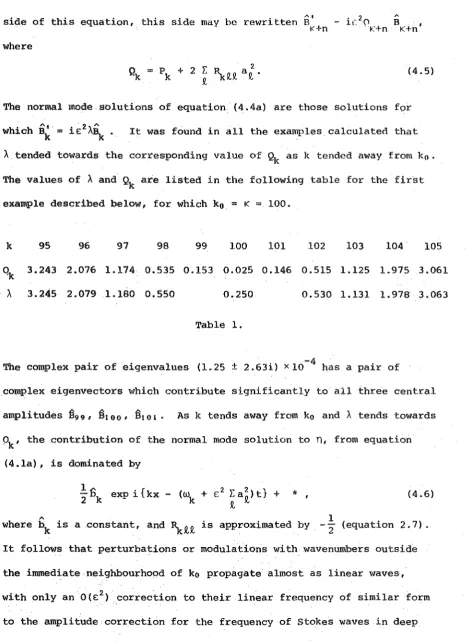
100.k 95 96 97 98 99 100 101 102 103 104 105
Qk 3.243 2.076 1.174 0.535 0.153 0.025 0.146 0.515 1.125 1.975 3.061
A 3.245 2.079 .1.180 0.550 0.250 0. 530 1.131 1. 978' 3. 063
Table 1.
-4
The complex pair of eigenvalues (1.25 ± 2.63i) XlO has a pair of
complex eigenvectors which contribute significantly to all three central
amplitudes §99,
Bt
00 , §toi. Ask tends away from ko and A tends towardspk, the contribution of the normal mode solution to
n,
from equation(4.la), is dominated by
tsk exp i {kx - (wk
+
t:2 Ea~)
t}+
*
5I,
(4.6)
where bk is a constant, and
~51,51,
is approximated by -~
(equation 2. 7).It follows that ·PElrturbations or modulations withwavenumbers outside
the immediate neighbou~hoqd of ko propagate almost as linear waves,
with only an.0(£2) correction to their linear frequency of similar form
to the amplitude correction for the frequency of Stokes waves in deep
.water. This is consistent with the property that nonlinear interactions
are significant only in the immediate neighbourhood of ko (relation 2.4).
The first example to be described is that for which £
=
0.01, [image:14.595.85.557.67.708.2]L4 •
with that in figure 1, since ko£ = l i n both cases. When the
perturbation is applied to one of the existing wave modes, the set of
wavenumbers of the perturbations coincides with the set of wavenumbers
of the group itself. A "'*
The perturbation variables are Bk, Bk,
k0 - k1 ~ k ~ k0 + k1 , which means that the real eigenvalues occur in
pairs, ±~, and the complex eigenvalues occur as ±(X ± iA..). If the
r l.
A A A
initial conditions are B100 = b, Bk
=
0 otherwise, the solution forthe three central perturbations (with the eigenvalues listed in and
below table 1) is found to be
B99
=
b[
(-197.45 + 212.24i) expi( X + iX.)r:2tr l.
A
Btoo
=
A
BlOt
=
+(-197.45- 212.24i} expi( X - iX.)£2t
·r l.
+( 197.77 + 212.90i) expi(-A + iA..)£2t
r J.
+( 197.77- 212.90i) expi(-A - iA.)£2t
r l.
- 0.37 expiAtoo£2t
+ 0.08 exp iA98 e::2t
bl (
16.85 + 547.58i)+( 16.85 - 547.58i)
- 0.02 exp- iAto2C2t+ ... (0.006)], (4.7a)
exp i ( A + H.)£2t
r l.
exp i ( X - iX,)£2t
r l.
+(-16.85 + 547 .6li) exp U-A + iA..) £~\
r l.
+(-16.85 - 547 .6li) exp i (-A . r - iA,)£2t
l.
+ 1.40 exp iAtoo£2t
+ 0.01 exp L\gs £2t
+ O.OlexpiAio.2£2t
Sl
< 223.25 + 44l.07i)+( 223.25 - 441. 07i)
+(-222.96 + 440.75i)
- 0.41 exp- iXt oo£2t
- 0.01 exp- iX9s
et
- 0.01 exp- iAto2£2t+ ... (0.0005)1, (4.7b)
+ iA,)£2t
exp i ( X
r l.
exp i ( A - iX.)£2t
r l.
exp i (-A
r +iA.)£
2 t
l.
+(-222.96 - 440.75i) expi(-A
r - iX. )£ 2
t l.
- 0.30expi~too£2t
15.
(The figure in brackets at the end of each equation is thE! magnitude
of the next term in the expansion.)
A
The complete complex amplitudes are Bk
=
ak + Bk, and the threevalues of ak to be added to the above equations are a9 9
=
0.207,atoo
=
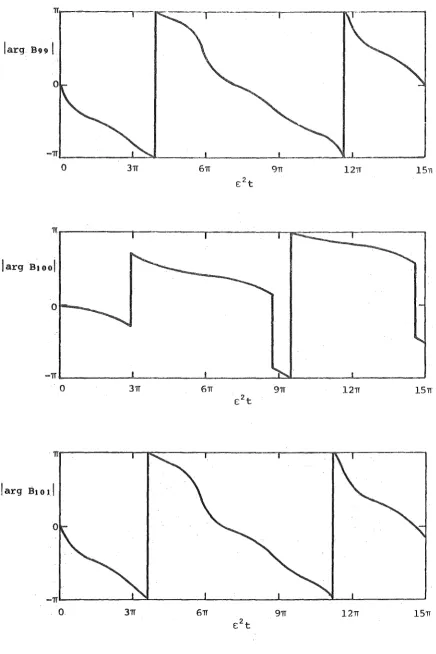
0.353, a101 = 0 •. 213. The moduli and arguments of B99 , B1oo.vA
Btol, for the initial pertur~ation amplitude b
=
0.01, are plotted infigure 3. The dashed curves are the complex amplitudes ·predicted by
the linearised model, including the perturbations given by equations
(4.7). The solid curves are the complex amplitudes without linearisation,
obtained by a numerical solution of the evolution equations (4.2) from
the same initial conditions as the linearised solution.
The curves for the moduli are of most interest because they have a
direct influence on the shape of the group envelope. They demonstrate
that the linearised theory fits well over the initial interval of slow
timet but in so doing predicts incorrectly that the perturbations will
continue to grow exponentially. The full solution without linearisation
shows that the moduli of these amplitudes return to a state close to
their initial state. These curves illustrate the important property
that the prediction of instability by the linearised model over shor.t
times is not applicable to the development of the wave system over
longer times. A better fit between the linearised model and the full
solution is found for the arguments of the complex amplitudes. The
nearly constant negative rate of change of these arguments corresponds
to an increase in the phase velocity of each .of the calculated wave modes.
The second e~ample described is that.for which
c
=
0.01, ko=
100,K = 99.8. This example has been chosen because it shows the structure
of the perturbation solution when the sideband modulation is applied at
a wavenumber which is not already present. The perturbation variables are
~
<
~"•
~ t(16.
eigenvalues
A
tend towards the corresponding values of Qk±0.2 as k
tends away from ko, as in the first example. The central eigenvalues
are A98 • 2
=
-0.457, A99. 8.= 0.268,\oo.
2 = -0.263; \o1.a=
0.441,with the complex set -6 ><10-4 ± O.Ol6i, 3 ><10-4 J 0.0121 favouring all
six central wavenumbers 99 ± 0.2, 100 ± 0.2~ 101 ± 0.2. The two central
A A A
modulations starting from initial condition$
a
99•8
=
B100.2=
b,Bk±0.2
=
0 otherwise, area
99•8
=
S[ (-1. 367 + 8.869i) exp i(-6 x10⁻⁴ t O.Ol6i) c2
t
+(-1.367- 8.869i) expi(-6 Xl0-4 - O.Ol6i)F:2t
+( 1.447 + 10.026i) expi( 3 ><10-4 + 0.012i)£2t
+( 1.447- l0.026i) expi( 3 Xl0-4 - 0.012i)£2t • ·. 2
- 0.355 exp1\oo.2£ t + ••• (0.01)
l,
(4.8a)
s;oo.2
=
S[ C-1.244 - 8.962i) exp i (-6 x10⁻⁴ + 0.016i)£2t
+(-1.244 + 8.962i) exp i (-6 x 10⁻⁴ - O.Ol6i)£2t
+( 1.284 - 10.084i) exp i ( 3 X 10⁻⁴ + 0.012i)£2t
+( 1.284 + 10.084i) exp i ( 3 X 10⁻⁴ - O.Ol2i)£2t
1 2 7' ., 2
1
+ 1.260 expi"lo0.2£ t - 0.33 exp1A99•8r t + •.. (0.01) •
(4.Bb)
The linearised solution could not be compared with a full solution of
the evolution equations because the large number of fractional
wave-numbers placed the calculation beyond the computing facilities availablP,
However, since the nearly resonant mechan.i.rJm of enerqy tr,msfor wi lh i 11
quartets which applied in the previous example still applies here, it
can be expected that the. above solution is valid only for an initial
interval in slow time, and that cyclic recurrence will occur over longer
1/.
5. An analytical soh~tion of 1-ho ovolution t~quations
A nonlinear wave group of small amplitude,.such as that in the
examples of the previous section, is dominated by the interactions
between its three central wave modes. The evolution equations (4.2)
are solved therefore for a nonlinear wave system consisting only of the
three central wave modes.
The coefficients in equations (4.2) are approximated and rewritten
as follows,
p
ko.
R
kQ.m
=
=
1
4 =
1
Po,
1
+-
=
pi4 (from equation 4.3b),
B(ko£)
11
(from equation 2.7). 2
The time variable is changed to T
=
£2t. The three complex amplitudesare rewritten
Bko-1 = X,
The evolution equations (4.2) then become
X' - iPtX
=
-~i{<lxl2
+2IYI2
+2lzl
2
>x
+y2z•},
(S.la)'l'
- iPo"i
=-%-i{(2lxl
2
+IYI
2
+2lzl
2
lY
+2XY*Z},
(S.lb)Z' - iP1Z
=
-%-i{<2lxl
2
+2IYI2
+lzP>z
+y2x*}.
(5 .lc).The steady solution of these equations is the nonlinear wave group whose
amplitudes are given by
x2
=z2
::::-
1 (4 - 1al2
(5.2a)(ko
£)2
=60
y2
= 1 (1+
1 }ao2
(5. 2b)(ko
£) 2 =10
Two first integrals of equations (5.1) may be found immediately.
These are
lxl
2
+IYI
2
+
lzl
2
=
Ct,I X
12
- I z I
2
-
C2 ,(5.3a)
lB.
where Ca, C2 are constants. When the combination Y" Y* - Y*"Y is
formed and the right hand side simplified using equation (5.3a), it
may be integrated to yield
Y' Y*- Y*'Y
=
.!:.iiYI~
+ · (
1 1 3c 21
J
IYI2 + ic3,
4 1
2
+ 4(ko£)7 - (5.4a)where C3 is a real constant. This equation is equivalent to
(arg Y) • =
8
1I I
2 1 1 3Ctc
3Y +
4
+
8 (koE:f2" -
4
+2l
Y 12 (5.4b)ly 1
2'--Next, the derivative Y'Y* + Y*'Y is formed from equation (.S.lb),
it is differentiated and the right hand side simplified from equations
I 1
2 II
(5.1a,c) and equations (5.3a,b) to yield Y ·as a cubic equation in
I Y 12• This ~ay now be integrated and written
[ IYI21
1
2 =ao
lv 1
8 +a.
I Y1
6+
o:1 I YI"
+ a3IYI 2 +(4,
(5. 5)where
ao
= 7 16 'O.t
=
3 _ 5CtS(ko £) 2 4
(
1 Ctr
+c2 - cz
3a2
=-4(ko£) 2 +
2
1 2+
2c3,
0.3
= -
2C 3 (4
(k~
£) 2 + Ct2
J
'
and ~ is arbitrary •
. Equation (5.5) defines T as an elliptic integral of the first
kind in IYI 2 [13], which means in particular that IYI 2 is periodic in
T (
=
£2tJ. The equation may be rearranged in particular examples tocalculate the elliptic integral solution, but instead the periodicity
is demonstrated more directly by simplifying.the quartic in IYI 2• If
the initial values of X, Y,
z
are denoted by X0 , Y0 , Z0 respectively,equation (5.5) may be rewritten
[ I Y
1
2'F
= -[
(I Y1
2 - I Yo1
2)<il
Y1
2+
il
Yo1
2 - 4(k~
£) 2 -c~
>+ XoY~2Zo +
xJ'yJzt1
2 + IYI "{ ( IYI2 - Ct) 2 -en .
(5.6)19.
C2
=
0 and equation (5.6) reduces to[ I
Y1
2'F
=
(I
Y1
2 -I
Yo1
2)(lj
YI
2 +lj
YoI
2 - _ _1_.., - 3 C1. ) x4 4 4(k0 £)' 2
liiY1
4+
(
4
(k~s)2- c~)IYI
2
+fiYol
4-
(
4
(k~e:)2 +
3
~
1
]1Yol
2
1
•
(5. 7)
When Y satisfies the steady solution (equations 5.2), equation (5.7)
becomes
(5.8)
This equation, with ko£
=
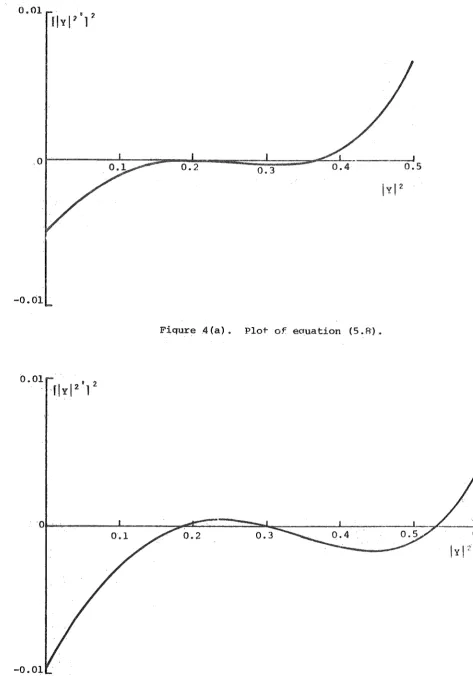
1, is sketched in figure 4(a) as a plot of[ IYI21
1
2 against IYI2• Necessary conditions for a physically relevantI
solution are [ jy 12 ] 2 ~ 0 and
IY
12 ~ 0, both of which are satisfied atthe double root jyj2 = aJ = 0.2, corresponding to the steady solution
Y
=
ao.When the steady solution with ko£
=
1 is disturbed by an initialperturbation of the central mode, namely Xo =at, Yo= ao + 0.1,
Zo
=
at, the resulting evolution is the sa.me in essence as in the firstA
example of the previous section (where the initial perturbation b was
0.01 instead of 0.1 here). Equation (5.7) is applicable to these
initial conditions, and reduces to
(5.9)
since yJ
=
0.3. This equation is sketched in figure 4(b) as a plot of[ jyj2
'J2
againstIYI
2• The initial point on the graph is atIY
12=
0.3,IY
12'=
O, jy 12"<
O, from whiqh jy 12 decreases until itreaches the point jy 12 =
~~
, jy 12' = 0, jy 12">
0, where IY I increasesuntil it returns to the initial point, and so on. Hence IYI is a
periodic function of.T ( =s2t), with a minimum value 0.43 and a maximum
value 0.55, while from equations (5.3a,b).
lxl
andlzl
have the same20.
rate of change of arg Y is given by equation (5. 4b), and in this example
has a mean of about -0.1.
The effect of a perturbation applifld to the nonlinear waV<.' group
is to redistribute the quartic in figure 4(a) so that it has a finite
intersection with the
IYI
2-axis in the neighbourhood of the initialpoint. For a small initial perturbation, the change in height of the
quartic near the initial point is small, but because of the flat slope
of the quartic near this point, the range of
IYI
in the resultingperiodic motion may be much larger. However, the important property
is that for any small perturbation of the three wave mode nonlinear wave
group, the resulting evolution of the wave group is strictly periodic,
even though a linear stability analysis shows that the wave group is
unstable to small perturbations.
6. Numerical solution of the evolution equations
The evolution equation for Bk (equation 4.2) may be re.,Yritten as
the difference equation
~(T +i\T) - Bk(T -t.T)
2M
. Bk ( T + t. T) + Bk ( T - M) - 1. pk 2
'where T = £2t, and this equation then used to generate a stepwise
(6 .1)
numerical solution of B , k{) - k1 ~ k ~ k{)
+
k1 • This form of differencf~k
equation was applied successfully to quadratic nonlinearities in a
previous investigation [14], and is such that the linear terms are
numerically stable • . The time step used in most calculations is
t'J.T :i: 'fT/200 •. The numerical S'Jlution described in §4 and in figure 3
...
,.
The principnl example tn be doscrlnod hon~ l!l "qonPtillin<~tlou
of tho 3 wave modC' example solved nnalytically in Uw pn,vious s<!ction.
The system is extended here to 21 wave modes, 90 ~ k
<
110, and thecalculations are started from the same initial conditions as before,
namely Btoo = a10o
+
0.1, Bk = .~ otherwise. The results are presentedin figure 5.
The moduli of B99, Btoo, and Btot are drawn in figure S(a). The
important property of this solution is that the moduli are found to be
almost periodic over the 5000 time steps of the integration, with no
evidence of a loss of periodicity beyond the interval of calculation.
The form of the solution agrees with that found in the last section for
a 3 wave mode system, but the valu~s for the amplitude and the period
of the moduli differ from those calculated because of the influence of
the additional 18 wave modes.
The arguments of B99 , B10o, and Bto1 are drawn in figure 5(b).
The interesting feature here is that the negative mean rate of change
of argument is nearly the same for all three wave modes, indicating that
the phase velocity of the wave inside the wave group is increased as a
result of the initial positive perturbation of the central wave mode.
Also, since the phase difference between the wave modes remains almost
zero, the change in envelope of the wave group is determined almost
solely by the change in moduli of the wave modes.
The upper side of the wave group envelope is drawn in figure 5(c)
.as a function of x and £2t, relative to an observer moving with the
propagation velocity
~of
the unperturbed wave group. The intervalr;r
slow time that is illustrated is 0 ~ £2t
<
15TI, only part of that infigures (Sa,b). It can be seen that the. small oscillation in shape of
.the envelope is related directly to the periodic oscillation of the
22.
investigation, . that the calculated linear instability of the· nonlinear
wave group gives a false impression of the evolution of the wave group.
The behaviour of the wave group shown in this figure is the behaviour of
a
stable system, and the definition of stability that is applied to thissystem should be consistent with this figure.
A comparison of figures 3(a) and 5(a) shows that the period of
oscillation of the moduli, like their amplitudes, is dependent on the
magnitude of the initial perturbation. This is to be expected for a
nonlinear system such as this, and is demonstrated by the analytical
:n.
NnnJl11t1t1t' WllVt; qru11pt1 ol ftlttutt~lll o't,llltrll WoiVt~llllllllu•i''• o111d ltttllt'ti
of different propagation veloclties, lt<wo beun shnwn t.htmrotlc:ally ,•wd
experimentally [
sl
to hav.e the soliton property that when they interact,they emerge from the interaction with at most a change of phase. The
numerical method desc:ribed.in the previous section is applied here to
the calculation of the interaction between nonlinear wave groups of
the same and of almost the same central wavenumbers propagating in the
same direction.
The three wave mode analytical solution ( §5) may be applied to
finding the values that should be given to the amplitudes and phases
of two nonlinear wave groups of the same central wavenumber so that the
interaction between them is as large as possible. Following these
approximate calculations, the initial conditions were chosen to desc:r:ibe
a nonlinear wave group for which
e:
=
0.01, ko=
100, superposed on asecond nonlinear wave group for which £
=
0.0075, ko=
100, with theirenvelope crests at half the fundamental wavelength apart, and their
central wave modes in phase. .The evolution of this system, calculated
for the waveband 90 ~ k ~ 110 over the interval 0 ~
e:
2t ~ 15TI, issketched in figure 6.
The moduli of B99, B1oor and BJoJ in figure 6(a) display excellent
periodicity over the interval calculated, even through the amplitudes .of
oscillation are much larger than in previous examples. The complex
amplitude B1oo passes through zero where there is a discontinuity of TI
in its argument. The evolution of the two envelopes is illustrated in
figure 6(c), where it can be seen that the interaction between the two
nonlinear wave groups has the form of an oscillation of energy between
them, without any significant change in their relative positions.
The final example calculated has the same initial conditions as in
nonlinear wave group lH ko "". 90. 'l'hn paths of thn PnV•' lnp<~H r>f Lho two
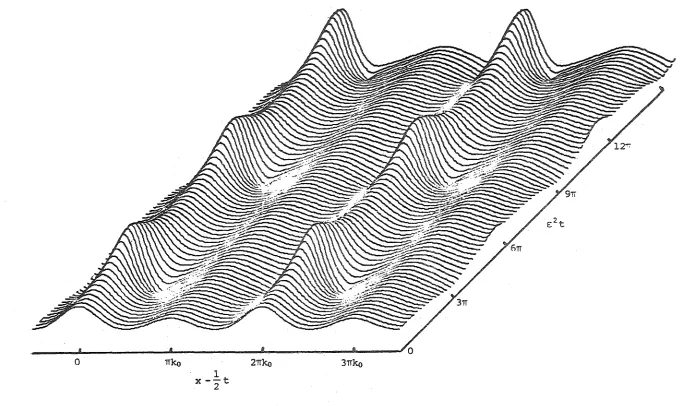
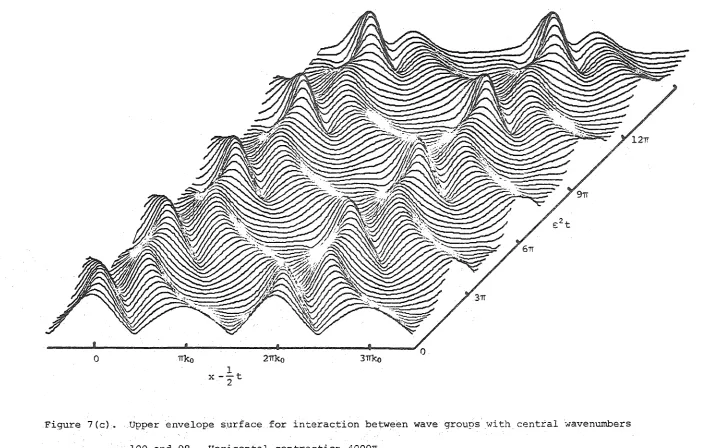
wnvetraina may bn di.AcN··ned i.n tho upper envelope t:Ut f<we j n fiq11rfl 7 (<.:).
The fanter nonlinear wave groups with central waw•nnmhet· 100 h<tve ine.lrl
paths parallel to the c2t-:axis, indicating that they are propagating
with the velocity
~of
undisturbed nonlinear wave groups at this centralwavenumber. The slower nonlinear wave groups with central wavenumber
98
have mean paths across the figure, with an exchange of roles occurring
between envelope crests as the two set.s of crests intersect. This figure
bears a striking resemblance to that describing the interaction of two
wavetrains in shallow water ([ 14], figure 4), even though the present
figure describes envelopes on deep water and the previous figure
described waves on shallow water. The immediate reason for the
resemblance is the similarity between the soliton properties of the
cubic Schrodinge:r:; equation and the soliton properties of the Korteweg
and de Vries equation. A unified approach to the complete spectrum of
nonlinear water waves·. may find deeper reasons for this resemblance~·
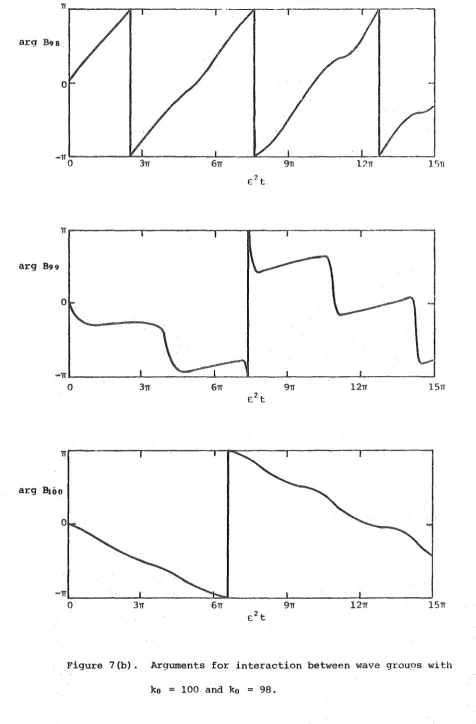
The moduli and arguments of B9s ,·B99, and Btoo are sketched in
·figures 7 (a), 7 (b) respectively, where it can be seen that the apparent
periodicity of figure 7(c) is not consistent with a closer scrutiny of
the wave modes at the centre of the interaction. The reasons for the
·loss of periodicity in this example, compared with the good periodicity
25.
8. Discussi.on
The analyaiR hr•ro hilS bc:wn reatr.ir.tc<l t:o w.:wo AI rut:t;uro~l (:nmpoBNt
of wave modes in a narrow waveband, for which tertiary interactions
between the wave modes are significant. Permanent wave structures of
this type were found to be linearly unstable, but to be stable in a
wider sense in that they exhibited a periodicity or cyclic recurrence
over longer times. These properties have been demonstrated also for
a modulated Stokes wavetrain [9], because the modulat~d wavetrain was
found experimentally to evolve into a 'pulse train' of the type
investigated here. An attempt will be made now to apply the methods
of the present investigation to modulated Stokes wavetrains, for which
the narrow waveband assumption does not apply initially; although the
cited experiments suggest that it may apply at later times. Stokes
waves are linearly unstable to sideband modulations in the same directit.
as the wavetrain on deep water, but are linearly stable to the same
modulations on shallow water. It is intended therefore to investigate
.the cyclic r'ecurrence of nonlinear water waves for the whole range of
Heforcnccs
1. D.J. Benney and A.c. Newell, The propaqation of nonlinenr wave
envelopes,
J. Math. Phys.
46,
133-139 (1967).2. Bruce I. Cohen, Kenneth M. Watson, and Bruce J. West, Some
properties of deep water solitons,
Phys. Flu-ids.
19, 345-354(1976).
3. V.E. Zakharov, Stability of periodic waves of finite amplitude on
the surface of a deep fluid,
J. Appl. Meoh. and Teah. Phys.
2 ~190-194 (1968).
4. Vincent H. Chu and Chiang
c.
Mei,, The nonlinear evolution ofStoke~ waves in deep water,
J. Fluid Meoh. 41,
337-351 (1971).5. Hideno:d Hasimoto and Hiroaki Ono, Nonlinear modu1a tion of gravity
waves,
J. Phys. Soe. Japan
33,
805-811 (1972).6. A. Davey, The propagation of a weak nonlinear wave,
J. Fluid Mech.
63,
769-781 (1972) •. 7. G.B. Whitham,
Linear and Nonlinear Waves,
Wiley, 1974.·a.
Henryc.
Yuen and Bruce M. Lake, Nonlinear deep water waves:Theory and experiment,
Phys. Fluids.
18, 956-960 (1975).9. Bruce M. I.pke, Henry
c.
Yuen, Harald Rungaldier and Warren E. Ferguson,Nonlinear deep water waves: Theory and experiment. Part 2. Evolution
of a continuous wave train,
J. Fluid Mech.
83,
49-74 (1977).10. G. Roskes, Comments on "Nonlinear deep water waves: Theory and
27.
11. T. Brooke Benjamin and J.E. Feir, The disintegration of wavetrains
on de~p water. Pa.rt l . Theory,
.r.
F'Luid Mec•h. 27; 417-430 (1967).12. P.J. Bryant, Stability of periodic waves in shallow water,
J.
Fluid
Meah. 66,.81-96 (1974).13. L.M. Milne-Thomsori, Elliptic integrals,
Handbook of MathematiaaZ
Functions,
Chap 17, Ed Milton Abramowitz and Irene A. Stegun,oover, 1965.
14. P.J. Bryant, Periodic waves in shallow water, ,J. Fluid Mech.
·!i!J,
a
2fl.
0.4 ___ ,,.- .... . ·--1-· ... _ .. - -·
+
0.3
"\. 0.2 +
+
k
0.1
0 30
+ +
+.,
40
k
50
Figure l(a). Nave amplitudes when ko
=
40, c -· 1/40.Figure l(b). One group wavelength (horizontal contraction 64TI) when
ko "" 40, £
=
i/40.0.10 T I I
++
o.m~ f- +
+
+
+
0.06
1-+
...-+ +
.0~04 1- +
-+
+
0.()2 f-.
+
.._+
++
0 . .&..&.4+++++ I I
20 30 40 50 60
k
· l!'igure 2 (a) • · t•'ave amJ?li tudes when k0 = 40, £ = 1/10.
oll=o-.... moe...__ ... __ ... _...._..., ... ...,,...,._,_,_,..._-..a:~- M - - = rsm
~i~ure 2(b). One grouo wavelength (horizontal contraction 16TI)
23
ttl ~ .... 0 0 ~ 0 0 -0 0 0 0 0 0 0 0 .0 --0 0.
.
--.
.
.
.
--.
..
0.
.
.
tv tv N :-,) w w w....
N N ·IV ~.,) 0 N ;l)o. 0\ ;l)o. 0\ 00 0 0 lo.J....
C' 0 0 0 ~1-\\
-1
~~
/
1\,) ~~
=I ~ II
I'
II
\ I'
\
~ ~I
.
~;j~\
\
\
•
,z::,. ..J'
=II
I t
(T)
I
I
u
I
l
'
'
!
N (T)'
(T)I
rT I N'
,.,
I
rT'
rT'
I
~
~
I
I
-1
~~
"
'
0\I
I'
=I!
'
I !'
•
i'
I
1
I
30.
-0.11T
-0.21Tb---~--~---~---~·~· ---~---~
0 21T 41T 611 A1T 1o·rr
arg B100
-O.l1T
.:.;0. 21T
'---'---'---A---L---.;.__
__
_.J0 21T 41T 61T 81T l01T
arg B1 o 1 ·
:n.
-0.01
Fiqure 4(a). Plot of ~auation (S.R).
0.01
[image:32.595.51.525.70.769.2]12.
0.4 -~- .. T
0.3
I
8991
0.2
o.J
.
.-4
I __j_ ___ 0
0 5TI lOTI 15Tr 20TI 2511 .Q
t; 2 t
0
0.5 Cl
H ~
..
c 0 rl0.4 .II
0
~
I
Bt 00I
'H
0
.
00.3 w
~ (j) .c. ~ ,,.-~ r-1 ::J 'C 0.2
0 5TI lOTI 15TI 20TI 25il
£
E: ;> t
~
.0. 4 rU
L{) C.' )..I
g
·.-I ILl 0.31131 0 I
I
. o.
20 .l 1 . . - - - L - - - c L - - - ____ _l _ _ _ _ _ _ .J.___ _ _ _ _
31.
0 STI lOTI 15TI 20TI 25TI
arg BiQO
~TIL---L--~----~L-·---L----L---~---~
0 5TI lO'IT 15TI 201f 25'1[
arg B.1 o t
0
-TIL. ---~L---~---~--~L---L---~
0 5TI lOTI 15TI 20TI 25TI
Figure S(b). Arguments when £
=
0.01, koA
0 7Tko
1 x-2t
27Tko 37Tko
Fiqure 5(c). Uooer envelope surface when € = 0.01, ko
Horizontal contraction 40007T.
A
100, K 100, b = 0.1.
157T
...,
35.
0.6
....---.---..,---
..·--.---.0.4
ls991
0.2
.
0 0 .-1 II 0 -~ <!)
0 ~ Ul
0 31T 61T 9rr 121r 15TI
E2t
fi
·.-4
0.9 ~
Ul o. ::l' 0 N .tr> Q) :> Ill
0.6 .~ s:::
<!)
(!)'
Is.
ooI
:;; .jJ (J) .0 s::: 0
0.3 .•.-4
.jJ u Ill 1-1 (J) .jJ s::: ·.-4 1-1 0 ~
0 31T 61T 9n 1211 . 151T 'H .-l
f:2t '::l '0
0.6 .9 ,;;,
~
ro 1.0
Q) 1-1
0.4
&
·.-4
~
IBtol
I
0.2
36.
n---,
r
-larg B991
.I
0 31T 6TI 91T l2'1T
-TIL---L---~L---~~---~b---~
·a
3'1T 61T 9TI l21T l57r-nL---~~---~---J---J-~---~~
0. 31T 61T 9TI 12'1T 15'1T
Figure 6(b). Arguments for interaction between wave groups with
[image:37.595.35.472.72.727.2]0 ifko
1 x - - t
2
21fko 31fko
Figure 6(c). Upper envelope surface for interaction between wave grouPs with same ko
=
100 [image:38.842.74.754.78.484.2]3H.
O.Gr---~---~---,---~---l
89flI
OJ.
01 0 .!<! '\.1 ~ <0 c c r-i
q
00 3'1T 61T 91T l2'1T lSTI ~
f.:2t .c.
+l
·rl
0;.6 ~
Ul p. ;::1 0 I>; tJ (!; ~ 10
0.4 :;:
~
<I) <I)
~
+l
18991
<I)
.Q
r::
0
o.·2 ·rl +'
0 ro H .I)) +l c ·rl H 0 4-l 0 ·rl
0 3'1T 6'1T £2t 9'1T 12TI l5'TT r-1
;::1
'd
0
0.6 ~
ro ~ !'-<I) ·H ;::1
0.4 b
'•.-1
j:L,
18100
I
0.2
arg B9s.
arg B99
0
-n~---~---~---L---L---~---~
0 3n 6n 9n 12TI l5'1T
n
arg .Btoo ·
-TI~---._---~~~---L---~---J 0 3TI 6TI 9TI 12TI 15TI
Figure 7(b). Arguments for interaction between wave grouos with
[image:40.595.36.513.99.824.2]Figure 7(c).
1
x - - t
2
Upper envel ope surfa ·. . ce for .
[image:41.842.55.757.72.520.2]PREVIOUS Ml\TIIEMJ\'riCJ\ I, RESP.l\RCH REPORTS
1. (November 1976) BRYANT, P.J. (Reprinted March 1978) Permanent wave structures on an open two layer fluid.
2. (December 1976) WEIR, G.J.
Conformal Killing tensors in reducible spaces.
3. (January 1977) WEIR, G.J. & KERR, R.P.
Diverging type~o metrics.
4. (February 1977) KERR, R.P. & WILSON, W.B.
Singularities in the Kerr-Schild metrics.
5. (May 1977) PETERSEN, G.M.
Algebras for matrix limitation.
6. (August 1977) GRAY, A.G.
Topological methods in second order arithmetic.
7. (September 1977} WAYLEN, P.C.
Green functions in the early universe.
8. (November 1977) BEATSON, R.K.
The asymptotic cost of Lagrange interpolatory side conditions.in the space C(T).
9. (November 1977) BEATSON, R.K.
The degree of monotone approximation.
10. (November 1977) BREACH, D.R.
On the non-existence of 5-(24,12,6) and 4-(23,11,6) designs.
11. (February 1978) BRYANT P.J.
&
LAING A.K.Permanent wave structures and resonant triads in a layered fluid.
12. (August 1978) BALL, R.D.