A thesis
submitted in partial fulfilment
of the requirements for the Degree
of
Master of Science in Computer Science
in the
University of Canterbury
by
C.R. Power
CHAPTER ABSTRACT
1. INTRODUCTION
2. REVIEW OF THE LITERATURE
3.
2.1 Background
2.2 Studies of effectiveness 2.3 User satisfaction
2.4 Summary METHODOLOGY
3.1 The behavioural model . 3.2 The questionnaire survey 3.3 Analysis of survey data 3.4 User interviews
3.5 Guide to use of the tool 4. RESULTS
4.1 Review of survey data . 4.2 The effectiveness measures 4.3 The interviews
4.4 Summary of results 5. CONCLUSIONS
ACKNOWLEDGEMENTS REFERENCES
APPENDICES
A Questionnaire B Questionnaire
used used
in the in the
1978 1980
c
A description of the computing D Factor pattern matrices. . .
PAGE 1 2 6 6 14 24 30
. .
. .
31 32 41 50 62 66 68 69 102 123 140 145 147 148survey 152
survey
.
163seryices under study 176
TABLE 1. 2.
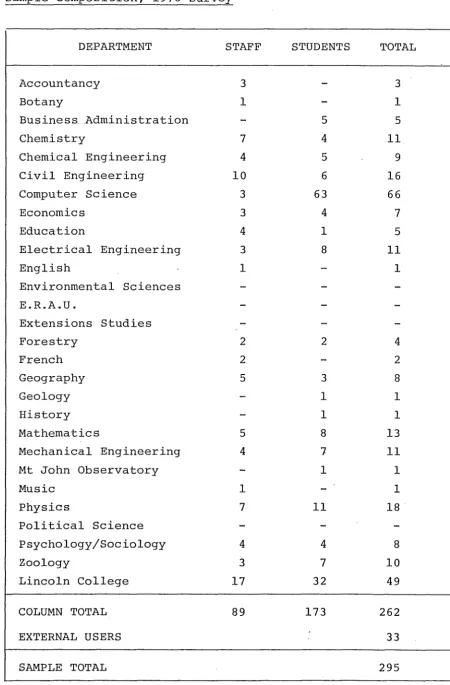
Structure of the factors exposed by McKaskill Sample composition, 1978 survey
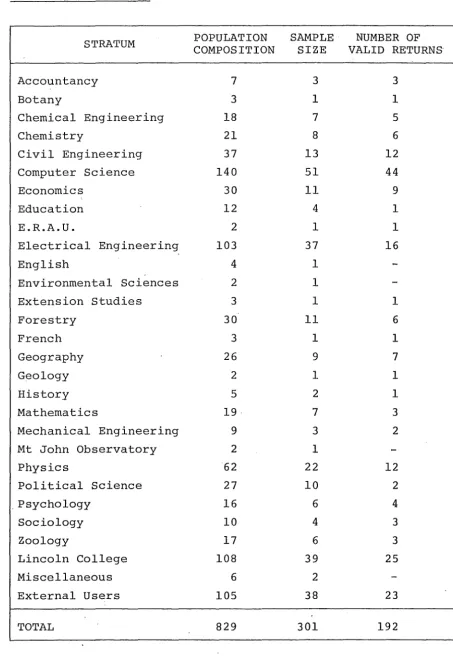
3. Population and sample composition and number of returns
4. 5. 6. 7. 8. 9. 10. 11. 12. 13. 14. 15. 16. 17. 18.
by strata, 1980 survey
Example Chi-square goodness-of-fit test 1978 survey response
1980 survey response
Response rates by major department, 1980 survey Major work type by status, 1978 survey . . Major application by status, 1980 survey . Major application'by discipline, 1980 survey . Skills by major application, 1980 survey . Skills by discipline, 1980 survey
Major language used Mode of interaction
Mode by major work type, 1978 survey . Mode by major application, 1980 survey
Satisfaction questions answered, 1978 survey Media used, 1980 survey
PAGE 29 48 49 53 70 70 72 74 74 74 78 78 80 80 82 82 84 84
19. CANOE use by discipline, 1980 survey 84
20. Use by status, 1978 survey . 87
21. Use by status, 1980 survey . 87
22. Expenditure by discipline, 1980 survey . 87
28. Structure of the batch factors, 1978 survey
.
. .
. . . .
10329. 1978 batch factor scores by status
.
.
.
. .
.
.
.
10630. 1978 batch factor scores by major work type
. .
.
.
.
. .
10631. Structure of the CANDE factors, 1978 survey
.
. . .
. . .
10932. Structure of the batch factors, 1980 survey
. .
. . .
11333. 1980 batch factor scores by status
.
. . .
. .
. . .
.
. .
11534. 1980 batch factor scores by discipline
.
.
. . . . .
11535. Structure of the CANDE factors, 1980 survey
. . .
. .
. .
11836. Factor pattern matrix, 1978 batch analysis
.
.
. . .
. . .
18237. Factor pattern matrix, 1978 CANDE analysis
. .
. . . .
. .
18238. Factor pattern matrix, 1980 batch analysis
. . . .
. . .
.
183FIGURE 1. 2.
Variables determining the user's response Summary of the factors under study
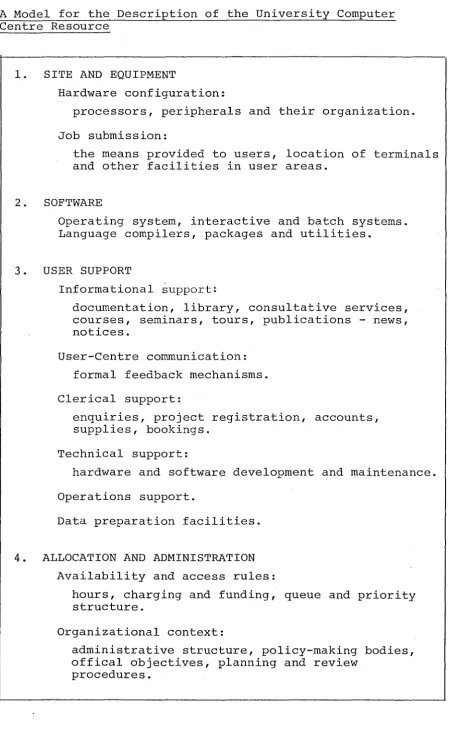
3. A model for the description of the university computer
4.
5. 6.
7.
centre resource
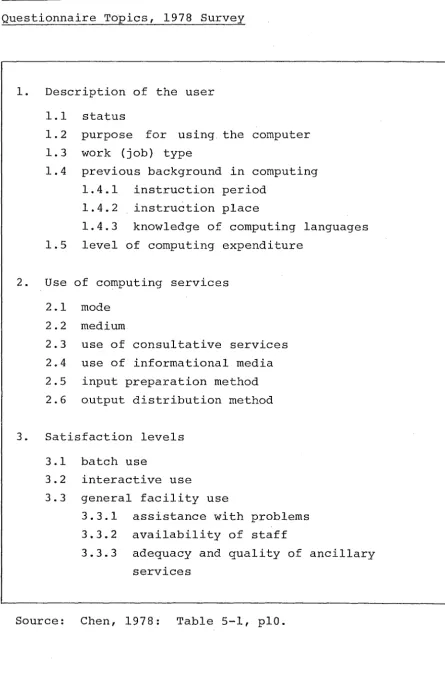
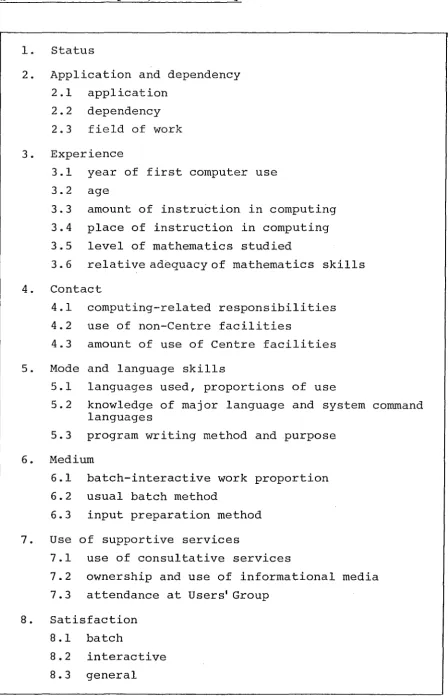
Questionnaire topics, 1978 survey Questionnaire topics, 1980 survey Interview schedule, 1980
Summary of the investigative process
PAGE 9
32
35
43
45 65
ABSTRACT
This thesis reports research that was carried out to develop a management tool for measuring the effectiveness of computing services.· Effectiveness was considered in terms of the degree to which services met users' needs, and measured by the degree of satisfaction expressed by users concerning those services.
The tool which was developed comprised a questionnaire survey of the user population, the construction and analysis of a data base of
responses, interviews with users, and acquisition of knowledge of the local computing environment.
Adequate development of the tool was achieved by carrying out two investigations of the services provided by the University of Canterbury Computer Centre. The major factors underlying the users' satisfaction responses were exposed, and their overall levels of satisfaction with these factors were used to measure the effectiveness of the service. The influence of various user and use characteristics on satisfaction was then examined. Both investigations revealed the importance of the human face of the service. Effectiveness was seen to depend on the provision of a technically adequate, yet convenient and friendly service.
INTRODUCTION
The development of computer technology is at a stage where the discipline is still emerging and the technical possibilities are being explored by computer professionals. At the same time, the new technology is being employed in a wide range of applications by users who are not computer professionals.
It has been a common observation of such applications that wider use and acceptance of computers depends not only on the development of greater computing power, but also on the delivery of that potential in useful and effective ways. Since the technology is being used to assist complex human activity, many factors affect its usefulness. At the present time, the success of these applications depends on an under-standing of the role of these factors in the use of computing.
This research deals with the provision of computing services by the computer centres of universities and similar institutions. Generally, these computer centres handle the majority of the academic and
administrative workloads, and provide both a technical capacity and support services. The adequacy of these services is judged by users on an individual basis. The user will evaluate and base future expectations on how well the computer performs for him, and how well his needs, as perceived by him, are being met. On the other hand, a computer centre, while being responsive to the needs of its users, is bound by its
internal structure and organizational context, and must operate within financial and technical constraints. The term
effectiveness
is loosely associated with the degree of success of such an operation.could be used by computer centre management to measure this. Thus we were concerned with the nature of the interaction that exists between the users and the services. The wider issue of evaluating the social. effectiveness of the use of computers was not tackled here.
The problem of assessing effectiveness was dealt with by adopting the user satisfaction approach, and drawing from previous work, particu-larly that of McKaskill (1978), that has used i t in other computing environments. The essence of this approach was that effectiveness was defined as the extent to which the users' computing needs were met. This, in turn, was measured by the degree of satisfaction expressed by the users.
Integral to the investigation of effectiveness, considered in these terms, was the testing of hypotheses concerning the influence of the following factors on user satisfaction:
(a) User characteristics - personal and situational factors such as status, work type, skills and experience.
(b) Use characteristics - mode, medium, use of the system and support services.
The study of these factors required the application of established social science methods with existing knowledge of man-computer interaction. The tool which was developed comprised a questionnaire survey,
construction and statistical analysis of a data base of questionnaire responses, interviews with users, and acquisition of knowledge of the local computing environment.
a pilot study, then collected data from 187 users and subjected these data to preliminary statistical analysis. This work showed that meaning-ful associations could be identified between user satisfaction and
characteristics of the user and usage.
The first task of the current project was to carry out further statistical analysis of the Chen data base. A number of components underlying user satisfaction were identified, and then explanations were sought for the variations in the levels of satisfaction expressed by users. From the range of user characteristics that had been surveyed, a number were found to be significantly associated with the user
satisfaction components.
In order to confirm these results and to identify other factors that might affect user satisfaction, twenty volunteer users were selected on the basis of the patterns of their questionnaire responses and
interviewed. This process provided practical explanations of why these users felt the way they did about the service.
On the basis of this feedback, the original questionnaire was
redesigned and the second investigation was carried out in 1980. Survey data were collected from 192 users, and 22 were interviewed. Data
analysis possibilities were explored more fully than had been done with the data from the first investigation, and development of a suitable analysis technique was completed.
Two papers summarising the methodology and results were published during 1981 (Good, Power and Chen, 1981a; 1981b). The tool was used to study the effectiveness of computing services provided by the Computer Centre of the University of Otago. This work was carried out by
Chrystine Burnside as a project towards her B.Sc .. Honours course at the University of Canterbury (Burnside, 1981).
Chapter Two contains a review of the literature on man-computer interaction, studies of effectiveness, and the measurement of user satisfaction.
In Chapter Three, methodology of the management tool is given. This covers the behavioural model upon which this research is based, the means used to measure effectiveness, and the major components of the tool.
The results of the two investigations that were carried out at Canterbury are descriped and compared in Chapter Four.
CHAPTER TWO
REVIEW OF THE LITERATURE
2.1 BACKGROUND
The use ofcomputers in our society has been established and is
becoming wide-spread.
The development of computer technology appears to
be following a pattern which Firnberg (1973) suggests is true of all
emerging technologies:
Stage 1
Specialised usage by a few experts, while the new
technology generally encounters resistance and
disbelief.
Stage 2
The "horseless carriage" phase in which the new
technology is used to replace previous technologies
at the same tasks.
Stage 3
A new language and discipline emerge which permit
the use of the technology in new ways for new
purposes.
Stage 4
The wider implications of the use of the technology
are understood and it becomes a tool for
non-specialist users.
Stage 5
The technology is fully developed, and its use is
routine and integrated into society.
Firnberg's own work concerned the use of information systems as a
management tool.
He saw the common use of computer technology to be
somewhere between stages 2 and 3 at the time of writing.
With the continuing development of computer.technology, particularly
as it approaches the fourth stage identified by Firnberg, there has been
a growth of interest in the more human-oriented issues.
Early work
concerned the widening range of applications of computer systems and
the rapid technological development that allowed this.
Effort was
directed toward the development of interactive terminal devices,
"more natural" programming languages, and computer-based
problem-solving techniques.
The comparison of time-sharing versus batch
proces-sing has been studied extensively (Gold, 1969; Hansen, 1976; Sackman,
1970; Smith, 1967).
In these and other studies, the typical approach taken was to
measure.various levels ofuserperformance under experimental conditions.
The importance of the role of human factors was recognised, but there was
a considerable lack in the methods for studying human behaviour.
Sackman
described the situation thus:
" •.. narrow technical considerations and immediate cost
constraints dominated computer technology, in large part
at the expense of human ease, convenience and social
effectiveness; computer system professionals were not
equipped or trained to measure and test human performance
in computer-aided systems." (op.cit., p14)
Recent work of interest has involved non-experimental studies of
users in their organizational context.
Since the majority of studies
have dealt with users in specialised environments, and the range of
interaction involved depends on the specific environment, we shall
introduce three categories of use, and .some of the research that has
been done in these areas.
2.1.1 Professional Programmers
users in the first category, whom we shall call "professional
programmers", write computer programs essentially for other people.
These programmers typically work in software houses, in DP departments
of large organizations, and in consultative organizations.
These users
have been the subject of investigation by, for instance, Weinberg (1971).
In his highly anecdotal book, he advpcates the "egoless programming"
individual programmer's effectiveness is maximised.
An alternative
approach, using the "chief programming team", has been advocated by
Mills (1973).
The results of some studies of professional programmers
have been reviewed by Boswell (1981) .
A view of "the typical
programmer" emerged that has implications for the management of
programmers and for the clients of the data processing profession.
For instance, programmers were found to have low social responsibility
and a low need for social interaction.
2.1.2 Naive Users
In the second category of users are the clerical and managerial
staff for whom programs are written and information services provided.
These persons were dubbed "naive users" by Eason et
al. (1974) in their
study of the users of
comme{~c~l
systems.
Clerical users are typically
involved in routine procedures to prepare and enter data, and to handle
output in standard clerical tasks, such as record-keeping, accounting
and invoicing, for which the computer fills a data processing function.
Managerial users are characterised by their use of the computer as a
source of information for decision making.
They are the end-users of
computer-based management information systems and exercise far more
discretion in their use of the computer than clerical users do.
The study of Eason et
al. included both naive users and amateur
programmers (discussed subsequently) •
A general behavioural model
was developed to describe the influences on these users' responses to
the system.
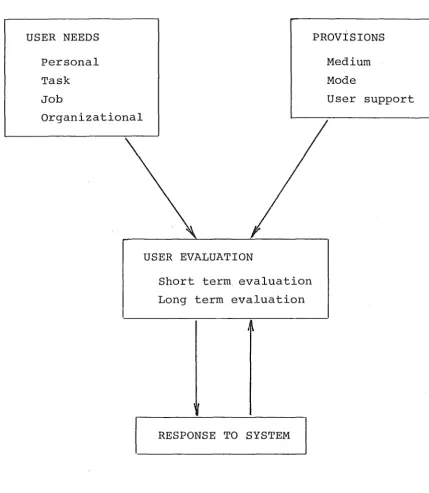
This model is presented in summary form in Figure 1.
The model shows that a wide range of factors were considered to
influence use of a computer system.
These factors were classified as
either user needs or the provisions made by the system to meet those
needs.
Eason et
al. described several sources of the needs felt by
the user:
the tasks for which the computer is used, the user's job,
Figure 1
Variables Determining the User's Response
USER NEEDS
Personal
Task
Job
Organizational
USER EVALUATION
Short term. evaluation
Long term evaluation
RESPONSE TO SYSTEM
PROVISIONS
Medium
Mode
User support
[image:14.600.73.503.134.628.2]range of personal needs, such as ergonomic considerations and
psychological differences, were considered to influence use of a
computer system.
The range of services studied by Eason et al. allowed the user
a great many possible forms of interaction.
The services and hence the
forms of interaction were categorized according to the characteristics
medium, mode and user support.
Medium referred to the means of
communication between the user and the computer system; i.e. whether
this was direct, via interactive terminals, or indirect using batch
processing via card decks and printout.
Mode concerned the software
facilities employed by the user for his task.
User support, comprising
documentary support and human support, concerned the source of
information and assistance made available to the user.
In the course of using the computing service, and in order to
determine his response, the user will make evaluations of two kinds,
according to the model.
The first is a series of specific short term
assessments, for example on matters of suitability and strategy.
A
user makes such assessments only if there is not already an acceptable
pattern of behaviour for carrying out his/her task.
The second kind
is a long term evaluation of the impact on the user's work, satisfaction,
etc.
This evaluation involves the steady accumulation over time of
information from the user's experiences, and the user's assessment of
indirect consequences of use of the computer.
One source of material
for attitude information is the attitude of other users.
Eason et al.
suggest that these general attitudes provide the frame of reference
within which the individual approaches the system.
The model was tested by way of a questionnaire survey of the users
of 26 commercial systems in the United Kingdom.
Four indices (task fit,
ease of use, user support, and indirect consequences) were constructed
of interaction were identified by the survey; furthermore, the response of
different types of users and their differing requirements were assessed.
2.1.3 Amateur Programmers
The present study considers computer users who form the general
user population of computer centres at universities and other educational,
scientific and engineering organizations.
These users are specialists
in some technical or academic field.
Although these specialists,
together with clerical and managerial users, were referred to as
"naive users" by Eason
et al., we reserve use of that term to the latter
two groups, and refer to specialists as "amateur programmers".
Amateur programmers come from a wide range of disciplines, yet
they differ significantly from users in the professional programmer and
naive user categories.
Characteristically, amateur programmers write
programs for their own use, being both producer and consumer.
Their
use of the computer is seen as a means to an end, whether that be
analysis of experimental data, an increased knowledge of computing
itself, or another of the great number of current applications.
Amateur programmers' patterns of utilization of computing resources
have been studied in order to understand the nature of the work load
that they generate (Hunt
et al., 1971; Haralambopoulos and Nagy, 1977).
Experimental studies have been conducted with undergraduate users to
determine learning rates (Jutila and Baram, 1971) and for comparisons
of performance under time-sharing and batch processing conditions
(Sackman, 1970).
Guidelines have been presented for the effective use of computers
in higher education, and for measuring needs and resources for
instructional computing (Mosmann, 1973; 1977).
Co-ordination of
state-wide computing systems has also been aiscussed (Mosmann, 1974).
(Gross, 1968) and university computing has been viewed as a political
process (Wiste, 1976).
The use of officiaL advisory services has been studied in detail by
Alty and Coombs (1978; 1980).
Their papers report surveys of the use,.
organization, and user perceptions of advisory services in four
university computer centres in the United Kingdom.
They found that
the advisory services were highly valued as an instant source of
guidance and correct and pertinent information.
On the other hand,
users claimed that they did not always understand the advice given.
Such misunderstanding was found to be mediated by
expertis~,~ndexpert
users were found to be much more satisfied with the service than inexpert
users.
In another paper (Coombs and Alty, 1980), they reported direct
investigations of the interactions between users and advisors.
The
authors carne to the following conclusions about the nature and
function of the advisory service:
"(a)
the advisory service is a problem solving
institution; it works well for both expert and
inexpert users at the problem solving level;
(b)
there is room for far greater flexibility in
advisory response, particularly for the inexpert
user;
{c)
there is a need to train advisors to recognize
deficiencies in user knowledge and to supply
appropriate and succinct explanations;
(d)
there is a need to raise the status of the
advisory function."
(Coombs and Alty, 1980, p428)
The study report of Eason
et al.(1974) provides much information
about the use of computers by amateur programmers in the commercial
environment.
Amateur programmers were found to be using computers to
produce detailed and sophisticated solutions to complex problems, many
of which could not have been tackled by manual methods.
Some used the
computer only indirectly, engaging professional programmers to carry out
their computing tasks.
The type of close contact required for this
specialist and the computing department were both organizationally
and physically remote.
Most amateur programmers were required to develop considerable
computing expertise, and this had a large impact on their jobs. Many
were found to become increasingly reluctant to change a particular
computer-based solution once it had been developed.
They preferred
instead to modify the problem, and there was a tendency towards tackling
only problems for which ready-made tools were available.
Some
specialists became highly skilled at programming and worked, in part,
either by themselves or in conjunction with professional programmers
to produce sophisticated packages that could be used by other
specialists.
In general, specialists were found to be more highly involved with
the computer than managerial staff, and more aware of computing and
able to exercise more discretion in their use of computing than
managerial or clerical users.
It was concluded that:
"Specialists require complex software and suites of
programs which they can tailor to their needs without
being diverted from their main task.
They may be
prepared to learn programming and complex operating
procedures but will probably only spend a small
proportion of their time actually using the system."
2.2 STUDIES OF EFFECTIVENESS
we have shown that amateur programmers use computers in sophisticated
and complex ways.
When considering the provision of computing services
for these users, Mosmann (1973, p64) claimed that an effective computing
organization should provide the means for reaching the following complex
and sometimes conflicting objectives:
(a)
Satisfaction of the users' real needs
(b)
User recognition of value and scarcity in computing
(c)
Supplier efficiency
(d)
Encouragement of useful growth
(e)
Control of stability and protection of the user
(f)
Encouragement of 'careful and skillful management
(g)
Evolution of goals and policy
(h)
Provision of a focus for responsibility and authority.
The need to evaluate the effectiveness of a computer centre stems
from the complexity of these objectives; so also does the difficulty of
measuring effectiveness.
From the body of literature relating to the measurement of the
effectiveness of organizations in general, it appears that effectiveness
has been used as a label for a number of related concepts, and that it
has been studied from many viewpoints.
We now review the known
approaches to measuring the effectiveness of organizations providing
computing services.
2.2.1 Formal Review
A formal review of operations and practices has been used by the
management of computer centres in universities as a means of improving
service effectiveness.
The computing service audit procedure that was
adopted by the Inter University Committee on Computing in the United
later adapted by Williams (1979) for use in the United States by the
Special Interest Group on University Computing Centers; (SIGUCC is a
member organization of the Association for Computing Machinery).
The IUCC computing service audit procedure and the SIGUCC peer
review procedure are fundamentally similar.
A small team of experienced
computer professionals is selected from outside the institution under
review.
They are given access to information and are free to interview
staff.
They are required to present a written report on the review to
the director of the computer centre; further circulation of the report is
at the discretion of the director.
Some discussion on the use of this approach is provided by Wells
(1974) and Law (1974).
Robinson (1980) describes the integration of
the peer review approach into the computer centre's planning process.
These three publications attest the benefits of the approach:
a rapid,
comprehensive review providing both formal and informal criticism,
and suggestions for improvements.
A different kind of review has recently been undertaken in New
Zealand by an investigative team established by the Audit Office.
Their objective was:
"To report to Parliament on the current level of use
of computers within the public sector and the extent
to which management is efficiently using and properly
controlling these and related sources."
(Shailes,
1980, p76)
The team surveyed 521 organizations in order to determine the extent and
cost of computing and the applications and staffing of installations
in the public sector.
In addition, they interviewed staff at 100
organizations and undertook a formal review of the management of 38
of thelargerinstallations.
An evaluation table.was developed to provide
a consistent means of assessment; installations were rated according to
the standards of each of the desirable management practices listed in
Using these methods, the team identified a large number of common
problem areas and made many strong recommendations aimed to improve the
existing systems.
Their final report
(op. cit.) also included a set of
guidelines for the management of computers and the evaluation table as
a checklist for managers.
It isclear that-the specific evaluation and recommendations for
each installation could be of considerable benefit if communicated to the
management concerned.
It is not explicit in the report that this was
done.
2.2.2 User Perfomance
The effectiveness of computing services has been considered in
terms of the performance of users with respect to personal or
organiza-tional goals.
Lucas (1975) studied the use of an information system by sales
personnel, and attempted to trace the contribution it made to
organizational performance.
He developed a descriptive model of the
relationships between use of the system, performance, decision style,
attitudes, system quality, and situational and personal factors.
The
model was tested by the collection and analysis of questionnaire data
and existing records.
Performance was measured by the financial value
of sales attributed to each sales person over a one year period.
The results of this study showed only weak associations between
performance and use of the information system.
However, several
personal, situational and decision style variables were found to
affect the use of information systems.
Furthermore, the findings
suggested the existence of multiple roles for an information system.
Lucas argued the case fbr greater flexibility in the design of
information systems, so that these human factors could be better catered
The use of financial return as a measure of performance appears
most suitable in the situation studied by Lucas:
maximum return is a
highly important goal for individual users of the information system
and the organization.
However, this measure of performance does not
reflect non-financial or long-term benefits.
In discussion on the use and evaluation of information systems,
McKaskill (1978) suggested that the information produced has potential
meaning only in the decision making process, and that its effectiveness
should be evaluated in this context.
He observed that the use of
computer output and other sources of information in this process is
highly complex, and in fact the decision maker may not even be able to
describe how he arrives at his decision.
It did not seem possible to
attribute the benefit gained by use of the information system to the use
of particular output or services.
He concluded that the use of this
approach to measure the effectiveness of an information system was a
near impossible task.
2.2.3 Achievement of Organizational Goals
In this approach, effectiveness is defined in terms of the degree to
which an organization realizes its goals (Etzioni, 1964).
In order to
measure the effectiveness of an organization, its goals must be
identified, and its achievement of those goals must be measured.
Major criticism of this approach centres on the problem of goal
identification.
Offical goals have been distinguished from operative
goals by Perrow (1961), and there are two corresponding approaches to
the problem.
The prescribed goal approach is characterized by the study
of official goals, whereas in the derived goal approach, the intentions
and activities of the major decision makers are examined and in this
way the operative or actual goals are derived.
The latter approach has
university computer centres (Varanelli, 1978).
In the study reported by Varanelli, four measures were constructed
for evaluating effectiveness.
Two measures were based on the perceptions
of the user of how well their
compute~centre was achieving certain goals,
and the other two measures were based on centre performance
character-istics provided by the chief administrator of the computer centre.
The relationship between the "perceived" and "operational" measures was
explored, and these measures were used for a comparative study of the
computer centres of ten universities in the United States.
Varanelli did not report the exact procedure that was used to
identify computer centre goals.
He provided only a general procedure
based on. the guides for the goal approach listed by Price (1972a).
Neither did he report the organizational goals that were identified;
hence it is not possible to see what goal achievement was measured.
The method used by Varanelli to measure goal achievement stemmed
from the study of community general hospitals by Georgopoulos and Mann
(1962).
In this study, a number of determinants of hospital
effective-ness were measured by asking hospital staff to rate the quality of
patient care provided.
The data were collected from hospital staff
since they were considered generally competent to .evaluate the adequacy
of patient care.
By contrast, an approach based on patient satisfaction
was dismissyd because patients were considered unable to provide an
acceptable evaluation (because of their medical and psychological
condition and lack of medical knowledge).
Also, the goals and
expectations of patients and those providing the care were often at
variance, and the researchers• interest was in the provision of "good"
care, and not necessarily in the provision of patient-satisfactory care.
It was suggested by Price (1972b) that the non-comparative measure
of patient care developed by Georgopoulos and Mann could be adapted for
by Varane1li differed in one respect:
the organization's achievement of
its goals was assessed by individuals (users) outside this organization
(the computer centre) and not by those within it (centre staff). This
departure from the original method has an unfortunate consequence:
certain goals that could be identified by the researcher as organizational
goals may not be shared by the outside individuals and it may be
unrealistic to expect a valid assessment from them.
Varanelli states (but does not demonstrate) that the technique is
able to highlight areas of poor computer centre performance.
Similarly,
it is claimed that the derived goal approach provides a means for
measuring effectiveness in many situations where users are vying for
the use of scarce recourses.
However, it is not clear how Varanelli's
method takes account of their varying computing needs and possibly
different goals.
2.2.4 User Satisfaction
With this approach, effectiveness is considered in terms of the
degree of satisfaction expressed by users concerning the computing
products and services that they use.
User satisfaction has been used to
measure effectiveness by Powers and Dickson (1973), McKaskill (1978) and
van der Hart (1979) among others.
Powers and Dickson studied the effectiveness of management
information system projects.
Four criteria of project success were
selected:
completion time, financial cost, user satisfaction and
impact of the project.
The user satisfaction component was described
as the attitude of user managers relative to how well their information
needs were being satisfied.
The relationships between these measures of project success and
possible predictive factors were tested using a simple bivariate
describe in detail how they measured user satisfaction.
The study by McKaskill (1978) concerned user satisfaction with the
total information system or data processing operation.
A total of 138
managers of functional departments in 21 manufacturing companies were
questionned concerning their use of their companies• data processing
services.
Follow-up interviews were held with 48 of the user managers
and the data processing manager of each installation.
McKaskill proposed a model of the factors expected to influence
system effectiveness, and these were categorized as organizational
context factors, systems context factors, management choice factors
and personal factors.
User managers were asked to rate the level of
benefits achieved through use of the system, the level of information
support for decision making, their level of satisfaction with specific
operations, and their attitudes to various aspects of computer systems.
A multiple-question approach was used tosurveyeach of these areas,
and a mathematical procedure was used to detect underlying user
satisfaction components.
Four such components or factors were identified
and subsequently used as measures of user satisfaction.
In decreasing
order of importance these were:
(a)
INTERACTION, the quality of the immediate interaction
between users and data processing staff.
(b)
SUPPORT, the short term operational and decision making
support received by the users.
(c)
IMPACT, the perceived level of benefits received by
the organization from its computer investment.
(d)
DESIGN, the quality of the systems work performed by
the data processing staff.
The relationships between these user satisfaction measures and the
factors expected to influence effectiveness were tested and some
users with the DESIGN factor was positively associated with the amount
of experience that the DP managers had in functional (or user)
departments.
By comparison, the amount of experience the DP manager
had in data processing was negatively associated with all four
satisfaction factors.
McKaskill reported that:
·"In the least effective companies it·was generally
found that poor communication existed between the two
areas and lack of functional knowledge and understanding
by the DP manager may be a fundamental cause of this."
(op.
cit.
p227)Follow-up interviews with users tended to explain and confirm the
results of the analysis.
The work by van der Hart
(1979)involved a marketing approach to
measuring the performance of a university computer centre.
Two
organizational objectives were identified for the centre under study:
a promotional function and an operational task.
Achievement of the
promotional function was not measured.
The centre's performance of its
operational task was measured by the calculation of a performance index
for each of
27service elements.
Index values were derived from user
satisfaction and importance ratings collected using a postal survey.
Index values for the
27service elements were compared and used to draw
attention to unsatisfactory services.
Cross-tabulations with user characteristics were performed to
identify groups of dissatisfied users.
The marketing approach
suggested that where the target group (the user population) could be
segmented according to their different needs, these market segments
could be treated separately.
Rough segmentation on the basis of user
involvement was made by categorizing users according to the number of
jobs they ran per year.
Very frequent users were considered to deserve
every attention, because they accounted for a large part of the work
load and were thought to act as channels for distribution and
Conclusions from this segmentation and the priorities indicated by the index values could be used in the formulation of an overall market-ing plan for the centre.
2:2.5
Summary and ConclusionsThe literature reveals a number of approaches that have been made to the formal study of the effectiveness of computing services, or of the organizational effectiveness of computer centres. We now summarize the fundamentals of these approaches and the conclusions reached
concerning their suitability for this research.
(a) Formal review: effectiveness is largely undefined; the
I
organization's activities are investigated by a team of outside experts. The review procedures use predominantly non-quantitative methods, and as such provide no firm basis for the comparison of the effectiveness of different computer centres, or of the same centre under changes of time and circumstance. Instead, they use a normative approach, relying on the experience andgood (but largely subjective) judgement of the investigators. However, the peer review procedure has been used successfully with university computer centres, and could possibly incorporate a quantitative measure of effectiveness.
(b) User performance: effectiveness is defined .in terms of the level of performance or benefit attributable to the use of the services, and measured according to some individual or organizational indication of success. The use of performance as a measure of effectiveness does not appear currently feasible, because of the lack of established and .widely-applicable performance measures.
(c) Achievement of organizational goals: measurement of effective-ness requires the identification of organizational goals, and the
insufficient details are supplied in the paper by Varanelli (1978) to
allow replication of the study.
There appear to be considerable
difficulties in the process of goal identification. and no firm basis for
using the assessments of outside individuals concerning the organization's
achievement of its goals to measure effectiveness.
(d)
User satisfaction:
effectiveness is defined by the degree of
satisfaction expressed by users concerning the services.
User
satisfaction has been employed by McKaskill. (1978) as a measure of
effectiveness for management information systems in the commercial
environment with interesting results.
This approach appears
suitable for a computer centre whose
raison d'~treis to meet the needs
2.3
USER SATISFACTION
The concept of satisfaction, particularly with reference to job
satisfaction, has been a major subject of study for psychologists.
There is general agreement that satisfaction is an attitude; an
individual's attitude toward something is characterised by the direction
(either positive or
negativ~and intensity of the feeling about it.
2.3.1 Measuring the Satisfaction of Computer Users
Research into the measurement of job satisfaction has provided some
guidance for the measurement of. computer user satisfaction. The principal
contribution of the study of job satisfaction conducted by Wanous and
Lawler (1972) was to affirm the validity of measuring a subject's
satisfaction with a number of facets of the same experience.
This multiple facet approach was used in the study of computer user
satisfaction by Pearson and Bailey (i9BO).
They defined user satisfaction
as:
" ... the sum of feelings or affective responses to
distinguishable factors of the computer-based
information products and services that are
provided within the organization."
(op. cit.p59)
The users under study were middle managers in commercial
organiza-tions.
A formal procedure was developed for identifying the factors
relevant to their use of computing services, and thirty-nine factors
were selected.
Users were asked to rate their feelings of satisfaction
by completing bipolar adjective scales for each factor.
For example,
concerning the format of output, they were asked to mark their responses
on scales constructed from the following adjective pairs:
good-bad,
simple-complex, readable-unreadable, useful-useless.
Four such
adjective pairs were provided per factor.
In addition, the pairs
satisfactory-unsatisfactory and important-unimportant were always
were assigned to the response categories.
Raw factor scores were
calculated as the average of the first four scores; the fifth score
was used as a direct measure of satisfaction, and the sixth as a
weight indicating importance.
These data were used to calculate two different total scores for
each individual.
The unweighted total was calculated as the sum of
the raw scores, whereas for the weighted total, the raw scores were
weighted according to the importance scores and then summed.
These
constructs correspond to the direct facet satisfaction measure and the
weighted direct facet satisfaction measure studied by Wanous and Lawler
(1972, Equations 1 and 2).
Weighted and unweighted total scores were
found to correspond very closely:
the Pearson product-moment correlation
coefficient for these two measures was 0.9968.
This extremely high
correlation indicated that the use of a weighting function did little
to increase the information conveyed by the less complex unweighted
score.
The importance that respondents attached to the factors was
found to be reflected in the intensity of their other responses.
This
result accords with the conclusion of Wanous and Lawler, that weighting
by importance is unnecessary
(op. cit. p104).
The arguments presented by Pearson and Bailey concerning the
reliability and validity of their construct are consequently based on
the unweighted scores.
One such argument reported the comparison of
raw factor scores (based on
th~first four scales) and direct factor
satisfaction scores (from the fifth scale) •
The correlation between
these two scores was calculated for each factor; these correlations
were generally very high:
they ranged from 0.75 to 0.97, with an
average value of 0.91.
This generally close correspondence was used
to affirm the predictive validity of the raw factor scores.
However,
this correspondence, and the use of the direct facet measure as the
indicate the suitability of the direct measure on its own for evaluating
satisfaction.
2.3.2
Satisfaction Data and Effectiveness Measurement
In the studies by McKaskill (1978) and van der Hart (1979), user
satisfaction data were collected for the purposes of evaluating the
effectiveness of organizations providing computing services.
These
studies were reviewed briefly in Section
2.2.4;however, they are of
further interest in the light of the work on satisfaction measurement
reviewed above, and becauseof.the ways in which the satisfaction data
were used.
Both studies employed the multiple facet approach and, for each
satisfaction topic, response categories labelled with adjectives.
McKaskill used three groups of questions regarding the satisfaction of
user managers with their information systems and data processing
departments.
Within each group of questions, response categories were
labelled and scored consistently.
Five-point scales were used to measure
both the direction (positive or negative) and intensity of the user's
feelings or attitudes toward each topic.
By contrast; there was some variation in the labelling of response
categories used by van der Hart. He was specifically interested in
dissatisfaction, and this was reflected in the categories and scoring.
For example, a question regarding waiting times employed the following
scale:
SATISFACTION
SYMBOL
ATTENTION
CATEGORY
SCORE
--Much too long
w
2-Rather long
w
1Acceptable
w
0Users were also asked to rate the importance of each service element
on a three point scale:
IMPORTANCE
SYMBOL
IMPORTANCE
C~TEGORY
SCORE
Very important
B
+
2Important
B
1-Slightly important
B
0
The users' satisfaction and importance data for each service element were
combined according to the following formula:
Index
=100 x (NB/N
+ 2
XNB+/N)
+
where NB, NB , NW
and NW
were the numbers of responses in the
corresponding categories, and N was the total number of respondents.
These performance indexes, devised by van der Hart, lack a
clearly-defined meaning.
Since index values were calculated from different
measurement scales, the validity of comparing them is doubtful.
The
use of importance data with suitably-constructed satisfaction
measurement scales has been shown to be unnecessary.
Although dissatisfaction data may be useful for certain purposes,
truncation of the satisfaction response scale has a major drawback:
it prohibits exploration of the dynamics of user satisfaction.
This
appears essential since satisfaction is being used to evaluate
effectiveness.
The collection of satisfaction data by McKaskill closely resembled
the direct facet satisfaction measure (Wanous and Lawley, 1972,
Equation 2).
However, factor analysis was used in an attempt to expose
underlying patterns in·the data.
This statistical method is commonly
used for its data reduction capability:
correlations between variables
extracted.
The influence of these factors on the observed variables
is expressed mathematically as a matrix of factor loadings; that is, a
loading for each factor on each variable.
The four major factors that were identified by McKaskill, and the·
variables most highly associated with them, are shown in Table 1.
McKaskill also used factor analysis to generate scores that indicated
an individual's satisfaction with each factor.
In this way the
theoretical constructs (the factors labelled Interaction, Support,
Impact and Design) were represented by four newly-created satisfaction
variables.
These new variables were used as measures of effectiveness.
McKaskill
we~ton to examine the influence on effectiveness of specific
management practices and other factors in the user-service interaction.
The four factors were found to describe different aspects of
effectiveness, and various predictor variables were found to be
Table 1
Structure of the factors exposed by McKaskill
FACTOR
ONE
TWO
THREE
FOUR
LABEL AND
DESCRIPTION
INTERACTION Quality of Interaction between users and DP staff
SUPPORT
Co-operativeness and willingness of DP staff
IMPACT
Impact of Computer Investment
DESIGN
Quality of the design system
COMPONENTS
Advised of delays on computer operations Quality of data
preparation work Advised of delays in data preparation Willingness of data preparation staff to
change arrangements Kept informed on changes
Interdepartmental relationships in joint activities Ease of contacting DP staff
Response to requests Willingness of DP to alter arrangements Operating Costs
Employee productivity Quality of customer service.
Production efficiency Quality of systems maintenance work
Opinion of how good the computer systems are Opinion on level of benefits received
SOURCE: McKaskill, 1978: Table 6.2, pll9
[image:34.598.72.522.85.777.2]2.4 SUMMARY
studies of man-computer interaction have generally considered users
in specific environments.
We have identified three broad categories of
users:
professional programmers, naive users and amateur programmers.
Our interest in effectiveness was to develop a concept suitable
for computer centres that provide services to amateur programmers, and
a means for measuring it. No adequate work of this nature appeared to
have been done before.
The concept of effectiveness chosen was the degree of satisfaction
which users express about the service.
Analysis of data concerning the
users, the services they use and their satisfaction with the differing
facets of the service, provided the means for measuring this concept
of effectiveness.
This did not measure effectiveness in terms of the
goals of the university or of society; neither was it a complete study
of the effectiveness of a computer centre in terms of Etzioni's
I
definition of effectiveness.
Many goals could be identified in the
formal charter of the organization and in the actions and intentions of
its members.
However, this informal one was chosen as being the most
important, likely to be widely accepted, and worthy of further research.
Techniques to analyse effectiveness in the information systems
context had been developed by McKaskill.
These were based on the
widely-accepted direct facet measure of satisfaction, but employed a
complex analysis in order to expose underlying satisfaction factors.
It appeared that this method could be developed for use with the amateur
programmers who use the computing services provided at universities and
similar institutions.
The behavioural model developed by Eason et
al. appeared suitable
for providing a framework for investigating the interaction between
amateur programmers and the computing services they use, and the
CHAPTER THREE
METHODOLOGY
The purpose of this research was to develop a management tool for measuring the effectiveness, in terms of user satisfaction, of a
computing service centre. The tool was to be economical and easy to use. A questionnaire survey was used to collect data about a large