Bachelor thesis
Industrial Engineering & Management
‘Improving the business processes at Laparkan Suriname’
ii Publication date:
December 2010 Author:
Lianne Schmidt (s0174955)
Student Industrial Engineering & Management A research for:
Laparkan Suriname Company supervisor: Dr. E. Audhoe
iii
Management Summary
This report is the result of a two-month research at the company Laparkan in Suriname. I did this research as a finishing report of my Bachelor industrial engineering and management at the University of Twente. The research is a practically-oriented study towards the company processes and procedures at Laparkan Suriname.
Motive and Research objective
Laparkan is a freight group with a network that spans over the Caribbean, Latin-America and North-America. In the last years Laparkan has grown to more than twenty employees and expanded their activities. Because of this growth in staff and activities and a new information system Laparkan didn’t keep a structured track of the administration. They had problems concerning the registration of cargo, payments of invoices and the outlining of tasks and responsibilities. The problems mainly concern two processes, the warehouse and sales process, so this is the focus of the research.
The research objective is to eliminate the bottlenecks in the warehouse and sales process and set up an organized administration structure. Also the responsibilities and tasks of employees at Laparkan are examined and defined. The eventual deliverable of the research is a manual with standard operation procedures to be used by the employees and a short task description. The main research question therefore is:
What is for Laparkan Suriname the best design of the administrative processes and the implementation of the associated procedures?
Research Strategy
Because Laparkan does not handle the physical transportation of the goods, except to and from the head office in Miami, the supporting processes are actually the core processes for Laparkan. These processes fall within the administrative organization, which is integrated within every organization. The administrative organization includes all activities which are related to the collecting, fixing and processing of data, supplying specific information to the management, functioning and controlling of the organization and accountability.
By studying theories concerning the administrative organization, interviewing employees and observing the processes a description of the current processes and organizational structure is made. Then an analysis of the current situation was made with help of the KAD model. The KAD model has three components: product, process and structure. Several bottlenecks have been found in each component.
Recommendations
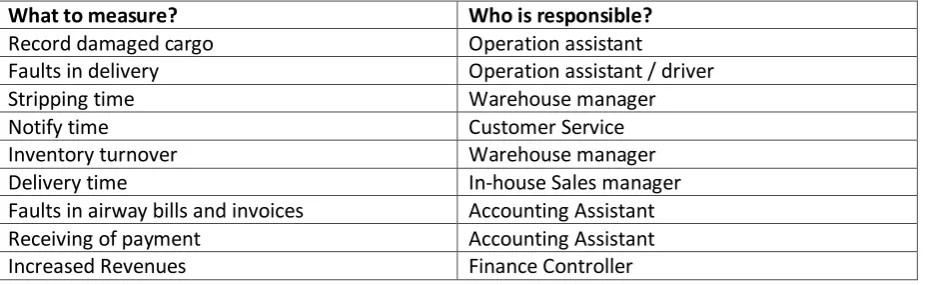
Laparkan needs to set up and measure the critical success factors of the company. Second they need to make responsibilities clear to every employee, this can be done through task descriptions and the new procedure description. Also it is recommended to have structured information transfers, the new procedures will help to in cooperate this. The main recommendation of this research is to implement the suggested procedures, which are set up with help from the KAD model and also include the preceding recommendations. Last measures for internal control have to be set up to have a sufficient control over the processes.
Implementation
iv Facilitation and support from the managers is also important to prevent possible resistance. The general manager as well as the department managers should support their staff by taking the lead in the implementation and give clear directions to their subordinates.
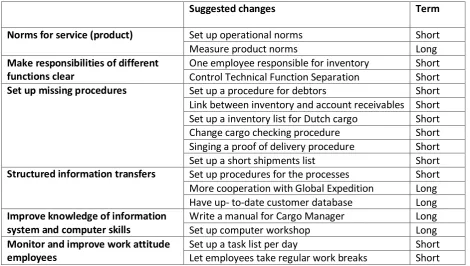
Suggested changes Term
Norms for service (product) Set up operational norms Short
Measure product norms Long
Make responsibilities of different functions clear
One employee responsible for inventory Short Control Technical Function Separation Short Set up missing procedures Set up a procedure for debtors Short Link between inventory and account receivables Short Set up a inventory list for Dutch cargo Short
Change cargo checking procedure Short
Singing a proof of delivery procedure Short
Set up a short shipments list Short
Structured information transfers Set up procedures for the processes Short More cooperation with Global Expedition Long Have up- to-date customer database Long Improve knowledge of information
system and computer skills
Write a manual for Cargo Manager Long
Set up computer workshop Long
Monitor and improve work attitude employees
Set up a task list per day Short
[image:4.595.64.535.123.389.2]v List of abbreviations
CSF - Critical Success Factor
FCL - Full Container Load
KAD - Quality of Administrative Service
LCL - Less than a Container Load
LPK - Laparkan
PMB - Private Mail Box
POD - Proof of Delivery
SOP - Standard Operation Procedure
WCA - World Cargo Alliance
Terms explained
Airway Bill and Bill of Lading
The airway bill gives information about the freight for a certain customer. Each cargo has its own airway bill, the original and a few copies are sent with the cargo by plane. The bill of lading or in short BL is the same, but then for ocean freight. Each bill has a number, so you can track the cargo in the system. If the freight has arrived, the consignee gets a copy of the airway bill as a proof of delivery. There are different kinds of BL’s. The Master BL is issued by the carrier and the House BL is issued by the freight forwarder.
Prepaid and Collect Payment
vi
Table of Contents
Management Summary ... iii
Preface ...viii
Chapter 1: Introducing the company and problem definition ... - 1 -
1.1 Introduction to Laparkan Suriname ... - 1 -
1.2 Problem definition ... - 2 -
1.3 Research objective ... - 3 -
1.4 Research questions... - 3 -
1.5 Research Strategy ... - 3 -
Chapter 2: Theoretical framework ... - 6 -
2.1 Administrative Organization ... - 6 -
2.1.1 Internal Control ... - 6 -
2.2 Design & analysis of the Administrative Organization... - 8 -
2.2.1. Product component ... - 9 -
2.2.2 Process component ...- 10 -
2.2.3 Structure component ...- 10 -
Chapter 3: Current Situation ...- 14 -
3.1 Product ...- 14 -
3.2 Process analysis ...- 14 -
3.2.1 Lining up the different processes ...- 14 -
3.2.2 Describing the relation between a process and the organizational structure...- 15 -
3.2.3 Mapping the relation between a process and activities ...- 17 -
3.2.3.1 The warehouse process ...- 18 -
3.2.3.2 The Sales process ...- 19 -
3.3 Data needed for activities ...- 22 -
Chapter 4: Analysis of the current situation...- 23 -
4.1 Product ...- 23 -
4.2 Process ...- 23 -
4.2.1 The warehouse process ...- 24 -
4.2.2 The sales process ...- 25 -
4.2.3 Internal control ...- 26 -
4.3 Structure...- 27 -
4.3.1 Organizational structure ...- 27 -
4.3.2 Information structure...- 27 -
4.3.3 Staff structure ...- 27 -
4.4 General bottlenecks ...- 28 -
Chapter 5: Redesign ...- 30 -
5.1 Product ...- 30 -
vii
5.2.1 Responsibilities of different functions are not clear...- 32 -
5.2.2 Missing or incomplete procedures...- 32 -
5.2.3 Chaotic transfer in information ...- 34 -
5.2.4 Internal control ...- 35 -
5.3 Structure...- 35 -
5.4 Main suggestions ...- 36 -
Chapter 6: Implementation Strategy ...- 38 -
6.1 Resistance to change ...- 38 -
6.2 Dealing with resistance ...- 38 -
6.3 The impact of organizational culture on change management ...- 39 -
6.4 The six cultural clusters ...- 40 -
6.4.1 Current situation at Laparkan...- 41 -
Chapter 7: Implementation ...- 44 -
7.1 Change management ...- 44 -
7.2 Implementation plan for Laparkan...- 45 -
Chapter 8: Conclusion & Recommendations ...- 49 -
References ... - 49 -
Appendix ... - 54 -
Appendix A: Goals of Laparkan ...- 55 -
Appendix B: Multi criteria analysis ...- 56 -
Appendix C: Organizational chart ...- 57 -
Appendix D: Flowchart symbols ...- 58 -
Appendix E: Warehouse process ...- 59 -
Appendix F: Sales Process: Order processing import ...- 60 -
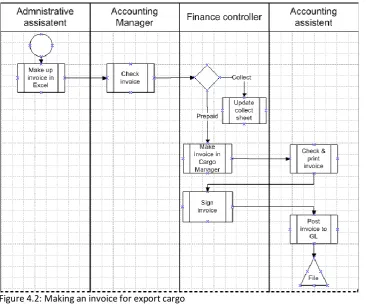
Appendix G: Sales Process: Order processing export...- 61 -
Appendix I: Sales Process: Payment import at airport ...- 63 -
Appendix J: Sales Process: Payment proceeding at office Laparkan...- 64 -
Appendix K: Sales Process: Payment at Laparkan office ...- 65 -
Appendix L: Sales Process: Payment Dutch cargo ...- 66 -
Appendix M: Methods for dealing with resistance ...- 67 -
Appendix N: Questionnaire Cultural Dimensions Hofstede ...- 68 -
Vragenlijst Cultuur ...- 68 -
Appendix O: Results Questionnaire...- 70 -
Appendix P: Control technical function separation on finance department...- 71 -
viii
Preface
In front of you lies my bachelor report, the result of an assignment that I have done at Laparkan in Paramaribo, Suriname as a closure of the bachelor Industrial Engineering & Management at the University of Twente.
In March 2010 I began to look for a bachelor assignment abroad. In first instance I wanted to go to England, to improve my English. But then, via another student of the University of Twente, Laparkan, a company in Suriname, got in view. The company and the assignment sounded very interesting that’s why I chose for Suriname and Laparkan.
I had a warm welcome and I had a good time at the company and in Suriname. I want to thank all my colleagues at Laparkan for their cooperation and time. They helped me to understand the different processes and ways of working. Special thanks to Mr Egon Audhoe, who had trust in me and gave me substantial feedback on the report. Of course I want to thank my two supervisors of the university Dr. Peter Schuur and Ir. Sandor Löwik. They helped me to find the right direction in literature and always gave really helpful feedback.
Last, but not least, I want to thank my parents for always supporting me and Tony for checking my grammar.
Chapter 1: Introducing the company and problem definition
This report is the result of a two-month research at the company Laparkan in Suriname. I did this research as a finishing of my Bachelor industrial engineering and management at the University of Twente. The research includes several aspects which have been studied at the Bachelor level like for example analyzing and devising processes within a company.
In this chapter more information about the activities of Laparkan are explained. In subsection 1.2 the problems occurring at Laparkan are outlined. Then we explain what the objective of this research is and the thereby belonging research questions. Last the research strategy is described.
1.1 Introduction to Laparkan Suriname
Laparkan is a freight group with a network that spans over the Caribbean, Latin-America and North-America. It was founded in 1982 by three friends. They saw a need of West Indians to have a reliable channel to send supplies, gifts and various personal items back home to their families. Today, Laparkan is solely owned by one of the founders Mr. Glen Khan and its corporate headquarters is located in Miami. Laparkan Suriname is part of the mother company Laparkan in Miami. Laparkan Suriname was founded in 1999, back then it was a small business with only two employees. Since 2006 the company is legally registered in Suriname and has his own office. (Laparkan, 2010) From now on the name Laparkan is used for Laparkan Suriname. If we talk about the headquarter in Miami, this is explicitly mentioned.
The import and export take place by means of cargo aircrafts and ships. The most important export and import routes for Laparkan are to the United States and Europe (the Netherlands). Most of the export concerns ‘fish on ice’. Import mostly concerns modern goods (electronics, clothes) and main-tainable food from Europe and the United States. Freight to the United States is handled by Laparkan Miami. In the Netherlands their partner for air and ocean freight is Cavalier. They will forward the freight to Laparkan Suriname or to the receiver in the Netherlands.
Laparkan is a member of the World Cargo Alliance. The WCA is a group of independent international freight forwarders. Laparkan can use this network if a customer wants to send a package or cargo to a certain country where they have no office. In the database of the WCA, you can search for an agent in a specific country. The agent will then handle the package for Laparkan. This also works the other way around. Laparkan is also an agent for Evergreen in Suriname. Evergreen is a shipping company and Laparkan handles all their freight in Suriname.
Laparkan does not have its own storage space, so it hires space from two competitors: Global Ex-pedition and Baank Shipping. The transport from the (air)port to one of the warehouse is done by the concerning partner a.k.a. Global Expedition or Baank Shipping.
Ocean
Laparkan is a sea- and air cargo service company. At sea Laparkan belongs to the ‘non-vessel opera-ting common carrier’ (NVOCC). Instead of having their own ships, they operate as transportation and logistics intermediaries. They book space on ships and sell it in smaller quantities and consolidate freight for transport in standard containers. Laparkan works with ‘Full container load’ (FCL) or ‘less than container load’ (LCL).
- 2 - Air
Laparkan Miami leases a transport plane from ABX air. Every Tuesday and Friday a flight leaves from Miami to Paramaribo. The airplane returns on the same day with export cargo to Miami. Every Wed-nesday and Sunday a flight arrives from the Netherlands. Baank Shipping handles everything at the airport and will ship the cargo to their storage shed. Export to the Netherlands is handled by Global Expedition.
Cargo
The cargo can roughly be divided into two kinds: commercial and private mail box. Private mail box (PMB) is freight that is ordered over the internet and shipped to Suriname. The consumer has to become a private mailbox member first. Consumers can order an item online at a chosen internet shop and have it shipped to Laparkan Miami or Cavalier. They will forward the package to Suriname. If the private mailbox member does not have a creditcard, Laparkan can place the order for them. Most people who use the service do not have a creditcard. Commercial freight is just regular import or export cargo. It mostly concerns business to business transport, but also regular consumers can use this service, especially when it concerns bigger items.
1.2 Problem definition
Laparkan has grown from only a few to more than twenty employees. Also they expanded their activities; an example is the private mailbox service and the operations at the airport. At Laparkan they have outlined the following departments: Financial, Operations, Customer Service, Private Mail-box, Sales & Marketing, Documentation and Clearance. There is a lot of interaction between all these departments. Some employees are operative on several departments and sometimes it is confusing to point out certain responsibilities. Recently the Customer Service department has composed a list with tasks for the people who have anything to do with this department. The list is relatively short though and most people have task descriptions like: back-up for employee ‘x’.
In February 2010 the Laparkan Group started using a management information system called Cargo Manager. It is a simple version of a management system, because it only has a few functions and is actually more a financial management system. The system is mainly used for making invoices, cash receipts, airway bills and keeping up the general ledger and profit&loss account. You can also track-and-trace cargo, but only if it is from Laparkan Miami.
Because of the growth in staff and activities and the new information system Laparkan didn’t keep a structured track of the administration. This has led to several problems:
There are a lot of unpaid invoices. Laparkan is sending the debt collector to these customers to collect the money.
Sometimes it is not clear if an invoice has been paid or not. Relatively employees spend a lot of time trying to examine if an invoice has been paid.
In the storage shed there is still cargo from two years ago. Laparkan recently found out it was still there.
It can be concluded that Laparkan has problems concerning registration of cargo and payments of invoices. These problems are linked with the problems concerning the outlining of tasks and responsibilities. For example there is not one employee responsible for the registration of cargo, but around four employees.
- 3 - 1.3 Research objective
Laparkan is a service organization with a flow of third party goods (Ven, 2001). Their primary process is to take care for a correct ‘flow’ of goods to and from Paramaribo. All the other processes are mainly supporting. Because Laparkan does not do the physical transportation of the goods, except to and from Miami, the supporting processes are actually the core processes for Laparkan. So the data processes are the primary processes.
Thereby in this research it is important to get a good look on the operations concerning the ad-ministration of invoices and cargo. The adad-ministration of invoices happens at the finance partment; however the responsibility of administration of cargo lies with different departments de-pending on the type of cargo. The organizational structure will be studied in order to have a clear view of the responsibilities and tasks of the employees.
Information is collected by interviews with the employees from the different departments and the management, but also by observation and company documents. By means of this information processes will be mapped and analyzed on gaps and bottlenecks. The eventual aim is to eliminate these bottlenecks and set up an organized administration structure. Also the responsibilities and tasks of employees at Laparkan are examined and defined. The practical outcome will be a manual with standard operation procedures to be used by the employees and a task description.
1.4 Research questions
Based on the identified problems, the following main research question is formulated.
What is for Laparkan Suriname the best design of the administrative processes and the implemen-tation of the associated procedures?
To answer this question, sub questions are formulated. First it must become clear what the criteria for a transparent and structured administration are. Also the responsibilities according to literature will be discussed.
1. What are the conditions for an organized administration?
An organized administration means that data is processed in an efficient and visible manner with as few faults as possible, stored in a way that it is easily traceable and controllable for the financial con-troller and forms a basis for the decisions of the management. This means the guidelines for internal control have to be met.
Then it is important to know what the current situation is. The different tasks of the departments will be described in order to get a clear view of the organizational structure. The processes in which the described problems occur will be discussed and if possible mapped. Then the organizational structure and the processes will be analyzed by means of the theory discussed in chapter two.
2. What is the current organizational structure of Laparkan?
3. In which processes do the described problems occur and what do these processes look like?
Then there will be taken a look at how to reorganize the important processes.
4. How can the processes be restructured, so the administrative organization will become more
organized?
Finally the presented changes have to be implemented in the organization. How can this be done with as little resistance as possible from the employees.
5. How can the employees be committed to follow the newly presented procedures?
1.5 Research Strategy
- 4 -
Theory exploration
First it is important to set up a theoretical framework. Chapter two will be dedicated to drawing up of this framework. The sub questions that belong to this part are:
1. What are the conditions for an organized administration?
It is important to know how an organized administration is maintained. We have looked for guide-lines to keep a clear overview in an efficient manner. To find the correct literature, a search was conducted on certain key terms like: order handling, payment, (principles of) administration, debtor administration, administrative organization, internal control, administrative model. First the univer-sity libraries of the Univeruniver-sity of Twente and the Anton Kom Univeruniver-sity (Suriname) are used as a source. Also different internet databases like Sciencedirect, Scopus and Google books are used. Also books that were used in the bachelor will be taken into account. In the books and articles there was particularly looked for models which help to arrange a good administration process. There has been searched for specific literature on NVOCC/freight forwarders, but without success.
Exploration of the current situation
After the theoretical exploration, it is important to examine the current situation. This will be done with the following two questions:
2. What is the current organizational structure of Laparkan?
3. Which processes encounter the most problems and what do these processes look like?
The processes in which the problems occur must be examined, but first the organizational structure is described. The different tasks of each department are briefly discussed, this is necessary for a good understanding of the processes.
To describe the processes, interviews with employees are taken. There are different kinds of inter-views. In this research non-structured interviews are taken with the employees. An unstructured interview begins with a broad open question. The general aim is: collecting a valid, relevant, entire and clear picture of the opinions or experiences of the concerning a certain subject (Baarda, 2004). Advantages of this method are: a good reliability and the interviewer is very flexible in asking questions. The disadvantages of this method are: outcomes are difficult to compare and it takes a lot of time for each interview. Laparkan does not have many employees; therefore it will not confiscate too much time. This kind of interviewing will help to get the most complete information about the processes. Employees from all departments were interviewed, the employees at the finance and operations department more thorough than others, because that is where the most problems occurred. The interviews were mainly combined with an observation of the work activities of the employees. This was done multiple times to get a clear and correct view of the activities in the different processes. Also the management system Cargo Manager and his different functions were explained by different employees, to get a complete image of the processes.
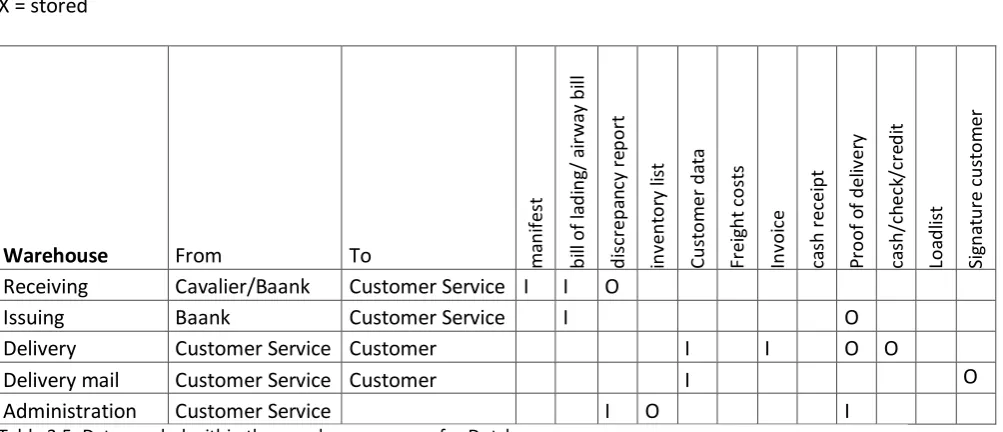
To complete and verify the information collected in the interviews, also company documents are collected. A few examples of documents that are collected during this research are: monthly mana-gement reports, documents used at the airport (loadlist, airway bill, manifest), financial documents (invoice, cash receipt, credit/debit note, debtor list), bill of lading, price list, inventory list, call lists, customer database, discrepancy reports and standard operation procedures.
Analysis of the current situation
- 5 -
Redesign
In this part the current situation will be compared with the theory. In chapter 5 an answer will be given to the following question:
4. How can the processes be restructured, so the administrative organization will become more
organized?
The new processes are mapped with an accompanying description, together this will be the basis for the manual. Next to this supplementary suggestions are made with concern to the internal control of the administrative organization.
Conclusions and recommendations for implementation
In the last part of this research recommendations for the implementation are formulated to solve the most important bottlenecks in practice. The recommendations are designed based on the theory (criteria), interviews and observation. Then the last question comes forward:
5. How can employees be committed to the presented changes?
In the past it appears there have been set up more procedures, but employees never looked at them. To prevent this from happening to the presented procedures from this research, we look at the implementation strategy, which is different for every organization. A literature research has been done in the same databases as mentioned with question one, but this time with the following key terms: change management, organization culture, implementation strategy, resistance to change. In chapter six the choice for the used theory is explained. The organization culture has an impact on the way of dealing with change. The organization culture will be examined by means of observation and a questionnaire. The questionnaire is taken by all employees of Laparkan, to get the perception of all the employees on the organization culture.
Limitations of this research
Laparkan Miami has made the decision to implement the information system Cargo Manager. Because this investment is very recent, there is no possibility to change the system. In this research we will not look at other options for this system.
- 6 -
Chapter 2: Theoretical framework
In this chapter the theoretical framework is provided, used in order to answer the research question
‘What are the conditions for an organized administration?’. First we take a look at the administrative
organization. The processes that are described in chapter 3, in particular the ones with a more financial nature, fall within the administrative organization. A big part of the administrative organization is the internal control. So second we will discuss the preventive measures that have to be taken in order to execute a proper internal control. In the last part of this chapter we will discuss a framework with design conditions for an organized administration.
2.1 Administrative Organization
An organization can be defined as an identifiable group of people working towards the attainment of common goals (Jans e.a., 2001). While aiming these goals the organization uses the resources that are available. The goals are defined by the management. The management is responsible for organizing, directing and controlling of the organization. To perform these tasks well, they need information about the internal processes. This information is supplied by an information system and the functioning of the system is arranged by the part of the organization which is called the administrative organization. Central in the administrative organization is the achieving and main-taining of information supply by means of structured data-processing processes. The data-processing processes must produce ‘products’ (information) that fulfill the needs for information in and round the organization.
The administrative organization includes all activities which are related to:
Collecting, fixing and processing of data
Supplying specific information for managing the organization
Functioning and controlling of the organization
Accountability
Advantages of a functional administrative organization
Of course there are advantages derived from a functional administrative organization. Usually it costs much effort to get an administrative organization functional, but it brings the following advantages: (Jans, 2001-2)
Pressure of workload reduction; by standardizing the requirements of a procedure, giving good information to its users, the use of standard forms and engagements of control require-ments many matters can be done by routine. The chance of errors decreases and much time is saved.
Responsibilities; with help of a functional administrative organization one can get insight in the responsibilities of departments or employees. Moreover there is created an insight in the separation of functions.
2.1.1 Internal Control
As mentioned earlier in this chapter, to manage an organization the internal processes have to be controlled. Because people make mistakes, the management has no certainty of the functioning of the organization. To obtain certainty, control is exercised by the management or by the controller on behalf of the management. This type of control is known as the internal control and is intertwine in the administrative organization. It is important that the control methods and techniques carry a preventive character as much as possible and they are used in procedures and information systems. The objectives of the internal control of a company are assessing and applying: (Jans e.a., 2001-2)
The correct use of granted powers
The effectiveness, efficiency and reliability of the processes
- 7 - In first place the internal control works repressive. Afterwards is observed if there were any defaults, which must then be corrected for the next period. Therefore many preventive measures are taken, which form the test criteria for the inspector who is charged with the function of internal control. Although these test criteria are in fact preventive measures aimed at the prevention of for example errors and abuse of data, the internal inspector uses it as test criteria.
With the internal control the granted powers, the effectiveness and efficiency of the processes and the guarding of the values are checked with the test criteria. Jans e.a. describe test criteria for the granted powers, effectiveness and efficiency of processes and the guarding of values.
The test criteria for granted powers must be secured in:
A task description. A general description of granted powers
A power of authorization instruction. A closer specification of powers, for example a mini-mum rate for the sales department.
The engagement of signatures. With this tool employees can identify co-workers and their authorization.
Creation and delegation recordings. In situations not (entirely) automated, this tool can be used to record who contracted a third party. Filling in the record and signing the record must be done by different employees, for a right control technical function separation.
The test criteria for the effectiveness and efficiency of processes are generally related to several aspects of the execution. What should be done, by whom, how the operation must be carried out and when the operations must be performed, is regulated with these test criteria. Commonly the criteria are set out in:
Task description with regard to who and what.
Work tasks for the specification of what and when.
Quality instructions. Deeper development of what, expressed in quality demands of (specific) products.
Procedures and work instructions. Procedures give a description of systematically arranged activities and operations and the possible use of resources. Work instructions give supple-mentary information about the procedures.
Working conditions regulations. Every country has its own laws on the working conditions of employees in organizations.
Environment regulations. Within the framework of environment legislation organizations should set up procedures for the reduction of environmental risks.
The guarding of the values is related to both the presence and the suitability of the intended
functions. With these values the next organizational measures come at hand:
The selecting of (gate) keepers or special inspectors
To make sure the office has good lockable windows, closets, safe and such
The use of security camera’s
The use of ID or company card
These are all options to keep a company and its possessions, like confidential data, safe. We won’t do an evaluation of these measures for Laparkan, because the company has these measures covered. Also this research is about an organized administration and these values are more about keeping the company safe.
Sub conclusion
- 8 - used for processes, the organization applies internal control. With the internal control the delegated powers, the effectiveness and efficiency of the processes and the guarding of the values are checked with various test criteria.
Now it is made clear what the administrative organization exactly is and which rules apply for the control on the processes. The eventual aim of this research is to set up an organized administrative structure, as mentioned in chapter 1. So the next step in our research is to find a fitting model for the reflection and redesign of the administrative organization.
2.2 Design & analysis of the Administrative Organization
There is not much research that focuses especially on the administrative organization, although the literature from the Netherlands is kind of an exception. The literature and research about the administrative organization often revolves around quality. So a quality model can be used to reflect and redesign the administrative organization. A few well known quality models are reviewed: Six Sigma, Balanced Scorecard and ISO 9001. Also two models that are often used in Dutch literature about the administrative organization are reviewed: the INK-management model and the KAD-model. The advantages and disadvantages of each model are briefly discussed.
According to the Six Sigma model, quality is not the goal, but the means to reach the real goal of improving the company result. The Six Sigma model is focused on the customer. It aims to improve the work processes (primary processes) and to reduce the variation in the output of these processes. In applying this quality management model a regular feedback takes place, which results in continuous improvement. Six Sigma is a difficult model to implement in an organization. Employees from the concerning organization need to be trained or there must be called upon an external expert (Daft, 2008). The Balanced Scorecard is mainly focused on the direction of the output of a process and is thereby somewhat limited. Also it cannot be used as a single model, but only as an addition to another quality model (Daft, 2008). The ISO-9001 only gives guiding principles for conducting a quality management system to which the organization must gives its own interpretations. No real solutions are offered. However, an organization has the possibility to make the quality management system applicable in a flexible way.
The INK-management model aims at the direction of the process input and output. It offers a qualitative assessment on nine different areas of the current situation of the company. A disadvantage is that the model only offers a diagnosis of a company that already has this model incorporated into their organization.
The KAD-model is the only model we found in literature that is especially designed for administrative processes. It does offer guidelines for the redesign to some extent, but is still very flexible. A disadvantage of this model is that it is only known in the Netherlands.
To chose the right quality model we have done a little multi criteria analysis. Five criteria have been set up to define which model would fit for the evaluation and redesign of the procesess at Laparkan. From the analysis (see appendix B) we can see that the ISO model has the highest score. However, the KAD model only scores lower on the last criterium and even higher on the ‘solution’ criterium. Although we have not given weights to the criteria, it seems more important to the author that the models offers some solutions than that it is a familiar model. Also the KAD-model has a special focus on administrative processes and although it is not an internationally known model, the model is known in Suriname.
The KAD-model (quality of administrative service)
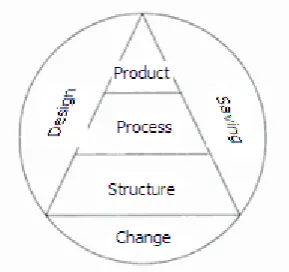
- 9 - organizations where the administrative service is the primary process, but also in organizations where the administration is there to support the primary process the model can be used (KAD, 2010). The KAD-model uses the system approach. For organizations this means that the properties of the organization are strongly dependent of the connection between the chosen organization elements. Both the elements and the relations are thereby subject of analysis. The system approach forces to make the function of the system clear, reasoning from the environment. Within the organization there are many complex relations between the elements of the organization. To the elements and relations numerous aspects can be distinguished. The system approach offers a few ‘empty’ concepts which can be used in different disciplines. The KAD-model exist out of three, to each other related and complementing components, which have been derived from the angles and considerations of the system approach. Together these components determine the efficiency and effectiveness of a process (Hartog, 1992).
Product; aimed at product specifications
Process; aimed at the control and arrangement of a process
Structure; aimed at the task, information and staff structure of the process.
[image:17.595.74.219.331.467.2]First the way how each different component contributes to the quality of the administrative organization will be described. At the end of each component the steps that need to be taken for a redesign of the administrative organization are outlined.
Figure 2.1: The KAD model
2.2.1. Product component
The starting point at improving of the quality of the administrative organization and thereby the service is the quality of the product. An information product is defined as a result of a data process, aimed at fulfilling the information needs of its users. The quality of the information product is defined as the degree to which the product fulfills the information needs of the users.
When translating the user needs to the product norms, the organization needs to define the critical success factors (CFS) of the product. The CSF’s are those requirements and wishes that are of vital importance for the success of the organization. For the managing and control of the processes the critical success factors must be translated in standards and operational norms. The realization of product standards depends on the design of the organization and its processes. This forms the subject of the process and structure module of the KAD-model.
Steps for redesign of administrative organization in product component:
1. Selecting the product(s) that require closer analysis
- 10 - 2.2.2 Process component
The process module is arranging the administrative and company processes, so that the organization can meet the requirements and needs of the consumers. The quality of the process is about the control of the process. This means that the system must be arranged that also under changing circumstances and in spite of disruptions, the product is realized. In the long run this means that the organization can adapt itself to changes in the surroundings.
The KAD model thereby uses two terms: reliability and topicality (or ‘on time’). The reliability of a process is secured by the various test criteria of the internal control. Topicality is aimed at an as short as possible delivery time or throughput time. The two terms lead to measures which complete each other but which are also partly contradictory. The organization has to asses which measure is more important.
For the throughput time it is sometimes necessary to commit other employees to a job, from the viewpoint of function separation this can be very inconvenient.
The time that is necessary for the needed control goes at the costs of the throughput time
Function separation and the creating of transfers in information expands the throughput time, but are sometimes necessary. But too many transfer points lead to a loss or incorrect information.
Steps for redesign of administrative organization in process component:
Drawing up the processes can be done on four different levels.
1. The first level gives an overview of the different processes within the organization. At this level the relation with the product module is guarded by choosing the product related processes.
2. The second level is the general process description. After the processes have been defined in the first level, the different process steps can be defined. The goal of a process description is to give an insight in the way in which a process is carried out. Different methods can be used like a textual description, IPO-scheme (input, process, output) or a process diagram.
3. The third level is a detailed process description. The recognized process steps are developed in detail. Activities are distinguished, but also forms, files or other resources that are used with these activities are indicated. Such a detailed process description is mostly done in the form of a procedure description.
4. The fourth level is the work instruction level. In the work instructions there is exactly stated how the activities should be executed by the employees.
2.2.3 Structure component
This part of the KAD-model aims at the structure and design of the organization in such a way that the realization of the goals can be achieved in an efficient and effective manner. There are three aspects of the structure of an organization: organization (or task) structure, the staff structure and the information structure. First the design rules per structure are laid down and then the total redesign of the structure component is laid down into different steps.
Organization structure
- 11 - tasks of the employees (Hartog e.a., 1992). In the KAD-model there are a few design rules with regard to an effective and efficient product-aimed structure.
Design rules with regard to the structure of transformation from function to product structure
1. Arranging the activities by order of the most important product.
2. Integrate or make sure of a minimum of dependences with preceding and succeeding processes. 3. Product positioning in a low aggregation level with per department no more than 10 workplaces. 4. Take care of a flexible allocation of tasks (in groups).
Design rules with regard to the structure of the regulation and directing activities
1. Closed control cycles for an integration of regulation and operations. The dividing of these two activities of a control cycle leads to ‘no observation of relevant activities’, ‘poor information processing’, limited information processing capacity, complexity and the ignoring of information. 2. Delegating or directing processes
The responsibilities of the way in which the objectives are achieved must be as low as possible in the organization, this means as closely as possible to the execution of the process.
3. Take care of a flexible allocation by the working group, by letting them determine the division of labour. This offers possibility for variation in tasks and regulation capacity.
4. Stimulating of a supporting department manager.
Design rules with regard to the structure of supporting processes
1. Take care of an adequate, directing staff support
2. Take care of a maximum integration and a maximum influence on processes.
Both designer rules aim at the support of the product-responsible management with a staff that is aimed at the specific needs. This means in the case of decentralization that the responsibilities in the department must be in line with the whole organization. For the task design of individual employees the design rules mean that there is strived for complete and skilled tasks. By means of meaningful product-aimed tasks, integration of regulation activities and a possibility of own decision space will offer a job to the employee in which one can function as good as possible as well as an optimization of the decision-making processes by speed and quality.
Information structure
The structure of the information supply can be divided in the following features:
Contents and the structure of the data that must be supplied at the different organizational levels.
The conditions under which the data is available and the requirements which can be consequently made to the system.
The data-processes and systems from which the data become available.
Design of the information system
This subject will not be discussed in this research, because Laparkan uses the information system Cargo Manager. This system has just been implemented throughout the whole organization and within the near future there will be no talk of changing the system.
Using the information system (‘’the organization around it’’)
Data must be recorded at the source. The employee, who records the data, is responsible for the engagement and contents of the data.
Users have only access to the data and applications that are relevant for their function.
- 12 -
Staff structure
This part of the structure component discusses the staff occupancy of the several positions within the organization. To these positions different roles, responsibilities and powers are bound. Most of the time this can be derived from the organizational chart. In an organization control technical function separation especially in the financial department is very important, because of the risk of fraud and mistakes. Control technical function separation means creating contrary interest between officials in an organization, which will offer a certain guarantee of the control of risk. There are five functions that can be separated: having, keeping, recording, controlling and executing.
‘Having’: authorization of contracting third parties.
‘Keeping’: taking care of the keeping of goods and financial resources.
‘Executing’: receiving or giving out money, securities, goods or data in order of someone else.
Within the executing function there is also the step of processing of the money etc.
‘Recording’: fixing financial facts
‘Controlling’: monitoring the correctness and completeness of supplied tasks including
analysis afterwards.
The following rules apply for a good separation of these functions:
Separate ‘having’ and ‘keeping’ function, unless restricted till a small amount of money
The ‘having’, ‘keeping’ and ‘executing’ functions must be strictly separated from the ‘recording’ and ‘controlling’ functions.
No employee must have the possibility to influence two successive links
However in smaller organizations this cannot always be realized, because there are simply too few employees. In such case, extra control is required.
Steps for redesign of administrative organization in structure component:
1. The first level describes the main structure of the organization, so the different departments and the vertical and horizontal relationships between them. An organizational chart can be used to get a clearer view.
2. The second level describes the tasks by department. By the development of the organizational structure the tasks by department are pointed out. The tasks can also be translated into (sub) products which a certain department has to provide.
3. At the third level the structure is laid down at the level of an employee. Per employee a description of the tasks are given and the qualifications he or she needs to satisfy.
Sub conclusion
With the KAD-model we have described a framework for a redesign of the administrative organization. In the product component the main point is to define the critical success factors from the user needs. In the process component the different levels of a process must be described in order to get a clear view of the control on the process. In the structure component the organizational structure on different levels is the main issue. To redesign an administrative organization there are certain steps laid down for every component of the KAD model. These steps will be used in chapter 5, when we will redesign the administrative organization of Laparkan.
Component Central topic Elements View on quality
Product Tuning organization to environment
User needs CSF
Product standards
Quality is producing by the wishes of the customers
Process Operation and control of organization
Process standards Control system
- 13 - Structure Structure and design
of organization
Organization Structure Information structure Staff structure
Quality is an effective and
[image:21.595.76.480.70.126.2]efficient organization structure
Table 2.1: Overview of the KAD-model
Conclusion
In this chapter we found an answer to our first research question: ‘What are the conditions for an
organized administration?’. An organized administration means that data is processed in an efficient
and visible manner with as few faults as possible, stored in a way that it is easily traceable and controllable for the financial controller and forms a basis for the decisions of the management. Centrally in the administrative organization is the achieving and maintaining of information supply by means of structured data-processing processes.
- 14 -
Chapter 3: Current Situation
As described in the problem definition, Laparkan has problems with the registration of cargo and invoices. These two activities are part of the warehouse process respectively the sales process. The two processes will be described and mapped in a flowchart. Before evaluating, first the organizational structure will be reviewed. Because the processes involve different departments of the organization, it is important to get a clear view of how these departments are organized. And what are the different functions and responsibilities within these departments. Seeing this within the KAD-model framework we discuss the product, then the process and structure component in this chapter. For Laparkan it is important to first understand the organization structure before the process description can be fully understandable. So we discuss the structure component within the process component. In this chapter we will give an answer to the following research questions:
‘What is the current organizational structure of Laparkan?’ and ‘In which processes do the described
problems occur and what do these processes look like’.
3.1 Product
As mentioned in chapter 1, Laparkan is a service organization with a flow of goods of a third party. So they do not have a physical product, but a service-product: ‘transportation of goods’. They divide their cargo (or service) in the following groups:
Commercial o Air o Ocean
Private Mailbox
Dutch Cargo
The private mailbox and Dutch cargo can be transported by ocean or air, but they define this as the same service. The head office in Miami has set up a few norms concerning the service.
Maximum error rate of 2%
Customer must be notified within 1 working day
Treat goods as if they are your own
Deliver as quick as possible after arrival cargo
The error rate concerns all kinds of errors liked damaged cargo and wrong delivered cargo. Laparkan Suriname sends the data to the head office, which records everything.
3.2 Process analysis
To have an adequate information service by means of the data processes, you need an insight in the structure of and connection between the current company processes. This insight is obtained by process analysis. A process analysis exists of the following phases: (Hartog, 1992)
1. Line up the different processes
2. Describing the relation between a process and organizational structure 3. Mapping the relation between a process and activities
3.2.1 Lining up the different processes
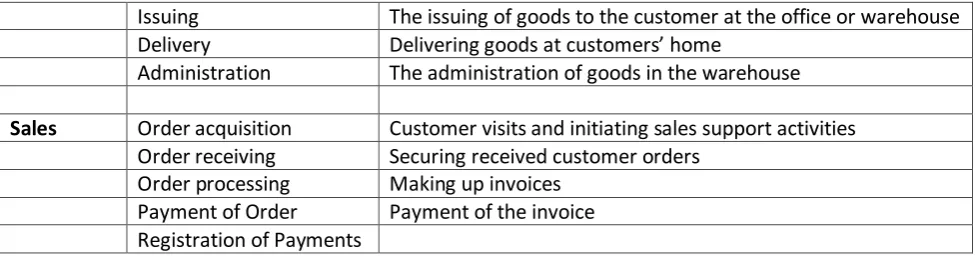
The problems Laparkan has concern two key processes, the warehouse and the sales process. With both processes almost every employee is involved. The different sub processes are summed up in table 3.1. These sub processes are defined by means of observation of the different activities at Laparkan and interviews with employees.
Process Sub process Description
Warehouse Receiving The receiving of goods at the airport/warehouse
- 15 - Issuing The issuing of goods to the customer at the office or warehouse
Delivery Delivering goods at customers’ home
Administration The administration of goods in the warehouse Sales Order acquisition Customer visits and initiating sales support activities
Order receiving Securing received customer orders Order processing Making up invoices
[image:23.595.66.554.70.198.2]Payment of Order Payment of the invoice Registration of Payments
Table 3.1 Overview of the sales and warehouse process
3.2.2 Describing the relation between a process and the organizational structure
To describe the relation between the defined (sub) processes and the organizational structure, we must first outline the organizational structure of Laparkan. The organization has grown the couple of years, not only in the amount of cargo they transport, but also in employees. At this moment they have 20 employees. An organizational chart has been set up, with help from the employees and manager (see appendix C). Some employees are mentioned twice, as can be seen on the chart. These employees are operative on both departments, on flight days they work for operations and on non flight days for customer service. Next the different functions of each department will be explained.
Sales & Marketing
There are two people responsible for the sales, this concerns only commercial cargo. The private mail box service does their own sales, but of course sometimes they work together. The head of the Sales department is also the head of the Customer Service department.
Operations
The operations department is concerned with the air cargo from and to Laparkan Miami. Every Tuesday and Friday a flight arrives and leaves to Miami. On these days the whole department, except the operation supervisor, is present at the airport. They ensure a correct handling of the export and import cargo as well as the payments. The day before they call all regular customers, mainly fish exporters, and ask if they have export cargo and how much. The department exists out of five em-ployees in total. The two assistants are only concerned with this department on flight days, the other days they work for the customer service department. At the airport these employees will physically handle all the cargo with the fork lift carriers. The manager of the department and the assistant manager handle all the paperwork and payment handling. Also the courier from the customer de-partment helps on flight days at the airport. The operation supervisor will make the arrival notices at the Laparkan office, from the arrival notice the finance department can make up an invoice.
Private Mail Box
This department holds three people, the manager, executive and supervisor. The manager and the executive handle all the activities concerning the private mail box service. This means they handle the registration of PMB clients, do the orders by credit card, but also sales and marketing. The executive is mainly charged with the sales and marketing. The PMB manager handles most of the ap-plications and orders. The supervisor is supposed to deliver the PMB mail to the customers. Sending post with the PMB service is free, so customers make eager use of it. At this moment the supervisor mainly keeps up the inventory in the Laparkan office and warehouse and emails customers their cargo has arrived.
- 16 - This department exists since May 2010. The main task is to notify the customers their cargo has arrived. At this moment they are currently busy with setting up a customer database. The in-house sales officer is charged with the operations and customer service of all the Dutch cargo. On non-flight days two employees from the operations department help at the customer service department. In shifts they will deliver the cargo and mail at peoples’ home. They are also responsible for making up the inventory list from ocean and air cargo.
Documentation
The documentation department exists of one employee. She is responsible for all the ocean cargo, except Dutch ocean cargo. Because Laparkan does not physically handle this cargo, the employee only has to do the paperwork.
Financial administration
The financial department at Laparkan exists out of five employees. At this moment there is one temporary employee. Her main job is to file invoices and other documents that concern payments. The administrative assistant is concerned with all the payments from customers, making invoices in Excel and handles declarations from other employees. The accounting assistant is currently charged with cleaning up the list of debtors, because he is responsible for the accounts receivable. He also checks the cash register at the end of the day. When the administrative assistant is absent, the accounting assistant will take over the cash deck. The accounting manager is responsible for the accounts payable, at Laparkan this means mainly checking and paying invoices from creditors. Beside these activities she does everything concerning human resource management
The financial controller main tasks are checking if all the invoices are made correctly, helping with the debtor list, making monthly report for Miami and keeping up the general ledger. Actually he is also the head of the department.
Customs broker
Recently Laparkan hired an employee who is familiar in the field of cargo clearance at the customs. This is an extra service Laparkan offers to its customers, which has not much interaction with the other departments. Therefore the Clearance department will not be taken into account in the report.
Guard
As mentioned the guard is hired from an external security company. He sometimes helps out with writing proof of delivery notes to customers and gets a little extra payment from Laparkan for this work. The guard is not on the organizational chart.
General Manager
The general manager is occupied with decisions on strategic level. At this moment he is busy trying to find a new location with warehouse for Laparkan. He tries to look for new opportunities like maybe a new flight from Suriname to Panama. The general manager does not involve himself in the daily monitoring of staff. The head of the Sales department is supposed to manage the daily operations at the office. Once a week there is a meeting with the whole staff, in which they discuss the problems and progress of their activities.
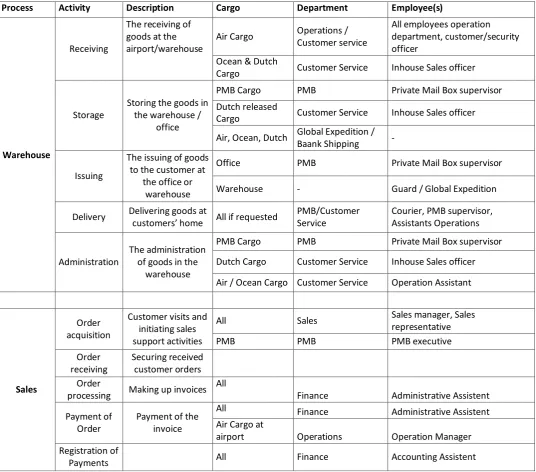
- 17 - Now we have outlined the organizational structure of Laparkan, we can define which employee executes each sub process.
Table 3.2: Overview of sub processes and executing employee
3.2.3 Mapping the relation between a process and activities
There are many techniques to map a process. A flowchart is a graphical representation of the sequence of operations in an information system or program. Flowchart uses boxes of different shapes to denote different types of instructions. The actual instructions are written within these boxes using clear and concise statements. These boxes are connected by solid lines having arrow marks to indicate the flow of operation, that is, the exact sequence in which the instructions are to be executed. Since a flowchart shows the flow of operations in pictorial form, any error in the logic of the procedure can be detected easily. Also they are easily understandable for employees.
Process Activity Description Cargo Department Employee(s)
Warehouse
Receiving
The receiving of goods at the airport/warehouse
Air Cargo Operations /
Customer service
All employees operation department, customer/security officer
Ocean & Dutch
Cargo Customer Service Inhouse Sales officer
Storage
Storing the goods in the warehouse /
office
PMB Cargo PMB Private Mail Box supervisor
Dutch released
Cargo Customer Service Inhouse Sales officer
Air, Ocean, Dutch Global Expedition /
Baank Shipping -
Issuing
The issuing of goods to the customer at
the office or warehouse
Office PMB Private Mail Box supervisor
Warehouse - Guard / Global Expedition
Delivery Delivering goods at
customers’ home All if requested
PMB/Customer Service
Courier, PMB supervisor, Assistants Operations
Administration
The administration of goods in the
warehouse
PMB Cargo PMB Private Mail Box supervisor
Dutch Cargo Customer Service Inhouse Sales officer
Air / Ocean Cargo Customer Service Operation Assistant
Sales
Order acquisition
Customer visits and initiating sales support activities
All Sales Sales manager, Sales
representative
PMB PMB PMB executive
Order receiving Securing received customer orders Order
processing Making up invoices
All
Finance Administrative Assistent
Payment of Order
Payment of the invoice
All Finance Administrative Assistent
Air Cargo at
airport Operations Operation Manager
Registration of
- 18 -
Flowchart symbols
Only a few symbols are needed to indicate the necessary operations in a flowchart. An overview of these symbols can be found in appendix D. Swim lanes are used to see easily which department executes which part of the process.
3.2.3.1 The warehouse process
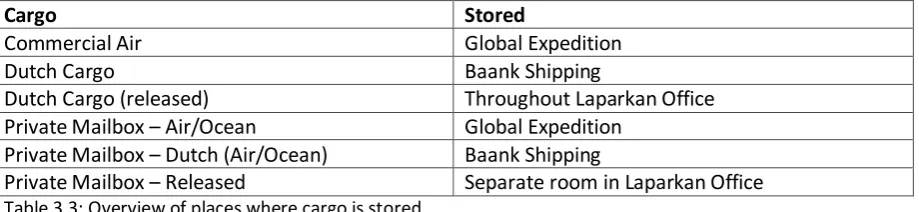
Laparkan has several places where cargo is stored. At the Laparkan office is cargo from Private Mail Box and sometimes Dutch cargo. In the warehouse of Global Expedition is the air and ocean cargo. Sometimes if customs does not give the private mail box cargo free pass, it has to be stored in the warehouse of Global. This problem does not arise with Dutch cargo, because Laparkan pays the total import duties for all customers once per month to the customs. The flowchart accompanying the description of the process can be found in appendix E.
Cargo Stored
Commercial Air Global Expedition
Dutch Cargo Baank Shipping
Dutch Cargo (released) Throughout Laparkan Office
Private Mailbox – Air/Ocean Global Expedition
Private Mailbox – Dutch (Air/Ocean) Baank Shipping
[image:26.595.69.529.244.350.2]Private Mailbox – Released Separate room in Laparkan Office
Table 3.3: Overview of places where cargo is stored
Receiving
Global Expedition or Baank Shipping receives all the cargo in their warehouse with a manifest they receive from the shipping company or from Laparkan. The operations department receives the air cargo from Miami at the airport, they make a load list with cargo that goes to the warehouse. They check all the cargo, also PMB, with the manifest and make up a discrepancy report. On this report are all the short shipments, not manifested cargo, name changes or extra shipments. Global Expedition picks up the cargo and transports it to their warehouse.
When a shipment (air or ocean) has arrived in one of the warehouses, the inhouse sales officer checks it with the manifest for any discrepancies. The discrepancies from air cargo are compared with the discrepancy report at the airport by the operation supervisor.
Private mail box cargo is checked by an employee from the PMB department. He first checks the cargo in the office, then in the warehouse. If the PMB has already been checked at the airport, he compares the discrepancies.
Storage
The storage in the warehouse is completely done by Global Expedition/Baank Shipping. At Global Expedition, Laparkan has an own separated part in the warehouse. At Baank Shipping the cargo is stored random in the warehouse. The PMB cargo in the office is randomly stored in the back of the office. Dutch cargo that is released from the Baank Shipping warehouse, but is not yet delivered to customers, is situated throughout the office.
Issuing
- 19 - customer has to sign a proof of delivery changes, because Laparkan is struggling what is the best moment.
The in-house sales officer picks up the Dutch cargo at the Baank Shipping warehouse. Customs note the import duties and Laparkan pays this once a month to the state. The in-house sales officer notes the import duties per cargo and adds this to the freight costs.
Delivery
People with a Private Mail Box account can ship free magazines and other mail from the U.S. This mail is sorted and the driver sets up a list with name, address and sign for delivery. Before this was done by hand, but they are trying to switch to an Excel sheet. The only obstacle is now that the driver can’t work with a computer very well.
Dutch cargo is also delivered at home, this service is free within Paramaribo. The in-house sales officer sets up a list with names, address and costs. He points two employees who are going to deliver the cargo. The customer must sign the delivery list, if they have received the cargo. Other cargo is mostly picked up by the customers, on payment of a little amount the cargo can be delivered.
Administration
After every flight day the load list from the operations department is copied to the inventory list. When ocean cargo arrives, the call list from the documentation department is copied to the inventory list. Every Thursday an employee from the Customer Department goes to the warehouse of Global and updates this inventory list. Then he calls the customers from who the cargo is there almost eight days and records this on the inventory list. After ten days the customer has to pay storage costs. The customers are always called the day after their cargo has arrived by the customer service.
The PMB inventory is kept up to date by an employee from the PMB department. When private mail box cargo arrives, he checks it with the Private Mail Box manifest. He also checks in the warehouse of Global Expedition to check the PMB cargo there. Finally he checks his list with the discrepancy report from the Operations department.
The inventory of Dutch cargo is not registered. Most of the Dutch cargo is directly released from the warehouse of Baank Shipping and then delivered at the customers’ home.
3.2.3.2 The Sales process
The Sales for the Private Mail Box is done separately from the rest of the sales. But as mentioned in the description of the organizational structure they work together sometimes. Next to the regular sales employees, from the rest of the employees it is expected to help with the sales. The flowcharts accompanying the description of the different steps in the process can be found in appendix F till L.
Order acquisition
This is the primary task of the Sales department. The sales representatives try to build a relationship with the customer and regular go out for a drink or eat with them. They make price agreements with the customers, the guidelines for the rates are given by Laparkan Miami. The private mail box representative does the sales for this department. The rates for the PMB are set by Miami, so there is no bargaining here.
Order receiving