MUSCLE ACTION DURING LOCOMOTION:
A COMPARATIVE PERSPECTIVE
BY IAN A. JOHNSTON
Gatty Marine Laboratory, Department of Biology and Preclinical Medicine, University of St Andrews, Fife, Scotland, KY16 8LB, UK
Summary
This essay explores how the properties of striated muscles are matched to the tasks they perform during running, swimming and flying. During exercise the major locomotory muscles undergo alternate cycles of lengthening and shortening. Force development is greatly influenced by the timing of stimulation in relation to the length-change cycle and by the nature of elastic structures connecting the muscle fibres to the skeleton. The storage and recovery of elastic strain energy by the tendons (apodema in insects) results in a considerable saving of metabolic energy. Strain is independent of locomotory frequency, body size and muscle tempera-ture. In contrast, the frequency of cycles, and hence strain rate, generally increases with speed and is inversely proportional to body size. The maximum isometric stress (PQ) striated muscles can exert is rather similar. During steady running or hopping in mammals the peak muscle stress is around one-third of / V Behaviours such as vertical jumping impose higher stresses requiring dispro-portionately larger muscles and tendons, which may limit the storage of elastic strain energy. Muscles of small animals consume significantly more energy per gram than do those of large ones. This may be because they need to activate and deactivate their muscles at a higher rate to move at an equivalent speed. When differences in force production are normalised, by multiplying the energy consumed per stride by stride frequency, similar values for the mass-specific cost of locomotion are found in animals with different leg architectures, numbers of legs, skeletal type, body sizes and muscle temperatures.
The power output of isolated muscle fibres can be measured by imposing cyclical strain fluctuations and stimulating briefly during each cycle to approximate normal operating conditions in vivo. This approach yields values for maximum power output of 76-130 W kg"1 for synchronous insect flight muscles at tempera-tures and wingbeat frequencies appropriate for flight. Frog sartorius muscle produces 20Wkg~1 at the hopping frequency used during escapes at 20°C. The strain rates and deactivation rates of muscle fibres are optimised to produce maximum power over a particular range of locomotory frequencies. In vertebrates this necessitates the sequential recruitment of muscle fibre types with faster maximum strain rates and shorter contraction times as speed increases. Estimates of overall muscle efficiency during locomotion in insects, fish and small mammals are mostly in the range 6-20 %.
168 I. A . JOHNSTON
Introduction
The ability of striated muscles to shorten and produce force is dependent on overlapping arrays of actin and myosin filaments, arranged in serially repeated sarcomeres. Although the mechanism underlying the conversion of chemical energy to mechanical energy is the same in all animals, numerous aspects of sarcomere structure and organisation can be varied to produce muscles with a diversity of mechanical properties (see Hill, 1950; Huxley, 1985; Squire etal. 1990). The action of muscles in locomotion is further modified by their anatomical arrangement, the lengths and properties of tendons, and by the operation of lever systems formed with the skeleton or cytoskeleton.
Whole-animal studies of muscle function
Terrestrial locomotion
During running or hopping, the major muscle groups are alternately stretched and then shortened during each stride (see Alexander, 1977). Inverted pendulum-like mechanisms operate at walking speeds in a wide range of legged animals (Full, 1989), but are most effective in bipeds (Cavagna etal. 1977). The common principle is that kinetic energy and gravitational potential energy are exchanged, and therefore saved, as the centre of mass of the animal rises and falls during each stride. Above certain speeds, pendulum mechanisms become ineffective and running or bouncing gaits are used. Animals running at constant speed over level ground do relatively little net work against the environment. The work done by the muscles and tendons serves to lift and accelerate the body and limbs, with positive work only just exceeding negative work. Prior to active shortening, the limb extensor muscles are stretched by the momentum of the animal. A proportion of the work done on the muscles is stored as elastic strain energy, which can be recovered during subsequent shortening of tendons and muscles (Cavagna et al. 1977). Thus, the muscles and tendons serve as springs which alternately store and release strain energy as the animal moves along, resulting in a considerable saving of metabolic energy (Cavagna etal. 1977).
Energy storage in the series elastic components is divided between the tendon and the muscle fibres, and depends on tendon length and compliance and the number of sarcomeres in series in the muscle fibres. Griffiths (1989) estimated that in the wallaby (Thylogale billardierii) up to 39 % of the work done on the gastrocnemius (MG) muscle during hopping was stored as elastic strain energy, mostly in the tendon. Since the tendon is essentially elastic, most of this energy is recovered during the propulsive phase of the stride (Griffiths, 1989). Humans achieve even greater savings during running, with more than half of the energy supplied to lift and reaccelerate the centre of mass during each stride being obtained from elastic energy storage mechanisms (Cavagna et al. 1964).
™covery of elastic strain energy and to minimise the cost of generating force. The peak stress in the ankle extensor muscles of white rats galloping at their 'preferred speed' was found to be around one-third of the peak isometric stress measured in
situ (Perry et al. 1988). This is similar to that reported for kangaroo rats hopping at
their 'preferred speed' (Biewener and Blickhan, 1988), and it may be a common feature of running and bouncing gaits.
Specialized runners, such as ungulates, have short muscles with long tendons in the lower parts of their legs that are slender in proportion to the forces they have to transmit. This increases the effectiveness of elastic energy storage. An extreme example of this is provided by the plantaris muscle of the camel, in which the tendon runs almost the whole length between the femur and insertions on the phalanges, and the muscle fibres are reduced to 1-3 mm (Alexander et al. 1982). In contrast, in the kangaroo rat {Dipodomys spectabilis), much less strain energy is stored in the ankle extensor tendons and muscles, with only 14 % of the work done on the muscles being recovered (Biewener et al. 1981). Biewener and Blickhan (1988) have proposed that these animals have disproportionately large muscles and tendons for their body mass, limiting energy savings by elastic storage and recovery. They propose that well-developed hindlimb muscles, tendons and bones are needed in kangaroo rats to match the large stresses involved in the high vertical jumps used to avoid predators (Biewener and Blickhan, 1988). Stresses developed in the plantaris and MG muscles were found to increase from 33-110 kNirT2 during hopping at a steady speed (0.6-2.1 ms"1) to 350kNm~2 for 50cm jumps (Fig. 1). These large jumps characteristically followed landing from a previous jump, providing the means for stretching the active ankle extensor muscles to give up to 1.75 times the maximum isometric force measured in situ (Fig. 1). During maximum jumps the force exerted on the ground was three times that exerted at the fastest steady hopping speed. The maximum stresses produced in the ankle extensor muscles are matched to the strengths of tendons and bones, providing a consistent safety factor to failure of 1.5-2.0 for the hindlimb as a whole (Fig. 1). It would seem that the muscles and skeletal structures of different animals have similar safety factors for the avoidance of injury. Thus, there may be a compromise in evolution between the design features needed for rapid acceleration/decele-ration and maximum elastic energy storage and recovery.
170
L A . JOHNSTOND 1ZU
<T 100 E Z 80
S
wn
c 40
T3 [2 20
n
\
\
Tensile strength
-1 -1 Hopping Jumping
(2.0-3.1 ms"1) (>40cm)
Hopping Jumping
C 400
Jump height (cm)
[image:4.451.73.382.57.423.2]Hopping 6-1.9ms"')
Fig. 1. Peak stresses in the bone (A), tendon (B) and plantaris muscle (C) of the kangaroo rat (Dipodomys spectabilis) during hopping and jumping. (Adapted from Biewener and Blickhan, 1988.)
Take-off hop
100-
75-50
25
0
0 100 200 300
100-
75-
50-
25-Steady hop
Footfall
Time (ms)
100-
75-8
50-(2
25-D
Take-off hop
- 6 - 4 - 2 | 2 4 6 - 6 - 4 - 2
[image:5.451.85.376.49.348.2]^> Muscle length change (%) i J
Fig. 2. Muscle action during unrestrained locomotion in the wallaby (Thylogale billardierii). Changes in length (A) and force (B) in the gastrocnemius (MG) muscle during a single stride for constant-speed hopping at l l k m h "1 and for a bipedal take-off hop. (C,D) The corresponding force-position or work loops. The body mass of the wallaby was 7 kg and resting MG length (Lo) was 197-198 mm. (Adapted from
Griffiths, 1989.)
speeds, stride length stabilised and hop frequency increased so that muscle force and work per hop remained constant.
The leg muscles in the wallaby function differently during steady hopping and take-off hops from rest. During bipedal take-off hops, the MG muscle was stretched by a more modest amount before generating force in a near-isometric contraction (Fig. 2). This resulted in a slower development of force than during constant-speed hopping (Fig. 2). As a result, the work done by the muscle was around two times higher for bipedal take-offs than for constant-speed hopping of similar speed (Fig. 2). Take-off hops are energetically more expensive because the MG muscle has to stretch the long compliant tendon actively.
Scaling studies
172 L A . JOHNSTON
are about the same in mammals of all sizes (Biewener, 1989). This can explained by differences in the mechanical advantage of leg muscles in different species achieved mainly by changes in limb posture, with larger animals running on more upright limbs (Biewener, 1989).
The muscles of small mammals consume significantly more energy per gram dur-ing runndur-ing than do the muscles of large ones (Taylor et al. 1970). Taylor (1985) has suggested that this is because small mammals must turn their muscles on and off at a higher rate to generate the forces needed to move at an 'equivalent' speed. Normalizing for differences in force production, by multiplying the cost per stride by stride period, produces values for the mass-specific cost of locomotion per stride that are similar over four orders of magnitude of body mass (Heglund and Taylor, 1988; Kram and Taylor, 1990). Surprisingly, body mass also accounts for around 85 % of the variation in the mass-specific costs of terrestrial locomotion in animals with different leg architectures, numbers of legs, skeletal type and body temperature (Full et al. 1990). To a first approximation, 0.9 J kg"1 is required to move the centre of mass l k m (Full and Tu, 1990). The fact that six- and eight-legged invertebrates produce similar force patterns to those of mammals suggests a comparable whole-body stiffness. Thus, animals may function as tuned mechan-ical spring systems with similar characteristics due to the basic material properties of muscles, connective tissue and skeletal structures (Full and Tu, 1990).
Swimming
0.8 -i
-0.2
-0.2
-10 - 8 - 6 - 4 - 2 f 2 4
[image:7.451.30.420.67.558.2]Muscle length change (%)
174 I. A. JOHNSTON
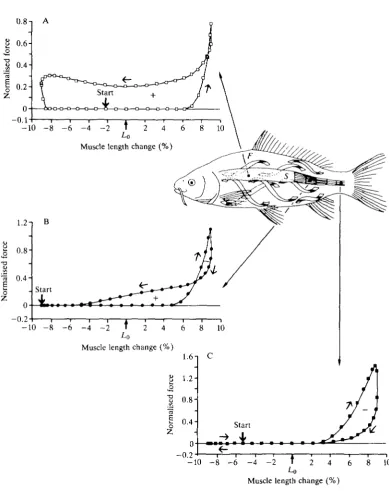
Van Leeuwen et al. 1990). For continuous swimming, the amplitude of fluctuations is similar along the trunk, except for the most anterior myotomes. Therefore, it would appear that there is a strict relationship between the minimum radius of curvature of the body and the initial position, and angle, of the muscle fibres with respect to the longitudinal axis of the fish. Van Leeuwen et al. (1990) recorded EMGs from eight points along the body. They were able to model normalised muscle power output from these measurements from a knowledge of the lengths of the actin and myosin filaments and by making certain assumptions about the properties of the muscle fibres. Their analysis showed that, except for a short initial period, the muscle fibres in anterior myotomes are active during shortening, producing net positive work over the entire tailbeat cycle (Fig. 3A). Towards the anus muscle, fibres are active during both shortening and lengthen-ing, such that the amounts of positive and negative work almost cancel each other out (Fig. 3B). In contrast, muscle fibres near the tail develop force mainly while being stretched, resulting in the production of net negative work (Fig. 3 C ) . Thus, most of the positive work is done by muscle fibres in the anterior myotomes, resulting in the stretching of muscle and collagen fibres in the region of the tail blade.
During startle responses (C-starts) muscle fibres in the carp shorten by a larger amount than during continuous swimming. Rome et al. (1988) calculated that, because of their special geometry, the fast fibres would only need to contract at one-quarter of the speed of the superficial slow fibres. Allowing for this, the maximum strain rate of the fast fibres would occur at around 0.3Kmax. This
corresponds to the shortening speed required for maximum power output. In contrast, during fast starts the slow fibres shorten at around four times their Vmax,
producing no positive work.
Insect flight
beetle (Oryctes rhinoceros) needed to be under static tension and to be dynamically stretched by an inertial load before it would contract. A special feature of asynchronous insect muscle is that it shows a marked strain activation (a small stretch increases force after a short delay), which may result from a mismatching of the actin and myosin filament arrays with changing sarcomere length (Squire etal. 1990). Estimates of the mechanical power requirements for free hovering flight have been obtained both from measurements of metabolic rate and from aerodynamic theory (Ellington, 1984; Casey and Ellington, 1989). Ellington and co-workers have carried out a comprehensive study on the kinematics, aerodynamics and metabolism of flight in euglossine bees, which vary in body mass by more than an order of magnitude. They found that, for hovering flight, mass-specific power input and wing-stroke frequency were inversely related to body mass (Casey and Ellington, 1989). However, the mass-specific energy expenditure per wing stroke was not correlated with body mass. They calculated that the mass-specific muscle power output required for the bees to fly was lOOWkg"1, assuming perfect elastic storage, and 200Wkg~\ assuming zero elastic storage (Casey and Ellington, 1989). The aerobic performance of insects during hovering flight exceeds that of the mass-specific Vo, of vertebrates
(Bartholomew, 1981). Both the fraction of the fibres occupied by mitochondria and the oxygen consumption rate per unit volume of mitochondria are higher for insect flight muscle than for vertebrate striated muscle (Casey and Ellington, 1989). For 1 g bees, mitochondria constitute around 43 % and myofibrils constitute 54% of the muscle fibre volume. Thus, the mechanical power output of the myofibrils estimated for small bees is extremely high, in the range 206-440 W kg"1, depending on the assumptions made about the storage of elastic strain energy (Casey and Ellington, 1989).
Studies with isolated muscles
Measurements of oscillatory work
The vast majority of studies on the mechanical properties of isolated muscles have been designed to answer questions concerning the mechanisms of muscle contraction. These studies have mostly involved contractions at constant length (isometric) or shortening under constant load (isotonic). This contrasts with the cyclical contractions that muscles perform during locomotion at constant speed. In
vivo muscle stress and strain rates vary in a complex manner throughout the strain
cycle (Figs 2,3). The work done by the muscle is critically dependent on the timing of stimulation relative to the start of the length-change cycle and can be dramatically altered by the nature of previous strain cycles. Muscles that develop force during shortening and relax completely during subsequent extension produce net positive work during each contraction cycle. In contrast, if force is developed whilst the muscle is being stretched, then the net work output per cycle
•
176 L A . JOHNSTON
In some cases, including insect flight muscle and fish myotomal muscle, length trajectories of fibres are approximately sinusoidal for steady movements. Machin and Pringle (1960) used sinusoidal length changes to measure the power output of isolated asynchronous beetle flight muscle fibres performing oscillatory work. Josephson (1985) developed this technique to measure the power output of a synchronous insect flight muscle in a way that mimicked normal operating conditions. Muscle fibres were subjected to imposed sinusoidal length changes, at a frequency and amplitude appropriate to flight, and given single or multiple stimuli at selected phases in the strain cycle. Work output per cycle was calculated from the area of the loop formed by plotting force against length over a full cycle. The area of the loop represents the difference between the work required to stretch the muscle and the work done by the muscle during subsequent shortening. An example of this method of measuring work output is shown in Fig. 4. Anti-clockwise components of the force-position loops indicate positive work, clock-wise components negative work (Josephson, 1985). The power output of the muscle is net work per cycle multiplied by frequency.
Stimulus 1 20 mN
B
Force
20 mN
5Hz
100 ms
Fibre length±5%
Fibre length±5%
200 ms
D
20 mN
• Stimulus
Stimulus — phase ( ^ " X ^ - ^ F o r c e 20 ms
5 Hz
50
.-. 40
B, 30
§ 20 o
fc 10
- 5 % Lo +5 %
Fibre length
Fig. 4. Record illustrating the 'work loop' technique for measuring the power output of isolated muscle fibres undergoing cyclical contractions. These recordings are from unpublished experiments with fast myotomal muscle fibres from the cold-water marine teleost Myoxocephalus scorpius. All recordings were made at 4°C. (A) Isometric twitch and tetanus. Note that the twitch has been delayed relative to the start of the tetanus. (B, C) The measurement of oscillatory work with sinusoidal strain fluctuations and a single stimulus per cycle. Values of strain, cycle frequency and stimulus phase (full cycle=360°) were chosen to maximise net positive work. (D) Loop 1, the force-position loop for the second cycle shown in B; loop 2, the increase in work obtained with a second stimulus and an inter-stimulus period of 20 ms. The peak stress is around 34% of that during an isometric tetanus under conditions for maximum positive work (±5% strain, 5 Hz cycle frequency, 30° stimulus phase and 2 stimuli cycle"1 at 50Hz). LQ, resting fibre length.
maximum positive work at 30° phase-shift by 20-30% (Johnson and Johnston, 1991).
178
I. A. JOHNSTONB Fast muscle
6 Hz, single stimulus
4 6
Cycle frequency (Hz)
10° 5.04/J 20" 5 50/d
30° 6.01/J
35° 5.46/J
10
C Fast muscle 4 Hz
2mN
4.49
[image:12.451.63.393.44.399.2]- 2 % +2% - 2 % +2%
Fig. 5. The measurement of oscillatory work in bundles of fast muscle fibres from the teleost Myoxocephalus scorpius. (A) Effects of varying strain at a range of cycle frequencies; 1 stimulus cycle"1 and a stimulus phase of 30°. (B) Effects of varying stimulus phase at 6 Hz cycle frequency and optimal strain. (C) Superimposed work loops at 4Hz with 1—4 stimuli cycle"1 (marked on the loops), an inter-stimulus interval of 20ms and a stimulus phase of 30°. Net work was maximal with three stimuli. The optimum number of stimuli depends on stimulus phase, inter-stimulus interval and the cycle frequency. From Altringham and Johnston (1990a).
frog sartorius muscle in vitro (±6 % resting muscle length) corresponded to the actual range of sarcomere excursions found in vivo, measured from the changing angle of each joint as the leg extends in jumping (Calow and Alexander, 1973). The effects of strain on work output are a complex function of passive compliance, the length-tension curve, the force-velocity relationship, shortening deactivation and length-dependent changes in twitch duration (Josephson and Stokes, 1989).
cycle frequency. Measured at the normal wing-stroke frequency (25 Hz) and operating temperature (30°C) for flight, the tettigoniid muscle produces its maximum power output (76 Wkg"1) with three stimuli per cycle at 4 ms intervals (Josephson, 1985). In order to maximise net work per cycle, the force-time integral during the shortening phase of each cycle (minus any negative work performed during stretch) must be maximised. For fast myotomal muscle fibres from the teleost Myoxocephalus scorpius at 3°C, and under optimal conditions of strain and stimulus phase, only a single stimulus is required at high cycle frequencies, but as frequency decreases more stimuli are needed owing to the longer duration of the shortening phase (Fig. 5C). If too many stimuli are given at a given cycle frequency then force levels remain high during the stretch part of the cycle, resulting in an increase in the negative work component. Negative work is performed by the servo system in vitro, and by the antagonistic muscles in a swimming fish. Grillner and Kashin (1976) have shown that the duration of EMGs remains a constant proportion of the tailbeat cycle, except at very high speeds. Thus, the number of stimuli delivered to a fibre in each cycle is likely to decrease with increasing tailbeat frequency, maximising the net work output.
Strain, stimulus phase, inter-stimulus interval and the number of stimuli per cycle can be optimised at each cycle frequency, and muscle power output determined over the range of frequencies found during locomotion. For all muscles investigated, work output increases with cycle frequency to some maximum value, and then decreases (Josephson, 1985; Stevenson and Josephson, 1990; Altringham and Johnston, 1990a). Maximum power output is produced at a higher cycle frequency than that required to produce the maximum net work per cycle (Stevenson and Josephson, 1990). Estimates of the maximum power output of synchronous insect flight muscles measured at the temperatures and wingbeat frequencies appropriate for flight range from 50 to 90Wkg~1 (Stevenson and Josephson, 1990) and are within the range predicted by current aerodynamic theory (Ellington, 1984). Frog sartorius muscle has a maximum power output of 2 0 W k g- 1 at the hopping frequency used during escapes at 20°C (Stevens, 1988). These values of power output take into account the work required to restretch the muscle after shortening and the fact that the muscle is only active for a fraction of each cycle. They are, therefore, considerably lower than those obtained from traditional force-velocity curves, which measure the instantaneous power output of fully activated muscles during linear shortening.
Muscle fibre types
180
L A . JOHNSTONB
20.1
2 Hz/10 stimuli 3/6 7/2
6 8 10 Cycle frequency (Hz)
14 16
Fig. 6. (A) Maximum power output of fast (open symbols) and slow (closed symbols) myotomal muscle fibres from the teleost Myoxocephalus scorpius. (B) Optimum work loops for each point on the upper fast fibre curve in A. Cycle frequency, number of stimuli and net work are given for each. The optimum frequency of the stimulus train within each cycle was that which gave a fused isometric tetanus (50 and 15 Hz in fast and slow fibres, respectively). Experiments were at 3°C. (From Altringham and Johnston, 1990a.)
M. scorpius, at 3°C, over the full range of frequencies used during swimming. The
various parameters influencing work were adjusted to optimise positive work at a range of cycle frequencies, simulating the behaviour of the anterior myotomes. Slow fibres were found to develop their maximum power output of 5-8 W kg"1 at 2 Hz, whereas fast fibres produced around five times more power at 5-8 Hz (25-35Wkg~1) (Fig. 6). The power output of the slow fibres was negligible relative to that of fast fibres at high cycle/tailbeat frequencies. Indeed, above 8 Hz the twitch kinetics and maximum strain rate of the slow fibres were too slow to generate positive work. Maximum strain rates at the optimal cycle frequencies were around 0.3 muscle lengths s"1 for slow fibres and 1.1-1.3 muscle lengths s"1 for fast muscle fibres. Thus, in order to produce maximum net positive work, fast muscle fibres shorten at around 0.23-0.29Vmax, the speeds predicted by the
force-velocity relationship for maximum power and efficiency (Altringham and Johnston, 1988). Rome and co-workers have suggested, from a study of sarcomere excursions during swimming, that fast fibres in the common carp are recruited when V/Vmax for slow fibres exceeds 0.17-0.36 (Rome et al. 1988, 1990a). Thus, in
io Marsh, 1990). This provides an explanation of why different fibre types are necessary for locomotion over a wide range of speeds.
Temperature and muscle power requirements
Thoracic temperatures of the tobacco hawkmoth (Manduca sexta) during hovering flight are 36-42 °C, and wingbeat frequencies range from 26 to 32 Hz (Heinrich, 1971). At lower ambient temperatures a warm-up period is needed prior to take-off, involving low-amplitude wingbeats to generate heat. Stevenson and Josephson (1990) used the work loop technique to measure the maximum power output of an indirect synchronous flight muscle in Manduca at different temperatures. They found that the cycle frequency that produced maximum power output increased from around 13 Hz at 20°C (20Wkg~1) to 28 Hz at 40°C (90Wkg~1). Thus, the in vitro experiments support the hypothesis that Manduca needs a muscle temperature of at least 30 °C to produce the necessary wingbeat frequency and power levels for flight.
Temperature is also a major factor determining the swimming performance of fish. The maximum tailbeat frequency and speed increase with temperature, whereas maximum tailbeat amplitude does not. For submaximal speeds the same tailbeat frequency and amplitude are used at all temperatures (Rome et al. 1990a). This implies that strain is independent of temperature, whereas shortening speed and the frequency required for maximum power output should both increase with temperature. Johnson and Johnston (1991) investigated the effects of temperature on the properties of fast muscle fibres from the short-horned sculpin, a cold-water fish widely distributed around the coasts of northern Europe. They found that the strain for maximum power output (±5 %) was similar at 4 and 15°C, whereas the cycle frequency required for maximum work increased from 5-7 Hz at 4°C to 9-13 Hz at 15 °C. Under optimal conditions muscle fibres developed twice the maximum stress at 15 °C in summer-acclimatized compared to values in winter-acclimatized fish. The maximum muscle power output at this temperature was 9 W k g- 1 in winter-caught fish and 3 0 W k g- 1 in summer-caught fish. At a typical winter temperature of 4°C, the power output of fast muscles from both groups of fish was 20-25 Wkg"1 (Johnson and Johnston, 1991). The mechanical properties of muscle fibres in some freshwater fish, such as common carp, also show phenotypic plasticity in response to seasonal temperature change. However, in this case the major adjustments in contractile properties occur with cold-acclimation. Following several weeks below 10°C, Vmax and isometric tension
increase at low temperatures whereas twitch duration decreases (Johnston et al. 1990).
Scaling studies
182 I. A. JOHNSTON
contraction frequency. Maximum tailbeat frequencies range from 40-60 Hz lcm fish to 5-8Hz in l m fish (Wardle, 1975). Altringham and Johnston (1990b) investigated the effects of cycle frequency on work output in fast fibres from the Atlantic cod (Gadus morhua). They found that the cycle frequency for maximum power output (/opt) decreased from 12.5 Hz in 13 cm fish to 5 Hz in 67 cm fish (/Opt=46.8~052). Thus, the strain rate of fibres required to produce maximum
positive work decreases from 2.2 muscle lengths s"1 in 10 cm cod to around 0.7 muscle lengths s"1 in 100 cm cod. However, other experiments with fast muscle fibres from the dogfish suggest that both Vmax and the curvature of the
force-velocity relationship are essentially independent of body length (Curtin and Woledge, 1988). For mammals, comparisons of Vmax over a 1200-fold range of
body mass suggest that slow muscle fibres scale to (body mass)"0 1 8 and fast twitch fibres to (body mass)"0 0 7 (Rome et al. 19906). These results would seem to imply that muscle fibres operate at different values of V/Vmax in small and large animals,
which is puzzling.
Muscle efficiency
Blchnique. Comparison with published values of energy expenditure during hovering flight suggested a muscle efficiency of around 10 %.
Moon et al. (1991) used the work loop technique to measure phosphocreatine (PCr) splitting by cod fast myotomal muscle fibres under conditions producing maximum positive work. In these experiments, the fibres were poisoned with iodoacetate and nitrogen to block the resynthesis of ATP. Muscle economy (work/PCr breakdown) increased over the first 8-10 cycles, reaching a value of around 12 mJ /zmol"1 PCr at 4°C. Using a value for Gibbs force free energy change for PCr hydrolysis in vivo of SSkJmoP1 (Woledge, 1989), this yields efficiency values ranging from 12 to 21 % (Moon et al. 1991).
I am grateful to F. W. Flitney for useful comments on the manuscript and to the Science and Engineering Research Council of the UK for grant support. I also thank Drs R. I. Griffiths, A. A. Biewener and J. L. Van Leeuwen for permission to use their figures and for numerous helpful comments.
References
ALEXANDER, R. M C N . (1969). Orientation of muscle fibres in the myomeres of fishes. /. mar.
biol.Ass. U.K. 49,263-290.
ALEXANDER, R. M C N . (1977). Terrestrial locomotion. In Mechanics and Energetics of Animal
Locomotion (ed. R. McN. Alexander and G. Goldspink). pp. 168-203. Chapman and Hall,
London.
ALEXANDER, R. M C N , MALOIY, G. M. O., KER, R. F . , JAYES, A. S. AND WARUI, C. N. (1982). The role of tendon elasticity in the locomotion of the camel (Camelus dromedarius). J. Zool.,
Lond. 198, 293-313.
ALTRINGHAM, J. D. AND JOHNSTON, I. A. (1988). The mechanical properties of polyneuronally innervated, myotomal muscle fibres isolated from a teleost fish (Myoxocephalus scorpius).
Pflilgers Arch. 412, 524-529.
ALTRINGHAM, J. D. AND JOHNSTON, I. A. (1990a). Modelling muscle power output in a swimming fish. J. exp. Biol. 148, 395-402.
ALTRINGHAM, J. D. AND JOHNSTON, I. A. (1990£>). Scaling effects on muscle function: power output of isolated fish muscle fibres performing oscillatory work. J. exp. Biol. 151, 453-467. BARTHOLOMEW, G. A. (1981). A matter of size: An examination of endothermy in insects and
terrestrial vertebrates. In Insect Thermoregulation (ed. B. Heinrich), pp. 45-78. New York: Wiley.
BIEWENER, A. A. (1989). Scaling support in mammals: limb posture and muscle mechanics.
Science 245, 45-48.
BIEWENER, A. A., ALEXANDER, R. M C N . AND HEGLUND, N. C. (1981). Elastic energy storage in
the hopping of kangaroo rats (Dipodomys spectabilis). J. Zool., Lond. 195, 369-383. BIEWENER, A. A. AND BLICKHAN, R. (1988). Kangaroo rat locomotion: design for elastic energy
storage or acceleration? J. exp. Biol. 140, 243-255.
BONE, Q. (1966). On the function of the two types of myotomal muscle fibre in elasmobranch fish. J. mar. biol. Ass. U.K. 46, 321-349.
CALOW, L. J. AND ALEXANDER, R. M C N . (1973). A mechanical analysis of a hind leg of a frog
(Rana temporaria). J. Zool. Lond., 171, 293-321.
CASEY, T. M. AND ELLINGTON, C. P. (1989). Energetics of insect flight. In Energy
Transformations in Cells and Organisms (ed. W. Wieser and E. Gnaiger), pp. 200-210.
Stuttgart, New York: Georg Thieme Verlag.
CAVAGNA, G. A., HEGLUND, N. C. AND TAYLOR, C. R. (1977). Mechanical work in terrestrial
184 I. A. JOHNSTON
CAVAGNA, G. A., SAIBENE, F. P. AND MARGARIA, R. (1964). Mechanical work in running. J. appf Physiol. 19, 249-256.
CURTIN, N. A. AND WOLEDGE, R. C. (1988). Power output and force-velocity relationship of live fibres from white myotomal muscle of the dogfish, Scyliorhinus canicula. J. exp. Biol. 140, 187-197.
ELLINGTON, C. P. (1984). The aerodynamics of hovering insect flight. VI. Lift and power requirements. Phil. Trans. R. Soc. ser. B 305, 145-181.
FULL, R. J. (1989). Mechanics and energetics of terrestrial locomotion: Bipeds to polypeds. In Energy Transformations in Cells and Organisms (ed. W. Wieser and E. Gnaiger), pp. 175-182. Stuttgart, New York: Georg Thieme Verlag.
FULL, R. J. AND TU, M. S. (1990). Mechanics of six-legged runners. /. exp. Biol. 148, 129-146.
FULL, R. J., ZUCCARELLO, D. A. AND TULLIS, A. (1990). Effect of variation in form on the cost of terrestrial locomotion. /. exp. Biol. 150, 233-246.
GRIFFITHS, R. I. (1989). The mechanics of the medial gastrocnemius muscle in the freely hopping wallaby (Thylogale billardierii). J. exp. Biol. 147, 439-456.
GRILLNER, S. AND KASHIN, S. (1976). On the generation and performance of swimming in fish. In Neural Control of Locomotion (ed. R. M. Herman, S. Grillner, P. S. G. Stein and D. G. Stuart), pp. 181-201. New York: Plenum Press.
HEGLUND, N. C. AND CAVAGNA, G. A. (1985). Efficiency of vertebrate locomotory muscles. J. exp. Biol. 115, 283-292.
HEGLUND, N. C. AND CAVAGNA, G. A. (1987). Mechanical work, oxygen consumption, and efficiency in isolated frog and rat muscle. Am. J. Physiol. 253, C22-C29.
HEGLUND, N. C. AND TAYLOR, C. R. (1988). Speed, stride frequency and energy cost per stride: how do they change with body size and gait? J. exp. Biol. 138, 301-318.
HEINRICH, B. (1971). Temperature regulation of the sphinx moth, Manduca sexta. I. Flight energetics and body temperature during free and tethered flight. J. exp. Biol. 43, 141-152.
HESS, F. AND VIDELER, J. J. (1984). Fast continuous swimming of saithe (Pollachius virens): a dynamic analysis of bending moments and muscle power. J. exp. Biol. 109, 229-251.
HILL, A. V. (1950). The dimensions of animals and their muscular dynamics. Proc. R. lnstn 34, 450-473.
HILL, A. V. (1951). The effect of series compliance on the tension developed in a muscle twitch. Proc. R. Soc. B 138, 325-329.
HUXLEY, H. E. (1985). The crossbridge mechanism of muscular contraction and its implications. J. exp. Biol. 115, 17-30.
JOHNSON, T. P. AND JOHNSTON, I. A. (1991). Power output of fish muscle fibres performing oscillatory work: Effects of acute and seasonal temperature change. J. exp. Biol. 157, 409-423.
JOHNSTON, I. A. (1981). Structure and function of fish muscles. Symp. zool. Soc. Lond. 48, 71-113.
JOHNSTON, I. A., DAVISON, W. AND GOLDSPINK, G. (1977). Energy metabolism of carp swimming muscles. /. comp. Physiol. 114, 203-216.
JOHNSTON, I. A., FLEMING, J. D. AND CROCKFORD, T. (1990). Thermal acclimation and muscle contractile properties in cyprinid fish. Am. J. Physiol. 259, R231-R236.
JOSEPHSON, R. K. (1985). Mechanical power output from striated muscle during cyclical contraction. J. exp. Biol. 114, 493-512.
JOSEPHSON, R. K. AND STOKES, D. R. (1989). Strain, muscle length and work output in a crab muscle. J. exp. Biol. 145, 45-61.
KRAM, R. AND TAYLOR, C. R. (1990). Energetics of running: a new perspective. Nature 346, 265-267.
MACHLN, K. E. AND PRINGLE, J. W. S. (1959). The physiology of insect fibrillar muscle. II. Mechanical properties of a beetle flight muscle. Proc. R. Soc. Lond. B 151, 204-225.
MACHIN, K. E. AND PRINGLE, J. W. S. (1960). The physiology of insect fibrillar muscle. III. The effects of sinusoidal changes in length on a beetle flight muscle. Proc. R. Soc. Lond. B 152, 311-330.
• I Z I S I N , A. P. AND JOSEPHSON, R. K. (1987). Mechanical power output of locust flight muscle. /. comp. Physiol. A 160, 413-419.
MOON, T. W., ALTRINGHAM, J. D. AND JOHNSTON, I. A. (1991). Muscle energetics and power
output of isolated fish fast muscle fibres performing oscillatory work. J. exp. Biol. (in press).
PERRY, A. K., BLICKHAM, R., BIEWENER, A. A., HEGLUND, N. C. AND TAYLOR, C. R. (1988). Preferred speeds in terrestrial vertebrates: are they equivalent? /. exp. Biol. 137, 207-219.
PRINGLE, J. W. S. (1977). The mechanical characteristics of insect fibrillar muscle. In Insect Flight Muscle, (ed. R. T. Tregear), pp. 221-268. Amsterdam: North Holland.
ROME, L. C , FUNKE, R. P. AND ALEXANDER, R. MCN. (1990a). The influence of temperature on
muscle velocity and sustained swimming performance in carp. /. exp. Biol. 154, 163-178.
ROME, L. C , FUNKE, R. P., ALEXANDER, R. MCN., LUTZ, G., AXDRTDGE, H. D. J. N., SCOTT, F. AND FREADMAN, M. (1988). Why animals have different muscle fibre types. Nature 355,
824-827.
ROME, L. C , SOSNICKI, A. A. AND GOBLE, D. O. (19906). Maximum velocity of shortening of three fibre types from horse soleus muscle: implications for scaling with body size. /. Physiol., Lond. 431, 173-185.
SQUIRE, J. M., LUTHER, K. P. AND MORRIS, E. P. (1990). Organisation and properties of the striated muscle sarcomere. In Molecular Mechanisms in Muscular Contraction (ed. J. M. Squire), pp. 1-29. London: Macmillan Press.
STEVENS, E. D. (1988). Effect of pH and stimulus phase on work done by isolated frog sartorius muscle during cyclical contraction. J. Muscle Res. Cell Modi. 9, 329-333.
STEVENSON, R. D. AND JOSEPHSON, R. K. (1990). Effects of operating frequency and temperature on mechanical power output from moth flight muscle. J. exp. Biol. 149, 61-78.
STOKES, D. R. AND JOSEPHSON, R. K. (1988). The mechanical power output of a crab respiratory muscle. /. exp. Biol. 140, 287-299.
TAYLOR, C. R. (1985). Force development during sustained locomotion. J. exp. Biol. 115, 253-262.
TAYLOR, C. R., SCHMIDT-NIELSEN, K. AND RAAB, J. L. (1970). Scaling of energetic costs of running to body size in mammals. Am. J. Physiol. 219, 1104-1107.
VAN LEEUWEN, J. L., LANKHEET, M. J. M., AKSTER, H. A. AND OSSE, J. W. M. (1990). Function of red axial muscles of carp (Cyprinus carpio): recruitment and normalized power output during swimming in different modes. J. Zool., Lond. 220, 123-145.
VIDELER, J. J. (1985). Fish swimming movements: A study of one element of behaviour. Neth. J. Zool. 35, 170-185.
WARDLE, C. M. (1975). Limit offish swimming speed. Nature 255, 725-727.
WILLIAMS, T. L., GRILLNER, S., SMOLJANINOV, V. V., WALLEN, P., KASHIN, S. AND ROSSIGNOL,
S. (1989). Locomotion in lamprey and trout: the relative timing of activation and movement. J. exp. Biol. 143, 559-566.