Imaging of Developmental Anomalies of the Eye and the Orbit
Larissa T. Bilaniuk1 and Martha Farber
From the Children's Hospital of Philadelphia, Philadelphia, PA (L TB) and the Scheie Eye Institute, University of Pennsylvania, Philadelphia, PA (MF)
The development of the eye and the orbit encompasses a series of stages that take place during the embryonic and fetal periods (1-4). These stages overlap each other temporally, and are interrelated. Multiple diverse genetic and ac-quired conditions may derange this normal pat-tern of development. The specific type of anom-aly that results, however, depends more heavily on the time that the insult or the developmental arrest occurred than on the specific etiology of the derangement (5). Familiarity with the se-quence of developmental events is a prerequisite for understanding the various anomalies of the visual organ and for correct interpretation of diagnostic studies. Imaging modalities now allow precise delineation of the ocular and orbital (6) anomalies and of any associated central nervous system, facial (7), and systemic abnormalities. Such information may be critical in planning the treatment and management of the patient, as well as in establishing a prognosis.
Normal Development
The eye develops from the neuroectoderm (neural plate), the surface ectoderm, and neural crest cells (1, 3, 4). Recent experimental embry-ologic studies have disproved the long held theory that mesoderm contributes significantly to the structures of the eye and the orbit. However, it is believed that the paraxial mesoderm that lies beneath the neuroectoderm induces it to become the eye-forming tissue, and also nourishes and
1
Address reprint requests to Dr Bilaniuk, Children's Hospital of Phila
-delphia, 34th St. and Center Blvd .• Philadelphia, PA 19104.
Index terms: Eyes, abnormalities and anomalies; Orbits, abnormalities and anomalies; Pediatric neuroradiology
AJNR 13:793-803, Mar/Apr 1992 0195-6108/92/1302-0793
© American Society of Neuroradiology
supports growth of the eye (2, 4). The mesenchy-mal tissue that gives rise to the eye and to the adnexal structures originates from neural crest cells that themselves arise from ectoderm located at the junction of surface ectoderm and neuroec-toderm. Neural crest cells also give rise to the bony orbit, the fat, and nerve sheaths. At a specific time during the fetal development, the crest cells migrate to surround the optic cup and optic stalk (8). The development of the globe and the development of the orbit are independent of each other. In the developing eye and orbit, the paraxial mesoderm contributes only to the vas-cular endothelium and to the striated extraovas-cular muscles. The origin, belly, and insertion of the extraocular muscles develop concurrently, and each individual muscle develops at the same time
(9).
During the period of embryogenesis (first 3 weeks after conception), the neuroectoderm forms the neural plate with a central groove and paired neural folds that flank the groove on each side. During this period, a group of cells within the neural ectoderm is induced by the underlying paraxial mesoderm to become the eye-forming tissue. The neural groove deepens and begins to close. At the 22nd day, before the anterior neu-ropore closes, the optic primordium can be iden-tified at either side of the still-open anterior neural groove. Eventually, the neural folds fuse to form a tube; the eye and the chiasm form from that portion of the neural tube destined to become the diencephalon.
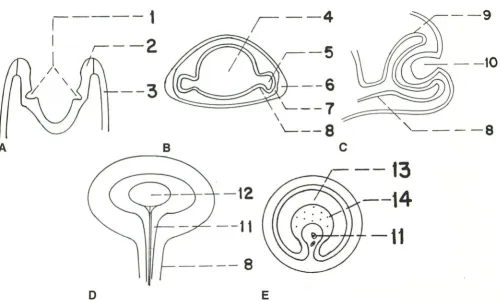
By the 24th day, while the neural tube is still open anteriorly, an ocular pit forms in each of the paired neural folds (Fig. 1A) and extends laterally to touch the surface ectoderm on its own side. As the optic pits deepen into sulci, neural crest cells insinuate themselves between the sur-face ectoderm and the neural ectoderm of the optic vesicles.
794 AJNR: 13, March/ April 1992
~--4
- - 9
r----2
--3
A
8
-12
- - - 8
D E
--6
\.__ -1
\\._ __ 8
c
" ' - - - - 8
--13
--14
-11
Fig. 1. A-D, Schematic drawings of early stages of eye development. £,Cross section of optic stalk with optic fissure. I, optic pits;
2, neural ectoderm; 3, surface ectoderm; 4, forebrain cavity; 5, optic vesicle; 6, lens placode; 7, neural crest; 8, optic stalk; 9, optic cup; 70, lens vesicle; I 1, optic fissure with hyaloid vessels; I2, lens; I3, optic stalk lumen; I4, axons from ganglion cells of the retina.
By the 26th day, the neural tube is closed at
the anterior neuropore. The optic pits have
deep-ened and expanded to form prominent outpouch-ings, the optic vesicles, that now project from the neural tube on short necks (the primitive optic stalks) (Fig. 18). The surface ectoderm overlying
the vesicles thickens and forms a lenticular plac-ode which then invaginates and, through multiple
steps, eventually forms the lens. At the same
time, the optic vesicle invaginates to form a cup
with an outer layer of cells destined to become the retinal pigment epithelium, an inner layer destined to form the neurosensory retina, and an
intervening cavity called the subretinal space. This process can be compared to a hollow rubber ball where one side has been pushed in against
the opposite side (Fig. 1 C). However; the optic cup is not completely continuous; ventrally it
contains a fetal (embryonic) fissure that permits
mesenchymal and vascular tissues (the hyaloid
artery) to enter the globe (Fig. 1D). This fissure
extends along the optic stalk. In normal
devel-opment, the fissure is eventually closed at its
margins by multipotential cells.
During its development, the eye has a
transi-tory vascular system (the hyaloid artery and branches) (Fig. 1D) that forms the primary vitre-ous and nourishes the structures of the eye. This primitive vascular system involutes by the 35th week of gestation. The vascular primary vitreous also atrophies, and secondary vitreous is formed. The optic nerve develops in the optic stalk, which connects the optic vesicle to the forebrain cavity (Fig. 18). A single layer of undifferentiated neuroectodermal cells that lines the cavity of the forebrain is continuous with the retinal pigment epithelium of the outer cup (4). During the invag-ination of the optic vesicle, there is also invagi-nation of the optic stalk (Fig. 1E). At the sixth week, axons from ganglion cells of the retina
grow posteriorly into the optic stalk, toward the central nervous system. There is also proliferation of glial cells to form a supporting framework and mantle for the optic nerve. During normal embry-ogenesis, an excess of ganglion cells is generated. All these ganglion cells send axons into the optic stalk toward the brain. Those axons that do not make appropriate connections or do not reach
[image:2.613.59.560.74.375.2]degenera-AJNR: 13, March/ April 1992
[image:3.615.55.273.74.564.2]B
Fig. 2. Right secondary anophthalmia and left congenital cystic eye.
A, Axial CT shows absence of the right globe. Somewhat thickened rectus muscles lying in the center of the orbit extend to irregular soft tissue that does not have any characteristics of a globe. The left orbit contains a congenital cystic eye (arrow) with a centrally located malformed lens and a small calcific density at its posterior aspect.
8, Histologic section of the congenitally cystic eye demon-strates the abnormal, centrally located lens (open arrow), disor-ganized retinal tissue (closed arrows) that extends into the optic stalk, and bony tissue (arrowhead) adjacent to the cystic eye.
tion of optic nerve fibers and retinal ganglion cells
(10).
Once the lumen of the stalk is obliterated by
795
Fig. 3. Coloboma of the left posterior globe (morning glory syndrome). Axial CT demonstrates a smaller left globe with prominent outpouching posteriorly. (Case courtesy of Thomas P.
Naidich, MD, Miami, FL.)
Fig. 4. Microphthalmia with cyst. Axial CT shows a small deformed right globe with a centrally located lens (open arrow) and calcified or ossified tissue (arrow) at the junction of the globe with the cyst (arrowheads). Extreme microphthalmia is present on the opposite (left) side.
the process of invagination and by the subse-quent growth of axons, the direct communication between the cavity of the optic vesicle and the third ventricle is lost. The optic recess on the floor of the third ventricle represents the site of the original connection (4) and is the only residual of the previous direct communication between the third ventricle and the eye.
Initially, the chiasm is formed only from crossed optic nerve fibers. Later, between the 11th and 13th weeks, uncrossed fibers enter the chiasm. Myelination begins posteriorly in the re-gion of the geniculate bodies at about the fifth month and reaches the globe by the eighth month
(4).
Anophthalmia and Microphthalmia
[image:3.615.347.530.79.193.2] [image:3.615.330.567.259.401.2]796
Complete failure of eye development is extremely rare. Only histologic examination can differentiate between true anophthalmia and severe micro-phthalmia. In cases of microphthalmia, ocular structures are identified, whereas they are absent in primary anophthalmia.
Microphthalmos is considered simple or pure when the eye is small but anatomically correct, and complex when the eye is malformed (11). Some use the term nanophthalmos to refer to the simple microphthalmos, but others reserve this term for those cases where there is marked de-crease in the axial length of the eye (less than 18 mm), microcornea, and absence of systemic ab-normalities (12). Microphthalmos, whether simple or complex, can be unilateral or bilateral; it can be the only abnormality or it can be as·sociated with systemic disorders that may be due to ge-netic causes (eg, microphthalmos is present in 75% of Trisomy 13 patients), environmental causes (viral prenatal infections), or unknown causes (13). Weiss et al (11, 12) proposed that the pathogenetic mechanism for complex micro-phthalmos is inadequate production of secondary vitreous. They also stated that small optic cup, low intraocular pressure, altered vitreous proteo-glycans, and abnormal release of growth factors play a role in the development of simple micro-phthalmos. The complex microphthalmos is fur-ther subdivided into two categories: noncolobom-atous and colobomnoncolobom-atous forms.
Congenital Cystic Eye
If the invagination of the optic vesicle does not occur or is incomplete, then a congenital cystic eye results (Fig. 2). This is an extremely rare condition. Microscopic examination reveals the cyst to be lined by malformed retina that shows an inverted arrangement of its layers, because there has been no invagination. That is, the outer layer lies on the side towards the cavity of the cyst (14) (Fig. 28). Tendons of extraocular mus-cles insert into the outer fibrous wall of the cystic eye and there is an abnormal lens (Fig. 2). Imaging studies may not be able to differentiate this entity from a very disorganized severe microphthalmia.
Colobomas
The term coloboma is of Greek origin meaning curtailment and is used in ophthalmology to refer to defects in ocular structures (14). Those colo-bomas that result from failure of the embryonic
AJNR: 13, March/ April 1992
A
8
Fig. 5. Microphthalmia with cyst.
A, Photograph of child with right microphthalmia and a huge
cyst that obscures the small eye.
B, Histologic section from another case demonstrates a smaller
malformed globe with an abnormal, centrally located lens (open arrow) and neuroectodermal tissue (solid arrow) prolapsing
through a coloboma into a much larger cyst. (Case courtesy of Dr Morton Smith, Washington University, Seattle, WA.)
choroidal fissure to close properly are classified as typical colobomas (15). Colobomas are com-mon malformations, constituting about 2% of all congenital abnormalities. They are usually bilat-eral (16).
[image:4.612.345.561.74.399.2]AJNR: 13, March/ April 1992 797
A
8
c
D
E
Fig. 6. Microphthalmos with a cyst.
A, Axial CT reveals a very small malformed globe (arrow) with centrally located lens lying medial to a huge cyst which has expanded the bony orbit.
8, Axial MR at the same level reveals a small deformed medially· located globe and a huge cyst that contains a smaller cyst (arrowheads) adjacent to the lateral aspect of the abnormal globe. The second centrally located cyst was not identified on CT.
C, Axial CT section slightly superior to A reveals extraocular muscles and an optic nerve sheath complex (arrow) that extends to the
abnormally small globe.
D, Coronal MR demonstrates the small deformed globe containing a lens (arrow). These lie inferomedial to the huge cyst.
E, Coronal MR slightly posterior to D reveals the smaller centrally located cyst whose wall is continuous with abnormal tissue (arrow)
that is continuous with the abnormally small globe. (Case courtesy of Richard Boyer, MD, Primary Children's Medical Center, Salt Lake
City, UT.)
Fig. 7. Aplasia of the right optic nerve. Axial Tl MR shows only the intracranial segment of the left optic nerve (arrow). No
right optic nerve could be identified intracranially or within the
right orbit.
Microphthalmia with Cyst
Microphthalmos with cyst is a severe colobom-atous malformation that results when neuroec-todermal tissue (the inner layer of the retina) proliferates at the margins of the unclosed fetal fissure and protrudes outward forming a cyst or cysts (14, 18). The sizes of the eye and the cyst vary: the globe may be near normal size or small and the cyst small (Fig. 4), or there may be a tiny malformed eye with a huge cyst (Figs. 5 and 6). This entity may be associated with numerous systemic abnormalities.
[image:5.614.58.558.81.348.2] [image:5.614.47.284.475.684.2]798 AJNR: 13, March/April 1992
A B
c
Fig. 8. Marked bilateral optic nerve hypoplasia with pituitary anomaly.
A, Proton density MR demonstrates tiny optic canals (arrowheads). The right optic nerve sheath complex (arrow) is very small.
8, Slightly higher MR section demonstrates extremely small intracranial optic nerves (arrows).
C, Sagittal MR shows absence of the pituitary stalk. There is abnormally high signal intensity (arrow) in the inferior hypothalamus at
the site where the pituitary stalk would be expected to have arisen.
Optic Nerve Aplasia and Hypoplasia
Optic nerve aplasia is due to failure of the embryonic fissure to reach the optic stalk. It is a sporadic, unilateral condition and is not associ-ated with any systemic abnormalities (Fig. 7) (3).
Optic nerve hypoplasia (Fig. 8) is a subnormal number of axons. It is a frequent congenital anomaly that may be isolated or may be associ-ated with ocular, facial, endocrine, or central nervous system anomalies (10). Among such entities are septo-optic dysplasia (Fig. 9) and encephalocele. One prospective study of 93 chil-dren with optic nerve hypoplasia found that those children who had bilateral optic nerve hypoplasia and poor vision had the highest incidence of associated nonocular congenital abnormalities and medical problems (10). In this study, devel-opmental delay was the most frequently associ-ated abnormality, and hypothyroidism was the most frequent endocrine disturbance. Those chil-dren that had bilateral optic nerve hypoplasia with good vision or those that had unilateral optic nerve hypoplasia fared much better.
The proposed pathogenesis of optic nerve hy-poplasia is excessive degeneration of optic nerve axons and retinal ganglion cells during develop-ment of the eye and visual pathways (much more than the normal amount) (10). Thus, one cause of optic hypoplasia can be major· midline and hemispheric anomalies that prevent the axons of the retinal ganglion cells from making connec-tions at their intracranial target sites. However, there are cases where the optic nerve hypoplasia is the only abnormality. In these instances, the
pathogenesis may be primary agenesis of retinal ganglion cells.
In children with optic nerve hypoplasia, imag-ing studies are of great value to exclude any associated intracranial abnormality. The imaging studies demonstrate small optic nerves and chiasm, display the morphology of the pituitary gland (Fig. 8) and depict associated brain anom-alies (Fig. 9). Slight symmetrical decrease in the size of the optic nerves may be difficult to appre-ciate on imaging, just as it is difficult to appreciate clinically. Marked decrease in the size of the optic nerves or unilateral involvement is much more easily detected.
Persistent Hyperplastic Primary Vitreous
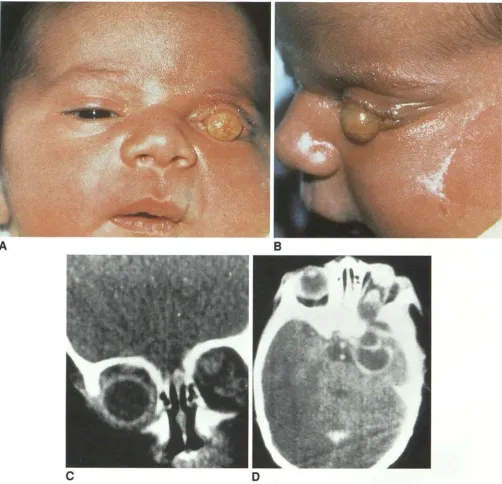
Persistent hyperplastic primary vitreous (PHPV) (Fig. 1 0) results when the embryonic
[image:6.614.61.559.77.239.2] [image:6.614.317.562.501.683.2]AJNR: 13, March/April 1992 799
A
B
Fig. 10. Persistent hyperplastic primary vitreous. Four different cases.
A, Photograph of a child with left leukocoria due to persistent hyperplastic primary vitreous.
B, Histologic section of persistent hyperplastic primary vitreous shows the abnormal lens (arrow) and
triangular fibrovascular material (arrowheads) extending from it toward the optic nerve head. The retina (open arrows) is detached.
C, Axial CT reveals a smaller right globe with tissue of increased attenuation (arrows) surrounding the posterior aspect of the right lens and extending posteriorly toward the right optic nerve head.
D, Axial T2 MR demonstrates a deformed lens with prominent retrolental tissue (arrowhead) that has a thinner band of tissue (arrow) extending from it toward the posterior aspect of the globe.
intraocufar vascular system (hyaloid artery with its branches) and the fibrovascular tissue of the primary vitreous fail to regress normally (20). It occurs in normal full-term infants, is usually uni-lateral and is usually associated with
microphthal-mos. The most typical clinical findings are
leu-kocoria (white pupil), microphthalmia, and cata-ract (21). The presence of microphthalmia and absence of calcification are important factors
differentiating PHPV from retinoblastoma, since
retinoblastoma also presents with leukocoria but
typically shows calcifications and a globe that is
normal in size or enlarged. Glaucoma is a
rela-tively frequent complication of PHPV (26% in one
series) and thus the affected eye may be
buphth-almic (21 ). Other complications that may occur
include recurrent spontaneous hemorrhages,
ret-inal detachment, and phthisis bulbi.
In PHPV, histologic examination reveals a
hy-aloid artery that extends from the optic disc to a
fibrovascular retrolental tissue (22) (Fig. 1 OB).
Imaging studies, CT and MR, demonstrate a
smaller globe with increased attenuation or
hy-perintensity on T1-weighted images and tissue
that extends from the posterior aspect of the lens
to the back of the globe in a band-like or
trian-gular configuration (20, 23, 24).
Congenital Glaucoma
Glaucoma is a condition that results from ab
-normal elevation of intraocular pressure. The
[image:7.612.59.563.68.535.2]800
A
B
c
Fig. 11. Severe primary congenital glaucoma of the left eye.
A, Three-dimensional soft tissue CT shows marked enlarge-ment of the left eye that protrudes between the lids.
8, Three-dimensional bone CT shows enlargement of the bony left orbit.
C. Axial CT demonstrates prominent diffuse enlargement of the left eye, particularly the anterior chamber. The left lens is flattened. There is slight indentation (arrow) at the optic nerve head consistent with cupping.
increased resistance to normal outflow of aqueous humor from the eye. Primary congenital glaucoma is most frequently due to abnormal development of the trabecular meshwork. Ander-son's investigations (25) suggest that the primary defect of congenital glaucoma may be premature or excessive formation of collagenous beams within the trabecular meshwork. These beams are thought to generate traction forces that cause compaction of the trabecular sheets with conse-quent obstruction to the outflow of aqueous
hu-mor (25).
Congenital glaucoma is bilateral in up to 80% of cases (26). It may be the only abnormality, or
AJNR: 13, March/ April 1992
A
B
Fig. 12. Cryptophthalmia.
A, Photograph of the infant shows total absence of the eyelids and continuous skin from forehead across the orbits to the cheeks. (Case courtesy of Dr. James Katowitz, The Children's Hospital of Philadelphia, PA.)
8, Axial CT shows malformed anterior structures of each globe
and continuity of the skin (arrow) with the tissue of the orbits. There is absence of the cornea, anterior chamber, and lens on each side. (Reprinted with permission from Levine et al (28).)
it may occur in association with other develop-mental disorders including phakomatoses. The glaucoma may minifest itself at birth or during the first few years of life. Increase in intraocular pressure causes enlargement of the entire eye (Fig. 11).
[image:8.615.341.555.68.440.2] [image:8.615.86.272.81.430.2]AJNR: 13, March/April 1992
Cryptophthalmos
Cryptophthalmos ("hidden eye") results when the lid folds fail to develop. Cryptophthalmos is considered typical when there is complete ab-sence of the lids (complete ablepharia) and the skin is continuous from the forehead, across the orbits, to the cheeks (27) (Fig. 12). The skin over the globes is shown pathologically to be corneal epithelium that has undergone metaplastic change (2). There is absence of eyelashes, mei-bomian glands, lacrimal glands, lacrimal puncta, and usually also eyebrows (27). Cryptophthalmos is not an isolated anomaly but is part of a sys-temic syndrome that often includes anomalies of face, cranium, extremities, and urogenital system
Fig. 13. Dermoid cyst. Axial CT demonstrates a heterogeneous . mass with a wall of higher attenuation (arrowhead). The content
of the mass is heterogeneous with some fatty tissue (low
atten-uation). In addition, the dermoid extends into the frontal zygomatic suture (arrow).
A
BFig. 14. Left orbital teratoma.
801
(28). Imaging studies are needed to demonstrate the globes and the rest of the intraorbital
struc-tures prior to surgical intervention.
Obstruction of the Nasal Lacrimal Duct
The nasal lacrimal duct forms in the
invagin-ated surface ectoderm between the inner canthus
and the inferior turbinate. Obstruction of this duct
is a frequent anomaly and is usually due to an
imperforate membrane at the lower end of the
duct (29). The membrane consists of epithelium
of the lacrimal duct and the mucosa of the nose.
The obstruction is manifested by overflow of tears (epiphora), or less commonly by a dacry
-ocystocele. Imaging studies are helpful in differ-entiating this entity from other masses that may present in the newborn.
Congenital Tumors of the Orbit
Congenital tumors of the orbit may be derived from one germ cell layer, such as dermoid cysts, from two germ cell layers (teratoid tumors), or from three germ cell layers (teratoma) (30). These congenital tumors are not true neoplasms but
developmental choristomas-that is, malformed
tissue found at a site that normally does not contain that tissue.
Dermoid and Epidermoid Cysts
Dermoid and epidermoid cysts originate from
sequestered embryonic surface ectoderm and
oc-c
A, Photograph of a child shows marked protrusion of the globe by a large posteriorly located mass that has expanded the orbit.
[image:9.615.79.297.288.400.2] [image:9.615.53.560.479.689.2]802 AJNR: 13, March/ April 1992
A B
c
DFig. 15. Orbital teratoma.
A, Frontal and B, Left lateral views of the child show protrusion of the markedly deformed globe anteriorly through the palpebral
fissure.
C, Coronal CT shows heterogeneous irregular tissue within the left orbit.
D, Contrast-enhanced axial CT reveals multiloculated cystic tissue that extends from the orbit into the left temporal fossa. At surgery, the teratoma lay entirely anterior to the temporal dura. Histologic evaluation of the tumor revealed tissues with pulmonary, gastrointestinal, muscular, and renal characteristics. Histologic examination of the globe revealed severely dysplastic microphthalmia with absent lens, iris, and anterior charnber segments; persistent hyperplastic primary vitreous; and retinal dysplasia. (Case courtesy of Lucy Rorke, MD, Philadelphia, PA.)
cur frequently in the orbit. They are typically
located at the site of sutures, particularly the
zygomaticofrontal and frontoethmoidal sutures.
Dermoid cysts are the most common pediatric
[image:10.614.60.562.80.564.2]con-AJNR: 13, March/ April 1992
sist of adnexal structures but may contain
cho-lesterol in addition to epithelial debris. Imaging
studies reveal the cysts as well-defined masses that may have thin walls. The cysts may be homogeneous or heterogeneous ( Fig. 13)
con-taining tissue ranging from muscle to fat in radio-density and signal intensity. Some lesions may contain a fat-fluid level or may be diffusely fatty.
Larger lesions may produce scalloping of the adjacent bony wall or even expansion of the entire orbit.
Congenital Orbital Teratoma
Orbital teratomas are rare congenital tumors that contain tissue derived from all three germ cell layers and are usually benign (30). In most instances, the tissue is disorganized, but some teratomas may actually have fetal features. One theory of pathogenesis of the teratomas is lack of normal response of tissue to inducers (31, 32). The most common presentation of a teratoma is extreme unilateral proptosis in an otherwise healthy full-term infant (30) (Fig. 14A). The tumor usually grows rapidly after birth. Most typically, the tumor is multicystic (Figs. 14 and 15), and ·
may be mixed cystic-solid or completely solid. Usually the bony orbit is markedly expanded and is two to three times its normal size (Fig. 14).
Rarely the teratoma may extend intracranially (33) (Fig. 15). Imaging studies permit delineation and characterization of the lesions, which leads to correct diagnosis, even when the clinical
find-ings are confusing. Teratomas need to be differ-entiated from other congenital lesions, such as microphthalmos with cyst, dermoid cyst, congen-ital cystic eye, hemangioma, and meningoen-cephalocele.
References
1. Ozanics V, Jakobiec FA. Prenatal development of the eye and its adnexa. In Jakobiec FA, ed. Ocular anatomy, embryology and ter a-tology Philadelphia: Harper and Row, 1982:11-96
2. Duke-Elder S, Cook C. Normal and abnormal development. In Duk e-ElderS, ed. System in ophthalmology Vol 3. St. Louis: Mosby, 1963 3. Smith CG, Gallie BL, Morin JD. Normal and abnormal development of the eye. In Cawford JS, Morin JD, eds. The eye in childhood. New
York: Grune and Stratton, 1983:1-17
4. Torczynski E. Normal development of the eye and orbit before birth: the development of the eye. In Isenberg SJ, ed. The eye in infancy, Chicago: Year Book Medical, 1989:9-30
5. Spaeth GL, Nelson LB. Beaudoin AR. Ocular teratology. In Jakobiec FA, ed. Ocular anatomy, embryology and teratology Philadelphia: Harper and Row, 1982:955-1080
803
6. Hooper KD. Haas, Sherman JL. The radiologic evaluation of congen -ital and pediatric lesions of the orbit. Semin Ultrasound CT MR 1988; 9:413-427
7. Fries PD. Katowitz JA. Congenital craniofacial anomalies of ophthalmic importance. Surv Ophtha/mol 1990;35:87-119 8. Morriss GM, Thorogood PV. An approach to cranial neural crest cell
migration and differentiation in mammalian embryos. In Johnson MH, ed. Development in mammals. Amsterdam: North-Holland, 1978: 363-412
9. Seve! D. A reappraisal of the origin of human extraocular muscles.
Ophthalmology 1981 ;86: 1330-1338
10. Skarf B, Hoyt CS. Optic nerve hypoplasia in children. Arch Ophthal
-mol 1984; 102:62-67
1 I. Weiss AH, Kousseff BG, Ross EA, Longbottom J. Complex micro-phthalmos. Arch Ophtha/mo/1989;107:1619-1624
12. Weiss AH, Kousseff BG, Ross EA, Longbottom J. Simple micr
o-phthalmos. Arch Ophthalmo/1989; 107:1625-1630
13. Bateman JB. Microphthalmos. lnt Opthalmol Clin 1984;24:87-1 07 14. Mann L Developmental abnormalities of the eye. 2nd ed. Philadelphia:
Lippincott, 1957
15. Pagan RA. Ocular coloboma. Surv Ophthalmol 1981 ;25:223-236
16. Mafee MF, Jampol LM, Langer BG, Tso M. Computed tomography of optic nerve colobomas, morning glory anomaly and colobomatous cyst. Radio/ Clin North Am 1987;25:693-699
17. Apple DJ. New aspects of colobomas and optic nerve anomalies. lnt Ophthalmol Clin 1984;24: 109-121
18. Foxman S, Cameron JD. The clinical implications of bilateral micr o-phthalmos with cyst. Am J Ophthalmol 1984;97:632-638
19. Weiss A. Martinez C. Microphthalmos with cyst: clinical presentations and computed tomographic findings. J Pediatr Ophthalmol Strabi
s-mus 1985;22:6-12
20. Magill HL, Hanna SL, Brooks MT, et al. Cases of the day: pediatric. RadioGraphies 1990; 10:515-518
21. Haddad R, Font RL, Reeser F. Persistent hyperplastic primary vitreous: a clinicopathologic study of 62 cases and review of the literature.
Surv Ophthalmol 1978;23: 123-134
22. Reese AB. Persistent hyperplastic primary vitreous. Am J Ophtha/mol
1955;40:317 -331
23. Mafee MF, Goldberg MF. Persistent hyperplastic primary vitreous
(PHPV): role of computed tomography and magnetic resonance.
Radio! Clin North Am 1987;25:683-692
24. Mafee MF, Goldberg MF, Valvassori GE, Capek V. Computed tom og-raphy in the evaluation of patients with persistent hyperplastic pri-mary vitreous. Radiology 1982;145:713-717
25. Anderson DR. The development of the trabecular meshwork and its
abnormality in primary infantile glaucoma. Trans Am Ophthalmol Soc 1981 ;79:458-485
26. Spencer WH. Glaucoma. In Spencer WH, ed. Ophthalmic pathology
VoL 1. Philadelphia: W. B. Saunders, 1985:526-537
27. Francois J. Malformative syndrome with cryptophthalmia. Jnt Ophthalmol Clin 1968;8:817-837
28. Levine RS, Powers T, Rosenberg HK, Siegel CA, Bilaniuk LT. The cryptophthalmos syndrome. Am J Radio/ 1984; 143:375-376 29. Kushner BJ. Congenital nasolacrimal system obstruction. Arch
Ophthalmol 1982; 100:597-600
30. Levin ML, Leone CR, Kincaid MC. Congenital orbital teratomas. Am J Ophthalmol 1986;102:476-481
31. Krafka J. Teratoma. Arch Pathol 1936;21:756-764
32. Alkemade PPH. Congenital teratoma of the orbit. Ophthalmologica
1976; 173:274-285
33. Ide CH, Davis WE, Black SPW. Orbital teratoma. Arch Ophthalmol