THE WORK AND ENERGETIC COST OF LOCOMOTION
I. THE EFFECTS OF LIMB MASS DISTRIBUTION IN QUADRUPEDSBY K A R E N S T E U D E L
Department of Zoology, University of Wisconsin-Madison, Madison, WI53706, USA
Accepted 29 May 1990
Summary
Does limb design influence the cost of locomotion in quadrupedal mammals? If not, morphologists must dismiss the economy of locomotion from consideration when assessing the adaptive factors shaping limb structure. Several studies have recently used externally applied loads to demonstrate a relationship between limb mass distribution and energy costs in human subjects. It is not clear whether a similar correlation would hold for quadrupeds, given their very different gaits. The present study addresses this question by measuring the rate of oxygen consumption in domestic dogs running on a treadmill with mass added either to the limbs or to the back. Trials with no additional mass were used as a control. The use of externally applied loads has the advantage of allowing limb mass to be altered in a system in which other aspects of physiology that might influence cost of locomotion are held constant. The cost of adding mass to the limbs in dogs was found to be significantly greater than that of adding it at the center of mass. Limb mass distribution does affect the cost of locomotion in quadrupeds. A comparison of the results from a variety of studies in which the energetic cost of adding external loads has been measured in animals across a wide size range suggests a qualitative difference in the factors determining the cost of locomotion in large and small animals.
Introduction
Locomotion is a critical aspect of the biology of any animal, yet the adaptive constraints associated with it are not well understood. Discussions of the selective forces likely to be acting on locomotor structures in mammals have focused on three major factors: mechanical resistance to the stresses induced by locomotion (McMahon, 1973; Lanyon and Baggott, 1976; Lanyon, 1981; Alexander, 1981, 1984; Biewener et al. 1983), generation of speed and/or power (Smith and Savage, 1955; Alexander, 1977; Steudel, 1981) and determination of the energetic cost of locomotion (Howell, 1944; Gray, 1968; Taylor et al. 1974; Alexander, 1982).
The significance of the last of these factors the energetic cost of locomotion -has been seriously questioned as an important force shaping the evolution of limb Structure as a result of a study in which no difference in cost was detected in three
species, cheetah, goat and gazelle, that differ substantially in limb morphology (Taylor et al. 1974). As a consequence, many workers have ruled out selection for energetic efficiency as an important design constraint on animal limb structure (Fleagle, 1979; Hurst etal. 1982; Williams, 1983). Other workers (Hildebrand and Hurley, 1985; Hildebrand, 1988), however, have resisted this conclusion.
To determine whether a controlled experiment could detect a difference in cost in response to differences in limb mass distribution, Myers and Steudel (1985) studied human subjects with externally applied loads. Their design allowed limb mass and its distribution to be altered in a system in which other factors that might influence locomotor energetics, such as differences in locomotor physiology and daily fluctuations within a subject, were minimized. The results showed a consistent, statistically significant, increase in the cost of locomotion when mass was added to the legs of a subject compared with the results when the same mass was added at the waist. Thus, it became clear that experimental alterations of limb mass and its distribution affect locomotor cost, at least in bipedal humans. Other experiments on human subjects have documented similar increases in cost as a result of externally applied limb loads (e.g. Martin, 1985; Claremont and Hall, 1988).
It is not clear, however, whether these results can be generalized to non-human locomotion (Cavanagh and Kram, 1985). The results of the comparative study of cost in the cheetah, goat and gazelle (Taylor et al. 1974) would seem to imply that they cannot. The bipedal gait of humans produces substantially different kinema-tic patterns from those of quadrupeds, with potentially different capacities for the storage and recovery of elastic strain energy and/or the transfer of energy between body segments or between kinetic and potential energy. Furthermore, humans do not show the pronounced morphological modifications of their limbs characteristic of many cursorial quadrupeds of similar mass. To date there has been no analogous experiment to determine whether the cost of locomotion in quadrupeds varies with differences in limb loading.
To remedy this situation, the present study measures changes in the energetic cost of locomotion of domestic dogs produced by experimentally adding mass either to the limbs or to the body center of mass. As in the experiment on human subjects (Myers and Steudel, 1985), this design allows experimental control of many variables other than limb inertia that might influence cost. The results of this study are used to evaluate the earlier conclusion that limb mass distribution has no apparent effect on the cost of locomotion.
The metabolic impact of adding mass to animals of different size in this and other studies are compared in order to investigate the scaling of the relationship between the mechanical work of locomotion and its energetic cost.
Materials and methods
Experimental approach
at 1.56ms"1, a slow trot, under three different loading conditions. In all trials the dogs wore a commercially available dog harness around their shoulders and specially constructed Neoprene casings on all four limbs. The two experimental conditions involved adding 0.77 kg of lead either to the dog's harness or distributed equally on the four limbs. The casings were positioned so that the mass was added at the level of the radius and ulna on the forelimb and at the level of the metatarsals on the hindlimb. All loads were firmly attached to minimize extraneous movement, but were not so tight as to cause the animals any detectable discomfort. Runs in which the animals wore the harness and the casings with no added mass were used as a control. The purpose of the trials with the mass added to the harness was to provide a measure of the effect of a 0.77 kg mass affecting only the work done to raise and reaccelerate the center of mass of the body. Addition of mass to the limbs increased not only the total mass raised and reaccelerated, but also the work done to move the limbs relative to the center of mass.
The object of this experimental design was to alter the mass and inertia of the limbs to an extent similar to that which might occur during the evolution of a less cursorial locomotion, without producing any concomitant changes in limb length (which would be likely to change stride length and frequency), intrinsic speed of contraction of locomotor muscles, the capacity of the limbs to store energy elastically, and so forth. The fact that naturally evolved differences in limb mass and moment of inertia are likely to be accompanied by changes in these and other factors that may influence cost of locomotion make such natural variation unsuitable for investigating the specific effect of mass distribution on cost.
The training period in which the animals were accustomed to the treadmill, the weighting system and an open-circuit respiratory gas analysis system lasted 4 months. The rate of oxygen consumption (VO2) under the various loading
conditions gradually declined over the training period. The animals were considered trained when the VO2 values for each animal under each test condition
no longer decreased with training. All data used in the analysis were taken after the animals had reached the trained state.
Measurement of oxygen consumption
Rates of oxygen consumption (VO2) were measured using an Applied
The analyzer and flow meters were calibrated at the beginning and end of every test session using the one-step N2 dilution technique described by Fedak et al. (1981), which has been found to be accurate to better than ±3 %. A small stream of the expired gases was removed from the main flow downstream from the flow meter and diverted through Ascarite and Drierite to the oxygen analyzer for continuous monitoring of its fractional concentration of oxygen. Runs continued until values leveled off, between 7 and 20min into a run, signalling that a steady state had been achieved, V ^ values for the last three successful runs for each dog under each of the three test conditions were used for data analysis.
Estimation of changes in limb inertial properties
These experiments tested whether an increase in limb mass produced an increase in the cost of locomotion when other physiological variables were held constant. To evaluate the significance of any increase in VO2, it is useful to assess
the extent to which the limb loads alter the inertial properties of the limbs. Based on the work-energy theorem (e.g. Halliday and Resnick, 1981), the internal work of locomotion, i.e. the work done to move the body segments relative to the center of mass, can be considered approximately equal to the sum of the changes in kinetic energy (Eke) and potential energy (Epe) of the body
segments. The body can be treated as a series of linked, rigid segments between which energy can be exchanged. At any instant the total energy change of the body is equal to the sum of the changes in Eke and Epe of its segments. The Eke of each
segment is the sum of its translational and rotational components (Cavagna and Kaneko, 1977; Fedak et al. 1982),
Eke = (l/2)Mv2 + (l/2)I0co2, (1)
where M is the mass of the segment, v is the linear velocity of its center of mass relative to the center of mass of the body, u> is its angular velocity and Io is the
moment of inertia of the segment about its center of mass. The potential energy of a segment is expressed as:
£pe = Mgh , (2)
where g is the acceleration due to gravity and h is the vertical displacement of the center of mass of the segment.
The relevance of these equations is that they indicate which morphological parameters affect internal work. Mass is an important aspect of potential energy and translational kinetic energy, while the moment of inertia about the center of mass is important because of its role in defining rotational energy as indicated above. Also relevant is the distance between the point of rotation and the center of mass (d) because:
v = (od. (3)
combination of the three aspects of work or energy that are determined morphologically.
2 (4)
It would be feasible to calculate the average effective 7p of limbs across a series of individuals or species by filming the animals, documenting the position of the segments at each instant, determining the mass, center of mass and moment of inertia of each segment, and combining this information into an estimation of average limb 7p for a stride. This approach, however, suffers from a major disadvantage. The effective limb 7p calculated by this method will differ within an individual as its speed changes and between individuals and species as a result of variation in both morphology and gait kinematics. It therefore confounds changes in 7p produced by morphological alterations with changes in 7p produced by kinematic variation. Because limb inertial characteristics and gait kinematics may vary independently and are both of interest, it seems advisable to describe the morphological component of 7p in a way that is independent of variation in gait. Consequently, the effect on limb mass distribution of the loads added to the distal limb segments has been estimated by calculating 7p as though the limb was a single rigid body arranged with segments extended - a single, standardized configuration. The alteration in 7p produced as a result of the addition of mass at a measured distance from the proximal point of rotation (the shoulder or hip joint) was calculated as described below. Estimation of limb moment of inertia based on particular segment configurations has also been used by Jayes and Alexander (1982).
Limb moments of inertia about the point of rotation have been determined experimentally for a sample of 12 dead dogs on which total body mass and a series of variables describing limb morphology have also been measured (K. Steudel and M. J. Myers, in preparation). Limb length was found to be an excellent predictor of limb inertia in the forelimb and the hindlimb, which both have coefficients of determination (r2) of 0.97. These regression equations were used to estimate
unloaded limb moments of inertia for the three dogs used in this study based on measurements of their limb lengths.
The moment of inertia of the load about the proximal joint of the limb (7p) was determined experimentally by fastening the 0.19 kg loads (the amount added to the casings on each limb) to a free-swinging metal rod, which was suspended at one end. The swing period of the rod plus load was determined in a series of tests with the load positioned at distances from the pivot equivalent to the distances of the load from the proximal joint in the forelimbs and hindlimbs of each of the three dogs. The swing period of the rod alone was also measured. The moments of inertia for the rod (7r) and for the rod plus load combination (7r+i) were calculated using the equation:
7p = ?mgd/Aj? , (5)
point to the center of mass of the system. The moments of inertia of the load itself at the various distances from the pivot were calculated by subtracting /r from each /r +i . These values were then used to calculate the absolute and percentage increases in limb moment of inertia produced by the loads for each limb of each dog, modelling the limb as a single rigid body.
All trials were videotaped at 200 frames s"1 using a NAC high-speed video camera. Stride frequency was measured for each trial by counting the number of fields per stride and averaging over 10 strides. Knowing the tape speed allowed conversion to strides per minute.
Results
Rates of oxygen consumption for unloaded dogs were similar to those observed by previous investigators. Expected VOl values calculated from data reported by
Taylor et al. (1970) for an 18 kg dog were slightly higher than those obtained here, while expected values calculated from data reported by Cerretelli et al. (1964) for a 24 kg dog were slightly lower.
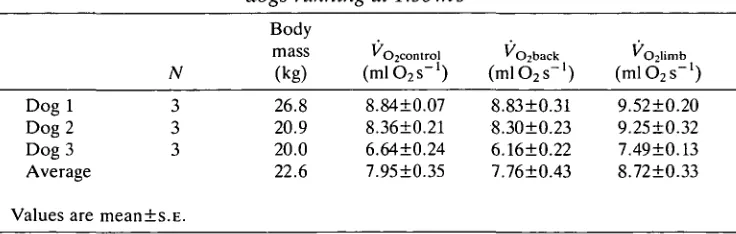
VO2 values for each subject under each of the three loading conditions are given
in Table 1. In all subjects, trials with limb loads produced significant increases in cost compared with back-loaded runs and control runs (P<0.001, N=6, two-tailed Mest). There was no significant difference between back-loaded trials and control runs (/»=0.344).
That the effect of the loads was similar in the three dogs tested can be verified using analysis of variance (ANOVA) with VOl as the dependent variable and dog
and loading condition as independent variables. Both dog and loading condition had significant individual effects on VOl (P<0.001), but there was no significant
interaction (P=0.472). This indicates that, although the dogs differed in VO2 (due
substantially to differences in their mass), they did not differ in the nature of their VOz responses to the loads.
[image:6.489.52.420.521.638.2]The estimated limb moments of inertia about the proximal joint for the loaded and unloaded limbs of the three dogs are shown in Table 2. The addition of the
Table 1. Rate of oxygen consumption of limb-loaded, back-loaded and unloaded
dogs running at 1.56ms~'
Dogl Dog 2 Dog 3 Average Values are
N
3 3 3
meanis.E.
Body (kg) 26.8 20.9 20.0 22.6
(ml STs™
1)
8.8410.07 8.3610.21 6.6410.24 7.9510.35
(mlC^T1)
8.8310.31 8.3010.23 6.1610.22 7.7610.43
(Jo's"
1)
Table 2. Estimated limb moments of inertia (lp) about the proximal joint and
increases in limb moments of inertia due to added loads
Dog 1 Dog 2 Dog 3 Forelimb Hindlimb Forelimb Hindlimb Forelimb Hindlimb
7p unloaded 5.78xlO5 9.95xlO5 3.86xlO5 5.66xlO5 4.19xlO5 4.59xlO5 (gem2)
/p loaded 6.88xlO5 12.44xlO5 4.86xlO5 7.76xlO5 5.20xl05 6.42xlO5 (gem2)
% increase 19 25 26 37 24 40
loads, representing between 2.9 and 3.9% increases in body mass, produced increases in moment of inertia of between 19 and 26% in the forelimb and between 25 and 40% in the hindlimb.
The dogs responded to the limb loads with a small decrease in stride frequency. The stride frequencies observed in the limb-loaded trials were significantly lower than those in control (P<0.001) or back-loaded trials (P<0.002). No significant difference was observed between stride frequencies in back-loaded and control trials (P=0.432). Stride frequency in the limb-loaded trials averaged 103.8 stridesmin"1 ( S . E . = 2 . 2 4 , N=9), 96% of that seen in both the control (average= 107.74stridesmin~\ S . E . = 2 . 5 7 , N=9) and back-loaded (average=108.34 strides
min"1, S . E . = 3 . 0 7 , N=9) trials.
Discussion
The effect of mass distribution on WO2
The addition of 0.77 kg of mass (2.9-3.9% of body mass) to the limbs of the dogs produced increases in VO2 that are qualitatively similar to those obtained in
analogous experiments on human subjects. In the current experiments, the average 3.5% increase in mass produced by the limb loads increased VOl by an
average of 9.9% over control values. In human subjects, the addition of a mass equivalent to 1.4-5.4 % of body mass resulted in increases in VOl of between 5.4
and 12.1% (Myers and Steudel, 1985; Martin, 1985; Claremont and Hall, 1988). Thus, increasing limb moment of inertia by using externally applied loads produces generally similar effects on cost in bipedal humans and quadrupedal dogs.
In the present study, the dogs showed a decrease in stride frequency with limb loading. The various experiments involving limb loads on human subjects have reported dissimilar effects of the loads on stride frequency. Martin (1985) reported a slight reduction in stride frequency, similar to that seen in these dogs, but Claremont and Hall (1988) noted the opposite - a slight increase in stride frequency in their limb-loaded human subjects.
consistent with previous findings. Taylor etal. (1980) measured the effect on VOl of
adding mass equivalent to 22 % and 27 % of body mass to the backs of dogs traveling at three different speeds. Calculation of the expected effect on VOl of
adding 0.77 kg of mass to the backs of dogs based on the data of Taylor et al. (1980) indicates that the expected increase would be of the order of 0.5 ml O2 s ~ \ within the range of experimental error. Cureton et al. (1978) found that the addition of a load equal to 10 % of body mass to the backs of human subjects did not have a significant effect on VOl. Nielsen et al. (1982) found that even a 25 % increase in
mass obtained with back loads did not produce a significant effect on VQ2 in ants.
Are the experimental changes in limb moment of inertia induced in this study of a magnitude that one might reasonably expect to see within natural populations? Limb moments in domestic dogs of similar body mass have been shown to vary by 3.4-fold in the hindlimb and 4.0-fold in the forelimb of domestic dogs of similar body mass (K. Steudel and M. J. Myers, in preparation). Owing to artificial selection, domestic dogs show greater morphological variation than will be found in most natural populations. Yet even dogs of the same breed (beagle) and similar mass showed 2.6-fold variation in moment of inertia in the hindlimb and 3.1-fold in the forelimb. Thus, the vastly smaller changes in limb moments produced in this study, between 19 and 40%, seem well within the range likely to be available for natural selection. This is especially true because measurement of 7p with the limb segments extended will tend to magnify the percentage change in Ip produced by
the loads because it assesses 7p when the added mass is at its most distant from the proximal point of rotation.
The influence of mass distribution on daily energy budget
That the addition of 0.77 kg (3-4 % of body mass) to the limbs of trotting dogs produced a 7-22 % increase in the rate of oxygen consumption while a similar load on the back produced no detectable effect demonstrates that mass distribution influences locomotor cost. But will these increased locomotor costs influence the total energy budget of an animal to such an extent that they create significant selection for more economical limb design?
Garland (1983) has estimated that the ecological cost of transport (the percentage of an animal's daily energy budget allotted to locomotion) should be approximately 10% for dogs of this size. The mass added in the present experiments would, therefore, increase the daily energy budget by approximately 1 %. Could such an increment in an organism's energy budget result in effective selection pressure?
I know of no studies that answer this question directly. That small changes in locomotor efficiency are detected and responded to by animals is suggested by data on the cost of locomotion in ponies. Rigorous training of the experimental animals coupled with data collection under very controlled conditions allowed Hoyt and Taylor (1981) to detect curvilinearity of the relationship between Vo,
midpoint of a gait range. Nevertheless, animals allowed to move freely selected speeds within each gait near the energetically optimal speed (Hoyt and Taylor, 1981).
Furthermore, several recent studies, albeit in completely different systems, suggest that energetic effects of very small magnitude can result in significant selection pressures. For example, Cowan and Farquhar (1977) found that time-varying adjustments of stomatal conductance in plants quantitatively match those predicted by an optimization model, and yet increase photosynthesis by only 2 % relative to a pattern of constant stomatal conductance. Givnish (1986) showed that leaf branching angles in the forest herb Podophyllum match the quantitative predictions of a model for minimum support costs, even though the variation in those costs within ±5° of the predicted and observed angle is considerably less than 1 % of the total biomass allocated to leaf, stem and vein tissue. Furthermore, Lande (1976) has shown that very weak selection (two selective deaths per million individuals per generation) can account for the evolutionary changes in paracone height and ectoloph length in the evolution of equids.
It should also be noted that Altmann (1987) has recently questioned the adequacy of the estimates of the distance moved daily on which Garland (1983) based estimates of the amount of energy allocated to locomotion as a percentage of the total. Altmann suggests that the energy required for locomotion might be several times higher than implied by the data on the ecological cost of transport quoted above. It seems, therefore, that variations in the cost of locomotion resulting from modest changes in limb mass distribution, such as those used in the present experiments, could indeed be the subject of selection to minimize daily energetic expenditures.
The influence of mass distribution on the duration of exercise
interpret-Table 3. Proportional changes in mean rates of oxygen consumption produced by
limb loads compared to proportional changes in mass
' o2
M VOl (M+ML)/M
Dog 1 1.03 1.07 1.04 Dog 2 1.04 1.11 1.07 Dog 3 1.04 1.13 1.09
M is the mass of the unloaded animal, ML is the mass of the load, VO2L and VOl a r e the rates of
oxygen consumption of the loaded and unloaded animal, respectively.
ation. More data are required, however, before this argument can be seriously evaluated.
The allometry of the effects of artificial loads on WO2
Taylor et al. (1980) analyzed their data on back loads by comparing the proportional increase in VOl with the proportional increase in mass. Table 3 shows
the results of an analogous approach to the limb load data from the present study. The proportional increase in Vo, for a given proportional increase in mass is
generally similar across dogs and speeds. The ratio {VO2^/Vo^/((M+Mi)lM),
where M is the mass of the animal, ML is the mass of the load and VO2,L is the rate
of oxygen consumption of limb-loaded animals, averages 1.06 (±0.02,7V=9) from the limb load data in the present study. This is significantly different (Student's Mest, P<0.05) from the average of 1.01 for dogs running with back loads sufficiently large to produce an effect on VOl (Taylor et al. 1980).
Although the double ratio tends to minimize the contribution of the increase in Vo2 due to the loads and the mass of the load by adding these effects to the unloaded values and then dividing by the unloaded value, it is useful for comparisons among species that differ widely in body size. Fig. 1 summarizes the results from a variety of studies in which varying amounts of mass were added to the limbs or backs of animals with a wide range of body mass. The line indicates the values that would be seen if the proportional increase in VOl were directly
proportional to the proportional increase in mass. It is apparent that adding mass to the limbs produces increases in VO2 that fall consistently above this line. Several
studies in which loads have been added to the backs of animals have produced a range of results. The results of Taylor et al. (1980) from rats, dogs, humans and horses all fall on or near the 1:1 line, as do the back loading data on humans from Myers and Steudel (1985). When very large loads (1.5-1.9 times body mass) were added in human subjects, however, VOl increased faster than mass, producing
values that fell above the 1:1 line (data from Soule et al. 1978). Very small animals, however, such as hermit crabs (Herreid and Full, 1986) and ants (Nielsen et al. 1982), showed a different pattern. In these animals, adding substantial load increased VO2, but the increase was not proportional to the increase in mas3
[image:10.491.50.422.98.164.2]Q.
3
2.0-
1.8-
1.6-
1.4
-
1.2-I
1.0-o a
/
V °
—a
a
/
/
o a J
/
A
O /
6
o o
o
o o
o
1.0 1.2 1.4 1.6 1.8 2.0 2.2 2.4 2.6 Mass of animals, loaded/unloaded
[image:11.494.124.400.42.282.2]2.8 3.0
Fig. 1. Oxygen consumption (loaded/unloaded ratio) versus the loaded/unloaded ratio of masses summarizing the results of several studies that have used external loads to alter the mechanical work of locomotion. Solid squares represent studies in which mass has been added to the limbs (present study, Myers and Steudel, 1985; Martin, 1985). Open symbols represent data in which mass has been added on animal's backs. Squares represent data on mammals from Taylor et al. (1980) and from Soule et al. (1978); triangles represent data on ants from Nielsen etal. (1982); and circles represent data on hermit crabs (Herreid and Full, 1986).
increase in the total work done in locomotion produced by increasing mass does not cause proportionate increases in cost, while a substantial linkage between increase in work and increase in cost holds for larger animals. Similarly Taylor et
al. (1972) found that increasing work by making animals run up and down inclines
produced negligible effects on cost in small animals (mice) but very substantial effects in large animals (chimpanzees). Again, the relationship between cost and work observed in large animals is not apparent in small animals. These obser-vations suggest that there may be a qualitative difference between large and small animals in the factors underlying the energetic cost of locomotion.
In conclusion, increases in limb mass result in substantially greater increases in cost than those that occur when the same amount of mass is added on the trunk. The magnitude of this effect is similar in quadrupedal dogs and bipedal humans. Comparison of the effects on cost of back loads on species showing a wide range of body size suggests substantial differences in the response of large and small animals.
Marcella Myers and Kevin Strang, for useful discussions about the determinants of the cost of locomotion and to Ted Garland, Tom Givnish, Kevin Strang and Marcella Myers for helpful criticism of the manuscripts. Cheryl Hughes drew the figure.
References
ALEXANDER, R. MCN. (1977). Terrestrial locomotion. In Mechanics and Energetics of Animal
Locomotion (ed. R. McN. Alexander and G. Goldspink), pp. 168-201. London: Chapman
and Hall.
ALEXANDER, R. MCN. (1981). Factors of safety in the structure of animals. Scient. Prog. 67, 109-130.
ALEXANDER, R. MCN. (1982). Locomotion of Animals. London: Blackie.
ALEXANDER, R. MCN. (1984). Optimum strengths for bones liable to fatigue and accidental fracture. J. theor. Biol. 109, 621-636.
ALTMANN, S. A. (1987). The impact of locomotor energetics on mammalian foraging. J. Zool.,
Lond. 211, 215-225.
BIEWENER, A. A., THOMASON, J., GOODSHIP, A. AND LANYON, L. E. (1983). Bone stress in the horse forelimb during locomotion at different gaits: a comparison of two experimental methods. /. Biomech. 16, 565-576.
CAVAGNA, G. A. AND KANEKO, M. (1977). Mechanical work and efficiency in level walking and running. J. Physiol., Lond. 268, 467-481.
CAVANAGH, P. R. ANDKRAM, R. (1985). The efficiency of human movement-a statement of the
problem. Med. Sci. Sports Exer. 17, 304-308.
CERRETELLI, P., PIIPER, J., MANGILI, F. AND RICCI, B. (1964). Aerobic and anaerobic metabolism in exercising dogs. J. appl. Physiol. 19, 25-28.
CHASSIN, P. S., TAYLOR, C. R., HEGLUND, N. D. AND SEEHERMAN, H. J. (1976). Locomotion in lions: Energetic cost and maximum aerobic capacity. Physiol. Zool. 49, 1-10.
CLAREMONT, A. D. AND HALL, S. J. (1988). Effects of extremity loading upon energy
expenditure and running mechanics. Med. Sci. Sports Exer. 20,167-171.
COWAN, I. R. ANDFARQUHAR, G. D. (1977). Stomatal function in relation to leaf metabolism and environment. Symp. Soc. exp. Biol. 31, 471-505.
CURETON, K. J., SPARLING, P. B., EVANS, S. M., JOHNSON, S. M., KONG, U. D. AND PURVIS,
J. W. (1978). Effect of experimental alterations in excess weight on aerobic capacity and distance running performance. Med. Sci. Sports Exer. 10, 194-199.
FEDAK, M. A., HEGLUND, N. C. AND TAYLOR, C. R. (1982). Energetics and mechanics of
terrestrial locomotion. II. Kinetic energy changes of the limbs and body as a function of speed and body size in birds and mammals. /. exp. Biol. 97, 23-40.
FEDAK, M. A., ROME, L. AND SEEHERMAN, H. J. (1981). One-step N2-dilution technique for
calibrating open-circuit VOl measuring systems. J. appl. Physiol. 51, R772-R776.
FLEAGLE, J. G. (1979). Primate positional behavior and anatomy: Naturalistic and experimental approaches. In Environment, Behavior, and Morphology: Dynamic Interactions in Primates (ed. M. E. Morbeck, H. Preuschoft and N. Gomberg), pp. 313-326. New York: Gustav Fisher.
GARLAND, T., JR (1983). Scaling the ecological cost of transport to body mass in terrestrial mammals. Am. Nat. 121, 571-585.
GIVNISH, T. J. (1986). Biomechanical constraints on crown geometry in forest herbs. In On the
Economy of Plant Form and Function (ed. T. J. Givnish), pp. 525-583. Cambridge:
Cambridge University Press.
GRAY, J. (1968). Animal Locomotion. Cambridge: Cambridge University Press.
HALLIDAY, D. AND RESNICK, R. (1981). Fundamentals of Physics, 2nd edn. New York: John
Wiley.
HILDEBRAND, M. (1988). Form and function in vertebrate feeding and locomotion. Am. Zool. 28, 727-738.
HILDEBRAND, M. AND HURLEY, J. P. (1985). Energy of the oscillating legs of a fast-moving cheetah, pronghorn, jackrabbit, and elephant. /. Morph. 184, 23-31.
HOWELL, A. B. (1944). Speed in Animals. New York: Hafner.
HOYT, D. F. AND TAYLOR, C. R. (1981). Gait and the energetics of locomotion in horses. Nature
292, 239-240.
HURST, R. J., LEONARD, M. L., WATTS, P. D., BECKERTON, P. AND ORITSLAND, N. A. (1982). Polar bear locomotion: Body temperature and energetic cost. Can. J. Zool. 60, 40-44.
JAYES, A. S. AND ALEXANDER, R. M. (1982). Estimates of mechanical stresses in leg muscles of galloping greyhounds {Canis familiaris). J. Zool., Lond. 198, 315-328.
KRUUK, H. AND TURNER, M. (1967). Comparative notes on predation by lion, leopard, cheetah and wild dog in the Serengeti area, East Africa. Extrait de Mammalia 31, 1-27.
LANDE, R. (1976). Natural selection and random genetic drift in phenotypic evolution.
Evolution 30, 314-334.
LANYON, L. E. (1981). Locomotor loading and functional adaptation in limb bones. Symp. zool.
Soc, Lond. 48, 305-329.
LANYON, L. E. AND BAGGOTT, D. G. (1976). Mechanical function as an influence on the structure and form of bone. J. Bone Jt Surg. 58B, 436-443.
MARTIN, P. E. (1985). Mechanical and physiological responses to lower extremity loading during running. Med. Sci. Sports Exer. 17, 427-433.
MCMAHON, T. (1973). Size and shape in biology. Science 179, 1201-1204.
MYERS, M. J. AND STEUDEL, K. (1985). Effect of limb mass and its distribution on the energetic cost of running. J. exp. Biol. 116, 363-373.
NIELSEN, M. G., JENSEN, T. F. AND HOLM-JENSEN, I. (1982). Effect of load carriage on the
respiratory metabolism of running worker ants of Camponotus herculeanus (Formicidae).
Oikos 39, 137-142.
SMITH, J. M. AND SAVAGE, R. J. G. (1955). Some locomotory adaptations in mammals. J. Linn.
Soc. (Zool.) 42, 603-622.
SOULE, R. G., PANDOLF, K. B. AND GOLDMAN, R. F. (1978). Energy expenditure of heavy load carriage. Ergonomics 21, 373-381.
STEUDEL, K. (1981). Functional aspects of primate pelvic structure: a multivariate approach.
Am. J. phys. Anthrop. 55, 349-410.
TAYLOR, C. R., CALDWELL, S. L. AND ROWNTREE, V. J. (1972). Running up and down hills: some consequences of size. Science 178, 1096-1097.
TAYLOR, C. R., HEGLUND, N. C , MCMAHON, T. A. AND LOONEY, T. R. (1980). Energetic cost of generating muscular force during running. /. exp. Biol. 86, 9-18.
TAYLOR, C. R., SCHMIDT-NIELSEN, K. AND RAAB, J. L. (1970). Scaling of energetic cost of running to body size in mammals. Am. J. Physiol. 219, 1104-1107.
TAYLOR, C. R., SHKOLNIK, A., DMI'EL, R., BAHARAV, D. AND BORUT, A. (1974). Running in cheetahs, gazelles, and goats: energy cost and limb configuration. Am. J. Physiol. 227', 848-850.
TIPLER, P. A. (1976). Physics, pp. 314-369. New York: Worth Publishers, Inc.
WILLIAMS, T. M. (1983). Locomotion in the North American mink, a semi-aquatic mammal.