Supported by the European Fisheries Fund (Operational Programme Fisheries – Axis III), by the EU (European Fisheries Fund for Renewable Fisheries), by the Department for Angling and Fisheries of the Ministry of Agriculture, Hungary; co-financed by the EU and the European Social Fund (Project EFOP-3.6.3-VEKOP-16-2017-00008). The experiments were supported by Zoltán Szabó (self-entrepreneur, fish farm in Nagykarácsony).
Effects of Chilled Storage and pH of Activating
Solution on Different Motility Parameters in Burbot
(
Lota lota
) Sperm
Zoltán Bokor
1, Balázs Csorbai
1,
Levente Várkonyi
1, Zsolt Szári
2,
Ferenc Fodor
2, István Ittzés
3, Daniel
Żarski
4, Béla Urbányi
1, Gergely Bernáth
1*
1Department of Aquaculture, Szent István University, Gödöllő, Hungary2Balaton Fish Management Non-Profit Ltd, Siófok, Hungary 3Self-entrepreneur, H-2425 Nagykarácsony, Hungary
4Department of Gamete and Embryo Biology, Institute of Animal Reproduction
and Food Research of Polish Academy of Sciences, Olsztyn, Poland
*Corresponding author: [email protected]
ABSTRACT
Bokor Z., Csorbai B.,Várkonyi L., Szári Zs., Fodor F., Ittzés I., Żarski D., Urbányi B., Bernáth G. (2018):Effects of chilled storage and pH of activating solution on different motility parameters in burbot (Lota lota) sperm. Czech J. Anim. Sci., 63, 429–434.
The effects of a simple saline solution prepared using two different pH (4.4 and 8.5) on sperm motility in burbot were investigated. Results were recorded during a 96-hour chilled storage (4°C) in 24-hour intervals. Measurements were focused on the detailed characteristics of motility using 12 parameters obtained from the Computer-assisted Sperm Analysis (CASA). Significantly higher progressive motility (pMOT), distance average path (DAP), distance curved line, distance straight line (DSL), average path velocity (VAP), curvilin-ear velocity, straight line velocity, and beat cross frequency (BCF) were observed with the activating solution buffered at pH 8.5 in comparison with pH 4.4. Already after 24 h a significant reduction was measured in pMOT (0 h: 49 ± 24%, 24 h: 12 ± 7%). Similar decreasing tendency was recorded only after 72 h in DAP (0 h: 26 ± 4 µm/s, 72 h: 19 ± 9 µm/s), DSL (0 h: 21 ± 5 µm/s, 72 h: 17 ± 8 µm/s), VAP (0 h: 59 ± 9 µm/s, 72 h: 43 ± 21 µm/s), and BCF (0 h: 28 ± 2 Hz, 72 h: 18 ± 10 Hz). The response of different investigated CASA parameters to different treatments varied in our experiments. According to our studies, numerous burbot sperm motility parameters are sensitive to chilled storage and to low pH of the activating solution. Our results could support the effective sperm quality assessment and successful artificial propagation process in burbot.
Keywords: short-term storage; activation; Lota lota; sperm analysis; CASA parameters
The burbot (Lota lota) is a freshwater (only gadid) ground fish with a Holarctic distribution (Lahnsteiner et al. 2002; Palinska-Zarska et al. 2015). A migrating behaviour is typical for the species in winter prior to the spawning season to reach the spawning area (Lahnsteiner et al. 1997). Its populations are threatened by the intensive fishing, overexploitation, thermal anomalies, in-hibition of spawning migration, water pollution and became endangered (Lahnsteiner et al. 2002; Palinska-Zarska et al. 2015). Obviously, burbot has a high commercial interest with a huge potential of intensive aquaculture whereas in the meantime its natural populations need to be managed from the conservation aspect in many European counties (Lahnsteiner and Mansour 2012; Palinska-Zarska et al. 2015; Kucharczyk et al. 2016). Therefore, the improvement of its effective propagation in controlled condition is a key factor of the restock-ing process and the commercial production as well (Palinska-Zarska et al. 2015; Kucharczyk et al. 2016). Fertilization success can be strongly af-fected by the gamete quality in many freshwater species, in burbot as well (Kucharczyk et al. 2016). Sperm biology in burbot differs from that in other commercial freshwater species (Lahnsteiner et al. 2002). Sperm motility is a major gamete quality parameter and can be an important predictor of fertilization success as well (Lahnsteiner et al. 1997; Fauvel et al. 2010). Sperm movement can be used as a tool to measure the effects of differ-ent experimdiffer-ental or practical conditions such as sample collection, sperm dilution medium, and the process of sperm storage (Bobe and Labbe 2010).
Sperm motility can be affected by the pH. This phenomenon has been studied in the North Ameri-can burbot subspecies (Lota lota maculosa) where sperm was immobilized or activated using solu-tions buffered in a pH range of 6.5–8.5. A clear effect of solutions buffered to 6.5 was revealed on sperm motility, however, movement characteristic was not investigated in detail (Zuccarelli et al. 2007). Lahnsteiner et al. (1997) measured the pH dependency (in a range 6–9) on a few motility pa-rameters (immotile, motile, linear and non-linear motility, circular motility, sperm velocity, average lateral head displacement, beat cross frequency) of burbot sperm. The observed parameters respond differently at pH 6, 7.5, and 9. Motility parameters were similar at pH 7.5 and 9. At pH 6, motility rate, swimming velocity, and linear movement
de-creased, while circular movement increased (head displacement and head motion frequency did not change). Furthermore, Gallego et al. (2013) proved in pufferfish (Takifugu niphobles) that total and progressive motility, curvilinear velocity, straight line velocity, and average velocity are key factors in fertilization success. These studies suggest that an overview of sperm movement characteristics relative to pH can support the effective fertiliza-tion and propagafertiliza-tion process.
Different storage methods are frequently used in fish farming (Aramli et al. 2013). Short-term (or chilled) storage is usually carried out above 0°C and long-term storage below 0°C. The gamete storage for short periods can solve the difficulties originating from asynchronous gamete production during the propagation and can help the transport process as well (Aramli 2014). Short-term or chilled storage has already been effectively investigated or developed in many freshwater fish species (cypri-nid, percid, acipenserid, salmonid etc.) (Stoss and Refstie 1983; Saad et al. 1988; Aramli et al. 2013; Sarosiek et al. 2013). However, to our knowledge, chilled storage of native burbot sperm has not been tested and/or published so far. Informa-tion regarding the effective sperm activaInforma-tion and chilled storage can support the improvement of the artificial propagation in burbot.
In our study, measurements were carried out to get information regarding the pH dependency and the sensitivity for chilled storage in burbot sperm. In comparison with former studies, our experi-ments focused on the detailed characteristics of sperm movement (using the CASA system) follow-ing different treatments (pH and chilled storage).
MATERIAL AND METHODS
(Zarski et al. 2010). Sperm was collected 3 days post injection. Before sampling, males were anes-thetised using 2-phenoxyethanol (99%) at a dose of 0.4 ml/l. The genital apertures of the injected males were wiped dry before the collection of sperm to prevent their activation. Samples were hand-stripped using 2 ml syringes. Milt was stored at 4°C before motility measurements according to the experimental design.
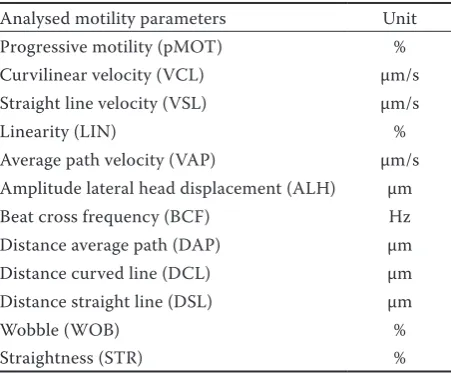
Sperm motility assessment. Fresh sperm motil-ity parameters (Rurangwa et al. 2004; Horvath et al. 2006; Fauvel et al. 2010; WHO 2010) (Table 1) were recorded using a CASA system (Computer-assisted Sperm Analysis, Sperm Vision™ v. 3.7.4., Minitube of America, Venture Court Verona, USA). A simple saline solution was used as activator (50 mM NaCl, 30 mM Tris) (Lahnsteiner et al. 2002) in a mixture of approximately 0.01 g/ml bovine serum albumin (BSA). In our study, two different experiments measuring motility of fresh burbot sperm were carried out. In the first experiment (n = 7), the simple saline solution was buffered for two different pH (4.4 and 8.5) and detailed sperm movement was compared in the two groups. In the second experiment (n = 6), samples were stored at 4°C for 96 h and motility parameters were re-corded at 24-hour intervals. For cells activation, the above mentioned solution buffered to pH 8.5 was used. All chemicals were purchased from Reanal (Hungary) and Sigma-Aldrich (USA).
Statistical analysis. Results of the motility assessments were analysed using the statistical software packages SPSS 14.0 (SPSS Inc., USA),
and GraphPad Prism 5.0 for Windows (GraphPad Software, USA). Kolmogorov–Smirnov test was used to test normal distribution of data at the significance level of P ≤ 0.05. Data not showing normal distribution were transformed using arcsine square (progressive motility (pMOT), linearity (LIN), wobble (WOB), straightness (STR)), root and logarithm (curvilinear velocity (VCL), straight line velocity (VSL), average path velocity (VAP), ampli-tude lateral head displacement (ALH), beat cross frequency (BCF), distance average path (DAP), distance curved line (DCL), distance straight line (DSL)) function. Results obtained from different groups were compared using one-way ANOVA, Student’s t-test followed by Tukey’s and Dunnett’s T3 post hoc tests.
RESULTS AND DISCUSSION
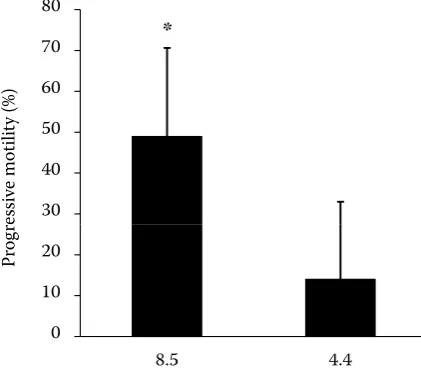
Former studies revealed that extra- and intracel-lular pH, temperature and the osmolality (as well as the dissolved ions) of the assay medium have a clear effect on fish sperm motility (Morisawa and Morisawa 1986, 1988; Marian et al. 1997; Alavi and Cosson 2005). K+ plays an important role in enhancing sperm movement in salmonids and sturgeons where extra- and intracellular pH has a lower impact (Alavi and Cosson 2005). In contrast, lower pH had a strong negative effect on the sperm motility of burbot in our experiment. A significantly higher pMOT (49 ± 22%), DAP (25 ± 5 µm/s), DCL (31 ± 4 µm/s), DSL (20 ± 5 µm/s), VAP (57 ± 10 µm/s), VCL (70 ± 9 µm/s), VSL (47 ± 11 µm/s), and BCF (27 ± 2 Hz) were measured with the activating solution buffered at pH 8.5 in comparison with pH 4.4 (pMOT 14 ± 19%, DAP 16 ± 5 µm/s, DCL 19 ± 7 µm/s, DSL 13 ± 4 µm/s, VAP 36 ± 13 µm/s, VCL 44 ± 17 µm/s, VSL 29 ± 9 µm/s, and BCF 18 ± 9 Hz). No significant dif-ferences were measured in STR, LIN, WOB, and ALH parameters using the two solutions (Table 2, Figure 1). Lahnsteiner et al. (1997) investigated the effect of pH in different solutions (in a range 6–9). Similar results were reported in their study where motility rate, linear motility and velocity were reduced by pH 6. ALH was not affected by low pH in both investigations, too. Contrary to their finding, BCF was reduced significantly by pH 4.4. In both studies, motility parameters responded differently for the reduction of the pH in the
activat-Table 1. Computer-assisted Sperm Analysis (CASA) pa-rameters observed in our experiments
Analysed motility parameters Unit
Progressive motility (pMOT) %
Curvilinear velocity (VCL) μm/s
Straight line velocity (VSL) μm/s
Linearity (LIN) %
Average path velocity (VAP) μm/s Amplitude lateral head displacement (ALH) μm
Beat cross frequency (BCF) Hz
Distance average path (DAP) μm
Distance curved line (DCL) μm
Distance straight line (DSL) μm
Wobble (WOB) %
[image:3.595.64.290.569.756.2]ing solution. However, Lahnsteiner and Mansour (2012) also reported a correlation between assay solution temperature and sperm motility in burbot. Too high and too low temperature also affected sperm movement. The highest initial motility and velocity was observed in a range of 4–6°C. Future studies could show how the motility parameters investigated in our experiment have been affected by the activating solution temperature. Similarly to our results, tap water as activator, titrated for pH 6.5, caused a significant reduction in motility of native North American burbot (Lota lota macu-losa) sperm. However, the sperm was less sensitive to pH. In contrast, a dose dependent inhibition of motility was observed when North American burbot sperm was incubated in an immobilizing solution (pH range 6.5–9) for 1 h and activated
also using tap water (Zuccarelli et al. 2007). In (Eurasian) burbot, former studies showed that the duration of sperm movement played a more important role during the fertilization process than the percentage of motile spermatozoa (Targonska et al. 2008; Kucharczyk et al. 2016). However, there is no information available regarding a correlation between all the motility parameters investigated in our study and the fertilization capacity in burbot sperm. Future studies could indicate which pa-rameters of the cell movement are the key factors during the fertilization process.
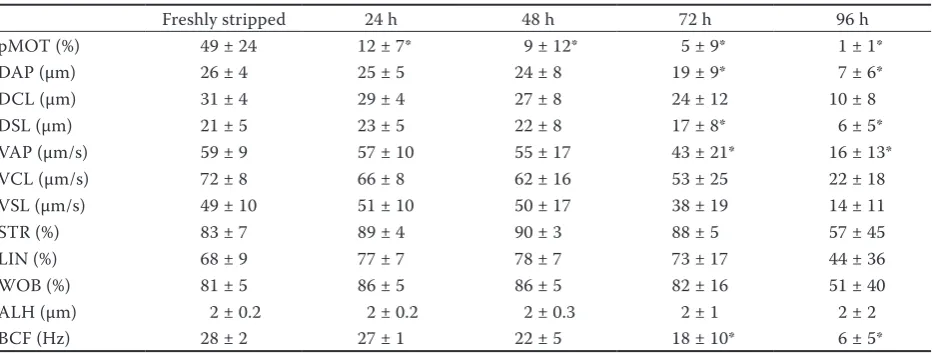
[image:4.595.62.531.126.180.2]Chilled storage caused a significant reduction in pMOT after 24 h (0 h: 49 ± 24%, 24 h: 12 ± 7%). Significant decreasing tendency was recorded only after 72 h in DAP (0 h: 26 ± 4 µm/s, 72 h: 19 ± 9 µm/s), DSL (0 h: 21 ± 5 µm/s, 72 h: 17 ± 8 µm/s), VAP (0 h: 59 ± 9 µm/s, 72 h: 43 ± 21 µm/s), and BCF (0 h: 28 ± 2 Hz, 72 h: 18 ± 10 Hz) parameters. No significant reduction was observed in DCL, VCL, VSL, STR, LIN, WOB, and ALH parameters for
[image:4.595.70.281.479.669.2]Figure 2. Progressive sperm motility (pMOT) during a 96-hour chilled storage (4°C) (n = 6). pMOT values in the columns marked with asterisks are significantly lower (P ≤ 0.05) if compared to freshly stripped group. The col-umns represent mean and standard deviation
Table 2. Motility parameters of burbot sperm by the use of two different activators (buffered at pH 4.4 and 8.5) (n = 7). Asterisks indicate significantly higher (P ≤ 0.05) values (means ± standard deviations)
pH pMOT (%) DAP DCL DSL VAP VCL VSL STR LIN WOB ALH (µm) BCF (Hz)
(µm) (µm/s) (%)
4.4 14 ± 19 16 ± 5 19 ± 7 13 ± 4 36 ± 13 44 ± 17 29 ± 9 81 ± 4 67 ± 8 82 ± 7 2 ± 0.5 18 ± 9 8.5 49 ± 22* 25 ± 5* 31 ± 4* 20 ± 5* 57 ± 10* 70 ± 9* 47 ± 11* 81 ± 7 66 ± 10 80 ± 5 2 ± 0.3 27 ± 2*
pMOT = progressive motility, DAP = distance average path, DCL = distance curved line, DSL = distance straight line, VAP = average path velocity, VCL = curvilinear velocity, VSL = straight line velocity, STR = straightness, LIN = linearity, WOB = wobble, ALH = amplitude lateral head displacement, BCF = beat cross frequency
30 40 50 60 70 80
essi
ve
m
oti
lity (
%
)
*
0 10 20
8.5 4.4
Pr
og
re
pH of the activating solution
Figure 1. Comparison of progressive sperm motility (pMOT) in burbot obtained using two different (pH 4.4 and 8.5) activators (n = 7). pMOT values in the column marked with asterisk are significantly higher (P ≤ 0.05). The columns represent mean and standard deviation
20 30 40 50 60 70 80
ess
iv
e
moti
lity
(%)
*
*
*
0 10 20
0 24 48 72 96
Pr
og
re
Storage time (h)
*
Storage time (h)
Pr
og
re
ssive
motility
[image:4.595.311.529.530.679.2]up to 96-hour storage (Table 3, Figure 2). Motility parameters respond to storage time with various levels of sensitivity, although the reduction in pMOT was notable and significant already after 24 h. To our knowledge, this experiment is the first to report on the storage of native burbot sperm. Contrary to our findings, common carp (Cyprinus carpio) sperm showed higher tolerance for chilled storage (at 4°C) for 2 days where the sperm quality was enhanced for 16 days with the addition of 50 µg/ml streptomycin and 50 IU bipenicillin (Saad et al. 1988). Native Eurasian perch (Perca fluviatilis) sperm could be stored for 3 days. Furthermore, samples stored in an immobilizing solution maintained motility for 48 days of storage at 4°C (Saroisek et al. 2013). In rainbow trout (Salmo gairdneri), the sperm treated using 500 IU penicillin and 500 µg streptomycin under pure oxygen showed an elevated fertilizing capacity even following 34 days of storage at 0°C (Stoss and Holtz 1983). Former studies suggest that the application of immobilizing solution and the addition of antibiotics or pure oxygen can prolong the possible storage time of native burbot sperm.
CONCLUSION
Native burbot sperm was sensitive to chilled storage and to the pH of the applied activating solution in general. However, motility parameters
responded to the mentioned effects in various ways. The results obtained from the two experiments support the establishment of an effective and practical quality measurement system in burbot sperm. These findings may also help improve the propagation process in burbot.
REFERENCES
Alavi S.M.H., Cosson J. (2005): Sperm motility in fishes. I. Effects of temperature and pH: A review. Cell Biology International, 29, 101–110.
Aramli M.S. (2014): ATP content, oxidative stress and mo-tility of beluga (Huso huso) semen: Effect of short-term storage. Reproduction in Domestic Animals, 49, 636–640. Aramli M.S., Kalbassi M.R., Nazari R.M., Aramli S. (2013): Effects of short-term storage on the motility, oxidative stress, and ATP content of Persian sturgeon (Acipenser persicus) sperm. Animal Reproduction Science, 143, 112–117.
Bobe J., Labbe C. (2010): Egg and sperm quality in fish. General and Comparative Endocrinology, 165, 535–548. Fauvel C., Suquet M., Cosson J. (2010): Evaluation of fish
[image:5.595.65.532.136.313.2]sperm quality. Journal of Applied Ichthyology, 26, 636–643. Gallego V., Perez L., Asturiano J.F., Yoshida M. (2013): Relationship between spermatozoa motility parameters, sperm/egg ratio, and fertilization and hatching rates in pufferfish (Takifugu niphobles). Aquaculture, 416, 238–243.
Table 3. Effects of a 96-hour chilled storage (4°C) on motility parameters of burbot sperm (n = 6). Values (means ± standard deviations) marked with asterisks at different storage times were significantly lower if compared to the freshly stripped group (P ≤ 0.05)
Freshly stripped 24 h 48 h 72 h 96 h
pMOT (%) 49 ± 24 12 ± 7* 9 ± 12* 5 ± 9* 1 ± 1*
DAP (µm) 26 ± 4 25 ± 5 24 ± 8 19 ± 9* 7 ± 6*
DCL (µm) 31 ± 4 29 ± 4 27 ± 8 24 ± 12 10 ± 8
DSL (µm) 21 ± 5 23 ± 5 22 ± 8 17 ± 8* 6 ± 5*
VAP (µm/s) 59 ± 9 57 ± 10 55 ± 17 43 ± 21* 16 ± 13*
VCL (µm/s) 72 ± 8 66 ± 8 62 ± 16 53 ± 25 22 ± 18
VSL (µm/s) 49 ± 10 51 ± 10 50 ± 17 38 ± 19 14 ± 11
STR (%) 83 ± 7 89 ± 4 90 ± 3 88 ± 5 57 ± 45
LIN (%) 68 ± 9 77 ± 7 78 ± 7 73 ± 17 44 ± 36
WOB (%) 81 ± 5 86 ± 5 86 ± 5 82 ± 16 51 ± 40
ALH (µm) 2 ± 0.2 2 ± 0.2 2 ± 0.3 2 ± 1 2 ± 2
BCF (Hz) 28 ± 2 27 ± 1 22 ± 5 18 ± 10* 6 ± 5*
Horvath A., Vasarhelyi J., Szenci O. (2006): The motility of spermatozoa. Literature review. Part 2 – The devel-opment of sperm motility analysing systems. Magyar Állatorvosok Lapja, 128, 437–442. (in Hungarian) Kucharczyk D., Nowosad J., Luczynski M.J., Targonska K.
(2016): New technique for fertilizing eggs of burbot, asp and ide under hatchery conditions. Animal Reproduction Science, 172, 143–147.
Lahnsteiner F., Mansour N. (2012): The effect of tempera-ture on sperm motility and enzymatic activity in brown trout Salmo trutta, burbot Lota lota and grayling Thy-mallus thyThy-mallus. Journal of Fish Biology, 81, 197–209. Lahnsteiner F., Berger B., Weismann T., Patzner R. (1997):
Sperm motility and seminal fluid composition in the burbot, Lota lota. Journal of Applied Ichthyology, 13, 113–119.
Lahnsteiner F., Mansour N., Weismann T. (2002): The cryo-preservation of spermatozoa of the burbot, Lota lota (Gadidae, Teleostei). Cryobiology, 45, 195–203.
Marian T., Krasznai Z., Balkay L., Emri M., Tron L. (1997): Role of extracellular and intracellular pH in carp sperm motility and modifications by hyperosmosis of regulation of the Na+/H+ exchanger. Cytometry, 27, 374–382. Morisawa S., Morisawa M. (1986): Acquisition of potential
for sperm motility in rainbow trout and chum salmon. Journal of Experimental Biology, 126, 89–96.
Morisawa S., Morisawa M. (1988): Induction of potential for sperm motility by bicarbonate and pH in rainbow trout and chum salmon. Journal of Experimental Biology, 136, 13–22.
Palinska-Zarska K., Zarski D., Krejszeff S., Kupren K., Lac-zynska B., Kucharczyk D. (2015): Optimal feeding level of Burbot larvae fed Artemia spp. and reared under con-trolled conditions. North American Journal of Aquacul-ture, 77, 295–301.
Rurangwa E., Kime D.E., Ollevier F., Nash J.P. (2004): The measurement of sperm motility and factors affecting sperm quality in cultured fish. Aquaculture, 234, 1–28. Saad A., Billard R., Theron M.C., Hollebecq M.G. (1988):
Short-term preservation of carp (Cyprinus carpio) semen. Aquaculture, 71, 133–150.
Sarosiek B., Cejko B.I., Kucharczyk D., Zarski D., Judycka S., Kowalski R.K. (2013): Short-term storage of perch (Perca fluviatilis L.) milt under cooling conditions. Reproductive Biology, 13 (Suppl. 1), 39.
Stoss J., Holtz W. (1983): Successful storage of chilled rainbow trout (Salmo gairdneri) spermatozoa for up to 34 days. Aquaculture, 31, 269–274.
Stoss J., Refstie T. (1983): Short-term storage and cryo-preservation of milt from Atlantic salmon and sea trout. Aquaculture, 30, 229–236.
Targonska K., Kucharczyk D., Mamcarz A., Glogowski J., Krejszeff S., Prusinska M., Kupren K. (2008): Influence of individual variability in the percentage of motile sper-matozoa and motility time on the survival of embryos of chosen fish species. Polish Journal of Natural Science, 23, 178–187.
WHO (2010): Semen analysis, 7-141. In: WHO Laboratory Manual for the Examination and Processing of Human Semen. World Health Organization, Geneva, Switzerland, 271.
Zarski D., Kucharczyk D., Sasinowski W., Targonska K., Mamcarz A. (2010): The influence of temperature on successful reproductions of burbot, Lota lota (L.) under hatchery conditions. Polish Journal of Natural Sciences, 25, 93–105.
Zuccarelli M.D., Jensen N., Ingermann R.L. (2007): Inhibi-tory effect of osmotic concentration, potassium and pH on motility of the sperm of the North American burbot Lota lota maculosa. Journal of Fish Biology, 70, 178–189.