FIREPOWER
(ENGLISH)
WARNING
ALTHOUGH NOT CLASSIFIED, THIS PUBLICATION, OR ANY PART OF IT, MAY BE EXEMPT FROM DISCLOSURE TO THE PUBLIC UNDER THE ACCESS TO INFORMATION ACT. ALL ELEMENTS OF INFORMATION CONTAINED HEREIN MUST BE CLOSELY SCRUTINIZED TO ASCERTAIN WHETHER OR NOT THE PUBLICATION OR ANY PART OF IT MAY BE RELEASED.
Issued on Authority of the Chief of the Defence Staff
FIREPOWER
(ENGLISH)
WARNING
ALTHOUGH NOT CLASSIFIED, THIS PUBLICATION, OR ANY PART OF IT, MAY BE EXEMPT FROM DISCLOSURE TO THE PUBLIC UNDER THE ACCESS TO INFORMATION ACT. ALL ELEMENTS OF INFORMATION CONTAINED HEREIN MUST BE CLOSELY SCRUTINIZED TO ASCERTAIN WHETHER OR NOT THE PUBLICATION OR ANY PART OF IT MAY BE RELEASED.
(Becomes effective upon receipt)
Issued on Authority of the Chief of the Defence Staff
OPI: DAD-7 1999-02-09
FOREWORD
1. B-GL-300-007/FP-001, Firepower, is issued on the authority of the Chief of the Defence Staff.
2. Suggestions for amendments should be forwarded through normal channels to the Director of Army Doctrine, attention DAD-7.
3. Unless otherwise noted, masculine pronouns apply to both men and women.
4. The NDID for the French version of this publication is B-GL-300-007/FP-002.
PREFACE
GENERAL
1. This doctrinal manual describes in detail the multi-dimensional concept of Firepower that the army has embraced as a combat function. This manual expands upon the operational and tactical notions of Firepower as presented in B-GL-300-001/FP-000, Conduct of Land Operations— Operational Level Doctrine for the Canadian Army and
B-GL-300-002/FP-000, Land Force Tactical Doctrine.
PURPOSE
2. The purpose of B-GL-300-007/FP-001, Firepower, is to explain the role of this combat function in the generation of combat power and how it contributes to success on the battlefield. The manual establishes the doctrinal basis for Firepower and defines its capability components and functions.
SCOPE
3. This publication is based on the precept that success in battle is fundamentally related to the successful integration of Firepower with the other combat functions of Command, Protection, Manoeuvre, Information Operations and Sustainment. The manual stresses the role of firepower, within the context of the manoeuvrist approach, in the conduct of deep, close and rear operations.
4. Chapter 1 explains Firepower from the perspective of Canada’s Army and makes a distinction between the firepower that is organic to a manoeuvre force commander, and that which falls within the purview of fire support, including indirect fire and firepower resources external to the manoeuvre force.
effectively meshed with the force commander’s intent and concept of operations.
6. The role of the targeting process in enabling the commander to synchronize information operations, manoeuvre and firepower systems by attacking the right target with the best system and munitions at the right time is explained in Chapter 3.
7. Air defence, doctrinally a component of the Protection combat function, possesses characteristics that make it also an element of Firepower and, as such, the subject is considered in Chapter 4.
8. Finally, Chapter 5 deals with non-lethal weapons and explains how these weapons and agents have added another dimension to the conduct of operations.
OFFICE OF PRIMARY INTEREST
9. The Director of Army Doctrine is responsible for the content, production and publication of this manual. Inquiries or suggestions are to be directed to:
DAD 7–Firepower Fort Frontenac
PO Box 17000 Station Forces Kingston, ON K7K 7B4
TERMINOLOGY
TABLE OF CONTENTS
FOREWORD ... i
PREFACE General ... ii
Purpose ... ii
Scope ... ii
Office of Primary Interest... iii
Terminology ... iii
CHAPTER 1 THE APPLICATION OF FIREPOWER Introduction ... 1
Firepower Effects ... 2
Operational Firepower... 3
Firepower at the Tactical Level ... 4
Capability Components ... 5
Interaction With the Other Combat Functions... 7
Combat Power ... 11
Firepower and the Manoeuvrist Approach ... 14
Combined Arms... 15
Manoeuvre and Organic Firepower ... 16
Firepower and the Law of Armed Conflict... 16
Summary ... 17
CHAPTER 2 FIRE SUPPORT Introduction ... 19
Fire Support in Deep, Close and Rear Operations... 20
The Fire Support System ... 25
Fire Support Coordination ... 38
Fire Support Planning Process... 42
Fire Planning ... 43
Fire Support Coordination Measures... 44
Summary ... 47
CHAPTER 3 THE TARGETING PROCESS Introduction ... 49
Targeting and the Law of Armed Conflict ... 50
Application ... 52
Targeting Concept ... 53
Targeting in a Joint Environment ... 54
The Targeting Team ... 56
Targeting Objectives ... 58
Targeting Methodology ... 59
Decide Function ... 60
Detect Function ... 71
Deliver Function... 72
Assess Function... 75
Corps and Division Synchronization... 77
Summary ... 78
ANNEX A THE TARGETING PROCESS... 81
CHAPTER 4 AIR DEFENCE Introduction ... 83
Methods of AD Deployment ... 84
AD and the Combat Functions ... 87
Counter-Air Operations ... 88
Offensive Counter-Air Operations ... 89
Fundamentals of AD... 93
Integration and Coordination... 94
AD Artillery Principles of Employment... 97
AD Command Organizations ... 98
Command ... 99
AD Warnings... 99
Weapon Control Orders... 100
Airspace Control... 101
Airspace Control System ... 102
Summary ... 103
CHAPTER 5 NON-LETHAL WEAPONS Introduction ... 105
Types of Non-lethal Weapons ... 106
NLW Capabilities... 111
Operational Employment... 113
NLW Use in OOTW... 114
NLW Use in Warfighting ... 115
Advantages of NLW... 117
Limitations of Non-lethal Weapons... 118
Employment Principles ... 121
Summary ... 125
LIST OF FIGURES
Figure 2-1: The Fire Support System... 26
Figure 2-2: The Artillery Commander’s Functions in
Developing the Commander’s Plan... 42
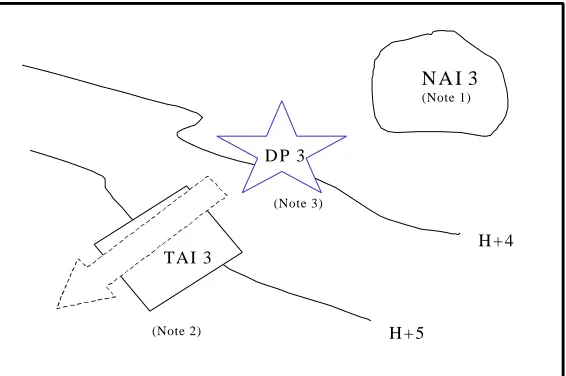
Figure 3-1: Relationship Between a Decision Point and
Target Area of Interest ... 63
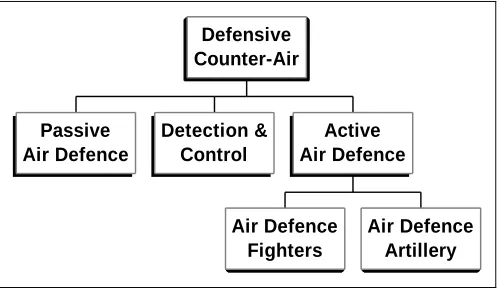
Figure 4-1: Defensive Counter-Air Operations... 90
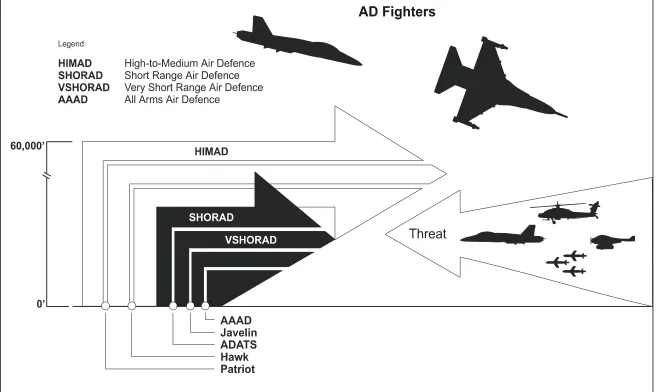
Figure 4-2: Layered Air Defence ... 95
Figure 5-1: Operational Employment of
Non-lethal Weapons... 116
LIST OF TABLES
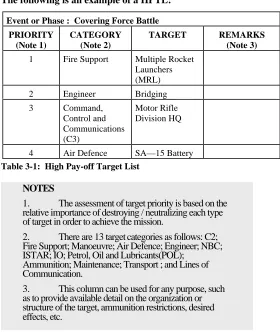
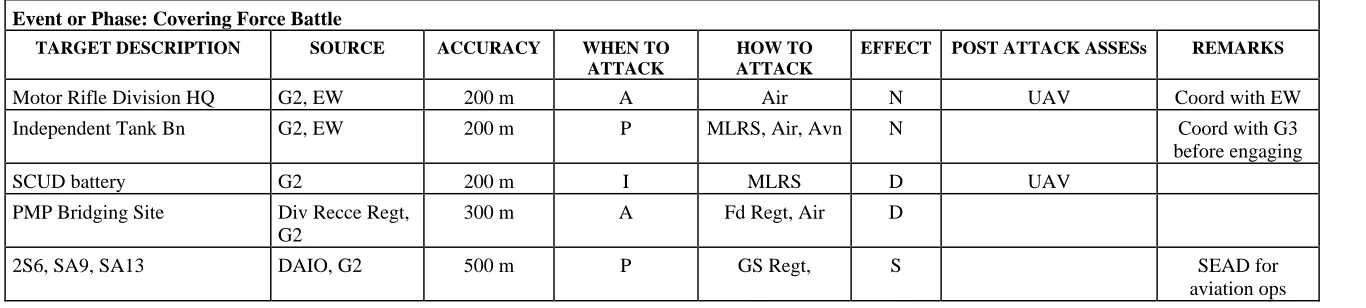
Table 3-1: High Pay-off Target List ... 64
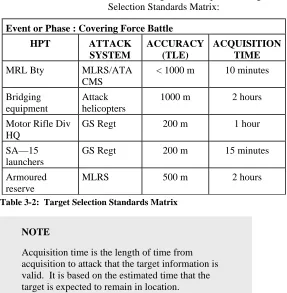
Table 3-2: Target Selection Standards Matrix ... 66
CHAPTER 1
THE APPLICATION OF FIREPOWER
It is firepower, and firepower that arrives at the right time and place, that counts in modern war— not manpower.
Captain Sir Basil Liddell Hart, Thoughts on War, 1944
INTRODUCTION
1. Firepower, integrated with manoeuvre or independent of it, is used to destroy, neutralize, suppress and harass the enemy. Firepower effects occur at the strategic, operational and tactical levels and must be synchronized with other attack systems. Maximum firepower effects require the full integration of army and joint service systems and procedures to determine engagement priorities, locate, identify, and track targets, allocate firepower assets and assess battle damage. Firepower should be viewed as a joint concept as it includes conventional land, air and maritime weapons effects. It encompasses the collective and coordinated use of target acquisition data from all sources, direct and indirect fire weapons, armed aircraft of all types, and other lethal and non lethal means against air, ground and sea targets.
2. Firepower is divided into two categories: those weapons that are organic to a manoeuvre unit, which are usually direct fire in nature and those primarily found within the scope of fire support and air defence. Fire support includes field artillery, mortars and other non-line of sight fires, naval gunfire, tactical air support, and elements of offensive information operations (IO).
opponent’s response is always desirable. The use of firepower, and the threat of its use, can have a tremendous effect upon enemy morale. The effects of firepower are often temporary and should be exploited immediately.
4. Firepower is a key element in defeating the enemy’s ability and will to fight. The traditional division between direct and indirect fire is becoming less meaningful. Indirect fire is increasingly able to achieve lethal precision effects; direct fire in the strict sense can be complemented by weapon systems in which the operator directly observes the target but his platform may not be in view. The application of firepower should be judged solely by the effect required on the enemy in terms of destruction, neutralization or suppression and in shaping the enemy. This prompts consideration of the volume, duration, and lethality of fire and the precision and range of munitions. The appropriate mix of weapons systems can then be chosen to achieve the desired effect.
FIREPOWER EFFECTS
5. Firepower effects are described as follows:
a. Destruction. Destruction physically renders the target permanently combat-ineffective or so damaged that it cannot function unless it is restored, reconstituted or rebuilt.
b. Neutralization. Neutralization fire renders the target ineffective or unusable for a temporary period.
Neutralization fire results in enemy personnel or materiel becoming incapable of interfering with an operation or course of action.
c. Suppression. Suppressive fire degrades a target (e.g. weapon system) to reduce its performance below the level needed to fulfil its mission objectives. Suppression lasts only as long as the fire is delivered onto the target.
OPERATIONAL FIREPOWER
6. At the operational level of conflict, a commander prescribes what military actions are necessary to achieve the nation’s strategic aim. At this level, commanders design, prepare and conduct joint campaigns and major operations, each of which comprise a series of battles, engagements and other actions. In developing a campaign plan, the operational commander and his staff require a clear picture of the theatre organization and command relationships. The theatre of operations is subdivided into a number of areas of operations. Each subordinate level of command will further define their area of operations by determining their area of interest and area of influence. Decentralization is further enhanced by defining, within a particular area of operations, responsibility for deep, close and rear operations.1
7. At the operational level, lethal and non-lethal firepower is
employed in deep, close and rear operations to achieve a decisive impact on the conduct of a campaign or major operation. Firepower and manoeuvre are not interchangeable at the operational level; each has a distinctive quality, complementary to the other. Operational firepower is normally furnished by assets other than those required for the routine support of tactical manoeuvre however, some assets, such as air and tactical missile systems, can support both.
8. Operational firepower focuses mostly on one or more of three general tasks: facilitating operational manoeuvre, isolating the battlefield, and attacking critical functions and facilities. Manoeuvre is supported by fixing, turning, disrupting or blocking the enemy, complicating enemy command and control, disrupting the sustainment of his forces and degrading his weapon systems. Isolating the battlefield could involve
1
B-GL-300-001/FP-000 Operational Level Doctrine for the Canadian Army, Chapters 1 and 5, provides a detailed explanation of the Levels of Conflict and Theatre Organization. An Area of Interest is the area in which a commander wishes to identify and monitor those factors, including enemy activities, which may influence the outcome of current and anticipated missions. An Area of Influence is that area within which a commander can directly influence operations by
disruption of lines of communications, destruction of intelligence collection means and communications networks and prevention of the move forward of reserve and follow-on forces. Operational firepower may also be used independent of manoeuvre to damage key enemy forces or facilities.
FIREPOWER AT THE TACTICAL LEVEL
9. At the tactical level of conflict, battles, engagements and other actions are planned and executed to accomplish military objectives
established by the operational level commander. Tactical firepower consists of the coordinated and collective use of target acquisition data, direct and indirect fire weapons, armed aircraft and other means against enemy elements in contact or imminent contact. Tactical firepower includes line of site weapons, artillery, mortars, close air support, aviation, naval gunfire and offensive IO. Manoeuvre commanders normally direct tactical firepower in support of manoeuvre operations.
10. At the tactical level, the commander needs highly responsive firepower in order to accomplish his mission. He fights the current close operation while fighting the deep battle to shape future close operations. The commander may also have to employ his firepower assets in the conduct of rear operations, at times simultaneously with close and deep operations. In the pursuit of tactical objectives, firepower is employed in the following manner:
a. to shape the enemy;
b. to attack enemy capabilities that have or can have an immediate impact on tactical operations;
c. to seize and retain the initiative and maintain the tempo of friendly operations;
d. to fight committed enemy formations throughout the depth of their dispositions; and
CAPABILITY COMPONENTS
11. The Firepower function comprises the following capability components:
a. Direct and Indirect Fire in Conjunction with Manoeuvre.
(1) Direct fire involves the use of line of sight weapon systems to either fix or strike. Its utility demands coordination with other battlefield activities, particularly manoeuvre, to achieve the greatest combined effect upon the enemy. Direct fire can be used to destroy, neutralize, suppress and demoralize. It is essential in defeating the enemy’s ability and will to fight.
(2) Indirect fire is provided primarily by field artillery and mortars. It shatters the enemy’s cohesion and undermines his will to fight. With its intrinsic flexibility, field artillery can be brought to bear on deep, close and rear
operations, simultaneously if necessary. It must be synchronized with other battlefield activities in terms of time, space and purpose to achieve the optimum concentration of force. Target priorities must be established and artillery must be used aggressively in concert with other firepower assets and intelligence, surveillance, target acquisition and reconnaissance (ISTAR) resources.
c. Coordination of the Targeting Process. Targeting is defined as “the process of selecting targets and matching the appropriate response to them, taking account of operational requirements and capabilities” (AAP-6). It is the mechanism for coordinating ISTAR and attack resources, such as aviation, indirect fire and offensive IO to ensure that they are properly integrated and that the most appropriate weapon system attacks each target. It is, therefore, a tool for the efficient and effective
management of resources and its successful
implementation is fundamental in our speed of reaction to the enemy.
d. Air Defence (AD). Land based air defence makes a vital contribution to the survival and manoeuvrability of a force by protecting it from aerial attack and surveillance. AD artillery contributes to firepower through the
aggressive use of its weapon systems to destroy or disable enemy air vehicles. This component also includes all arms AD (AAAD), the active AD measures taken by combat units, primarily by means of integral, non-AD specialized weapons. AD therefore has characteristics than span both the Protection and Firepower combat functions.
e. Non-lethal Weapons. Disabling or non-lethal measures may be employed across the continuum of military operations, including combat operations, against personnel and materiel targets, with the following aims:
(1) to impair or control human capabilities;
(2) to prevent mobility of equipment and personnel;
(3) to neutralize weapons and crews;
(4) to exploit or disrupt command and control;
INTERACTION WITH THE OTHER COMBAT FUNCTIONS
12. Firepower contributes to all combat functions and it is a
fundamental component of combat power. The relationship of firepower to the other combat functions is as follows:
a. Manoeuvre.
(1) Manoeuvre and firepower are inseparable and complementary dynamics of combat power. Manoeuvre is the employment of forces through movement in combination with speed, firepower or fire potential, to attain a position of advantage in respect to the enemy. Firepower provides the weapons effects essential for the defeat of the enemy’s ability and will to fight and is most effective when combined with manoeuvre.
(2) Successful manoeuvre requires not only fire and movement, but also agility and versatility of thought, plans, operations and organizations. Operational manoeuvre is the disposition of forces to create a decisive impact on the conduct of the campaign by either securing the
centre of gravity2 on either the physical or moral plane as required.
(3) Firepower and manoeuvre forces are
concentrated at decisive points to destroy enemy elements when the opportunity presents itself and when such a confrontation fits the larger purpose. These actions may involve high attrition of selected enemy forces where firepower is focused against critical enemy assets. The aim of this attrition is not merely to reduce incrementally the enemy’s physical strength but to contribute to the enemy’s systematic disruption. The greatest effect of firepower is generally not physical destruction— the cumulative effects of which are felt only slowly— but the disruption it causes.
(4) The effectiveness of firepower and manoeuvre are also enhanced by the integration of obstacles. Planning barriers in conjunction with firepower and manoeuvre forces the enemy to conform to the commander’s intent. If the enemy can move it is done to our benefit and his detriment. With movement impeded the enemy is disrupted, turned, fixed or blocked.
(5) Firepower may also play a key role in deception operations. In this application, firepower can be used to support a feint or demonstration by manoeuvre forces by helping to convince the enemy that the action is of sufficient strength so as to pose a major threat.
b. Protection.
2
(1) Protection preserves the fighting power of a force so that it can be applied at a decisive time and place. Firepower contributes to protection by fixing the enemy through neutralizing fire while our own forces are manoeuvring or by destroying the enemy before he is in position to attack effectively. Firepower can also protect the force from ground attack by using counter-mobility munitions such as anti-tank scatterable mines. Firepower systems also require
protection particularly in an expanded battle space. Within our own lines, area protection is not sufficient in many cases especially when the bypass policy is too liberal. Firepower assets should be concealed from the enemy, especially from his direct fire weapons, by means of deployment tactics, camouflage and concealment, emission control (EMCON) measures and an unmasking policy.
(2) Air defence is another key aspect of protecting freedom of action and it encompasses land, air and maritime capabilities. It prevents the enemy from using a primary means, air power, to break friendly cohesion. While air defence is a component of the Protection combat function, its capabilities extend within the realm of Firepower and, as such, it will be considered in Chapter 4 of this publication.
command, the use of identification means, detailed situational awareness and adherence to disciplined operating procedures and anticipation of operations when conditions raise the
probabilities of fratricide. With this knowledge, commanders can exercise positive control over firepower resources without overly constricting initiative and audacity in combat.
c. Information Operations (IO). IO provides the requisite Communication Information Systems (CIS) and relevant information, including ISTAR, which enables firepower assets to accurately acquire and identify targets and to conduct battle damage assessment. Information systems provide for the establishment of essential communication linkages to facilitate rapid target engagement. Offensive IO may be used as a means of attacking targets with the aim of denying the enemy the effective use of his C2 by influencing, degrading or destroying his C2 Information Systems. Defensive IO has the aim of maintaining the effectiveness of friendly C2, including those of the Firepower combat function, as well as protecting friendly forces from the effects of enemy offensive IO.
d. Command. Command is the authority vested in an individual for the direction, coordination and control of military forces. Military command encompasses the art of decision-making, motivating and directing resources into action to accomplish a mission. It requires a vision of the desired result, an understanding of concepts, missions, priorities and the allocation of resources.3 With regard to firepower, commanders must ensure that:
(1) firepower and target acquisition assets are deployed within effective range of critical target areas;
3
(2) firepower resources are apportioned to
subordinate commanders to support lower level operations;
(3) ammunition, in sufficient quantity and nature for planned operations, is provided to the various weapons systems;
(4) sufficient intelligence is provided concerning enemy capabilities and intentions; and
(5) an effective command and control system is established so that fire can be applied to support deep, close and rear operations.
e. Sustainment. Sustainment of the force is a key component of combat power and must be part of the planning and execution of operations. Firepower assets, including artillery, consume large quantities of combat supplies resulting in one of the largest challenges to the replenishment system. Close cooperation between firepower and sustainment staffs is necessary to ensure that the correct quantities of combat supplies, particularly ammunition and fuel, arrive at the designated location at the right time to allow the commander to influence the battle. Other sustainment functions including medical evacuation, repair and recovery, routine replenishment and personnel replacements must also be considered as the dispersion of firepower assets adds a significant dimension to providing this support.
COMBAT POWER
13. Combat Power is the total means of destructive and/or disruptive force, which a military unit/formation can apply against an opponent at a given time (AAP-6). Overwhelming combat power is achieved when all combat elements are efficiently and effectively brought together, at the decisive point and time, giving the enemy no opportunity to respond with coordinated or effective opposition. As explained in B-GL-300-002/FP-000,
the enemy. Inherent in the two dynamic forces of fixing and striking is the requirement to find the enemy.
14. Firepower plays a key role in the creation of combat power by contributing to the two dynamic forces of Fixing and Striking in the following manner :
a. Fixing the Enemy.
(1) Fixing involves the use of combat forces to hold ground against enemy attack, to hold or fix an enemy in one location by firepower and/or manoeuvre, or to hold vital points by protecting against enemy intervention. The object of fixing is to deprive the enemy of his freedom of action and therefore his ability to manoeuvre. It achieves freedom of action for friendly forces to strike the enemy in a manner, place and time of their choosing.
(2) Firepower contributes to fixing the enemy by the following:
(a) the application of firepower to destroy, neutralize, suppress or harass elements of the enemy force and deny the enemy freedom of action;
(b) the protection of friendly forces, particularly by counter battery fire, to enable tasks and missions to be achieved; and
(c) the creation of surprise by the use of deception and fire plans to distract the enemy from his main purpose and deny him his goals.
(1) Striking the enemy is achieved by attacking on the physical or moral planes, or ideally a
combination of both. The objective of striking in physical terms is to manoeuvre into a position from which to focus combat power to capture ground, to destroy equipment, vital points and installations, to kill enemy personnel or to gain a position of advantage. Firepower contributes to striking the enemy by means of the following:
(a) the deployment of fire support assets to achieve the maximum concentration of combat power;
(d) the coordination of fire plans;
(e) the use of the targeting process to prioritize, synchronize and deliver fire in concert with the overall operational plan; and
(f) the deployment of air defence artillery to interdict enemy flight corridors and enable our own forces to strike the enemy by providing protection.
(2) Striking the enemy on the moral plane aims to destroy his cohesion by attacking his morale, his sense of purpose or his decision-making ability. By its very nature, firepower intrinsically contributes to this goal through casualties, materiel destruction and psychological trauma caused by munitions effects or information attack. Firepower often plays a key role in feint attacks, demonstrations of force and disruption of enemy command and control infrastructure by fire.
intentions. This information is acquired through the employment of target acquisition systems and the coordination of these assets with other ISTAR systems. The assets allocated to this role include unmanned aerial vehicles (UAVs), weapon locating and surveillance radars, electronic warfare (EW), air and aviation as well as the necessary linkages to strategic and
operational ISTAR assets. The process is also aided by the participation of fire support staff in the Intelligence Preparation of the Battlefield (IPB) and targeting processes.
16. The use of the targeting process to prioritise, synchronize and deliver firepower effects in unison with the overall operational plan, and the effective and efficient use of command and control are central to the achievement of the above objectives. Targeting is discussed in detail in Chapter 3 of this publication.
FIREPOWER AND THE MANOEUVRIST APPROACH
17. Canada’s Army has adopted the manoeuvrist approach to
operations. The manoeuvrist approach is defined as a philosophy that seeks to defeat the enemy by shattering his moral, and physical cohesion, his ability to fight as an effective coordinated whole, rather than destroying him by incremental attrition. 4 The manoeuvrist approach concerns itself primarily with attacking the enemy’s critical vulnerability, which does not necessarily imply physical destruction. Conversely, this concept does not rule out attrition, which may not only be unavoidable at times, but necessary depending upon the commander’s concept of operations.
18. The manoeuvrist approach is not to be confused with the combat function Manoeuvre. In this context, manoeuvre is the employment of forces through movement in combination with speed, firepower or fire potential, to achieve the mission.5 Manoeuvre refers to the employment of forces through offensive or defensive operations to achieve positional advantage over an enemy force. Generating combat power on a battlefield requires combining the movement of combat forces and employment of
4
B-GL-300-002/FP-000, Land Force Tactical Doctrine, p. 1-7.
5
their direct fire resources in unison with fire support. The more immediate the combat in time and space, the more intertwined are firepower and manoeuvre.
19. The effective coordination of firepower and manoeuvre requires direction from the commander on where fire will be applied and flexible command and control arrangements. This allows firepower effects to be allocated while not tying the delivery systems to a particular aspect of the manoeuvre force. Firepower in deep operations is invariably a joint activity. In close operations, joint forces may provide the means but command must lie with the close operation commander.
COMBINED ARMS
20. In order to maximize combat power, all available resources must be employed to the best advantage. Combined arms methodology is the full integration of arms in such a way that, to counteract one, the enemy
becomes more vulnerable to another. This objective is accomplished through tactics at lower levels and through task organizations at higher levels. In doing so, the complementary characteristics of different types of units are used to best advantage and mobility and firepower are enhanced.
21. Generating effective firepower against an enemy requires that organic and supporting fire assets be coordinated with other combat functions such as command, information operations and sustainment. Subordinate systems and processes for determining priorities, identifying and locating targets, allocating fires assets, attacking targets, and assessing battle damage must be fully integrated. The efficient use of firepower will ensure that the right targets are adequately attacked to achieve the
commander’s intended effects.
and concept of operations. This aspect of firepower is covered at length in Chapter 2— Fire Support.
MANOEUVRE AND ORGANIC FIREPOWER
23. Organic firepower includes the firepower assets integral to a manoeuvre unit. These resources include small arms, machine guns, vehicle mounted cannons, grenade launchers, anti-armour weapons, mortars and tank guns, and are commanded and controlled by the manoeuvre unit commander.
24. Manoeuvre forces employ fire and movement to close with and destroy an enemy, to seize and hold terrain and to gain information. They consist of mounted and dismounted units. Dismounted manoeuvre forces include light, airborne and air assault units. They have a high degree of strategically deployability and, depending on the nature of the mission and terrain, either complement mounted manoeuvre units, or are complemented by them. While dismounted forces have a distinct mobility advantage over mounted troops in restricted or urban terrain, they have a limited amount of organic firepower compared with mounted forces.
25. Mounted manoeuvre forces employ a combination of armoured and mechanized infantry units. Mounted units employ tanks, armoured fighting vehicles and dismounted infantry within a combined arms team that produces mobile, protected firepower to create an overwhelming shock effect. The effectiveness of armoured and infantry combined arms groupings rests on their ability to rapidly combine complementary effects, particularly in the area of firepower, to present the enemy with a variety of threats more rapidly than he can react. In addition to providing increased mobility and protection, the light armoured vehicle (LAV) significantly enhances the firepower of an infantry force.
FIREPOWER AND THE LAW OF ARMED CONFLICT
Armed Conflict, which details the application of the law of armed conflict (LOAC) at the operational and tactical levels. The LOAC explains the principles and definitions that guide military forces in the selection of legitimate weapons and targets. Further guidance with respect to the LOAC is provided in Chapter 3 (The Targeting Process) of this manual.
SUMMARY
27. Firepower, either integrated with manoeuvre or employed independently, can be used to destroy, neutralize, suppress and harass the enemy. As one of the principle means of generating combat power, it can be used for both fixing and striking the enemy and can attack the enemy on the moral as well as the physical plane. Ownership of the various firepower assets is irrelevant, and the focus should be on coordinating available weapons platforms to produce the maximum effect on the enemy as directed by the commander.
CHAPTER 2 FIRE SUPPORT
Battles are won by superiority of fire.
Frederick the Great, Military Testament, 1768
INTRODUCTION
1. Fire support is the collective and coordinated use of the fire of land and sea based indirect fire systems, armed aircraft, offensive information operations (IO) and non-lethal munitions against ground targets to support land combat operations at both the operational and tactical levels. Fire support is the integration and synchronization of fire and effects to delay, disrupt, or destroy enemy forces, combat functions, and facilities in pursuit of operational and tactical objectives. It includes field artillery, mortars, naval fire and air-delivered weapons. The force commander employs these means to both support his manoeuvre plan and to engage enemy forces in depth. Fire support planning and coordination are essential at all echelons of command.
2. Generating effective firepower against an enemy requires that organic and supporting firepower be integrated with the other combat functions. Subordinate systems and processes for determining priorities for fire, identifying and locating targets, allocating assets, attacking targets, and assessing battle damage must be fully integrated. Fire support provides for the planning and execution of fire so the right targets are effectively attacked to achieve the commander’s intended effects.
3. Commanders are responsible for fighting their fire and manoeuvre assets. A significant portion of the firepower available to a commander comes from sources external to his command. Consequently, the ability to employ all available firepower throughout the depth of the battlefield, as an integrated and synchronized whole, is done through the process of fire support planning, coordination, and execution. The artillery commander coordinates fire support by binding fire support resources together so that the multiple effects of each asset are synchronized with the force
artillery commander must be clear on the supported commander’s concept of operations. The effective planning, coordination and synchronization of fire support is critical to success in war as well as operations other than war (OOTW).
FIRE SUPPORT IN DEEP, CLOSE AND REAR OPERATIONS
4. Land operations encompass three inseparable aspects - deep, close, and rear operations, which must be considered together and fought as a whole. The concept of deep, close and rear operations provides a means of visualizing the relationship of friendly forces to one another, and to the enemy, in terms of time, space, resources and purpose. They are focused on attacking the enemy’s cohesion and will be conducted on both the moral and physical planes1. Deep, close and rear operations may overlap in time and space and some formations and units may engage in each at different stages.
5. Deep and close operations should be conducted concurrently not only because each influences the other, but also because the enemy is best defeated by fighting him throughout his depth. The requirement to integrate and synchronize fire support with these three operations is inherent in this responsibility. The role of fire support in deep, close and rear operations is as follows:
a. Deep Operations.
(1) Deep operations can degrade the enemy’s firepower, disrupt his command and control, destroy his logistic base and break his morale. While fire support plays an essential role in the conduct of deep operations, the integrated application of firepower and manoeuvre make a
1
B-GL-300-001/FP-000 describes conflict on the moral plane as a struggle between opposing wills. The term moral pertains to those forces that are
deep attack capability effective. Success is founded on the synchronization of all assets at all echelons.
(2) Deep operations are generally offensive actions conducted at long range and over a protracted time scale against enemy forces and functions beyond close operations. Deep operations can shape the enemy and prevent him from using his forces where and when he wants to on the battlefield. Fire support assets, particularly artillery and armed aircraft, and target acquisition means, are major contributors to these operations. The success of deep operations is also reliant upon air defence to protect the attack resources and, as applicable, the manoeuvre elements.
(3) The commander’s battle plan for deep operations requires several special considerations. Deep operations may include the use of surface-to-surface artillery, aviation, air, offensive IO, non-lethal weapons (NLW) or manoeuvre or a combination of any of the above. Manoeuvre forces may be required to exploit the result of large-scale, conventional deep fire support or to set the conditions for deep attacks. Fire support is the most responsive asset that the operational-level commander has to shape the enemy’s operations. The successful conduct of deep operations requires careful analysis of enemy capabilities to interfere with friendly operations and of enemy vulnerabilities. Only those enemy targets that pose a significant threat to friendly forces or those that are essential to the
(4) At division level and above, deep operations are planned and controlled in the deep operations coordination centre (DOCC) located in the main division command post (CP). The DOCC is formed by selected staff members from the appropriate main CP cells under the overall direction of the division chief of staff. The DOCC provides the commander with a means to focus the activities of all units, agencies and cells involved in supporting deep operations.
Artillery representation is a key element in the DOCC composition, particularly with respect to targeting, which will be addressed in the following chapter.
(5) Typical deep fire support tasks include the following:
(a) destroying, neutralizing or suppressing selected targets in the depth of the formation’s area of influence;
(b) delivering scatterable anti-tank mines, electronic jammers and non-lethal munitions deep into the formation’s area of influence; and
(c) suppressing enemy air defences.
b. Close Operations.
variable rates of fire, variety of munitions and inherent flexibility, are well suited to such operations. Artillery is usually commanded at the highest level while control of fire may be decentralized to the lowest levels (e.g. forward observation officer (FOO) at combat team level).
(2) Close operations include the battles and engagements of a force’s manoeuvre and fire support units, together with the requisite combat support and combat service support functions, to seek a decision with the enemy. Close fire support is directed against targets or objectives that are sufficiently near the supported force as to require detailed integration or coordination of the supporting action with fire, movement, or other actions of the supported force.
(3) Close fire support is employed both to protect the force and to provide maximum combat power at the decisive point of an engagement. The direct support (DS) standard tactical mission requires a field artillery unit to provide close supporting fire to a specific manoeuvre brigade.
(4) Fire support for close operations includes the following activities:
(a) fire support advice, planning and coordination by artillery staffs and tactical groups at the following levels:
i. Division— Commander Division Artillery (CDA) and staff;
ii. Brigade— Field artillery regiment CO and Fire Support Coordination Centre (FSCC);
iv. Combat Team— assigned FOO and party.
(b) Common fire support tasks for close operations include the following:
i. providing defensive, preparatory and covering fire which is
responsive, accurate and consistent;
ii. neutralizing or suppressing enemy forces and destroying specific targets;
iii. illuminating portions of the battlefield;
iv. screening friendly movement and blinding enemy positions with battlefield obscurants;
v. marking locations on the battlefield with visual indicators; and
vi. delivering scatterable anti-tank mines in accordance with the barrier plan.
c. Rear Operations.
(2) On occasion, rear area operations will include the engagement of enemy forces
(airmobile/airborne insertions, special forces, irregular forces, etc) by close combat manoeuvre elements. In rear area combat operations the requirement for and tasks of fire support will be the same as for close operations. The primary difference is that fire support assets are not normally dedicated to rear operations.
Accordingly, close fire support to rear operations are planned on a contingency basis taking advantage of the fire support system’s ability to quickly shift fire to where it is needed.
(3) The primary purpose of fire support in the rear area is to protect the force. In combat
operations, rear area fire support is an economy of force effort. Commanders must focus their efforts on protecting the most critical
capabilities.
(4) An artillery representative will de designated by the artillery commander to advise, plan and coordinate rear area fire support as required.
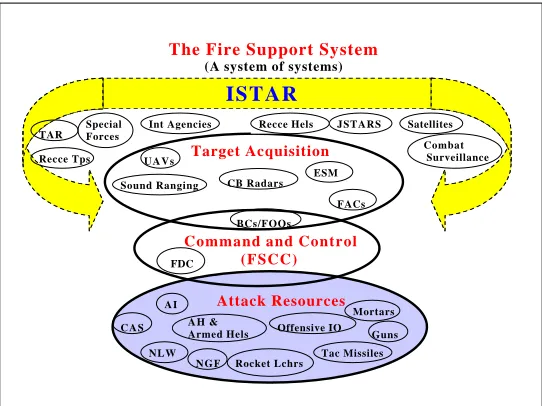
THE FIRE SUPPORT SYSTEM
The Fire Support System (A system of systems)
Attack Resources
C A S
Target Acquisition U A V s
TAR
CB Radars
Guns Offensive IO
N G F Rocket Lchrs A H &
Armed Hels
[image:38.396.57.328.72.275.2]Command and Control (FSCC) BCs/FOOs FACs ISTAR JSTARS Int Agencies ESM Special Forces Satellites Recce Tps Combat Surveillance Recce Hels Sound Ranging NLW A I Mortars Tac Missiles FDC
Figure 2-1: The Fire Support System
NOTE
1. Fire Support TA resources are part of the ISTAR system. ISTAR links intelligence, surveillance, TA and reconnaissance to provide the commander with situational awareness, to optimize the detection, location and
identification of targets to cue manoeuvre and attack resources.
2. BCs and FOOs perform both TA and fire control coordination functions and therefore span two components of the Fire Support System.
a. Command and Control (C2).
(1) C2 systems bring all information together for collation and decision making. C2 systems, personnel, equipment and a variety of related procedures support the execution of fire missions. The C2 process for employing fire support assets includes fire support planning and coordination, tactical fire direction procedures as well as special procedures for the employment of air and naval attack resources.
(2) The Fire Support Coordination Centre (FSCC) is a centralized location in all manoeuvre
headquarters, from battle group to corps and above, at which representatives of fire support elements and other elements with a direct interest in fire support coordination meet. Each
representative in the centre has access to communications, which will permit him to implement the necessary coordination. The FSCC is a full time focal point for fire support coordination, but it must not be regarded as the single location where all such coordination occurs. Wherever fire planning and coordination take place the resulting decisions and directions flow back through the FSCC where any further coordination necessary is effected. The required executive action is then taken by the fire support element concerned. The aim is to ensure coordination and not to infringe on the prerogatives of the commanders of the various fire support agencies.
anti-tank mines for barrier planning. If naval gunfire (NGF) support is available, it will also be represented and, at division level and above, the FSCC will include an airspace coordination centre (ASCC). Within the FSCC, each
representative is responsible for the maintenance of up-to-date information on his element, which is required by the other agencies. Each
representative will take any action necessary within his delegated authority to ensure effective coordination and integration of his resource with the others, to resolve any conflicts, and to ensure maximum practical safety of all friendly forces. The field artillery forms the basis for an FSCC, with the artillery commander being responsible for the overall coordination of all fire support.
(4) Command and Control Information Systems (C2IS) enable the following functions to take place:
(a) the conduct of all activities associated with the planning, collection,
formulation, processing, and distribution of fire support command and fire control information, orders and reports at all levels of command;
(b) the integration of the various fire support elements with the Land Force Command System and joint attack agencies as well eventual
interoperability with allied fire support systems;
(c) the collection, processing and
(d) the collection, processing and
distribution of information pertaining to fire support logistics activities; and
(e) the collection, processing and
distribution of information pertaining to survey and meteorological activities.
b. Target Acquisition (TA).
(1) TA systems and equipment perform the essential tasks of target detection, location, tracking, identification and classification. The aim of TA is to provide timely and accurate information to enable the attack of specified targets. Targets must be detected, located, identified and prioritized with sufficient speed and accuracy to permit effective engagement. Attack resources obtain target information from both organic and attached TA assets and require access to data gathered by other ISTAR sources. The fire support system consolidates targeting information from many different agencies including manoeuvre forces, intelligence units, special reconnaissance operations and satellites, all of which contribute to the ISTAR system.2
(2) Target information may be obtained by the following means:
(a) Intelligence Agencies. Intelligence agencies produce and provide
2
information and intelligence, from a variety of sources, which are of use to the TA component. These agencies include national level/strategic intelligence assets as well as intelligence organizations at all echelons of command down to unit level.
(b) Combat Units. Individual units can provide time-sensitive combat information about enemy troops and equipment. Surveillance radars, observation posts and reconnaissance patrols are also useful in collecting information.
(c) Reconnaissance Units. Much of the information provided from
reconnaissance and combat surveillance is of a time-sensitive nature and is reliant upon an efficient means of transmission and interpretation. Reconnaissance units can engage the targets themselves, hand off the target to a manoeuvre force or call for indirect fire. Additionally, they also have the capability to perform battle damage assessment. Special operations forces collect and report information beyond the sensing capabilities of tactical collection systems by conducting missions to verify the capabilities, intentions and activities of the enemy.
such as counter-gun and counter-mortar locating radars, and moving target radars.
(e) Unmanned Aerial Vehicles (UAV). UAVs provide timely and highly accurate intelligence required for attacking and assessing high pay-off targets and maintaining surveillance over the battlefield. They can provide a broad range of collection capabilities, including electronic intelligence, radar, electro-optical, infrared imagery and real-time imagery through the use of television. UAVs can also provide laser designation of targets for engagement by attack resources such as artillery and air.
(f) Aircraft. Information provided by aircraft is obtained through visual, photographic, radar or infrared means. The information may provide suitable detail for target attack purposes. As part of a coalition force, a Canadian formation may have access to information provided by the Joint Surveillance, Target Attack Radar System (JSTARS). JSTARS is a joint surveillance, targeting and battle management C2 system designed to provide near real time, wide area surveillance and targeting information on moving and stationary ground targets.
used to identify and locate enemy installations, equipment, concentrations and activities and deduce their
significance.
c. Attack Resources. The attack resources of the fire support system include the following:
(1) Field Artillery. Field artillery consists of guns, rocket launchers and tactical missiles (e.g. Army Tactical Missile System (ATACMS)). Field artillery provides 24-hour, all-weather, accurate lethal or non-lethal firepower throughout the depth of the battlefield and can be readily massed and then quickly reoriented as necessary. Field artillery characteristics include the
following:
(a) the provision of survivable, mobile delivery means capable of firing all types of ammunition, including high explosive projectiles, specialized rounds, such as precision munitions, improved conventional munitions, anti-tank scatterable mines and non-lethal munitions;
(b) the provision of delivery means capable of sustaining high rates of fire,
including an eventual burst fire capability, with the potential for first round hit accuracy and sufficient consistency to provide safe fire support to close combat troops; and
(2) Mortars. Mortars are the infantry battalion’s organic fire support means. Mortars can engage targets with high explosive, smoke and
illuminating ammunition. Mortar characteristics include a high rate of fire, rapid response to calls for fire and good tactical mobility.
(3) Attack and Armed Helicopters.
(a) An attack helicopter (AH), such as the US Army AH-64 Apache, is a helicopter specifically designed to employ various weapons to attack and destroy enemy targets. An armed helicopter is one fitted with weapons or weapon systems such as the British Army’s Lynx/TOW, a utility helicopter fitted with an anti-armour capability. AH have full combat capability while armed helicopters have a limited combat capability.
(4) Air.
(a) Tactical air operations involve the use of high performance, multi-role fighter aircraft, under the operational control of the air component, to support land force operations. High performance aircraft can carry a wide range of munitions including bombs, rockets, cannon, missiles, EW assets and precision guided munitions, for overhead release or stand off delivery. Tactical air operations have three firepower related components as follows:
i. Air Interdiction (AI). AI operations are defined as those conducted to delay, isolate, neutralize or destroy the enemy’s military potential before it is brought to bear effectively against friendly forces. AI is conducted at such a distance from friendly forces that detailed integration of each air mission with the fire and
movement of friendly forces is not required.
ii. Close Air Support (CAS). CAS is air action against targets that directly affect the course of the land battle and are in close proximity to friendly land forces. CAS requires detailed integration of each air mission with the fire and movement of the land forces concerned. Tactical air
through the use of airborne sensors. This data is used to provide information on the disposition, composition, location, activities and movements of hostile forces and electronic emissions. When available, TAR may be utilized for the conduct of post attack
assessments.
iii. Armed Reconnaissance. Armed reconnaissance is defined as air missions flown with the primary purpose of locating and attacking targets of opportunity (ie. enemy materiel, personnel and facilities in assigned general areas or along assigned communications routes). It is a form of air interdiction against opportunity targets.
(b) Air support planning and coordination is achieved through the provision of a Tactical Air Control Party (TACP), an air support control agency which may be found at any level between battle group and corps. CAS operations are directed from a forward position by forward air controllers (FAC) who provide advice, planning and
coordination on air support matters to the ground tactical commander.
(5) Naval Gunfire.
(a) When naval gunfire fire (NGF) support is available and the general tactical situation permits its use, naval
Naval spotters or observers may be specially attached to the supported troops for the purpose of controlling naval gunfire or the task may be assigned to artillery FOOs. The naval officer responsible for coordinating NGF in support of land operations commands the fire support ships from the Supporting Arms Coordination Centre (SACC) in his command ship.
(b) Naval gunfire has the advantages of a variety of munitions and a high rate of fire, mobility and a flat trajectory, which is effective against vertical face targets such as coastal bunkers. Limitations include a large range probable error, due to high muzzle velocity and flat trajectory, and unfavourable hydrographic conditions, which may force the ship into
undesirable firing positions. Other disadvantages include ship fixation and navigation errors, particularly in rough seas and bad weather conditions, limited quantities of ammunition and ship to shore radio communication limitations.
(6) Offensive IO.
i. by denying information to the enemy through destruction of his collection means, by influencing the information he gets or by causing him not to collect at all;
ii. by influencing and manipulating the enemy’s perceptions and causing disorientation of his decision cycle;
iii. by degrading the enemy’s IO through selective disruption of his Command Control Information Systems (CCIS); and
iv. by neutralizing or physically destroying the enemy ‘s communication nodes and links.
(b) The elements of Offensive IO include the following:
i. electronic counter measures (ECM3);
ii. computer network attack (CNA); and
iii. physical destruction.
(c) Additional detail on the subject Offensive IO is found in
B-GL-300-005/FP-001, Information Operations.
3
(7) Non-lethal Weapons (NLW). NLW are weapons designed and employed to incapacitate personnel or materiel while minimizing fatalities, permanent injury to personnel and undesired damage to property and the environment. Non-lethal effects can be delivered by a variety of attack resources such as gun and rocket artillery and aircraft. Chapter 5 of this publication provides a detailed description of NLW capabilities.
FIRE SUPPORT COORDINATION
7. The integration and synchronization of fire support with the commander’s battle plan is achieved through the process of fire support planning and coordination. Formal planning and coordination binds the fire support resources together in a common effort with the aim of attacking targets with the most effective and efficient attack resource(s) in accordance with the commander’s intent. In coordinating fire support, cooperation among the various fire support agencies is necessary for the effective delivery of fire. Fire support coordination is conducted at all levels of command from combat team and up.
8. Fire support activities must be integrated with the commander’s plan and are based on the following principles:
a. The manoeuvre commander retains the authority and responsibility to direct target priorities, levels of effort and the sequence of those efforts. At corps level and below, the field artillery commander is responsible for ensuring that all available means of fire support are fully integrated and synchronized with the operational plan and are in accordance with the commander’s guidance. He serves as the commander’s fire support coordinator and speaks for the commander on all matters pertaining to fire support.
intelligence and fire support system attack resources with the necessary service support functions.
c. The fire support system must be responsive to the needs of the commander. The activities of each fire support agency must be focused on the attainment of the commander’s mission. This is achieved through
concurrent planning based on the commander’s intent and concept of operations.
9. Field artillery commanders at corps, division and manoeuvre brigade levels supervise the operation of their FSCCs in addition to commanding their respective field artillery organizations. Field artillery is organized at these levels with a specific command and control structure that enables the field artillery commander to accomplish both aspects of his mission.
10. It is the responsibility of the artillery commander at each level to carry out fire support coordination on behalf of the supported arms commander. To effect the required coordination, the artillery commander establishes a FSCC within the operations centre of the supported unit or formation headquarters. The FSCC consists of one common operations centre with representatives and communications from all available indirect fire support agencies. The artillery commander is responsible for the operation of the FSCC
11. The artillery commander advises the supported commander on the employment of all fire support attack resources. These resources must be employed so that each is used to best advantage, in the most effective and efficient manner, and such that all conflicting demands are resolved. This requires that the FSCC coordinate the fire support in accordance with the following guidelines:
a. Requests for fire support are assigned to the agency that can deliver the most effective fire in time.
c. The type of fire support furnished must meet the wishes of the supported arm commander. If the commander’s request cannot be met, viable alternatives must be suggested and provided.
d. Care must be taken to safeguard friendly forces.
12. The FSCC carries out the following functions:
a. Advice. Advice to the supported commander and staff is provided on the capabilities and use of all fire support attack resources. Air defence advice is also provided by the AD cell within the FSCC.
b. Coordination. Fire Support coordination involves the following aspects:
(1) the planning and coordination of all fire support within and in support of the formation or unit;
(2) the coordination of fire support with adjacent units/formations; and
(3) the coordination of airspace control measures through the ASCC at brigade and above.
c. Allotment of Resources. The FSCC allots and prioritizes fire support attack resources in order to support the commander’s plan. This includes the processing of fire support requirements from resources external to the supported formation.
ROLE OF THE ARTILLERY COMMANDER
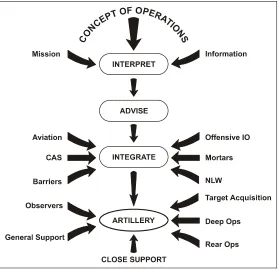
14. At every level, the artillery commander must understand his supported commander’s mission, intent and concept of operations in order to properly apply the fire support resources necessary for the success of the operational plan. The artillery commander is both an advisor to his supported arm commander and a commander in his own right. He carries out his own fire support estimate, as well as being intimately involved in his commander’s planning process. It is therefore necessary that he achieve an appropriate balance in terms of time and effort between conducting his own planning process and contributing to his commander’s. The functions that the artillery commander must perform are as follows:
a. Interpret. The artillery commander must fully assimilate the information he receives and completely comprehend the mission of the supported commander. He must understand the concept of operations (intent, scheme of manoeuvre and end state) of their mutual superior commander and the commander two levels up.
b. Advise. The artillery commander must use his knowledge of the fire support TA and attack resources available to him to advise the commander and develop the fire support necessary for the commander’s plan.
Figure 2-2: The Artillery Commander’s Functions in Developing the Commander’s Plan
FIRE SUPPORT PLANNING PROCESS
16. Once the outline operational plan is firm, the artillery commander, having conducted his own estimate, issues guidance to his staff in the form of an outline fire support plan from which the final artillery operation order will be produced.
17. The planning process culminates in the production and confirmation of orders. At division level, this will normally involve the production of a fire support operation order or annex to the main operation order; at brigade level an artillery sub-paragraph to the operations order is normally sufficient. All artillery headquarters and units supporting an operation must receive artillery specific orders.
18. During the formulation of the plan and the production of orders, it is essential that the artillery commander’s staff consult with other staff cells, particularly regarding movement, terrain allocation and ammunition resupply. Close coordination is also required for the support of non-artillery ISTAR/attack resources, such as offensive air support, aviation, reconnaissance and offensive IO.
FIRE PLANNING
19. Fire planning is the continual process of analysing, allocating, and scheduling fire support and is an integral part of the commander’s battle procedure. The aim of fire planning is to integrate fire support effectively into battle plans in order to optimize combat power. To accomplish this aim, fire support planning is done concurrently with battle procedure at all levels and for deep, close and rear operations. Fire planning must be flexible to accommodate the unexpected in combat and to facilitate rapid change. It encompasses the massing of fire support assets, changes in the force mission, resupply, target acquisition and target engagement. It involves the synchronization of collective and coordinated fire support resources to focus the fire support effort exactly where the manoeuvre commander intends to fight the battle.
acquire these targets and how to attack them. Fire planning is more of a linear process with a beginning and an end. Fire planning is conducted for a specific operation, normally in support of close operations. Fire plans are prepared at all levels and may support a deep or even rear operation. A fire plan consists of targets, which are critical to the attainment of the
manoeuvre commander’s plan. These targets may or may not have been initially designated to be priority targets, as determined through the
targeting process. A fire plan is the tactical plan to effect the engagement of these targets.
FIRE SUPPORT COORDINATION MEASURES
21. Integral to fire support coordination is the requirement to ensure the safety of our own troops against the effects of friendly fire. The FSCC coordinates all fire support impacting in the area of responsibility of the manoeuvre force that it is supporting. The FSCC will ensure that fire support will not jeopardize troop safety, is synchronized with other fire support means and /or will not disrupt the operations of adjacent friendly units. Fire support coordination measures (FSCM) assist in achieving these aims.
22. The following FSCM are in effect:
easy to define on a map and easily recognised from the ground and air.
b. No Fire Line (NFL). A line short of which indirect fire systems do not fire except on request or approval of the commander who established the line, but beyond which they may fire at any time without danger to friendly troops. The NFL is used to expedite the quick attack of targets beyond it by fire support units (of higher levels), without the delay of unnecessary coordination but also to guarantee that no targets are attacked short of it without coordination with the responsible manoeuvre commander. The NFL is normally established by the commanders of division or brigade size forces. On occasion, the commander of a battalion-sized force may establish a NFL. Some NATO nations refer to this measure as the Fire Support Safety Line (FSSL).
c. Free Fire Area (FFA). A specific designated area into which any weapon system may fire (to empty guns, etc) without additional coordination with the establishing headquarters. The FFA is also used to facilitate the jettison of munitions when aircraft are unable to drop them on a target area. The area is usually established by a division or higher commander following coordination with the host nation, if appropriate. It is located on identifiable terrain when possible or designated by grid coordinates.
d. Restrictive Fire Line (RFL). A line established between converging friendly forces (one or both may be moving) that prohibits all fire or effects from fire across the line without coordination with the affected force. The purpose of the line is to prevent fratricide and duplication of attacks by converging forces. The line is established by the HQ that controls both forces, based on submissions from them. This line is located on identifiable terrain, usually closer to the stationary force.
those restrictions will not be delivered without
coordination with the establishing headquarters. An RFA is established by a manoeuvre battalion or a larger ground forces or by an independently operating company. Usually, it is located on identifiable terrain, by a grid reference or a radius (in metres) from a centre point.
f. No Fire Area (NFA). An area usually established by a division or corps, into which no fire or the effects of fire are allowed. Two exceptions are:
(1) when the establishing headquarters approves fire temporarily within the NFA on a mission-by-mission basis; and
(2) when an enemy force within the NFA engages friendly troops the friendly force commander may engage the enemy to defend his force.
The NFA is located on identifiable terrain, when possible.
g. Airspace Coordination Area. A restricted area or route of travel specified for use by friendly aircraft and established for the purpose of preventing friendly aircraft from being fired on by friendly forces. The purpose of the Airspace Coordination Area is to allow simultaneous attack of targets near each other by multiple fire support means, one of which normally is air. An Airspace Coordination Area is established by the FSCC at brigade level and higher. The area will be designated by timings, grid references of a centreline, width on either side of this line, and a maximum and minimum altitude in feet. An Airspace Coordination Area is placed on call and fire will not be delivered through it without the permission of the FSCC that ordered its adoption.
terrain features. Boundaries are both permissive and restrictive in nature. They are restrictive in that no fire may be delivered across a boundary unless the fire is coordinated with the force having responsibility within the boundary, or unless a permissive fire support coordinating measure is in effect that would allow firing without further coordination. Boundaries are permissive in that a manoeuvre commander, unless otherwise restricted, enjoys complete freedom of fire and manoeuvre within his own boundaries. Normal unit and formation boundaries, extended into enemy territory, establish the lateral limits for coordination. Rear boundaries must also be respected.
SUMMARY
24. Fire support involves the collective and coordinated use of land, air and sea-based TA and attack resources in support of the operational plan. Fire support encompasses the integration and synchronization of fire and weapon effects to delay, disrupt or destroy enemy forces, combat functions and facilities in order to attain operational and tactical objectives. It plays a key role in the dynamic forces of fixing and striking within the framework of deep, close and rear operations.
25. The activities of the fire support system must be closely integrated with the manoeuvre commander’s concept of operations and plan. The constituent components of the system must action in unison and must be responsive to the needs of the supported unit or formation commander. Fire support coordination, which is the responsibility of the senior artillery commander, enables the necessary advice, planning and execution of fire support so that the right targets are attacked to achieve the manoeuvre commander’s intended effects. To effect the required coordination, the artillery commander establishes an FSCC within the operations centre of the supported unit or formation headquarters. The coordination process is further refined by the use of fire support coordination measures, which set conditions on the application of fire within designated areas.
26. Further detail on the subject of fire support may be obtained from the following reference manuals:
a. BGL-371-001/FP-001, Field Artillery Doctrine; and