Abstract— In this study, a method to extract bridge vibration components from vehicle vibration data is proposed. The aim of this technology is to accurately estimate the bridge position, to improve the accuracy of on-going monitoring. The technology of on-going monitoring is a kind of alternate inspection for bridges’ status by using only data measured on a traveling vehicle. The estimation process mainly consists of three steps; 1) measuring the acceleration vibrations on the unsprung-mass points at the front and rear axes, 2) synchronizing positions of the measured data, and 3) calculating the subtraction of the two synchronized data. The applicability of this method is numerically examined, in which the RBSM and FEM are used to simulate VBI (Vehicle-Bridge Interaction) system. This numerical experiment shows that the proposed method can accurately estimate the bridge position.
Index Terms—on-going monitoring, VBI system, vehicle vibration,
I. INTRODUCTION
ridges are generally inspected by close visual check and hammering by experienced engineers. In Japan, there exist more 700,000 bridges, of which span lengths are longer than 2m, maintained under regular checks in every five years required by a law. However, while many bridges are aging, the number of civil engineers in this country continues to decrease. Since engineers are required to have various skills, their training is usually time- and money-consuming. Thus, there will be demand for a new method to improve efficiency of bridge inspection in near future.
As a new inspection technology, methods using vibration data has been studied by many researchers in these days. A popular method is called bridge monitoring, which acquires vibration data from several sensors attached to the bridge structure and evaluates the health of the bridge. Despite of the high accuracy, the installation of many sensors for each bridge is labor-consuming so that the improvement effect is limited. On the other hand, there is a method called on-going monitoring that a sensor-equipped vehicle travels through a Manuscript received March 18, 2019; revised April 6, 2019. This work was supported in part by the Strategic Advancement of Multi-Purpose Ultra-Human Robot and Artificial Intelligence Technologies (SamuRAI) project commissioned by the New Energy and Industrial Technology Development (NEDO), the joint program of the University of Tsukuba and Toyota Motor Corporation, titled "Research on the next generation social systems and mobilities.", and JSPS KAKENHI "Grant-in-Aid for Scientific Research(B)" [JP19H02220].
R. Murai is a master student of University of Tsukuba, Japan.
R. Miyamoto is a master student of University of Tsukuba, Japan.
K. Yamamoto is an assistant professor of University of Tsukuba, Japan (phone: +81-29-853-5146; e-mail: [email protected], address: 1-1-1 Ten-No-Dai, Tsukuba, Ibaraki, Japan).
Y. Okada is an associate professor of University of Tsukuba, Japan (e-mail: [email protected]).
bridge, and the bridge information is extracted from the vehicle vibrations by data processing [1]. It is a method to estimate bridge vibration from vehicle vibration, and research on estimation of natural frequency of bridge [2] and damage detection [3] has been advanced in recent years. The installation cost of sensors is very low. There is also the research on on-going monitoring by using route bus [4]. This kind technology is expected to be implemented in society by combining it with existing services and to avoid cost increase.
For the social implementation of on-going monitoring methods to bridge maintenance, the estimation of bridge position is still one of the common technical issues. The previous studies are usually performed under the condition that the times when the vehicle is at the entrance and at the exit of the bridge are known in numerical simulation or given from sensors on the bridge. However, to summarize data about the precise positions of all bridges is not easy in the aspect of the efficiency. If it is possible to automatically get the position data, the technology can be easily realized.
To recognize the bridge position, the change of dynamic characteristics of vehicle vibration can be used theoretically. However, it is generally strongly affected by vehicle speed and road surface unevenness. Furthermore, road profile generally shows wide range of predominant frequencies often including bridges’ ones so that it becomes difficult to determine them as some generated from road profile and others from bridges. If this problem is overcome, more services can be implemented for on-going monitoring, and a better bridge management system will be possible.
In time or frequency domain, it is difficult to distinguish the difference between the vehicle vibration characteristics during passing through the bridge and that on the other roads. On the other hand, the road profile is spatially fixed. To automatically estimate the bridge position from vehicle vibration, spatial synchronization of the vehicle data is necessary. While the accuracy of GPS (Global Positioning System) is not enough for comparing two vehicles, the spatial synchronization of the front and rear axes of one vehicle is realistic.
The unsprung-mass vibration of the vehicle is very similar to the input profile, which is forced displacement input of the vehicle system, and which can be described as the sum of road profile and bridge vibration component. Therefore, the bridge component can be extracted from the difference between the vehicle vibrations of the front and rear axes. Wang et al. [2] estimate the displacement input of the front wheel and the rear wheel from the sensors inside one vehicle. They remove the influence of the road surface unevenness by subtracting estimated input profile. They show that the natural frequency of the bridge can be estimated from the
Numerical Experiments of Bridge Position
Estimation for On-Going Monitoring
Ryo Murai, Riku Miyamoto, Kyosuke Yamamoto, Yukihiko Okada
difference, even if there is a speed change. Because the bridge vibration component appears in the vehicle vibration only during passing through the bridge, it is considered that it is possible to recognize the bridge existence from the difference of the vehicle vibrations. However, due to the effects of speed and noise, it is difficult to estimate automatically the bridge entrance and exit, with acceptable accuracy. Thus, in this study, a method to improve the bridge detection accuracy by applying the cross-correlation to the subtraction of unsprung-mass vibrations is proposed.
II. BASIS THEORY OF THE PROPOSED METHOD
A. Vehicle-Bridge Interaction (VBI)
The vehicle vibration can be simulated as the output of VBI (Vehicle-Bridge Interaction) system. VBI is the contact force and the bridge vibrations under the vehicle axes. When a vehicle enters a bridge, the vehicle shakes the bridge, and the bridge shakes the vehicle. The vehicle vibration is also excited by road surface unevenness. Fig. 1 shows the concept of VBI.
The vehicle can be modeled as a rigid-body-spring system, while the bridge can be done as a continuum body as shown in Fig. 2.
In this study, the sensor-equipped vehicle has one sprung-rigid-body and two unsprung-mass points as the front and rear axes. The sprung- and unsprung- ones indicate the upper and bottom sides of the suspension. The equation of motion of the vehicle system is expressed by Eqs. (1) to (4).
(1)
(2)
(3)
(4)
where , and are mass of the sprung-rigid-body
and of unsprung-mass-points at the front and rear axes, and are damping of the suspension at the front and rear
axes, and , , and are stiffness of the
suspension at the front and rear axes and of the tyres of the front and rear axes, respectively. and are distances from the centre of gravity of the sprung-rigid-body to the front and rear axes, and is the inertia moment of the sprung-rigid-body, which can be described as . These parameters are the system parameters of the vehicle. The system outputs are , , and ,
which are the vertical displacement vibrations of the sprung-rigid-body and unsprung-mass-points at the front and rear axes, respectively. The operators and denote the first and second order derivative with respect to time. Only
and are observed by the sensors. The input of the vehicle system are and , which are called input profiles.
The contact forces and acting under the front and rear axes, respectively, are described by Eqs. (5) and (6).
(5)
(6)
where is gravitational acceleration.
The equation of motion of the bridge system is expressed by (7).
(7)
where is mass per unit length, and is flexural rigidity of the bridge, respectively. In this study, Eq. (7) is numerically analyzed by FEM (Finite Element Method). The input of bridge system are the contact forces and , expressed in Eqs. (5) and (6), while the output is .
The input profiles of the vehicle are expressed by Eqs. (8) and (9).
(8)
(9)
where is the road surface unevenness at position .
[image:2.595.45.281.311.451.2]Fig. 1 Conceptual image of VBI
[image:2.595.42.284.511.594.2]The vibration of the vehicle at time are simulated by numerically solving Eqs. (1) to (9).
B. Bridge component extraction by subtraction process
The vehicle vibrations of the front and rear axes, which are spatially synchronized, are referred to as signals and . It is assumed that the vehicle vibration components generated by bridge vibration are and . Let be the vehicle vibration component from the road surface unevenness. If the vehicle travels on the bridge at constant speed, these relations are considered to be expressed by Eqs. (10) and (11).
(10)
(11)
where and are expected to contain many non-matching components. Since they do not exist except on the bridge, and are considered to be the same value during passing outer side of the bridge. By subtracting and
shown in Eq. (12), the vehicle vibration component generated only by the bridge is available:
(12)
are expected to show almost zero except on the
bridge. Using these characteristics, it is possible to create an index that can react only to the bridge existence.
III. NUMERICAL VERIFICATION.
A. Numerical model
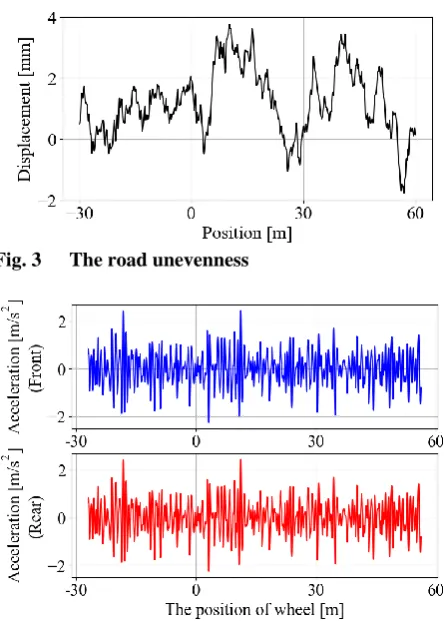
The system parameters of VBI system consisting of the vehicle taken as the rigid-body-sprung-model (RBSM) and the bridge modeled by FEM using one-dimensional finite beam elements are shown in TABLE I and TABLE II. The road profile introduced in this simulation are also shown in
Fig. 3.
TABLEI
THE VEHICLE SYSTEM PARAMETERS
Mass: 18000 [kg]
Inetia Moment (Pitch): 65000 [kg*m2] Damping (Sprung-mass): , 10000 [kg/s]
Stiffness(Sprung-mass): , 1000000 [kg/s2]
Unsprung-Mass: , 1100 [kg]
Stiffness(Upsprung-mass): , 3500000 [kg/s2]
Length: , 1.875 [m]
TABLEⅡ
THE BRIDGE SYSTEM PARAMETERS
Length 30 [m]
Number of Elements 15
Mass per unit length values of all elements
3000 [kg/m]
Flexual Rigidities of all elements 156*108 [N*m2]
B. The results of numerical simulation.
The sampling rate is 1000 [Hz] and the vehicle speed is fixed in each case. As an example, : the vibration of the
unsprung-mass at the front axle when traveling at 10 [m/s] and : that at the rear axis are shown in Fig. 4 after the
spatial synchronization. -30[m] ~ 0[m] are on the road, 0[m] ~ 30[m] are on the bridge, 30[m] ~ 60[m] are on another road.
Fig. 3 The road unevenness
Fig. 4 The vibrations of the vehicle unsprung-mass
and (10 [m/s])
From Fig. 4, it can be seen that the vibrations of the front and rear axes are almost the same. There is no big difference between vibrations on the bridge and the roads. This means that the vehicle acceleration vibrations are predominantly affected by the road profile.
Fig. 5 shows a plot of the vehicle vibration of the front
axis on the horizontal axis and that of the rear axis on the vertical axis. The shown case is one that the vehicle speed is set at 10 [m/s]. Each point is vibration data when passing through the same place. However, data from -30 [m] to -27 [m] are excluded because problems specific to simulation have occurred. From these figures, it can be seen that the vehicle vibrations under the front axis sprung and the rear axis sprung after position synchronization are almost the same. In addition, it is clear that the ratio of the vibration component of the bridge generated by VBI to the vehicle vibration is extremely small.
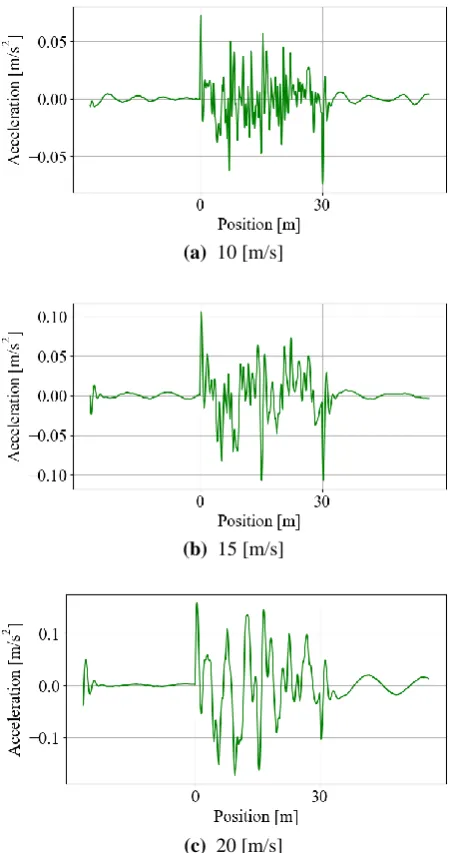
[image:3.595.308.531.48.359.2] [image:3.595.348.495.605.747.2]Fig. 6 is a plot of the values obtained by subtracting the vibration under the front axis spring and that under the rear axis spring after position synchronization. Fig. 6 is a plot of subtraction calculated from the vehicle vibration at (a) 10 [m/s], (b) 15 [m/s], and (c) 20 [m/s]. For vehicle speed at 20 [m/s], the spatial synchronization of the front and rear axes cannot be performed, because of the mismatch due to the sampling rate, so it is done by the interpolation using cubic spline interpolation [5]. From Fig. 6, it can be seen that the values that react significantly on the bridge and not on the road are derived at each speed. In addition, the peaks occur near the entrance and exit of the bridge, especially in lower speed cases, whereas when the speed is high, peaks occurs in the central part of the bridge.
Next, the influence of noise is examined. Assuming noise of the sensors in the actual measurement, noise is added to the simulated vibration data. It is white Gaussian noise with an average of zero, standard deviation , and is set to be % of the maximum amplitude of the vehicle vibration. Fig. 7 and Fig. 8 show the vibration of 10 [m/s] and 20 [m/s] with noise corresponding to = 1, 2 and 3. At 10 [m/s], as the noise gets stronger, the components of the bridge disappears. On the other hand, relatively low frequency vibration is
observed on the bridge at high noise at 20 [m/s]. This is considered to be caused by a large amount of data interpolated at the time of position synchronization by spline interpolation
C. Detection of bridge entrance and exit
Extracting the vibration waveform due to the existence of the bridge is equivalent to detecting the entrance and exit of the bridge. Thus, it is very important to detect the times when entering and leaving the bridge. As shown in Fig. 7, when the vehicle speed is 10 [m/s] and the influence of noise is small, peaks can be observed when entering and leaving the bridge. For the case of 10 [m/s] speed and = 1 (Fig. 7(a)), if the maximum amplitude is detected to estimate the position of the entrance of the bridge, the result becomes 0.21 [m], while the correct value is 0 [m], which means the error is 0.21 [m]. Similarly, assuming that the minimum value is the exit, it becomes 30.19 [m], while the correct value is 30 [m].
(a) 10 [m/s], = 1
(b) 10 [m/s], = 2
[image:4.595.46.275.51.478.2](c) 10 [m/s], = 3
Fig. 7 Subtractions of front and rear vibration with
noise (10 [m/s])
(a) 10 [m/s]
(b) 15 [m/s]
(c) 20 [m/s]
[image:4.595.300.541.275.722.2]To examine the possibility for bridge detection, a numerical experiment is carried out, next. In this experiment, the approximate position of the vehicle is always available by using GPS. Now assuming that two data-sets (shown in Fig. 9) are obtained from the subtraction process for the case of 10 [m/s] and = 1, and the case of 15 [m/s] and = 3 now, respectively, and that they have out of phase by 8.0 [m] as GPS error. Again, for the case of 10 [m/s] and = 1, the position of the entrance can be estimated as 0.21 [m] with the maximum amplitude. And the position of the exit can be estimated as 30.19 [m] with the minimum amplitude. However, for the case of 15 [m/s] and = 3, the position of the entrance can be estimated as 0.36 [m] with the maximum amplitude, while the position of the exit will be estimated as 15.22 [m] with the minimum amplitude. So, the error of estimated exit position is -14.78 [m], which is far from the true value (30 [m]). The spectrogram of this waveform is shown in Figure. 10. Length of each segment is set to 1 [m], which is equivalent to 0.067 [sec]. From Figure. 10, it is still difficult to distinguish automatically the bridge’s entrance and exit from the rest, due to the power of vibration at the central span.
Next, to improve the detection accuracy, their cross-correlation is calculated, as shown in Fig. 11. As a result of Fig. 11, the value of the cross-correlation shows the maximum peak at the point of -8.18 [m], which means that the vibration for the case of 15 [m/s] and = 3 is shifted by -8.18 [m]. Therefore, the estimated bridge entrance is 0.21 8.0 8.18 = 0.03 [m], while the exit is 30.19 8.0 8.18 = 30.01 [m]. The estimation accuracy is acceptable. In the same situation, with reference to the waveform of the case of 10 [m/s], = 1, the accuracy of position estimation when
(a) 20 [m/s], = 1
(b) 20 [m/s], = 2
(c) 20 [m/s], = 3
Fig. 8 Subtractions of front and rear vibration with
noise (20 [m/s])
Fig. 9 Subtractions of front and rear vibration with noise
Fig. 10 Spectrogram of subtraction of front and rear
vibration with noise (15 [m/s] and = 3, Length
of each segment is 1 [m])
[image:5.595.310.548.44.212.2] [image:5.595.46.274.54.487.2] [image:5.595.309.547.454.623.2]speed and noise are changed is clarified. The speed is set to 10 to 20 [m/s] in 1 [m/s] steps, and set a total of 11 patterns under the condition that the speed is constant. For noise, 11 patterns are set, from = 0 to 5 with the increments of 0.5. The phase to be shifted is 8.0 [m]. In Fig. 12, the errors in the estimated bridge entrance and exit for each speed and noise are visualized in a heat map. From this figure, it can be confirmed that the error changes due to the speed and noise.
In Fig. 13, the distribution of errors in Fig. 12 is visualized
by histogram, without considering the difference between speed and noise. According to Fig. 13, it can be confirmed that the errors are within -0.3 to 0.3 [m] at entrance and exit of the bridge. It can be said that a robust accuracy is shown, even for differences in noise and speed.
D Discussion about the results
From Fig. 12, it can be seen that the error increases in negative direction as the speed increases. Thus, if the pre-estimated position of the bridge entrance with the case of low-speed and low-noise is before the actual position, another estimated position of entrance may be extremely different from the true position. Similarly, if the bridge exit estimated in advance is before the actual exit, another estimated position of exit may be on a bridge. Therefore, in the method shown in this research, it is important to use reference vibration data for accurate bridge detection.
Since the assumed experimental pattern is simple, it is necessary to perform verification in consideration of vehicles and bridge models with different parameters, speed change, three-dimension and so on. Moreover, since position synchronization becomes extremely difficult in an actual vehicle, it is necessary to verify whether it is effective even when the synchronization cannot be performed accurately.
IV. CONCLUSION
In this study, it is shown that bridges can be detected by the subtraction of vehicle vibration data synchronized spatially, if the sensors are installed on the unsprung-mass points. In order to improve the estimation accuracy for the entry/exit positions and to reduce the fault detection, the cross-correlation method can be applied. This result is obtained by numerical experiments. The VBI system is modeled by RBSM vehicle and one-dimensional FEM bridge. Numerical experiments show that, for the cases of no noise, the signals' subtraction can successfully react only during passing through the bridge. These experiments also show that it is difficult to estimate the position of entrance and exit by subtraction with larger noise and faster vehicle speed. However, if accurate data is available, it is possible to estimate the position with high accuracy, even for data with strong noise and high speed.
The effectiveness of the proposed method is verified with a simple case under the condition of two-dimension, and constant vehicle speed. In order to connect the results of this research to social implementation, it is important to verify with more complicated cases. As future work, it is necessary to confirm whether this method is useful by three-dimensional simulation and experimental data. It is also should be done to investigate the data obtained under the condition that vehicle speed is changing.
REFERENCES
[1] Yang, Y.B., Lin, C.W., and Yau, J.D., “Extracting bridge frequency from the dynamic response of a passing vehicle”, Journal of Sound and
Vibration, Vol.272, pp.471-493, 2004.
[2] H. Wang, T. Nagayama, J. Nakasuka, B. Zhao, D, Su., “Extraction of bridge fundamental frequency from estimated vehicle excitation through a particle filter approach”, Journal of Sound and Vibration, Vol. 428, pp.44-58, 2018.
[3] Kyosuke Yamamoto, Yuta Takahashi, “Experimental Validation of Bridge Screening Method based on Vehicle Response Analysis”, Proc. of World Congress on Engineering 2017, Vol.2, pp.928-933, London, U.K., July 5-7, 2017.
[4] Ayaho Miyamoto, Akito Yabe, Válter J. G. Lúcio, “Damage Detection Sensitivity of a Vehicle-based Bridge Health Monitoring System”,
Journal of Physics: Conference Series, Vol.842, 012032, pp.1-12,
2017.
[5] McKinley, S., and Levine, M., “Cubic spline interpolation.” College of
the Redwoods, 45.1, pp.1049-1060, 1998.
(a) Bridge Entrance
(b) Bridge Exit
Fig. 12 Effects of noise and vehicle running speed on Estimated Position Error
(a) Bridge Entrance
(b) Bridge Exit
[image:6.595.78.243.52.339.2] [image:6.595.54.268.54.583.2]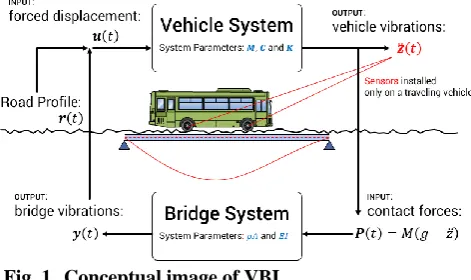
![Fig. 10 Spectrogram of subtraction of front and rear vibration with noise (15 [m/s] and = 3, Length](https://thumb-us.123doks.com/thumbv2/123dok_us/395686.537101/5.595.46.274.54.487/fig-spectrogram-subtraction-rear-vibration-noise-m-length.webp)