FM 31-70
D E P A R T M E N T O F T H E A R M Y F I E L D M A N U A L
BASIC
COLD WEATHER
MANUAL
H E A D Q U A R T E R S , D E P A R T M E N T O F T H E A R M Y
This copy is a reprint which includes.EW 3iO
LjI V LU4Jt4YiUJ '.J.LI UJ[]Ea V
Z1J
EIEPD wvnvr J
HhtcflVTLET2
MO. 2I—JO ) flV2HIMCLOI4b1't't7t? T 1ATDTA
DC'
T (L T LTL 7'UTLTTDVCI '..'JIU
PI% A& P I I II %AI.JIAP
IV1CVLflD YVYV1IIV1U V V Z4bJLLDJ'Li47U
CHVLLEIf 1 II'1JdODflCLIO4 I_Tb I-S 2
6cçiou (J6U6LBJ
-
S—I—S—3 2r%T ATT (1 ZT ('T'I TIZTTA (1 ZTA T ci'c r TTTATTAT
III. Ed!bli16U
--II• C1OW1IJ - e
CHThLEX
3 21!vrr fl.1Ii
FIAIMCL UJ'
rr
0 0 0 10 0026C4!0U I CGIJGLffJ - 2—r2—
LA ooq vxiq
6-ur
uJbLoAJeGq apGJ4GL- — 3123S1
r TCUNTRG ufl nruL cdnihuicu
-A H16U6 IJq UL2 2—33——2—'1
A1 BAOflC LOITçIU - P0
11
26C4IOIJ I•
oqnc;iou
CHVLLEE t 2KIIWL VJ4D 2MOiA2HOEI4C
III• Il(!J1LA JCI1U
QTTflM Q1U1
TLTT —
1K IJIBL
2flO!A2pOGiU. t-3e-—t-38 &1.CHVLLEIC 2 WOAE?IEMJ
j ybbJ!cvou o jq uuq UO&O6c6cpu!dn - ______
6C4JOU J JLOJ6W 6C4iIJ UIOA6WGIJ - 701
ill
TT 1400c UJOAGUYG1JUJjJJJt
TAOA Vf!0JJ JAJJ6IJJ0a 2—IO--—2—1
1K rq uAlcOU
- 2i—2—8 fl3—
jj p(6GpIJ6q
q ço
WOA66-I111I —JJ
ATT
T6Q— D—T& 9—T.
TThb4JU4J I- L)1JLJAqJJuj UJ(IJUJ4JJbLU L1J.
CHV1LEB 0 COrtBVL I1ECH4I11E
ir
!A6bon2 uq TULflhiJ6IJ-iir JL6 vuqWOJ6W61J
-Ar
q
opçtw -
e—s----e--2sK CW0flU6 BJJq COIJG6JW6U
-
e—ie—-e--sel2
1K E!P!U 46C}JIJJdfl6 - 0—12—1—12 125
oat vi i a v ii010
26C10U I. CGU6LUI
!'JTIE'TI L !DTAT7T'T rtTAT T TIt'.JTYT'T?O
if b6d11J10L bLOpJGUJ O JGvq6L
-jp,s uaaunoi .b...qsa w3i—O 3 .pLLA iom' ucnqu8 cpevkr
C. 2X1 icirr
BE2CI1E 2EVICH
-W C!-WflPID\V1J EWEJCEMCX CODE EOK fl2E III YI\FVMD
)EMDIX V IEEEKEMCE 121
Q corD !AEVJHE}c HIMJ2 181
E' E4AIEO?1EMLVT EMECJ2
VMD LAbE rovD
-
LbE IIEICHJ2 OE COrD liEVLHE} COLHfl4C VMD E6flILWEML
D EEEECJ OE COL'D IAEVILHEIC 014 1EVbO142
IMDEX 18't
C'0a9VKA
wqo VX\MSC 52 sc ss
8qJ& vMVEc o 20
HV DM8' \MD1 9JLG ia 00
3Ot6' IJG BnLIJ6L' dcwq'(Wino -
- 8
r 20 52B1116 3700
MWG180mw' Tjj93)
MOCJCGCr - 8 00
VJWCPGL 12' 00
311% MOCJC64' r''v
2W26b1fl6' 713 38 20
YI1IJV' 3/1521 31 00
BflL6 58' 00
SJWW 31OLVL1 31158:
QLGnaqc fl""P"' -11S8 9' 00
COWb2' G1J29fIG '20
BWLTqOJGGL' AS'O5WUJ 1WW1333!flOIJ (90 Lq2) 9' 91
320 LOI11J2' resuuf yjucpiuceriu 3s 00
L!2c01' vcownw' cr i2 - 3'20
p,sabou' yuclbcL2ouuGr (cJuAwoL6) w 00
CJO1JJ!IJ 34 43
BOOfr uc'pccq /LP!f 2 20
Ot.GLEtP!CG 26
r
I!ff61 JU26Lf&; /AOOJ XIU 0 33
yI!ctGJs 2JIGHQ' jL!e&GL EUJeGL
- 0'43
YIRW6L' j/OOMWt - 0' 32
0'Be
cvb' 10211JIU -jGJw6ç r!uGL-w1w6r - 0'30
F!UGL' C''r Yi':l°" flJL6q 0'32
c° ccc" jOu m1
9' So2P!L1' 11s001 L4AIOIJ00 120
1L0112GL21 conouy4?.JWJ ThU
-
3' 10nabGnqGL 0' 32
2OC'C"2J'1°"OJG 0' 10
DLWJLGL2' 20\20 0' 20
flhJqGLeJflLç' 2o\2o 0' s J{GJIUGCb IA\73116L 9 00
wwtsia
WJ cdenbwnç io' 23
bL016Cf!t$ 'JjV2$
poq?.7LWOL 2'
2L011.2P0G' 'IUeIJG2!nIIJ c eo B?.o1JGr u.\2GJpJMTLq j' O JJJfLGUCJJ!JJE jpoj' JL\CtTLL!GL. 3' 80 RGJ' /I14 11\ULf !q brcjcGf ç boucir -
j'
orCffIJVGGU' ojq CI! IJJtWG 3 22 LORGJ' '113J13J0' S'O5I17UJ yJJ4 ( GB) -- 1'40
WTeflJUGb zt.U'esww7WWO(2 G) -- - - s'82
LGIJUqG 1130 (s G) F 00
JS!UGb YSIJI 0' 08
CHANGE
No. 1
FM 31-70, 12 April
Page 53, paragraph
changed to read
FM 31-70 C l
HEADQUARTERS
DEPARTMENT OF THE ARMY WASHINGTON, D.C., /7 December /968
BASIC COLD WEATHER MANUAL
1968, is changed as follows: 3-51 b, In line 16 “(LOW)” is “(LAW or Lubricant, Semi-Fluid, MIL--L--46000A(LSA)).”
Page 165, paragraph D-2 a. In line 10 “(LOW)”
is changed to read “(LAW or Lubricant, Semi-Fluid, MIL-L-46000A(LSA)).”
Page 166, paragraph D-3a (2). In line 21 “LOW”
is changed to read "LAW or Lubricant, Semi-Fluid, MIL-L-46000A(LSA).”
Page 166, paragraph D-3 a (3), In lines 3 & 4
“LOW” is changed to read “LAW or Lubricant, Semi-Fluid, MIL-L-46000A(LSA).”
Page 166, paragraph D-3 b (4). In line 7 “LOW” is
changed to read “LAW or Lubricant, Semi-Fluid, MIL--L-46000A(LSA).”
Page 170, paragraph E–2 a. In line 14 “Cap, Cold
Weather” is changed to read “Cap, Insulting, Helmet Liner-Helmet.”
Page 171, paragraph E 2c. Entire page 171 is
deleted and the following is added:
E-3. Type Load
The loads shown below are type loads which could be worn during moderately cold weather
(approxi-TAGO 649A—December 340-470 —68
JJ,QIJ Ei1Jt4.(.I?. 0 I
HIJ!LC
LOCJ -
o. oDox J.Jgcp /* tIl{LbLOO
-. 0• 12
IJU QGI i#.\cimc
- 0 30
0 10
HncJtrcc' AIo1J D'1 OC-- - 2' 00
to3;.
Io1vl J,!RpUR o1q. ' 02
joD. I.
0.JJGt 1LOnG3.9 y).jou 5rn;;q
- 0 Of
c' JL17GLgGbcJJIJ
-nommiic - 2 00
B'
J0c!!JJ (InvoL)-D1J2IcGbw (QnL)
- . 00
poLuicjmicjc:
LOnoRJe(OUJmc O. mrctcpoqio
'uuou JA°°1
- - - 0
2L6L L!LO 0. 12
L0!/.GIJ1Lr!p - 0
e
J0JJOLCJCd - . 00
1\ jçiioiJ
.
1
;).iov..L!11 00
20CJ CnJJ?0JJ 2016
(
bL)- 0
a
JOF J
.L°I O
pLj
iq EtCUG6.L0'J E!26UCO oq
-
a. s
c. Supplemental Existance Load. The following
are items of clothing not immediately needed by the individual during moderately cold weather. These items are normally carried in the duffle bag on unit transportation and should be available to the individual when needed:
Undershirt, 50/50 Drawers, 50/50 Socks, Cushion Sole (3 pr) Trousers, Cotton Nylon, WR Shirt, Wool Nylon, OG Parka, Cotton Nylon Liner, Parka, Nylon Quilted Mitten Set, Arctic
Page 184, paragraph G-6a. In line 1 “(LOW)” is changed to read “(LAW or Lubricant, Semi-Fluid, MIL-L-46000A(LSA)).”
By Order of the Secretary of the Army:
Official:
KENNETH G. WICKHAM,
Major General, United States Army, The Adjutant General.
W. C. WESTMORELAND,
General, United States Army, Chief Of Staff.
Distribution:
CHAPTER 1
INTRODUCTION
1-1. Purpose and Scope
a. This manual is designed to prepare the
individual soldier and small unit commander to conduct military operations for extended periods of time under the most severe and varying cold weather climatic conditions. The doctrine and techniques in the manual are applicable in any area that has cold weather and snow with their accompanying opera-tional problems. Troops properly trained in this doctrine and these techniques will be able to fight; live; and move in any cold weather area of the world.
b. The provisions of SOLOG Agreement 23R,
Arctic Doctrine are implemented in this manual.
c. The material contained herein
empha-sizes that cold, with its attendant problems affects military operations but does not pre-vent them. The proper use of authorized equip-ment and field expedients will, to a major degree, overcome any problems encountered as a result of the cold. It is the commander’s responsibility to train his men so they can make the environment save military opera-tions, not hinder them. The material presented herein is applicable, without modification to nuclear and nonnuclear warfare, employment of, and protection from, chemical, biological, and radiological agents, and internal defense and development operations.
d. Throughout this manual reference is
made to the additional time required to con-duct various tasks in cold weather operations. This requirement cannot be overemphasized and must be included in all planning. In addi-tion to the increased amount of time con-sumed in actual movement, allowance must be made for other time consuming tasks that are not present in temperate zone operations.
These include, among others, erecting and striking tents, performing maintenance, con-structing roads, starting and warming engines, movement of supplies, and hundreds of other small tasks that must be performed while wearing bulky cold weather clothing.
e. Insofar as possible illustrations used in
this manual reflect Standard A items of cloth-ing and equipment. However, because of non-availability of some items at time of publica-tion, some illustrations show Standard B or C items of clothing (para 2-7).
f. Measurements in this manual to the
ex-tent practicable, reflect both the Metric and U.S. systems; however, in some cases figures will show only the U.S. system. For ease in transposition, meters have been converted to yards on a one for one basis. For more exact measurements use the conversions shown in appendix H.
g. Users of this manual are encouraged to submit recommendations to improve its clarity or accuracy, Comments should be keyed to the specific page, paragraph, and line of the text in which the change is recommended. Reasons should be provided for each comment to insure understanding and complete evaluation. ments should be forwarded direct to Com-manding General, United States Army, Alaska, APO Seattle 98749. Originators of proposed changes which would constitute a significant modification of approved Army doctrine may send an information copy, through command channels, to the Commanding General, United States Army Combat Developments Command, Fort Belvoir, Virginia 22060, to facilitate re-view and followup.
1-2. Relation to
This manual is tion that normal
Other Manuals
CHAPTER 2
INDIVIDUAL CLOTHING AND EQUIPMENT
Section 1.
2-1. Basis of Issue
a. As used in this manual, individual
cloth-ing and equipment are those items issued or sold to a soldier for his personal use, and in-clude certain organizational equipment utilized by the individual. The basis of issue of cold weather clothing and equipment may be found in TA 50-901. Mandatory items of personal clothing are listed in AR 700–8400–1.
b. The U.S. Army, through continuous
re-search and development, endeavors to main-tain the best clothing and equipment in the world. When properly fitted and properly util-ized this clothing will provide adequate pro-tection from the elements and will enable trained, well disciplined troops to carry out year-round field operations under cold weather conditions, wherever they may be encountered. c. To utilize fully the protection afforded by the present standard cold weather clothing and equipment, it is necessary to understand the principle involved and the correct function of each item. This chapter covers basic principles and provides general guidance on the purpose and use of cold weather clothing and equip-ment.
2-2. Commander's Responsibilities
a. Many factors will influence the command-er’s decision as to what items of clothing and equipment his troops should wear or carry. These include the weather, mission at hand, actual duties to be performed, overall physical condition of individuals and their degree of proficiency. If a movement is involved he must consider the distance to be traveled, the method of travel, and how the troops will be fed en route, if applicable. If the movement is on foot, he must bear in mind that under
nor-GENERAL
mal winter conditions, 65 to 70 pounds is the maximum weight a man can normally wear and carry and still be effective on reaching his destination.
b. The weight of individual clothing and
equipment is covered in appendix E. Com-manders should give particular attention to additional organizational equipment required for a given operation. Some of the more com-mon items are also listed in appendix E. Since the individual soldier’s combat load in cold weather operations exceeds that of a temperate climate load by more than 20 pounds, these organizational items (such as binoculars, com-passes, radios and batteries, pioneer tools, crew served weapons, etc. ) become major consider-ations and must be included at all levels of planning.
c. In addition to the individual combat load, another 45 to 55 pounds of clothing and equip-ment is required for the protection and com-fort of each individual under conditions of
ex-treme cold. Transportation must be provided
for this additional load whenever possible.
d. The commander must take positive action
must not be arbitrary in delineating strict uniform requirements, but must allow some personal choice of undergarments.
2-3. Cold Weather Conditions
The use of cold weather clothing is affected by two types of weather conditions: wet and dry. These conditions are amplified by humid-ity coupled with temperature and wind veloc-ity; high humidity (wet conditions), low humidity (dry conditions).
a. Wet Conditions. Cold-wet conditions occur
when temperatures are near freezing and vari-ations in day and night temperatures cause alternate freezing and thawing. This freezing and thawing is often accompanied by rain and wet
2-4.
a.
snow, causing the ground to become
Section II.
Purpose of Clothing
Protection of Body Against Climatic
CLOTHING
Factors.
(1)
(2)
If the body is to operate efficiently, it must maintain a normal temperature. The body attempts to adjust itself to the variable external conditions it encounters. These attempts are evi-denced by the need for more food to produce additional heat during colder weather, by perspiration to increase removal of heat during hot weather, and by the gradual darkening of the skin as protection against extended exposure to the rays of the sun.
Proper clothing, correctly worn, will assist the body in its adjustment to extreme climatic conditions. The clothing does this by holding in the body heat, thereby insulating the body against the cold outside air. The problem of protection becomes acute when freezing temperatures are in-volved. To understand this problem requires a knowledge of the methods by which the body resists the effects of climatic changes.
b. Balancing Heat Production and Heat Loss.
The body loses heat at variable rates. This heat may flow from the body at a rate equal to or greater than the rate at which it is produced.
muddy and slushy. During these periods troops should wear clothing which consists of a water-repellent, wind-resistant outer layer and inner layers with sufficient insulation to pro-vide ample protection in moderately cold weather (above 14°F.).
b. Dry Conditions. Cold-dry conditions occur
when average temperatures are lower than 14°F. The ground is usually frozen and snow is usually dry, in the form of fine crystals. Strong winds cause low temperatures to seem colder and increase the need for protection of the entire body (windchill) (fig. F-1). During these periods, troops should have available additional insulating layers of clothing. This is particularly true when entering static situa-tions form a period of strenuous exercise.
When heat loss exceeds heat production, the body uses up the heat stored in its tissues, caus-ing a rapid drop in body temperature. Exces-sive heat loss can result in shivering. Shivering uses body energy to produce heat which at least partially offsets the heat loss and slows the rate at which the body temperature will drop. Shivering is an important warning to start action to rewarm, either by adding more clothing, by exercising, by eating some food, or by entering a warm shelter, or by any combination of these actions. In freezing temperatures it
adjust clothing ing as it is to loss.
is as important to remove and to prevent excessive overheat-add clothing to prevent heat
2-5. Principles of Clothing Design
Certain principles are involved in the design of adequate cold weather clothing to control the loss of heat from the body, to facilitate proper ventilation, and to protect the body.
a. Insulation. Any material that resists the
heat loss. Fur provides warmth in the same way; warm, still air is trapped in the hair and is kept close to the body.
b. Layer Principle.
air. If this gives too much ventilation, only the neck of the garment should be opened to allow warm air to escape without permitting com-plete circulation. (1)
(2)
(3)
Several layers of medium-weight clothing provide more warmth than one heavy garment, even if the single heavy garment is as thick as the combined layers. The effect results from the several thick layers of air which are trapped between the layers of clothing, rather than one or two layers of large volume. These layers, as well as the minute air pockets within the fibers, are warmed by the body heat.
The layers of clothing are of different design. The winter underwear is most porous and has many air pockets. These air pockets trap and hold the air warmed by the body. To keep the cold outside air from reaching the still inside air that has been warmed by the body, the outer garments are made of windproof, water-repellent fabric.
The layer principle allows maximum
2-6. Winter Use of Clothing
a. Basic Principles of Keeping Warm.
(1) Keep clothing Clean. (2)Avoid Overheating. (3)Wear Clothing Loose and in layers. (4) Keep clothing Dry (5) Remember C-O-L-D to keep warm in winter.
b. Application of Basic Principles.
(1)
freedom of action and permits rapid adjustment of clothing through a wide range of temperatures and ac-tivities. The addition or removal of layers of clothing allows the body to maintain proper body heat balance. c. Ventilation. Perspiration fills the air-spaces of the clothing with moisture laden air and reduces their insulating qualities. As per-spiration evaporates, it cools the body just as water evaporating from a wet canteen cover cools the water in the canteen. To combat these effects, cold weather clothing is designed so that the neck, waist, hip, sleeve, and ankle fastenings can be opened or closed to provide ventilation. To control the amount of circula-tion, the body should be regarded as a house and the openings in the clothing as windows of the house. Cool air enters next to the body through the openings in the clothing just as cool air comes into a house when the windows are open. If the windows are opened at opposite ends of a room, cross-draft ventilation results. In the same way, if clothing is opened at the waist and neck, there is a circulation of fresh
AGO 8641A
nor-mal insulation, grease will make the clothing more flammable. All outer garments of the Cold Weather Cloth-ing System are washable and have laundry instruction labels attached. If washing is not possible for clothing that would normally be washed with soap and water, dry rubbing and airing will rid them of some dirt and accumulated body oils.
(2) Avoid overheating. In cold climates,
overheating should be avoided when-ever possible. Overheating causes perspiration which in turn, causes clothing to become damp. This damp-ness will lessen the insulating quality of the clothing. In addition, as the perspiration evaporates it will cool the body even more. When indoors, a minimum of clothing should be worn and the shelter should not be over-heated. Outdoors, if the temperature rises suddenly or if hard work is be-ing performed, clothbe-ing should be adjusted accordingly. This can be done by ventilating (by partially opening parka or jacket) or by re-moving an inner layer of clothing, or by removing heavy mittens or by throwing back parka hood or chang-ing to lighter head cover. The head and hands, being richly supplied with blood, act as efficient heat dissipators when overheated. In cold temperature it is better to be slightly chilly than to be excessively warm. This pro-motes maximum effectiveness of the body heat production processes. (3) Wear clothing loose and in layers.
Clothing and footgear that are too tight restrict blood circulation and invite cold injury. Wearing of more socks than is correct for the type of footgear being worn might cause the boot to fit too tightly. Similarly, a field jacket which fits snugly over a wool shirt would be too tight when a liner is also worn under the jacket. If the outer garment fits tightly, putting additional layers under it will restrict circulation. Additionally, tight garments lessen the volume of
trapped air layers and thereby reduce the insulation and ventilation avail-able.
(4) Keep clothing dry.
(a) Under winter conditions, moisture
will soak into clothing from two directions-inside and outside. Dry snow and frost that collect on the uniform will be melted by the heat radiated by the body.
(b) Outer clothing is water-repellent
and will shed most of the water collected from melting snow and frost. The surest way to keep dry, however, is to prevent snow from collecting. Before entering heated shelters, snow should be brushed or shaken from uniforms; it should not be rubbed off, because this will work it into the fabric.
(c) In spite of all precautions, there
will be times when getting wet can-not be prevented and the drying of clothing may become a major prob-lem. On the march, damp mittens and socks may be hung on the pack. Occasionally in freezing tempera-tures, wind and sun will help dry this clothing. Damp socks or mit-tens may be placed, unfolded near the body, where the body heat will dry them. In bivouac, damp cloth-ing may be hung inside the tent near the top, using drying lines or improvised drying racks. It may even by necessary to dry each item, piece by piece, by holding before an open fire. Clothing and footwear should not be dried to near a heat source. Leather articles, especially boots, must be dried slowly. If boots cannot be dried by any other meth- od, it is recommended that they be placed between the sleeping bag and liner. Heat from the body will aid in drying the leather.
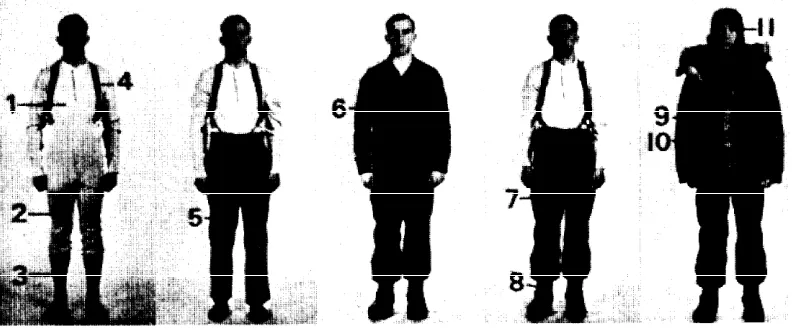
2-7. Components of Cold Weather Uniforms
V
IC
II
[image:12.610.98.497.61.226.2]H
•1i'
Figure 2–1. Basic components of cold-wet uniform.
and upon requisitioning some Standard B clothing may be issued. Although not shown as basic items of the cold weather uniforms, light cotton underwear may be worn under the winter underwear (para 2-6 b (l)).
a. Cold-Wet Uniform. The basic components
of the cold-wet uniform are illustrated in fig-ure 2-1 unless otherwise indicated.
(1) Undershirt Mans. 50 Cotton 50 Wool,
Full Sleeve.
(2) Drawers Mens. 50 Cotton 50 Wool,
Ankle Length.
(3) Socks Mens. Wool Cushion Sole, OG
408, Stretch Type.
(4) (5) (6)
(7)
(8)
(9)
(10)
(11)
Suspenders Trousers. Scissors Back
Type.
Trousers Mens. Wool Serge, OG 108. Shirt Mans. Wool Nylon Flannel, OG
108.
Trousers Mens. Cotton Nylon, Wind Resistant Sateen, 8.5 oz, OG 107.
Boot Insulated Cold Weather. Mens
Rubber Black (or Boot Combat: Mens Leather Black 8½" high with Overshoe: Rubber Man’s High Cleated 5 Buckle).
Coat Man. Cotton and Nylon Wind
Resistant Sateen, 8.5 oz, OG 107, with integral hood.
Liner Coat Mens. Nylon Quilted 6.2
oz, OG 106.
Cap Insulating, Helmet Liner-Helmet. Cotton Nylon Oxford, OG 107.
(12)
(13)
(14)
Glove Shells. Leather Black with
Glove Inserts; Wool and Nylon Knit, OG 208, or Mitten Shells; Trigger Finger Leather Palm and Thumb with Mitten Inserts; Wool and Nylon Knit, OG, Trigger Finger, or Mitten Set Arctic; Gauntlet Style Shell with Leather Palm (fig. 2-5).
Hood Winter. Cotton and Nylon
Ox-ford, OG 107, with drawcord and fur.
Poncho. Coated Nylon Twill, OG 207
(not illustrated).
b. Cold-Dry Uniform. The basic components
of the cold-dry uniform are illustrated in fig-ure 2-2
(1)
(2) (3) (4) (5) (6)
(7)
(8)
(9)
unless otherwise indicated.
Undershirt Mens. 50 Cotton 50 Wool,
Full Sleeve.
Drawers Mens. 50 Cotton 50 Wool,
Ankle Length.
Socks Mens. Wool Cushion Sole, OG
408, Stretch Type.
Suspenders Trousers. Scissors Back
Type.
Shirt Mans. Wool Nylon Flannel, OG
108.
Trousers Mens. Cotton Nylon, Wind
Resistant Sateen, 8.5 oz, OG 107.
Liner Trousers. Nylon Quilted, 6.2 oz,
OG 106.
Boot Insulated Cold Weather. Mens
Rubber White, w/release valve.
Coat Man. Cotton and Nylon Wind
J
(10) (11) (12) (13)
(14)
(15)
(16)
[image:13.613.120.438.64.278.2](17)
Figure 2-2. Basic components of cold-dry uniform. Liner Coat Mans. Nylon Quilted, 6.2
oz, OG 106.
Parka Mans. Cotton and Nylon Oxford
OG 107, w/o hood (not illustrated),
Liner Parka Mans. Nylon Quilted, 6.2
oz, OG 106 (not illustrated).
Cap, Insulating, Helmet Liner.
Cot-ton Nylon Oxford, OG 107.
Hood Winter. Cotton and Nylon
Ox-ford, OG 107, w/drawcord and fur.
Glove Shells. Leather Black with
Glove Inserts; Wool and Nylon Knit, OG 108, or, Mitten Shells; Trigger Finger Leather Palm and Thumb with Mitten Inserts; Wool and Nylon Knit, OG, Trigger Finger, or, Mitten Set Arctic; Gauntlet Style Shell with Leather Palm (fig. 2-5).
Poncho. Coated Nylon Twill, OG 207
(not illustrated).
Gloves Cloth. Work Type (not
illus-trated).
(b)
constructed so that circulation and ventilation are not restricted.
Suspenders. The scissors-type
sus-penders are worn over the under-shirt. The drawers and all succeed-ing layers of trousers are supported by the suspenders. The use of sus-penders allows the drawers and trousers to be worn loose at the waist so that neither circulation nor ventilation is restricted.
(2) Intermediate layer. The intermediate
layer consists of the wool OG shirt and trousers which provide excellent insulation against the cold. The shirt is worn outside the trousers for bet-ter control of ventilation. The wool trousers and shirt are not designed to be worn as outer garments under field conditions since they lose their insulating qualities if they become wet or matted with dirt. When en-gaged in strenuous activity, care must
2-8. Description and Wearing of the be taken so that the wool material
Uniform Components will not come in contact with the
a. Cold-Wet. skin, thus causing possible irritation
(1) Inner layer. and discomfort.
(a) Underwear. The underwear is loose (3) Outer layer.
fitting and is made of 50 percent (a) Coat. The coat ensemble is made up
Figure 2-3. Cap insulatng helmet and helmet liner.
(b)
The coat has a combination slide, snap and touch-and-close fastener front closure. The sleeves have ad-justable cuffs with a hand shield extension. A lightweight hood is an integral part of the coat. When not being used the hood is secured un-der the collar and is concealed by a slide fastened enclosure. The detachable liner is made of quilted nylon and is extremely light and warm. The liner has a collar, open underarms, and buttonhole tabs for attachment to the coat.
Trousers. The trousers are made of
smooth, light, wind resistant sa-teen. They have extra closures and adjustments. to provide for ventila-tion and better fit.
(4) Headgear.
(a) Cap. The insulating helmet liner
cap (fig. 2-3) is close fitting, visorless, and of helmet style. It has a combined one-piece earlap and neck protector, and utilizes an overlap touch-and-close fastener. The cap is designed to be worn un-der the steel helmet or unun-der the winter hood. When worn as an outer headpiece, the lower flap por-tion of the cap may be folded up
(5) (6)
(b)
around the top with the touch-and-close fasteners crisscrossed in the front (fig. 2-3).
Hoods. The winter hood (fig. 2-4)
is a one-piece covering for the head, face, and neck. It utilizes touch-and-close fasteners and can be worn over the steel helmet. A malleable wire inside the fur ruff may be shaped as desired for visi-bility or greater protection of the head and face. Unit commanders must enforce “hood discipline,” es-pecially while men are on sentry duty or on patrols. The winter hood and the cold weather cap with flaps down will greatly reduce a man’s hearing capabilities. When the temperature or wind does not. require the use of heavier head-gear, the cold weather cap and the lightweight hood should be worn. Hoods should be removed before the head starts to perspire. Breath-ing into the winter hood causes moisture and frost to accumulate and should be avoided as much as possible. Accumulated frost should be removed frequently.
yqn$p6
W416IJ BJJ6JJ
pççu !IL
n1J1JG4
2 oLq joobuvb iveue&
q•naBpI6 IAI4; aLb e cOLq joob
wc;" iJeij 2 JI46LI7gOL
J(j6I7 1I72OL1 JLj.ft6LJu.eLjoob
4st —•
tOOUt•
I
li00J 6Ø}J6L GJJb. Cold-Dry.
(1) Inner Layer. Same as cold-wet. (2) Intermediate Layer. The wool OG
shirt is worn as the basic upper body garment. The wind resistant sateen trousers with the quilted nylon liner are worn as the basic lower body gar-ment. In extreme cold weather, the
(8)
coat with detachable liner, used as an outer layer in the cold-wet uni-form, may be worn as an inter-mediate layer in cold-dry conditions.
Outer Layer. Depending on
The parka is a three-quarter length, unlined coat with adjustable cuffs. It has a combination slide and snap fastener front fly closure, waist and hem drawcords and a split lower back. The parka has a detachable quilted nylon liner.
(4) Headgear. Same as cold-wet. (5) Handwear. See c below. (6) Footwear. See d below. c. Handwear.
(1) Gloves.
(a) Standard black leather gloves are
worn in mild weather or when work must be done that requires more freedom of finger movement than can be acquired with heavier handwear. In colder weather the same gloves are worn with wool in-serts (fig. 2-5). Gloves may be worn with either the cold-wet or cold-dry uniforms when the weather is not cold enough to re-quire the use of mittens.
(b) Personnel engaged in delicate
fin-ger operations, such as instrument adjustment may be issued light-weight cotton work gloves. These gloves allow for finger dexterity, have leather palms, and prevent the skin from sticking to cold metal. They will provide protection against cold for only a very short period.
(2) Mittens.
(a) The trigger finger mitten shells
(fig. 2-5), are worn with wool trig-ger fintrig-ger inserts during periods of moderate cold. The mittens may be worn with either the cold-wet or cold-dry uniform. Figure 2-5 shows the Standard B mitten. The Standard A item, although identi-cal in outward appearance has had the trigger finger loop deleted and is lined on the inside upper surface with lightweight quilted nylon.
(b) During periods of extreme cold the
arctic mitten set is worn (fig. 2-5). The mitten has a liner, a leather palm, a cheek warmer and a
fast-ener on the back. A neck strap is attached to both mittens to prevent loss. The neck strap permits the mittens, when not required for warmth, to be conveniently carried snapped together behind the back. The arctic mitten set is carried whenever there is the possibility of the onset of severe cold weather, regardless of the mildness of the weather when setting out.
(3) Utilization.
(a) The general rules concerning the
use of clothing apply also to hand-wear—keep it clean, avoid over-heating, wear loose in layers, and keep it dry.
(b) The outer shells should always be
worn with the minimum insulation necessary to provide protection, thus avoiding perspiration. Inserts should never be worn by themselves because they wear out quickly and provide little warmth alone. Trig-ger finTrig-ger inserts are designed to fit either hand. Changing them to opposite hands frequently will in-sure even wear.
(c) Tight fitting sleeves should be
avoided. They may cut down cir-culation and cause hands to be-come cold.
(d) When handling cold metals, the
hands should be covered to prevent cold burns (immediate freezing of the flesh in contact with cold soaked metals).
(e) To keep hands warm when
wear-ing mittens, the fwear-ingers should be curled (inside the mittens) against the palm of the hand, thumb under-neath the fingers, or flexed inside the mitten whenever possible to in-crease the blood circulation. Hands may be exercised by swinging the arms in a vertical circle. Frost-bitten hands can be warmed by placing them next to the skin un-der the armpits.
(f) An extra pair of mitten inserts
d. Footwear.
(1) General. The feet are more vulner-able to cold than are other parts of the body. Cold attacks feet most often because they get wet easily (both ex-ternally and from perspiration) and because circulation is easily re-stricted. Footgear is therefore one of the most important parts of cold weather clothing.
(2) Principles.
(a)
(b)
(c)
(d)
The rule of wearing clothing loose and in layers also applies to foot-gear. The layers are made up by the boot itself and by the socks. Socks are worn in graduated sizes. The instructions pertaining to fit-ting of footgear, as outlined in TM 10-228, must be carefully adhered to. If blood circulation is re-stricted, the feet will be cold. Socks, worn too tightly, might easily mean freezing of the feet. For the same reason: AVOID LACING FOOTGEAR TIGHTLY. Since the feet perspire more read-ily than any other part of the body, the rules about avoiding overheat-ing and keepoverheat-ing dry are difficult to follow. Footgear is subjected to be-coming wet more often than are other items of equipment. The in-sulated boots with release valve (white, dry and black, cold-wet) are designed to contain pers-piration within the interior of the boots. A change of dry socks should be carried at all times. Whenever the feet get wet, dry as soon as possible and put on a pair of dry socks. Also, the inside of the boots should be wiped as dry as possible. Footgear should be kept clean. Socks should be changed when they become dirty. Socks and feet should be washed frequently. This washing will help keep feet and socks in good condition.
The feet should be exercised. Stamping the feet, double-timings few steps back and forth, and flex-ing and wigglflex-ing toes inside the
(e)
(3) T (a)
boots all require muscular action, produces heat, and will help keep the feet warm. The feet should be massaged when changing the socks.
Boots are designed to permit at-tachment to individual oversnow equipment (skis and snowshoes).
BINDINGS MUST BE
AD-JUSTED CAREFULLY. If they are too tight, the circulation of blood is restricted and feet will get cold. Improperly adjusted bindings may soon chafe feet or badly wear and tear the boot.
ypes.
Boot, insulated, cold weather: mens, rubber, black. These boots
(l, fig. 2-6) are particularly useful in snow, slush, mud, and water (cold-wet conditions), but are not adequate for prolonged wear in temperatures below –20° F. They are specifically designed for com-bat personnel who may not have the opportunity to frequently change to dry socks. Insulating material is hermetically sealed into the sides and bottoms of the boots. The insulation takes the place of removable innersoles and the sec-ondary layer of socks worn in other types of cold weather boots. Pers-piration from the feet and water spilling over the tops of the boots cannot reach the insulating mater-ial because it is sealed-in and al-ways remains dry. Moisture from outside sources or from perspira-tion may make the socks damp; this dampness is not harmful to the feet, provided they receive proper care such as frequent dry-ing and massagdry-ing. If socks are not changed and feet dried regularly (at least twice daily) the skin be-comes softened and is more readily chaffed or blistered. These effects are occasionally mistaken for su-perficial frostbite. Only one pair of
-
1p.
--tQ 3)%b&
o\9oog•
BOO; uanjq PJCJC S BOO1 ujçq p46' \L6JeBa6 A&JA6(b)
the not
boots. Additional socks should be worn as the feet may become cramped, resulting in restricted blood circulation and cold feet.
Boot, insulated, cold weather: mens, rubber, white, w/release valve. The insulated white boot (2,
fig. 2–6 ) is designed for wear in cold-dry conditions and will pro-tect the feet in temperatures as low as –60° F. The boots have a seam-less inner and outer carcass, sealed insulation, and an outside air re-lease valve used to compensate for air differentials. The white boots are worn over one pair of cushion
sole socks. The air release valve
provides airborne troops a means of equalizing external and internal air pressures when undergoing ex-treme changes in altitude. This valve must remain closed at all other times to prevent the possi-bility of introducing any amount of moisture into the insulation of the boot and rendering it perma-nently unserviceable.
2-9. Nose and Cheek Protectors and Masks
a. The Mask, Cold Weather may be issued
for use during severe windchill conditions. The mask must be removed at intervals to check for frostbite.
b. A certain amount of protection can be
gained by covering as much of the face as possible with a wool scarf. It may be adjusted from time to time, and should be rotated when the section opposite the mouth and nose be-comes covered with frost. The frozen end should be left outside the coat or parka. The scarf, like the mask, must be removed at in-tervals to check for frostbite.
2-10. Camouflage Clothing
a. Winter camouflage clothing (overwhites)
consists of white trousers and lightweight parka with hood. White covers are also issued for the rucksacks.
b. Camouflage clothing provides a means of
grounds. The correct use of camouflage cloth-ing is extremely important (para 6-22).
c. Overwhites may become frosty and icy
after use. As with all clothing, the frost and ice must be removed to expedite drying. Soiled camouflage clothing will lose its effectiveness; therefore, care must be exercised when han-dling stoves, digging in ground, and perform-ing similar tasks. Avoid scorchperform-ing or burnperform-ing the garments when drying or when lying down by an open fire. The clothing should be washed or changed frequently. When changing, cloth-ing should be checked to insure that it fits over the basic garments without restricting movement.
2-11. Maintenance of Clothing and Equipment
a. Footgear.
(1) Boots. The leather in boots should be
treated with approved agents. Nor-mally, the insulated boot can be re-paired with ordinary tire patching or air mattress patching material. If these items are not readily available, friction tape or even chewing gum may be used temporarily to plug up the hole and prevent moisture from damaging the insulation. If the dam-age cannot be repaired, the boots should be removed, airdried, and
SECTION III. EQUIPMENT
2-12. Sleeping Equipment
a. The complete sleeping bag for use in cold
climates consists of three parts: a case, of water-repellent material; an inner bag (moun-tain type), of quilted tubular construction, filled with a mixture of down and feathers; and an outer bag (arctic bag), of the same material as the inner bag. In
sulating air mattress and a into which the sleeping bags issued.
b. When temperatures are normally above
14° F., only one bag is used. It is placed in and addition, an in-waterproof bag are packed are
laced to the cover. When temperatures are be-low 14° F., both bags are used. The inner bag is placed inside the outer bag and secured at
(2)
turned in for replacement as soon as possible. The inside of the boots should be washed at least once a month with a mild soap, and rinsed with warm water.
Caution: Do not clean with
abra-sive materials. Also do not apply polish or paint to any part of the boot as it will result in deterioration of the rubber.
Socks. Socks should be washed daily,
using lukewarm water to avoid ex-cessive shrinkage. After washing, they should be wrung out and stretched to natural shape before drying. Holes in socks should be re-paired as soon as possible, taking special precautions to avoid bunching or roughness of the mended area. It should be noted that proper repairs under field conditions are almost im-possible and that blisters should be expected if field mended socks are worn.
b. Handgear. Holes should be mended promptly. Gloves or mittens should not be
dried too near an open fire.
c. Headgear. Headgear should be washed as
required to remove perspiration, dirt, and hair oils. When drying, normal care must be exer-cised to avoid scorching or burning.
the foot with the loops and tie straps provided and the cover laced over the outer bag.
c. When the bag is used, it is first fluffed up
temperatures. This is caused by condensation on the mattress due to the difference in tem-peratures between the lower side touching the ground and the upper side touching the rela-tively warm sleeping bag. Care must be taken to prevent puncturing the mattress or damag-ing sleepdamag-ing bags. In general, the more insula-tion between the sleeping bag and the ground, the warmer the body.
d. If the tactical situation permits,
individ-uals should avoid wearing too many clothes in the sleeping bag. When too many clothes are worn they tend to bunch up, especially at the shoulders, thereby restricting circulation and inducing cold. Too many clothes also increase the bulk and place tension upon the bag, thus decreasing the size of the insulating airspaces between layers and reducing the efficiency of the insulation. In addition, too many clothes may cause the soldier to perspire and result in excessive moisture accumulating in the bag, a condition which will likewise reduce the bag’s insulating qualities.
e. The sleeping bag is equipped with a full
length slide fastener which has a free run-ning, nonlocking slider. In an emergency, the bag can be opened quickly by grasping both sides of the opening near the top of the slide fastener and pulling the fastener apart. As a safety precaution, bags should be tested at frequent intervals to insure that the slide fast-ener operates freely and will function properly.
f. The sleeping bag should be kept clean
and dry. It should be opened wide and venti-lated after use to dry out the moisture that accumulates from the body. Whenever possi-ble, it should be sunned or aired in the open. The bag always should be laced in its water-repellent case and carried in the waterproof bag to prevent snow from getting on it. The warmth of the body could melt the snow dur-ing the night and cause extreme discomfort. Individuals should avoid breathing into the bag. If the face becomes too cold it should be covered with an item of clothing. Sleeping bags should be drycleaned at least twice a year. As a safety precaution, bags should be thoroughly aired prior to use to prevent possi-ble asphyxiation from entrapped drycleaning solvent fumes.
2-13. Manpack Equipment
a. Rucksack-Nylon, OG 106 (fig. 2-7).
(1) The nylon rucksack consists of the following:
(a)
(b)
(c)
(d)
(e)
(f)
A lightweight aluminum alloy frame to which all other compo-nents are attached.
A lightweight aluminum alloy cargo support shelf provided as op-tional equipment for attachment to the frame when the frame is used as a packboard.
A pouch fabricated from 4-ounce nylon fabric.
Nylon left and right shoulder straps. The left shoulder strap has a quick-release device designed to facilitate rapid doffing of the ruck-sack. The right shoulder strap has a rapid adjustment buckle for lengthening the strap which allows the wearer to fire his rifle while in the prone position. The two straps are interchangeable to accommo-date left-handed soldiers.
A nylon webbing waist belt de-signed to prevent the rucksack from swinging to either side or bouncing during body movements. A rifle carrier consisting of a rifle butt pocket, constructed of nylon webbing, with a double hook and a rifle strap.
5A5tt t—s? WCY%C\ 3!3\S045 OC 1O%
4 5JJOflJq6L R;LBba
9 JLBW6
S C° apaba
j job poL1SO1J4øJ UL
8 HIU6 a;Løb pflc]CJ62;J.b
e cotsJPUc lrncjc
2 }flU6 a;Lub LBCJCG4
13 HIU6 e;tvb joob Gnq
—%• 1bo4e rut*.t.
b. Suspenders and Belt, Individual Equip-ment. The suspenders and belt of the M-56
standard load-carrying equipment is worn be-neath the nylon rucksack to carry ammunition pouches, first aid or compass case, and the entrenching tool. The suspenders and belt should be adjusted to fit loosely over the cold weather clothing, to allow for proper ventila-tion. The suspender belt combination is de-signed so that the belt can be worn unbuckled while on the march, if additional ventilation is required.
2-14. Miscellaneous Equipment
a. Sunglasses, Sunglasses always should be
worn on bright days when the ground is cov-ered with snow. They are designed to protect the eyes against sunglare and blowing snow. If not used, snow blindness may result. They should be used when the sun is shining through fog or clouds, A bright, cloudy day is deceptive and can be as dangerous to the eyes as a day of brilliant sunshine. The sunglasses should be worn to shade the eyes from the rays of the sun that are reflected by the snow. Snow blindness is similar to sunburn, in that a deep burn may be received before discomfort is felt. To prevent snow blindness, sunglasses must be used from the start of exposure. Waiting for the appearance of discomfort is too late. The risk of snow blindness is in-creased at high mountain altitudes because the clear air allows more of the burning rays of sunlight to penetrate the atmosphere. When not being used, they should be carried in the
protective case to avoid scratching or breaking the lens. If sunglasses are lost or broken, a substitute can be improvised by cutting thin, 3 cm (l”) long slits through a scrap of wood or cardboard approximately 15 cm (6”) long and 3 cm ( 1“ ) wide. The improvised sun-glasses (fig. 2-8 ) can be held on the face with strips of cloth if a cord is not available.
b. Canteens.
(1)
(2)
Canteen, water; cold climatic (fig.
2-9), This canteen is a vacuum-in-sulated canteen of one quart capacity with an unpainted dull finish steel exterior. The inner and outer stain-less steel vessels are welded together at the top of the neck. A nonmetallic mouthpiece at the neck prevents lips from freezing to the metal neck. A plastic cap seals and protects the mouthpiece. A nesting type metal cup with a capacity of one pint is pro-vided for eating and drinking bever-ages. The canteen with cup is carried in a canvas cover which fastens to field equipment in a manner similar to the conventional canteens. Care must be taken to insure that the mouthpiece or cap are not lost. A sharp blow to the canteen may result in denting or rupture with conse-quent loss of insulating capabilities.
Conventional metal and plastic can-teens. Conventional canteens are
ruck-'I
__________
I
ius.t
sack. Conventional thermos bottles will keep liquids hot, or at least un-frozen for approximately 24 hours, depending on temperatures. If can-teens or thermos bottles freeze, they should be thawed out carefully to pre-vent bursting. The top should be opened and the contents allowed to melt slowly.
c. Pocket Equipment. There are several
small items that should be carried in the pockets so they will be readily available for use. Having these items when they are needed will contribute to the well-being of individuals and help prevent injuries. A good sharp pocketknife is an essential item. It is useful for cutting branches, in shelter construction, in repairing ski bindings, and numerous other tasks. Waterproof matches should be carried and kept in the watertight matchbox and used only in an emergency. They should never be used when ordinary matches and lighters will function. Sunburn preventive cream will pro-tect the skin from bright, direct sunshine, from sunrays reflected by the snow, and from strong winds. The chapstick will prevent lips from chapping or breaking due to cold weather or strong winds. The chapstick should be pro-tected from freezing. The emergency thong has numerous uses, such as lashing packs, re-placing broken bootlaces, and repairing ski and snowshoe bindings.
d. Emergency Kit. It is recommended that
all personnel carry an emergency kit for use in individual survival. With this kit, an indi-vidual can survive off the land by trapping and fishing and can procure the minimum amount
strength (1) (2) (3) (4) (5) (6) (7) (8) (9) (10)
of- food necessary to maintain his for a short period of time.
1 each emergency thong. 1 each sharp pocketknife. Single-edge razor blades. Waterproof matches. Safety pins.
Fishing line. Fire starters. Salt tablets.
High protein candy bars. Bouillon cubes.
2-15. Steel Helmet
The steel helmet may be worn during warm periods in cold areas in the same manner as in moderate climates. During cold periods it is normally worn over the Cap, Insulating Hel-met Liner-HelHel-met. The helHel-met may also be worn under the winter hood.
2-16. Protective Mask
a. The Mask, Protective, Field, M17 is the
outserts for the plastic lenses, this kit pro-vides for winterization inlet and nosecup valves together with an ice prefilter. This al-lows the standard mask to be worn at tem-peratures down to –50° F. with the M6A2 hood.
b. The protective mask may be worn in
moderately cold weather in the same manner as in moderate climates. When the mask is used in extreme cold, the rubber facepiece should be warm enough to make it pliable when it is adjusted to the wearer’s face. One method of keeping the mask warm is to carry it inside the outer garments and next to the body. It is also recommended that the mask be kept inside the sleeping bag during the night. On removing the mask, any moisture on the face should be wiped off immediately to pre-vent frostbite. After drying the face, the face-piece of the mask should be thoroughly dried to prevent freezing of moisture inside the mask. The rubber cover of the outlet valve should also be raised and the valve, surround-ing area, and the inside of the cover wiped dry to prevent the outlet valve from icing.
c. If it becomes necessary to wear the mask
for protection against chemical agents during extreme cold weather, troops must be advised
that the facepiece of the protective mask will not protect the face from the cold and that, in fact, the opposite is true. The danger of frostbite increases when the mask is worn.
d. The three automatic atropine injections
of 2 mg each, carried as accessories during moderate temperature conditions, are carried in a pocket of the protective mask carrier. In cold weather (40° F. and below), the injectors will be removed from the carrier and placed in the inside of the right-hand pocket of the OG shirt, where body temperature will pre-vent freezing.
2-17. Body Armor
CHAPTER 3
SMALL UNIT LIVING
Section 1.
3-1. Characteristics of Operations in Cold Weather
Unlimited space and a sparse, widely scat-tered population are dominant features of most of the colder regions of the world. Such condi-tions permit unrestricted maneuver for troops properly trained and equipped for cold weather operations. Warfare under such circumstances is characterized by, widely dispersed forces operating at great distances from other units or their parent organization. Units must be highly mobile and have the ability to sustain themselves while carrying out independent op-erations over extended periods of time.
3-2. Composition of Units
a. Small units (squad, gun crew, tank crew,
wire team, etc.) form the basic working group
GENERAL
for cold weather operations. Under normal op-erating conditions they will work together, cook and eat together, and share the same tent or other shelter. These small units should be formed at the beginning of training and, if possible, kept intact. The standard to be achieved is a unit which can make or break camp quickly, efficiently, and silently under all conditions; one in which each man knows the tasks to be completed and does them without having to be told.
b. Small units operating in cold weather
must be thoroughly familiar with the special equipment required and the techniques in-volved in living away from their parent orga-nization for extended periods of time. Equip-ment, and the techniques of using it, are dis-cussed in this chapter.
Section II. TENTAGE AND OTHER EQUIPMENT
3-3. General
A considerable quantity of various types of special equipment is required to maintain small units in cold weather. Permanent shelters are usually scarce in northern areas of operations and heated shelters are required. Special tools are necessary for establishing bivouacs, break-ing trails, and constructbreak-ing temporary winter roads and battle positions.
3-4. Need for Shelter
a. In order to conduct successful military
op-erations in cold weather and maintain a high level of combat efficiency and morale, heated shelter must be provided for all troops. An in-dividual’s ability to continue to work, live, move, and fight under extreme climatic
condi-tions depends upon adequate shelter. Tents and stoves, therefore, become a vital part of cold weather equipment.
b. In cold weather, tents should be placed as
close as practicable to the scene of activity, whether the activity be combat or administra-tive. By so placing the tents, rotation of men for warmup is possible and maximum conti-nuity of effort can be maintained.
c. Tents vary in size and shape, depending
bibE ObElliltO
Wl—LEIU bOE
\\ /_—
.\
Jy/
11
rulE
iEHL
f/f
,—2$OM cro.u4LQac1 uI.c o-,uar
for the unit, temporarily, to use only one-half or one-fourth of its tentage; i.e., one 10-man tent per platoon, with the men sleeping on a rotation basis. Reduced numbers of tents and stoves will decrease the requirement for logis-tical support, such as fuel and transportation.
d. Elements smaller than the rifle squad
(tank and SP artillery crews), which require less shelter space, are normally equipped with the 5-man tent (FM 31-71).
e. Normally, small reconnaissance patrols
are not equipped with tents, as tents tend to hamper the mobility and speed of the patrol. Strong combat patrols and long-range recon-naissance patrols may be equipped with tents and stoves if sufficient transportation is avail-able to move the extra weight. When speed is of the essence, patrols will improvise shelters built from local materials at hand. For semi-permanent base camps, portable type frame shelters may be erected for increased com-fort of the troops.
3-5 Description of Tentage
a. General. Tentage issued for use in cold
weather is designed on the same layer prin-ciple as cold weather clothing. It is, however, made of only two layers. The outside layer is made of strong, tightly woven fabric. It is water repellent and impervious to rain and snow. The inner layer is much lighter in weight than the outer layer. The liner is fas-tened by toggles to the tent and provides an
airspace the same as in clothing. It is de-signed to provide insulation against the cold. It also prevents frost from forming on the in-side of the tent. Heat is provided by stoves (normally the M-1950 Yukon stove).
b. Tent, Artic, 10-Man (fig. 3-1). The
/:,
3$t
bst %—%•
c. Tent, Hexagonal, Lightweight (fig. 3-2).
This tent is also six-sided, pyramidal, and sup-ported by a telescopic tent pole. It is designed to accommodate four to five men and their in-dividual clothing and equipment. Under emer-gency conditions one tent may provide shelter for a rifle squad or other similar unit when rucksacks are placed outside the tent. The tent has one door; ventilation is provided by two built-in ventilators located on opposite sides and near the peak of the tent. Three lines are provided for drying clothing and equipment. Total weight of the tent, including the pins and center poles, is 48 pounds. The tent is heated by an M1950 Yukon stove.
d. Tent, Frame-Type, Sectional (James-way). This 16 by 16 frame-type tent (fig.
3-3) is a lightweight unit that offers protec-tion for one squad. It has wooden floor units, a frame, a rounded roof, and comfortable head clearances along the centerline of the shel-ter. The roof and ends of the tent are fabri-cated from insulated, coated, fabric blankets. The structure is fastened to the ground with tent pins or snow with improvised devices. An optional vestibule may be erected at one or both ends. Additional floor sections may be added to each other lengthwise for creating larger buildings. Extra end sections may be installed along any rib as interior partitions. It weighs approximately 2,250 pounds and is
heated by one tent stove M1941. The heavier weight of this tent restricts its normal use to permanent or semipermanent base camps. It could be
stabilized
used for forward elements conditions.
under
e. Tent, General purpose, Small (fig. 3-4).
ad-1!st %-1 St.bO& wt
justable aluminum poles around the eave line and a standard telescopic magnesium pole at the peak. The tent is used for command posts, fire direction centers, battalion aid stations, or for any general purpose use. Although similar in appearance to the Tent, Arctic, 10-man, the tent has an eave height of 152.40 cm (60”) compared to 91.44 cm (36”) for the 10-man tent. The complete tent, with liner, pins and poles weighs 186 pounds.
3-6. Pitching and Striking Cold Weather Tents
a. With proper training, small troop units
will be able to pitch tents in 15 to 30 minutes. Additional time will be required to complete the camouflage of the tent. Pitching and strik-ing of the tents are performed in a routine drill manner in accordance with instructions contained in FM 20-15.
b. The following must be considered when
pitching or striking the tents in snow or on frozen ground:
(1) Whenever possible snow should be cleared to the ground surface to
ob-tain a lower silhouette and gain ad-vantage of ground temperatures which are generally warmer than air temperatures. Coniferous boughs or similar material should then be placed on the ground for insulation and comfort. When it is impractical to remove snow to ground level, an adequate tent site may be made by packing the snow with skis or snow-shoes until a firm base is provided for pitching. In this case, the tent pole is placed on a log or other suit-able support to keep the pole from sinking into the snow. Support is also needed for the stove under similar conditions.
114E
MO \\ bVCk(D
.c\\\\ \\"\\\\\\\\
/
'I AP
I
p j6uc J!IJe pni4Gq ciiiq6L aoifl6qUJUU pI1LGq IJ bvcJc6q IJOM
ro.e I
Ct Ml( 'Is QIvIEj(bCt i4OfQ
r \\.\ I
I
\
Ct MISC
$IK %— \OtS XtO8 O t$ttO.$3t Q3S$
q D613"
r
I-V'MTTtfR c,IHtTnt riiinrtRn TCGbJucGq IJ }JGJC CGaio
''
a,o Mvrr—bEAYIMG MIlID DIbEC.UOM
1.,"
1Ii.i11t1Jt'11
EU$V1E . DOMMMIIID
t %—• ' '
cw çpu
(3)
(4)
wind (fig. 3-5). Variable winds may require construction of a windbreak at the entrance. High winds in cer-tain cold areas necessitate anchoring the tent securely. When the tent is set up, the snow cloth should be flat on the ground outside the tent. Stones, logs, or other heavy objects should be placed on the snow cloth in addition to the snow to assist in anchoring the tent. If this is not done, the tent will be drafty and very diffi-cult to keep warm.
Tents may be pitched rapidly and anchored securely by attaching the tent lines to trees, branches, logs or stumps whenever possible. If these natural anchors are not available, suitable holes are dug into the snow for the purpose of using “deadmen.” This is accomplished by digging a hole into the snow large enough to insert a pole or log approximately one meter (3') long with the tent line at-tached. The hole is then filled with snow, well packed, and in a short pe-riod of time the packed snow freezes and the tent will be securely anchored (a, fig. 3-6). Driving metal pins into frozen or rocky ground should be avoided when excessive force is re-quired. On rocky ground, tent lines may be tied around heavy rocks and then weighted down with other stones (b, fig. 3-6).
Tents are also occasionally pitched on ice. When the thickness of the ice is not excessive, a small hole is chopped
%—•
\o
roM o DbVL
• ErOe2
2LOA h
(5) When striking the tent in winter it normally will be covered with snow and ice which must be removed or the tent may double in weight. Snow and ice can be removed easily by shaking the tent or by beating it with a mitten or a stick. If the snow cloth is frozen to the ground, the snow and ice around it must be carefully re-moved by chopping or shoveling in order to avoid damage to the mate-rial. One method of accomplishing this is to ease the shovel between the cloth and the ground and gently pry the cloth away from the ice.
c. The vestibule attached to the basic
frame-type tent (Jamesway) helps reduce heat loss when the door is frequently used. The main door of the tent opens inward, and thus cannot be blocked by drifting snow if the oc-cupants are equipped with a shovel or impro-vised digging equipment. However, the vesti-bule door opens outward and can be blocked by drifting snow during a violent storm. A safe practice is to install the vestibule only at one end facing the prevailing wind and to use no vestibule on the more leeward end where drift will probably accumulate. Rapid exit in case of fire or other emergency is then assured. Where severe winds are expected the tent should be sited crosswise to the anticipated wind direction since the curved roof tolerates the wind load better than the flat ends, and buffeting is reduced. A vestibule should not be used on a tent intended for aid station use, since a standard litter cannot negotiate the right angle turn required in the short vestibule.
3-7. Ventilation
a. Tents are pitched to protect-occupants
from the elements and to provide necessary warmth and comfort. When the bottom of the arctic tent is properly sealed and the doors are zipped shut, moisture will form on the inside of the tent and accumulate on clothing and equipment, thereby causing dampness and hoarfrost. In addition, carbon monoxide, car-bon dioxide, and fumes from the stoves may soon accumulate to a dangerous degree. To offset these factors, the built-in ventilators near the peak of the tent must be kept open.
b. To improve ventilation, a draft channel
may be constructed by forming a pipe with green logs (fig. 3-7). The channel is buried in the floor and has an opening under the stove. The draft of the stove draws fresh air from outside the tent into the channel.
3-8. Heating Tents with Stove, Yukon, Ml950, 60,000 BTU
a. General. The Yukon stove (1, fig. 3-8) is
used to heat the 10-man, 5-man, and GP Small tents. In addition to providing heat, the top surface of the stove and, to a small degree, the area beneath the stove, may be used to cook rations or heat water. The Yukon stove utilizes standard leaded motor fuel as its normal fuel, but may also be operated with white gasoline, kerosene, light fuel oil, naptha, or JP-4 fuel, without modification (2, fig. 3-8). During low temperatures the stove will burn five gallons of gasoline every 8 to 12 hours. When solid fuels (wood, coal, etc.) are used, the stove must be modified by removing the oil burner from the top of the stove, closing the opening where the burner was installed, and turning over the wire grate so that there is space below the grate for draft and ashes. A piece of plywood slightly larger than the base of the stove should be carried as part of the tent group equipment. The plywood is covered with alumi-num foil and is used to provide a firm base for the stove and to prevent it from melting down into the snow.
b. Operating Procedures. The compact,
pre-i B0
s srrCsSCV
c1 JMSI
'k_$fl. %—%
O4
JStyOM %SiS Ia;uJiv;ou ae;nb
vents a backdraft from forcing smoke or gases into the stove and tent. Three, 4.5 meter (15') guylines tied to the draft diverter serve to anchor the stovepipe in strong winds. These guylines must be anchored to the tent or tent ropes, not to the ground or nearby trees. A simple method of erecting a tripod for the fuel can is to obtain three poles about 2 meters
(6') in length; the poles are tied about two-thirds of the way up using wire from ration cases, string, rope, or emergency thong, and then spread out to form a tripod. The fuel can should be at least one meter (3') higher than the stove. The lowest part of the inverted gaso-line can should be a minimum of 30 cm (1') above the level of the needle valve of the Yukon stove. It should not be higher than 1.50 meters (5') if the valve is to operate smoothly. If the fuel can is wobbly or if there is some wind the can must be tied to the tripod for addi-tional protection. Make certain that the can is tilted so that air is trapped in the upper-most corner. The stove is assembled, operated, and maintained in accordance with TM 10-735.
c. Precautions. The following precautions
must be observed when the Yukon stove is used:
(1) Burning liquid fuels.
(a).
(b)
(c)
(d) (e)
(f)
(9)
All stovepipe connections must be tight and necessary tent shields ad-justed properly.
Stove must be level to insure that the burner assembly will spread an even flame within the stove. The fuel hose must be protected so it cannot be pulled loose accident-ally. If necessary, a small trench may be dug and the hose imbedded where it crosses the tent floor. The fuel line must not be allowed to touch the hot stove.
When adjusting the fuel flow, the drip valve lever must be turned carefully to prevent damage to the threads.
Rate of fuel flow must be checked at regular intervals. The rate of flow will change as fuel supply level drops and will require some ad-justment. The stove should never be left unattended. Maintaining a hotter fire than necessary may cause the stove body to become overheated and warp.
(h)
must be wiped up and 2 or 3 min-utes allowed for gas fumes to es-cape before relighting the burner.
The burner must be cool before re-lighting stove. If stove lit before burner is cool, the fuel will vaporize prior to ignition, causing an explo-sion.
All fuel supplies must be kept out-side the tent. Spare cans of gaso-line or other fuel should never be stored inside the tent. Fuels used in combat areas in the north are normally low temperature fuels which will flow freely.
(2) Burning solid fuels.
(a)
(b) (c) (d)
(e)
Fuel should be fed a small amount at a time until the bed of coals is burning brightly.
Stove should not be allowed to overheat.
Oil or gasoline should not be poured on the fire.
Ashes should not be allowed to ac-cumulate below the grate.
Clinkers should be removed to pre-vent grate from becoming blocked.
3-9. Heating of Semipermanent Tents With Tent Stove, Ml941
Stoves of this type normally are used to pro-vide heat for the semipermanent, frame-type, sectional tent. The stove may be operated with wood or coal or with various types of oil and gasoline. This stove has the same general char-acteristics and safety features outlined for the Yukon stove in paragraph 3–8.
3-10. Fuel Economy
The minimum daily fuel consumption per Yukon stove approximates five gallons of gaso-line per 8 to 12 hours of operation. The M1941
Tent Stove will burn five gallons in 3 to 4 hours. Prior planning must be accomplished to reduce the number of stoves required, espe-cially for operations that are some distance from a road net. Wood should be used as fuel whenever possible. Cooking and heating are combined and, when extra heat is required to dry clothes, all individuals should dry clothes at the same time, when possible.
3-11. Lighting Tents
Candles will provide light in forward areas. In rear areas, gasoline lanterns or lighting equipment sets may be used.
3-12. Tools
a. Handtools are needed by small units for
several purposes such as erection and striking the tent, building ski and weapon racks, build-ing field latrines, choppbuild-ing firewood, etc. Tools are also needed for trailbreaking, preparation of positions, and similar tasks. Because en-trenching tools are lightly constructed, they are of little value for work in heavy timber or frozen ground. The following tools are needed by squad sized units to accomplish routine tasks in cold regions, regardless of the season of the year:
(1) One axe, chopping.
(2) One saw (Buck or Swede). (3) Two machetes with sheaths. (4) One shovel, general purpose.
b. Tools must be kept sharp, clean, oiled and
in good condition. Care must be taken to pre-clude small tools and items of equipment from being left in the snow or thrown aside where they may become buried and lost in the snow. Particular care must be exercised while wear-ing gloves because ice or frost may form on the gloves and cause the tools to slip from the users hands, resulting in injury to nearby person-nel and/or loss of equipment.
Section III. IMPROVISED SHELTERS
3-13. Requirement for Improvised Shelters open for long periods unless they are moving.
The requirement for improvised shelters may
a. There are many occasions when tents or arise for several reasons, e.g., vehicles
'-HOOD
IE
IVD tV.LJILDk
-r OME—WH 3HEr.LEB S .LMO -VVK 2HEr.LEb
• U
I. nirgnr tiøtciQ
b. If suitable natural shelters s