BUSINESS CONTINUITY PLANNING IN
SEVERE WEATHER
ADVICE TO BUSINESSES ON PREPARING FOR
SEVERE WEATHER
1
Table of Contents
1.
Business Continuity Planning in Severe Weather
2
1.1
Introduction
2
1.2
Impact of Severe Weather
3
2.
Business Continuity Planning Checklist – Responding to a Severe Weather
Event
5
2.1
Planning Activities
5
2.2
Business Issues to Address
6
2.3
Measures to Underpin Continuity
7
2.4
Responding to Workplace Risks in a Weather Emergency
8
3.
Using the Checklist
9
3.1
Planning Activities
9
3.2
Business Issues to Address
11
3.3
Measures to Underpin Continuity
16
1.
Business Continuity Planning in Severe Weather
1.1 Introduction
It is remarkable that two of the six coldest spells in the recent weather history of Ireland occurred in the same calendar year; that they were preceded by an exceptional flooding event in November 2009 demonstrates the unpredictability of weather patterns which can affect the country.
Report on the Review of the Response to Exceptional Severe Weather Events of 2009 - 2010 National Directorate for Fire and Emergency Management
Severe weather can potentially have a significant impact on the business environment. Just how significant, is uncertain. The more severe and prolonged the weather related events in terms of floods, snow or ice, the greater the likely impact. Severe weather may not just affect your business, it may also be experienced by other businesses, in Ireland and globally.
The Government has launched a „Winter-Ready Information Campaign‟ to provide advice and information to help the public be better prepared to deal with a period of severe weather. The Office of Emergency Planning has prepared a booklet „Be Winter-Ready‟ and developed a website www.winterready to provide practical advice and contact details of the main services that can provide help in extreme weather-related emergencies. This initiative brings together all the relevant services to provide practical advice to the public.
In addition the Department of Jobs, Enterprise and Innovation and Forfás have prepared a short checklist for businesses to help in preparing for severe weather events, based on previous guides for business continuity in the event of an influenza pandemic1. Business continuity planning for high risks should be part of normal business practice. While many enterprises, in particular large companies and financial institutions, already have plans in place for business continuity including severe weather events, all enterprises need to be informed and prepared for the range of disruptions that could arise.
3
1.2 Impact of Severe Weather
Among the many implications and responsibilities for businesses in the event of a severe weather event would be higher rates of absenteeism, disruption to supply-chains (incoming and outgoing), disruption to business travel, and a fall in demand for goods and services, as well as human resource, insurance and cash flow implications.
The following are among the key likely affects of severe weather:
It is likely to cause a sharp increase in employee absences, particularly during the main weather event. For a typical business, it would be prudent to consider a fairly severe scenario under which employee absences peak at 25%, though the rate of absenteeism will depend on the business location, commuting distances and modes of travel;
It may disrupt customer demand, both in terms of volume and in terms of what customers require;
It may disrupt the flow of supplies and other inputs that a business needs to operate;
It may disrupt utilities and power outages may be significantly longer than normal;
It may disrupt the operation of systems of transport and logistics used by businesses; and
It is not possible to say with certainty what the impact of a weather emergency will be on essential business services.
Reasonable business planning assumptions are as follows:
Drainage/sewerage, electricity, gas, telecommunications and water core services may be disrupted and such disruptions may be prolonged depending on how widespread the issues;
That passenger transport (both international and domestic) might be disrupted;
That there may be some disruption to waste collection and disposal;
That domestic and international logistics services may be affected by staff shortages and also by a reluctance among logistics operators to put employees and equipment at risk due to poor weather or travel conditions;
That the effective management of supply chains may be affected because of inability to travel, staff shortages which will affect supplies, but also by decisions about the prioritisation of product flow. It is possible that some suppliers may decide to prioritise local customers where there are shortages; and
That the incident may be widespread (snow or floods) and in these circumstances customers and stakeholders may be more sympathetic to companies, particularly where there is national coverage of the event. Where there is an incident which only affects one organisation (fire, internal flood, technical failure, etc) customers and
5
2.
Business Continuity Planning Checklist – Responding to a Severe
Weather Event
The following is a checklist of the key risks to the continuity of your business activities in the event of a severe weather event and of preparatory actions that can be taken to respond. Advice on issues to consider in completing the checklist is included in Section 3 of this document.
2.1 Planning Activities
Not Started Underway Complete
1.1 Assign responsibility for planning and preparedness to a senior executive and a deputy
1.2 Obtain information on severe weather events and review the impacts of previous weather related events for the business
1.3 Consult within the company and with staff/labour representatives
1.4 Consult with suppliers
1.5 Assess ‘High Level’ impact on your business and attach appropriate priority to the planning process
1.6 Develop a business continuity plan
1.7 Establish authorities, triggers and procedures for implementing the plan
1.8 Test the plan in exercises
1.9 Share best practice with other businesses
2.2 Business Issues to Address
Not Started Underway Complete
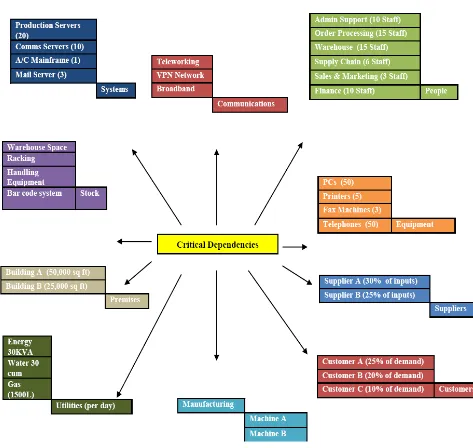
2.1 Identify critical dependencies to your operation and the employees, materials, equipment, utilities and inputs required to maintain them
2.2 Consider the possible impact of employee absences
2.3 Consider the possible impact of disruption to the supply of utilities and inputs
2.4 Examine the likely impact of a severe weather event on your market and on your customers’ requirements
2.5 Identify and agree strategic imperatives
2.6 Understand the business need for face-to-face meetings during a severe weather event
2.7 Consider the issues for business related travel during weather related disruptions to road, rail sea and air transport as appropriate
2.8 Understand the special needs of some employees during a severe weather event
2.9 Consider the financial management implications of a severe weather event
2.10 Examine the extent to which others will be dependent on your business in the event of a severe weather event
7
2.3 Measures to Underpin Continuity
Not Started Underway Complete
3.1 Nominate deputies
3.2 Cross-skill internally
3.3 Communicate with staff in a manner appropriate to the current state of weather alert
3.4 Prepare an emergency communications plan
3.5 Prepare policies on employee absences and compassionate leave during a severe weather event
3.6 Prepare policies on travel during a severe weather event
3.7 Plan for the needs of staff overseas
3.8 Make arrangements to assure supplies in the event of a severe weather event
3.9 Consider the possibility of changes to your product, your service, or your interaction with customers, during a prolonged severe weather event and plan for any changes you consider appropriate
2.4 Responding to Workplace Risks in a Weather Emergency
Not Started Underway Complete
4.1 Ensure your crisis management process is defined and understood. Ensure the team know what their role is and what actions may be required
4.2 Plan to provide for external snow / ice clearance
4.3 Plan for frequent and effective cleaning of the workplace
4.4 Plan for putting in place flood defences; identify who is responsible and when they will activate flood defences
4.5 Plan for putting in place measures to reduce the likelihood of leaks and their consequences
4.6 Prepare policies on attendance by employees who have difficulty travelling to work, require special arrangements for working from home or compassionate leave arrangements
4.7 Prepare policies on flexible work locations (e.g. teleworking) and flexible working times (e.g. shift-working)
4.8 Provide ICT infrastructure to support teleworking and remote customer interaction
4.9 Plan measures to reduce travel and face-to-face contact with customers / suppliers
4.10 Identify work organisation measures that can be taken to reduce potential for employees who are in the workplace and may have mild colds etc to infect each other
9
3.
Using the Checklist
This section provides guidance on preparing the checklist in Section 2 above.
3.1 Planning Activities
3.1.1 Assign responsibility for planning and preparedness
Your organisation should appoint a business continuity planning coordinator and/or team with defined responsibilities and budget for planning and for preparedness. A deputy should also be appointed. The team should pay particular attention to planning in the event of severe weather.
If your organisation already has a business continuity planning process, you should review and consider how weather related events are prepared for and the effectiveness of the process in the past.
3.1.2 Obtain information on weather emergencies
This document provides a checklist on the business aspects of preparing for severe weather related event.
Key sources of information on weather related events and emergencies are:
www.winterready.ie
Department of Environment, Heritage and Local Government www.environ.ie
Department of Transport, Sport and Tourism www.transport.ie
Met Éireann www.met.ie
National Roads Authority www.nra.ie
AA Roadwatch, etc
Other bodies, including air and sea ports, representative organisations and local authorities within Ireland may also provide relevant information and advice.
Review past weather related events, their scale (30 year and 100 year flood levels, prolonged periods of snow and ice) and the impact of previous severe weather on your organisation.
3.1.3 Consult within the company and with staff labour representatives
Consult widely within the business. A severe weather event or emergency has the potential to impact on all aspects of the business.
3.1.4 Consult with suppliers
Consult with your key suppliers and subcontractors to clarify whether they have robust business continuity plans in place. You will need to understand how they are likely to react in the event of a severe weather event and consider how they have coped on previous
occasions. It may be possible to make arrangements to secure supplies or service. Consider pre-qualification of additional suppliers or emergency procurement arrangements in instances where you have a sole supplier.
3.1.5 Assess ‘High Level’ Impact
Assess the „High Level‟ impact on your business and attach appropriate priority to the planning process. Your organisation should initially prepare a „High Level‟ impact assessment on the business. This should provide a financial assessment of the impact and propose strategic priorities for the business in the event of a severe weather event, and an outline budget for the development and maintenance of the business continuity planning process. This should be approved by the board and/or senior management.
3.1.6 Develop a plan
Use the checklist to assist in developing a plan to prepare for a severe weather event, and to respond in the event that an emergency occurs.
A severe weather event is not the only threat to business continuity that your business faces. Once the plan is developed, consider using it as the starting point for a business continuity plan that addresses a wider range of risks.
3.1.7 Establish authorities, triggers and procedures for implementing the plan
Establish who will have the authority to trigger the plan and its elements, identify if it may be anyone of a team or is dependent on consensus. Establish procedures for implementing the plan.
There should be clarity as to the circumstances under which the plan will be triggered and terminated. Many businesses internationally use warnings from meteorological and weather forecasting services or by governments to trigger the various elements of their plan. For most Irish businesses, the key severe weather frameworks and alerts will be from Met Éireann and the Government‟s interdepartmental group on emergency planning.
3.1.8 Test the plan in exercises
11
Implementation of strategies to reduce the risks of travel to employees, customers, suppliers;
Disruption to customers and market; and
Disruption to suppliers and logistics.
If you wish to include disruption to an essential service in the scenario, consider that a fault develops, and it takes significantly longer than usual for it to be resolved. Consider the possible implications of disruption to your power supply. Work through the consequences of the scenario, either as a desk exercise, or with line managers and staff.
Revise the plan based on what is learned from the exercise.
3.1.9 Share best practice with other businesses
Discuss planning and preparedness for a severe weather event or emergency with other businesses. Use business networks or other business organisations to share best practice, to learn from each other, and to engage in joint exercises.
3.1.10 Revisit Plan Periodically
You should revisit, and retest, the plan periodically, particularly when new products or services are introduced and to include learnings from the previous year. The plan should be reviewed at least once per year, to ensure that it remains current. You should check that preparations that could go out of date (e.g. phone lists or arrangements for deputies) are up to date.
3.2 Business Issues to Address
3.2.1 Identify critical dependencies
Figure 1: Example of Mapping of Critical Dependencies
13 Employees may be absent for a range of reasons:
Those who are ill with colds or flu or weather related injuries that cannot attend work;
Some employees may have other illnesses that justify non-attendance. Other illnesses will continue to occur during a weather emergency;
Some employees may wish to remain away from work to provide care to older relatives. In the event of school and/or childcare closures, others may wish to remain at home to care for children;
Some employees may have difficulty in arranging transport to work; and
Public transport may be curtailed or cancelled.
The likelihood is that non-attendance will peak during the most severe weather related events such as snow storms or severe freezing. These could be for prolonged periods over days in the case of snow fall and weeks in the case of persistent low temperatures. It is not possible to predict with confidence how high absenteeism will rise in your business. It will depend on factors such as how employees perceive the risks, whether local schools close, and related increases in illnesses such as colds and flu and the measures you take to reduce the risk of cross infection within the workplace.
Factoring in absences due to other causes, it would be prudent for a typical business to take account of a scenario under which 25% of its employees are absent during peaks of severe weather when planning. You should also take account of the possibility that levels of absence could be significantly lower than this, or indeed could be higher.
Consider whether there are critical business activities that are vulnerable to the absence of a small number of key staff. There may be key managers. You may depend on a small number of IT staff to operate. You may depend on a specialist function such as a laboratory, or on a small number of certified professionals.
In order to maintain contact with customers, consideration could be given to providing extra on-line ordering/ecommerce options.
Owner-managed SMEs may face particular challenges if the owner-manager becomes ill or otherwise immobilised while the business is under stress from a severe weather event or emergency.
3.2.3 Consider the possible impact of disruption to the supply of inputs
Identify your key suppliers. For each key supplier:
Understand to what extent inventories buffer your business from supply disruption and do your key times overlap with increased likelihood of severe weather;
Explore what the impact would be if the supplier was unable to serve your business, if it could not supply usual volumes, or if lead times lengthened;
Assess how vulnerable the source of supply is to disruption caused by a severe weather event, taking account of staffing issues, the supplier‟s upstream supply chain,
competing commitments and any other factors that seem relevant;
Assess whether your business would have access to alternative sources of supply, and whether this would improve security of supply meaningfully; and
Assess if your procurement procedures will allow you to source alternative suppliers in an emergency, consider pre-qualifying alternate suppliers or assessing their quality in advance.
3.2.4 Examine the likely impact on your market
Examine the likely impact of a severe weather event on your market and on your customers‟ requirements. Consider whether demand for your product is likely to increase or decrease in the event of a severe weather event. For example:
If your product or service is not a necessity and if it depends on your customers travelling, then demand may fall.
If you are supplying other businesses, they will also be affected by a weather
emergency. During severe weather events, manpower shortages may mean that they cannot use as much of your product as usual. Your customers‟ markets will also be affected by the weather emergency.
Any disruption to international logistics could have a ripple effect on demand.
Consider whether demand for your product is likely to increase in the event of a weather emergency.
Demand for some types of communications services may rise.
Some products and services will be more attractive than others in a weather related emergency. For example, home delivery services that facilitate people in avoiding leaving their homes may well increase.
If your products and services are good substitutes for other products or service that become less attractive during a weather emergency, then demand may increase.
Customers may wish to change the ways in which they engage with you during a weather emergency. Many customers will wish to reduce or eliminate travel. Selling, taking orders and providing customer service by telephone or over the Internet is likely to become more
popular. If you sell to consumers, home delivery services and product picking services may be attractive.
3.2.5 Identify and agree strategic imperatives
15
3.2.6 Understand the business need for face-to-face meetings during a weather emergency
Review the type and number of face-to-face meetings that take place with customers and suppliers, and within the business. Consider what the business need is for these meetings. Consider whether the business need dictates that a face-to-face meeting is necessary, or whether other approaches might be feasible.
Consider whether participants who would usually demand a face-to-face meeting might prefer an alternative approach that minimises travel in a weather emergency.
3.2.7 Consider the issues for business related travel during a weather emergency
Modes of transport including road, rail, sea and air transport can be severely disrupted during a severe weather event. This can have knock-on effects on the supply chain both in terms of producing products and services and the delivery of those products and services. Planning of alternatives may be necessary.
Furthermore, though there is no general legal obligation on an employer to order an
employee not to travel during inclement weather, employers are likely to remain responsible for ensuring whether safe alternatives to driving for work in poor weather conditions are „readily available‟.
In order to reduce liabilities and preserve the safety of your workforce, business related travel should be reduced to the minimum essential for your organisation, with clear policies in place that are understood by your management team.
3.2.8 Understand the special needs of some employees during a weather emergency
Your employees will not all be affected in the same way by a severe weather event.
Some will have specific health needs;
Some will place a high priority on maintaining their income;
Some will have more caring responsibilities than others;
Some will have greater travel distances than others or have more hazardous routes (steep inclines, areas subject to flooding, etc); and
Some will be more dependent on public transport availability.
3.2.9 Consider the financial management implications of a weather emergency
Consider what the financial impact of a severe weather event may be, on profits and margins, and particularly on cash flow. For example:
Demand for your business‟s products or services may fall;
Manpower levels may be reduced (with the impact on cash flow depending partly on the business‟s sick leave and compassionate leave arrangements);
Do you depend on a key customer where failure to deliver could have a significant impact on future business with that customer.
Identify the areas where a problem has the potential to threaten the business‟s financial stability.
Consider how to manage finances during a severe and prolonged weather event so as to maintain financial stability.
3.2.10 Dependencies on your business
Examine the extent to which others will be dependent on your business in the event of a weather emergency. In addition to considering your business‟s own needs, you should understand whether others are dependent on your business.
Does your business supply critical sectors of the economy where ongoing and timely supply of goods and services from you is essential, such as the agri food sector, Irish health service, or healthcare providers internationally?
Do people depend on your business for food, transport and logistics, heating or other essentials?
Do other businesses depend on your business to operate?
3.2.11 Scaling back
Consider the circumstances under which you might decide to scale back or suspend operations during a weather emergency. The main purpose of business continuity planning for a severe weather event is to plan for continuity of operations through the emergency. Even so, circumstances may arise where it is in the long term interests of the business and its employees to intentionally scale back or suspend operations.
This is most likely to be relevant:
Where market demand for your product or service has fallen sharply;
If the business runs out of inputs;
If a high proportion of employees are unavailable; and / or
If the emergency immobilises or causes dislocation of a large numbers of people (e.g. flooding).
17 As a part of the planning process, nominate deputies with the necessary skill and knowledge and authority to manage, make decisions and undertake appropriate actions. As the first deputy in line for a role may also be unavailable, back-up deputies should also be nominated.
3.3.2 Cross-skill internally
Consider introducing or extending cross-skilling to:
Increase the number of employees who can do essential specialist work;
Increase the level of knowledge of the management team to make decisions for the wider organisation; and
Increase flexibility in assigning employees to different roles.
Consider preparing an additional pool of workers, such as retirees or contractors.
3.3.3 Staff Communications
Communicate with staff in a manner appropriate to the current state of severe weather alert. Disseminate information to the workforce that is appropriate to the current state of a severe weather alert. Severe weather events have significant impacts on your workforce; they may not be able to get to work or home again, accidents may be more likely. To operate and function, your organisation needs your staff. If they do not feel valued they may not be willing to support the organisation in times of crises.
In a severe weather event you should consider what communications channels you have open to you, how you will communicate with your staff, particularly out of hours. Where will staff obtain information in relation to the severe weather events and ifs effect on the organisation? Consideration should be given to the use of call cascades, group texts, social media and other types of communication.
In previous severe weather events it is recognised that difficulties were encountered by people wishing to undertake car journeys as to the weather situation along the entirety of their route. This is because, in many instances, precise information on the status of roads was only available within local authority areas and information from national organisations was not specific enough because of the diversity of locations and weather situations. If travel is considered a necessity, your organisation will have to review how such information can be obtained and disseminated.
Communications with staff should address:
Status of the severe weather alert / emergency and possible impact on the business and operations; and
The business‟s weather emergency preparedness and response plan, and employees‟ role in the plan.
Communications should be appropriate to the target audience in terms of content, presentation and language. Reminders of ice and snow safety and preparedness should be posted on websites, physical / electronic notice boards, in the employee newsletters etc before and during the severe weather events.
not only those who made efforts to get to the workplace but those who supported the organisation remotely.
3.3.4 Prepare emergency communications plan
Prepare an emergency communications plan, for communication with employees, customers, suppliers and other stakeholders in the business. The plan should identify key contacts (with back-ups), chains of communications, and processes for tracking business and employee status.
Consider preparing platforms, such as dedicated websites, group mobile phone texts, and hotlines, for communicating with employees, customers and suppliers about the
organisation‟s status, about the actions it is taking, and about the actions they should take.
Consider preparing, in advance, notices on subjects such as site safety and customer/supplier engagement in the event of a severe weather alert.
The plan should be designed to ensure that communications are culturally and linguistically appropriate. For some businesses, it may be important that communications be made available in more than one language.
3.3.5 Prepare Policies on Employee Absences and Compassionate Leave
As an organisation you should develop your HR policies surrounding emergency leave. Do they account for people looking after elderly parents or other special needs cases? Policies should be communicated in advance to employees. Establish policies on sick leave absences unique to weather emergency.
These should take account of:
the likelihood that it will not be practicable for employees to visit medical practitioners to examine and certify staff who become ill; and
the need to judge when a person can return to work if they have developed conditions such as flu etc.
Establish policies on compassionate leave unique to a weather emergency, to cover circumstances such as:
where employees are bereaved;
where employees face a pressing need to provide care for others; or
19
3.3.6 Prepare policies on foreign travel during a severe weather event
In the event of a weather emergency abroad, develop policies on travel to affected geographic areas overseas, and on employees working in or near affected areas, taking account of advice from the Department of Transport and Foreign Affairs and Trade.
Prepare policies on international business travel, taking account of possible disruption to flight schedules and the likelihood that many staff will be reluctant to fly. Be mindful that Irish Airports may close during the severe weather event.
3.3.7 Plan for the needs of staff overseas
Consider how to manage and support staff overseas and their families that may be in Ireland during a weather event and consider issues such as repatriation and payment.
If the business has subsidiaries or other operations overseas, ensure that they also plan for the possibility of severe weather events in Ireland and the impact such events could have on overseas operations in terms of supply of goods, services and personnel.
3.3.8 Make arrangements to assure supplies in the event of a weather emergency
Consider taking action to assure continuity of supply in the event of a severe weather event;
Explore the possibility of obtaining commitments as to the priority that suppliers will place on supplying your organisation in the event of an emergency;
Encourage suppliers (particularly small suppliers) to plan for severe weather;
Identify alternative sources of critical inputs, assess their quality in advance and make arrangements to draw on them in the event that supplies are disrupted; and
Review contracts to take account of circumstances that may arise in the event of a severe weather event.
3.3.9 Consider the possibility of changes
Consider the possibility of changes to your product, your service, or your interaction with customers, during a weather emergency, and plan for any changes you consider appropriate. Consider changes to the product or service your business provides during a weather
emergency:
Is it possible to provide the product or service with less face-to-face interaction with customers?
Is it possible to reduce travel or its frequency?
If there is disruption to supplies, will it still be possible to produce a product or service that will satisfy customers‟ minimum needs?
Is it possible to reduce the labour input into the product or service, perhaps by
3.3.10 Review insurance coverage
Identification of critical dependencies and severe weather event scenarios should assist you in developing a risk map for your organisation. The risk map should be compared to your
insurance coverage to identify gaps. You should review all aspects of your insurance coverage, to ensure it is likely to be sufficient for circumstances likely to arise in severe weather or a weather emergency. Among the areas of insurance you may wish to consider reviewing are:
Business Interruption cover;
“Key man” insurance;
Liabilities that may arise from severe weather such as snow, ice, flooding etc;
Whether the levels of cover are adequate; and
Whether any exclusions such as flood, burst pipes exclusions, etc. may be relevant. It is important to remember that most policies have a „reasonable care‟ clause. This would include taking appropriate precautions particularly where there is advance notice of severe weather. Such measures may include activating flood defence measures, putting in place additional security where warranted, clearing of internal paths and roadways, etc.
Discuss with your insurance broker whether your business is covered for relevant risk exposures.
3.4 Planning in Response to Workplace Risks in a Weather Emergency 3.4.1 Ensure Your Crisis Management Process is Defined and Understood.
Traditionally in Ireland snow events have lasted less than three days. Although significant travel disruption associated with these events was experienced it lasted for a short time and most business did not suffer significantly. Recent severe weather events have been more prolonged and your plan must be flexible to adapt, as it is very unlikely you can predict the next incident.
Ensure your crisis management team process is well defined and understood. Your team should know what their role is and what actions they might take in the event of various scenarios and evolving conditions. This is best achieved through practice and testing. Ensure your plan is communicated throughout the organisation.
3.4.2 Plan to provide for external snow or ice clearance.
21 see after snowfall begins. Pre-winter condition and locations of these items should be
documented.
Ensure there are adequate supplies of weather related supplies and equipment available in advance of anticipated weather related events and appropriate suppliers should be identified as part of the plan. These include, where relevant, adequate manual equipment such as snow shovels, ice scrapers and brooms. Preventive maintenance on snow and ice removal
equipment should be performed before the projected date of first snowfall. An assessment should be made of how much ice-melt such as salt and sand would be needed in the event of a severe and prolonged weather event. Plans should also be made to ensure a supply of walk-off mats, interior and exterior.
Assess also whether in-service training for staff involved in snow removal will be required, covering safety procedures, equipment procedures and proper body mechanics.
For larger premises or where internal resources may not be available, take steps to have a snow and ice removal contractor available and ensure the contractor has a knowledge of the premises and grounds and review performance expectations in advance of severe weather.
Confirm the snow loading for structures on your premises in order to determine if removal of snow from roofs is required. Such work should only be undertaken by competent personnel with adequate safety procedures in place and when the elements allow.
3.4.3 Plan for frequent and effective cleaning of the workplace.
Weather related events such as flooding or freezing ice with burst pipes etc can give rise to additional cleaning requirements in the workplace and plans for dealing with such possibilities should be prepared for. Many of these issues may be addressed in the site‟s Health and Safety Statement and it should be reviewed in this context.
3.4.4 Flood defences
Plan for putting in place flood defences; identify who is responsible and when they will activate flood defences. Where flood defences need to be manually put in place for your premises, there should be a clear understanding of who is responsible for putting them in place. The plan should detail how and when they are to be erected. If you have moved in to a new premise, you should ensure that the flood defences have been tested and are
operational. Sump pumps should be tested and measures to consider include:
Identify who is responsible for putting in place flood defences;
Identify sources of information for when the flood defences will be put in place; and
Review critical equipment that is subject to damage from potential flood waters (electrical, IT, etc) and locate away from high risk areas (basements) where possible.
3.4.5 Reduce the likelihood of leaks
Remember, it is often during the thaw rather than the freeze that most damage will become apparent and some preventative measures to consider include:
Provide insulation on external pipework and valves;
Provide for periodic heating when the premises is unoccupied;
Where practicable provide for recirculation of water in pipes; and
Ensure your staff know what do to in the event of a burst pipe.
Ensure staff are also trained in what action to take In the event of a leak, such as:
Isolate water and electricity supplies;
Move high value items susceptible to damage away from the affected area; and
Do not reconnect utility services until they have been checked.
3.4.6 Prepare HR policies
Prepare policies on attendance by employees who have difficulty travelling to work, require special arrangements for working from home or compassionate leave arrangements.
3.4.7 Prepare flexible working policies
Prepare policies on flexible work locations (e.g. teleworking) and flexible working times (e.g. shift-working).
3.4.8 ICT Infrastructure
Where teleworking or other remote working can be considered, you should review what measures are required to provide ICT infrastructure to support this. This should be done in advance of severe weather events as your IT resources may already be stretched responding to issues during the severe weather event. The use of Cloud Computing can be an effective means of ensuring business continuity, but will need to planned in advance. ICT infrastructure for remote customer interaction may be considered, where maintaining orders is critical to the business, though the investment should take into account potential difficulties in supplying customers.
3.4.9 Plan measures to reduce face-to-face contact with customers/suppliers.
www.forfas.ie
To sign up for our email alerts contact us at [email protected] or through the website.
November 2011
Insert Date
Forfás
Wilton Park House Wilton Place Dublin 2
Tel: +353 1 607 3000 Fax: +353 1 607 3030