MCWP 4-11
Tactical-Level
Logistics
U.S. Marine Corps
13 June 2000 FOREWORD
1. PURPOSE
Marine Corps Warfighting Publication (MCWP) 4-11, Tactical-Level Logistics, provides the doctrinal basis for the planning and execution of ground and avia-tion logistic support for Marine air-ground task force (MAGTF) operaavia-tions at the tactical level of war. It establishes standard terms of reference for tactical lo-gistics and combat service support operations and provides guidance for devel-oping local Fleet Marine Force standing operating procedures. MCWP 4-11 expands on MCWP 4-1, Logistics Operations, and provides detailed guidance to Marine Corps logisticians for the conduct of tactical-level logistics.
2. SCOPE
This manual is intended for commanders and their staffs who are responsible for planning and conducting logistic support at the tactical level of war. The sec-ondary audience is commanders and staff officers who require logistical support or who will benefit from a greater understanding of logistical support at the tac-tical level.
3. SUPERSESSION
Fleet Marine Force Manual 4-1, Combat Service Support Operations, 12 July 1993.
4. CERTIFICATION
Reviewed and approved this date.
BY DIRECTION OF THE COMMANDANT OF THE MARINE CORPS
J. E. RHODES
Lieutenant General, U.S. Marine Corps Commanding General
Changes: Readers of this publication are encouraged to submit suggestions and changes that will improve it. Recommendations may be sent directly to Commanding General, Marine Corps Combat Development Command, Doctrine Division (C 42), 3300 Russell Road, Suite 318A, Quantico, VA 22134-5021 or by fax to 703-784-2917 (DSN 278-2917) or by E-mail to
[email protected]. Recommendations should include the following information:
l Location of change
Publication number and title Current page number
Paragraph number (if applicable) Line number
Figure or table number (if applicable)
l Nature of change
Add, delete
Proposed new text, preferably double-spaced and typewritten
l Justification and/or source of change
Additional copies: A printed copy of this publication may be obtained from Marine Corps Logistics Base, Albany, GA 31704-5001, by following the instructions in MCBul 5600, Ma-rine Corps Doctrinal Publications Status. An electronic copy may be obtained from the Doc-trine Division, MCCDC, world wide web home page which is found at the following universal reference locator: http://www.doctrine.usmc.mil.
Table of Contents
Page
Chapter 1 Fundamentals
1001 Levels of War 1-1
1002 The Logistic Continuum 1-2
1003 Strategic Logistics 1-2
1004 Operational Logistics 1-2
1005 Tactical Logistics 1-3
1006 Functions and Subfunctions of Tactical Logistics 1-3
1007 Tactical Logistic Support External to
the Marine Air-Ground Task Force 1-7
1008 Combat Service Support Installations 1-7
Chapter 2 Organizations, Capabilities, and Responsibilities
Section I Marine Corps Organization 2-1
2101 Headquarters, Marine Corps 2-1
2102 Marine Corps Reserve 2-1
2103 Supporting Establishment 2-1
2104 Operating Forces 2-1
Section II Marine Air-Ground Task Force Organization 2-3
2201 Core Elements 2-3
2202 Marine Air-Ground Task Forces 2-3
Section III Marine Expeditionary Force Organizations and Capabilities 2-5
2301 Force Service Support Group 2-5
2302 Marine Division 2-11
2303 Marine Aircraft Wing 2-13
Section IV Marine Expeditionary Brigade Organizations and Capabilities 2-16
2401 Combat Service Support Element 2-16
2402 Aviation Combat Element 2-16
2403 Ground Combat Element 2-16
Section V Marine Expeditionary Unit Organizations and Capabilities 2-17
2501 Combat Service Support Element 2-17
2502 Aviation Combat Element 2-17
2503 Ground Combat Element 2-17
Section VI Task Organizations 2-18
2601 Combat Service Support Organizations 2-18
2602 Movement Control Organizations 2-19
2603 Maritime Prepositioning Force Organizations 2-20
2604 Amphibious Ship-to-shore Movement Organizations 2-20
Section VII Logistic Staff Responsibilities 2-23
2701 Joint Task Force 2-24
2702 Marine Forces 2-25
2703 Marine Air-Ground Task Force 2-25
2704 Combat Service Support Organization 2-26
2705 Aviation Logistics Department and
Marine Aviation Logistics Squadron 2-26
Chapter 3 Command and Control
3001 Establishing Command and Control 3-1
3002 Logistic and Combat Service Support Missions 3-3
3003 Management Procedures in Tactical Logistic Functional Areas 3-6
3004 Command Groups and Control Agencies 3-8
3005 Communications 3-9
3006 Logistic Information Management 3-10
3007 Liaison 3-13
Chapter 4 Planning
4001 Logistic Planning Concepts 4-1
4002 Planning for Expeditionary Operations 4-1
4003 Types of Joint Planning 4-3
4004 Marine Corps Planning Process 4-3
4005 Concept of Logistic Support 4-4
4006 Planning Elements 4-4
4007 Planning Techniques 4-5
4008 Deployment Planning Considerations 4-6
4009 Commander’s Intent 4-6
4010 Operational Planning Considerations 4-6
4011 Functional Area Planning Considerations 4-7
4012 Coordinating Support 4-11
4013 Intelligence Support 4-11
4014 Host Nation Support 4-12
4015 Planning Documents 4-12
Chapter 5 Logistic Functional Area Support Operations
Section I Supply 5-1
5101 Combat Service Support Element Supply Support Operations 5-1
5102 Ground Combat Element Supply Support Operations 5-5
5103 Aviation-Peculiar Supply Support Operations 5-8
Section II Maintenance 5-12
5201 Ground Maintenance Support Operations 5-12
5202 Aviation-Peculiar Maintenance Support Operations 5-15
Section III Transportation 5-19
5301 Motor Transport Operations 5-19
5302 Port and Terminal Operations 5-20
5303 Air Delivery Operations 5-21
5304 Deployment 5-22
5305 Employment 5-23
5306 Movement Control 5-23
Section IV General Engineering 5-27
5401 Naval Construction Force 5-27
5402 Engineering Tasks 5-27
5403 Engineer Group Concept 5-27
Section V Health Service Support 5-29
5501 Marine Air-Ground Task Force Capabilities 5-29
5502 Capabilities External to the Marine Air-Ground Task Force 5-30
5503 Patient Movement 5-30
Section VI Services 5-31
5601 Combat Service Support Services 5-31
5602 Command Services 5-35
Appendices
A Logistic and Combat Service Support Task-Organization Guide A-1
B Sample Format of a Logistic/Combat Service Support Estimate B-1
C Sample Format of Annex D (Logistics/Combat Service Support) C-1
D Maintenance Recovery, Evacuation, and Repair Cycle Flowchart D-1
E Glossary E-1
F References and Related Publications F-1
Fundamentals
Logistics is defined as “the science of planning and carrying out the movement and maintenance of forces. In its most comprehensive sense, those aspects of military operations which deal with: a. design and development, acquisition, storage, movement, distribution, maintenance, evacuation, and disposition of materiel; b. movement, evacua-tion, and hospitalization of personnel; c. acquisi-tion or construcacquisi-tion, maintenance, operaacquisi-tion, and disposition of facilities; and d. acquisition or fur-nishing of services.” (Joint Publication [JP] 1-02,
Department of Defense Dictionary of Military and Associated Terms)
Logistics is a fundamental element of Marine air-ground task force (MAGTF) expeditionary operations. Marine expeditionary forces provide self-contained and self-sustained forces that have everything necessary to accomplish the mission— from individual equipment to expeditionary air-fields and medical treatment facilities. These forc-es are structured to meet a wide range of contingency operations and possess the logistic capabilities needed to initiate an operation, sus-tain forces, and reconstitute for follow-on mis-sions.
Effective logistic support must be viewed from the perspectives of supported (e.g., ground com-bat element) and supporting (e.g., comcom-bat service support element) organizations. It emphasizes the need for detailed planning and close integration of logistic capabilities of both supported combat units and supporting combat service support units.
Combat service support (CSS) is defined as “the essential capabilities, functions, activities, and tasks necessary to sustain all elements of operat-ing forces in theater at all levels of war. Within the national and theater logistic systems, it in-cludes but is not limited to that support rendered by service forces in ensuring the aspects of sup-ply, maintenance, transportation, health services,
and other services required by aviation and ground combat troops to permit those units to ac-complish their missions in combat. Combat ser-vice support encompasses those activities at all levels of war that produce sustainment to all oper-ating forces on the battlefield.” (JP 1-02) CSS in the Marine Corps is a function or tasking associat-ed with a unit that, by table of organization (T/O) and table of equipment (T/E), is organized, equipped, and trained as a CSS organization to perform CSS operations.
1001. Levels of War
Military operations require specific logistic sup-port which is based on the strategic, operational, or tactical levels of war.
a. Strategic
“The level of war at which a nation, often as a member of a group of nations, determines nation-al or multinationnation-al (nation-alliance or conation-alition) security objectives and guidance, and develops and uses national resources to accomplish those objectives. Activities at this level establish national and mul-tinational military objectives; sequence initia-tives; define limits and assess risks for the use of military and other instruments of national power; develop global plans or theater war plans to achieve these objectives; and provide military forces and other capabilities in accordance with strategic plans.” (JP 1-02)
b. Operational
objectives, initiating actions, and applying re-sources to bring about and sustain these events. These activities imply a broader dimension of time or space than do tactics; they ensure the lo-gistic and administrative support of tactical forc-es, and provide the means by which tactical successes are exploited to achieve strategic objec-tives.” (JP 1-02)
c. Tactical
“The level of war at which battles and engage-ments are planned and executed to accomplish military objectives assigned to tactical units or task forces. Activities at this level focus on the or-dered arrangement and maneuver of combat ele-ments in relation to each other and to the enemy to achieve combat objectives.” (JP 1-02)
1002. The Logistic Continuum
Strategic, operational, and tactical logistics paral-lel and complement the levels of war. Strategic lo-gistics supports the organizing, training, and equipping of forces needed to further the national interest. Operational logistics links tactical re-quirements and strategic capabilities to accom-plish operational goals and objectives. Tactical logistics includes organic unit capabilities and combat service support activities required to sup-port military operations.
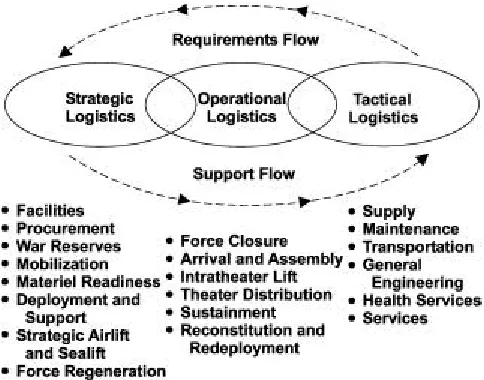
Effective tactical logistic support results from the proper employment of logistic capabilities within the MAGTF concept of operations and scheme of maneuver. Commanders and logisticians must carefully integrate logistic considerations into op-erations planning and execution. Tactical-level lo-gistic capabilities are a primary element of a self-sufficient MAGTF, which is supported externally through the logistic activity at the strategic and operational levels. Figure 1-1 depicts the continu-um of logistic support through the levels of war.
1003. Strategic Logistics
Strategic logistic capabilities are generated based on guidance from the National Command Author-ities and logistic requirements identified by the operating forces. The combatant command and staff plan and oversee logistics from a theater strategic perspective. They assign execution re-sponsibilities to Service components unless a joint or multinational functional command is formed to perform theater strategic logistic func-tions. The joint staff and combatant commanders generate and move forces and materiel into the-ater and areas of operations where operational lo-gistic concepts are employed.
1004. Operational Logistics
[image:10.612.312.554.490.680.2]Operational logistics connects the logistic efforts of the strategic level with those of the tactical lev-el. The Marine component commander is respon-sible for conducting operational logistics and coordinating operational logistic support with tac-tical logistic operations. The component com-mander may assign operational-level logistic tasks to the combat service support element and aviation combat element commanders in addition to their tactical logistic responsibilities. In larger operations, a Marine logistic command may be
established to conduct operational-level logistic tasks.
To provide operational-level support to tactical operations, Commander, Marine Corps Forces (COMMARFOR), may establish a Marine logis-tics command (MLC). The MLC would be re-sponsible for establishing the theater support structure to facilitate arrival, assembly, reception, staging, onward movement, and integration oper-ations. In addition, the MLC could provide opera-tional logistic support to Marine Corps forces as the Marine component commander’s operational-level logistic agency in theater. Normally, COM-MARFOR assigns the MLC mission to a specific force service support group (FSSG). The COM-MARFOR also assigns additional resources, based on the operational situation, theater geogra-phy, and infrastructure requirements, to the FSSG for the conduct of theater-supported logistic oper-ations.
1005. Tactical Logistics
Effective logistic support is a command responsi-bility. The MAGTF commander must plan and coordinate tactical logistics within the MAGTF and coordinate with higher headquarters for the operational-level logistic support necessary to sustain MAGTF operations. Subordinate element commanders are responsible for the efficient em-ployment of organic logistic capabilities, while the combat service support element (CSSE) com-mander is also responsible for executing CSS op-erations in support of the entire MAGTF.
All elements of the MAGTF execute tactical lo-gistics to some degree by employing organic ca-pabilities. The initial source of logistic support available to any unit is its own organic capabili-ties. Organic capabilities are defined in T/Os and T/Es. The CSSE, possessing capabilities beyond those found in the other MAGTF elements,
con-ducts CSS operations to provide any additional logistic support the other MAGTF elements re-quire.
1006. Functions and
Subfunctions of Tactical
Logistics
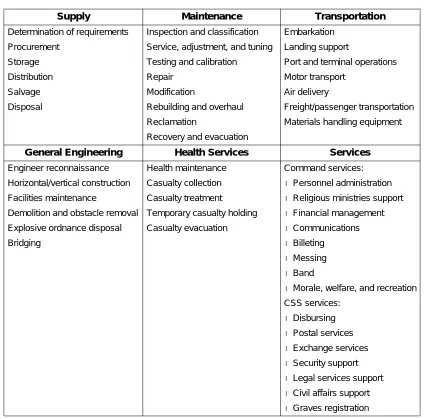
Marine Corps tactical-level logistics encompasses all of the logistic support activities performed at the tactical-level of war, to include combat ser-vice support. Tactical logistics is normally cate-g o r i z e d i n s i x f u n c t i o n a l a r e a s : s u p p l y , maintenance, transportation, general engineering, health services, and services. See table 1-1, on page 1-4.
a. Supply
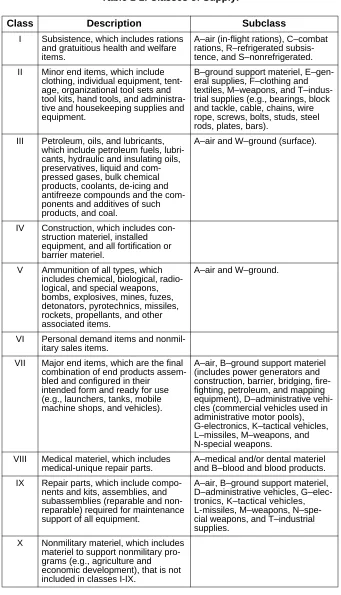
Supply is a cyclic process of acquiring and issu-ing materiel to supported units. This materiel may be consumable or durable materiel, components, and end items. See MCWP 4-11.7, MAGTF Sup-ply Operations, for additional information. Logis-ticians normally calculate requirements for each class and subclass of supply. See table 1-2, on page 1-5.
b. Maintenance
Table 1-1. Functions and Subfunctions of Tactical Logistics.
Supply Maintenance Transportation
Determination of requirements Inspection and classification Embarkation Procurement Service, adjustment, and tuning Landing support
Storage Testing and calibration Port and terminal operations
Distribution Repair Motor transport
Salvage Modification Air delivery
Disposal Rebuilding and overhaul Freight/passenger transportation Reclamation Materials handling equipment Recovery and evacuation
General Engineering Health Services Services
Engineer reconnaissance Health maintenance Command services: Horizontal/vertical construction Casualty collection l Personnel administration Facilities maintenance Casualty treatment l Religious ministries support Demolition and obstacle removal Temporary casualty holding l Financial management Explosive ordnance disposal Casualty evacuation l Communications
Bridging l Billeting
l Messing
l Band
l Morale, welfare, and recreation CSS services:
l Disbursing
l Postal services
l Exchange services
l Security support
l Legal services support
l Civil affairs support
Table 1-2. Classes of Supply.
Class Description Subclass
I Subsistence, which includes rations and gratuitious health and welfare items.
A–air (in-flight rations), C–combat rations, R–refrigerated subsis-tence, and S–nonrefrigerated. II Minor end items, which include
clothing, individual equipment, tent-age, organizational tool sets and tool kits, hand tools, and administra-tive and housekeeping supplies and equipment.
B–ground support materiel, E–gen-eral supplies, F–clothing and textiles, M–weapons, and T–indus-trial supplies (e.g., bearings, block and tackle, cable, chains, wire rope, screws, bolts, studs, steel rods, plates, bars).
III Petroleum, oils, and lubricants, which include petroleum fuels, lubri-cants, hydraulic and insulating oils, preservatives, liquid and com-pressed gases, bulk chemical products, coolants, de-icing and antifreeze compounds and the com-ponents and additives of such products, and coal.
A–air and W–ground (surface).
IV Construction, which includes con-struction materiel, installed equipment, and all fortification or barrier materiel.
V Ammunition of all types, which includes chemical, biological, radio-logical, and special weapons, bombs, explosives, mines, fuzes, detonators, pyrotechnics, missiles, rockets, propellants, and other associated items.
A–air and W–ground.
VI Personal demand items and nonmil-itary sales items.
VII Major end items, which are the final combination of end products assem-bled and configured in their
intended form and ready for use (e.g., launchers, tanks, mobile machine shops, and vehicles).
A–air, B–ground support materiel (includes power generators and construction, barrier, bridging, fire-fighting, petroleum, and mapping equipment), D–administrative vehi-cles (commercial vehivehi-cles used in administrative motor pools), G-electronics, K–tactical vehicles, L–missiles, M–weapons, and N-special weapons.
VIII Medical materiel, which includes medical-unique repair parts.
A–medical and/or dental materiel and B–blood and blood products. IX Repair parts, which include
compo-nents and kits, assemblies, and subassemblies (reparable and non-reparable) required for maintenance support of all equipment.
A–air, B–ground support materiel, D–administrative vehicles, G–elec-tronics, K–tactical vehicles, L-missiles, M–weapons, N–spe-cial weapons, and T–industrial supplies.
c. Transportation
Transportation is moving from one location to an-other using railways, highways, waterways, pipe-lines, oceans, and airways. Throughput is the amount of cargo and personnel passed through the transportation systems. The transportation system includes the means and the controls for managing the transportation means. The transportation sub-functions are generally applicable to all levels of support, although the means, methods, control, and management procedures employed at each level will vary. Although transportation is dis-cussed as a logistic function, at the tactical level, transportation is a combat support function. Com-bat organizations use organic, attached, and sup-p o r t i n g t r a n s sup-p o r t a t i o n a s s e t s f o r t a c t i c a l movement.
d. General Engineering
[image:14.612.85.513.90.330.2]General engineering is distinct from combat engi-neering. General engineering is typically consid-ered a CSS function (e.g., engineer support battalion), while combat engineering is consid-ered a combat support function (e.g., combat en-gineer battalion). General enen-gineering assets at the tactical level may be used to reinforce or aug-ment combat engineer organizations in specific situations for mobility, countermobility, or survivability tasks. These assets are normally in general support of the MAGTF for a wide range of tasks. These tasks often involve more detailed planning and preparation and higher standards of design and construction than typical combat engi-neer tasks.
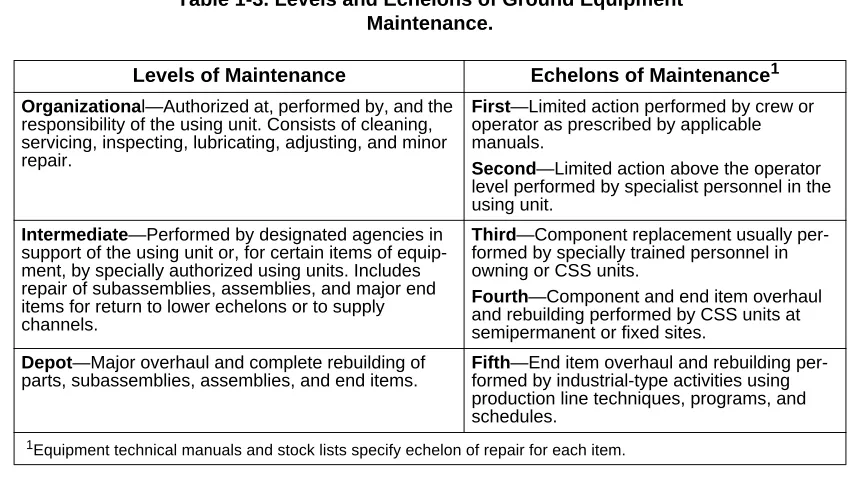
Table 1-3. Levels and Echelons of Ground Equipment Maintenance.
Levels of Maintenance Echelons of Maintenance1
Organizational—Authorized at, performed by, and the responsibility of the using unit. Consists of cleaning, servicing, inspecting, lubricating, adjusting, and minor repair.
First—Limited action performed by crew or operator as prescribed by applicable manuals.
Second—Limited action above the operator level performed by specialist personnel in the using unit.
Intermediate—Performed by designated agencies in support of the using unit or, for certain items of equip-ment, by specially authorized using units. Includes repair of subassemblies, assemblies, and major end items for return to lower echelons or to supply channels.
Third—Component replacement usually per-formed by specially trained personnel in owning or CSS units.
Fourth—Component and end item overhaul and rebuilding performed by CSS units at semipermanent or fixed sites.
Depot—Major overhaul and complete rebuilding of parts, subassemblies, assemblies, and end items.
Fifth—End item overhaul and rebuilding per-formed by industrial-type activities using production line techniques, programs, and schedules.
1Equipment technical manuals and stock lists specify echelon of repair for each item.
Table 1-4. Levels of Aviation Equipment Maintenance Activities.
Levels of
Maintenance Maintenance Activities
Organizational Tactical and training squadrons, Marine Corps air stations with aircraft assigned. Intermediate Marine aviation logistics squadrons (MALS). Depot Naval aviation depots, contract
e. Health Services
Health services support (HSS) seeks to minimize the effect that wounds, injuries, and disease have on unit effectiveness, readiness, and morale. HSS is accomplished by a preventive-medicine pro-gram that initially safeguards personnel against potential health risks and by the establishment of a system that provides medical support from the point of wounding, injury, or illness through evacuation. See MCWP 4-11.1, Health Service Support Operations, for additional information.
f. Services
The services function provides for the effective administration, management, and employment of military organizations. Services subfunctions are essentially administrative in nature. These are cat-egorized as either command services, which are services provided to Marines by their individual commands, or CSS services, which are services provided by a CSS unit.
1007. Tactical Logistic Support
External to the Marine
Air-Ground Task Force
Cross-Service support is appropriate when there are standing Department of Defense (DOD) pro-cedures for common-item support (e.g., for mate-rial managed by the Defense Logistics Agency [DLA]) or there are existing inter-Service support agreements (ISSAs) (e.g., for the U.S. Army to provide line-haul transportation to Marine Corps forces in certain theaters). Commanders of unified commands have directive authority for logistics by which they may authorize cross-Service sup-port within their theater. Coalition, bilateral, and/ or host nation support agreements authorize spec-ified support across national lines. Requests for cross-Service or cross-national logistic support are coordinated by the Marine component com-mander.
1008. Combat Service Support
Installations
The CSSE established fixed installations to build up logistic capabilities in support of the MAGTF. These installations are physical locations either aboard ship or ashore. Their number, location, and specific capabilities are dictated by the con-cept of CSS, which is based on the MAGTF mis-sion and concept of operations. The MAGTF concept of operations must address the require-ment to defend and protect the following CSS in-stallations and facilities, as required.
a. Beach Support Area
In amphibious operations, the beach support area (BSA) is “the area to the rear of a landing force or elements thereof, established and operated by shore party units, which contains the facilities for the unloading of troops and materiel and the sup-port of the forces ashore; it includes facilities for the evacuation of wounded, enemy prisoners of war, and captured materiel.” (JP 1-02)
The BSA is one of the first CSS installations es-tablished ashore during an amphibious operation and maritime prepositioning force (MPF) opera-tions involving in-stream offload. It is established by the shore party group or team, but the CSSE commander may eventually disestablish it or con-solidate it as part of the combat service support area (CSSA). In some situations, the BSA may be the only CSS installation ashore; in other situa-tions, it may be one of several CSS installations.
b. Landing Zone Support Area
This CSS installation is established to support helicopterborne assault elements. It is established by the CSSE when a buildup of supplies or other CSS capabilities is anticipated. When a logistic buildup is not planned, the supported unit is re-sponsible for helicopter support team (HST) oper-a t i o n s oper-a s s o c i oper-a t e d w i t h s u p p o r t o f t h e helicopterborne force.
c. Combat Service Support Area
A CSSA is “an area ashore that is organized to contain the necessary supplies, equipment, instal-lations, and elements to provide the landing force with combat service support throughout the oper-ation.” (JP 1-02)
The CSSEs operate CSSAs in accordance with the CSSE operation order (OPORD). Because CSSAs are primary targets, the landing force must plan for their defense. The BSAs or landing zone support areas are often developed into CSSAs when the CSSE establishes the necessary CSS ca-pabilities in the installation to support sustained operations.
d. Force Combat Service Support Area
An force combat service support area (FCSSA) is “the primary combat service support installation established to support MAGTF operations ashore. Normally located near a beach, port, and/or air-field, it usually contains the command post of the combat service support element commander and supports other combat service support installa-tions.” (MCRP 5-12C)
The FSSG establishes an FCSSA near a beach, seaport, and/or airfield to support other CSS in-stallations and to provide support not available at forward installations. Normally, the FCSSA con-tains the command post of the FSSG commander.
e. Repair and Replenishment Point
A repair and replenishment point is “a combat service support installation, normally in forward areas near the supported unit, established to sup-port a mechanized or other rapidly moving force.
It may be either a prearranged point or a hastily selected point to rearm, refuel, or provide repair services to the supported force.” (MCRP 5-12C)
Normally, a CSSD establishes a repair and replen-ishment point in support of a mechanized or other rapidly moving force. It may be either a prear-ranged point or a hastily selected point at which to rearm, refuel, or provide repair services to the supported force. Depending on the size of the sup-ported force, the CSSD may establish multiple points.
Although the main body of the CSSD normally follows in trace of the advancing mechanized force, repair and replenishment points are normal-ly in forward areas near the supported unit. This presents some unique command and control prob-lems because CSS assets can become scattered over a wide area. The CSSD can also select repair and replenishment points farther to the rear of the mechanized force. Optimally, however, the CSS unit minimizes handling of supplies by having ve-hicles from the rear make deliveries directly to the users at repair and replenishment points.
f. Forward Arming and Refueling Point
A forward arming and refueling point (FARP) is a temporary facility organized, equipped, and de-ployed by an aviation commander to rapidly refu-el and rearm simultaneously. The aviation combat element (ACE) commander may establish a FARP to support the force scheme of maneuver.
The FARP locations are selected where natural camouflage and terrain features can hide equip-ment and aircraft. Good drainage and room for tactical dispersion (helicopter servicing, fueling, arming) are of primary importance. Towns and villages are usually ideal locations because they provide hard land for easy movement of aircraft and wheeled vehicles, intersecting road networks, and excellent night operation capabilities.
ma-terial handling equipment and personnel. Helicop-ters may be used for rapid, initial emplacement of the FARP. Resupply may be accomplished by air or surface transportation. Under certain situations, a combination of aerial and ground-established FARPs may be operationally desirable. The FARPS are usually established in or near the for-ward assembly areas. Locations and routes to and from FARPs should be masked from radar detec-tion. Because of the volume of air traffic and its importance to helicopter operations, FARPs should be kept beyond medium artillery range. To minimize this threat, FARPs must be displaced of-ten when they are located farther forward.
g. Airfields
The availability of existing airfields within or close to the MAGTF objective area is a key plan-ning consideration. ACE fixed-wing aircraft may require runway surfaces as long as 10,000 feet. Helicopter, short takeoff, vertical landing, and tilt-rotor aircraft runway requirements are consid-erably less.
Fixed-wing aircraft can operate from runways as short as 4,000 feet by reducing fuel and ordnance loads and by using arresting gear. Additionally, less developed strips can be enhanced with expe-ditionary airfield equipment. If required and if time permits, a complete expeditionary airfield can be installed.
(1)Expeditionary Airfields. An expeditionary airfield is a prefabricated and portable airfield. The effort (e.g., material, engineer support, opera-tional guidance, security) required for the
installa-tion and operainstalla-tion of an expediinstalla-tionary airfield may require the support of all elements of the MAGTF. When deployed, it provides the capabil-ity to launch and recover MAGTF helicopters and fixed-wing aircraft under all weather conditions. Expansion of expeditionary airfield facilities into a strategic expeditionary landing field (SELF) al-lows the support and maintenance for a complete wing-sized ACE. The SELF has parking and taxi-ways to accommodate the Air Mobility Command and Civil Reserve Air Fleet aircraft. Small expe-ditionary airfields are constructed by the Marine wing support squadron (MWSS). Larger airfields may require the MWSS to be augmented by the FSSG engineer support battalion or naval con-struction forces. The Navy mobile concon-struction battalion provides augmentation to the FSSG and MWSS, or, if required, it assumes full responsi-bility for construction of the expeditionary air-field.
(2)Bare Base Expeditionary Airfields. Bare base expeditionary airfields provide the capability for using an existing airfield or road network to establish an expeditionary airfield. A bare base expeditionary airfield is established in place of a full expeditionary airfield due to the extensive embarkation or construction requirements associ-ated with the full expeditionary airfield. The bare base expeditionary airfield concept calls for the use of available concrete and/or asphalt-surfaced facilities. This concept involves embarking only those assets that are necessary for conducting air operations (e.g., airfield lighting or marking, landing aids, arresting gear). Bare base kits have been established to support all expeditionary air-fields.
Organizations, Capabilities,
and Responsibilities
Commanders, staff officers, and logisticians at all levels must understand the logistic and CSS capa-bilities of the MAGTF in order to plan effectively for the tactical phases of expeditionary opera-tions. This chapter discusses Marine Corps
orga-nization, MAGTF and task organizations’ logistic capabilities, and commanders and staff officers’ roles and responsibilities for planning and direct-ing tactical-level logistic support.
Section I. Marine Corps Organization
The Marine Corps is structurally organized into four categories: Headquarters, Marine Corps; the Marine Corps Reserve; the supporting establish-ment; and the operating forces. These structural organizations have inherent logistic capabilities and responsibilities at the strategic, operational, and tactical levels of war.
2101. Headquarters, Marine
Corps
Headquarters, Marine Corps, is responsible for strategic logistics. The Commandant ensures that Marine Corps forces (MARFOR) under the com-mand of a combatant comcom-mander or joint task force (JTF) commander are trained, equipped, and prepared logistically to undertake assigned mis-sions.
2102. Marine Corps Reserve
The Marine Corps Reserve is organized under the Commander, Marine Corps Forces Reserve (MARFORRES). The MARFORRES consists of a combined-arms force with a division, a wing, and a force service support group. The logistic and combat service support capabilities resident in the MARFORRES are comparable to the capa-bilities of the active forces. The MARFORRES possesses the graves registration capability and
the bulk of the bridging capability for the Marine Corps. See MCWP 4-1, Logistics Operations, and Marine Corps Reference Publication (MCRP) 5-12D, Organization of Marine Corps Forces, for more information.
2103. Supporting Establishment
The Marine Corps supporting establishment con-sists of those personnel, bases, and activities that support the Marine Corps operating forces. This establishment consists of many bases and stations. In addition, it includes the Marine Corps Materiel Command, the Marine Corps Recruiting Com-mand, the Marine Corps Combat Development Command, as well as all training activities and formal schools. The supporting establishment provides logistic support vital to the combat readiness of the Marine Corps.
2104. Operating Forces
commander (JFC). The MARFORPAC and the MARFORLANT may deploy a headquarters ele-ment to the JFC. This eleele-ment exercises adminis-trative control over assigned MAGTFs as a Service component commander. In the absence of a headquarters element from a Marine component command, the senior MAGTF commander in the-ater may assume the responsibilities of Service component commander. Independent of the Ser-vice component arrangement, MARFORPAC and MARFORLANT coordinate operational-level lo-gistic requirements that affect the employment of MAGTFs. Marine and Navy operating forces are assigned to type commanders for the purposes of training, employment, and logistic support. Fleet
Section II. Marine Air-Ground Task Force
Organization
The MAGTF is the principal Marine Corps orga-nization for all missions across the range of military operations. It is composed of forces task-organized under a single commander capable of responding rapidly to a contingency anywhere in the world.
2201. Core Elements
The types of forces in the MAGTF are functional-ly grouped into four core elements: a command element (CE), an aviation combat element (ACE), a ground combat element (GCE), and a combat service support element (CSSE). See figure 2-1. These core elements are categories of forces, not formal commands. The basic structure of the MAGTF never varies, though the number, size, and type of Marine Corps units comprising each of its four elements will always be mission de-pendent.
2202. Marine Air-Ground Task
Forces
The five types of MAGTFs are the Marine expe-ditionary force (MEF), Marine expeexpe-ditionary bri-gade (MEB), Marine expeditionary unit (MEU),
special purpose MAGTF (SPMAGTF), and air contingency MAGTF.
a. Marine Expeditionary Force
The MEF is the largest MAGTF and the principal Marine Corps warfighting organization, particu-larly for larger crises or contingencies. It is task-organized around a permanent command element and normally contains one or more Marine force service support groups, Marine divisions, and Marine aircraft wings. The MEF is capable of missions across the range of military operations, including amphibious assault and sustained oper-ations ashore. It can operate from a sea base and/ or a land base. It may contain other Service or for-eign military forces assigned or attached to the MAGTF.
The MEF can also task-organize MAGTFs to conduct a specific mission. Typically, a combat service support detachment (CSSD) is the task-organized CSSE for the following MAGTFs:
l The SPMAGTF is a MAGTF that is organized,
trained, and equipped with narrowly focused capabilities. It is designed to accomplish a spe-cific mission, often of limited scope and dura-tion. It may be any size, but normally it is a relatively small force—the size of a MEU unit or smaller. It may contain other Service or for-eign military forces assigned or attached to the MAGTF.
l The air contingency MAGTF is an on-call,
combat-ready MAGTF that deploys by airlift. Air contingency MAGTFs vary in size based on mission requirements and the availability of airlift. Because they deploy by air, they have a limited organic logistic capability and require
an arrival airfield. Air contingency MAGTFs usually are activated to respond to developing crises. They may deploy independently or in conjunction with other expeditionary forces.
b. Marine Expeditionary Brigade
The MEB is a mid-sized MAGTF that provides combatant commanders with an extremely flexi-ble expeditionary force. Commanded by a general officer, a MEB is normally built around a GCE of a reinforced infantry regiment. Its ACE consists of a Marine aircraft group with fixed- and rotary-wing squadrons. The CSSE is a brigade service support group (BSSG) organized to provide the full spectrum of CSS to the MEB. As an expedi-tionary force, the MEB is capable of rapid deploy-ment and employdeploy-ment via amphibious shipping,
strategic airlift and/or sealift, marrying with mari-time or geographical prepositioning force assets, or any combination thereof. The MEB is a com-plete fighting force. It is a MAGTF that has been task-organized for the mission and is capable of self-sustainment for 30 days. It can function alone, as a logical follow-on force to the MEU, as part of a joint task force, or as the lead element of a MEF.
c. Marine Expeditionary Unit
Section III. Marine Expeditionary Force Organizations
and Capabilities
The MEF’s tactical logistic capabilities include the organic logistic personnel and equipment ar-rayed in the various units that comprise the MAGTF element and the CSS capabilities associ-ated with the CSSE. The primary mission of the CSSE is to provide combat service support throughout the MAGTF. Generally, each MEF consists of a permanent CE, an FSSG, a Marine division, and a Marine aircraft wing. When the MEF deploys, it may be reinforced with more ca-pabilities than it possesses in garrison, such as an additional division in the GCE or an FSSG in the CSSE.
2301. Force Service Support
Group
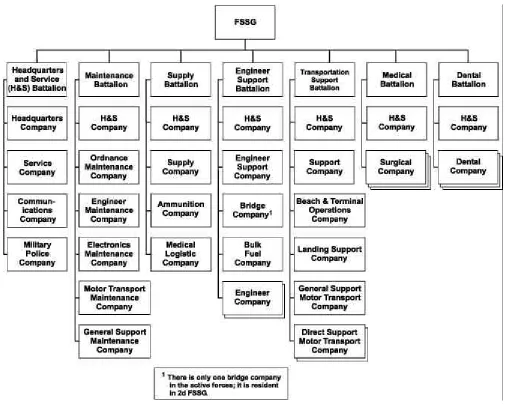
[image:22.612.61.567.303.710.2]The FSSG is the MEF CSSE. It is a grouping of functional battalions that provide tactical-level ground logistic support to all elements of the MEF. See figure 2-2. In addition, the FSSG may be tasked to provide operational-level logistic support to the Marine component of a joint command. The FSSG embodies the funda-m e n t a l principle—econofunda-my of operations through centralization of logistic resources and
decentralization of support operations. The FSSG organizations are structured to provide task-organized groups to support independently de-ployed battalions, regiments, MAGTFs, and/or geographically separated units.
a. Headquarters and Service Battalion
The headquarters and service (H&S) battalion provides command and control, administration, services, communications, and security support to the FSSG. It also coordinates CSS to other M A G T F e l e m e n t s . T h e b a t t a l i o n i s s e l f -supporting in supply, organizational maintenance, health services, communications, and transporta-tion for its command and administrative func-tions. It provides communications for the FSSG CE and subordinate CSSEs. In addition, the bat-talion provides messing for itself, and the mainte-nance, supply, and motor transport battalions. The H&S battalion is organized into headquarters, military police, services, and communications companies. See figure 2-3.
(1) Headquarters Company. The headquarters company provides command and control (C2), administration, and command support functions for the H&S battalion, the FSSG, and the CSSE CEs. The H&S battalion’s supply, health services, and messing capabilities are resident in this com-pany. The headquarters company transports its ad-ministrative and command sections and performs organizational maintenance on organic equip-ment.
(2) Communications Company. The communi-cations company provides communicommuni-cations sup-port to the FSSG CEs and those subordinate
CSSEs without organic communications capabili-ties. The company is capable of organic transpor-tation support for administrative and command functions. It performs organizational maintenance on its equipment, except for test equipment, and conducts third echelon maintenance on the battal-ion’s ground communications and electronics crit-ical low-density equipment.
(3) Military Police Company. The military police company provides security support, ene-my-prisoner-of-war (EPW) control, and law-and-order operations for the MEF. The company is capable of organic transportation support for ad-ministrative and command functions. It also per-forms organizational maintenance on organic equipment.
(4) Service Company. The service company pro-vides general support services support for the MEF. It also provides administrative and disburs-ing support for U.S. Navy personnel assigned to the MEF. The company contains the nucleus for initial active duty civil affairs support. It is capa-ble of performing organizational maintenance on organic equipment.
b. Maintenance Battalion
The maintenance battalion provides intermediate-level, third and fourth echelon maintenance support for tactical ordnance, engineer, motor transport, communications-electronics, and gener-al support equipment of the MEF. It gener-also evacu-ates equipment to repair facilities. The battalion is self-supporting in supply, organizational mainte-nance, and transportation of command and admin-istrative elements. The maintenance battalion is
organized into H&S, ordnance, engineer, elec-tronics, motor transport, and general support maintenance companies. See figure 2-4.
(1) Headquarters and Service Company. H&S company provides C2, administration, and com-mand support functions for the maintenance bat-talion. It is capable of organic supply and first echelon maintenance on organic equipment. It provides second echelon maintenance on the bat-talion’s ordnance and motor transport equipment, except for motor transport equipment belonging to general support maintenance and motor trans-port maintenance companies. The H&S company is capable of organic transportation support for administrative and command functions.
(2) Ordnance Maintenance Company. The ord-nance mainteord-nance company provides third and fourth echelon maintenance support for the MEF’s Marine Corps-furnished ordnance equip-ment. The company is capable of organic trans-portation support for its administrative and command functions. It also conducts first echelon maintenance on organic equipment and second echelon maintenance on ordnance equipment.
(3) Engineer Maintenance Company. The com-pany provides third and fourth echelon mainte-nance support for MEF engineering equipment and second echelon and intermediate maintenance on fabric. It conducts first echelon maintenance on organic equipment and second echelon mainte-nance on engineer assets. The company is capable of organic transportation support for its
adminis-trative and command functions and of transporta-tion support to evacuate heavy engineer items.
(4) Electronics Maintenance Company. The electronics maintenance company provides third and fourth echelon maintenance support for the ground communications-electronics equipment of a MEF and the evacuation of ground communica-tions-electronics equipment to repair facilities. It conducts first echelon maintenance on organic equipment and second echelon maintenance on organic ground communications-electronics equipment and ordnance equipment, except for infantry weapons. The company is capable of or-ganic transportation support for its administrative and command functions.
(5) Motor Transport Maintenance Company.
The motor transport maintenance company pro-vides third and fourth echelon maintenance sup-port for MEF motor transsup-port equipment. It conducts first echelon maintenance on organic equipment and second echelon maintenance on battalion motor transport equipment, except for those items belonging to the H&S and general support maintenance companies. In addition, the company provides transportation support to effect evacuation of heavy motor transport equipment. The company is capable of organic transportation support for its administrative and command func-tions.
(6) General Support Maintenance Company.
The general support maintenance company pro-vides third and fourth echelon maintenance sup-port, including component rebuilding for MEF
ground equipment, except for communications-electronic equipment and fire control compo-nents. It conducts organizational and intermediate maintenance on organic equipment. In addition, the company is capable of organic transportation support for its administrative and command func-tions.
c. Supply Battalion
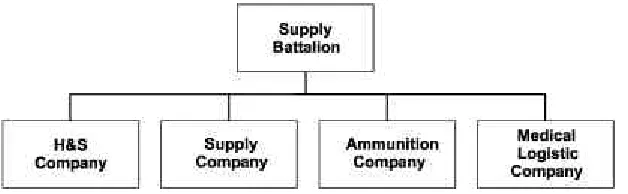
The supply battalion provides general supply sup-port, except for bulk liquids and Navy-funded stock and programs, for sustaining MAGTF oper-ations. The battalion provides organizational and intermediate maintenance on medical and dental equipment. It also provides packing, preservation, and packaging capabilities. The battalion is self-supporting in administration, organic supply, or-ganizational maintenance, and transportation for its command and administrative functions. The supply battalion is organized into H&S, supply, ammunition, and medical logistic companies. See figure 2-5.
(1) Headquarters and Service Company. The H&S company of the supply battalion provides C2, administration, and command support func-tions for the supply battalion and general subsis-tence supply support to the MEF, including packing, preservation, and packaging capabilities. The battalion’s organic supply and internal trans-portation capabilities are resident in this company. The H&S company has organic capabilities to provide transportation for its administrative and command functions and to perform organizational maintenance on its equipment.
(2) Supply Company. The supply company pro-vides general supply support, including supply management and control, to sustain the operations
of the MEF. The company provides support for class II, class III (except for bulk), and classes IV, VI, VII, and IX items. The company has organic capabilities to provide transportation for its ad-ministrative and command functions and to con-duct first echelon maintenance on its equipment.
(3) Ammunition Company. The ammunition company provides general class V supply support to the MEF. The company has organic capabilities to provide transportation for its administrative and command functions and to conduct first eche-lon maintenance on its equipment.
(4) Medical Logistic Company. Medical logistic company provides general supply and mainte-nance support for medical and dental (class VIII) materiel. The company has organic capabilities to provide transportation for its administrative and command functions and to conduct first echelon maintenance on its equipment. The company pro-vides organic and intermediate maintenance on equipment held by the medical logistic company and conducts intermediate maintenance on equip-ment held by other units.
d. Engineer Support Battalion
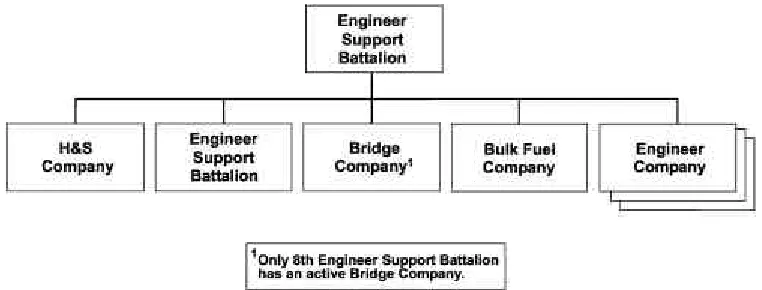
[image:25.612.146.460.611.708.2]The engineer support battalion provides general engineering support of an expeditionary nature, including survivability, countermobility, and mo-bility enhancements. This support includes explo-sive ordnance disposal (EOD), horizontal and vertical construction, utilities support, engineer reconnaissance, and general supply support inci-dent to the handling, storing, and dispensing of bulk class I (water) and bulk class III and III(A) items. The battalion has organic capabilities for administration, organizational maintenance, messing, engineering support, single-channel
communications, supply, and transportation for its command and administrative elements. The engineer support battalion is organized into H&S, engineer support, bridge, and bulk fuel compa-nies, as well as three engineer companies. See fig-ure 2-6.
(1) Headquarters and Service Company. The H&S company provides C2, administration, and command support functions for the engineer sup-port battalion and EOD supsup-port for the MEF. The battalion’s organic supply, single-channel com-munications, chaplain, medical, and messing ca-pabilities are resident in this company. The H&S company has organic capabilities to provide trans-portation for its administrative and command functions and to perform first echelon mainte-nance on organic equipment. It also provides sec-ond echelon maintenance on ordnance, surveying, and communications-electronics equipment.
(2) Engineer Support Company. The engineer support company provides bath, laundry, potable water supply, and mobile electric power to the MEF. It also provides maintenance support for specified equipment that is organic to the battal-ion, transportation and services support, as well as general support and reinforcing heavy equipment augmentation to the battalion’s engineer compa-nies. The company is capable of first echelon maintenance on organic equipment and second echelon maintenance on organic equipment (ex-cept for communications-electronics), ordnance, EOD, and bulk fuel equipment. It is also capable of third echelon maintenance on bridge equip-ment and boats.
(3) Bridge Company. The bridge company pro-vides bridging support to enhance tactical mobili-ty. The company has organic capabilities to provide transportation for its organic administra-tive and command functions and to conduct orga-nizational maintenance on its equipment.
(4) Bulk Fuel Company. The bulk fuel company provides general support class III supply support. The company has organic capabilities to provide transportation for its administrative and command functions and to conduct organizational mainte-nance on bulk fuel system-specific equipment.
(5) Engineer Companies. Engineer companies provide general engineering support of a delib-erate nature. The companies have organic capa-bilities to provide transportation for their administrative and command functions and to conduct organizational maintenance on their equipment (except for communications, ordnance, EOD, and bulk fuel items).
e. Transportation Support Battalion
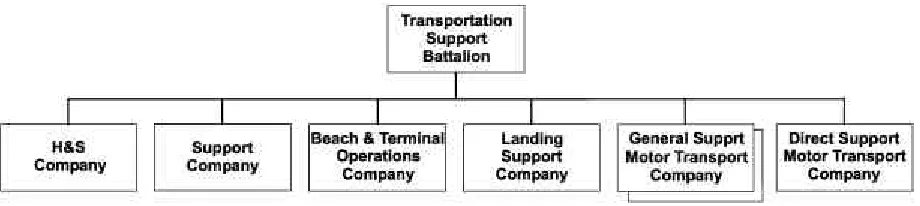
[image:26.612.123.504.561.706.2]Transportation support battalion provides motor transport, air delivery, and landing support for the MEF. Landing support provides for ship-to-shore movement during amphibious, maritime preposi-tioning force (MPF) operations, and subsequent terminal operations to permit throughput of sup-plies, equipment, and personnel. Motor transport support includes medium- and heavy-lift transpor-tation support. The battalion has organic capabili-ties to provide for its administration, supply, communications, and transportation of command
and administrative elements. Having a limited en-gineering capability, the battalion conducts orga-nizational maintenance on organic equipment, third echelon maintenance on motor transport and engineering equipment, and intermediate mainte-nance on air delivery equipment. The support bat-talion is organized into H&S, support, beach and terminal operations, landing support, general sup-port motor transsup-port, and two direct supsup-port motor transport companies. See figure 2-7.
(1) Headquarters and Service Company. The H&S company of the support battalion provides C2, administration, and command support func-tions for the battalion. The battalion’s organic supply, communications, and organizational maintenance for ordnance and communications-electronic equipment are resident in this company. The H&S company has the organic capability to provide transportation for its administrative and command functions.
(2) Support Company. The support company provides materials handling equipment (MHE) and container handling support. The company has the organic capability to provide transportation for its administrative and command functions. It is also capable of organizational maintenance on its landing support equipment (LSE), second and third echelon maintenance on motor transport as-sets, and first through third echelon maintenance on engineer equipment organic to the battalion.
(3) Beach and Terminal Operations Company.
The beach and terminal operations company pro-vides general transportation support in coordinat-ing throughput operations. The company provides air delivery support and coordinates transporta-tion support in throughput operatransporta-tions at
designat-ed ports, beaches, railheads, airheads, cargo terminals, dumps, and depots. The company has organic capabilities to provide transportation for its administrative and command functions and to conduct first echelon maintenance on its equip-ment and organizational and intermediate mainte-nance on air delivery equipment.
(4) Landing Support Company. The landing support company provides C2 for throughput op-erations in support of surface and/or helicopter as-sault operations. This company provides the MAGTF’s with shore party teams or groups, heli-copter support teams (HSTs), departure airfield control groups (DACGs), port operations group (POG), and/or arrival airfield control groups (AACGs). The company has organic capabilities to provide transportation for its administrative and command functions and to conduct first eche-lon maintenance on its equipment.
(5) General Support Motor Transport Compa-ny. The general support company provides gener-al medium- and heavy-lift transportation support. The company is capable of first echelon mainte-nance on organic equipment.
(6) Direct Support Motor Transport Compa-nies. Direct support companies provide direct and general medium- and heavy-lift transportation support. The companies are capable of first eche-lon maintenance on organic equipment.
f. Medical Battalion
The medical battalion conducts initial resuscita-tive HSS. It is the only source of organic Marine Corps medical support above the aid station level. In addition to initial resuscitative surgical
[image:27.612.73.533.602.705.2]vention, the battalion provides temporary casualty holding, ground evacuation support to forward medical elements, and preventive medical port. It has organic capabilities to provide its sup-plies and to perform organizational maintenance on its equipment and first echelon maintenance on medical equipment. The battalion can transport its command and administrative elements, evacuate casualties from forward areas, and transfer pa-tients to medical treatment facilities (MTFs) in rear areas. The medical battalion is organized into an H&S company and three surgical companies. See figure 2-8.
(1) Headquarters and Service Company. The H&S company provides the medical battalion’s C2, command support functions, and shock-trau-ma capabilities. The H&S company is capable of organic supply and intermediate maintenance on organic equipment. In addition, the company has the organic capability to transport its command and administrative elements.
(2) Surgical Companies. Each of the surgical companies can support regimental-sized opera-tions. The surgical company provides MTFs for resuscitative surgery, medical treatment, and tem-porary holding of casualties.
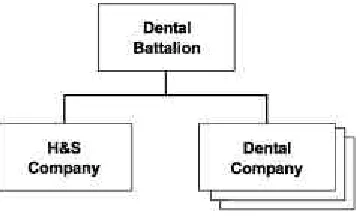
g. Dental Battalion
The dental battalion has organic supplies. It is ca-pable of organizational maintenance on organic equipment and third echelon maintenance on den-tal equipment. In addition, it is capable of trans-porting its command and administrative elements.
It is organized into an H&S company and three dental companies. See figure 2-9.
(1) Headquarters and Service Company. The H&S company provides the dental battalion’s C2 and command support functions. The company is capable of transporting its command and adminis-trative elements.
(2) Dental Companies. The dental companies provide dental services to the major subordinate elements of the MEF. These companies have or-ganic capabilities to provide transportation for their administrative and command functions.
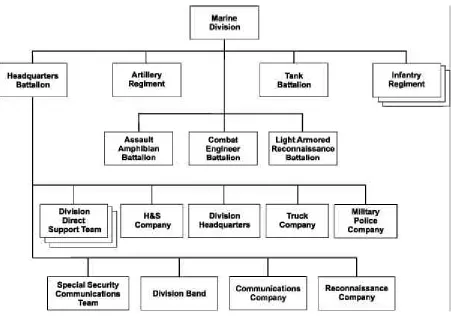
2302. Marine Division
While the Marine division depends on the FSSG for extensive CSS, the division is structured with a significant array of organic logistic capabilities, which should be utilized before requesting sup-port from the FSSG. The division consists of a headquarters battalion, infantry regiments, an ar-tillery regiment, a tank battalion, an assault amphibian battalion, a combat engineer battalion, and a light armored reconnaissance (LAR) battalion (figure 2-10, on page 2-12). See MCWP 5-12D for additional information.
a. Headquarters Battalion
[image:28.612.357.537.559.667.2]The headquarters battalion is capable of self-ad-ministration, organic supply support, food service support, first and second echelon maintenance on
[image:28.612.89.271.562.669.2]all organic equipment, and third echelon mainte-nance on communications-electronics equipment. The battalion’s medical services provide routine and emergency medical care. The battalion’s truck company provides general motor transport support to the division.
b. Infantry Regiment
The infantry regiment is capable of self-adminis-tration, organic supply support, food service sup-p o r t , a s w e l l a s f i r s t a n d s e c o n d e c h e l o n maintenance on all organic equipment. It has a limited transportation capability (high mobility, multipurpose wheeled vehicles [HMMWVs]). The regimental medical platoon can establish a regimental aid station to provide routine and emergency medical care. The regiment’s infantry battalions are capable of self-administration, or-ganic supply, food service support, first and sec-ond echelon maintenance on organic equipment a n d w e a p o n s , a n d l i m i t e d t r a n s p o r t a t i o n (HMMWVs). The regiment’s battalion medical
platoons establish battalion aid stations that pro-vide routine and emergency medical care.
c. Artillery Regiment
The artillery regiment is capable of organic ply support, self-administration, food service sup-port, routine and emergency medical services support, first and second echelon maintenance on organic equipment (except fire control), third and fourth echelon maintenance on electronics systems, and fourth echelon maintenance on weapons-loading radar equipment. The regiment, as a whole, has significant organic logistic capa-bility for short-term self-sufficiency, but requires extensive CSS, especially fuel and ammunition, for sustained operations. The regiment’s artillery battalions are capable of self-administration, or-ganic supply support, food service support, medi-cal services that provide routine and emergency support, and first and second echelon mainte-nance on organic equipment (except fire control). The regiment’s artillery units are capable of
[image:29.612.76.527.72.388.2]ing their personnel, equipment, and a limited quantity of supplies.
d. Tank Battalion
The tank battalion is capable of self-administra-tion, organic supply support, food service support, and medical services that provide routine and emergency medical care. The battalion has signif-icant organic logistic capabilities for short-term self-sufficiency, but requires extensive CSS, espe-cially fuel and ammunition, for sustained opera-tions. The battalion’s tank companies conduct first and second echelon maintenance on all or-ganic equipment. The battalion provides second echelon maintenance on motor transport equip-ment and third echelon maintenance on tanks, tank-mounted weapons, and tube-launched, opti-cally tracked, wire-command link guided missile (TOW) systems. The battalion possesses a signifi-cant amount of motor transport equipment.
e. Assault Amphibian Battalion
Assault amphibian battalion is capable of self-ad-ministration, organic supply support, food service support, and medical services that provide routine and emergency medical care. The assault amphib-ian battalion has significant organic logistic capa-bilities for short-term self-sufficiency, but for sustained operations, it requires extensive CSS, especially fuel and ammunition. The battalion conducts second echelon maintenance on motor transport equipment and third echelon mainte-nance on amphibious assault vehicles, mounted weapons, and communications equipment. The battalion possesses a significant amount of motor transport equipment. The battalion’s assault am-phibian companies conduct first and second eche-lon maintenance on its equipment.
f. Combat Engineer Battalion
The combat engineer battalion is capable of self-administration, organic supply support, food ser-vice support, and medical serser-vices that provide routine and emergency medical care. It conducts first and second echelon maintenance on all or-ganic engineering, motor transport, and communi-cations equipment. The battalion has significant organic logistic capabilities for short-term
self-sufficiency, but requires extensive CSS, especial-ly fuel, for sustained operations.
g. Light Armored Reconnaissance Battalion
The LAR battalion is capable of self-administra-tion, organic supply support, food service support, and medical services that provide routine and emergency medical care. It conducts first and second echelon maintenance on all organic equip-ment and third echelon maintenance on light-armored vehicles. In addition, the battalion has motor transportation capability. The battalion has organic logistic capabilities for short-term self-sufficiency, but requires extensive CSS, especial-ly fuel and ammunition, for sustained operations.
2303. Marine Aircraft Wing
[image:30.612.323.564.554.706.2]The MAW possesses organic aviation and ground logistic capabilities. It employs organic aircraft-specific aviation supply, maintenance, and ser-vices capabilities in direct support of aircraft squadrons and groups. Although the MAW has its own aviation ground support capabilities, it de-pends on the FSSG for ground CSS and delivery of aviation bulk commodities. The MAW is orga-nized into a Marine wing headquarters squadron (MWHS), fixed- and rotary-wing Marine aircraft groups (MAGs), a Marine air control group (MACG), and a Marine wing support group (MWSG). A notional garrison MAW is depicted in figure 2-11.
a. Marine Wing Headquarters Squadron
The MWHS provides command, administrative, and supply support for a MAW headquarters and certain elements of the MACG.
b. Marine Wing Support Group
The MWSG, via its Marine wing support squad-rons, provides all essential aviation ground sup-port to fixed- and rotary-wing components of an ACE. The group is organized into a headquarters, two fixed-wing support squadrons, and two rota-ry-wing support squadrons. See figure 2-12.
(1) MWSG Headquarters. The MWSG head-quarters performs administrative, C2, religious ministries support, and coordination functions. It conducts organic supply, first echelon mainte-nance on all assigned equipment, and second ech-elon maintenance on nuclear, biological, and chemical (NBC) defense equipment.
(2) Marine Wing Support Squadrons. Marine wing support squadrons (MWSSs) are designated either fixed-wing or rotary-wing and provide the same capabilities with the exception of the opera-tion of M-21 aircraft recovery equipment which is found in a fixed-wing MWSS. The MWSS is self-supporting in administration. It provides second echelon maintenance for organic motor transport and engineering equipment except for those items that belong to the MACG. It conducts organiza-tional maintenance on organic engineering, com-munications and motor transport equipment, and weapons. It also conducts third echelon and limit-ed fourth echelon maintenance on explimit-editionary airfield systems equipment. In addition, MWSSs
provide the following essential aviation ground support to an ACE:
l Internal airfield communications. l Weather service.
l Expeditionary airfield service. l Aircraft rescue and firefighting. l Aviation and ground refueling. l Essential engineering service. l Motor transport support. l Field messing support. l Medical service. l Personnel training. l NBC defense.
l Security and law enforcement. l Air base commandant functions. l EOD support.
c. Marine Aircraft Group
The MAG is an administrative and tactical head-quarters. It is the smallest aviation unit designated for independent operations with no outside assis-tance except access to a source of supply. There are two types of MAGs: fixed-wing and rotary-wing. The MAG is self-administrating and capa-ble of performing routine and emergency support. MAGs are organized into several aircraft squad-rons that perform organizational maintenance on assigned aircraft and a Marine aviation logistic squadron (MALS).
The MALS is capable of self-administration, rou-tine and emergency medical care, first echelon maintenance on organic equipment, and second echelon maintenance on infantry weapons. In ad-dition, it provides the following aviation logistic support (e.g., aviation-peculiar maintenance and supply) for the subordinate units of either a fixed-or rotary-wing MAG:
l Conducts intermediate maintenance on aircraft
and aeronautical equipment.
l Provides aircraft supply support.
l Assembles and distributes class V(A)
[image:31.612.50.286.274.386.2]ammuni-tion (requires motor transport support from the MWSS for distribution).
l Manufactures cryogenics.
l Provides supply support to the MWSS
expedi-tionary airfield and weather sections.
d. Marine Air Control Group
The MACG provides, operates, and maintains the M a r i n e a i r c o m m a n d a n d c o n t r o l s y s t e m (MACCS). The MACG is capable of routine and
Section IV. Marine Expeditionary Brigade
Organizations and Capabilities
The MEB is the mid-sized MAGTF and is nor-mally commanded by a brigadier general. The MEB bridges the gap between the MEU and the MEF. The MEB is a task-organized MAGTF nor-mally composed of a CE, a reinforced infantry regiment, a composite MAG, and a BSSG. With 30 days of sufficient supplies for sustained opera-tions, the MEB is capable of conducting amphibi-ous assault operations and MPF operations. During potential crisis situations, a MEB may be forward deployed afloat for an extended period to provide an immediate combat response. A MEB can operate independently or serve as the advance echelon of a MEF. The MEB CE is embedded in the MEF CE and is identified by line number for training and rapid deployment.
2401. Combat Service Support
Element
The BSSG is the CSSE for the MEB. The FSSG provides MSSGs with the necessary personnel and equipment to accomplish their missions. The MSSGs provide the MEU with the following CSS:
l Supply support. l Maintenance support. l Transportation support.
l Deliberate engineering support. l Medical and dental services.
l Automated information processing support.
l Utilities support.
l Landing support (port and airfield support
op-erations).
l Disbursing services. l Legal services. l Postal services.
l Accompanying supplies (classes I, II, III[B],
IV, V[W], and IX) necessary to support the MEU for 30 days.
2402. Aviation Combat Element
The MEB composite MAG generally receives ground tactical logistic support from a composite MWSS (fixed-wing [FW])/(rotary-wing [RW]) or both MWSS(RW) and MWSS(FW), depending on the number of airfields ashore. Normally, the aviation maintenance support for MEB aircraft is provided by the aviation intermediate mainte-nance department (AIMD) of the general purpose amphibious assault ships and the aviation logis-tics support ship (TAVB).
2403. Ground Combat Element
Section V. Marine Expeditionary Unit
Organizations and Capabilities
The MEU is the MAGTF routinely forward ployed for presence and quick response to a de-veloping contingency. The MEU is organized and equipped to provide a rapidly deployable, sea-based capability with 15 days of self-sustainment. The MEU may serve as an enabler for larger mis-sions in the event that the situation or mission re-quires additional capabilities or resources.
2501. Combat Service Support
Element
The MSSG is the CSSE for the MEU. The FSSG provides MSSGs with the necessary personnel and equipment to accomplish their missions. The MSSGs provide the MEU with the following CSS:
l Supply support.
l Maintenance support.
l Transportation support.
l Deliberate engineering support.
l Medical and dental services.
l Automated information processing support.
l Utilities support.
l Landing support (port and airfield support
op-erations).
l Disbursing services.
l Legal services.
l Postal services.
l Accompanying supplies (classes I, II, III[B],
IV, V[W], and IX) necessary to support the MEU for 15 days.
2502. Aviation Combat Element
The MEU ACE generally consists of a medium-lift helicopter squadron reinforced with several heavy-lift helicopters and AV-8B attack aircraft. Aerial refueling support is provided by a shore-based aerial refueling detachment. Normally, the aviation maintenance support for MEU aircraft is provided by the aviation intermediate mainte-nance department (AIMD) of the general purpose amphibious assault ship on which the ACE is em-barked. The MALS augments the ship’s capabili-ties with personnel and materiel. If the MEU ACE is directed ashore, the ship operating offshore or a MALS deployed ashore provides intermediate-level support.
2503. Ground Combat Element
Section VI. Task Organizations
Logistic and CSS organizations, units, and sec-tions within larger organizasec-tions are either perma-nently organized or task-organized. Task-organizing is basic to the concept of the MAGTF. It is the process by which commanders organize the forces under their command to meet the re-quirements of the mission. MAGTFs have a wide range of capabilities that are further enhanced by task-organizing. This gives commanders the abili-ty to respond to different abili-types and intensities of contingency situations. Task organizations are used in garrison at the operational