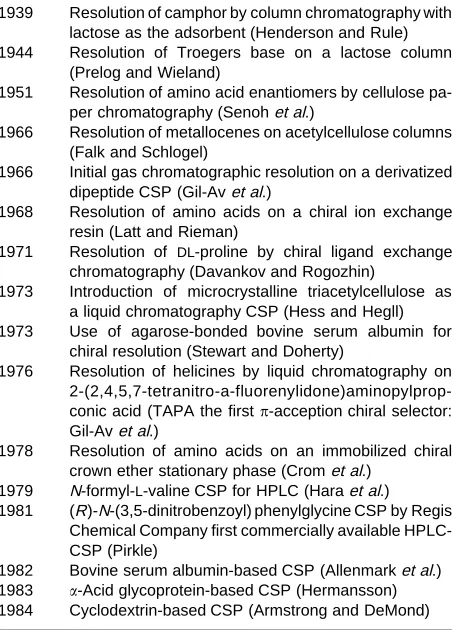
Table 1 Some key dates in direct enantioselective separations 1939 Resolution of camphor by column chromatography with
lactose as the adsorbent (Henderson and Rule) 1944 Resolution of Troegers base on a lactose column
(Prelog and Wieland)
1951 Resolution of amino acid enantiomers by cellulose pa-per chromatography (Senohet al.)
1966 Resolution of metallocenes on acetylcellulose columns (Falk and Schlogel)
1966 Initial gas chromatographic resolution on a derivatized dipeptide CSP (Gil-Avet al.)
1968 Resolution of amino acids on a chiral ion exchange resin (Latt and Rieman)
1971 Resolution of DL-proline by chiral ligand exchange chromatography (Davankov and Rogozhin)
1973 Introduction of microcrystalline triacetylcellulose as a liquid chromatography CSP (Hess and Hegll) 1973 Use of agarose-bonded bovine serum albumin for
chiral resolution (Stewart and Doherty)
1976 Resolution of helicines by liquid chromatography on 2-(2,4,5,7-tetranitro-a-fluorenylidone)aminopylprop-conic acid (TAPA the first-acception chiral selector: Gil-Avet al.)
1978 Resolution of amino acids on an immobilized chiral crown ether stationary phase (Cromet al.)
1979 N-formyl-L-valine CSP for HPLC (Haraet al.) 1981 (R)-N-(3,5-dinitrobenzoyl) phenylglycine CSP by Regis
Chemical Company first commercially available HPLC-CSP (Pirkle)
1982 Bovine serum albumin-based CSP (Allenmarket al.) 1983 -Acid glycoprotein-based CSP (Hermansson) 1984 Cyclodextrin-based CSP (Armstrong and DeMond)
Mechanisms: Chiral
I. W. Wainer, Georgetown University Medical Center,
Washington DC, USA
Copyright^ 2000 Academic Press
The separation of racemic compounds into their con-stituent enantiomers is now routinely performed by high performance liquid chromatography (HPLC) on chiral stationary phases (HPLC-CSPs). HPLC-CSPs are based on molecules of known stereochemical composition immobilized on liquid chromatographic supports. Single enantiomorphs, diastereomers, dia-stereomeric mixtures and chiral polymers (such as proteins) have been used as the chiral selector.
The Rrst chromatographic separation of an enan-tiomeric compound on a CSP was reported in 1939 by Henderson and Rule. In this study, racemic cam-phor was enantioselectively separated on a column containing lactose as the adsorbent. Some of the other signiRcant advances in this Reld are presented in Table 1.
TheRrst commercial HPLC-CSP was developed by Pirkle and introduced by the Regis Chemical Com-pany in 1981. By 1996, the number of commercially available HPLC-CSPs had grown to 110. The rapid increase in the availability of this technology was primarily due to its importance in the discovery, development and regulation of pharmaceutical products.
The Basis of Chiral Recognition
In order to utilize the wide range of available HPLC-CSPs effectively, it is important to identify the chiral recognition mechanisms operating on these phases. The enantioselective resolutions obtained on CSPs are the result of the formation of temporary diastereo-meric complexes between the enantiodiastereo-meric solute molecules and immobilized chiral selector (solute/ CSP). The difference in energy between the resulting diastereomeric R-solute/CSP andS-solute/CSP com-plexes determines the magnitude of the observed stereoselectivity, whereas the sum total of the interac-tions between the solute and CSP, chiral and achiral, determines the observed retention and efRciency.
In order for two enantiomers to be separated chromatographically, there must be a difference in the free energies of binding (G) between the two transient diastereomeric complexes. The energy difference arising from one such interaction would normally be insufRcient to permit resolution. How-ever, chromatography is a weighted time-averaged
view of many dynamic adsorption}desorption pro-cesses. These processes occur throughout the entire length of a column and their sum total can be sufR -cient to allow an observable difference in the reten-tion times of two enantiomers.
The difference in free energy, G, needed for adequate chromatographic separation is inSuenced by the efRciency of the system employed. If the chromatographic system is of high efRciency, so that narrow peaks are observed, relatively small G values will afford acceptable analytical-scale enan-tiomer separations.
For a chiral separation where tr1 is the retention time of theRrst eluting enantiomer,tr2is the retention time of the second eluting enantiomer andt0 is the retention time of an unretained solute (Figure 1). The partitioning of two enantiomerically related analytes between the stationary phase and the mobile phase is deRned by the retention factorsk1andk2.
k1"
(tr1!t0) t0
Figure 1 The enantioselective separation of two enantiomers and the measurements required to calculatek1,k2and.
k2"
(tr2!t0) t0
[2]
"k2 k1
[3]
G"!RTlnK [4]
whereKis the equilibrium constant for the distribu-tion of a solute between the stadistribu-tionary phase and the mobile phase.
G"G2!G1 [5]
whereG1 andG2are the free energies of binding for the Rrst and second eluting enantiomers, respec-tively.
G"!RT(lnK2!lnK1) [6]
G"!RTlnK2 K1
[7]
G"!RTlnk2 k1
[8]
G"!RTln [9]
Chiral Recognition Mechanisms
Chiral recognition is a speciRc aspect of the much broader area of molecular recognition. In chromato-graphic terms it usually implies the preferential inter-action of one solute enantiomer with another enantiomer immobilized on an inert support. The
three-dimensional spatial arrangement of the solute requires a complementary three-dimensional struc-ture with which to form a sufRcient and necessary number of bonded and nonbonded interactions.
To specify the origin of enantioselective adsorp-tion, one must specify the nature of the various interactions between the species involved. It is also necessary to deRne a model with which to character-ize the requirements of enantioselective recognition. TheRrst model was proposed by Easson and Stedman in 1933. In their mechanism, enantioselective recep-tor binding was the result of the differential binding of two enantiomers to a common site produced by a three-point contact model between ligand and re-ceptor (Figure 2).
In this model, enantiomer 1 was more active than its enantiomorph 2 because 1 was more tightly bound to the receptor (3). The differential binding is a result of the sequence of the substituents,BCD, around the chirally substituted carbon atom which forms a tri-angular face of the tetrahedral bond array. For enan-tiomer 1, the sequence matches the complementary triad of binding sites on the receptor 3, (BCD), leading to a three-point interaction. The enan-tiomorph 2 has a mirror image sequence,DCB, and its interaction with 3 occurs at only two of the three sites on the receptor surface, producing a relatively weaker ligand}receptor interaction.
Figure 2 Easson and Stedman’s three-point interaction model of chiral discrimination.
Figure 3 The three-point chiral recognition mechanism, as illustrated by a Pirkle-type CSP.
stereoselective decarboxylation of the prochiral inter-mediate metabolite aminomalonic acid. In Ogston’s model, the carboxylic moieties on the aminomalonic acid become nonequivalent due to the existence of three nonequivalent binding sites on the enzyme, one of which is responsible for the decarboxylation. Ogsten’s mechanism was a slight variation of the Easson and Stedman three-point model in that it did not require all three interactions to be attractive.
TheRrst application of the three-point chiral recog-nition model in chromatography was published by Dalgliesh in 1952. In this work, amino acid enantio-mers were resolved by paper chromatography and a three-point mechanism postulated for the interac-tion between the chiral cellulose stainterac-tionary phase and the solute enantiomers. Since its introduction into enantioselective chromatography, the three-point in-teraction model has been the basis for the rational design of a large number of CSPs as well as the basic explanation for the enantioselective separations achieved on them.
Pirkle was the Rrst to exploit this model in the design of synthetic, small molecule CSPs based upon derivatized amino acids. His initial HPLC-CSP was a 3,5-dinitrobenzoyl derivative of phenylglycine (Figure 3).
As in the Easson and Stedman model, interactions between the enantiomeric solutes and the CSP take place in the plane deRned byBCD. However, unlike the enzyme model, all of the attractive interactions are contained along the C axis, including sites for hydrogen bond donation and acceptance, an amide
dipole which can participate in dipole}dipole interac-tions and the 3,5-dinitrobenozyl moiety which can act as a site foracid}base interactions. The phenyl moiety and hydrogen atom on theBandCaxes are sites of steric interaction.
In the chiral recognition process involving two en-antiomers (BCD,DCB) attractive interactions be-tween the amide moieties on the respectiveC(solute) andC(CSP) axes create the solute}CSP complexes. The energetic difference between the R-solute} CSP and S-solute}CSP complexes arises from the stericRt of the BDandDBsequences on the enan-tiomeric solutes into theBDsites on the CSP.
It is clear that the three-point interaction model works in a number of situations, especially with small synthetic CSPs. However, when large chiral bio-polymers are used as the CSP, this model does not give an accurate description of how the dissymmetry of one molecule is perceived by a second or of how stereochemically equivalent moieties are distin-guished from each other. The problem lies in the perception between point asymmetry and molecular asymmetry. In the former approach, a molecule is broken down into its parts, while in the latter it is viewed as the sum of its parts.
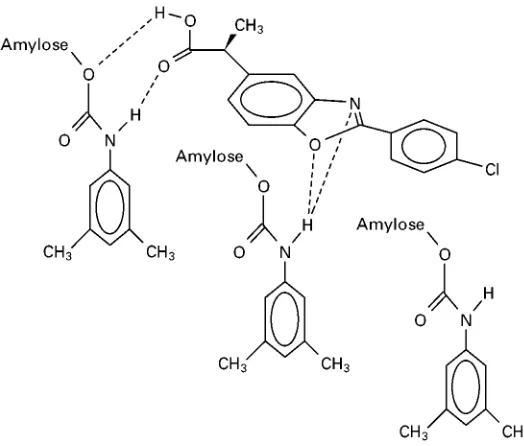
[image:3.568.295.511.55.198.2]Figure 4 Representative interactions betweenS-benoxaprofen and the AD-CSP, representing a conformationally driven chiral recognition mechanism.
In analogy with the induced conformational Rt utilized in enzyme kinetics, a conformationally driven chiral recognition mechanism has been described for the separation of -alkyl arylacetic acids on an amylose tris(3,5-dimethylphenylcarbamate) CSP (AD-CSP). The chromatographic retentions and enantioselective resolutions of 28 chiral -alkyl arylacetic acids were related to their respective structures through the construction of quantitative structure}enantioselective retention relationships (QSERR). The QSERR data were combined with mo-lecular modelling studies and the results indicate that the enantioselective discrimination on the AD-CSP proceeds via a three-step process. These steps are: E Step 1: Distribution of the solute to the stationary
phase through hydrogen-bonding interactions be-tween the acid moiety on the solute and amine moieties on the CSP.
E Step 2: Conformational adjustments of the solutes and insertion of the aromatic portion of the solute into a ravine on the CSP.
E Step 3: Stabiliztion of the solute}CSP complex through electrostatic and hydrogen-bonding inter-actions within the ravine.
This process can be illustrated using the enantioselec-tive separation of R- and S-benoxaprofen on the AD-CSP. The optimal interaction between S-benoxa-profen and the CSP is illustrated in Figure 4.
BothR- andS-benoxaprofen form identical hydro-gen-bonding interactions}and presumably the same
hydrophobic interactions as well}with the AD-CSP. The energetic differences between the dia-stereomeric R-benoxaprofen}CSP and S-benoxa-profen}CSP complexes arise from the internal energies of the two enantiomer conformations which are required to achieve the optimum interactions. The bonding conformation of R-benoxaprofen has been calculated to be approximately 250 cal mol\1 higher in energy than that of S-benoxaprofen. The theoretical enantioselectivity arising from this energy difference was estimated using eqn [9]
G"!RTln, and the calculated(1.52) was consistent with the observed(1.82).
The determining factor in these processes is the molecular chirality of the biopolymer. Enzymes and amylose are large chiral biopolymers with distinct three-dimensional structures. While it is possible to assign speciRc electrostatic or hydrogen-bonding sites within these molecules, most interactions take place within cavities or ravines. Thus, a more accurate description of the chiral recognition process would be to replace the three-point interaction model with one based on molecular chiralities.
Figure 5 A molecular chiral recognition process.
classes of chiral selectors from biopolymers to de-rivatized amino acids.
Using Molecular Chiral Recognition
to Select a HPLC-CSP
The chiral recognition mechanism presented in Figure 5 can be broken down into its separate parts if one remembers that these parts are interdependent and cannot exist apart from one another. The advant-age of considering the steps independently is that it allows for the development of a system for the
classi-Rcation of HPLC-CSPs. If one considers that the key chromatographic step in the chiral recognition pro-cess is the formation of the diastereomeric solute}CSP complex, the current HPLC}CSPs can be broken down into Rve basic types on the basis of the sol-ute}CSP bonding interactions. Using these classes and the molecular structure of the solute, one or more HPLC-CSPs can be selected for the required enan-tioselective separations. The resulting classes of CSPs are:
E Type I: when the solute}CSP complexes are for-med by attractive interactions, such as hydrogen bonding, }, dipole stacking, etc., between the solute and CSP. The Pirkle type of CSPs are in-cluded in this category
E Type II: when the primary mechanism for the formation of the solute}CSP complex is through attractive interactions, but inclusion complexes also play an important role. The cellulosic and amylosic CSPs are included in this category E Type III: when the primary mechanism for the
formation of the solute}CSP complex is through the formation of inclusion complexes, wherein the sample enters a chiral cavity within the
CSP. The cyclodextrin CSPs are included in this category
E Type IV: when the solute is part of diastereomeric metal complex}chiral ligand}exchange chromato-graphy
E Type V: when the CSP is a protein and the sol-ute}CSP complexes are based on combinations of hydrophobic and polar interactions. CSPs based on immobilized -acid glycoprotein, bovine and human serum albumin and enzymes such as chymotrypsin are included in this category
Conclusion
Research into chiral recognition on CSPs has ex-panded the original three-point interaction model into a model of molecular chiral recognition.
See Colour Plates 24, 25.
See also: III/Chiral Separations: Cellulose and Cellulose Derived Phases; Cyclodextrins and Other Inclusion Complexation Approaches; Ligand Exchange; Liquid Chromatography; Protein Stationary Phases; Synthetic Multiple Interaction (‘Pirkle’) Stationary Phases.
Further Reading
Booth TD and Wainer IW (1996) Investigation of the enantioselective separations of -alkyl arylcarboxylic acids on an amylosetris(3,5-dimethylphenylcarbamate) chiral stationary phase using quantitative structure-enantioselective retention relationships (QSERR): identiRcation of a conformationally driven chiral recog-nition mechanism.Journal of Chromatography A737: 157}169.
Francotte E (1994) Contribution of preparative chromato-graphic resolution to the investigation of chiral phe-nomena.Journal of Chromatography A666: 565}601. Hara S, Nakagawa T and Terabe S (eds) (1994) Inter-national symposium on molecular chirality, Kyoto, Ja-pan, 24}27 May 1994.Journal of Chromatography A
694.
Jinno K (ed.) (1997)Chromatographic Separations based on Molecular Recognition. New York: Wiley-VCH.
Pirkle WH, Pochapsky TC, Burke JA III and Deming KC (1988) Systematic studies of chiral recognition mecha-nisms. In: Stevenson D and Wilson ID (eds)Chiral Sep-arations, pp. 23}36. London: Plenum Press.
Schreier P, Bernreuther A and Huffer M (1995)
Analysis of Chiral Organic Molecules. Berlin: Walter de Gruyter.