No. 39 Jan./Feb.1988
THE
M
C R
PC Graphics
This issue we're concentrating on graphics, from mathematically-generated fractals to human-generated acorns. Plus, we'll look at the newest hardware for displaying the finished product.
Drawing The Mandelbrot
And
Julia
Sets
page 6It was so much fun creating Mandelbrots that we couldn't resist using this one as our first full-color cover. Larry tells you how to do it.
Desktop Graphics
page 10Expanding the desktop world. Here's how an author and a graphic designer use desktop graphics.
Designing A PC
Workstation Board Around
The TMS34010
page 18Dean Klein takes a close look at this super-powerful graphics processor.
A Hercules Primer
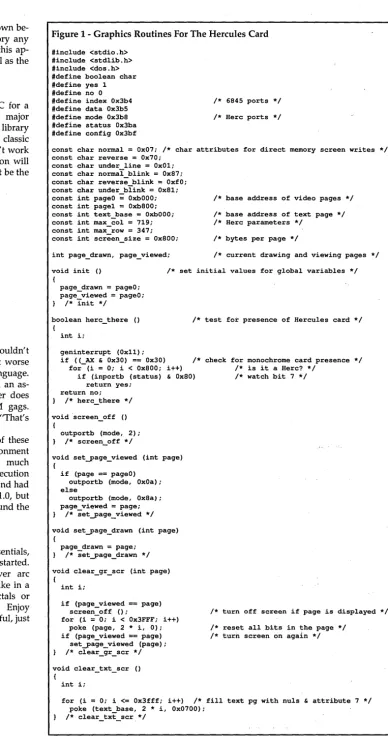
page 24The Hercules card is the only non-IBM standard. Here's how to write graphics routines for this interesting little card.
Controlling Synchronous
Serial Chips With A
Parallel Port
page 30 Want some speed in your morning serial? Bruce Eckel clocks in with a primer on fast bits.1 2 I
I',
..
;...
.
o
74470 19388 3$3.95
VERY HIGH RESOLUTION
The PC Tech Monochrome Video Board and Monitor
~~Jl.flIl!iL!.'.!!!-LT~mri1[;';:;-m~:~~mtj:E:'" ,==~i::
•
Windowing, most desk top
:~'''!.',''I
PC Tech Scooppublishing packages, full page
';~PC;::TeC~h
I=n(.=='~~====~
Lotus 123 and other applications.
;~:~:::ff
•
PC, XT, and AT Compatible.
;Publisher at
• MDA (MONOCHROME) emulation.
• CGA (COLOR GRAPHICS)
emulation.
• Full Screen Graphics.
• 6 MIPS TMS34010 32-bit
graphics CPU. 736 by 1024
resolution. Both black on
white and white on black
I
text modes supported.
I
1~'";';""'wm""w'w"".""" . , •
Complete systems available.
, - - - "
*SPECIAL LIMITED TIME OFFER:
PC Tech is offering the complete video system (monitor,
graphics adapter card,aH necessary interface software and cables) fora special introductory
price of
$995
plus shipping and handling. Bank card orders welcome.
SPECIAL FOR'MICRO-C USERS:
Ask for the Micro-C specialwhichwillinclude
~xtensive
development software at
no
charge!
~.'>. N <., ~ ~ " , }
Now also available: The PC Tech Color 34010 Video Board. This is the workstation class graphics
engine featuring:
• 6 MIPS TMS34010 32-Bit graphics CPU.
• Up to 4 Megabytes non-display memory.
• Up to 1 Megabyte of display memory.
• Eight bits per pixel give 256
simultaneous colors.
• Color palette provides up 256K
color choices.
• Hardware support for CGA/M DA
emulation.
• 800 by 512 to 1024 by 800 resolution.
This board is designed to be the ultimate windowing engine with the PC Tech native mode
MS-Windows driver. In addition to the MS-Windows support, CGA and M DA emulation software
is provided as well as the PC Tech graphics development toolkit.
Introductory SpeCial:
$995
(includes 1.5mega/lytesme1p9ry, and software)
Designed, Sold and Serviced
By:
PC, XT, and A T are trademarks of International Business Machines Corp.
904 N. 6th St.
Lake
City,
MN 55041
(612) 345·4555
(612) 345·5514 (FAX)
Enlarged
Shift keys
Two Ctr/and
Aft keys for ambidextrous
Positive-tactile, firm-feel keys. access. - _ _ _
Isolated
Escape key.
IBM just announced their new
redesigned "standard" keyboard for per-sonal computers. There's only one problem:
it won't work on your IBM computer if it
was purchased priortoJune 1986 oron any PC compatible purchased at any time! Not to worry. Our new Turbo-1D1 Enhanced Keyboard gives you the layout and en-hancements of the IBM with some logical improvements (see above photo). And it works on your existing PC, XT, AT, PCjr, AT&T, Epson and virtually all compatibles!
Get Borland's Turbo Lightning ™
For FREE!
To really turbocharge
I
your productivity, we are' ,.'~~~ra~~~ :~~~h~~~~~~e,
..
!.' ...
i.'f .... '·,,· .•
,.::,',··~:
,1
Lightning software with ~~
each keyboard. Now,
when using SideKick, WordPerfect, Micro-soft Word, 1-2:'3 or most popular programs, our Turbo-101 Keyboard will check your spelling as you type, gives you instant access to Random House's 80,OOO-word Concise Dictionary and 60,OOO-word Thesaurus and much, much morel
"Lightning's good enough to make programmers and'users cheer, executives Of other software companies weep," says
Jim Seymour of PC Week. Sold separately, , Thrbo Lightning retails for $99.951
12 Function
keys for increased automatic operation.
Extra-wide, easy-to-find Return key.
IBM changed sizes
again by shrinking their Return key.
Dedicated
Function
Con-trol keys.
Separate dedicated
Numeric Pad
with enlarged
Enter key, four
Arithmetic
r---
Function keys.The Turbo-l0l is the best data entry tool since the pencil!
For users of spreadsheets like 1-2-3, the Turbo-101's separate cursor controls and numeric keypad makes entering numeric data into cells and moving from cell to cell as natural as moving your fingers. And for
word-processing, the 'Selectric'typewriter
layout makes the Turbo-101 as easy to use as a pencil; and with the extra large Enter, Shift & Control Keys, you'll make so few mistakes, you won't even need an eraser!
Up to now, DataDesk International may be one of the best kept secrets, but here's what's being said about our first end-user l(eyboard/Borland software bundle:
"Who Can Pass Up a Deal? Department. Talk about an aggressive productl" John C. Dvorak,
InfoWorld Mar 86
"It solves all of the problems exhibited by their regular PCIXT keyboard ... It sa great bargain!" PC Productivity Digest JI1ay86
"DataDesk Inti. has designed a sturdy and handsome
key-SPEC/
'AL
OFF'l:!R'
board that has tactile re·H J;;, • sponse ... ls the hardware
ONLY
$149.95*
FOR BOTH bargain of the year" saysKEYBOARD & SOFTWARE Charles lIumble, Oregonian
Jan 86
Includes 30-day money back "The bestpart of the
key-guarantee and 2 year full warranty. board Is the way Itfeels. It's
To prove that we don't ignore you Ideal! Andfast. I've 1Iever worked on a keyboard with
"It s a good keyboard. Good feel: the keys have tactile feedback. No mush at al/. This Is about as good a key-board deal as you're likely toflnd ... 1 have absolutely no hesitation In recommend-Ing the Model PC8700." Jerry Pourne/le.
Byte JI1agazlne Sept. 86 "This keyboard Is 1Ieat to type on andfeels solid. It
has tactllefeedback keys ... 1
ca1l type much faster on It."
Test Drive Scorecard: DataDesk-l0 Key Tronlcs·9 Teleconnect Magazine May 86
or your pocketbook, you get our a nicer touch."
Turbo-101 Enhanced Keyboard and Business Computer Digest : : \
Borland's Turbo Lightning for an Aug 86 _
-astounding $149.95.* No, you didn't ~__ ' read it wrong. During this amazing
Introductory Offer you get both ' , ~\\\\f>.\\t~\)'~
keyboard and software for less
t ...
i ...•.•. : .. :.ii: .• '... v.\1\\\\~\\V.\):\\\\ ~v-.\\~~
\\}\\v.\) \ than most software programs:\:· . . ..~~"lv.\)ft..\\\)
f>.\\\)~~f>.\\~
T\)\\ \)\\\1'. by themselves! Now, if you're ... ' .\.\u\\\\\\\\~" ~~
",:k
~r~l~O
still feeling ignored, you can
a
~Pt\~
-,
always do whatyou-know-who~:
' . . . ..~:~~:~~:~:\\,~~
wants you to do .. . and buy
11&',,'."
'i.' ~\\\~:t~~'a new computer to get their ~JL::," . Dt\\tt~
On9.\\A~
~
<o]a~adesk
NI N T E R N A T I O N A L
7650 Haskell Avenue
k e Y b O a r d ! , , ,
~~~i~O:~~~
~~~1j;~!a~:5398."~,:~ ~~~'~
... .
:
\\~,,~.
. .. . .•
'.
~:'
.' '.' ..
1.\~'.----Van Nuys, California 91406 (818) 780-1673 ,
Turbo-101 is a trademark of DataDesk International, Turbo Lightning Is a trademark of Borland International, IBM and IBM AT are registered trade· marks of International Business Machines. Inc,
Re'ader Service Number 8
'Price does not include adaptor cables required by certain compat· ibles • A Limited offer-price subject to change without notification.
..
\)\)\\~~~"
'. '. ' .. :' ... ' .. " .
.
%"\~
.•
~---t.\rt~~~~'~\\ .~"'~:~
~~\~~
2
MICRO CORNUCOPIA, #39, Jan-Feb 1988- - - ---
---By
David Thompson
CC
(QWlfi)
LO'
lUl
~
®
rr
5)~(Q)W~
~®'W®@l~®(QJ
Comdex is going to be bigger than ever. I know be-cause I started calling around for motel reservations in August. It took four frustrating weeks to find a room, but it was worth the effort. Sandy and I will have a wonderful view of the Grand Canyon.
Of course there were still some slots in the by-the-hour rooms, but I'm not sure they'd let us stay there. We're married.
-Secret New Pcoducts
The reason most people go to Comdex is to see (or announce) new products. I know there'll be the stand-ard $25 clones-the 800 meg, 5 ms, half-height hstand-ard drives-the one pound, 60 MHz, 80486 laptops-and so on. Of course all these have been rumored for years. It's gotten so folks are more interested in the products that aren't being shown.
"Hi, Zilog. Seen any good Z800s lately? You remem-ber the Z800?"
"Hi, Microsoft. How about a demonstration of OS/2? You know, like the one you were supposed to give the developers last Spring."
I happen to know that the most interesting new products won't be announced at Comdex. These new
"unrumored" products will be announced at the other "dex" shows. These shows aren't widely known, which
makes them particularly fertile ground for hunters of unique technology.
You probably haven't heard about Rolladex (world's largest display of automatic bowlers), Index (data com-munications for the incarcerated), Spandex (work sta-tions for rubber bridge designers), or Carddex (gam-bling software). And that's, of course, just a few. Unrumored New Products
I thought you'd like a sampling of the new an-nouncements, announcements which you won't find in any other magazine.
(1) No Risk Poker. This program is worth its weight
in quarters if you're having friends over for a game. Program sets hands and takes bets. Selected player will lose steadily (amount is configurable) until the last half hour. Then he cleans out everyone. Great way to enter-tain old Navy buddies and relatives.
6
10
18
24
30
48
THE
M Ie R 0
TECHNICAL
J.O URN A L
MICRO CORNUCOPIA
Larry Fogg
Drawing The
Mandel-brot And Julia Sets
Math is really fun, especially if you're using it to explore the nether regions of Mandelbrot.
David Thompson
Desktop Graphics
Desktop graphics for desktop publish-ing? This is a deluxe "On Your Own" from those who are doing it.
Dean Klein
Designing A PC Workstation Board
Around The TMS34010
The 34010 was the graphics processor of choice at Fall Comdex. Take a close look at this super chip with its general purpose instruction set.
Larry Fogg
A Hercules Primer
Nearly everyone has a Hercules (or Hercules compatible) graphics card. Here's how to write graphics routines.
Bruce Eckel
Controlling Synchronous Serial Chips
With A Parallel Port
High speed communications. Bruce makes it easy.
Russ Eberhart
Taming The PC's
Serial Port
Russ designs data transfer routines for his serial ports.
inc chnr
cnp chnr,7Gb jn: txwait loa dx,crlf mov uh,9
int 2lh
lou dx,oxgood mov ah,g int 2lh
mov uh,04ch
int 2lh
; non
ilaBt
ino,
iyes, ;prin
iDOS
; load iprin
;DOS
;toxm
;DOS
54
58
JAN.lFEB. 1988 - ISSUE NO. 39
Ramachandran Bharath
LISP Programming From The Bottom Up
Interested in true recursion? USP is the prophet.
Sam Bogoch & Lain Bason
Parallon Message Passing
How to pass messages in a parallel system made up of standard processors.
62
86 World
70
78
91
93
Laine runs afoul of the (local) law, then discusses the joys of working in foreign lands.
Shareware
Tony loads all his programs aboard the ARC. Thorough description of the rival archive packages.
Technical Tips
Pascal Column
The $6.00 scanner part III. Fleshing out the software.
Culture Corner
74
CP/M Notes
76
Kaypro Column
84
Tidbits
96
Programming an EGA.
Last Page
The Cover:
The Mandlebrot on this issue's cover was photographed for us by Dean Klein. He generated the image on PC- Tech's 34010 Hi-res color board. rUnfortunately we can't show you the animated version he was showing at SaG,)
Letters
Seagate And C
Thanks for a delightful magazine. Love the whole thing, especially the Cul-ture Corner.
The Seagate ST 251 is a puzzle. We've had a rash of bad 251s here at Applied Management. Virtually everyone has failed after several months on the job. I have one here in my home office, and price/performance-wise it's a gem. However, I expect a failure any time now. Meanwhile, Seagate is promoting them like they were movie stars. That would seem like a bad idea if they were flawed, wouldn't it?
I know Gary Entsminger printed those benchmarks for the C statistics program (issue #38 Tidbits) just to get reader feedback. I imagine that every fourth C programmer in the country sat down and ran the same program. Twice the time of Prolog?
Perhaps it's our supercooled machines out here, but my results are much better. Using Aztec C version 3.20e on a WiseTEK 10 MHz AT (no coprocessor) the program ran in about 5.25 seconds.
Guess I'm not much impressed with Turbo C. Aztec has a much more stand-ard library. Not "improved" like the Turbo C library (see lseek 0). There are also typos and non-running examples in the Turbo documentation. In comparison with any other C compiler I've had ex-perience with, Aztec C86 is much under-rated. I started with Aztec on CP /M four years ago and see no reason to change. Bob Worthy
Worthy Computer 1132 Breckenridge Helena, MT 59601
Subhead Intentionally Left Blank The blankety-blank Culture Corner in issue #38 left me speechless. The reason,
of course, has to do with the problems of obtaining a PAGE INTENTIONALLY LEFT BLANK, or PILB. Until now they were only available pre-printed in large quantities or as a custom-designed product from professional printers.
Imagine my frustration with the in-ability of any word processor to produce a PILB. I can't count the number of sleepless nights I've grappled with this problem until my mind has gone blank.
With the development of page make-up programs like Ventura, I was sure the problem had been solved. But alas! I was still unable to cajole my LaserJet into printing a PILB.
I finally concluded that I would have to write my own program to accomplish this. After many more sleepless nights (thank heavens for daytime!), I finally succeeded. As evidence of my success, I am writing this letter on the reverse side of a PILB. This would have been incon-ceivable before I developed this mar-velous little program. And most wonderful of all, it operates with any word processor, under any operating system, and with any printer.
Of course my program has no name and it exists quite happily on a blank, unforma tted disk. I am willing to share it with you and your readers. Anyone who would like a copy should send me a DISK INTENTIONALLY LEFT BLANK along with a CHECK INTEN-TIONALL Y LEFT BLANK (except for the signature). Registered owners be-come eligible to receive documentation (a manual consisting of PILBs) and fu-ture updates. The first planned update will create a SCREEN INTENTIONAL-L Y INTENTIONAL-LEFT BINTENTIONAL-LANK.
Joe Backus P.O. Box 794
East Lansing, MI 48826
(000) 000-0000
4
MICRO CORNUCOPIA, #39, Jan-Feb 1988Shareware/Public Domain Confusion While speaking to you on the phone recently, I said I'd go over your "Best of Micro Cornucopia" poster and detail the problems I see with it. From the very start, the poster's subtitle, "A Catalog of Public Domain Software," is in error.
Much of the software displayed in the poster is shareware-quite distinct from public domain software. Shareware programs are copyrighted, public domain programs aren't. A shareware author retains all rights to the program, but allows it to be distributed freely. That's the only difference between a shareware program and a commercial program. If you give a friend a copy of PC File, you're not breaking the law; if
you give her a copy of Paradox, you are. You list PIANOMAN prominently-that's good. But you wrongly label it .public domain-that's very bad. In theory, wide distribution is good for shareware programs. But if the people receiving them don't register, there's no benefit. I don't know why you chose to use that erroneous phrase on my program-I don't see it anywhere else. With all the rest of the programs (except . two), you simply imply that they are in
the public domain.
The two exceptions are PROCOMM and PC Write. You refer to PROCOMM as shareware and PC Write as "user supported software." That's nice, but will your readers understand how that's different from public domain?
In the same vein, you're giving poor Tony Barcellos a bad name. He writes great columns about shareware programs
under the heading "In The Public Domain." Do yourselves, your readers, and Tony a favor. Get the heading right for that column.
I first contacted Micro C about the poster because a friend told me it listed PIANO MAN as public domain. I
Blaise puts the
Accent on C with
'r
1[([J)([J)IL§ IFIL1lJ§/§o([V
Enhance your Microsoft C programming environment with
C TOOLS PLUS/S.OTM- a new, quintessential library of C
functions. C TOOLS PLUS/S.O from Blaise Computing Inc. puts a prime
accent on quickly building professional applications using the full power of
Microsoft C Version 5.0 and QuickC. Now you can concentrate on program
creativity by having full control over DOS, menus, interrupt service routines,
memory resident programs, printer and keyboard control, and more!
WINDOWS·
C TOOLS PLUS/S.O prebuilt libraries are ready to use
with either QuickC or the Microsoft C Version 5.0
com-mand line environment. Complete documented source
code is included so that you can study and adapt it to your
specific needs. Blaise Computing's attention to detail, like
the use of full function prototyping, cleanly organized
header files, and a comprehensive, fully-indexed manual,
makes C TOOLS PLUS/S.D the choice for experienced
developers as well as newcomers to C.
Continuous refinement of Blaise Computing's library
products has produced a collection of tools that are
unsurpassed for reliability, functionality and ease of use.
Built upon the widely acclaimed C TOOLS PLUS,
C TOOLS PLUS/S.O includes such highly-developed
features as:
~INTERVENTION CODE
. - Stackable~ removable. - Schedule C functions at specified times, inter-vals or with a "hot keY.' NEW!
- Optional borders, cursor memory. - Accept user input, formatted output. - "printf" window-oriented output. NEW!
Q INTERRUPT SERVICE ROUTINES - Capture DOS critical errors and keystrokes. - Install hardware interrupt handlers.
')RESIDENT SOFTWARE SUPPORT - Install, detect and remove memory resident
- Take full advantage of DOS, even from memory resident programs. NEW!
~FAST DIRECT VIDEO ACCESS - All monitors, even EGA 43-line mode.
~PRINTER CONTROL
- Access BIOS print functions. NEW! - Control the DOS PRINT utility. NEW!
~UTILITIES AND MACROS programs.
~MENUS - Take advantage of DOS file structure. - Horizontal and pulldown. - Manipulate data types, far & near pointers. NEW!
NEW! - Access any memory areas with fast "peek" and - Lotus-style support. NEW! "poke" macros. NEW!
Drawing The Mandelbrot
And Julia Sets
Attractive Fractals
This article will deal with the Mandelbrot set and its close relative, the Julia set. Be-ware ye who read on. Fractals are addictive and incredibly greedy with your computer's resources. One fractal can tie it lip for days.
W
ay back in issue #33, I wrote about geometric fractals-those infinitely detailed, wildlyir-r~gular, self-similar curves. Since then I've become more interested in the class of fractal which deals with domains of attraction. You may recognize the figure on this issue's cover. It's one of these non-geometric fractals.
Why Bother?
Who needs a program that gobbles up so much· time? Actually, fractals would be worth the trouble if only for their bea~ty. One of the characteristics of fractals is that they look very familiar-very natural. They'll remind you of any-thing from trees, to galaxies, to landscapes, to eddies in a stream, to im-ages you'll remember from· grade school when you saw your own blood under a microscope.
Remember the Genesis world in Star Trek II? It was a fractal world. For a good look at the wide variety of fractals (and enough math to keep anyone happy), see B. B. Mandelbrot's The Frac-tal Geometry of Nature and The Beauty of Fractals by H.-O. Peitgen and P. H.
Rich-ter. . They aren't just pretty pictures, though. Fractals model complex systems very successfully. Scientists study the scattering of stars in galaxies, turbulent flow, stock market behavior ... Douglas Adams even' suggests· in his latest book,
Dirk Gently's Holistic Detective Agency,
that fractal geometry can predict the movement of laughter through a crowd
of people. I got a chuckle out of that. Domains Of Attraction
Dr. Mandelbrot (the father of fractals) has spent a great deal of time studying domains of attraction within the com-plex number plane.
The notion of domains of attraction is central to these fractals, so let's talk about it. Look at the function:
feZ) <- Z2
where: Z = X + iY
This may be unfamiliar notation to some. of you. Z is a complex number. That means it has two components-a real part and an imaginary part. Real numbers are the ones you're used to. They can be represented as ~ fraction in-volving integers.
Ip\aginary numbers have an i com-ponent also. i is the square root of -1. How do you take the square root of -1? You can't. So we'll imagine that you can and call the result i. It helps to think of complex numbers as vectors-that is, a quantity with a direction. Complex numbers exist as vectors in the complex plane.
Complex· number theory is· a very powerful tool. For example, you can use it to predict the response of active cir-cuits in electronics quite easily. Or you can work with differential equations~
considerably more difficult. Everything we talk about from now on will take place in the complex number plane.
Back to f(Z) <- Z2. Run this function through an iterative process.
That is:
Zn+l
=
Zn2If we start with some initial value for Z and iteratively plug the results of Z2 back into the function, one of three
6
MICRO CORNUCOPIA, #39, Jan-Feb 1988things happens. For an initial Z greater than one, Z2 becomes larger and larger. It approaches infinity. So we can say that infinity is an attractor for Z2.
If the initial Z is less than one, Z2 be-comes smaller and smaller. It
ap-2
proaches zero, another attractor for Z . If
Z equals one, then Z2 doesn't change. One squared will always be one.
. When I say Z is one, I'm talking about its modulus or size. You find the modulus of a complex number by taking the square root of the sum of the squares of its real and imaginary parts-its dis-tance from the origin of the complex plane.
So Z2 has two attractors, infinity and zero, and a border between them con-sisting of a circle with radius one.
This is a simple function. What if we add a complex constant? The function becomes:
feZ) <- Z2 +
c
where: C
=
P + iQThis function is the heart of both the Mandelbrot and Julia sets. What a surprise: that such a simple function could open up a world of infinite com-plexity and beauty.
The Mandelbrot Set
The Mandelbrot set is a connected set (see Figure 1). That means that every point in the set touches other points in the set. There aren't any islands discon-nected from the main figure. Infinitely many smaller copies of the Mandelbrot set attach to the main set by filaments.
Definition time:
Zn+1 = zn2 +
c
Starting with Z~ =
a,
the Mandelbrot set is the set of all values of C such that Z remains finite after any number of iterations. Seems like that would be a hard test to deal with.while (Z < infinity) do another iteration
This code would be slow even on a Cray. There are two things working for us though. First, complex number theory says that, for this function, if the size of Z ever exceeds 2, then: Z will eventually blow up (become infinite). But it could still take a long tiIT).e for Z to exceed 2, so we'll also limit thenum-' ber of iterations to 1000.
It turns out that there are points which blow up after 1000 iterations, but not enough to worry about.' Basically, you use this value, the 1000 iterations, to set the resolution of the picture. The more iterations, the better the resolution.
So all we really have to test for is:
while (size of Z < 2) and (# iterations < 1000) do another iteration
To generate the Mandelbrot set, look at each value of C' on the screen (the screen is a map of C-the x-axis sents C's real part and the y-axis repre-sents its imaginary part). See what hap-pens to Z2 + C. The initial value of Z will always be zero. If after 1000 itera-tions the size of Z remains less than 2, then C is within the Mandelbrotset and it gets colored black.
By
Larry
Fogg
Micro C Stan
The other bands of color show how fast the points outside of the Man-delbrot set blow up. A point close to the border may take 900. iterations to blow up while one farther away could blow up in one iteration. That makes sense. The larger initial values of· points far away from the Mandelbrot set should
make them blow up faster.
,The most detailed and interesting pictures come from zooming in on the border region. That's why they take so long to draw-each of the points is close to the Mandelbrot set and therefore takes many iterations to blow up.
The Julia Set
The Mandelbrot set explores the C plane bi looking at the beha~ior of f(Z) = Z + C for various values of C, and Zo = O. Julia sets turn things around a bit. They set some value for C and ex-plore the Z plane. Instead of a different, value of C for each point plotted, we use a different value of Zoo
You'll find lots of room for explora-tion here. The Mandelbrot set. is one well-defined object. You can zoom in on various portions of it and get wildly dif-ferent pictures, but it's still just one ob-ject. On the other. hand, there are in-finitely many Julia sets-one for each value of C. '
The relationship between the Man-delbrot and Julia sets allows us to predict, to a certain' extent, what the Julia sets will look like. Remember, the, Mandelbrot set is plotted in C space, while each value of C generates a dif-ferentJulia set in Z space.
If we take C from within the Man-delbrot set, the corresponding Julia set will be connected. AsC passes over the border of the Mandelbrot set, the Julia set becomes disconnected. When C is far away from the Mandelbrot set, the Julia set turns into a very diffuse, discon-nected dust.
Graphics Tools And Hardware
Before we get into the coding, let me talk briefly about hardware. I spent a lot of time playing with CGA on a large screen monitor. But it was really unsatis-fying. The resolution just isn't good enough. And detail is what fractals are all about. I settled on a Hercules card because its resolution is quite good and there are lots of them out there. If you want to play with Mandelbrot and Julia sets, I'd recommend that you have at least the resolution of a Hercules card
(720 X 348). EGA (640 X 350) works nice-ly, too.
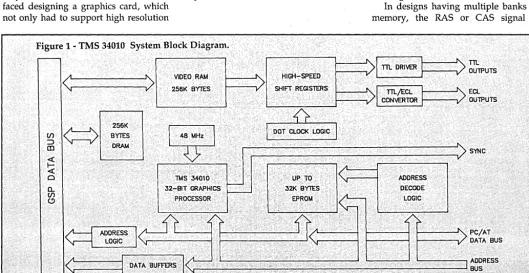
Earl Hinrichs from PC Tech was one of the stars of this year's SOG. He showed off PC Tech's new 34010 based video board by creating truly fantastic Mandelbrot and Julia sets. Earl had his own assembler routine running on the 34010. So he had excellent color resolu-tion along with blazing speed. If you have an itchy pocketbook and a yearn-ing for great beauty on your monitor, look into this board.
I'm using Borland's Turbo C to generate fractals these days. I had hoped that Turbo C Tools from Blaise Comput-ing wo~ld supply the graphics routines I needed to control the Hercules. card. Un-fortunately, they implement only those graphics procedures supported by the BIOS. So hello CGA and EGA, goodbye Hercules. See A Hercules Primer in this
issue for a library of graphics functions. Coding For These Critters
For the Mandelbrot set, we only have to find out what region of the set the user wants to view, and then examine each point in that region to see if it's in the set. Very easy. And very slow.
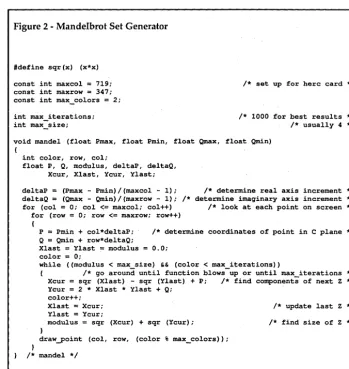
Figure 2 shows the guts of a simple program to explore the Mandelbrot set. I'll leave it to you to add procedures to get parameters from the user and to save and show the different pictures you generate. Or you can be lazy and download the complete program from Micro C's RBBS at (503) 382-7643. Look in the CURRENT ISSUE area. It's also available on disk (along with the rest of the code from this issue) for you modemless folks. Give us a call at 1 (800) 888-8087 and ask for the Issue #39 disk. (Disks are $6 for
u.s.
subscribers, $8 for non-subscribers and foreign readers, postpaid.) [image:10.632.215.564.30.399.2]The function mandel receives the screen's boundaries as parameters. They define a portion of the C plane. The first tWo lines of code calculate the change in P between adjacent columns and the
Figure 2 - Mandelbrot Set Generator
#define sqr(x) (x*x)
const int maxcol
=
719; const int maxrow=
347; const int max_colors=
2; int max iterations; int max=size;/* set up for herc card */
/* 1000 for best results */ /* usually 4 */
void mandel (float Pmax, float Pmin, float Qmax, float Qrnin)
{
int color, row, col;
float P, Q, modulus, deltaP, deltaQ, Xcur, Xlast, Ycur, Ylast;
deltaP
=
(Pmax - Pmin)/(maxcol - 1); /* determine real axis increment */ deltaQ=
(Qmax - Qrnin)/(maxrow - 1); /* determine imaginary axis increment */ for (col=
0; col<=
maxcol; col++) /* look at each point on screen */for (row
=
0; row<=
maxrow; row++) {P
=
Pmin + col*deltaP; /* determine coordinates of point in C plane */ Q=
Qrnin + row*deltaQiXlast
=
Ylast=
modulus=
0.0; color=
0;while «modulus < max size) && (color < max iterations»
{ /* go around until function blows-up or until max iterations */ Xcur
=
sqr (Xlast) - sqr (Ylast) + Pi /* find components of next Z */ Ycur=
2 * Xlast * Ylast + Q;color++; Xlast
=
Xcur; Ylast=
Ycur;modulus
=
sqr (Xcur) + sqr (Ycur);/* update last Z */
/* find size of Z */
draw-point (col, row, (color % max_colors»; }
/* mandel */
change in Q between adjacent rows. Once we know these step sizes, we use the nested for loops to look at each point (P, Q) on the screen.
When testing a point, the number of iterations of the while loop determines the color of the point. So call the loop counter "color." Xcur is the real part of Xn+l and Xlast is Xn'S real part. Expand Z2 + C yourself to verify the first two lines of the while loop. Remember,
i2 = -1.
Note that we've really calculated the square of the modulus in the last line of the while loop. No sense wasting the time .to take the square root when it's just as easy to compare modulul to 22.
Finally, draw the point using (color
% max_colors) for its color. The modulo division lets you use the available palette of colors repeatedly throughout the range of max_iterations. Choose a multiple of max_colors for the value of max_iterations. This forces points within the Mandelbrot set to be drawn in color 0, typically black.
Julia Sets
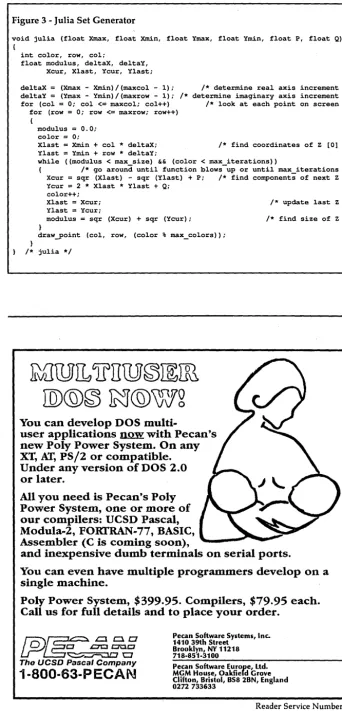
Programming for Julia sets is very similar (see Figure 3). Pass values for P and Q to the function julia. These
con-stants determine which Julia set we'll see. Since we're looking at Z space rather than C space, julia receives screen boundaries in terms of X and Y instead of P and Q.
You'll see two differences in the body of julia. (I won't say it-it would be too easy.) First, we're calculating increments in X and Y. And second, the value for
Zo
comes from the screen location being tested. In mandel it was always zero. Execution Speed
The best fractals I've done have each taken over a day to generate~ Even on a 10 MHz 186. That's a real drawback. Especially in a place like Central Oregon. I enjoy our thunderstorms, and during the last few weeks we've had some doozies. But when they destroy a day's worth of work. ..
So we'd really like to speed up the process. Sinking some bucks into faster hardware is the best solution. The PC Tech board creates fractals in a matter of minutes. And I'll be cranking out frac-tals on a parallel processing board stuffed with V20s in the near future. Stay tuned.
Cheaper, though less effective, solu-tions exist in software. One speedup
technique takes advantage of symmetry. The Mandelbrot set is symmetric about the real axis. So, as long as the real axis is in the center of the screen, we only have to go through the iterative process for either the top or bottom of the screen. As each half column is generated, we draw its reflection on the opposite half of the screen.
This cuts the generation time in half but doesn't work when you zoom in on an area which doesn't contain the real axis. No more symmetry there.
The Julia set has a different sym-metry. Instead of symmetry about an axis as in the Mandelbrot set, we have symmetry about a point-the origin. Ex-amine only the points in the top of the screen. When a point (row, col) has been colored, fill in its companion at (max_row - row, max_col - col). Again, this technique won't work unless the origin is at the center of the screen (or, at least, on the screen).
Or you can reduce max_iterations to some value below 1000. The lower the value, the less time it takes to draw the set. But the resolution suffers. This method allows coarse exploration to take place without as much of a time commitment. When you find an interest-ing region, go back to the
fun
1000 itera-tions for higher resolution.Earl came up with an algorithm which deals with large portions of the screen rather than points. Split the screen into sections. Now look at the center point of each section. How does it behave when put through the iterative process? Color the entire section accord-ing to the behavior of the center point.
Now split each section into more sec-tions and repeat the process. You can see that we're starting at a very low resolution and improving that resolu-tion with each new subdivision of sec-tions. The advantage of this method is that you don't have to calculate every point on the screen. After only a few rounds, you can get an idea what the fractal will look like and decide whether it's worth continuing.
What's Next?
A year ago I finished the first fractal article by promising further exploration, including a dip into fractal music. I lied. I got sidetracked by Dr. Mandelbrot and a multitude of other projects. This time I'm not lying. Along with music, I'll be looking into applications of fractal mathematics in the real world. Till then.
[image:11.629.231.573.35.746.2]•••
Figure 3 - Julia Set Generator
void julia (float xmax, float xmin, float Ymax, float Ymin, float P, float Q) {
int color, row, col;
float modulus, deltaX, deltaY, Xcur, Xlast, Ycur, Ylast;
deltaX = (xmax - xmin)/(maxcol - 1); /* determine real axis increment */
deltaY
=
(Ymax - Ymin)/(maxrow - 1); /* determine imaginary axis increment */for (col = 0; col <= maxcol; col++) /* look at each point on screen */
for (row = 0; row <= maxrow: row++)
{
modulus
=
0.0: color=
0;Xlast
=
xmin + col * deltaX; /* find coordinates of Z [0] */Ylast
=
Ymin + row * deltaY;while «modulus < max size) && (color < max iterations»
{ /* go around until function blows-up or until max iterations */ Xcur = sqr (Xlast) - sqr (Ylast) + P; /* find components of next Z */
Ycur
=
2 * Xlast * Ylast + Q; color++;Xlast
=
Xcur; Ylast=
Ycur;/* update last Z */
modulus
=
sqr (Xcur) + sqr (Ycur); /* find size of Z */draw-point (col, row, (color % max_colors»;
/* julia */
k'vJtl)]I11fIItl)]~IEill
l])®~ ~®WJ~
You can develop DOS
multi-user applications
D..QlYwith Pecan's
new Poly Power System. On any
XT, AT, PS/2 or compatible.
Under any version of DOS 2.0
or later.
All you need is Pecan's Poly
Power System, one or more of
our compilers: UCSD Pascal,
Modula-2, FOKfRAN-77, BASIC,
Assembler (C is coming soon),
and inexpensive dumb terminals on serial ports.
You can even have multiple programmers develop on a
single machine.
Poly Power System, $399.95. Compilers, $79.95 each.
Call us for full details and to place your order.
fPLo
~c:""\
C ~ .Cl Cl C1 C7i:1c:::1~o
Tho UCSD PDDcal Company
1-800-63-P ECAN
Pecan Software Systems, Inc. 1410 39th Street
Brooklyn, NY 11218 718·851·3100
Pecan Software Europe, Ltd. MGM House, Oakfield Grove Clifton, Bristol, BS8 2BN, England 0272 733633
Reader Service Number 29
Desktop Graphics
J have a very carefully worked out method for finding something to write about. I hang arollnd the office until something clubs me in the head. However, this time I gave myself an assignment, outlined where I was going with it, and began researching. For a . while it· looked like this procedure wouldn't work at all.
I'd intended to give you an overview of all the great and glorious ways to scan graphics, edit the scanned images, create graphics from scratch, and incorporate all the. above into desktop packages like Ven-tura.
I managed most of that. But it was a struggle. I'd assumed that I could just get on the phone, line up some very graphic people, take notes, and pass along what I learned. However, finding the people wasn't all that easy.
After a lot of digging, I found two folks who sounded interesting and arranged to spend half
a
day with each, doing on-site in-terviews.·· What follows is a transcription ofthe discussions. .
T
wo weeks ago Carol Steffy, our new graphics designer, and I , headed for Oregon's city lights in our search for folks doing computer graphics. We started the day in Corvallis with Dr. David Sullivan, an associate professor,of
information science 'at Oregon State University.. David had written a computer textbook using Ventura Publisher, and I;d heard through Z-Soft that he was also using a graphics.' package called Publisher's Paintbrush. (And, even if we didn't learn anything about graphics, he should have
a:
wealth of information about dealing with publishers.)He was a technical person using an AT, Ventura, and a graphics package. to produce, books. Not only could Carol
and I get information for this article, we
could tryout wha t we learned on this
ar-ticle.
In The Beginning
On arriving at David's ranch-style house (packed into a suburban sub-division), we were shown into a large bedroom/ family room mostly taken over by desks and computers. A patio door opened onto a small fenced -back yard.
. David started the discussion with a :description of the ways desktop publish-:'irig has changed the way books are.
. 'designed. How he works with designers.: David Sullivan: 'It used to be that all. the inter'action between me and the publishers happened on the phone, things were outside of my control. It ended up that I'd get these design sug-gestions at the end of the project that said, "We need . to have boxed inserts scattered ,throughout to. match the design we created after you submitted, the ,manuscript."
10
MICRO CORNUCOPIA, #39, Jan-Feb 1988. - .. ---.-.---.----.. -~---. _
-It' s . sort of like collecting all the materials for a house and then bringing in the architect. He sits down, takes an inventory of what you've got, and then designs the house around what's there.
Then he says he wants you to go out and get a bunch more materials. He couldn't find a spot for some of the material you already had, so he threw it away.
(Laugh)
That really gets to you in short order. What you say is, "I want a design to start with and I'll paginate. I'll do all the work because then I'll be in control."
There are things you can do now that you really .couldn't do before. If you're writing a boxed insert, you know how long the page is going to be. If you're two inches short of filling the page then you can go back and write a little more.
You have the designer,. working at the beginning of the project, designing what the concept should be and the con-struction worker, the author, working within the envelope.
Micro C: How do you handle graphics in your books?
David Sullivan: It's easiest in Ven-tura to put all the artwork in a separate art chapter file-if you have art, piece after piece, page after page. I just open up holes, little grey patches, the same size; as the art so the printer knows where to position it. After all, how long does. it ,take someone to physically paste it in if the hole's there? The caption's there.
Micro C: How do you create the artwork?
David Sullivan: That depends. Some of it ,is line art and that's done by some-one else .. The text stuff is just samples of what. output would look like: Lotus FreeLance, for instance, straight off the
color with labels and arrows pointing out what I'm discussing in the text.
You can really get a good feel of what a software package's output looks like when you see it on the screen (through screen capture).
My whole goal is to do such a good job with the artwork and the text that the competition (other writers and other publishers) can't compete in the category that I select.
After all, if I'm going to do some-thing, I'm going to do the best I'm able.
Micro C: What got you started in this form of publishing?
David Sullivan: I took last year off, without pay, to spend full time going to conferences. If I hadn't done that, there's no way I could have switched over to desktop publishing. Jumping in early, the solutions have not really been there.
Ventura 1.0 was a pretty crude product. Took me weeks to work around some of the rough edges.
What the publisher sent me is all the stuff they would normally give a profes-sional typositer. I had to look at all that and try to figure out how it matched up to what I could do with Ventura Publisher. Then I created the style sheets.
I probably have two months of full time work in the style sheets. Style for chapters, boxed inserts, artwork chap-ters, glossary-and each is different. Un-fortunately you can't print out what's in a style sheet. A tremendous shortcom-ing, and it wouldn't take long to reverse engineer the data inside a style sheet file and create a report writer, then sell it for a couple hundred dollars a copy.
Micro C: We'd certainly be interested in a product like that. What about your equipment? How did you select that?
David Sullivan: The budget has been whatever I've wanted to have. I got the Mac because Adobe's downloadable fon ts wouldn't download from an· IBM
to a PostScript printer. They claimed you could get the Mac versions, have someone to convert them over to IBM disk format, and then download them from the IBM. I went through the process. It didn't work, and they weren't willing to give me any technical support.
They just said, "We believe this can be done. We did it in our technical department, but we won't tell you how we did it."
(Editor's note: I later heard that if YOll
initialize Adobe fonts on the Mac, save them as a text file (not Adobe font file), transfer them to the PC and add:
o
serverdict begin exitserverBy
David Thompson
it's transferred, makes some sense. Micro C: How about converting graphics files?
David Sullivan: The thing I find amusing is that grabbing Macintosh screens and publishing them through a PC is often easier than it is to grab PC screens. That seems really strange, but it's true. Though it runs on the PC, Ven-tura Publisher has a box for Mac Paint-type stuff and you just click on it.
Built into the Mac operating system is a screen capture utility. They name their utilities flowers, open apples and closed apples. Cutesy stuff. I haven't figured it all out.
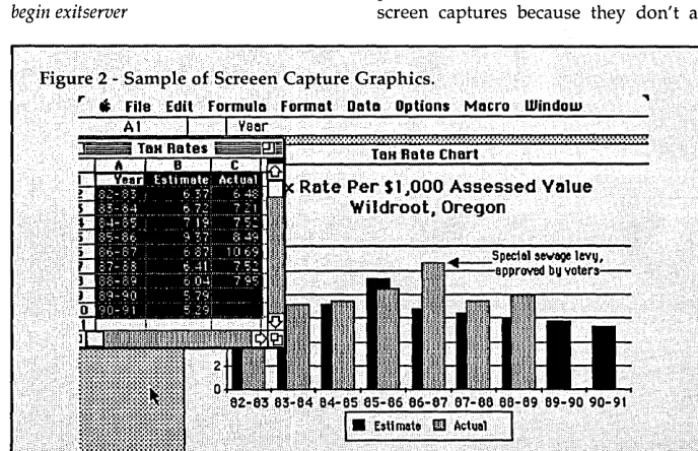
[image:13.621.228.577.417.642.2]It's on the IBM side that you have the problem. You need lots of different screen captures because they don't all
Figure 2 - Sample of Scree en Capture Graphics.
r • File Edit Formula Format Data Options Macro Window
,
to the start of the text file, you have a'Post-Script font file which can be copied directly to the PostScript device.
Anyway, I got a Mac. Because of the Mac, I needed a network so the IBM and Mac could talk. I got the Centram Tops network. Then I needed to bone up on conversion utilities so the data, when
work with all the PC programs. There are so many different standards for dif-ferent screens.
I spent $100 to capture images from Microsoft windows because Windows freezes up if there are certain memory resident programs. Other screen capture programs are sensitive to some TSR
rO,utines. None of these things are docu-mented.
I called Microsoft and asked how they grabbed screens for their documen-tation. After being passed around for awhile, I reached someone who knew. He basically said they had this quick and dirty thing that sometimes works with Windows, but not reliably. They certainly wouldn't be willing to release it to anyone else.
I'm thinking, "Wait a minute. You're creating a window operating environ-ment that doesn't have a built-in screen capture, and you can't even get one to run in-house?"
Is there a problem here?
They finally recommended that I buy Hot Shot, which works if you have the particular type of monitor that Hot Shot captures. EGA is one. The reason I can't use a really high-resolution screen is I need to take snapshots, and EGA is the highest up that list for the screen cap-ture utilities.
You look at those problems on the IBM side and all of a sudden, even though I use the IBM 98% of the time, there's a lot of logic in that little box (Mac) over there.
Sure, you're single-sourced to one hardware manufacturer, but the real question is: "Are you single sourced to one software philosophy?" If we all stick to the IBM then I think we're single-sourced to a bankrupt philosophy.
With IBM you get a weird command line style, hierarchical menu bars in spreadsheet programs, pull-down menu bars in Reflex, function-key interfaces in Word Perfect, control-key interfaces in WordStar, and you've got users who'd rather get t~ings done than learn eight different interfaces. Someone who buys a Mac will use more software because they aren't so intimidated.
If it hadn't been for the Mac, I doubt we'd be seeing OS/2.
Micro C: If you were writing an ar-ticle on creating graphics for your desktop program, wh'at would you tell the Micro C audience?
David Sullivan: I'd be cautious about suggesting that tools for graphics are the best thing since sliced· bread. Illustrators can work with pen and ink more suc-cessfully and more quickly than they could do a oile-shot thing on· the com-puter. Do you want to create a sketch of a floppy disk on the computer? As a one-shot thing? That's assuming, of course, you're not doing the standard graph or pie chart, but a technical il-lustration.
I've looked at Adobe Illustrator (for the Mac) and other programs like that, but by the time you've learned to use all the tools and get everything right, the average person with pen and ink could have done more illustrations, more quickly.
If what you're documenting is what's going on in the PC, then there are good canned approaches like Frieze and Hot Shot for capturing screen menu displays. SideKick's good for capturing screen text.
My conclusion is that graphics are coming along more slowly than the text.
Plus, there's another aspect. Giving someone an electronic paint program is like giving someone a brush and a
buck-~
'm thinking, "Wait
a minute. You're
creating a window
operating
environment that
doesn't have a
built-in screen
capture, and you
can't even get one
to run in-house?"
et of paint. The skill isn't in the package, the skill is in the artist. What does the artist want to do? If there's an artist who really wants to use graphics programs, that's fine.
Micro C: What about scanning and modifying?
David Sullivan: The only scanning I've played with has been photographs. Even then it. doesn't seem practical, be-cause the halftone process is so quick and -easy (at print shops).
The majority of the illustrations I deal with are either example screen displays or extremely involved illustrations.
Micro C: What about the possibility of scanning line art? Then tracing it? Modifying it? Things that wouldn't be as easy to do with traditional tools. And doing it very precisely. And why limit yourself to trying to duplicate the media
12
MICRO CORNUCOPIA, #39, Jan-Feb 1988that's already available? Why not syn-thesize graphics using electronic tools like we synthesize music?
David Sullivan: You need to talk to a graphics artist to get any enthusiasm. I'm really clear in my mind that people who aren't artists shouldn't be dealing with these sorts of packages. Unless your job is graphic art then these tools will only distract you from what you should be doing.
Micro C: However, take the syn-thesizer analogy one step further. A very powerful synthesizer doesn't make you a musician, but there will be people who do beautiful things with a synthesizer who would have done nothing if they'd had only a piano.
David Sullivan: I have almost no ar-tistic ability. My stick figures are still back in the third grade. So given that, I make sure that when I need art, some-one else does it. Like everysome-one else, I generalize well; if I can't do it, then nC?body else will.
Micro C: There's something much more mysterious about creating an image from scratch, an image that reflects what you really want to say. I think the thing that happens when people scan images is that they begin with someone else's work. They want to use it as their own, but it isn't.
David Sullivan: Plus the original creator may be upset because you've ruined his work. But I've heard of no one who's been taken to court because they stole all the visual elements of a publication. That's why I think so many people can successfully do desktop publishing.
Later That Day
Wes Wait is a completely different kind of person. Not concerned with the text, almost anti-techie, he's the compleate
graphic designer and illustrator. The ar-chitect in David's analogy.
Wes comes into a project at the end. The text is finished, signed off, and delivered on disk. A Macintosh disk.
As Carol and I entered his home/studio high in the wooded hills. west of Portland, we heard a low, quiet chanting. We left our shoes at the door.
I'm not a typist; I have no desire to be a typist.
I bought a scanner and within two months they were supposed to bring out an OCR (optical character reader) program for it. It's now nine months later.
Micro C: How long did this first project take you?
Wes Wait: I don't n:member exactly, it was two years ago. I was trying to learn how to use the software and design something real at the same time. It was an exercise to work out a relationship with the software. I suspect the project took me a couple of weeks, including a lot of phone calls to Aldus. They've always been notorious. I've never been able to call them and get someone on the phone immediately. They always call back two hours later. By then you've figured it out or you're dead in the water until they call.
With all this technology, there are ways to get around aU that.
Micro C: Do you have Adobe Il-lustrator?
Wes Wait: Yes. (He digs out a but-terfly.)
[image:15.624.235.579.177.385.2]Micro C: Looks like it works beauti-fully.
Figure 3 - Wes' Adobe Butterfly.
Wes Wait: It's an amazing tool. Micro C: You went through the Linotronic L300 for your output?
Wes Wait: Yes.
Micro C: Did you have anything to do with the accompanying text?
Wes Wait: They gave me the text signed-off as error free and then I for-matted it-made all the typographical decisions. They proofed it. Of course, clients never proof it like they should. Even when the technology lets them see it at a very early stage (300 dpi Apple-Writer output which looks amazingly similar to the finished piece), they still find errors at the end.
There's really no difference between
the first-round proof out of the com-puter and last-round pr~of off the typesetter. But they don't fo~us like they should. I don't read' the text anymore. It's their responsibility.
I'm just cake decorating.
Micro C: 50 there's a market for cake decorators.
Wes Wait: Oh yes, there always has been. There was a time when I was in-volved in projects from the start. I had control over what was written, total
creative control. I'm not interested in that anymore. Now I just design the layout, proof the piece on the Laser-Writer, do final output through the (Linotronic) L300, paste it down on the board, lay a tissue over it and I'm finished.
Micro C: What about photos? Wes Wait: I scan those and put them in the original layouts, so clients see sized halftone photos in the presentation proof I hand them.
Micro C: Of course the print shop uses the original photo when producing the final piece. For quality.
Wes Wait: Right. But the scanned image still gives them the cropping, the placement. It's a lot tighter looking than a tissue layout. The nicest thing about presentations like this is that they get approved immediately. There's no im-agination required.
No more saying, "This is going to look like this, and that's going to look like that..." And then the client isn't happy when it's done. It isn't the way he imagined it.
Micro C: How many proofs do you give people?
Wes Wait: One.
Micro C: How many sample layouts? Wes Wait: One. If I feel that the
con-cept is complex, then maybe I'll do a couple. Usually I'm dealing with just one person. It used to be that I'd paste up the presentation, then rip it all up and paste it again for the printer. With the computer, I just re-output it.
Micro C: Now that you're using the computer, how's business? Are you swamped?
Wes Wait: I don't sell the computer as a way to get projects, it's just my choice of a way to work. Actually a lot
of projects lately have come in because of the computer. Customers specifically want it. I just did a thing for Tektronix. They wanted me to develop a whole format for a communications system.
They were going to produce material on their own desktop equipment so I created the look, the shell which they would fill in each month. The City of Portland hired me a couple of months ago on a project that had to be done this way because of time constraints.
At the moment I'm very comfortably doing nothing.
It
doesn't ,bother me in the least. I was incredibly busy until I left for vacation, and everyone was in-credibly upset that I was going away for a month. Now I'm back but the projects are waiting for approvals or whatever. I should have stayed away longer.Micro C: What packages do you use? Wes Wait: Cricket Draw, Adobe Il-lustrator, Pagemaker, Microsoft Word, Macpaint, Macdraw, 5uperpaint. Right now Illustrator is taking the place of (just about) everything else for me.
Micro C: What percentage of your work is still traditional pen and ink?
Wes Wait: Two years ago I decided that I couldn't use anything else if I was going to learn how to use the computer. That's exactly what I've done.
Micro C: You can't go into it 50-50 while you learn?
Wes Wait: You can't use it as aspirin. A lot of people have talked to me about getting a computer, and then if a project warrants it they'll use it. But it won't be cost effective because you'll always be calling up the manufacturer asking how to use the software. Unless you commit to using it, you won't master it.
Micro C: How long did it take you ... Wes Wait: I'm still working on it be-cause I'm still getting new software. I was constantly referencing the manuals for the first year. I don't suggest you use the technology unless you really use it, otherwise it will always be a toy.
Micro C: Now that you have reasonable mastery, how has it changed the way you work? The process? What are you doing now that you wouldn't have before?
and see what happens. Or you grab the curve itself. You can just play with these curves until infinity.
This is probably the only piece of software created for the Mac which is not intuitively obvious. You have to know where to put the points to create the curves, so you have to have a good mental image of what you're going for. It's not a freehand tool. Though you can use it sort of free, it's intended to be very powerful for tracing.
You can scan a photo in and then draw on top of the photo and do a drawing in nothing flat. This piece took an hour and a half. I output it on a Linotronic at 1270 dots per inch. It's a very fast tool.
[image:16.623.28.563.288.458.2]Micro C: There's a real difference be-tween 300 dots per inch and 1270, espe-cially when you look at characters described identically by PostScript, but
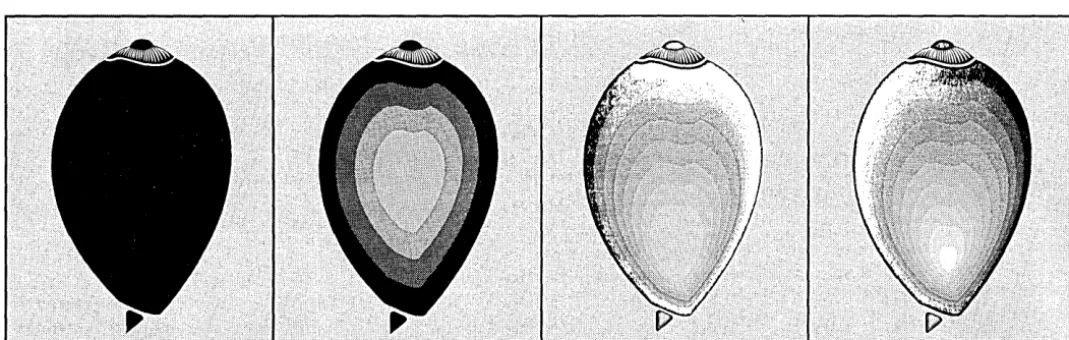
Figure 5 - Four Progressions of Wes' Computer Artwork.
Wes Wait: Mainly, the time frame to do the project is much shorter. Using the computer is second nature. I'm not spin-ning my wheels. I have a sense now that I could push the creativity much farther than I have.
Micro C: If I asked you for a complex piece of line art, would you do it your-self or pass it on to someone else?
Wes Wait: I don't consider myself an illustrator, and never have. But if it's something I can reduce to a symbolic level then I'll do it.
I can scan something, crop it, re-scale it, and lay it on the screen. That way I can work from an exact ratio in terms of shapes, weight of the line, everything.
Micro C: How do you work with the curves on Illustrator?
Wes Wait: It's pretty far out. Very hard for a lot of people. Rather than drawing like you're used to, you create a curve by giving reference points. If the curve isn't right, you grab the handles
the hilirlines, the serifs, are so thick, so crude on the 300 dot machine. It feels heavy, loses its crispness.
Wes Wait: I did one piece that was all 300 dpi. The client wanted to save some money. I told them if they found the laser proof satisfactory, they could have it. It's just part of my creative process.
Dynagraphics printed the final piece, and they have a trick. They screen 300 dpi type. Nowadays, with the laser printer papers they're coming out with, there's no need to screen. The laser out-put is so crisp, screening no longer helps. I'm using Hammermill Laser Plus paper, it feels like it's clay coated.
Micro C: But usually you output on the Linotronic. How about outputting scanned images? Is 300 dpi scan resolu-tion a problem?
Wes Wait: I haven't tried one recent-ly. Around January (1987), I tried to out-put a scanned image and it came out
bit-14
MICRO CORNUCOPIA, #39,]an-Feb 1988mapped. It had a totally digitized look. I called the company and they said it shouldn't. I'll tackle it again.
Micro C: Any scanner generates bit-mapped images. There's software com-ing out which translates bitmapped im-ages into vectors. Of course the image will change somewhat in the translation. Hopefully it'll be compatible with some-thing that can edit vector images. Then it could be output on a Linotype at 1200 dpi.
Wes Wait: That would be really far out. Right now I'm using scanned im-ages as templates for drawing in Adobe Illustrator. Illustrator is so quick to work with. Tracing over a template, it only took me two hours to create this image.
Or I can take a letter, make it black, reduce it slightly and make it white, then reduce it again in black and lay all three layers over each other, creating a
very sharp version of the letter. Il-lustrator has some incredible typographical things.
Each program has its own strength, like Cricket Draw can set type in a circle easily. In Illustrator it's very hard. Generally, though, I use Illustrator.
Micro C: How did you do the acorn with the eye on top?
Wes Wait: I did the tiny moon shapes on top and made them white. Then duplicated them and duplicated them. Then stretched each individually to give it a unique character. When I reduced the first one, they filled in too much, so I took every-ather-one out.
This was an interesting project. I saw this ad. I didn't know why, but all of a sudden I started looking through metaphysical publications, had a feeling I was supposed to do something. When I saw the ad, I felt I knew this person and she was going to do a book.
doing a book. And I'm probably going to do a book. Her book. I've just started on the logo.
There's a trap to the computer, it's so easy to explore you can get lost in the process. It's so easy to make another change you lose half a day on a project that should have taken an hour.
I think of myself as kind of a spiritual plagiarizer. I get a strong sense of something floating through the air. I just copy it and put it down on paper and it always works. If it doesn't' work for the client, it's because he's so uptight he can't see it.
Micro C: Have you tried a PC-based system?
Wes Wait: From what I hear, it's a real pain in the butt working with PC-based Pagemaker. The approach to the technology is so different between Apple and IBM.
I played with Pagemaker on the PC down at ComputerLand. There's no comparison.
Micro C: How's it different?
Wes Wait: I spent 30 seconds, after working with the Mac version for two years, and I knew it'd be a pain in the butt. I just walked away from it. It's designed to work in the IBM environ-ment, so the interaction with the piece is entirely different. All I can tell you is my feeling about it. I just clicked a few boxes and moved a few things and, oh boy, I'm glad I have a Mac.
Micro C: There are some philosophi-cal differences between the Mac and the PC operating systems, one of the main ones is that if you output something to a file, a text file, or graphics file, the next application may need to understand that file. There's no single type of text or graphics file on a Pc.
On the Macintosh you can move in-formation from one application to another without too much worry since
the operating system provides a single standard. On the PC there are many standards, so you need to know which programs can share files and which can't. Many do, but it's something you need to check ahead of time.
Wes Wait: You need to do a lot more homework. Another example is . Microsoft Word; any idiot could go in and run it. With WordStar, you have to learn so much stuff. IBM will switch over because the Mac has proven the viability of this format, but there's so much stuff which is still geared to the traditional person-computer relationship that it's going to take a while for OS/2 and the PC to get here. Meanwhile Apple will be light-years ahead.
Apple has kept all this stuff to itself so no one will be able to clone it, and so they'll push it that much farther ahead.
Post Script
The two interviews were interesting, partly for the kinds of graphics David and Wes were doing, but even more for the graphics they weren't doing. David was grabbing example screen displays for his books. That's fine, but it's a very limited form of graphics.
Wes showed us some very, very nice graphics pieces: pieces which would have been quite difficult to render with other media. However, he too, after two years, was still tentative, still feeling his way in this new technology.
After leaving Wes, Carol and I headed into downtown Portland to talk to one of the major printing houses. We'd heard that the printer was kind of a center for desktop publishers in the area.
They'd just had a meeting attended by the ten top designers in the area. When we asked them who was generat-ing interestgenerat-ing computer graphics, they said there was only one, Wes Wait.
My conclusion is that desktop tech-nology is coming along very quickly. The illustrating part of the process, however, is still learning to crawl. The software and hardware is just getting solid, and a few folk are beginning to feel their way around.