1
Platforms for Non-Speakers Annotating Names in Any Language
Ying Lin,1Cash Costello,2 Boliang Zhang,1 Di Lu,1 Heng Ji,1 James Mayfield,2 Paul McNamee2
1 Rensselaer Polytechnic Institute
{liny9,zhangb8,lud2,jih}@rpi.edu
2 Johns Hopkins University
{ccostel2,mayfield,mcnamee}@jhu.edu
Abstract
We demonstrate two annotation platforms that allow an English speaker to anno-tate names for any language without know-ing the language. These platforms pro-vided high-quality “silver standard” an-notations for low-resource language name taggers (Zhang et al.,2017) that achieved state-of-the-art performance on two sur-prise languages (Oromo and Tigrinya) at LoreHLT20171and ten languages at TAC-KBP EDL2017 (Ji et al., 2017). We dis-cuss strengths and limitations and compare other methods of creating silver- and gold-standard annotations using native speak-ers. We will make our tools publicly avail-able for research use.
1 Introduction
Although researchers have been working on unsu-pervised and semi-suunsu-pervised approaches to alle-viate the demand for training data, most state-of-the-art models for name tagging, especially neu-ral network-based models (Pan et al.,2017;Zhang et al., 2017) still rely on a large amount of train-ing data to achieve good performance. When ap-plied to low-resource languages, these models suf-fer from data sparsity. Traditionally, native speak-ers of a language have been asked to annotate a cor-pus in that language. This approach is uneconom-ical for several reasons. First, for some languages
We thank Kevin Blissett and Tongtao Zhang from RPI for their contributions to the annotations used for the exper-iments. This material is based upon work supported by the Defense Advanced Research Projects Agency (DARPA) un-der Contracts No. HR0011-15-C-0115 and No. HR0011-16-C-0102. The views, opinions and/or findings expressed are those of the authors and should not be interpreted as represent-ing the official views or policies of the Department of Defense or the U.S. Government.
1https://www.nist.gov/itl/iad/mig/lorehlt-evaluations
with extremely low resources, it’s not easy to ac-cess native speakers for annotation. For example, Chechen is only spoken by 1.4 million people and Rejiang is spoken by 200,000 people. Second, it is costly in both time and money to write an anno-tation guideline for a low-resource language and to train native speakers (who are usually not lin-guists) to learn the guidelines and qualify for an-notation tasks. Third, we observed poor anan-notation quality and low inter-annotator agreement among newly trained native speakers in spite of high lan-guage proficiency. For example, under DARPA LORELEI,2the performance of two native Uighur speakers on name tagging was only 69% and 73% F1-score respectively.
Previous efforts to generate “silver-standard” annotations used Web search (An et al.,2003), par-allel data(Wang and Manning, 2014), Wikipedia markups (Nothman et al.,2013;Tsai et al.,2016;
Pan et al.,2017), and crowdsourcing (Finin et al.,
2010). Annotations produced by these methods are usually noisy and specific to a particular writing style (e.g., Wikipedia articles), yielding unsatisfac-tory results and poor portability.
It is even more expensive to teach English-speaking annotators new languages. But can we annotate names in a language we don’t know? Let’s examine a Somali sentence:
“Sida uu saxaafadda u sheegay Dr Jaamac Warsame Cali oo fadhigiisu yahay magaal-adaBaardheerehadda waxaa shuban caloolaha la yaalla xarumaha caafimaadka 15-cunug oo lagu arkay fuuq bax joogto ah, wuxuu xusay dhakhtarku in ay wadaan dadaallo ay wax kaga qabanayaan xaaladdan”
Without knowing anything about Somali, an En-glish speaker can guess that “Jaamac Warsame Cali” is a person name because it’s capitalized, the
2
word on its left, “Dr,” is similar to “Dr.” in En-glish, and its spelling looks similar to the English “Jamac Warsame Ali.” Similarly, we can identify “Baardheere” as a location name if we know that “magaalada” in English is “town” from a common word dictionary, and its spelling is similar to the English name “Bardhere.”
What about languages that are not written in Ro-man (Latin) script? Fortunately language universal romanization (Hermjakob et al.,2018) or translit-eration3 tools are available for most living
lan-guages. For example, the following is a Tigrinya sentence and its romanized form:
“ናይዚ እዋን'ዚ ፕረዝደንት ዓብደልፈታሕ አል-ሲሲ ነቲ ናይ 2011 ዓ.ም.ፈ ተቃውሞ ብምንኣድ እቲ ተቃውሚ ሓዳስ ግብጺ ዘምጸአ'ዩ ኢሎም።”
“naayezi ’ewaane’zi perazedanete ’aabedale-fataahhe ’ale-sisi nati naaye 2011 ’aa.me.fa taqaawemo bemene’aade ’eti taqaawemi hhaadaase gebetsi zametsa’a ’yulome .”
An English speaker can guess that “ዓብደልፈታሕ
አል-ሲሲ” is a person name because its romanized
form “aabedalefataahhe ’ale-sisi” sounds simi-lar to the English name “Abdel-Fattah el-Sissi,” and the romanized form of the word on its left,
“ፕረዝደንት,” (perazedanete) sounds similar to the
English word “president.”
Moreover, annotators (may) acquire language-specific patterns and rules gradually during anno-tation; e.g., a capitalized word preceded by “ mag-aalaa” is likely to be a city name in Oromo, such as “magaalaa Adaamaa” (Adama city). Synchro-nizing such knowledge among annotators both im-proves annotation quality and boosts productivity. The Information Sciences Institute (ISI) devel-oped a “Chinese Room” interface4to allow a non-native speaker to translate foreign language text into English, based on a small set of parallel sen-tences that include overlapped words. Inspired by this, RPI and JHU developed two collaborative an-notation platforms that exploit linguistic intuitions and resources to allow non-native speakers to per-form name tagging efficiently and effectively.
2 Desiderata
We see the following requirements as being most important to allow a non-speaker to annotate a lan-guage, independent of interface. None of these re-quirements is necessary, but the more that are sat-isfied, the easier it will be for the annotator to pro-duce accurate annotations:
3https://github.com/andyhu/transliteration
4https://www.isi.edu/ ulf/croom/ChineseRoomEditor.html
Word recognition. Presentation of text in a fa-miliar alphabet makes it easier to see similarities and differences between text segments, to learn as-pects of the target language morphology, and to re-member sequences previously seen.
Word pronunciation. Because named entities often are transliterated into another language, ac-cess to the sound of the words is particularly impor-tant for annotating names. Sounds can be exposed either through a formal expression language such as IPA,5 or by transliteration into the appropriate
letters of the annotator’s native language.
Word and sentence meaning. The better the annotator understands the full meaning of the text being annotated, the easier it will be both to iden-tify which named entities are likely to be men-tioned in the text and what the boundaries of those mentions are. Meaning can be conveyed in a va-riety of ways: dictionary lookup to provide fixed meanings for individual words and phrases; de-scription of the position of a word or phrase in a semantic space (e.g., Brown clusters or embedding space) to define words that are not found in a dic-tionary; and full sentence translation.
Word context. Understanding how a word is used in a given instance can benefit greatly from understanding how that word is used broadly, either across the document being annotated, or across a larger corpus of monolingual text. For ex-ample, knowing that a word frequently appears ad-jacent to a known person name suggests it might be a surname, even if the adjacent word in the current context is not known to be a name.
World knowledge. Knowledge of some of the entities, relations, and events referred to in the text allows the annotator to form a stronger model of what the text as a whole might be saying (e.g., a document about disease outbreak is likely to in-clude organizations like Red Cross), leading to bet-ter judgments about components of the text.
History. Annotations previously applied to a use of a word form a strong prior on how a new in-stance of the word should be tagged. While some of this knowledge is held by the annotator, it is dif-ficult to maintain such knowledge over time. Pro-grammatic support for capturing prior conclusions (linguistic patterns, word translations, possible an-notations for a mention along with their frequency) and making them available to the annotator is es-sential for large collaborative annotation efforts.
Adjudication. Disagreements among annota-tors can indicate cases that require closer exami-nation. An adjudication interface is beneficial to enhance precision (see Section4).
The next section discusses how we embody these requirements in two annotation platforms.
3 Annotation Platforms
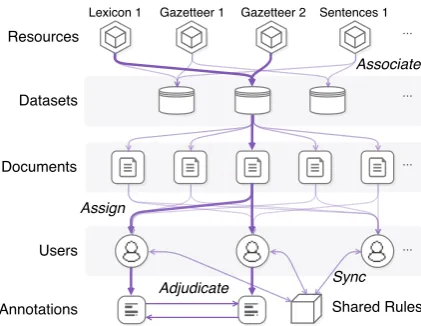
We developed two annotation tools to explore the range of ways the desiderata might be fulfilled: ELISA and Dragonfly. After describing these interfaces, Figure 1 shows how they fulfill the desiderata outlined in Table2.
[image:3.595.77.288.279.442.2]3.1 ELISA
Figure 1: ELISA IE Annotation Architecture.
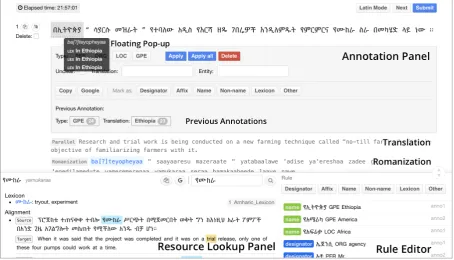
The ELISA IE annotation platform was devel-oped at Rensselaer Polytechnic Institute.6 Fig-ure 1 depicts ELISA’s overall architecture. Fig-ure2demonstrates the main annotation interface, which consists of:
Annotation Panel. For each sentence in a doc-ument, we show the text in the original language, its English translation if available, and automatic romanization results generated with a language-universal transliteration library.7 To label a name mention, the annotator clicks its first and last to-kens, then chooses the desired entity type in the annotation panel. If the selected text span has been labeled before, previous annotations are displayed at the bottom of the panel for reference. Annotated mentions are styled differently according to type.
Resource Lookup Panel. This panel is used to browse/search the associated resources. Right
6See examples at http://nlp.cs.rpi.edu/demo/
elisa_annotation.html.
7https://github.com/andyhu/transliteration
clicking a token in the document will show its full definition in lexicons and bilingual example sen-tences containing that token. A floating pop-up displaying romanization and simple definition ap-pears instantly when hovering over a token.
Rule Editor. Annotators may discover useful hueristics to identify and classify names, such as personal designators and suffixes indicative of lo-cations. They can encode such clues asrulesin the rule editor. Once created, each rule is rendered as a strikethrough line in the text and is shared among annotators. For example (Figure1, if an annotator marks “agency” as an organization, all annotators will see a triangular sign below each occurrence of this word.
Adjudication Interface. If multiple users pro-cess the same document we can consolidate their annotations through an adjudication interface (Fig-ure 3). This interface is similar to the annota-tion interface, except that competing annotaannota-tions are displayed as blocks below the text. Clicking a block will accept the associated annotation. The adjudicator can accept annotations from either an-notator or accept the agreed cases at once by click-ing one of the three interface buttons. Then, the ad-judicator need only focus on disputed cases, which are highlighted with a red background.
3.2 Dragonfly
Dragonfly, developed at the Johns Hopkins Uni-versity Applied Physics Laboratory, takes a more word-centric approach to annotation. Each sen-tence to be annotated is laid out in a row, each col-umn of which shows a word augmented with a va-riety of information about that word.
Figure 2: ELISA IE Annotation Interface in use annotating a Tigrinya document.
Figure 3: ELISA IE Adjudication Interface in use annotating a Tigrinya document.
are displayed at the bottom of the column.
In addition to word-specific information, Drag-onfly can present sentence-level information. In Figure 4, an automatic English translation of the sentence is shown above the words of the sentence (in this example, from Google Translate). Trans-lations might also be available when annotating a parallel document collection. Other sentence-level information that might prove useful in this slot in-cludes a topic model description, or a bilingual em-bedding of the entire sentence.
Figure 4 shows a short sentence that has been annotated with two name mentions. The first word of the sentence (Romanization “uttara”) has translations of “due north,” “northward,” “north,”
etc. The second word has no direct translations or Brown cluster entries. However, its Roman-ization, “koriyaavannu,” begins with a sequence that suggests the word ‘Korea’ with a morpho-logical ending. Even without the presence of the phrase “North Korea” in the MT output, an an-notator likely has enough information to draw the conclusion that the GPE “North Korea” is men-tioned here. The presence of the phrase “North Korea” in the machine translation output confirms this choice.
The sentence also contains a word whose Ro-manization is “ttramp.” This is a harder call. There is no translation, and the Brown cluster translations do not help. Knowledge of world events, examina-tion of other sentences in the document, the trans-lation of the following word, and the MT output together suggest that this is a mention of “Donald Trump;” it can thus be annotated as a person.
4 Experiments
Figure 4: The Dragonfly tool in use annotating a Kannada document.
ELISA Dragonfly
Recognition & pronunciation
universal transliter-ation
uroman
Meanings Resource Lookup Panel; pop-ups; Annotation Panel
Dictionary; Brown clusters; sentence translation Word context Resource Lookup
Panel
Concordance
World knowl-edge
External External
History Previous annota-tions; Rule Editor
Cascade; pop-ups
Adjudication Adjudication inter-face
[image:5.595.74.535.71.204.2]None
Table 1: How Platforms Fulfill Desiderata
name taggers based on a bi-directional long short-term memory (LSTM) network with a Conditional Random Fields (CRFs) layer (Lample et al.,2016). The lexicons loaded into the ELISA IE annotation platform were acquired from Panlex,8 Geonames9 and Wiktionary.10 Dragonfly used bilingual lexi-cons by (Rolston and Kirchhoff,2016).
4.1 Overall Performance
The agreement between non-speaker annotations from the ELISA annotation platform and gold stan-dard annotations from LDC native speakers on the same documents is between 72% and 85% for var-ious languages. The ELISA platform enables us to develop cross-lingual entity discovery and link-ing systems which achieved state-of-the-art per-formance at both NIST LoreHLT201711 and ten
languages at TAC-KBP EDL2017 evaluations (Ji et al.,2017).
8https://panlex.org/ 9http://www.geonames.org/ 10https://www.wiktionary.org/
11https://www.nist.gov/itl/iad/mig/lorehlt-evaluations
Albanian Kannada Nepali Polish Swahili
#sents 1,652 535 959 1,933 1,714 #tokens 41,785 8,158 16,036 26,924 42,715 #dict
entries
96,911 9,931 10,048 644,232 216,323
#names 2,683 900 1,413 1,356 2,769
F1(%) 75.9 58.4 65.0 55.7 74.2
Table 2: Data Statistics and Performance on KBP2017 EDL Pilot
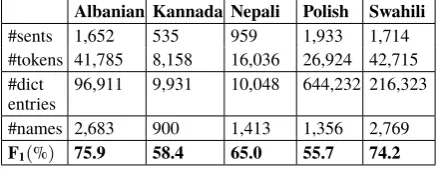
Four annotators used two platforms (two each) to annotate 50 VOA news documents for each of the five languages listed in Table 2. Their anno-tations were then adjudicated through the ELISA adjudication interface. The process took about one week. For each language we used 40 documents for training and 10 documents for test in the TAC-KBP2017 EDL Pilot. In Table 2 we see that the languages with more annotated names (i.e., Alba-nian and Swahili) achieved higher performance.
4.2 Silver Standard Creation
We compare our method with Wikipedia based silver standard annotations (Pan et al., 2017) on Oromo and Tigrinya, two low-resource languages in the LoreHLT2017 evaluation. Table3shows the data statistics. We can see that with the ELISA annotation platform we were able to acquire many more topically-relevant training sentences and thus achieved much higher performance.
Data Oromo Tigrinya
ELISA Annotated Training 4,717 6,174 Wikipedia Markup Derived Training 631 152 Gold Standard Unsequestered 2,957 2,201
[image:5.595.307.527.261.346.2]Method Oromo Tigrinya
ELISA Annotated 68.2 71.3
[image:6.595.306.526.62.125.2]Wikipedia Markup 6.2 2.7
Table 4: Comparison of Silver Standard Creation Methods (F-score %).
4.3 Comparison with Native Speaker Annotations
F1 Score (%)
25 35 45 55 65
Number of Sentences
1000 2000 3000 4000 5000 6000
Native-speaker Annotation Non-speaker Annotation
Figure 5: Russian Name Tagging Performance Us-ing Native-speaker and Non-speaker Annotations.
Figure 5 compares the performance of Rus-sian name taggers trained from Gold Standard by LDC native speakers and Silver Standard by non-speakers through our annotation platforms, test-ing on 1,952 sentences with ground truth anno-tated by LDC native speakers. Our annotation plat-forms got off to a good start and offered higher performance than annotations from native speak-ers, because non-speakers quickly capture com-mon names, which can be synthesized as effective features and patterns for our name tagger. How-ever, after all low-hanging fruit was picked, it be-came difficult for non-speakers to discover many uncommon names due to the limited coverage of lexicon and romanization; thus the performance of the name tagger converged quickly and hits an upper-bound. For example, the most frequently missed names by non-speakers include organiza-tion abbreviaorganiza-tions and uncommon person names.
4.4 Impact of Adjudication
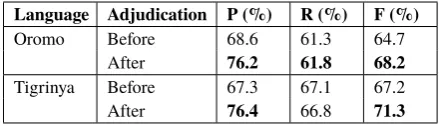
Table 5 shows that the adjudication process sig-nificantly improved precision because annotators were able to fix annotation errors after extensive discussions on disputed cases and also gradually learned annotation rules and linguistic patterns. Most missing errors remained unfixed during the adjudication so the recall was not improved.
Language Adjudication P (%) R (%) F (%)
Oromo Before 68.6 61.3 64.7 After 76.2 61.8 68.2
[image:6.595.74.293.63.101.2]Tigrinya Before 67.3 67.1 67.2 After 76.4 66.8 71.3
Table 5: Impact of Annotation Adjudication
References
J. An, S. Lee, and G. G. Lee. 2003. Automatic acquisi-tion of named entity tagged corpus from world wide web. InACL.
P. F. Brown, P. V. deSouza, R. L. Mercer, V. J. D. Pietra, and J. C. Lai. 1992. Class-based n-gram models of
natural language.COLING.
T. Finin, W. Murnane, A. Karandikar, N. Keller, J. Mar-tineau, and M. Dredze. 2010. Annotating named en-tities in twitter data with crowdsourcing. InNAACL HLT 2010 Workshop.
U. Hermjakob, J. May, and K. Knight. 2018.
Out-of-the-box universal romanization tool uroman. In
PRoc. ACL2018 Demo Track.
H. Ji, X. Pan, B. Zhang, J. Nothman, J. Mayfield, P. Mc-Namee, and C. Costello. 2017. Overview of TAC-KBP2017 13 languages entity discovery and linking. InTAC.
G. Lample, M. Ballesteros, K. Kawakami, S. Subrama-nian, and C. Dyer. 2016. Neural architectures for
named entity recognition. InNAACL HLT.
J. Nothman, N. Ringland, W. Radford, T. Murphy, and J. R Curran. 2013. Learning multilingual named en-tity recognition from wikipedia. Artificial Intelli-gence194:151–175.
X. Pan, B. Zhang, J. May, J. Nothman, K. Knight, and H. Ji. 2017. Cross-lingual name tagging and linking for 282 languages. InACL.
Leanne Rolston and Katrin Kirchhoff. 2016. Collec-tion of bilingual data for lexicon transfer learning. InUWEE Technical Report.
C. Tsai, S. Mayhew, and D. Roth. 2016.
Cross-lingual named entity recognition via wikification. In
CoNLL.
M. Wang and C. Manning. 2014. Cross-lingual pro-jected expectation regularization for weakly
super-vised learning. Transactions of the Association of
Computational Linguistics2:55–66.
[image:6.595.71.282.193.315.2]